-Apr-02-2026-10-42-36-4815-AM.png)
Inconsistent metrics across dashboards are usually the result of missing context.
Definitions vary, ownership is unclear, and systems operate in isolation. Without a shared layer of meaning, even accurate data becomes unreliable.
A business context layer in enterprise data platforms addresses this gap. It connects technical data with business definitions, ownership, governance policies, and relationships across warehouses, pipelines, and BI tools. This creates a shared, cross-system understanding of data, so teams interpret metrics consistently and trust what they see.
In this blog, we’ll break down what a business context layer is, how it compares to semantic layers and data catalogs, the core components behind it, and how it works across enterprise platforms to improve data understanding and decision-making.
What is a business context layer in enterprise data platforms?
A business context layer in enterprise data platforms connects technical data with business meaning, definitions, ownership, and governance rules. It links metadata, business glossaries, and data lineage across systems to ensure consistent interpretation.
This layer standardizes metrics, aligns policies, and improves data trust across analytics and AI workflows. It enables discoverability, traceability, and cross-system consistency, so teams and systems use data with shared context and accuracy.
What matters is how this layer operates across systems. A business context layer does not sit inside a single tool; it moves with data across warehouses, pipelines, BI platforms, and AI workflows, ensuring that meaning, ownership, and policies remain consistent at every stage.
This is what separates it from traditional modeling or catalog approaches. It does not just define metrics or document assets, but connects how data is created, used, and governed across the enterprise.
It brings structure to how data is understood across teams:
-
Connects data across systems with shared business meaning that stays consistent from source to consumption.
-
Embeds ownership, policies, and governance directly into how data flows and is used.
-
Maps relationships between datasets, metrics, dashboards, and business processes to show how data drives decisions.
-
Enables consistent interpretation across teams, tools, and workflows without redefining logic in each system.
This is what turns data from a technical resource into a business asset that teams can rely on. To understand how this clarity is created in practice, it is important to look at how a business context layer improves enterprise data understanding at a deeper level.
How a business context layer improves enterprise data understanding
Most data platforms are built to store and process data efficiently, but they stop short when teams need to actually use that data in a business context.
A business context layer helps remove that friction by giving teams a consistent view of metrics, clear ownership, and enough context to use data confidently without second-guessing it.
|
Did you know? This translation layer matters because the underlying trust problem is still unresolved in many organizations. Precisely’s 2025 survey found that 64% of organizations identify data quality as their top data integrity challenge, and 51% cite data governance as one of their biggest obstacles. When teams cannot rely on shared definitions and governed context, they end up validating data repeatedly before they can use it. |
It also brings alignment. When definitions and KPIs are standardized across systems, teams stop debating numbers and start focusing on decisions. The same metric means the same thing, regardless of where it is accessed.
Another shift is in how data is discovered. Users can search using business terms, not technical names, making data more accessible and reducing dependency on data teams.
This clarity comes from more than just better definitions. It requires a structured way to connect meaning, ownership, and usage across systems, which is where the differences between related approaches become important.
Business context layer vs semantic layer
A semantic layer focuses on making data easier to query and analyze. It defines metrics, dimensions, and logic for reporting. But a business context layer goes further. It connects those metrics to ownership, governance policies, and real-world business meaning.
In practice:
-
The semantic layer supports query and reporting.
-
The business context layer supports meaning, ownership, and decision context.
This distinction becomes critical as organizations move from reporting to decision-driven analytics.
|
Here’s a fact: That distinction matters even more now that analytics is feeding AI-driven decisions, not just dashboards. McKinsey’s global AI survey found that 72% of organizations use AI and 65% regularly use generative AI in at least one business function. Once AI starts using enterprise data, a layer built only for querying is not enough. Teams also need consistent business meaning, policy context, and ownership. |
Business context layer vs data catalog
A data catalog helps users find and document data assets. It organizes metadata and enables search across datasets. A business context layer builds on this foundation by connecting those assets to business definitions, relationships, and usage context.
However, most data catalogs remain largely static. They document metadata, but they do not consistently enforce definitions or carry that context across systems where data is actually used.
In simple terms:
-
A data catalog helps you find data.
-
A business context layer helps you understand how data is used and why it matters.
This difference often determines whether teams can move from discovery to confident decision-making.
Business context layer vs metadata layer
A metadata layer stores technical details such as schemas, tables, and pipelines, and describes how data is structured. A business context layer translates that structure into business language. It adds definitions, ownership, and relationships that make data usable for decision-making.
In short:
-
The metadata layer defines structure.
-
The business context layer defines interpretation.
To deliver this level of clarity at scale, enterprises need to understand the foundational elements that make a business context layer work.
Core components of a business context layer
A business context layer is built on a set of foundational elements that shape how business meaning connects to data. These components do not operate in isolation. They work together to create a consistent layer of context that stays intact across systems, teams, and workflows.
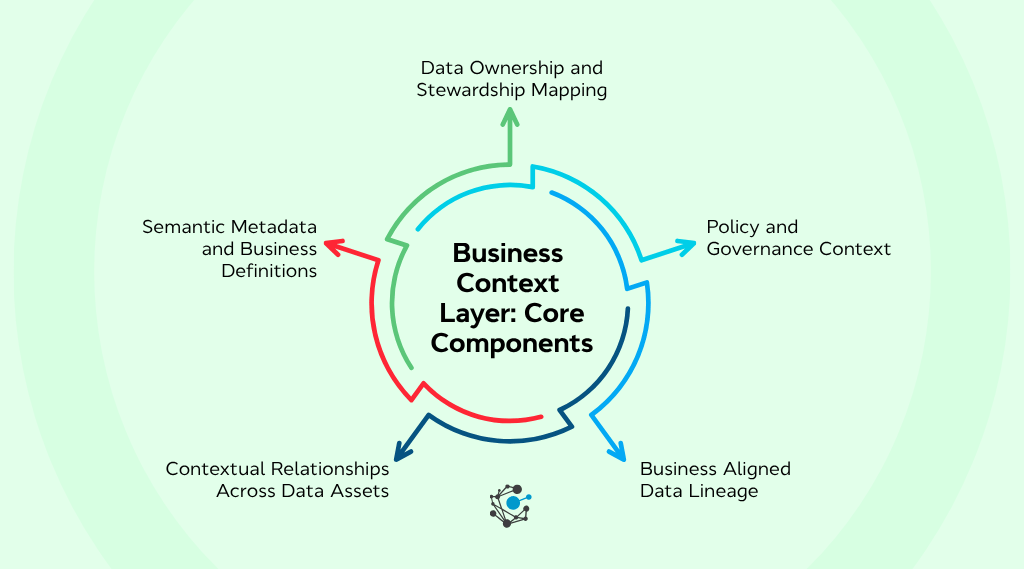
Semantic metadata and business definitions
At the core is semantic metadata, which defines how data should be understood in business terms. Instead of leaving interpretation open to individual teams, it standardizes key metrics, entities, and terminology so everyone works with the same definitions.
This is what prevents situations where “active customer” or “net revenue” means something different in every dashboard. Once defined, these terms carry the same meaning across systems.
Data ownership and stewardship mapping
A business context layer also brings clarity around ownership. It connects data assets to responsible owners and stewards, making it clear who is accountable for quality, governance, and changes.
|
Expert insight: This focus on ownership reflects a broader executive shift. In Deloitte’s 2025 Chief Data Officer survey, data governance ranked as the top priority for the next 12 months for 51% of CDOs. That makes stewardship mapping more than an operational detail. It becomes part of how organizations build stronger data foundations. |
This reduces ambiguity. When something breaks or looks off, teams know exactly who to reach out to, instead of spending time figuring out ownership.
Policy and governance context
Governance becomes more effective when it is embedded in how data is defined and used. This component links datasets to policies, compliance requirements, and access rules, ensuring that governance is not an afterthought.
As a result, data usage aligns with business rules automatically, rather than relying on manual checks or separate processes.
Business-aligned data lineage
Traditional lineage shows how data moves across pipelines. A business context layer adds another layer by showing how those changes impact metrics, reports, and decisions.
This makes lineage more actionable. Teams can understand not just where data comes from, but what a change actually means for the business.
Contextual relationships across data assets
Perhaps the most powerful component is the ability to map relationships across data. It connects datasets, metrics, dashboards, and business processes into a unified view.
This helps teams see how everything fits together. Instead of working with isolated assets, they can understand how data flows through the organization and supports real workflows.
To operationalize these components, organizations need a structured way to activate and maintain context across systems. This is where the lifecycle of a business context layer comes into play.
How a business context layer works across enterprise data platforms
A business context layer works as a continuous lifecycle rather than a one-time setup. As data moves across warehouses, pipelines, and BI tools, context moves with it, staying aligned with how the business actually operates.
Operationally, this changes how teams interact with data. Definitions are not recreated in every tool, and ownership does not need to be rediscovered. When data changes upstream, the impact on metrics, dashboards, and reports is visible immediately.
Instead of treating context as documentation that teams refer to separately, it becomes part of how data is created, transformed, and consumed across systems.
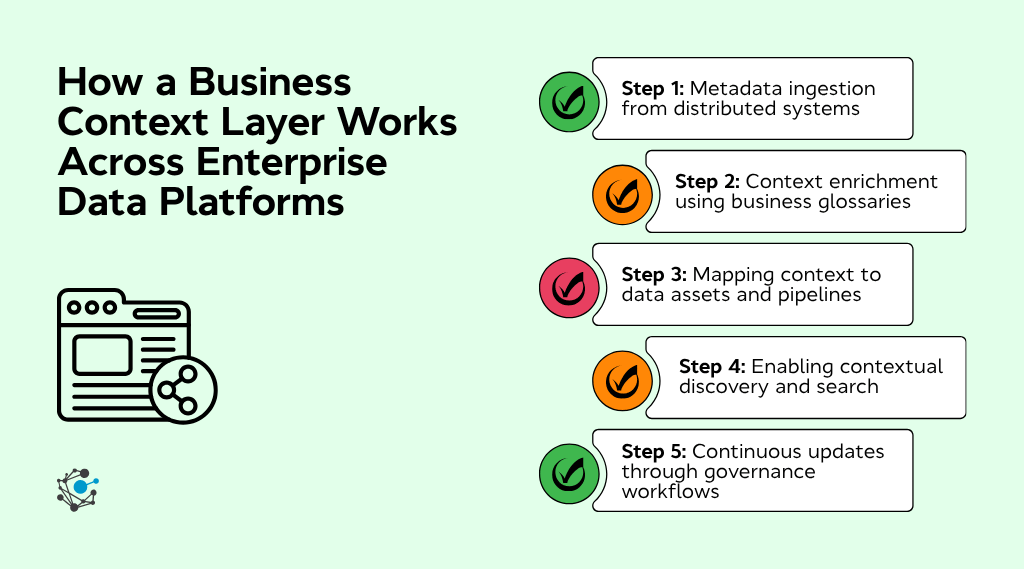
Step 1: Metadata ingestion from distributed systems
The process begins by pulling in metadata from across the data ecosystem, including warehouses, lakes, pipelines, and BI tools.
At this stage, the goal is simply to gather all available inputs so there is a complete view of what data exists and where it lives.
Step 2: Context enrichment using business glossaries
Once the metadata is in place, business definitions and domain knowledge are applied. This is where data starts to become meaningful, as terms, KPIs, and classifications are layered on top of raw structures.
Instead of looking at isolated tables, teams now see how data connects to real business concepts.
Step 3: Mapping context to data assets and pipelines
The next step is linking that context directly to datasets, transformations, and pipelines. This creates a clear connection between business definitions and how data flows across systems.
As a result, teams can trace a metric back to its source and understand how it is built, rather than treating it as a black box.
Step 4: Enabling contextual discovery and search
With context applied, data becomes easier to discover. Users can search using business language instead of technical names, which makes data more accessible to non-technical users.
This reduces dependency on data teams and allows more people to work with data confidently.
Step 5: Continuous updates through governance workflows
The final piece is keeping everything up to date. As data changes, governance workflows and stewardship processes ensure that definitions, relationships, and ownership stay relevant.
This ongoing refinement is what keeps the context layer aligned with both data changes and evolving business needs. In fact, that ongoing refinement is becoming more important as AI expands the governance burden.
According to a 2026 Cisco study, 90% of organizations say their privacy programs have expanded because of AI, yet only 12% describe their AI governance committees as mature and proactive.
A business context layer helps close that gap by keeping governance, ownership, and meaning connected to data as it changes.
When this lifecycle is in place, context is no longer something teams look up separately. It becomes part of how data is created, discovered, and used every day. This is where the impact becomes visible in how teams trust, access, and act on data across the enterprise.
Key benefits of implementing a business context layer
A business context layer changes how teams interact with data in a very real way. Instead of working in silos with different interpretations, teams start operating with a shared understanding that stays consistent across systems and workflows.
Before implementing a business context layer, teams often face:
-
Same KPI defined differently across departments
-
Analysts spending hours validating data
-
Dashboards showing conflicting numbers
-
Data discovery relying on tribal knowledge
After implementing a business context layer, the shift is clear:
-
Shared, standardized definitions across teams
-
Faster data usage without repeated validation
-
Consistent reporting across dashboards
-
Self-service discovery using business terms
In many enterprise environments, this translates into fewer reporting inconsistencies, higher adoption of self-service analytics, and faster decision-making because teams trust the data they are working with. The time spent reconciling numbers drops, and the focus moves toward using data to drive outcomes.
|
Stat: This becomes even more important as organizations try to scale AI on top of enterprise data. IBM notes that only 29% of technology leaders strongly agree that their enterprise data meets the quality, accessibility, and security standards needed to scale generative AI efficiently. That gap helps explain why improving context, trust, and governance has become a practical business priority rather than a metadata exercise. |
Some of the core benefits that teams start to notice include:
-
Consistent data definitions across teams
-
Faster onboarding for new users
-
Improved trust in dashboards and reports
-
Stronger governance and compliance alignment
-
Better collaboration between business and technical teams
-
Reduced duplication of metrics and datasets
When context becomes part of the data itself, organizations move away from fragmented usage toward a shared, reliable view of information.
This is where modern platforms like OvalEdge play a role by bringing metadata, governance, and business context together into a unified layer that supports consistent decision-making at scale.
Conclusion
Fixing business context in your data requires more than adding another layer of reporting or documentation. It requires building a business context layer that connects definitions, ownership, governance, and relationships directly to your data so teams can trust it without second-guessing.
If you are exploring how to move in this direction, the next step is understanding how this would work in your environment. With OvalEdge, that typically starts by mapping your existing metadata, identifying gaps in definitions and ownership, and connecting business context to your data assets and pipelines.
From there, governance workflows and lineage are aligned to ensure context stays consistent as your data evolves.
If you want to see how this approach can work for your organization, schedule a call with OvalEdge and explore how to bring clarity, consistency, and trust into your data ecosystem.
FAQs
1. How is a business context layer different from a semantic layer in data platforms?
A semantic layer focuses on simplifying data for querying and reporting. A business context layer goes further by embedding ownership, governance rules, and relationships, helping teams understand how data connects to real business decisions across systems.
2. Can a business context layer improve data literacy across non-technical teams?
Yes, it simplifies complex data by connecting it to familiar business terms, KPIs, and workflows. This makes it easier for non-technical users to interpret data correctly and reduces reliance on data teams for everyday analysis.
3. What role does AI play in building a contextual metadata layer?
AI helps automate classification, detect relationships between datasets, and suggest business context based on usage patterns. This reduces manual effort and keeps the context layer updated as data evolves across enterprise systems.
4. How does a business context layer support self-service analytics initiatives?
It enables users to search, interpret, and use data independently by providing clear definitions and relationships. This reduces confusion, improves confidence in data usage, and accelerates decision-making without constant support from data teams.
5. Is a business context layer necessary for modern data platforms like data lakes and warehouses?
Yes, because these platforms store large volumes of raw and processed data but lack business meaning. A context layer ensures users can interpret data correctly, making these platforms more usable and aligned with business goals.
6. How do organizations measure the success of a business context layer?
Success is measured through improved data discovery time, reduced inconsistencies in reports, higher adoption of data tools, and fewer governance issues. It also reflects in faster decision-making and better alignment across business and technical teams.
.png?width=1081&height=173&name=Forrester%201%20(1).png)
.png?width=1081&height=241&name=KC%20-%20Logo%201%20(1).png)