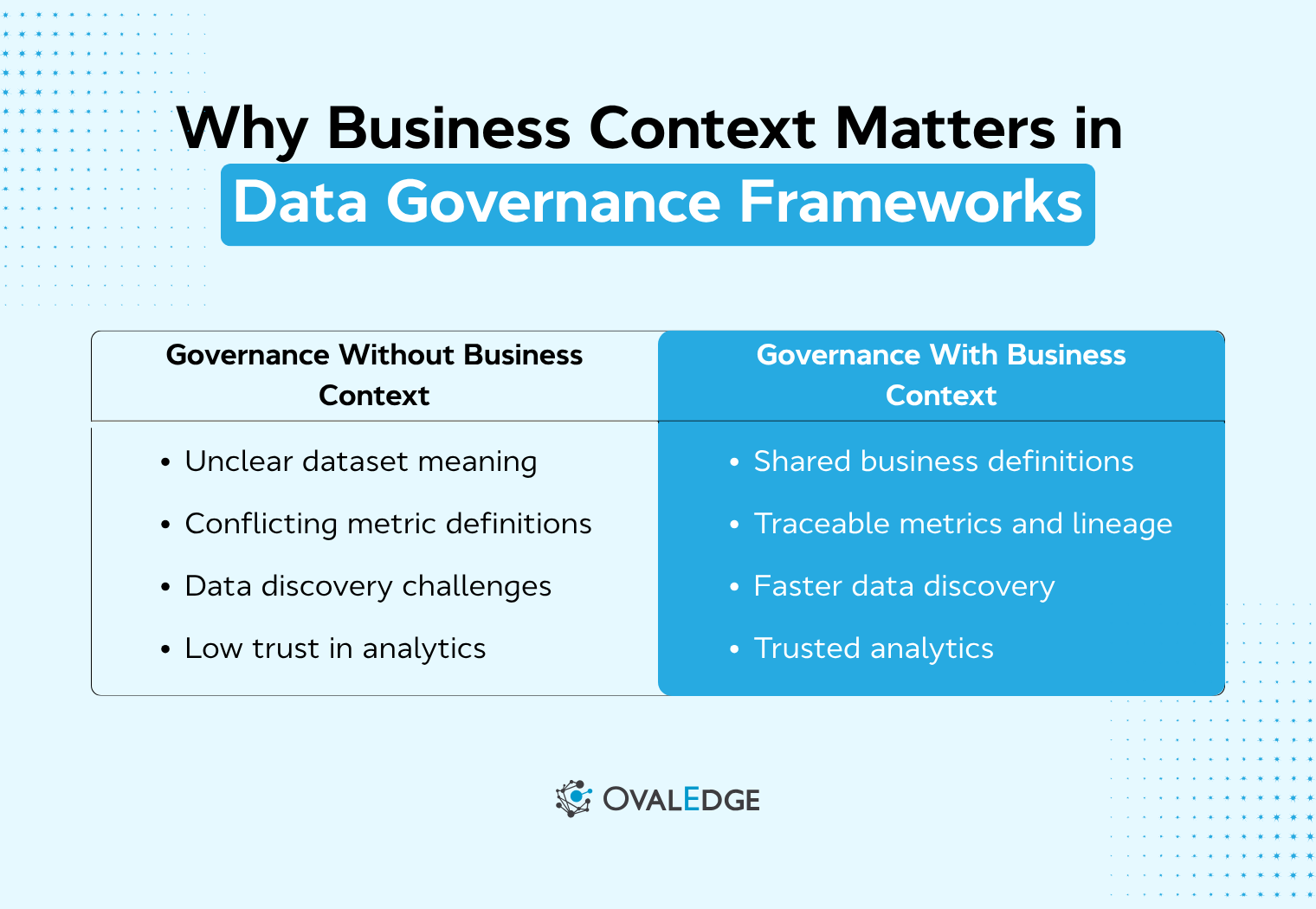
Governance frameworks often capture data, but fail to capture its meaning, which is why teams still struggle to trust and use it effectively.
Business context acts as a governance layer that connects technical data assets with business meaning, ownership, and usage rules. Without it, governance becomes static documentation instead of a system that supports decisions.
In fact, Forrester reports that over 25% of data professionals estimate losing more than $5 million annually due to poor data quality, with some organizations reporting losses exceeding $25 million.
Modern data governance frameworks are shifting toward contextual governance. They combine business metadata, semantic definitions, and governance workflows to make data understandable and usable across teams.
In this guide, we’ll explain what business context in data governance frameworks means, why it matters for analytics and decision-making, and how you can implement contextual governance effectively.
What is the business context in data governance frameworks?
Business context in data governance frameworks connects data assets to their business meaning, definitions, and ownership. It brings together metadata, business glossary terms, and lineage to show what the data represents, how it is used, and where it comes from.
Instead of treating data as isolated tables or pipelines, business context ties it directly to business metrics, processes, and decision-making scenarios. This makes it easier for teams to interpret data correctly, trace it back to its source, and use it confidently across systems.
It also supports compliance, auditability, and AI governance. Business context ensures that data remains interpretable, trusted, and usable across systems and domains.
Business context matters because it:
-
Ensures analytics teams interpret data consistently across departments
-
Aligns datasets with business definitions such as revenue, churn, or customer value
-
Enables traceability between metrics and underlying pipelines
-
Reduces confusion across finance, product, and analytics teams
-
Supports compliance by linking data to policies and reporting standards
-
Improves trust in analytics and AI-driven decision-making
At its core, the business context acts as a bridge between business stakeholders and technical data systems.
Where does the business context fit in a governance framework
Most governance frameworks appear complete on paper, with policies defined, metadata captured, and workflows in place. But unless these layers connect, teams still struggle to understand and use data effectively.
|
Expert insight: Even with structured frameworks in place, execution remains a challenge. Gartner predicts that 80% of data and analytics governance initiatives will fail by 2027 due to a lack of alignment with business outcomes. |
Data governance typically operates across a few core layers that need to work together.
-
Governance policies: These define how data should be used, secured, and maintained. They set expectations around compliance, quality, and access across the organization.
-
Metadata management: This layer captures the technical side of data. It documents tables, schemas, pipelines, and lineage, giving teams visibility into how data is structured and how it moves across systems.
-
Business context layer: This is where things start to click. Business context adds meaning to technical data by introducing business glossaries, metric definitions, ownership details, and domain knowledge. It helps teams understand exactly what the data means.
-
Governance workflows: These make governance operational. They include stewardship responsibilities, approval processes, issue resolution, and policy enforcement that keep governance running at scale.
When these layers operate in silos, governance feels fragmented, but when they connect, governance becomes usable.
Platforms like OvalEdge help bring these layers together by linking policies, metadata, and business context within unified workflows. It bridges the gap between how data is built and how it is used, setting the foundation for more reliable analytics and decision-making.
Business context is not a single feature. It is built through multiple connected components that work together to give data meaning and usability.
Core components of business context in governance frameworks
Business context is built through a combination of governance elements that work together to give data meaning, traceability, and usability across systems.
In practice, organizations create business context by bringing together business metadata, glossaries, lineage visibility, and ownership models. Each of these plays a distinct role, but the real value comes from how they connect.
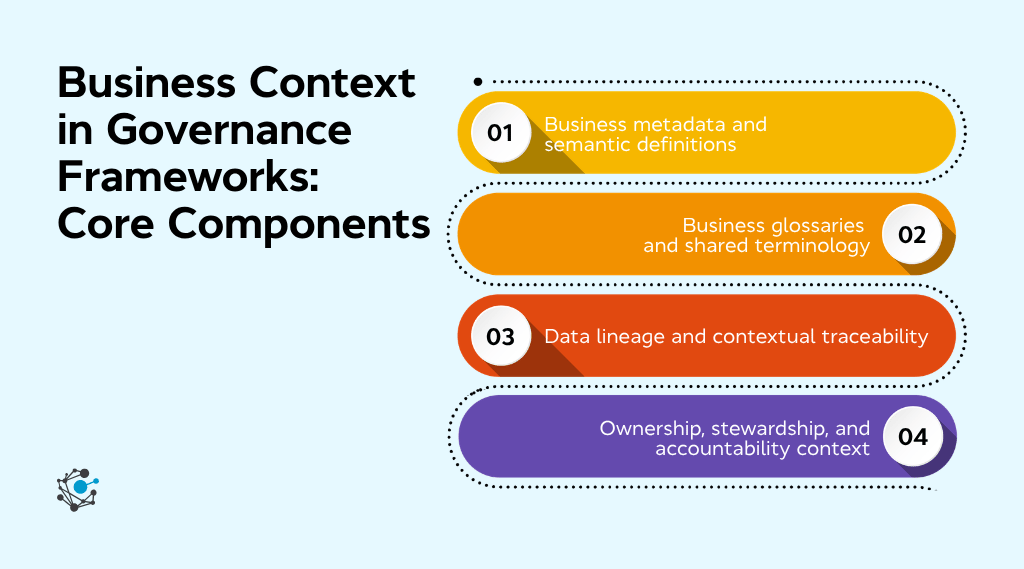
Business metadata and semantic definitions
Business metadata is where data starts to make sense from a business perspective. It defines how metrics are calculated, how KPIs should be interpreted, and how datasets are meant to be used.
For instance, take something like customer lifetime value or monthly recurring revenue. These sound straightforward, but in most organizations, different teams calculate them differently. Without clear definitions, the same metric can tell completely different stories depending on who is using it.
This is where semantic definitions become critical. They give analytics teams a shared understanding of how data should be interpreted, reducing ambiguity and making reports more consistent.
|
Did you know? The importance of this layer is only increasing. By 2027, more than 75% of organizations will adopt active metadata management to support analytics, AI, and automation. |
Business glossaries and shared terminology
Even with well-defined metrics, teams can still run into confusion if they use different language to describe the same concepts. Business glossaries solve this by creating a shared vocabulary across the organization. They standardize how key terms, entities, and metrics are defined, so everyone works from the same understanding.
This becomes especially important in cross-functional environments. Marketing might define an active user based on engagement signals, while product teams might base it on feature usage. Without alignment, dashboards and reports quickly drift apart.
A well-maintained glossary brings these definitions together, reducing ambiguity and making it easier for teams to trust what they see.
Data lineage and contextual traceability
Understanding what a metric means is one part of the equation. Understanding where it comes from is just as important. Data lineage provides that visibility. It shows how data moves across systems, how it transforms, and where it is ultimately used.
This becomes critical when teams need to validate numbers. For example, a revenue metric might originate in a CRM system, move into a data warehouse, pass through transformation pipelines, and finally appear in a BI dashboard. Lineage connects each of these steps, making it possible to verify that the final output reflects the intended logic.
By linking business metrics to technical processes, lineage adds another layer of context that strengthens trust in analytics.
Ownership, stewardship, and accountability context
Business context does not maintain itself. It needs clear ownership to stay accurate and relevant over time.
-
Data owners are responsible for defining the business meaning of data.
-
Data stewards ensure that metadata and definitions remain up to date.
-
Domain experts provide validation and ensure that terminology reflects real-world usage.
When these roles are clearly defined, governance becomes a shared responsibility, leading to updated definitions, faster issue resolution, and improvement in data quality. When they are not, even the best-defined context starts to drift, leading to the same confusion that governance was meant to solve.
When all these components come together, business context stops being abstract and starts becoming operational. It gives teams the clarity they need to use data confidently, which is exactly where governance begins to show measurable impact.
How business context improves data governance outcomes
Once the business context becomes part of your governance framework, impact shows up quickly. Teams stop debating definitions, analysts spend less time searching for data, and governance starts supporting real decisions instead of sitting in documentation.
Here’s how contextual governance translates into measurable outcomes across analytics, compliance, and operations.
1. Improving data discovery for analytics teams
One of the biggest friction points for analytics teams is simply finding the right data. Without context, analysts often jump between multiple datasets, second-guess definitions, and rely on tribal knowledge to understand what they are looking at.
When the business context is in place, datasets come with clear descriptions, ownership details, and usage guidance. Analysts can quickly understand what a dataset represents, how it should be used, and whether it is reliable for their use case.
This shift reduces time spent on investigation and allows teams to focus more on analysis instead of data validation.
2. Enabling trusted data for decision-making
Trust in data rarely comes from the data itself. It comes from consistency in how that data is defined and used across the organization.
When different teams use different definitions for the same metric, even small variations can lead to conflicting insights. This is where business context plays a critical role. It standardizes definitions and ensures that metrics like revenue, churn, or customer value are calculated the same way across reports.
As a result, teams spend less time debating numbers and more time acting on them. Dashboards become more reliable, and decision-making becomes more aligned.
3. Strengthening regulatory and compliance alignment
Governance frameworks are often tested most during audits. Without a clear context, it becomes difficult to explain how data is classified, where it flows, and how it is used.
Business context helps organizations map datasets to regulatory definitions and policies. Teams can identify sensitive data, track its usage, and maintain traceability across systems.
This makes compliance processes more structured and reduces the effort required to demonstrate adherence to regulations. Governance becomes easier to audit and more transparent to stakeholders.
4. Supporting AI and advanced analytics governance
As organizations invest more in AI and advanced analytics, the need for context becomes even more critical. AI models depend on clearly defined inputs and reliable training datasets. Without a proper business context, teams struggle to understand what the data represents or how it should be used. This creates risks around model accuracy and explainability.
By documenting datasets, defining business meaning, and tracking lineage, contextual governance provides the foundation for responsible AI. Teams can better understand model inputs, validate outputs, and maintain accountability across the lifecycle.
|
Here’s a fact: The risk is already visible in enterprise AI initiatives. According to Gartner, 63% of organizations either lack or are unsure if they have the right data management practices to support AI, and 60% of AI projects may fail due to poor data readiness. |
5. Enabling governance automation
One of the most overlooked benefits of business context is its role in automation. When definitions, classifications, and ownership are clearly defined, governance platforms can start applying rules automatically. Policies can be enforced consistently, data can be classified based on context, and quality checks can run without manual intervention.
Tasks like sensitivity tagging, access control, and issue resolution move into automated workflows, reducing reliance on manual processes. Platforms like OvalEdge use contextual metadata to drive these workflows, helping organizations scale governance without increasing operational overhead.
When business context is embedded into governance, the shift is hard to miss. Data becomes easier to find, easier to trust, and easier to manage at scale. That same foundation also shapes how modern data platforms are designed, where context is no longer an add-on but a core architectural layer.
The role of contextual governance in modern data platforms
Most modern data environments are not built in one place. Data lives across warehouses, pipelines, BI tools, and AI platforms, each serving a different purpose. The challenge is not just managing these systems, but keeping the meaning of data consistent across all of them.
Without a unifying layer, business definitions start to drift. A metric defined in one system may not match how it appears in another. Over time, this fragmentation makes governance harder to enforce and analytics harder to trust.
This is where contextual governance plays a critical role. It introduces a context layer across the data stack, connecting technical metadata with business meaning so that data stays interpretable across systems.
At a practical level, this architecture comes together through a few key components:
-
Data catalogs as central hubs: They bring together datasets, business definitions, and governance policies in one place, making it easier for teams to discover and understand data.
-
Metadata and lineage integration: Metadata platforms capture how data is structured, while lineage systems show how it flows across pipelines and dashboards. Together, they provide a complete view of data relationships and dependencies.
-
Context layers across systems: This layer connects datasets to business processes, KPIs, and regulatory classifications, ensuring that data retains its meaning regardless of where it is used.
-
Governance workflows: These workflows keep context up to date. They manage ownership, approvals, and policy enforcement as data evolves across systems.
When these elements work together, governance shifts from being system-specific to ecosystem-wide. Platforms such as OvalEdge help operationalize this by integrating metadata discovery, lineage visibility, business glossaries, and governance workflows into a unified context layer.
As data platforms continue to expand, the challenge is no longer just managing data, but maintaining its meaning across systems. That makes business context not just a governance feature, but a foundational part of how modern data architectures operate.
How organizations implement business context in governance frameworks
Building business context requires structured governance processes that connect definitions, data, ownership, and workflows across the organization.
Most teams that succeed with contextual governance follow a clear sequence of steps. Each step builds on the previous one, gradually turning abstract definitions into something operational.
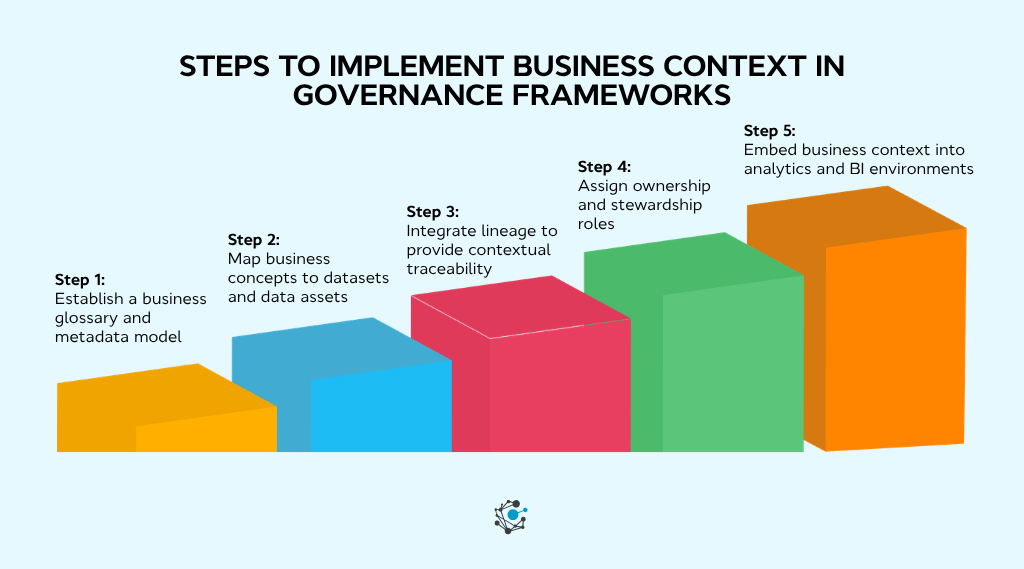
Step 1: Establish a business glossary and metadata model
The starting point is defining what the business actually means by its data. This typically includes:
-
Core business entities such as customers, products, and transactions
-
KPIs and metrics like revenue, churn, or customer lifetime value
-
Domain-specific terminology across finance, marketing, operations, or analytics
Many organizations structure this work around business domains. Each domain maintains its own glossary while aligning with enterprise-wide standards. This approach keeps definitions closer to the teams that use them, which improves accuracy and makes governance easier to maintain.
These definitions form the foundation of the business context. They allow organizations to connect business language with metadata and data assets across the governance framework.
Step 2: Map business concepts to datasets and data assets
Definitions only become useful when they connect to actual data. Organizations link business concepts directly to data assets, for example:
-
Metrics mapped to data tables
-
Glossary terms linked to specific columns
-
Dashboards tied to underlying datasets
This mapping creates traceability between business definitions and physical data. It ensures that when someone looks at a metric, they can immediately see where it comes from and how it is constructed.
Step 3: Integrate lineage to provide contextual traceability
Once definitions are connected to data, the next step is understanding how that data moves.
Lineage provides visibility into where data originates, how it is transformed across pipelines, and which dashboards, reports, or models depend on it. This visibility strengthens trust.
Teams can validate how a metric is calculated and quickly identify where issues might originate if something looks off.
Step 4: Assign ownership and stewardship roles
Business context needs accountability to stay accurate over time. Organizations typically define:
-
Data owners who are responsible for business definitions
-
Data stewards who maintain metadata and ensure quality
-
Governance teams that oversee policies and processes
Clear ownership ensures that definitions do not drift and that governance remains active rather than reactive.
Step 5: Embed business context into analytics and BI environments
The final step is where contextual governance becomes part of everyday workflows. This includes:
-
Dashboards referencing governed and standardized metrics
-
BI tools connected to business glossaries
-
Analytics teams accessing contextual metadata directly within their tools
When business context is embedded into analytics environments, teams no longer need to search for meaning. It is already part of the data they use.
Platforms like OvalEdge help enable this by integrating contextual metadata into analytics workflows, making it easier for teams to discover and trust governed data assets.
When these steps are implemented together, the business context moves from theory to practice. Governance becomes part of how data is created, used, and trusted across the organization, rather than something maintained on the side.
Conclusion
When definitions differ, ownership is unclear, and lineage lacks meaning, governance slows decisions instead of enabling them. Fixing this requires building a connected context layer across your data ecosystem.
Teams typically start by centralizing business glossaries, linking definitions to data assets, and embedding context into analytics workflows. But doing this at scale needs the right platform and structure.
OvalEdge works with teams to assess existing governance maturity, identify missing context layers, and design a structured approach to connect business metadata, lineage, and governance workflows. From there, the focus shifts to implementation.
This includes setting up business glossaries, mapping context to data assets, integrating lineage, and embedding governance into analytics workflows so teams can actually use and trust the data.
If your governance framework feels complete but still isn’t delivering the clarity your teams need, schedule a call with OvalEdge today and see how you can turn your governance framework into a system your teams can rely on every day.
FAQs
1. How does business context differ from traditional metadata in data governance?
Traditional metadata describes technical details such as schema, tables, and pipelines. Business context adds interpretation by explaining what the data represents, how it should be used, and which business processes or decisions depend on it.
2. Who is responsible for maintaining the business context in a data governance framework?
Maintaining business context typically involves multiple roles, including data owners, data stewards, and domain experts. These stakeholders collaborate to define business terms, validate metadata accuracy, and ensure governance documentation stays aligned with evolving data assets.
3. Can business context improve collaboration between business and technical teams?
Yes. Business context creates a shared understanding of data across departments by connecting technical datasets with business terminology and processes. This alignment reduces miscommunication and enables analysts, engineers, and business leaders to work from consistent data interpretations.
4. What tools help organizations manage business context in governance frameworks?
Organizations often rely on data governance platforms, data catalogs, and metadata management tools to capture and maintain business context. These systems centralize business definitions, data relationships, and governance policies, making contextual information accessible across the data ecosystem.
5. How does business context support data literacy initiatives?
Business context improves data literacy by helping employees understand what datasets represent, how metrics are calculated, and when data should be used. Clear definitions and documentation make it easier for non-technical teams to interpret analytics confidently.
6. Why is business context important for scaling enterprise analytics?
As organizations scale analytics initiatives, teams rely on shared datasets and standardized metrics. Business context ensures these assets are interpreted consistently, helping organizations avoid conflicting analyses while enabling reliable reporting across departments and business units.
.png?width=1081&height=173&name=Forrester%201%20(1).png)
.png?width=1081&height=241&name=KC%20-%20Logo%201%20(1).png)