Your dashboards should answer questions, not raise more of them.
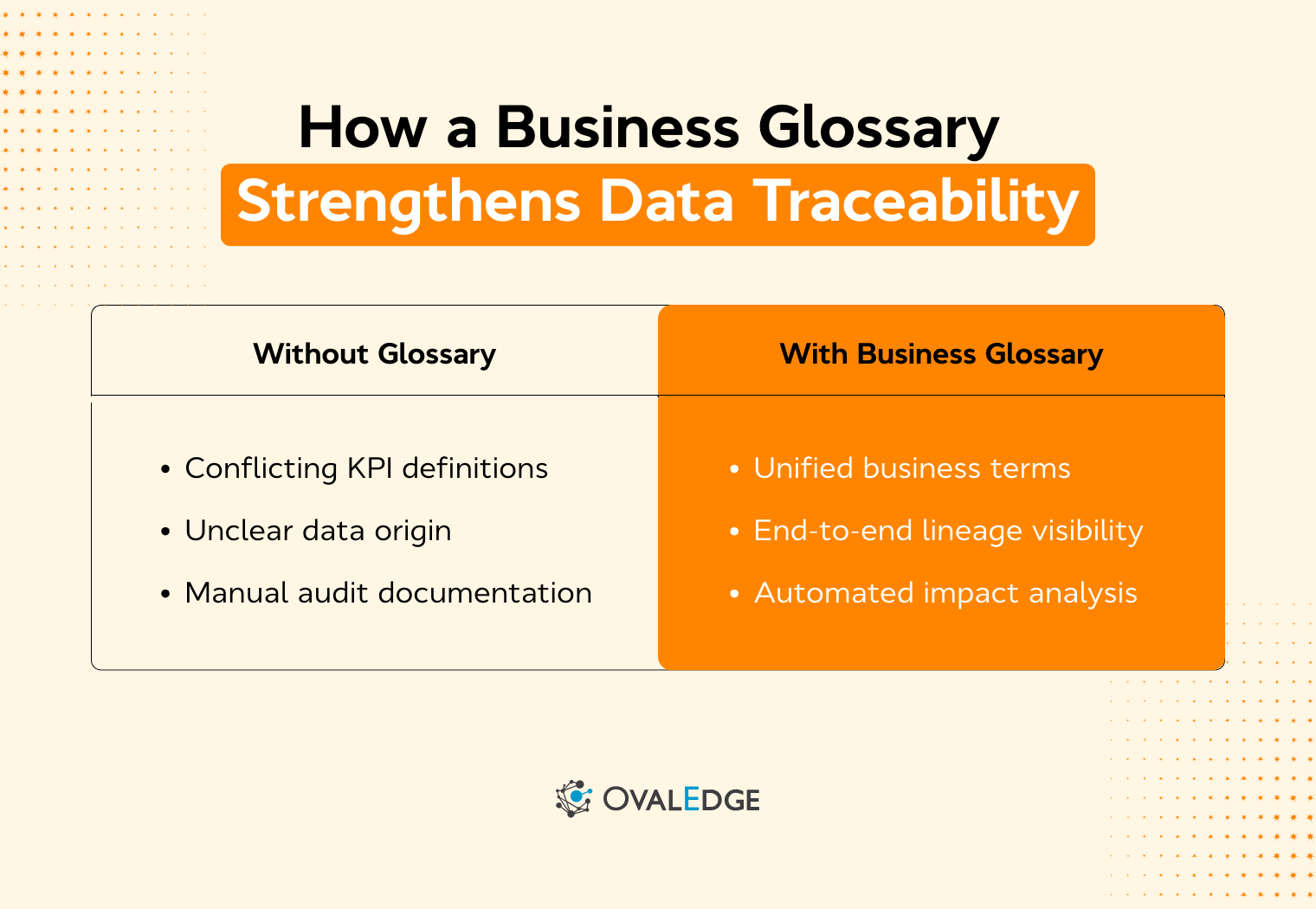
When revenue, churn, or customer growth show different numbers across systems, the issue is broken meaning. Technical lineage shows how data moves, but it does not explain what it represents or who owns it.
Improving data traceability using a business glossary fixes that gap. A business glossary connects business definitions to metadata, lineage, and ownership. It enhances traceability with glossary-driven governance and turns technical flows into a business-understandable context.
In this guide, we'll break down practical ways to strengthen business glossary traceability, improve data origin visibility, and build a traceability framework glossary that increases data transparency and trust across your organization.
What is a business glossary, and why does it matter for traceability?
Improving data traceability using a business glossary means linking business definitions to data lineage, metadata, and physical data assets to create end-to-end visibility.
A business glossary standardizes terminology across systems and connects terms to reports, dashboards, and pipelines. This integration enables impact analysis, audit trails, and regulatory compliance.
Stewards govern term ownership and workflows. Metadata associations automate traceability across domains. Organizations use glossary-driven traceability to reduce risk, improve change management, and strengthen data governance maturity.
A business glossary is more than a list of terms stored in a document or wiki. It is a centralized system where business definitions, ownership details, and governance policies live together in a structured format. When that glossary connects to technical metadata and lineage visibility, it stops being passive documentation and starts functioning as the backbone of business glossary traceability.
Without this layer, traceability remains technical. You can see that a column moved from one table to another, but you cannot clearly explain what that column represents in business terms or why it matters.
Here is why a glossary plays such a critical role in improving data traceability:
-
It creates a common language across departments, so finance, marketing, and analytics rely on the same approved definitions instead of conflicting interpretations.
-
It connects business definitions directly to technical data assets, including tables, columns, pipelines, and reports, making data origin visibility clearer for everyone.
-
It improves audit traceability and regulatory visibility by documenting term ownership, approval workflows, and associated controls.
-
It enables impact analysis at the business term level, so when a schema changes, you can immediately see which KPIs or reports may be affected.
-
It strengthens data transparency across analytics environments, helping stakeholders understand not just where data flows, but what it truly means.
|
Expert insight: This shift toward structured traceability is already underway. A 2025 governance benchmark report found that 83% of organizations use data catalogs to centralize metadata and reduce silos, and 58% rely on lineage tracking to ensure accuracy and traceability. Business glossaries typically operate within or alongside these catalogs, making glossary-to-lineage linking the operational foundation behind real traceability. |
In short, a business glossary bridges the gap between lineage movement and business meaning. That bridge is what transforms traceability from a technical exercise into a trust-building mechanism across the organization.
9 practical ways to improve data traceability using a business glossary
Improving data traceability using a business glossary is not about adding more documentation. It is about embedding business meaning directly into your lineage, metadata, and reporting layers so traceability becomes operational, not theoretical.
Here are 9 practical, field-tested ways to enhance traceability with glossary-driven governance.
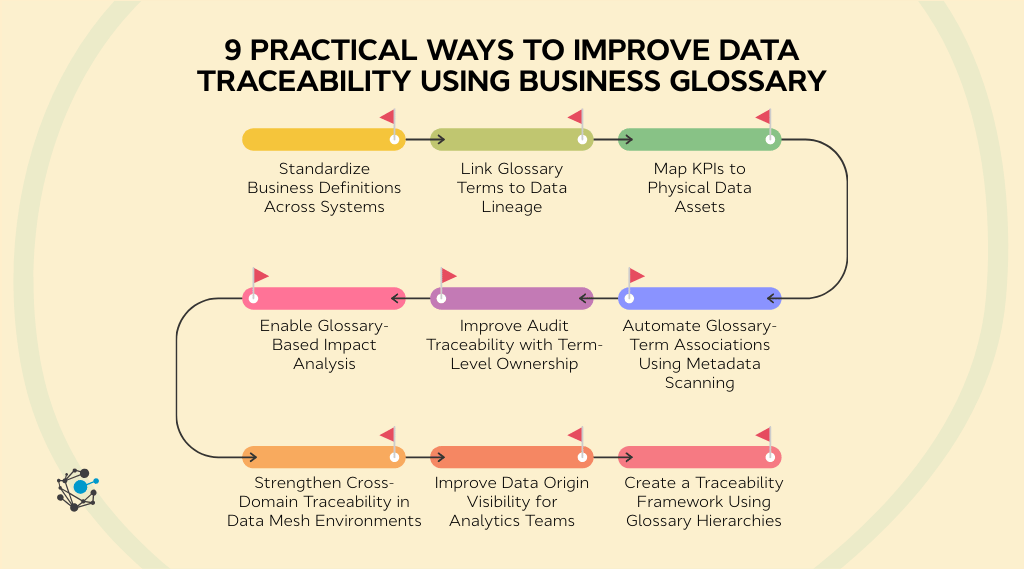
1. Standardize business definitions across systems
When revenue, churn, or active customers mean different things across systems, trust erodes quickly. Teams start reconciling spreadsheets instead of making decisions.
A business glossary solves this by defining each KPI once and mapping it consistently across CRM platforms, warehouses, and BI tools. Every dashboard, report, and transformation references the same approved definition.
As a result, business glossary traceability strengthens because each metric traces back to a single source of semantic truth. The impact on governance is immediate, as conversations shift from “Which number is correct?” to “What action should we take?”
2. Link glossary terms to data lineage
Technical lineage shows how data flows through systems. A glossary adds the missing layer of meaning.
When you link a term such as Net Revenue to its tables, columns, transformations, and dashboards, you create true end-to-end visibility. Analysts do not just see movement across pipelines; they understand what the data represents and why it matters.
This connection transforms lineage visibility into business-level traceability. It makes governance understandable beyond engineering teams and supports stronger data transparency across the organization.
3. Map KPIs to physical data assets
Traceability becomes powerful when KPIs connect directly to the systems that produce them. Mapping a metric like customer churn to its transformation logic, warehouse tables, and final dashboards creates a clear audit trail. Anyone reviewing the metric can trace it from its origin to its presentation layer.
This structured approach strengthens audit traceability and reduces reporting risk. It also improves confidence in BI environments where executives rely on accurate, explainable numbers.
4. Enable glossary-based impact analysis
Data structures evolve constantly. Columns change, tables are redesigned, and pipelines are updated.
Without glossary integration, impact analysis remains technical and incomplete. With glossary-based traceability, a schema change immediately highlights the business terms and KPIs that depend on that column.
This improves change management control and reduces unexpected reporting errors. More importantly, it links technical risk to business consequences, which is essential for mature governance.
|
Stat: The cost of weak traceability is not theoretical. A 2024 survey of data leaders found that two-thirds experienced a data incident costing more than $100,000 in just six months, and 70% said it takes longer than four hours to identify a data incident. Faster impact analysis through glossary-linked traceability directly reduces both the duration and financial impact of these disruptions. |
5. Improve audit traceability with term-level ownership
Traceability weakens when no one owns a definition. Assigning stewards to each business term creates clear accountability. Ownership details, review cycles, and policy references become part of the glossary itself.
This approach strengthens audit traceability because every critical metric has a documented responsibility behind it. Accountability improves compliance readiness and reinforces trust across stakeholders.
6. Automate glossary-term associations using metadata scanning
Manual mapping may work in small environments, but it rarely scales.
Automated metadata scanning identifies new datasets, columns, and transformations, then suggests associations with existing business terms. This reduces mapping gaps and prevents orphan data assets.
Automation enhances the scalability of your traceability framework glossary and ensures business metadata stays aligned with technical change. Traceability evolves alongside your data ecosystem rather than lagging behind it.
7. Strengthen cross-domain traceability in data mesh environments
In distributed architectures, different domains own their data products. Without alignment, traceability fragments quickly.
A centralized glossary with federated governance enables each domain to define its metrics while aligning with enterprise standards. This balance preserves autonomy without sacrificing consistency.
The result is stronger cross-domain traceability and clearer data transparency across distributed teams.
8. Improve data origin visibility for analytics teams
Analytics teams often spend more time validating numbers than analyzing them.
|
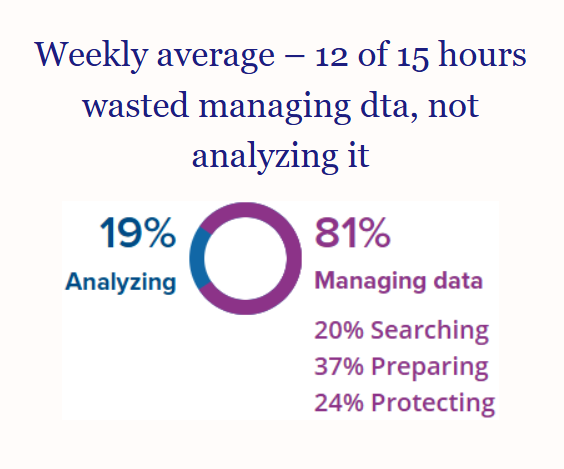
Here’s a fact: IDC estimates that up to 12 hours per week can be wasted because employees cannot find, prepare, or protect the data they need. Much of that time disappears into searching for definitions, tracing transformations, and validating upstream changes, exactly the friction glossary-driven traceability is designed to eliminate.
Image source: IDC Research |
When a glossary connects directly to lineage, analysts gain clear data origin visibility. They can trace a dashboard metric back to source systems and transformation logic while reviewing the approved business definition.
This improves root cause analysis and shortens troubleshooting cycles. Over time, it builds trust in executive dashboards and decision-making processes.
9. Create a traceability framework using glossary hierarchies
A mature glossary does not exist as a flat list of definitions. It reflects relationships between terms. Parent-child structures and derived-from logic allow metrics to map to their components.
For example, Total Revenue may aggregate Product Revenue and Service Revenue, each linked to separate datasets and transformations.
This hierarchical design creates a structured glossary-based traceability architecture. Instead of isolated mappings, you build a scalable framework that supports long-term governance maturity.
When you apply these practices consistently, traceability moves beyond technical tracking and becomes a shared business capability. That shift lays the groundwork for something even more important: sustained data transparency and organizational trust.
How a business glossary enhances data transparency and trust
When business definitions connect directly to lineage and ownership, something important shifts. Data stops feeling abstract and technical, and starts feeling understandable and accountable.
Instead of asking where a number came from or whether it can be trusted, stakeholders can trace the logic, see the ownership, and understand the business meaning behind it.
That clarity changes the way teams work with data. A well-integrated glossary does more than organize terms. It strengthens transparency at every layer of the ecosystem:
-
It improves enterprise data visibility across systems, so teams can follow metrics from source to dashboard without confusion.
-
It reduces KPI disputes between departments by anchoring conversations in standardized, approved definitions.
-
It strengthens compliance documentation by linking metrics to policies, controls, and accountable stewards.
-
It increases stakeholder confidence in reporting, especially at the executive level, where trust in numbers directly influences decisions.
-
It accelerates audit response time because traceability and ownership are already documented and accessible.
Over time, this level of transparency reshapes organizational culture. Teams stop questioning the integrity of the data and start focusing on insights, strategy, and performance.
Of course, building that level of trust requires more than good intentions. It also requires avoiding common mistakes that quietly undermine glossary-based traceability.
Common mistakes that weaken glossary-based traceability
Even the most well-designed glossary can fail if it is treated as a side project instead of a governance backbone. Organizations invest months building definitions, only to watch traceability weaken because the glossary never connects to real workflows.
Here are the most common mistakes that quietly undermine glossary-based traceability and what to do instead.
-
Treating the glossary as static documentation: When the glossary lives in isolation, disconnected from lineage and governance tools, it becomes a reference document rather than an operational system. To sustain business glossary traceability, integrate it directly with lineage visualization, metadata updates, and change management workflows so it evolves with your data ecosystem.
-
Ignoring column-level lineage integration: Table-level visibility may look complete on paper, but real traceability often depends on specific fields. If you cannot trace a KPI to the exact column feeding it, audit traceability remains shallow. Extending visibility to column-level lineage strengthens both impact analysis and compliance readiness.
-
Lack of stewardship ownership: Without clearly defined stewards, definitions become outdated, and accountability fades. Assigning ownership, defining review cycles, and formalizing approval processes ensure that glossary terms remain accurate and trusted over time.
-
Relying only on manual mapping: Manual associations may work early on, but they do not scale as systems grow. Automated metadata discovery and intelligent mapping reduce gaps, prevent orphan data assets, and improve the long-term reliability of your traceability framework glossary.
Avoiding these pitfalls is just as important as implementing best practices. Once the foundation is stable and operational, you can move beyond fixing weaknesses and focus on building a structured, scalable traceability framework that grows with your organization.
How to build a traceability framework using a business glossary
Once you understand how a glossary improves traceability, the next step is turning that understanding into structure. A strong traceability framework glossary does not emerge from scattered mappings. It requires deliberate prioritization, clear ownership, and continuous oversight.
Here is a practical way to build it step-by-step.
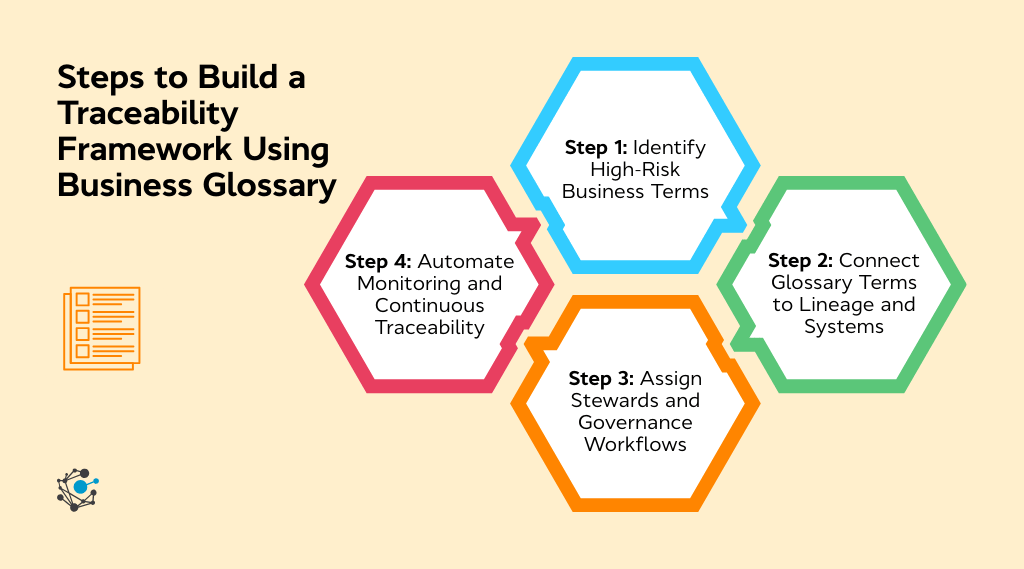
Step 1: Identify high-risk business terms
Start where the risk is highest. Financial KPIs, compliance metrics, and regulatory reporting terms should always come first because errors in these areas carry real consequences.
Look at the metrics that feed executive dashboards or external disclosures. If a number influences board decisions or regulatory filings, it deserves structured business glossary traceability. By prioritizing high-impact terms first, you ensure your framework protects what matters most before expanding to lower-risk areas.
Step 2: Connect glossary terms to lineage and systems
A glossary gains power when it connects directly to the systems that produce and consume data. Each business term should map to its underlying datasets, transformation logic, and reporting layer.
|
You can think of it as a structured flow: Business Term → Data Asset → Transformation → Consumption Layer |
This mapping should go beyond surface-level associations. Table-level visibility helps, but column-level traceability strengthens lineage visibility and improves audit traceability. When someone asks how a KPI is calculated, you should be able to trace it confidently from source to dashboard with both technical clarity and business context.
Step 3: Assign stewards and governance workflows
Even the most carefully mapped glossary weakens without accountability. Every critical business term needs a clearly assigned steward who owns its definition, review cycle, and approval process.
Governance workflows bring structure to that ownership. Change management alerts, version tracking, and approval checkpoints ensure updates do not silently break traceability. When ownership and process are documented, business glossary traceability remains reliable rather than reactive.
Step 4: Automate monitoring and continuous traceability
Data ecosystems do not stand still. New datasets appear, transformations evolve, and dashboards change.
Continuous monitoring ensures your traceability framework glossary evolves alongside those changes. Track unmapped terms, detect orphan data assets, and measure traceability coverage across systems.
Platforms like OvalEdge integrate business glossary management, lineage visualization, and automated metadata scanning to operationalize this framework at scale without heavy manual overhead. Automation sustains transparency as complexity grows and prevents traceability gaps from accumulating unnoticed.
|
Did you know? The efficiency gains from structured metadata and traceability programs are significant. A 2024 Forrester TEI study reported a 379% ROI over three years for a composite organization implementing modern data governance capabilities, along with a 90% reduction in data engineering time spent searching, integrating, and debugging data. These gains align directly with the outcomes glossary-driven traceability aims to deliver. |
A traceability framework built this way does more than document definitions. It embeds business context into the fabric of your data architecture.
When governance, lineage, and glossary operate as a unified system, traceability stops being a project and becomes a permanent capability.
Conclusion
Technical lineage alone does not build trust. Improving data traceability using a business glossary brings clarity to definitions, ownership, and data origin visibility so stakeholders understand not just where data flows, but what it means. That shift transforms governance from documentation to operational control.
This is where platforms like OvalEdge make a measurable difference. OvalEdge unifies business glossary management, lineage visualization, metadata integration, and automated scanning in one environment.
Instead of stitching together disconnected tools, you can operationalize glossary-based traceability at scale. Your teams gain structured definitions, column-level lineage, steward workflows, and continuous monitoring without heavy manual overhead.
If improving data transparency and audit traceability is on your roadmap, the next step is simple. Schedule a call with OvalEdge to see how you can enhance traceability with glossary-driven governance and build a scalable traceability framework tailored to your enterprise.
FAQs
1. How does a business glossary support regulatory compliance audits?
A business glossary centralizes approved definitions, ownership, and policy references, making it easier to demonstrate how regulated metrics are calculated. Auditors can trace definitions back to source systems and controls without relying on disconnected documentation or manual explanations.
2. Can a business glossary improve collaboration between technical and business teams?
Yes. A glossary creates a shared language between analysts, engineers, and business stakeholders. By aligning technical assets with approved business definitions, teams reduce misunderstandings, speed up reporting discussions, and improve cross-functional decision-making accuracy.
3. What is the difference between glossary-based traceability and data catalog tagging?
Glossary-based traceability links standardized business terms directly to lineage and governance workflows. Simple catalog tagging labels assets but does not necessarily connect definitions to transformations, ownership, or compliance controls, limiting true business-level traceability.
4. How often should business glossary definitions be reviewed for traceability accuracy?
Organizations should review high-impact terms quarterly or whenever schema changes occur. Automated alerts tied to metadata updates help detect when definitions or mappings require validation, ensuring traceability remains accurate as data pipelines evolve.
5. Does glossary-based traceability help with root cause analysis?
Yes. When a business term is linked to lineage and ownership, teams can quickly identify upstream transformations or source systems causing discrepancies. This shortens investigation time and reduces downtime during reporting or analytics incidents.
6. What industries benefit most from improving data traceability using a business glossary?
Highly regulated industries such as banking, healthcare, insurance, and telecommunications benefit significantly. These sectors require clear metric definitions, audit documentation, and data origin visibility to maintain compliance, reporting accuracy, and operational transparency.
.png?width=1081&height=173&name=Forrester%201%20(1).png)
.png?width=1081&height=241&name=KC%20-%20Logo%201%20(1).png)