Why does a simple metric review turn into a 30-minute argument?
Sales trusts the dashboard. Finance questions the revenue logic. Data points to the warehouse and says the query is correct. Everyone uses the same reports. No one agrees on what the numbers actually represent.
This is not a visualization issue. It is not a tooling failure. It is a breakdown between meaning and structure. It sits at the center of the business glossary vs data dictionary debate.
One team updates definitions without checking the fields. Another modifies tables without reviewing the business context. The gap widens quietly. By the time discrepancies surface, trust has already eroded.
This can’t be solved by choosing one discipline over the other. A business glossary without a data dictionary leaves business terms floating without technical grounding. A data dictionary without a business glossary documents fields that different stakeholders interpret in different ways.
Both are equally important. One governs shared language. The other governs how that language is implemented in systems.
In this blog, you will see how they differ, how they connect, and how aligning them prevents metric disputes, strengthens governance, and restores confidence in your data.
What is business glossary?
A business glossary is a centralized metadata resource that defines standardized business terms, metrics, and KPIs in clear language. It aligns stakeholders around shared definitions and supports consistent reporting.
A business glossary differs from a data dictionary, which documents technical fields, formats, tables, and system structures. Together, they strengthen data governance by connecting business meaning to data implementation and lineage.
Key components of the business glossary
A business glossary is a governance asset that helps organizations align language, reduce reporting friction, and ensure that business meaning stays consistent as data scales.
Each component below addresses a specific problem that commonly arises when business terms are undocumented or loosely defined.
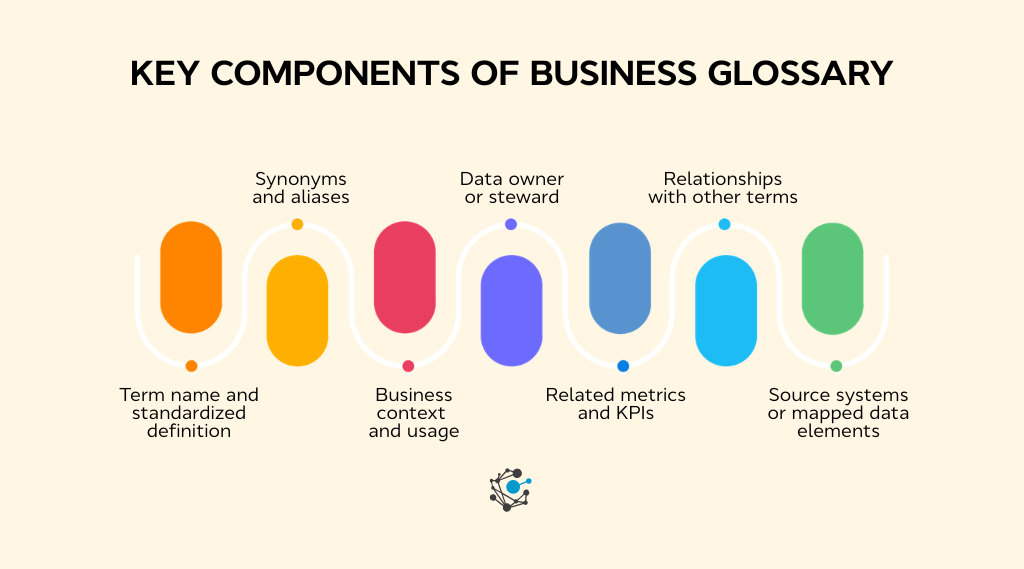
1. Term name and standardized definition
An effective business glossary is a clearly defined term with an agreed, documented meaning. This definition is written in business-facing language so that executives, analysts, compliance teams, and operational staff can interpret it consistently.
It avoids technical field names, database logic, or system-specific rules. The goal is clarity of intent.
The problem this solves is semantic inconsistency, which is one of the most common root causes of reporting conflicts.
When marketing defines a customer based on engagement activity, finance defines it based on billing status, and operations defines it based on account creation, dashboards quickly diverge.
The numbers may all be technically correct within their own logic, but they are not comparable.
A standardized definition in a business glossary acts as a governance checkpoint. Before a term is used in a KPI, report, or regulatory submission, it is anchored to a shared meaning. This makes metrics defensible and reduces debate in executive settings.
Clear term definitions also support onboarding and data literacy. New employees can reference the glossary to understand how the organization defines key concepts, rather than relying on informal explanations that vary by team.
Modern metadata platforms such as OvalEdge help reinforce this by centralizing glossary terms alongside usage, lineage, statistics, and user knowledge.
Instead of hunting through emails or relying on tribal context, users can search in natural language, explore related data, and understand how a term connects to actual data elements. This strengthens shared understanding and builds confidence in both definitions and data.
2. Synonyms and aliases
Over time, organizations accumulate multiple labels for the same concept. Sales may refer to a client, support may refer to a user, and finance may refer to an account.
These differences often reflect historical system implementations or departmental culture. Without documentation, they create friction in reporting and analytics.
The risk is not just confusion in conversation. It affects queries, dashboards, and metric alignment. If two analysts build reports using different terms that refer to the same underlying concept, they may unknowingly duplicate work or misinterpret results.
A business glossary addresses this by capturing synonyms and aliases and linking them to a single approved term. This does not force teams to abandon familiar language immediately.
Instead, it creates a structured mapping that clarifies equivalence. When a user searches for a term in a data catalog or governance platform, they can discover the standardized definition even if they use an alternative label.
3. Business context and usage
A business glossary definition that only explains what a term means is incomplete. For governance to work, users also need to understand how and where that term should be applied.
Business context and usage clarify the operational boundaries of a term. They explain which reports, decisions, or processes rely on it and under what conditions it should be used.
This becomes especially important for metrics that influence strategy.
|
For example, a strong glossary entry for the term “Customer Lifetime Value” would not only define it conceptually but also describe how it is used in forecasting, retention planning, or marketing budget allocation. It may also clarify whether the calculation applies only to active customers, subscription models, or specific product lines. Without this context, teams may use the same term in different scenarios with slightly different assumptions, leading to inconsistent conclusions. |
One common pain point in analytics programs is declining trust in dashboards. Business users often question numbers because they do not understand the logic behind them.
When glossary entries include business context and intended usage, they reduce that uncertainty. Users can see why a metric exists, how it supports decision-making, and what limitations apply.
Including context also improves data literacy. Instead of simply memorizing definitions, users learn how concepts interact within workflows and performance management frameworks. This turns the business glossary into a tool for interpretation, not just documentation.
4. Data owner or steward
Definitions change over time as products evolve, regulations shift, or reporting standards are updated. When a term becomes ambiguous or disputed, someone must have the authority to resolve it.
A well-designed business glossary assigns a data owner or steward to each term. This individual or group is responsible for maintaining the definition, reviewing proposed changes, and ensuring alignment across departments.
Without assigned ownership, glossary entries quickly become outdated or inconsistent. Different teams may quietly modify how they interpret a term without formal review, leading to definition drift.
Stewardship is not just an internal housekeeping practice. It shapes how an organization is perceived.
According to Deloitte’s 2025 Connected Consumer Analysis, only 8% of companies qualified as “data stewards,” earning high marks for data responsibility, privacy, transparency, and control.
The small percentage highlights how rare structured accountability still is, even though trust in data increasingly defines brand credibility.
Stewardship formalizes responsibility and creates a clear escalation path for disagreements. If marketing and finance interpret a metric differently, the steward facilitates resolution based on agreed governance standards.
When these stewardship roles are clearly defined and coordinated, governance becomes practical rather than theoretical. Questions about what a term means are resolved at the business level. Questions about how a field behaves are resolved at the technical level.
5. Related metrics and KPIs
Business terms do not exist in isolation. They often serve as the foundation for key performance indicators that guide strategy, budgeting, and operational planning.
A mature business glossary makes these connections explicit by linking terms to the metrics and KPIs they influence.
|
For example, a glossary entry for Customer should not stand alone as a static definition. It should reference the KPIs that depend on that definition, such as churn rate, net revenue retention, or average revenue per user. When these connections are documented, users can see how a single conceptual definition flows into measurable outcomes. |
This addresses a common governance challenge. Teams may agree on a KPI name but disagree on how it is calculated because they interpret the underlying business term differently.
If churn rate is calculated using one definition of customer in marketing and another in finance, dashboards will conflict even if both calculations are technically correct. Anchoring KPIs to glossary terms ensures that the metric inherits a standardized meaning.
6. Relationships with other terms
Business concepts are interconnected. A glossary that treats each term as an isolated entry fails to reflect how organizations actually operate. Relationships between terms create a conceptual model of the business.
|
For instance, a Customer may relate to Orders, Subscriptions, Accounts, or Products. Documenting these relationships helps users understand dependencies and context. It clarifies whether an Order can exist without a Customer, or how a Subscription differs from a one-time transaction. |
Without relational documentation, new employees and cross-functional teams often misinterpret terminology. They may assume two terms are interchangeable when they are not, or overlook dependencies that affect reporting logic.
By showing how terms connect, the glossary provides a structured view of the business domain.
7. Source systems or mapped data elements
As organizations mature in their metadata practices, business glossaries increasingly connect terms to the actual systems and data elements that represent them. This is where the boundary between glossary and dictionary becomes collaborative rather than separate.
Linking a business term to specific tables or fields provides traceability.
|
For example, the term Customer may map to an object in a CRM platform and to corresponding tables in a data warehouse. This mapping clarifies which data elements implement the agreed business definition. |
Without this connection, definitions risk becoming abstract statements that are difficult to operationalize.
Analysts may interpret the same term differently based on which field they select, especially if multiple similar columns exist across systems. Mapping business terms to data elements reduces this ambiguity and supports consistent implementation.
From a governance perspective, this alignment supports lineage, impact analysis, and change management.
When a source system changes or a field is modified, stakeholders can quickly identify which business terms are affected. This prevents silent inconsistencies and reinforces transparency across reporting and analytics workflows.
What is data dictionary?
A data dictionary is a centralized metadata document that describes the structure, format, and rules of data within a system. It documents field names, data types, table relationships, constraints, default values, and source systems.
A data dictionary helps users understand how data is stored, validated, and connected across databases. It supports accurate reporting, reliable analytics, and strong data governance by making technical data elements clear, consistent, and traceable.
Key components of the data dictionary
Understanding the key components of a data dictionary helps clarify why it plays such a critical role in data documentation and why it cannot be replaced by a business glossary alone.
1. Data element name
The data element name is the exact identifier used in a database, table, or file.
|
Examples include customer_id, order_date, or subscription_status. These names are not conceptual labels. They are the literal references used in SQL queries, data transformations, dashboards, and pipelines. |
Precision here is critical. Even minor differences in naming conventions can create confusion.
|
For instance, customer_id and client_id may appear similar but refer to different systems or definitions. Without clear documentation, analysts often rely on guesswork or institutional memory, which increases the likelihood of incorrect joins or duplicated logic. |
Onboarding analytics teams is significantly slower when field-level documentation is incomplete. Analysts spend valuable time exploring schemas, running exploratory queries, or asking colleagues what a field represents.
A well-maintained data dictionary reduces that friction by providing structured, searchable documentation.
2. Data type and format
A data dictionary also documents the technical format of each field. This includes whether a field is an integer, string, date, timestamp, decimal, or boolean, as well as any constraints on length or precision.
This may appear purely technical, but it directly impacts data accuracy. If a financial field is stored as an integer rather than a decimal, rounding behavior will affect reporting. If a date is stored as a string, sorting and filtering may not behave as expected.
Without documented data types, analysts may misinterpret how values should be aggregated, compared, or transformed.
Data type documentation also supports validation and data quality checks. Engineers can confirm whether values align with expected formats. Analysts can understand whether null values are permitted or whether a field should always contain a value.
From a governance perspective, this is one of the clearest examples of how a data dictionary goes deeper than a business glossary.
Business users need to understand definitions and usage. Technical users need to understand the structure and behavior. Accurate documentation of the format ensures that business logic can be reliably implemented in queries and reporting tools.
3. Description or definition
Even though a data dictionary focuses on technical metadata, field-level descriptions are essential for accurate interpretation. A data element name alone rarely explains how a field is populated, updated, or intended to be used. A clear description bridges that gap.
|
For example, a column such as order_status may appear straightforward. However, without documentation, teams may not know whether it reflects the latest fulfillment milestone, the billing state, the payment confirmation status, or a composite value derived from multiple systems. |
If one team interprets it as a shipping indicator and another treats it as a billing indicator, reports will diverge even though they reference the same column.
This is a recurring challenge in analytics environments. Analysts often assume that column names are self-explanatory, only to discover later that business logic was embedded in transformation rules upstream.
A strong data dictionary description clarifies how the field is generated, whether it is system-generated or derived, and any conditions that influence its value.
4. Source system or table
A critical function of a data dictionary is to document the origin of each field. This includes identifying the source system, the specific table, and sometimes the ingestion or transformation layer where the data enters analytical environments.
Traceability is a core principle of data governance. When a KPI shifts unexpectedly, teams need to understand whether the change originated in the source application, the transformation logic, or the reporting layer.
Without documented source information, troubleshooting becomes fragmented and time-consuming.
|
For example, a customer attribute stored in a CRM system may be transformed before landing in a data warehouse. If analysts only see the warehouse table without knowing the original source, they may struggle to understand discrepancies or historical changes. |
A well-maintained data dictionary documents this lineage at the field level, making it easier to investigate anomalies and assess impact when systems evolve.
This documentation also strengthens the connection between data dictionaries and broader metadata documentation tools such as data catalogs. Source visibility enhances discoverability and supports governance workflows, including impact analysis and schema change reviews.
5. Field-level constraints
Field-level constraints define the technical rules applied to a column. These may include NOT NULL requirements, uniqueness constraints, primary key designations, or referential integrity rules.
While they may appear purely technical, they directly influence data quality and reliability.
If a field is marked as NOT NULL, analysts can assume that it should always contain a value. If a field is defined as UNIQUE, it may serve as a reliable identifier.
When constraints are undocumented, users may assume stronger guarantees than the system actually enforces.
By documenting constraints in the data dictionary, organizations make structural expectations explicit.
Analysts understand which fields are safe for joins, which may contain gaps, and where validation checks should be applied. Engineers can ensure that transformations respect underlying integrity rules.
6. Default values and allowed values
Many fields in operational and analytical systems are governed by predefined rules. These include allowed value lists, enumerated categories, and default settings applied when a record is created.
A data dictionary documents these rules explicitly so users understand how data behaves at the field level.
|
For example, a status field may only accept specific values such as Active, Inactive, or Suspended. A boolean flag may default to false unless explicitly changed. |
Without documentation, analysts might interpret unexpected values as data errors when they are actually part of a controlled workflow. Conversely, they may overlook data quality issues because they do not know what the valid range of values should be.
This documentation supports validation logic in downstream systems and reporting tools. When allowed values are clearly defined, it becomes easier to detect anomalies and enforce data integrity rules.
Analysts can quickly determine whether a new or unexpected category represents a legitimate business change or a data ingestion issue.
Documenting allowed and default values also supports governance during system migrations or updates. When schemas evolve, teams can verify whether new values align with existing definitions or require glossary updates.
7. Relationships and dependencies
Data does not exist as isolated columns. It is organized into tables, linked through keys, and shaped by dependencies across systems.
A comprehensive data dictionary documents these relationships in detail, including primary keys, foreign keys, and referential integrity constraints.
This information is foundational for accurate analytics. Analysts rely on documented relationships to build correct joins between tables. Without clear documentation, they may join the wrong field or overlook important dependencies, leading to duplicated records or inconsistent metrics.
Undocumented relationships often create reliance on tribal knowledge. New team members must ask colleagues how tables connect, and experienced analysts may rely on memory rather than verified documentation. This increases the risk of error and makes analytics less repeatable.
Documented dependencies also play a critical role in impact analysis. When a schema change occurs, teams need to understand which reports, dashboards, or downstream systems depend on the affected fields.
A well-maintained data dictionary provides visibility into these dependencies, making change management more controlled and predictable.
8. Data steward or owner
Technical metadata requires ownership to remain accurate and useful. A data dictionary assigns a steward or owner for each field, table, or domain.
This individual or team is responsible for maintaining documentation, reviewing changes, and ensuring that definitions reflect the current system design.
Without clear ownership, data dictionaries often become outdated. Fields are added or modified, but documentation is not updated. Over time, this erodes trust in the metadata itself. Users begin to question whether descriptions, constraints, or relationships are still valid.
Clear stewardship aligns with established governance frameworks that emphasize defined roles and responsibilities. When questions arise about a field’s behavior, format, or lineage, teams know who to contact. This reduces ambiguity and accelerates issue resolution.
Difference between business glossary and data dictionary
When comparing a business glossary and a data dictionary, the confusion usually comes from overlap in terminology rather than overlap in purpose. Both are metadata tools. Both support data governance. But they operate at different layers of understanding.
|
Aspect |
Business Glossary |
Data Dictionary |
|
Primary Purpose |
Defines business terms and shared meaning |
Documents the technical structure of data elements |
|
Focus |
Business context and interpretation |
Technical metadata and implementation |
|
Audience |
Business users, analysts, stakeholders, executives |
Data engineers, analysts, architects, developers |
|
Type of Metadata |
Semantic metadata |
Structural and technical metadata |
|
Language Style |
Plain, business-facing language |
Technical, system-level language |
|
Key Question Answered |
What does this term mean? |
How is this field stored and structured? |
|
Content Scope |
Terms, KPIs, definitions, usage context |
Fields, tables, data types, constraints, relationships |
|
Ownership |
Business data steward or domain owner |
Technical data steward or system owner |
|
Level of Detail |
Conceptual and contextual |
Field-level and schema-level detail |
|
Examples of Entries |
Customer, Revenue, Churn Rate |
customer_id, order_date, subscription_status |
|
Governance Role |
Aligns definitions across departments |
Ensures data accuracy and structural consistency |
|
Relationship to KPIs |
Links terms to metrics and reporting logic |
Documents fields used to calculate metrics |
|
Constraints & Rules |
Rarely includes technical constraints |
Includes NOT NULL, UNIQUE, and default values |
|
Data Types |
Not typically included |
Explicitly documented (string, integer, date, etc.) |
|
Relationships |
Conceptual relationships between business terms |
Primary keys, foreign keys, and table dependencies |
|
Use in Reporting |
Prevents misinterpretation of metrics |
Supports correct joins and transformations |
|
Compliance Support |
Defines regulated terms clearly |
Documents source systems and lineage details |
|
Integration Point |
Maps business terms to data elements |
Links technical fields back to business terms |
|
Tooling |
Often managed in data governance platforms or catalogs |
Often integrated with databases, modeling tools, or catalogs |
|
When You Need It |
When teams disagree on definitions |
When teams struggle with schema understanding |
Treating the glossary and the dictionary as optional documentation layers is one of the most common governance mistakes. Organizations that implement only one create a structural imbalance. They either define meaning without enforcement or document structure without alignment. In practice, this leads to disputes, duplicated metrics, and inconsistent reporting logic.
Mature governance programs approach this differently. They treat the business glossary and data dictionary as interdependent metadata pillars. Meaning and structure evolve together. Definitions stay connected to implementation. Governance becomes enforceable, not theoretical.
Relationship between business glossary and data dictionary
A business glossary and a data dictionary solve different problems, but they are most effective when they operate as a connected system. On their own, each provides partial clarity.
Together, they create alignment between what the business intends to measure and how data actually exists in systems. This relationship is central to understanding business glossary and data dictionary from a governance and usability perspective.
In reality, most organizations build a glossary first. They define terms, circulate documentation, and consider the job done. Mapping to actual data fields is delayed or ignored. Usage is not enforced.
Over time, the glossary becomes a static reference document rather than a governance control.
When that happens, leaders often conclude that governance failed. The failure is rarely conceptual. It is operational. Without linking definitions to approved data elements and embedding them into reporting workflows, meaning never translates into practice.
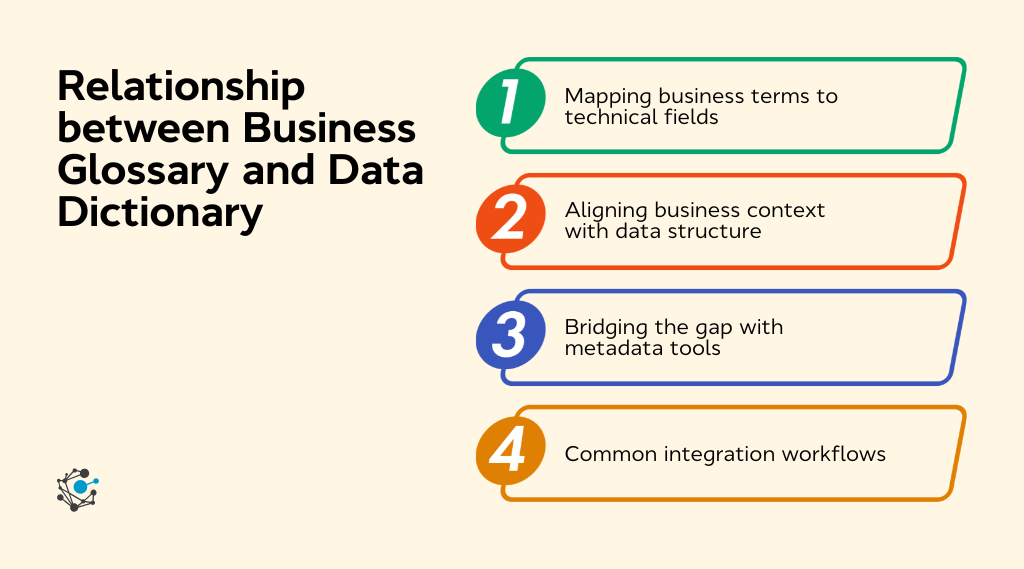
1. Mapping business terms to technical fields
The practical intersection of business glossary and data dictionary becomes clear when business terms are mapped to actual data elements. This mapping is not optional in mature data governance programs. It is what turns definitions into enforceable standards.
A term such as Revenue often represents multiple realities in data systems. There may be fields for gross revenue, net revenue, deferred revenue, or recognized revenue. Each may live in different tables or even different systems.
Without explicit mapping, analysts may select a field based on name similarity rather than approved business logic. That is one of the most common causes of inconsistent dashboards and lengthy reconciliation efforts.
-
The business glossary clarifies what Revenue means within the organization, including calculation logic and contextual boundaries.
-
The data dictionary identifies the exact fields, their data types, constraints, and source systems.
Mapping the glossary term to specific dictionary entries creates a governed pathway from concept to implementation.
2. Aligning business context with data structure
As products evolve, regulations change, or reporting requirements shift, definitions must adapt. At the same time, systems and data models are continuously updated to support new features and integrations.
When these changes occur independently, alignment breaks down.
Definitions that exist only in conceptual documents are vulnerable to drift. Over time, they may no longer reflect how data is actually captured or processed.
|
For example, a definition of Active Customer might remain unchanged in documentation while system logic is modified to reflect new eligibility rules. If that change is not reviewed at both the glossary and dictionary levels, inconsistencies emerge. |
Linking glossary terms directly to dictionary entries makes this drift visible. If a field is renamed, deprecated, or structurally modified, stakeholders can assess whether the associated business definition needs revision.
This structured alignment supports change management and impact analysis.
Metadata management research consistently emphasizes that governance requires integration between semantic and technical layers. It is not enough to define terms clearly.
Those terms must remain grounded in real data structures, source systems, and transformation logic.
When organizations actively align business context with data structure, they create a feedback loop. Changes in systems trigger a review of definitions. Changes in business logic trigger a review of technical implementation.
This continuous alignment is what transforms documentation into a living governance framework rather than a static reference.
3. Bridging the gap with metadata tools
As organizations scale, business glossaries and data dictionaries rarely remain effective as static spreadsheets or isolated documents.
The real integration happens through metadata platforms and data catalogs that bring both semantic and technical metadata into a unified experience.
Modern metadata tools serve as the connective layer for business glossaries and data dictionaries. They allow users to search for a business term, review its standardized definition, and immediately view the associated data elements, source systems, lineage, and usage across reports.
This reduces the fragmentation that occurs when glossary content lives in one system and technical documentation lives in another.
For business users, this integration builds trust. When they can trace a KPI from its definition to the underlying tables and fields, confidence increases.
For technical users, the benefit is contextual clarity. They see not only how a field is structured but also why it exists and how it supports business outcomes.
This shared visibility addresses a common operational pain point. In many organizations, business teams frequently ask analysts to clarify where numbers come from, while analysts spend time explaining system logic.
When glossaries and dictionaries are integrated within metadata documentation tools, these explanations become discoverable rather than conversational. The result is fewer interruptions, clearer accountability, and more efficient collaboration.
4. Common integration workflows
Effective integration between a business glossary and a data dictionary does not happen automatically. It depends on repeatable governance workflows that keep both layers aligned over time.
A typical workflow begins when a new business term is proposed or an existing one is updated. The definition is reviewed and approved by the designated business steward.
Once finalized, the term is mapped to one or more data dictionary fields that represent its implementation. These mappings are documented and made discoverable within the metadata platform.
From there, usage is tracked. Reports, dashboards, and compliance processes that rely on the term are linked to both the glossary definition and the corresponding technical fields.
This creates transparency around where and how the term is used. If a field is modified, renamed, or deprecated, stewards can assess the impact on associated business terms and reporting assets.
This workflow transforms metadata from static documentation into a governed lifecycle. Changes in business definitions trigger a review of technical mappings. Changes in schemas trigger a review of business definitions. Over time, this feedback loop maintains alignment between intent and implementation.
Why both matter in data governance
A business glossary and a data dictionary address different but equally critical layers of governance. Without both, governance becomes either theoretical or overly technical, but rarely effective.
1. Glossary and dictionary as metadata pillars
In a well-structured governance framework, metadata acts as the connective tissue between strategy, systems, and reporting.
The business glossary represents semantic metadata. It defines what terms mean, how they should be interpreted, and how they relate to business objectives. The data dictionary represents structural metadata. It documents how those terms are physically represented in tables, fields, and formats.
If you only maintain semantic definitions, governance lacks enforceability. Definitions may exist in documents, but they are not tied to actual data elements.
If you only maintain structural documentation, governance lacks clarity. Teams may know how data is stored, but not why it exists or how it should be used.
Mature practices connect meaning and implementation rather than treating them as separate efforts. In practical terms, this means linking business glossary terms directly to data dictionary fields and ensuring both evolve together.
This dual structure is what turns metadata from static documentation into an operational governance asset.
2. Enabling consistent definitions and trusted data
Different departments produce reports that appear to measure the same KPI but produce different results. The root cause is often not faulty data pipelines but misaligned definitions or undocumented data transformations.
When business glossary and data dictionary work together, they reduce ambiguity at both the conceptual and technical levels.
Business users can interpret metrics confidently because definitions are standardized. Analysts can validate calculations because the underlying fields are transparent and documented.
Trust in data is cumulative. It builds when stakeholders can trace a reported number back to a clearly defined term and then further back to specific tables and fields.
Without that traceability, executive decision-making becomes cautious and reactive. With it, leaders can rely on reports with greater confidence because both meaning and structure are governed.
3. Supporting data stewardship and accountability
Governance fails quickly when responsibility is vague. If no one owns a definition, it drifts. If no one owns a data field, it becomes outdated or misused.
A business glossary assigns accountability for meaning. Business stewards are responsible for defining terms, resolving disputes, and approving updates when business processes change.
|
For example, if the organization revises how it defines an active customer, that change must be formally reflected in the glossary. Without stewardship, different departments may quietly apply different interpretations, leading to inconsistent KPIs. |
A data dictionary assigns accountability for structure. Technical stewards manage field definitions, data types, constraints, and schema changes.
If a column is deprecated or its format changes, the data dictionary must be updated to prevent downstream errors.
When these stewardship roles are clearly defined and connected, ownership becomes operational rather than symbolic. Questions about a metric’s meaning go to the business steward. Questions about a field’s behavior go to the technical steward.
This clarity reduces delays, prevents miscommunication, and reinforces trust in data assets.
4. Powering compliance, auditability, and lineage
Regulatory environments place increasing pressure on organizations to demonstrate how data is defined, sourced, and transformed.
In industries such as finance, healthcare, and telecommunications, auditors often require documented definitions and traceable lineage for reported figures.
A business glossary provides documented definitions for regulated metrics and attributes. It ensures that terms used in official reports are standardized and consistently interpreted. A data dictionary complements this by documenting the fields, tables, and systems that implement those terms.
Together, they support lineage tracking. When a regulator or auditor asks how a reported value was calculated, teams can trace the metric from the business definition in the glossary to the underlying data elements in the dictionary, and then to the source systems. This transparency reduces compliance risk and shortens audit cycles.
Without both tools, audit responses often rely on manual explanations or undocumented knowledge. That creates operational risk and undermines credibility.
In the broader context of data governance, connecting glossary definitions to dictionary fields is what makes lineage demonstrable rather than theoretical.
5. Driving adoption of self-service analytics
Self-service analytics depends on two forms of clarity. Business users need to understand what the terms mean. Analysts need to understand how data is structured. The business glossary and data dictionary address these needs from different angles.
The reality is that most organizations still struggle to operationalize insights at scale.
According to a 2023 Forrester Research on Data Strategy & Insights, fewer than 10% of enterprises are advanced in their insights-driven capabilities.
A common reason is not a lack of tools, but a lack of shared understanding and reliable metadata. When definitions and structures are unclear, self-service becomes guesswork rather than empowerment.
When definitions are clearly documented in a glossary, business users can search for a term and understand its context before using it in a report. This reduces the risk of misinterpretation and encourages more confident exploration of data.
When structural details are documented in a data dictionary, analysts can quickly understand how to join tables, interpret constraints, and validate calculations.
Organizations that lack one or the other often see bottlenecks. Business users repeatedly ask analysts to clarify definitions. Analysts spend time investigating schema details that should already be documented.
By integrating glossary and dictionary information within metadata platforms or data catalogs, organizations make both meaning and structure discoverable.
Conclusion
Data drives reporting, forecasting, compliance reviews, and strategic decisions. Leaders rely on dashboards to allocate budgets, evaluate performance, and manage risk.
When numbers shift unexpectedly, the impact is not limited to analytics teams. It affects confidence, planning, and accountability across the organization.
Data, however, is not just about structure. Clean schemas, optimized pipelines, and well-built models do not guarantee clarity. Meaning matters as much as format. Definitions shape interpretation. Context shapes usage.
When meaning and structure drift apart, even technically correct data can produce conflicting narratives.
Many disputes around metrics are labeled as data quality issues. Some are technical. Many are not. They stem from communication gaps. One team defines a term differently. Another selects a similar but not identical field.
Reports diverge. Meetings turn into reconciliation sessions. The real issue is not broken queries. It is a misalignment between language and implementation.
If you are auditing data-related problems, do not limit the review to pipelines and tables. Examine whether your business glossary and data dictionary are aligned.
Check whether business terms are mapped to approved data elements. Verify whether definitions reflect how data is actually stored and transformed.
Consistency between your glossary and dictionary is not a documentation exercise. It is a governance safeguard. When meaning and structure move together, disputes decrease, trust improves, and data becomes a foundation for decisions rather than a source of debate.
Struggling to align business definitions with technical data fields?
Platforms that unify glossary, dictionary, lineage, and stewardship reduce the friction between business and technical teams. When meaning, structure, and ownership live in separate tools or spreadsheets, misalignment becomes inevitable.
Evaluating whether your current tooling supports that alignment is often the most practical next step.
See how OvalEdge unifies business glossary, data dictionary, lineage, and governance in one AI-powered platform. Make your data trusted, discoverable, and audit-ready across teams.

Book a demo to see how you can govern smarter.
FAQs
1. How does a business glossary improve data literacy across teams?
A business glossary standardizes definitions for terms, KPIs, and metrics in plain language. It reduces confusion between departments and helps users interpret reports consistently. By providing shared meaning and context, it enables non-technical stakeholders to understand data confidently without relying on informal explanations.
2. How does a data dictionary support accurate reporting?
A data dictionary documents field names, data types, constraints, and table relationships. This structure helps analysts build correct joins, apply accurate filters, and avoid calculation errors. It ensures reports reflect how data is actually stored and processed in systems.
3. When should an organization prioritize building a business glossary first?
An organization should prioritize a business glossary when teams disagree on definitions or metrics. If reports show conflicting numbers due to semantic differences, standardizing business terms is the first step before improving technical documentation.
4. When is a data dictionary most critical in analytics projects?
A data dictionary becomes critical during system migrations, warehouse redesigns, or onboarding new analysts. It prevents misinterpretation of fields and ensures schema changes do not disrupt reporting or downstream processes.
5. Can a data catalog replace a business glossary or data dictionary?
A data catalog does not replace them. It connects them. A catalog integrates glossary definitions and dictionary metadata into one searchable platform, improving discoverability, lineage visibility, and governance workflows.
6. Who typically updates glossary terms versus dictionary fields?
Business stewards update glossary terms based on policy or strategy changes. Technical stewards update dictionary fields when schemas or systems change. Clear ownership ensures both meaning and structure remain aligned over time.
.png?width=1081&height=173&name=Forrester%201%20(1).png)
.png?width=1081&height=241&name=KC%20-%20Logo%201%20(1).png)