Your dashboards say one thing. Your reports say another. Meetings that should focus on decisions turn into debates about which number is correct.
This situation is more common than many organizations expect. Different teams often calculate the same metric differently, leading to reporting conflicts, slower decisions, and reduced trust in analytics.
The issue is rarely missing definitions. Most enterprises already document key business terms in a glossary. The real problem is that those definitions are not connected to the data systems used to generate reports and analytics.
As enterprise data environments grow across warehouses, pipelines, analytics tools, and AI systems, keeping definitions consistent becomes increasingly difficult. Industry analysts are also highlighting the need for stronger governance and metadata management.
A 2026 Gartner press release predicts that 50% of organizations will adopt zero-trust data governance by 2028 as data complexity and AI-generated data increase.
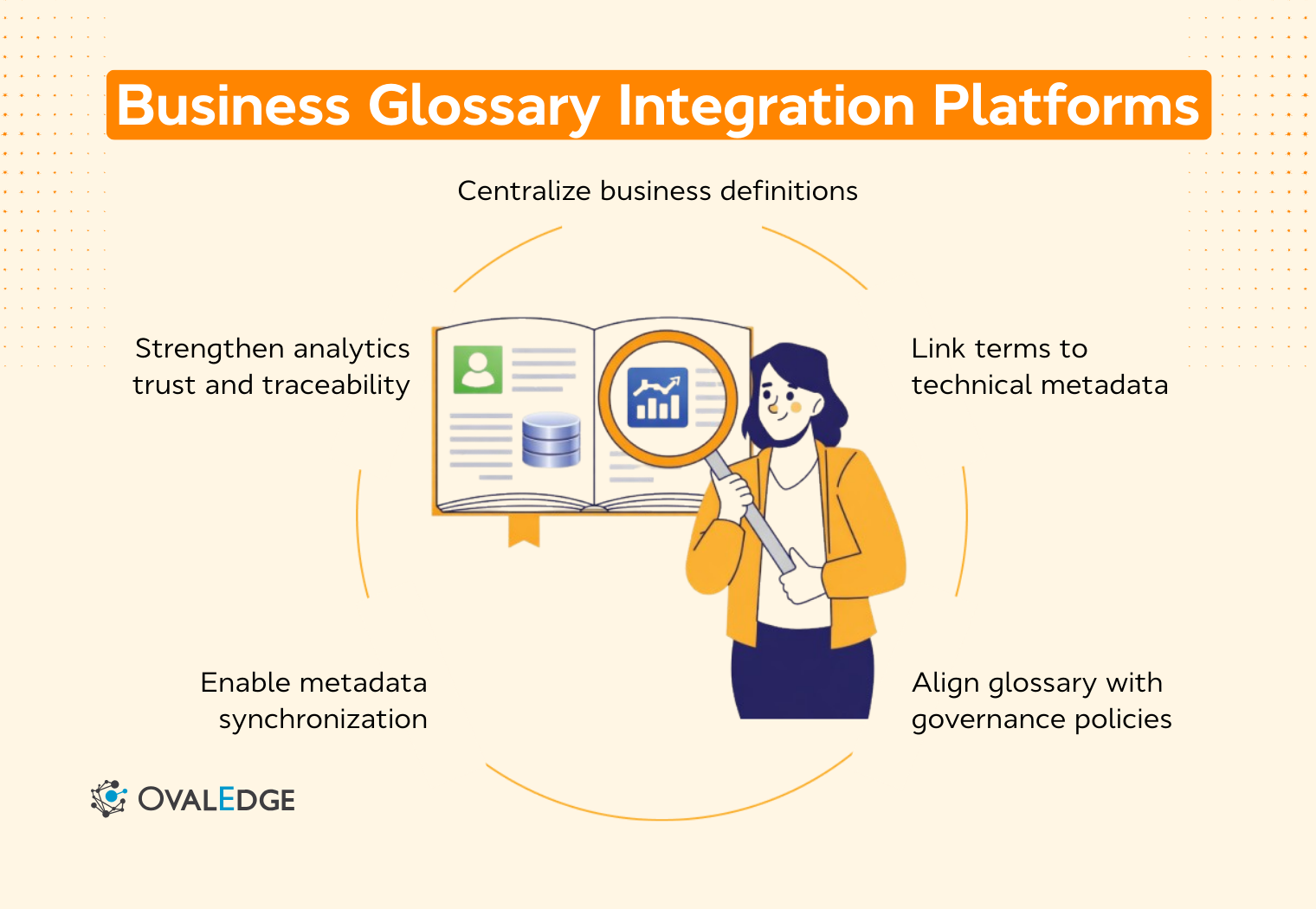
A business glossary integration platform addresses this gap by connecting business definitions with metadata, lineage, governance policies, and analytics assets across the enterprise data ecosystem.
What is a business glossary integration platform?
A business glossary integration platform is enterprise software that manages business definitions and synchronizes them with metadata, lineage, analytics assets, and governance policies across the data ecosystem.
Unlike traditional glossaries that function as static documentation repositories, a business glossary integration platform connects business terminology directly to the technical systems that generate, transform, and analyze data. This allows organizations to maintain consistent definitions while ensuring those definitions remain aligned with real data assets and analytics environments.
In practice, the platform functions as both a glossary management platform and a metadata integration platform, bridging the gap between business language and technical metadata.
What a modern glossary integration platform connects
A modern enterprise platform integrates multiple components across the data stack, including:
-
Business terms and KPI definitions used across reports and dashboards
-
Metadata from databases, data warehouses, BI tools, and data pipelines
-
Lineage relationships that show how data moves across systems
-
Governance policies tied to specific data assets or business terms
-
Data ownership and stewardship workflows that define accountability
-
Analytics dashboards and reports that use the governed data definitions
By linking these elements together, organizations create a shared semantic layer that keeps business definitions aligned with operational data systems.
How this differs from traditional business glossaries
Traditional business glossary tools typically focus on documentation. They store definitions in centralized repositories but rarely connect those definitions with operational data systems.
|
Traditional glossary tools |
Glossary integration platforms |
|
|
Because of these capabilities, modern enterprise business glossary software increasingly functions as a glossary governance platform that connects business language with the broader metadata ecosystem.
Why enterprises need a business glossary integration platform
As enterprise data environments grow across warehouses, pipelines, BI tools, and AI systems, maintaining consistent business definitions becomes difficult. Without integration between business terminology and metadata, definitions drift from the datasets and dashboards.
How glossary integration connects systems across the data stack
A business glossary integration platform works by linking business terminology with the technical systems that store, transform, and visualize data. Instead of existing as isolated documentation, glossary definitions connect with metadata, pipelines, and analytics tools across the data environment. This creates a semantic governance layer that keeps business definitions aligned with how data actually moves and appears in reports.
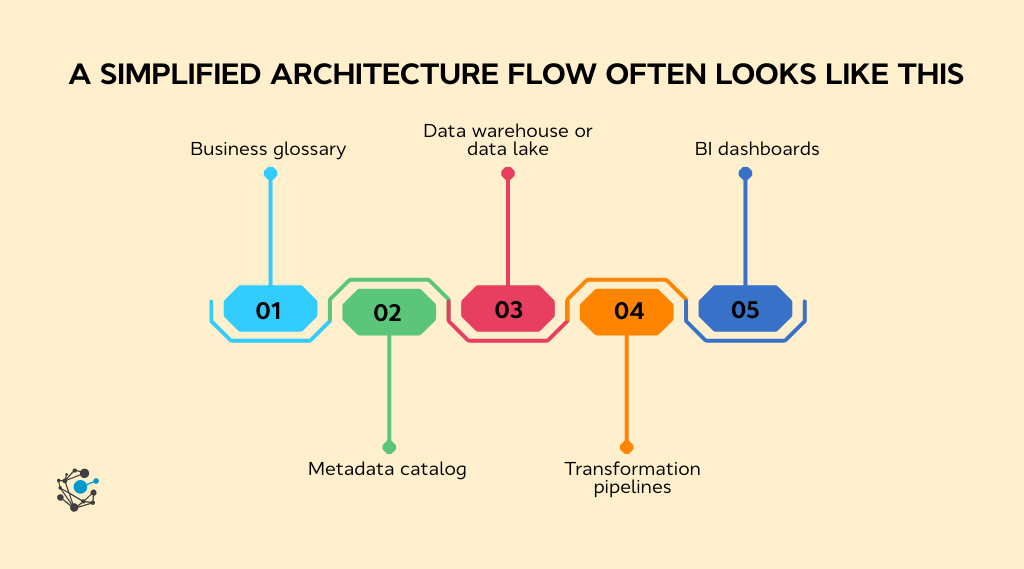
In this model, business terms and KPI definitions originate in the glossary. These definitions connect to metadata assets in the catalog, which then map to datasets in data warehouses or lakes. Transformation pipelines process and prepare the data, and BI dashboards use the governed datasets to generate reports.
Because the glossary sits at the top of this flow, organizations can maintain consistent definitions while tracing how each metric moves from raw data to the dashboards used for decision-making.
Why standalone glossary tools are no longer enough
Traditional glossary tools were designed primarily for documentation. They store definitions and descriptions of business terms, but they rarely integrate with operational systems where data is created and analyzed.
This limitation creates several challenges:
-
Definitions often live in documents or wiki pages rather than connected platforms
-
Business terms remain disconnected from underlying datasets and pipelines
-
Metadata changes in systems are not reflected in glossary definitions
-
Governance teams must update relationships manually
As enterprise data architectures grow more complex, this model becomes difficult to maintain. Modern data environments commonly include:
-
Cloud data warehouses such as Snowflake, BigQuery, or Databricks
-
ETL and data pipeline tools
-
BI and analytics platforms
-
Data catalogs and governance systems
-
Machine learning and AI pipelines
In these environments, standalone documentation cannot keep pace with system changes. Enterprise business glossary software must integrate across the entire metadata ecosystem to remain accurate and useful.
The business impact of glossary and metadata alignment
When business definitions are connected to metadata and data assets, organizations gain several operational and governance benefits.
Operational benefits
-
Consistent KPI definitions across dashboards and reports
-
Reduced reporting disputes between departments
-
Faster root cause analysis when data issues arise
-
Greater trust in analytics outputs
Governance benefits
-
Stronger enforcement of data policies and standards
-
Clear ownership and stewardship of business terms
-
Improved traceability for audits and regulatory reporting
Analytics benefits
-
Improved data discoverability across the organization
-
Alignment between the business glossary and the semantic layer used in analytics tools
-
More reliable analytics models and reporting frameworks
These outcomes are possible because integration ensures that business definitions remain aligned with the datasets, pipelines, and reports that implement them.
In the next section, we look at leading platforms that provide these capabilities and function as enterprise glossary governance platforms within modern metadata ecosystems.
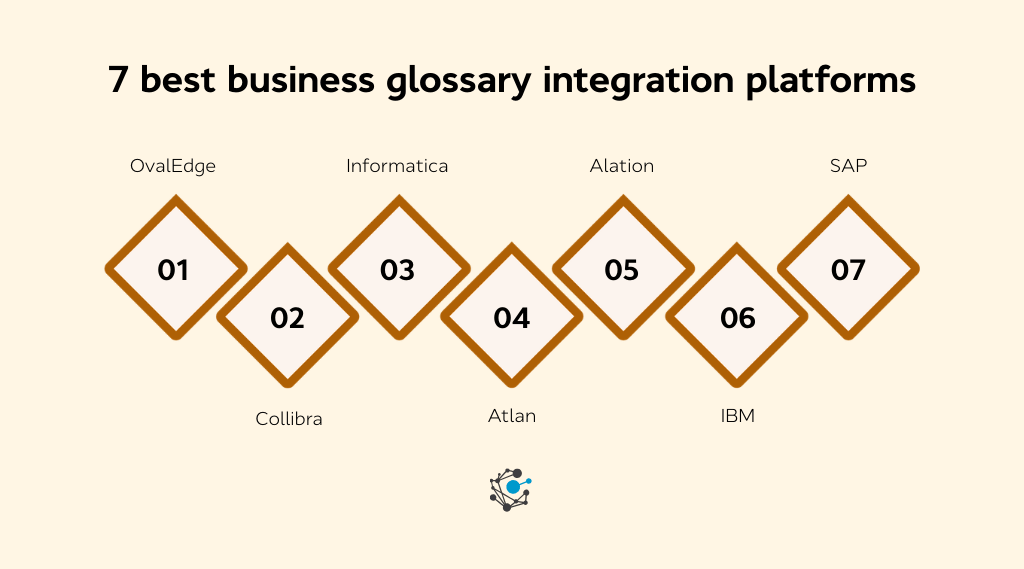
7 best business glossary integration platforms
As organizations adopt integrated metadata ecosystems, many governance platforms now combine business glossary management with metadata integration, lineage mapping, and governance workflows.
Below are seven widely used platforms that support enterprise business glossary integration.
1. OvalEdge
OvalEdge is an enterprise data governance platform that combines business glossary management, metadata cataloging, data lineage tracking, and governance workflows within a unified system. The platform focuses on connecting business definitions with the technical metadata that exists across databases, analytics tools, and data pipelines.
Instead of maintaining glossary definitions as static documentation, OvalEdge links business terms directly to datasets, reports, and data pipelines. This integration allows organizations to maintain consistent definitions while providing visibility into how metrics are calculated, where data originates, and how it moves across systems.
By integrating glossary management with metadata harvesting and lineage mapping, OvalEdge helps enterprises operationalize governance across modern data environments.
Key features
-
Integrated business glossary and metadata catalog: OvalEdge connects business terms with datasets, tables, columns, and reports, allowing organizations to maintain a shared vocabulary aligned with actual data assets.
-
Automated metadata harvesting: The platform automatically ingests metadata from databases, BI tools, and data pipelines, keeping glossary relationships synchronized with underlying systems.
-
End-to-end data lineage visualization: OvalEdge maps how data flows across systems, enabling users to trace business terms and KPIs back to their source datasets and transformations.
-
Governance workflows and stewardship management: Built-in workflows allow organizations to assign data owners, manage term approvals, and enforce stewardship responsibilities across teams.
-
Policy and compliance integration: Glossary terms can be connected with governance policies, classifications, and compliance rules, supporting regulatory reporting and data governance programs.
Best for
Enterprises looking for a unified governance platform that connects business glossary management, metadata integration, lineage tracking, and governance workflows across complex data ecosystems.
|
Real-world implementations show how glossary integration improves governance outcomes. For example, UK-based meal-kit company Gousto, which delivers over 500 recipes each month, adopted OvalEdge to strengthen its data governance and ensure accurate data across pricing, ingredients, and nutritional information. By implementing OvalEdge’s data catalog and governance capabilities, Gousto established a single source of truth for key data assets, improved data discoverability, and introduced automated data quality checks. These capabilities help ensure that critical information, such as allergen data, pricing, and recipe details, remains accurate and consistent across teams. You can explore how Gousto implemented this approach and scaled its governance program in the full case study. |
If you want to see how glossary-driven governance works in practice, you can book a demo with OvalEdge to see how the platform connects business definitions, metadata, and lineage across your data ecosystem.
2. Collibra
Collibra is an enterprise data governance platform that provides structured capabilities for managing business glossaries, governance workflows, and metadata integration. The platform is widely used by large organizations that operate formal data governance programs with defined stewardship roles and governance policies.
Key features
-
Business glossary management and stewardship workflows: Collibra provides structured workflows that allow organizations to define business terms, assign stewards, and manage the approval lifecycle of definitions.
-
Policy and governance rule management: The platform allows governance teams to create and enforce data policies tied to glossary terms, datasets, and metadata assets.
-
Metadata integration across enterprise systems: Collibra connects glossary definitions with metadata from databases, data warehouses, and analytics platforms to maintain consistent terminology across systems.
-
Role-based governance and stewardship controls: The platform supports role-based access and stewardship models that define who can create, modify, or approve glossary terms and governance rules.
-
Data catalog and lineage connectivity: Collibra integrates glossary terms with catalog assets and lineage views, helping teams understand how business definitions relate to underlying datasets and pipelines.
Best for
Large enterprises with formal governance programs, defined stewardship structures, and compliance-driven data management requirements.
3. Informatica
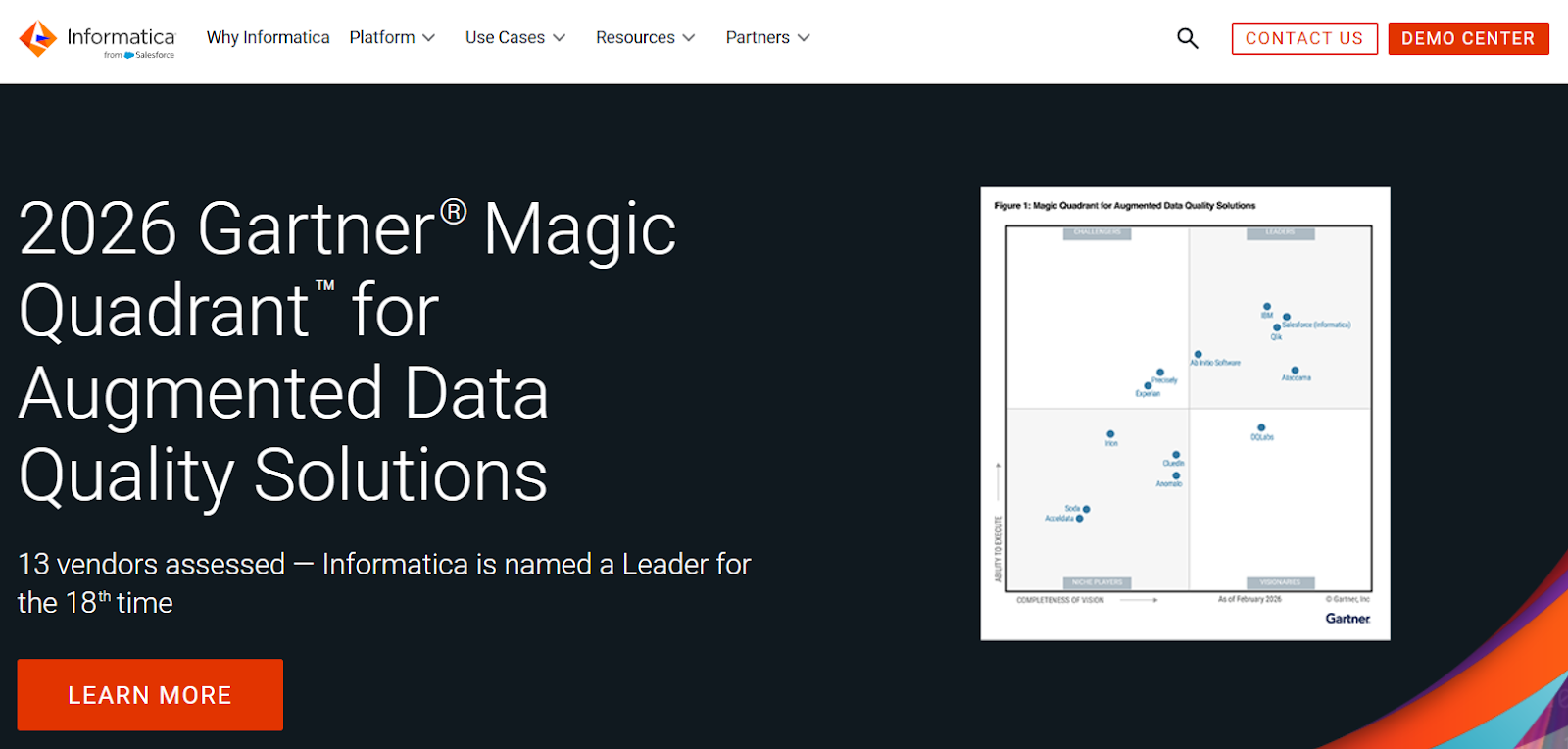
Informatica provides business glossary and governance capabilities as part of its broader enterprise data management ecosystem. Through platforms such as the Enterprise Data Catalog and Data Governance solutions, Informatica integrates glossary management with metadata management, data quality, and data integration services.
Key features
-
Integrated business glossary and metadata catalog: Informatica connects business terms with metadata assets such as tables, columns, and reports, creating alignment between business definitions and technical datasets.
-
Automated metadata discovery and ingestion: The platform automatically scans enterprise systems to collect metadata, enabling glossary terms to stay synchronized with evolving data environments.
-
End-to-end data lineage tracking: Informatica provides lineage capabilities that trace how data moves across pipelines and transformations, helping teams understand the origin of business metrics.
-
Data quality and governance integration: Glossary definitions can be linked with data quality rules and governance policies, allowing organizations to monitor whether datasets meet defined standards.
-
Enterprise policy and compliance management: The platform supports governance policies and regulatory compliance requirements by linking glossary terms with classification rules and policy controls.
Best for
Organizations already using the Informatica data management stack and looking to extend governance by integrating glossary management with metadata, lineage, and data quality processes.
4. Atlan
Atlan is a cloud-native data catalog and governance platform designed for modern data teams. The platform combines business glossary management, metadata cataloging, and collaboration features to help organizations document and discover data assets across cloud data environments.
Key features
-
Collaborative business glossary management: Atlan allows teams to create, edit, and discuss business definitions collaboratively, enabling shared ownership of business terminology across departments.
-
Automated metadata ingestion: The platform automatically ingests metadata from cloud warehouses, BI tools, and data pipelines to keep glossary relationships aligned with technical assets.
-
Unified data catalog and discovery: Atlan integrates glossary terms with cataloged datasets and reports, helping users discover trusted data assets while understanding their business context.
-
Integration with modern cloud data stacks: The platform supports integrations with common cloud tools such as Snowflake, BigQuery, Databricks, and modern analytics platforms.
-
Search and data asset exploration: Atlan provides search capabilities that allow users to locate datasets, dashboards, and glossary terms quickly across large data environments.
Best for
Cloud-native data teams and analytics-driven organizations looking for a collaborative catalog and glossary platform that integrates with modern cloud data stacks.
5. Alation
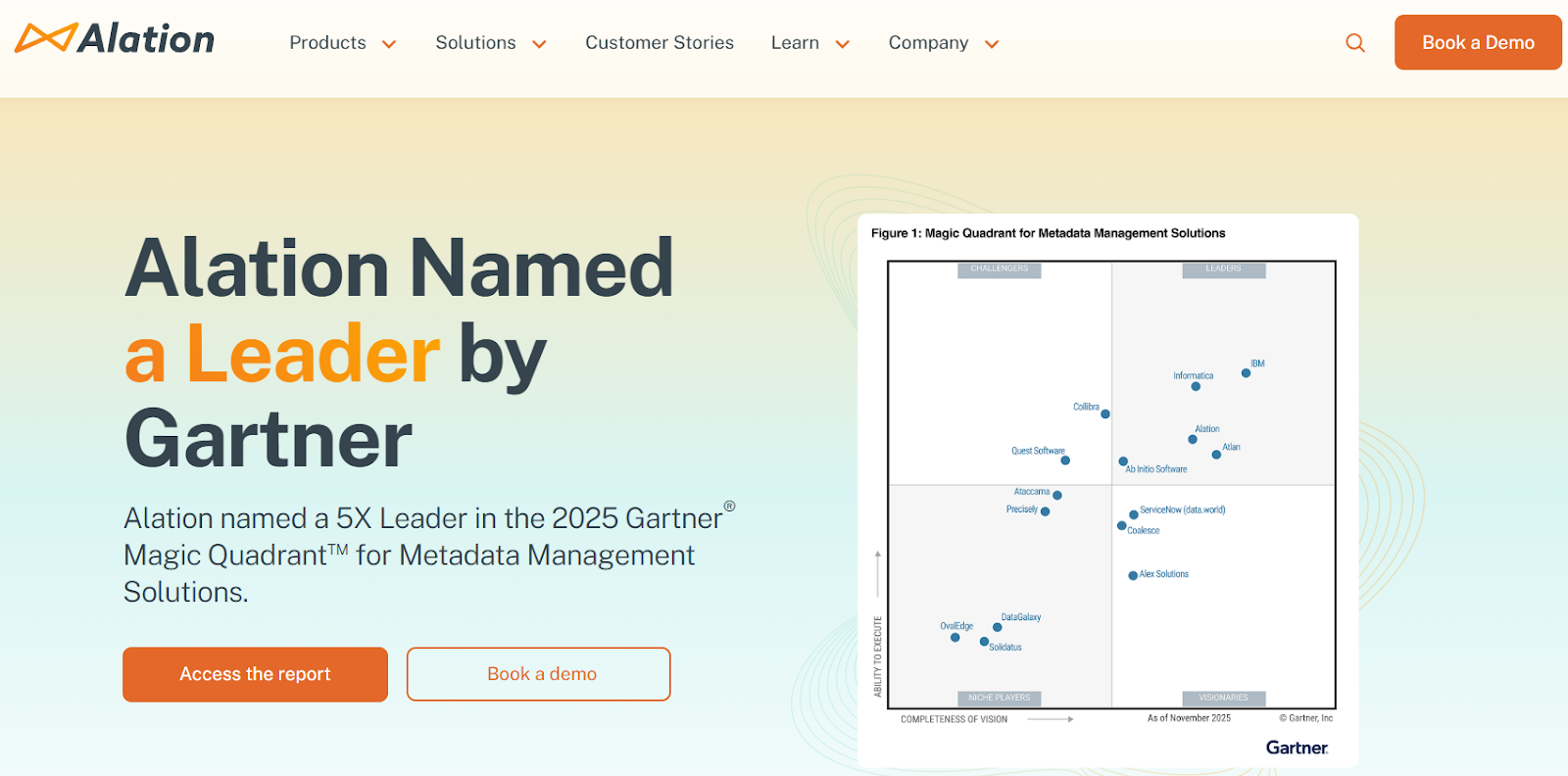
Alation is a data catalog and governance platform that focuses on improving data discovery and analytics adoption across organizations. The platform combines business glossary management with metadata indexing and catalog capabilities, allowing users to locate and understand trusted data assets.
Key features
-
Business glossary and semantic metadata management: Alation allows organizations to define business terms and link them with datasets, queries, and reports to maintain consistent terminology across analytics environments.
-
Enterprise data catalog and discovery: The platform indexes enterprise data assets and enables users to search and discover datasets, dashboards, and analytics resources.
-
Governance workflows and stewardship management: Alation supports governance processes through workflows that allow data stewards to review, approve, and maintain business definitions.
-
Metadata indexing and data asset documentation: The platform automatically captures metadata from connected systems to provide context about data sources, tables, and analytics queries.
-
Integration with BI and analytics tools: Alation integrates with common analytics platforms so glossary terms and metadata appear directly within data exploration workflows.
Best for
Organizations prioritizing data discovery, analytics adoption, and metadata cataloging across business intelligence environments.
6. IBM
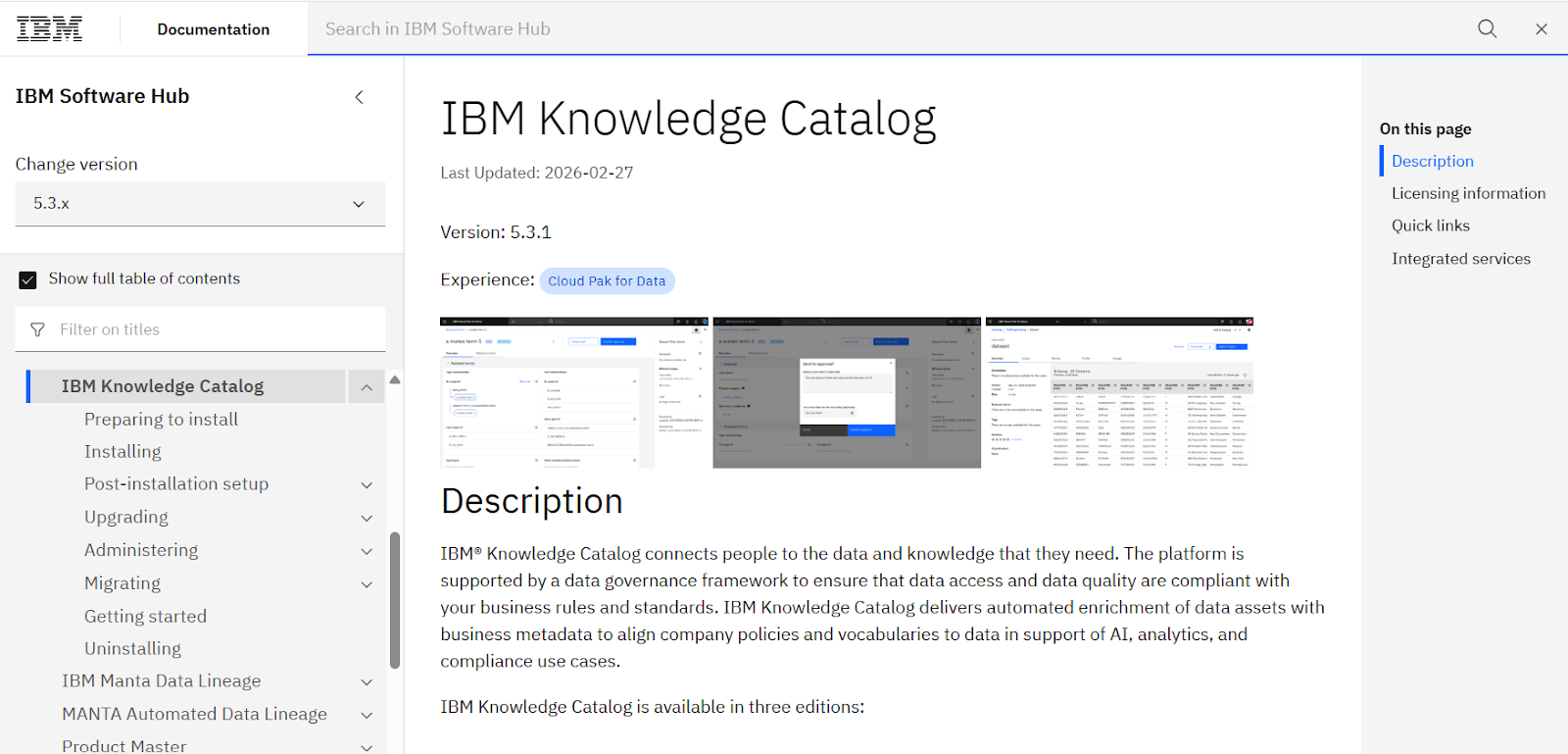
IBM provides enterprise data governance capabilities through IBM Knowledge Catalog, a platform designed to manage business glossaries, metadata, and governance policies across complex data environments. The platform helps organizations standardize terminology, enforce governance rules, and maintain traceability across data assets.
Key features
-
Enterprise business glossary management: IBM Knowledge Catalog allows organizations to define and manage business terms while linking them to datasets, reports, and governance policies.
-
Metadata catalog and data asset management: The platform catalogs data assets across enterprise systems and connects them with glossary definitions to improve data understanding.
-
Data lineage and impact analysis: IBM provides lineage capabilities that help teams trace how data moves across pipelines and understand the impact of changes on downstream systems.
-
Policy management and regulatory compliance support: Governance teams can define policies and classification rules that align with regulatory requirements and internal governance standards.
-
AI and analytics governance capabilities: IBM integrates governance with analytics and AI environments to help organizations manage trusted datasets used in advanced analytics and machine learning workflows.
Best for
Enterprises in highly regulated industries require strong governance frameworks, policy management, and audit traceability across data platforms.
7. SAP
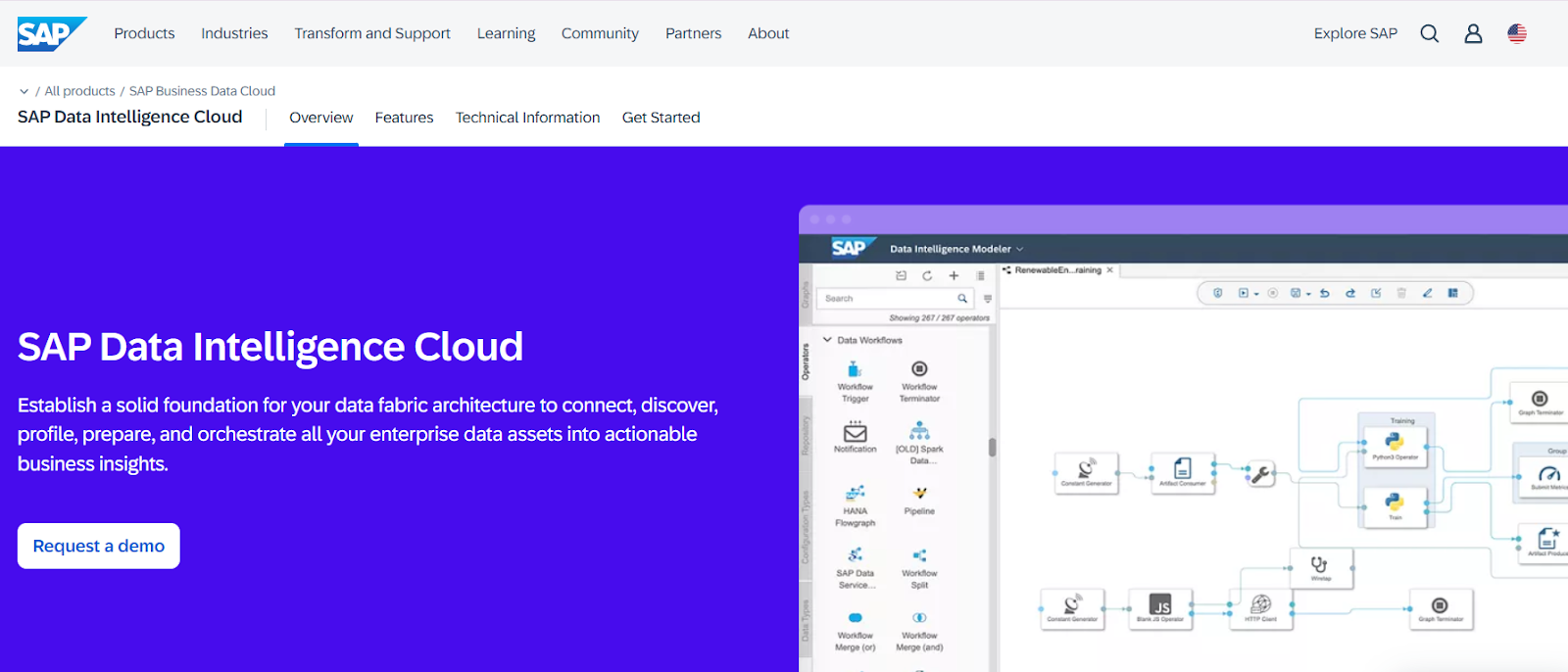
SAP provides business glossary and metadata governance capabilities through platforms such as SAP Data Intelligence and SAP Data Catalog. These platforms allow organisations to manage metadata, governance policies, and business definitions across complex enterprise data environments.
Key features
-
Business glossary and metadata management: SAP platforms allow organizations to define business terms and link them with datasets, tables, and reports across enterprise systems.
-
Enterprise metadata orchestration: SAP Data Intelligence manages metadata flows across data pipelines and applications, helping organizations maintain visibility into how data moves across systems.
-
Data lineage and pipeline monitoring: The platform provides lineage capabilities that allow teams to trace data transformations and understand dependencies between systems.
-
Governance and compliance management: SAP supports governance policies and classification frameworks that help organizations maintain compliance with internal and regulatory standards.
-
Integration with SAP data ecosystems: The platform integrates with SAP data warehouses, analytics tools, and enterprise applications, enabling governance within SAP-centric architectures.
Best for
Organizations with SAP-centric data architectures that need governance and glossary capabilities integrated with SAP data platforms and analytics environments.
Why traditional glossary tools fail at integration
Many organizations start their governance journey with a business glossary to document key terms. However, traditional glossary tools are built for documentation, not integration. As data ecosystems expand, these static tools struggle to keep definitions aligned with datasets, pipelines, and analytics systems, creating inconsistencies across reports and business metrics.
Below are several common limitations that prevent traditional glossary tools from supporting enterprise-scale integration.
Static documentation
In many organizations, business glossaries exist as documentation stored in portals, spreadsheets, or wiki pages. While these repositories capture definitions, they operate separately from operational data systems.
Because definitions are not connected to datasets or analytics assets, they can quickly become outdated. Teams may continue using legacy definitions in dashboards and reports even after glossary terms change.
No metadata synchronization
Traditional glossary tools do not synchronize with technical metadata stored in databases, data warehouses, BI platforms, or ETL pipelines.
Without automated synchronization, organizations experience semantic drift. Business definitions may say one thing, while the datasets and transformations used in reporting reflect something different. Over time, this disconnect creates reporting conflicts and reduces trust in analytics.
Manual updates
When glossary tools lack integration with metadata systems, governance teams must manually maintain relationships between:
-
business terms
-
datasets
-
dashboards
-
data pipelines
At enterprise scale, this process becomes difficult to sustain. As systems evolve and schemas change, manual updates introduce delays and increase the risk of errors.
No lineage linkage
Without lineage integration, glossary definitions remain disconnected from the pipelines that produce business metrics.
This makes it difficult to answer questions such as where a KPI originates, which datasets feed a report, or how data is transformed. Without lineage visibility, impact analysis and root cause investigations become significantly harder.
Limited compliance enforcement
Traditional glossaries document definitions but cannot enforce governance policies across data systems.
This limits their usefulness in regulatory environments where organizations must manage controls such as PII classification, data access policies, retention rules, and regulatory reporting requirements.
Modern governance platforms address these limitations by integrating glossary definitions with metadata, lineage, and policy management capabilities across the enterprise data ecosystem.
Key features to evaluate in a business glossary integration platform
Selecting the right business glossary integration platform requires more than evaluating glossary management alone. Below are several key capabilities enterprises should evaluate when comparing glossary governance platforms.
Automated business glossary management
Manual glossary management quickly becomes difficult as the number of business terms, datasets, and analytics assets grows. A modern platform should support automation that reduces the operational workload for governance teams.
Key capabilities include:
-
Automated term discovery that identifies potential business terms from datasets and metadata sources
-
Semantic classification that helps categorize business definitions across domains
-
Bulk glossary updates that allow teams to manage large numbers of terms efficiently
-
Automated stewardship workflows that assign review and approval responsibilities to data owners
Automation ensures that glossary management can scale as enterprise data ecosystems expand.
Metadata linking and synchronization
A glossary integration platform must connect business definitions directly with technical metadata across systems. Without this capability, the glossary remains disconnected from the datasets and reports it is meant to govern.
Organizations should evaluate whether the platform can link glossary terms with:
-
datasets and tables
-
database columns and schema metadata
-
dashboards and analytics reports
-
data pipelines and transformations
Modern platforms also provide real-time synchronization and event-driven updates, ensuring that glossary relationships remain aligned when schemas, pipelines, or reports change.
Data catalog and lineage integration
To provide context for business definitions, glossary platforms should integrate closely with data catalogs and lineage systems.
This integration allows organizations to connect glossary terms with:
-
lineage graphs showing how data flows across systems
-
impact analysis tools that evaluate downstream dependencies
-
root cause analysis workflows used during data incidents
When glossary terms are connected to lineage relationships, organizations gain semantic lineage, which helps users understand both how data moves and what it means in a business context.
Governance collaboration workflows
Effective glossary governance requires collaboration between business users, data stewards, and technical teams. Platforms should support structured workflows that manage how definitions are created, reviewed, and maintained.
Important workflow capabilities include:
-
approval processes for new or updated glossary terms
-
defined stewardship roles and responsibilities
-
review cycles to validate business definitions
-
ownership management for business domains
These workflows transform glossary management from a documentation task into an operational governance process.
Compliance and policy mapping
In many organizations, glossary terms also serve as anchors for governance policies and regulatory requirements. Platforms should allow organizations to connect definitions with governance rules and compliance controls.
Examples include:
-
mapping glossary terms to PII classifications
-
linking terms with data access policies
-
connecting definitions to data retention rules
-
supporting regulatory reporting requirements
This integration helps organizations enforce governance standards across datasets and analytics systems.
Enterprise scalability and architecture
Finally, enterprises should evaluate the technical architecture of the platform to ensure it can operate across complex data environments.
Important architectural considerations include:
-
API-first design that enables integration with enterprise systems
-
multi-cloud support across AWS, Azure, and GCP environments
-
metadata ingestion pipelines that scale across thousands of datasets
-
search and indexing capabilities for large metadata repositories
Additional features such as versioning, change tracking, and drift detection help organizations maintain consistent definitions as data environments evolve.
How to choose the right business glossary integration platform
Selecting a business glossary integration platform requires more than comparing feature lists. Below is a step-by-step approach organizations can follow when evaluating enterprise business glossary software.
Step 1: Assess your data governance maturity
Before evaluating platforms, organizations should understand how mature their current governance processes are. Some enterprises already operate formal stewardship models and governance committees, while others are just beginning to standardize definitions and ownership.
Understanding this maturity level helps determine whether the platform should prioritize governance workflows, analytics collaboration, or metadata automation.
Actionable steps
-
Review how business terms, data ownership, and governance policies are currently documented.
-
Identify gaps such as inconsistent definitions, unclear stewardship roles, or manual governance processes.
-
Determine whether the organization requires strong compliance controls, collaborative glossary management, or both.
Step 2: Map your enterprise data ecosystem
A glossary integration platform must connect with the systems that generate and manage data. This includes databases, data warehouses, BI tools, ETL pipelines, and analytics platforms.
Without clear visibility into the data ecosystem, organizations risk selecting a platform that lacks connectors or integration capabilities for key systems.
Actionable steps
-
Create an inventory of major data platforms, including warehouses, analytics tools, and pipeline systems.
-
Identify where metadata currently resides across databases, catalogs, and reporting platforms.
-
Evaluate whether the platform supports connectors and integrations for your existing data stack.
Step 3: Evaluate metadata integration and automation capabilities
One of the main benefits of a glossary integration platform is its ability to synchronize business definitions with technical metadata automatically. Platforms that rely heavily on manual configuration may struggle to scale in complex environments.
Organizations should assess how well the platform ingests metadata, links business terms to datasets, and updates relationships when systems change.
Actionable steps
-
Verify whether the platform supports automated metadata harvesting from your core systems.
-
Evaluate how glossary terms link to datasets, columns, dashboards, and pipelines.
-
Assess whether the platform supports real-time updates or event-driven metadata synchronization.
Step 4: Assess governance workflows and stewardship models
Glossary integration platforms should support governance processes that manage how definitions are created, reviewed, and maintained. Without structured workflows, glossary management can quickly become inconsistent.
Governance capabilities should align with how your organization assigns data ownership and stewardship responsibilities.
Actionable steps
- Review whether the platform supports approval workflows for new or updated glossary terms.
- Confirm that the system allows assignment of data owners, stewards, and domain experts.
- Evaluate how the platform tracks changes to definitions through versioning and audit history.
Step 5: Validate scalability and architecture
Enterprise data ecosystems often include thousands of datasets, dashboards, and pipelines. A glossary platform must be able to scale across large metadata environments without performance limitations.
Organizations should also evaluate architectural flexibility, including API integration, cloud support, and extensibility across multiple platforms.
Actionable steps
- Confirm that the platform supports large-scale metadata ingestion and indexing.
- Evaluate whether the architecture supports multi-cloud and hybrid data environments.
- Assess API capabilities for integrating the glossary with governance tools, analytics platforms, and enterprise systems.
Common challenges enterprises face with glossary integration
Implementing a business glossary integration platform helps organizations align business terminology with metadata and governance processes. However, many enterprises encounter challenges during implementation. Understanding these obstacles early helps governance teams plan implementation more effectively and improve long-term adoption.
Semantic inconsistencies across systems
Large organizations often define the same business metric differently across systems. For example, revenue may be calculated one way in finance systems, another in CRM platforms, and differently again in BI dashboards. These inconsistencies grow as teams build reports independently. When organizations attempt glossary integration, they must reconcile these differences and establish a single authoritative definition for critical metrics.
Manual metadata mapping
In many organizations, glossary terms are initially linked to datasets and reports through manual mapping. While manageable in smaller environments, this becomes difficult at enterprise scale. As schemas evolve and new datasets appear, manual updates introduce delays and increase the risk of outdated relationships. Without automation, governance teams struggle to keep glossary definitions aligned with actual data assets.
Integration gaps across multi-cloud environments
Modern enterprises operate across multiple cloud platforms, data warehouses, analytics tools, and SaaS applications. These distributed environments make it difficult to synchronize glossary definitions across all systems. If the platform lacks connectors for certain tools, definitions remain disconnected from parts of the data ecosystem.
Governance ownership ambiguity
Glossary initiatives often fail when ownership of business terms is unclear. Questions arise about who defines metrics, approves changes, and maintains definitions. Without defined stewardship roles and workflows, glossary updates can stall or become inconsistent.
Low business adoption
Even well-designed glossaries struggle if business users cannot access them easily. When definitions exist only in governance tools, teams often rely on informal documentation or local definitions. Integrating glossary terms into analytics and reporting environments improves visibility and encourages consistent usage.
Conclusion
Consistent business definitions are essential for reliable analytics, effective governance, and confident decision-making. Many organizations already maintain a business glossary to document important terms and metrics. However, documentation alone does not solve the deeper problem. When glossary definitions remain disconnected from metadata, pipelines, dashboards, and governance policies, inconsistencies quickly reappear.
A business glossary integration platform addresses this gap by connecting business terminology with the broader data ecosystem. By synchronizing glossary definitions with metadata, lineage, and analytics assets, organizations can maintain consistent KPI definitions, improve data discoverability, and strengthen governance oversight.
As enterprise data environments grow more complex, organizations increasingly move beyond static glossaries toward integrated metadata platforms that combine glossary management, cataloging, lineage, and governance workflows.
Platforms such as OvalEdge help operationalize this approach by linking business definitions with technical metadata and governance processes in a unified environment.
If your organization is working to standardize data definitions and improve governance across analytics systems, exploring a modern glossary integration platform can be an important step toward building a trusted and well-governed data ecosystem.
FAQs
1. What is a business glossary integration platform?
A business glossary integration platform is enterprise software that manages business definitions and connects them with metadata, lineage, governance policies, and analytics assets across the data ecosystem. This integration ensures that business terms remain aligned with the datasets and systems used for analytics and reporting.
2. How is a glossary integration platform different from a data catalog?
A data catalog focuses on indexing and discovering datasets, while a glossary integration platform focuses on managing business definitions and linking those definitions to metadata assets. Many modern governance platforms combine both capabilities by integrating glossary management with data catalog features.
3. Why do enterprises need glossary governance platforms?
Enterprises need glossary governance platforms to maintain consistent definitions for business metrics, reduce reporting conflicts, and improve data governance. By connecting business terminology with metadata and analytics systems, these platforms help organizations standardize language across departments.
4. What features should enterprise business glossary software include?
Enterprise business glossary software should support automated metadata ingestion, glossary term management, lineage integration, governance workflows, and real-time synchronization with data systems. These capabilities ensure that definitions remain aligned with datasets and analytics assets.
5. How does glossary integration improve data governance?
Glossary integration improves data governance by linking business definitions with metadata, lineage, and governance policies. This alignment helps organizations enforce consistent terminology, track data usage across systems, and maintain transparency around how metrics are calculated.
6. Can a business glossary integrate with BI tools and analytics platforms?
Yes. Modern business glossary integration platforms connect directly with BI and analytics tools such as dashboards, reporting systems, and data exploration platforms. This integration allows business definitions to appear alongside datasets, metrics, and reports. As a result, analysts and business users can understand how metrics are defined and calculated while working within their analytics environment, which helps maintain consistent terminology and improves trust in reporting.
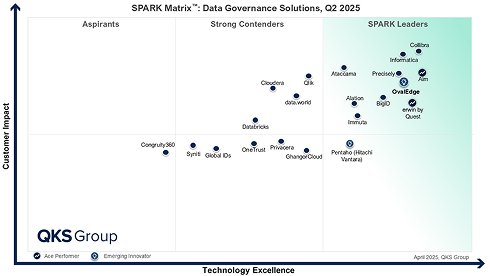
.png?width=1081&height=173&name=Forrester%201%20(1).png)
.png?width=1081&height=241&name=KC%20-%20Logo%201%20(1).png)