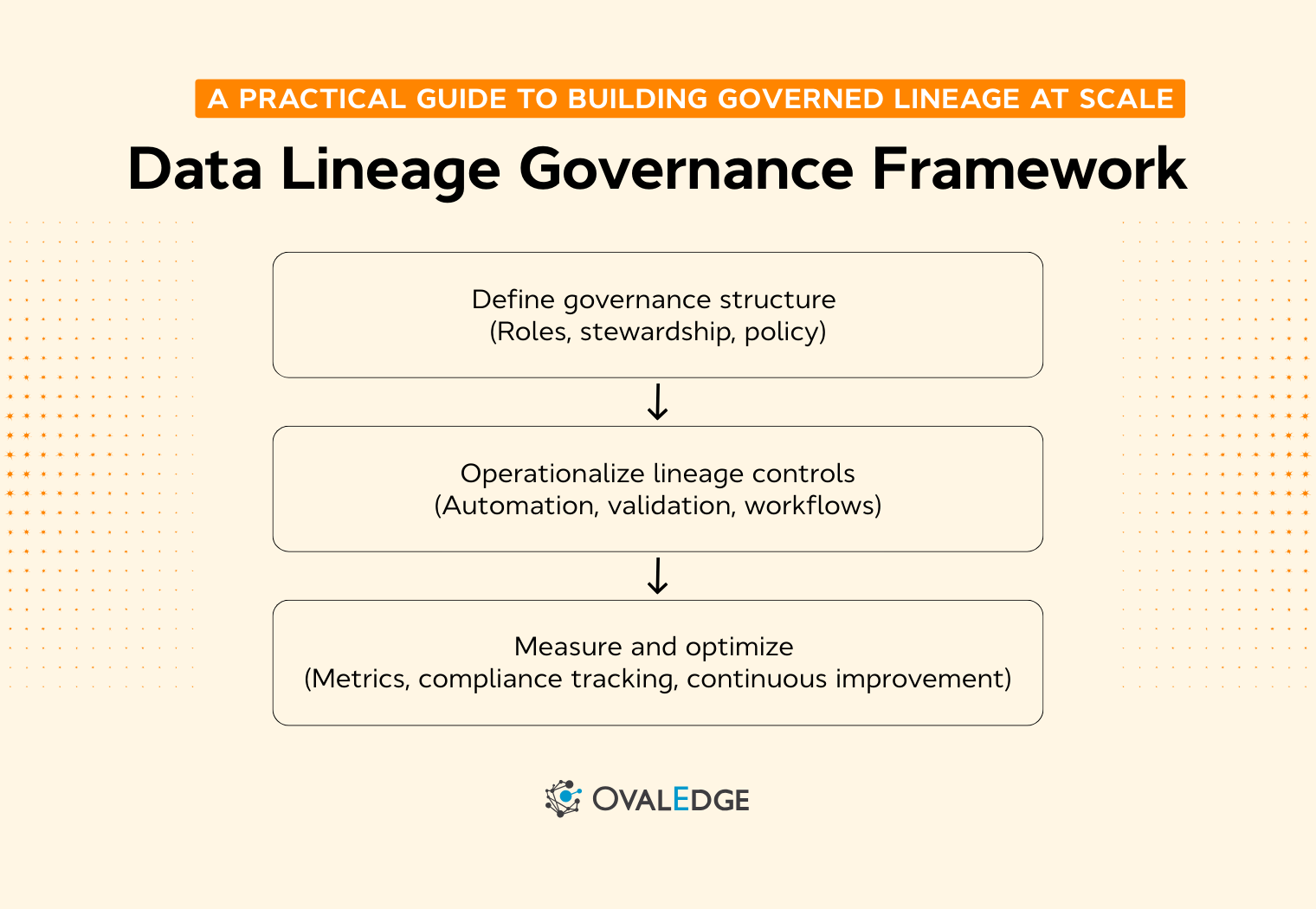
A revenue number appears on the executive dashboard during a leadership meeting. Someone asks where it came from, and suddenly, analysts, engineers, and data teams start tracing pipelines across warehouses, transformation scripts, and BI models.
What should be a quick answer turns into a lengthy investigation. Pieces of lineage exist across different systems, but no one can clearly explain the full journey of the data.
This challenge is becoming more common as organizations scale their data ecosystems.
According to a 2024 industry survey cited by Corporate Compliance Insights, only 46% of finance leaders believe their organizations have strong data governance maturity, highlighting a significant gap between the rapid growth of enterprise data and the governance capabilities needed to manage it effectively.
As companies generate massive volumes of data across pipelines, warehouses, and reporting tools, tracing how that data moves through transformations becomes increasingly difficult.
The real issue is not the absence of lineage. Many systems technically capture lineage, but governance around it is often missing. This article explains how a data lineage governance framework provides the structure organizations need to manage lineage effectively.
What is a data lineage governance framework?
Many teams believe they “have lineage” because they can generate a lineage diagram from a tool. In reality, those diagrams often exist as static visuals with no ownership, validation process, or accountability.
Without governance, lineage quickly becomes outdated and unreliable. A data lineage governance framework transforms lineage from a technical artifact into a structured operating model that ensures lineage information stays accurate, trusted, and usable across the organization.
Definition & core components of a data lineage governance framework
A data lineage governance framework is a structured system of roles, policies, controls, and processes that governs how data lineage is captured, validated, maintained, and used across an organization.
Its primary purpose is to ensure lineage accuracy, establish clear accountability, and support compliance, impact analysis, and operational transparency across the data ecosystem.
The framework typically governs three key dimensions of lineage:
-
Technical lineage: Tracks how data moves across systems, including tables, columns, pipelines, and transformations. It provides visibility into the technical flow of data from source to destination.
-
Business lineage: Connects business metrics, KPIs, and reports to the underlying datasets and transformations that produce them, helping stakeholders understand how analytical outputs are generated.
-
Operational oversight: Governs how lineage updates are reviewed, validated, and maintained over time, ensuring that lineage documentation follows defined governance standards.
To operationalize lineage governance, organizations typically structure the framework across four core layers.
-
Governance structure: It establishes decision authority and accountability. It defines roles such as data owners, data stewards, and governance councils, along with escalation paths for resolving lineage issues.
-
Policy layer: It defines the rules that guide lineage documentation and maintenance. This includes the lineage governance policy, documentation standards, and approval workflows for changes affecting critical data flows.
-
Control mechanisms: They enforce governance standards and ensure lineage remains accurate over time. These controls include lineage validation checks, change-management reviews, and audit trails that capture updates and approvals.
-
Stewardship layer: It operationalizes governance through day-to-day ownership. Data stewards monitor lineage accuracy, resolve lineage gaps, and ensure metadata and lineage documentation stay aligned with governance standards.
Together, these components transform lineage from a static diagram into a governed capability that supports transparency, compliance, and reliable data operations.
How it differs from data lineage management
Many organizations confuse lineage management with lineage governance, but they serve different purposes. Lineage management focuses on capturing and visualizing data flow, while lineage governance focuses on accountability, control, and policy enforcement.
|
Aspect |
Data lineage management |
Data lineage governance |
|
Primary focus |
Capturing and visualizing data flows |
Governing how lineage is maintained and controlled |
|
Core capability |
Technical lineage discovery and visualization |
Policy enforcement, ownership, and validation |
|
Responsibility |
Data engineering or platform teams |
Data governance teams, stewards, and owners |
|
Key question answered |
“Where does the data flow?” |
“Who owns this lineage and how is it governed?” |
|
Risk without it |
Limited visibility into pipelines |
Inconsistent lineage, ownership gaps, and audit risks |
Without governance, lineage tools often produce diagrams that quickly become outdated. Governance ensures lineage remains accurate, accountable, and usable for decision-making and compliance.
How it fits within a metadata governance framework
Data lineage governance is typically implemented as part of a broader metadata governance framework. Metadata governance defines how data assets are documented, owned, and maintained across the organization.
Within that ecosystem:
-
Metadata describes what the asset is, including definitions, ownership, and classifications
-
Lineage describes how the asset was created and transformed across systems
-
Governance defines who is responsible and how lineage and metadata are controlled
This relationship ensures that lineage does not exist as an isolated technical diagram. Instead, it becomes a governed component of the broader metadata environment that supports transparency, compliance, and reliable analytics.
Why organizations need governance for data lineage
As data ecosystems expand across pipelines, warehouses, and BI tools, lineage without governance can quickly become unreliable. Many organizations can generate lineage diagrams through technical tools, but diagrams alone do not guarantee accuracy, ownership, or accountability. Without governance, lineage documentation often becomes outdated, fragmented, and difficult to trust when teams need answers quickly.
A data lineage governance framework addresses this challenge by establishing structured oversight, defined ownership, and enforceable controls that ensure lineage remains accurate and usable across the organization.
Regulatory compliance and audit readiness
Organizations operating in regulated industries must demonstrate how data flows through systems, especially when that data supports financial reporting, regulatory submissions, or operational decisions.
Auditors and regulators often expect clear documentation that shows how data originates, how it is transformed, and how it ultimately appears in reports.
To support audit readiness, organizations typically need:
-
Documented data flows tracing information from source systems to reporting outputs
-
Change logs tied to critical reporting datasets and transformation pipelines
-
Traceability records showing when data was modified and by whom
Without governed lineage, teams often rely on manual investigations to reconstruct data flows during audits. This process can delay audit responses and increase the risk of compliance issues.
Impact analysis and risk mitigation
Modern data environments evolve continuously. Schema updates, pipeline changes, and new transformations are routine as organizations refine their analytics capabilities. The real challenge arises when teams cannot quickly determine how these changes affect downstream systems.
A governed lineage model improves impact analysis by making upstream and downstream dependencies visible across pipelines and reporting systems.
|
Do you know: Modern data governance platforms such as OvalEdge enable organizations to automatically discover lineage across data sources, transformation pipelines, and BI tools.
|
With lineage governance in place, organizations can:
-
Identify which reports, dashboards, or datasets depend on a specific field or table
-
Assess downstream impacts before modifying pipelines or schemas
-
Route change approvals to the appropriate data owners and stewards
This structured visibility reduces the risk of broken dashboards, incorrect reporting, and unexpected pipeline failures.
Trust, transparency, and data accountability
Trust in data is built through transparency and accountability. When lineage governance is implemented effectively, organizations can clearly identify who owns a dataset, who maintains its lineage documentation, and who is responsible for resolving issues.
A governed lineage model typically establishes:
-
Data owners are responsible for the quality and reliability of domain data
-
Data stewards are responsible for validating lineage documentation and resolving issues
-
Defined escalation paths for addressing lineage gaps or discrepancies
This accountability structure ensures that questions about data lineage can be addressed quickly and by the right stakeholders.
Operational efficiency across data pipelines
When lineage is not governed, teams often spend unnecessary time investigating data dependencies. Analysts may trace how metrics are calculated, while engineers examine pipelines to understand how datasets are produced.
These investigations typically involve:
-
Searching through ETL and transformation scripts
-
Reconstructing data flows across multiple systems
-
Repeating lineage explanations across different teams
A lineage governance framework improves operational efficiency by ensuring lineage information is consistently captured, validated, and accessible. Instead of repeatedly reconstructing pipeline relationships, teams can quickly understand dependencies, troubleshoot issues faster, and manage data pipelines with greater confidence.
How to build a data lineage governance framework
Building a data lineage governance framework requires more than creating lineage diagrams or documentation. The objective is to establish enforceable processes, clear ownership, and governance controls that ensure lineage information remains accurate as data systems evolve.
A structured approach helps organizations implement lineage governance in manageable stages while maintaining accountability across data domains.
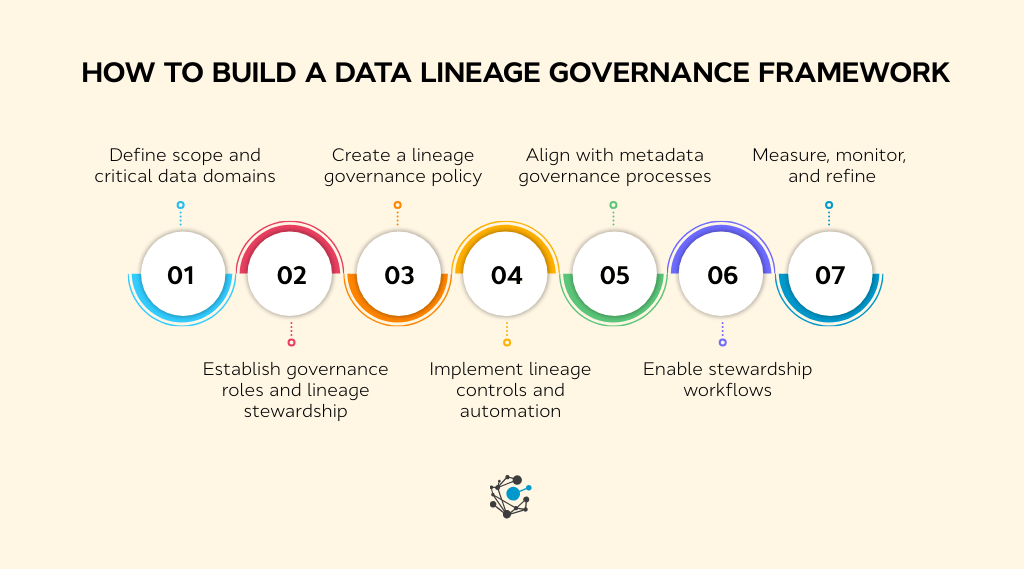
Step 1: Define scope and critical data domains
Attempting to govern lineage across the entire data ecosystem at once often leads to delays and complexity. A focused scope helps organizations prioritize high-impact data assets and implement governance gradually.
Start by identifying domains where lineage failures could cause significant business or regulatory risk, such as:
-
Financial data used in external reporting
-
Customer and identity data used for segmentation, personalization, or risk analysis
- Regulatory reporting datasets and critical business KPIs
When determining which domains to prioritize, organizations typically evaluate:
-
Regulatory exposure: Datasets subject to compliance requirements
-
Executive visibility: Reports and dashboards are frequently used for strategic decisions
-
Frequency of change: Pipelines or datasets that evolve regularly
-
Downstream impact: Number of reports, systems, or teams dependent on the data
Defining scope early prevents governance initiatives from becoming overwhelming while ensuring that critical data assets receive immediate attention.
Step 2: Establish governance roles and lineage stewardship
Governance cannot function without clearly defined roles. Assigning ownership ensures lineage documentation remains accurate and accountable across the organization.
A typical governance structure includes:
-
Data owner: Accountable for the quality, reliability, and business outcomes of a data domain
-
Data steward: Responsible for validating lineage accuracy, resolving issues, and maintaining documentation
-
Governance council: Establishes governance standards, resolves cross-domain conflicts, and enforces policy decisions
Lineage stewardship responsibilities should be clearly defined and operationalized, including:
-
Validating lineage accuracy on a scheduled cadence
-
Resolving lineage gaps and documentation inconsistencies
- Maintaining metadata and lineage updates when pipelines or schemas change
Clear ownership prevents lineage governance from relying on informal knowledge or ad hoc processes.
Step 3: Create a lineage governance policy
A lineage governance policy serves as the operational rulebook that defines how lineage must be documented, validated, and maintained. Instead of high-level guidelines, the policy should provide actionable standards that teams can follow consistently.
A well-structured lineage governance policy typically includes:
Technical standards
-
Required lineage granularity, such as system-level, table-level, or column-level mapping
-
Systems and platforms that must be included in lineage documentation
-
Rules for documenting transformations and data flows
Documentation requirements
-
Minimum metadata attributes for governed datasets
-
Ownership assignments and stewardship tags
-
Definitions and descriptions for critical data assets
Compliance checkpoints
-
Validation frequency for lineage documentation
-
Evidence and audit trail requirements
-
Retention policies for lineage and metadata records
These policies create consistent expectations across engineering, analytics, and governance teams.
Step 4: Implement lineage controls and automation
Controls ensure that lineage governance standards are consistently enforced as the data ecosystem evolves. Without automated controls, governance processes often become manual and difficult to maintain.
Common lineage governance controls include:
-
Automated lineage discovery across ETL pipelines, databases, and reporting tools
-
Change alerts are triggered when upstream schemas or transformations are modified
-
Approval workflows for updates affecting regulated or critical reporting datasets
-
Audit logs recording lineage updates, approvals, and system changes
Effective governance balances automation and oversight:
-
Automation supports lineage discovery, monitoring, and issue detection
-
Human review ensures exceptions and high-risk changes receive proper evaluation
This balance helps maintain lineage accuracy without slowing down data development.
Step 5: Align with metadata governance processes
Lineage governance should not operate independently from the organization’s metadata governance framework. Integrating lineage with metadata processes ensures that technical data flows are connected to business context and ownership.
Key integration points include:
-
Data catalog entries documenting datasets and data assets
-
Business glossary definitions describing business terms, metrics, and KPIs
-
Ownership and stewardship metadata linking responsible stakeholders to lineage assets
Aligning lineage and metadata governance prevents a common issue where technical lineage diagrams exist without business definitions or accountable owners.
Step 6: Enable stewardship workflows
Governance becomes operational through clearly defined workflows that track lineage issues and enforce accountability. Stewardship workflows ensure lineage gaps or inconsistencies are identified, assigned, and resolved systematically.
A typical workflow lifecycle includes:
-
Detection: Identifying lineage gaps, schema changes, or validation failures
-
Assignment: Routing the issue to a responsible data steward or owner
-
Resolution: Updating lineage mappings, correcting metadata, or documenting exceptions
-
Closure: Verifying updates and recording completion for governance tracking
When these workflows are implemented effectively, organizations can maintain lineage accuracy even as their data ecosystem evolves.
Step 7: Measure, monitor, and refine
A lineage governance framework requires continuous monitoring and improvement. As new systems, pipelines, and data assets are introduced, governance practices must evolve accordingly.
Organizations typically maintain governance effectiveness through feedback mechanisms such as:
-
Post-incident reviews analyzing lineage-related failures or reporting issues
-
Periodic policy reviews ensure governance standards remain aligned with business and regulatory needs
-
Training programs for data stewards, owners, and engineering teams
Regular monitoring and refinement ensure that lineage governance remains practical, scalable, and aligned with organizational objectives.
|
Further reading:
Data Lineage Best Practices for 2026: Ensure Accuracy & Compliance. This blog explores practical strategies organizations can use to improve lineage visibility, maintain accurate data flow documentation, and support regulatory compliance.
|
Common challenges in lineage governance
Implementing lineage governance often involves organizational and operational challenges rather than purely technical ones. Without clear ownership, standardized processes, and aligned systems, maintaining reliable lineage across complex data environments becomes difficult.
-
Incomplete or Fragmented metadata: When metadata is scattered across siloed systems or legacy platforms, building end-to-end lineage visibility becomes difficult. Organizations can only govern the data flows they can observe, leaving hidden dependencies unmanaged.
-
Lack of ownership: Without clearly defined data owners and stewards, lineage gaps often remain unresolved. Accountability becomes unclear, causing documentation updates and issue resolution to stall.
-
Tool sprawl: Multiple ETL tools, warehouses, and catalogs often generate inconsistent lineage information. This fragmentation creates conflicting lineage views across systems.
-
Cultural resistance: Governance initiatives may be perceived as additional process overhead by technical teams. Without clear business value, adoption and participation in lineage governance can remain limited.
Addressing these challenges requires a structured governance framework, clear ownership, and consistent lineage standards across systems and teams.
Metrics to measure data lineage governance maturity
In this section, we define measurable indicators that help organizations evaluate the effectiveness and maturity of a data lineage governance framework.
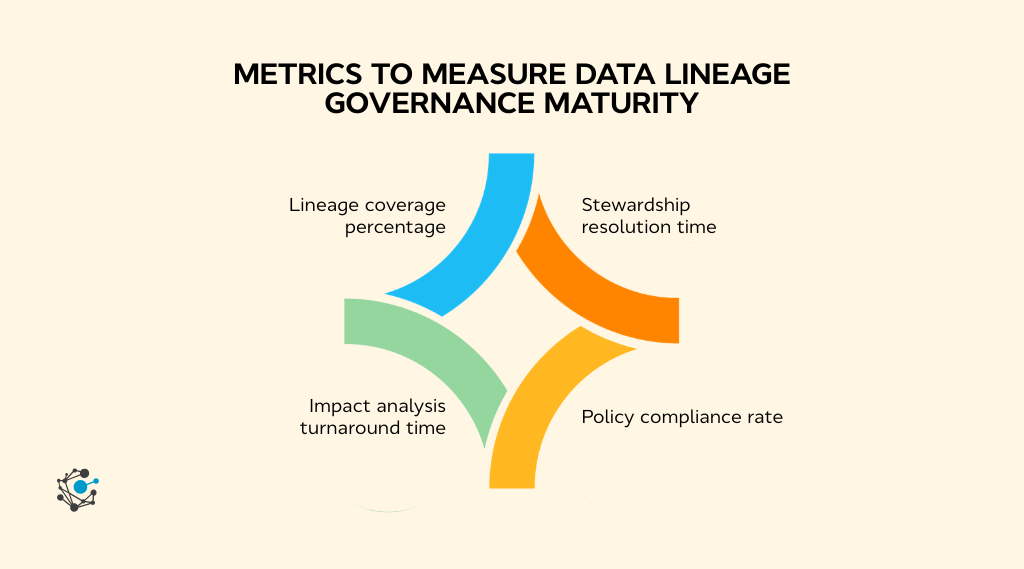
Lineage coverage percentage
Lineage coverage percentage measures how much of the organization’s governed data environment has documented and traceable lineage. It helps governance teams understand how completely data flows are mapped across pipelines, datasets, and reporting assets.
Organizations typically evaluate this metric by comparing the number of assets with documented lineage against the total number of governed data assets.
Coverage levels often indicate governance maturity:
-
Below 40 percent: Limited lineage visibility with many undocumented data flows
-
40–70 percent: Partial coverage across key data domains
-
Above 70 percent: Mature lineage governance with broad ecosystem coverage
Stewardship resolution time
Stewardship resolution time tracks how quickly lineage issues are resolved by data stewards.
Measurement: The average time required to close lineage-related governance tasks such as missing lineage mappings, documentation gaps, or validation failures.
Faster resolution times indicate effective stewardship workflows and clear ownership across data domains.
Policy compliance rate
Policy compliance rate measures how consistently lineage governance policies are followed.
It tracks the percentage of datasets that meet governance requirements such as ownership assignment, lineage documentation, and validation schedules. Monitoring compliance trends helps governance teams identify policy adoption gaps and improve governance enforcement.
Impact analysis turnaround time
This metric measures how quickly teams can assess upstream and downstream dependencies when data pipelines or schemas change.
The measurement window typically starts when a change request is raised and ends when dependency analysis is completed. Faster turnaround times usually indicate strong lineage coverage and better operational visibility across the data ecosystem.
How modern platforms enable data lineage governance
A governance framework defines how lineage should be governed, but platforms enable organizations to apply that governance consistently across complex data environments.
As data pipelines expand across multiple tools and systems, manual lineage documentation becomes difficult to maintain. Modern data governance platforms address this challenge by embedding lineage discovery, governance controls, and stewardship workflows directly into daily data operations.
Automated lineage discovery and end-to-end mapping
Modern data governance platforms automatically capture lineage across the data ecosystem by ingesting metadata from multiple systems. Instead of relying on manual documentation, these platforms continuously update lineage as pipelines and transformations evolve.
Common sources of automated lineage discovery include:
-
ETL and ELT tools that transform and move data across pipelines
-
Databases and data warehouses that store structured datasets
-
BI and reporting platforms that generate dashboards and analytical outputs
This automation ensures organizations maintain a complete view of how data flows from source systems to final reports.
|
How OvalEdge enables automated lineage capture Modern data environments involve multiple transformation tools, databases, and reporting platforms. Manually documenting lineage across these systems becomes difficult as pipelines evolve and new datasets are introduced. OvalEdge addresses this challenge by automating lineage discovery and ensuring lineage information stays continuously updated. Key capabilities that enable automated lineage capture include:
By automating lineage capture and integrating it with metadata governance workflows, OvalEdge helps organizations maintain accurate, up-to-date lineage across complex data ecosystems. |
Embedded governance roles and lineage stewardship workflows
Governance frameworks require clearly defined roles, but modern platforms operationalize those roles directly within the system. This allows organizations to connect governance responsibilities to the data assets and lineage flows they oversee.
Key governance capabilities typically include:
-
Role-based access controls to manage governance responsibilities
-
Stewardship dashboards that monitor lineage quality and ownership
-
Issue assignment and resolution tracking for lineage gaps or inconsistencies
Platforms like OvalEdge link data owners and stewards directly to lineage assets, allowing organizations to track accountability across the entire lineage lifecycle.
Policy enforcement and lineage controls
Governance policies are effective only when they are consistently enforced across the data ecosystem. Modern governance platforms help operationalize these policies by embedding automated controls into everyday data operations, reducing reliance on manual reviews and ad hoc processes.
These automated controls typically include:
-
Change impact alerts that identify upstream and downstream dependencies before schema or pipeline updates occur
-
Validation rules that verify the completeness and accuracy of lineage documentation
-
Audit logs that record lineage updates, policy approvals, and governance activities
By embedding these controls into data workflows, organizations can ensure that lineage governance policies are applied consistently, improving transparency, compliance readiness, and operational reliability.
Unified metadata governance framework
Lineage governance becomes difficult when metadata, stewardship, and governance processes are managed across separate tools. Modern platforms solve this challenge by integrating lineage with broader metadata governance capabilities.
A unified governance environment typically combines:
-
Data catalog for documenting datasets and assets
-
Business glossary for defining business terms and metrics
-
Data quality rules for monitoring data reliability
-
Lineage visualization for tracing upstream and downstream dependencies
By bringing these components together, platforms such as OvalEdge provide a unified metadata governance framework where lineage, stewardship, and policy controls operate in a coordinated environment. This integration helps organizations scale governance practices across large and complex data ecosystems.
Conclusion
A structured data lineage governance framework transforms lineage from static documentation into a trusted and scalable governance capability.
By defining clear governance roles, enforcing lineage policies, enabling stewardship accountability, and tracking measurable metrics, organizations can ensure lineage remains accurate and reliable across their data ecosystem.
A practical starting point is assessing current lineage coverage and identifying ownership gaps in critical data domains. From there, organizations can establish governance policies, validation workflows, and controls that keep lineage updated as pipelines evolve.
Modern governance platforms accelerate this process by automating lineage discovery and embedding governance into everyday data operations. askEdgi by OvalEdge helps teams quickly explore data relationships and lineage insights through AI-powered search and AI agents.

Book a demo with OvalEdge to see how automated lineage and governance workflows can simplify and scale your data governance initiatives.
FAQs
1. Who owns a data lineage governance framework in an organization?
Executive data leaders typically sponsor the framework, while data governance councils define standards. Data owners remain accountable for lineage accuracy, and data stewards manage day-to-day validation, updates, and issue resolution across governed domains.
2. How often should a data lineage governance framework be reviewed?
Organizations should review lineage governance policies at least quarterly. High-change environments may require monthly validation cycles to ensure lineage accuracy, policy compliance, and alignment with evolving regulatory or business requirements.
3. Can data lineage governance work without automation tools?
Manual governance can work temporarily, but it does not scale. Automation ensures consistent lineage capture, real-time updates, policy enforcement, and audit tracking, which become critical as data ecosystems grow in complexity.
4. What industries benefit most from lineage governance frameworks?
Highly regulated industries such as banking, healthcare, insurance, and telecommunications benefit significantly. These sectors require documented data flows, traceable reporting logic, and strong accountability controls to meet compliance and audit demands.
5. How does lineage governance support data quality initiatives?
Lineage governance provides visibility into upstream and downstream dependencies. This visibility helps teams trace root causes of data quality issues, assess impact scope, and implement corrective controls without disrupting dependent systems.
6. What are the first signs that lineage governance is failing?
Warning signs include undocumented data flows, repeated impact surprises after schema changes, unclear data ownership, delayed audit responses, and inconsistent lineage diagrams across tools or business units.
.png?width=1081&height=173&name=Forrester%201%20(1).png)
.png?width=1081&height=241&name=KC%20-%20Logo%201%20(1).png)