.png)
A metadata framework is a structured system that defines how metadata is captured, organized, governed, and used across an organization’s data systems. It sets the standards, taxonomies, lineage rules, and ownership models that turn scattered metadata into a connected, trustworthy asset.
Done well, it solves the daily friction every data team knows: conflicting metric definitions between marketing and finance, AI models trained on fields no one can trace, dashboards that show different numbers for the same KPI, and audits that take weeks because lineage lives in a spreadsheet.
The market reflects how urgent this has become.
According to Grand View Research, Metadata Management Tools Market Size Report, 2024, the global metadata management tools market is expected to grow from USD 11.69 billion in 2024 to USD 36.44 billion by 2030.
This guide explains the components, types, and trade-offs of a modern metadata framework and walks through the seven steps to build one.
What is a metadata framework, and why does it matter
A metadata framework is the set of standards, taxonomies, policies, and tooling that defines how metadata is captured, classified, governed, and made available across an organization’s data systems. Understanding the difference between data and metadata helps clarify how these layers relate.
A complete metadata framework typically covers five things:
-
Standards and taxonomies: Naming conventions, classifications, and reference models that keep metadata consistent across teams.
-
Repositories: Where technical, business, and operational metadata are stored and made searchable.
-
Lineage: How data and metadata flow between systems, pipelines, and outputs.
-
Governance and ownership: Who creates, approves, and maintains metadata, and what policies they follow.
-
Tooling and automation: The catalog, discovery, and quality systems that make metadata usable in day-to-day work.
Why a metadata framework matters
A 2024 Precisely survey found that 71% of organizations now maintain a formal data-governance program, up from around 60% in 2023. Metadata management is the connective layer underneath that growth, since governance depends on consistent and traceable metadata.
A working metadata framework delivers five concrete benefits:
-
Prevents inconsistent definitions across marketing, finance, and product teams.
-
Improves AI readiness through reliable lineage, feature tracking, and model transparency.
-
Reduces operational friction with a shared metadata language across tools.
-
Strengthens compliance by making metadata documented, traceable, and audit-ready.
-
Accelerates analytics by making trusted metadata available wherever it is queried.
A metadata framework is often confused with metadata architecture. The framework defines standards, ownership, and processes, while the architecture defines the technical structure, such as repositories, integration layers, and lineage pipelines. Both are required and should be designed together.
Key concepts: Metadata architecture, management framework & strategy
Before you build a metadata framework, it helps to untangle a few terms that often get blended together. You’ll hear people talk about metadata architecture, metadata management, and metadata strategy as if they’re the same thing, but they play very different roles in how your organization handles metadata.
The four terms below get used interchangeably more often than they should. Here is the cleanest way to keep them straight:
|
Term |
What it answers |
What it covers |
Who owns it |
|
Metadata architecture |
Where does metadata live, and how does it flow? |
Repositories, taxonomies, lineage paths, integration layers |
Data engineering, platform teams |
|
Metadata management framework |
How do we run metadata day to day? |
Tools, capture rules, documentation standards, and quality checks |
Data governance office, stewards |
|
Metadata strategy |
Why are we doing this, and what outcomes are we after? |
Business goals, prioritized domains, multi-year roadmap |
Chief Data Officer, data leadership |
|
Metadata governance |
Who is responsible, and what are the rules? |
Roles, policies, approvals, retention, escalations |
Governance council, stewards |
Each one feeds the next: strategy sets direction, the framework operationalizes it, the architecture is the technical foundation, and governance keeps everyone accountable.
1. Metadata architecture explained
Metadata architecture refers to the structure that defines how metadata is created, stored, connected, and delivered across systems. Think of it as the blueprint for where metadata lives, how it flows, and how different tools talk to each other. It covers the technical pieces that make metadata usable in day-to-day work.
A strong architecture typically includes:
-
Metadata repositories that store technical, business, and operational metadata in one or more central locations.
-
Metadata taxonomies that classify datasets, tables, reports, AI assets, and business terms so people can find what they need quickly.
-
Metadata lineage that shows how data moves between systems, which pipelines touched it, and how it influences reports and AI outputs.
-
Integration layers that connect your data platforms, BI tools, ML systems, and governance tools so metadata doesn’t get stuck in silos.
When this architecture is well designed, teams don’t have to guess where to look for information about a dataset or model. They know there’s a clear place to go, a consistent way to read it, and a reliable view of how everything fits together.
2. Metadata management framework: definition and purpose
If metadata architecture is the blueprint and plumbing, the metadata management framework is the entire operating model that sits on top of it. It is the set of tools, standards, policies, and procedures that govern how metadata is captured, updated, integrated, and used across the organization.
A practical metadata management framework usually covers:
-
Which tools handle metadata capture, cataloging, and lineage?
-
How new datasets, reports, or models get documented.
-
Who is responsible for maintaining definitions, tags, and classifications?
-
How changes are reviewed, approved, and communicated.
-
How quality checks are run to keep metadata accurate and complete.
The goal is simple: make metadata consistent, traceable, and trustworthy. Instead of every team inventing its own way of naming fields or documenting lineage, the framework gives them a shared playbook. That reduces confusion, minimizes risk, and makes it much easier to support AI, analytics, and governance at scale.
3. Metadata strategy vs metadata governance
Metadata strategy and metadata governance are closely linked, but they answer different questions.
Metadata strategy answers the question, “Why are we doing this, and what are we trying to achieve?” It focuses on:
-
The business outcomes metadata should enable, like AI transparency, faster analytics, better customer experiences, or smoother audits.
-
Which domains or use cases should be prioritized first?
-
How metadata supports broader data and AI strategy over the next few years.
In other words, the strategy sets the direction. It makes sure metadata work ties back to real business value and isn’t just documentation for documentation’s sake.
Metadata governance answers the question, “How will we manage metadata day to day?” It focuses on:
-
Roles and responsibilities for owners, stewards, and reviewers.
-
Policies for naming conventions, access control, approvals, and retention.
-
Workflows for onboarding new assets, updating definitions, and resolving conflicts.
-
Processes to monitor quality, handle exceptions, and refine standards over time.
You can think of it this way: strategy sets the goals, governance keeps everyone honest on the way there. Strong organizations have both. They know why metadata matters, and they have a clear, repeatable way to manage it across teams and tools.
|
Did you know? According to the DBTA 2024 Data-Driven Organizations Survey, 62% of companies remain in early stages of data management maturity, with only a small fraction achieving optimized, repeatable metadata workflows. |
Why organisations need a metadata framework in AI data management
A metadata framework is essential for any organization trying to manage large volumes of data, especially when AI and analytics are part of the workflow. It creates the structure teams need to understand their data, trace where it comes from, and use it with confidence. This section breaks down why that foundation matters and what happens when it’s missing.
Challenges without a framework
If you’ve ever tried to scale analytics or build AI models without a clear metadata structure, you know how quickly things start to break down. Teams spend unnecessary time hunting for datasets, debating definitions, or trying to retrace how a field was created. Work slows down. Mistakes creep in. And trust in the data erodes.
Without a metadata framework in place, organizations face recurring issues:
-
Inconsistent definitions across departments: A metric defined one way in marketing might mean something completely different in finance or product.
-
Poor data discoverability: Teams waste time searching across warehouses, BI tools, and cloud platforms, or worse, recreate datasets that already exist.
-
Lack of lineage and traceability: AI models rely on clean, well-understood inputs, but without lineage, teams can’t explain where a feature came from or how it was transformed.
-
Regulatory vulnerability: Compliance frameworks depend on clear documentation and traceability, which becomes nearly impossible when metadata is scattered or missing.
These challenges create friction across the entire data lifecycle. When teams can’t trust metadata, it affects model accuracy, decision-making, and the ability to meet compliance obligations. A Precisely–Drexel 2025 Data Integrity Survey 2024 found that data governance is the leading obstacle to AI initiatives, and only 12% of organizations say their data is truly AI-ready.
Benefits of a metadata framework
A well-designed metadata framework brings clarity and consistency back into the picture. Instead of navigating chaos, teams work with a shared structure they can trust.
Active metadata also plays a measurable role here.
According to a 2025 Gartner report, organizations that prioritize semantics and active metadata can increase GenAI model accuracy by up to 80% and reduce costs by as much as 60%.
With a strong framework, organizations gain:
-
Reliable discoverability makes it easier for analysts, engineers, and scientists to find relevant datasets and understand them quickly.
-
Better governance and control, so definitions, classifications, and updates follow clear rules rather than ad-hoc interpretations.
-
Stronger AI and ML pipelines, supported by transparent lineage, feature documentation, and consistent metadata quality.
-
Improved compliance readiness, because metadata is documented, accessible, and audit-friendly.
-
Faster onboarding, allowing new team members to ramp up with far less confusion.
-
Higher data quality, driven by consistent standards across all platforms and workflows.
Ultimately, a metadata framework isn’t just an internal organizational tool. It becomes the backbone of trustworthy data, reliable AI, and efficient collaboration across teams.
Types of metadata frameworks & models
Different organizations structure their metadata in different ways depending on their goals, systems, and regulatory needs. Understanding the main types of metadata frameworks helps you choose the approach that fits your environment and the complexity of your data ecosystem.
Structural vs operational vs business metadata frameworks
Structural, operational, and business metadata frameworks each serve a distinct role, and most mature organizations use a blend of all three.
-
Structural metadata focuses on technical details like schemas, tables, and data types, helping ensure consistency across systems.
-
Operational metadata tracks data in motion, including pipelines, transformations, and system performance, enabling monitoring and troubleshooting.
-
Business metadata provides context such as KPIs, definitions, and ownership, helping teams understand and align on data meaning.
Together, these three types ensure metadata isn't just stored but understood, governed, and actionable.
Industry-specific framework variants
Metadata frameworks often evolve based on industry requirements, especially in regulated sectors where accuracy and traceability are critical.
-
Healthcare: Emphasizes standards like HL7 and FHIR for compliance and data exchange.
-
Finance: Focuses on governance, audit readiness, and standards like ISO 20022.
-
Retail & eCommerce: Centers on product, customer, and omnichannel data for personalization.
-
Manufacturing: Captures equipment, sensor, and supply chain data to improve operations.
Each industry adapts the same core principles, such as structure, governance, and consistency, while tailoring the framework to its own operational realities and compliance landscape.
|
Stat: IBM’s Cost of a Data Breach report 2024 estimates the global average cost of a breach at USD 4.88 million, with regulated industries like healthcare and financial services facing even higher impacts. |
Common metadata standards and frameworks
Most metadata frameworks borrow from one or more established standards. Knowing which standards apply to your industry saves months of taxonomy work.
|
Standard |
What it covers |
Where it's used |
|
Dublin Core |
15 core elements for describing digital resources |
Libraries, content repositories, archives |
|
ISO 11179 |
Specification for managing metadata registries |
Government, large enterprise data programs |
|
DAMA-DMBOK |
Data management body of knowledge, including metadata |
Enterprise data governance offices |
|
DCAT (W3C) |
Data Catalog Vocabulary for describing datasets |
Open data, data marketplaces, public sector |
|
FAIR Principles |
Findable, Accessible, Interoperable, Reusable |
Research data, scientific computing, and AI training data |
|
HL7 / FHIR |
Healthcare data exchange |
Hospitals, EMR systems, clinical research |
|
ISO 20022 |
Financial messaging metadata |
Banks, payment networks, and regulatory reporting |
|
PROV (W3C) |
Provenance and lineage representation |
Audit-heavy environments, scientific reproducibility |
Most enterprises do not rely on a single standard. They combine a horizontal framework like DAMA-DMBOK with an industry-specific standard such as FHIR or ISO 20022, then layer internal taxonomy and governance on top.
How to build a metadata framework: A step-by-step guide
Building a metadata framework doesn’t have to feel overwhelming. When you break the process into clear, practical steps, it becomes a structured roadmap rather than a massive transformation. The goal here is to give your teams clarity, consistency, and a repeatable model they can rely on as your data ecosystem grows.
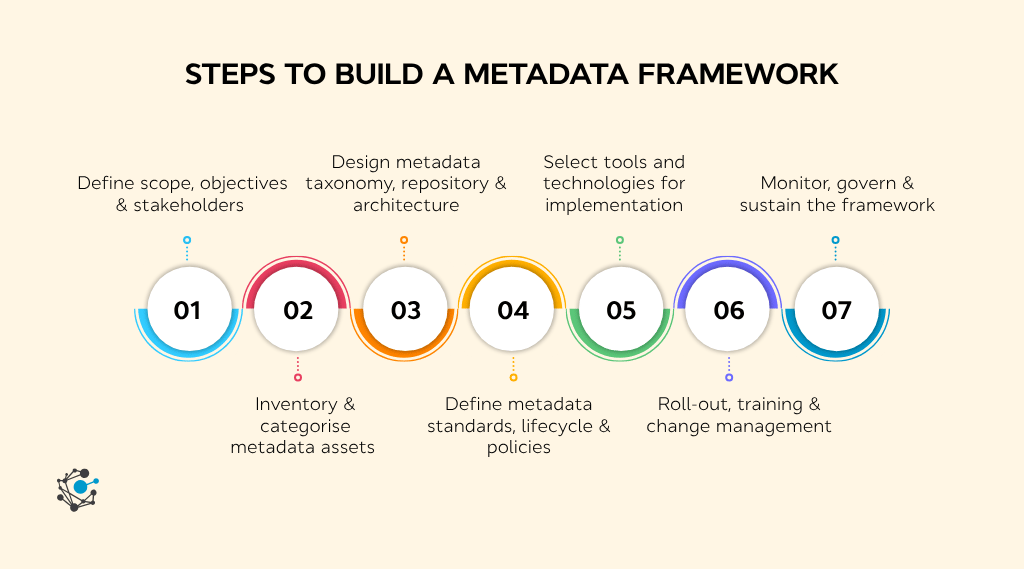
Step 1: Define scope, objectives & stakeholders
Start with clear business goals. Some organizations aim to improve compliance, while others want faster AI feature discovery or more efficient analytics.
Define who owns each area of metadata, such as data stewards, product owners, platform leads, and compliance teams.
Step 2: Inventory & categorise metadata assets
Catalog all metadata sources across data warehouses, AI platforms, BI tools, and cloud services. Categorize assets based on usage, risk, and accessibility.
A metadata inventory should typically include fields like asset type, source system, owner, lineage notes, and quality status.
Step 3: Design metadata taxonomy, repository & architecture
Create a unified taxonomy that defines terms, classes, categories, and relationships. Design the metadata repository that will store structured, operational, and business metadata.
Define how lineage will be captured and integrated using automation or metadata ingestion layers.
Step 4: Define metadata standards, lifecycle & policies
Establish naming conventions, documentation requirements, validation rules, and retention guidelines. Define lifecycle steps from metadata creation to archival. These standards ensure that metadata remains consistent even when teams change.
Step 5: Select tools and technologies for implementation
The right metadata platform should automate capture, provide end-to-end lineage, support steward-friendly workflows, and integrate easily with your stack.
Evaluate tools based on:
-
Connector breadth: Coverage across warehouses, BI, ML, and SaaS tools
-
Active metadata: Tracks usage and pipeline behavior, not just static schemas
-
Lineage depth: Column-level and pipeline-level visibility
-
Governance workflows: Approvals and certifications usable without engineering support
-
AI assistance: Natural-language search and semantic discovery (e.g., AskEdgi in OvalEdge)
OvalEdge combines these capabilities through a unified catalog, automated lineage, governance workflows, and built-in metadata intelligence. Explore it in a live demo.
Step 6: Roll-out, training & change management
Train data stewards, engineers, and analysts to use the framework. Provide clear guidelines and onboarding materials. Effective metadata frameworks emerge from consistent adoption, not one-time deployments.
Step 7: Monitor, govern, and sustain the framework
A metadata framework only stays useful if someone is actively monitoring it. Define a small set of KPIs and review them on a fixed cadence:
-
Metadata completeness rate: Share of critical assets (target: 90% or higher) that include owner, description, classification, and lineage.
-
Lineage coverage: Share of in-scope pipelines with end-to-end lineage captured.
Prioritize full coverage for regulated and AI-critical workflows. -
Metadata quality score: Composite measure of accuracy, freshness, and consistency, reviewed monthly across stewards.
-
Catalog adoption: Monthly active users of the metadata catalog, and the ratio of search queries to dataset views. A healthy ratio typically falls between 2:1 and 5:1.
-
Time to find data: Average time analysts report it takes to locate a trusted dataset, measured quarterly.
Review these metrics in a monthly steward meeting and a quarterly governance council. New AI use cases, regulatory requirements, and data sources continuously put pressure on the framework. Regular review cycles keep it aligned and prevent it from drifting.
Metadata framework best practices
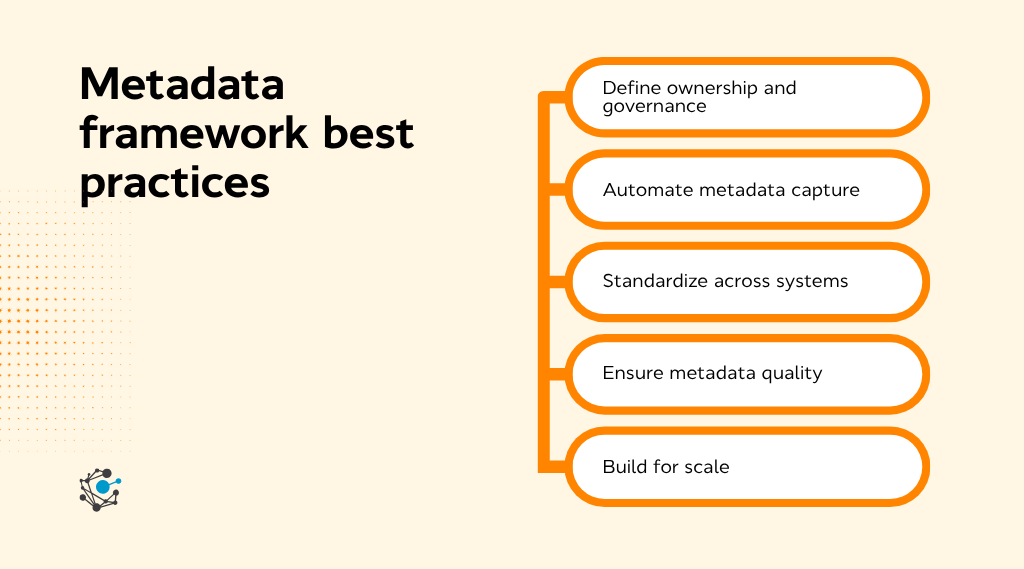
A strong metadata framework is much easier to maintain when the right habits and structures are in place. These best practices help teams stay aligned, reduce friction, and keep metadata accurate as systems and workloads grow.
-
Define ownership and governance: Assign clear roles to stewards, governance teams, and product owners to maintain consistency and accountability.
-
Automate metadata capture: Use automation, event-driven updates, and AI-based tagging to reduce errors and keep metadata current.
-
Standardize across systems: Apply a unified taxonomy and consistent conventions across all platforms to ensure interoperability.
-
Ensure metadata quality: Set standards for completeness and accuracy, supported by validation checks and performance metrics.
-
Build for scale: Use federated governance, reusable templates, and APIs to support growth and cross-team adoption.
Building a reliable metadata framework becomes much easier when you have the right structure, automation, and governance in place. For a deeper walkthrough on the operational side, see our guide to metadata management best practices.
To see how OvalEdge can support metadata strategy, book a demo with our experts and explore it in action today.
How OvalEdge implements this framework
OvalEdge brings the four metadata layers, architecture, management, strategy, and governance into a single platform. Here is how each layer maps:
|
Framework layer |
OvalEdge capability |
|
Architecture |
Unified metadata catalog with 200+ connectors, column-level lineage, and open APIs |
|
Management framework |
Capture rules, glossary, classification, and quality workflows in one workspace |
|
Strategy |
Domain-level views, executive dashboards, and AI readiness insights |
|
Governance |
Stewardship workflows, approval policies, audit logs, and access controls |
|
Metadata intelligence |
AskEdgi natural-language search and semantic discovery across the catalog |
Most metadata platforms cover two or three of these layers. OvalEdge is built to cover all five, which is why customers in regulated industries (financial services, healthcare, manufacturing) standardize on it as the system of record for metadata.
Conclusion
A metadata framework turns metadata from documentation into infrastructure. It gives teams clear ownership, reliable lineage, and consistent definitions that support analytics, AI, and governance.
Start small. Focus on a few critical data domains, define ownership, build a basic glossary, and capture lineage for key pipelines. As adoption grows, the framework becomes easier to scale.
When complexity increases, a unified platform helps replace fragmented tools. OvalEdge brings cataloging, lineage, governance workflows, and AskEdgi metadata intelligence into one system.

See it in action on your own data. Book a 30-minute demo.
FAQs
1. What are the key components of a metadata framework?
A metadata framework has five core components: standards and taxonomies, metadata repositories (technical, business, and operational), lineage tracking, governance and ownership models, and tooling for capture and discovery. Together, these layers keep metadata consistent, searchable, and trustworthy across systems.
2. What is the best metadata framework for data governance?
There is no single best framework. Most organizations combine standards like DAMA-DMBOK with industry-specific models such as FHIR or ISO 20022. The right choice depends on your data environment, regulatory needs, and governance maturity level.
3. What is the difference between metadata architecture and a metadata framework?
Metadata architecture defines the technical structure, including storage, flow, and integration of metadata. A metadata framework defines the operating model, including standards, ownership, and processes. Architecture enables the framework to function effectively across systems.
4. How does metadata impact AI data management?
Metadata provides context for AI systems, including data origin, transformations, and ownership. It ensures models use reliable inputs, supports explainability, and reduces risk. Without metadata, AI systems face issues with accuracy, traceability, and compliance.
5. What tools are best for implementing a metadata framework?
The best tools support automated metadata capture, end-to-end lineage, governance workflows, and a searchable glossary. Look for platforms with strong connectors, active metadata capabilities, and support for standards like DCAT and FAIR.
6. How do you automate metadata management?
Automation involves ingesting metadata from systems, enriching it with classification and tagging, and updating it through events like schema changes. Most organizations automate core metadata capture while leaving business context to stewards.
.png?width=1081&height=173&name=Forrester%201%20(1).png)
.png?width=1081&height=241&name=KC%20-%20Logo%201%20(1).png)