-1.png)
Your AI agent just answered the same business question two different ways. No error message. No warning. Just two confident, conflicting outputs, and now nobody knows which one to trust. It happens more than most organizations admit: a sales team pulls active customer count from one dashboard, finance pulls it from another, and the AI returns a different number to each. Same question. Same company. Two answers.
That is what happens when enterprise AI runs on an ungoverned data context. And it is more common than most organizations admit.
McKinsey's 2025 State of AI found that while 88% of companies use AI in at least one function, only one-third have successfully scaled it, and inconsistent business logic is a major reason why.
The fix is a governed semantic layer for AI, a managed abstraction layer that sits between your raw data and your AI systems, enforcing certified definitions, access policies, and data lineage at every query.
This blog covers what a governed semantic layer actually is, why it is non-negotiable for enterprise AI, how it differs from a traditional semantic layer, and what it enables for data architects, AI leads, and analytics teams.
What is a governed semantic layer for AI?
A governed semantic layer for AI is a managed abstraction layer between raw enterprise data and AI systems or analytics tools. It translates technical data structures into business-meaningful terms, definitions, metrics, KPIs, and relationships while enforcing governance controls like access policies, data lineage, and certified metadata, so AI agents always operate on consistent, trusted context.
What separates this from general data governance is where control happens. Rather than sitting at the perimeter, governance is enforced directly in the path of every AI query, at the exact moment semantic meaning is resolved, before a single SQL statement is generated.
Why a governed semantic layer is critical for enterprise AI
AI agents do not have tribal knowledge. A human analyst knows which metrics finance trusts and which tables to avoid. AI does not, unless that context is made explicitly machine-readable.
Without semantic grounding, agents resolve ambiguity probabilistically, inferring meaning from column names and schema patterns. That breaks down fast in financial reporting, customer analytics, or any regulated workflow where precision is non-negotiable.
Making this more urgent: LLMs and agents are now the front door to enterprise analytics. Every question once routed through a dashboard gets answered directly by an agent, raising the stakes for every metric definition underneath it.
The result of an ungoverned context is metric drift. Marketing defines "active customer" one way, finance another, and the AI picks whichever field looks most likely. Two teams, two answers, zero trust.
Governed semantic layer vs. traditional semantic layer
Traditional semantic layers were built for static dashboards and fixed queries with human analysts in the loop. AI agents change that entirely, introducing dynamic, multi-turn reasoning where governance cannot depend on human intervention at every step.
The fundamental shift: traditional semantic layers support reporting. Governed semantic layers support AI reasoning and automated decisions, where certified definitions, lineage, and access policies must be enforced at query time, automatically, every time.
|
Dimension |
Traditional Semantic Layer |
Governed Semantic Layer |
|
Primary design target |
Dashboards and BI reports |
AI agents + self-service analytics |
|
Governance |
Manual, siloed |
Automated, policy-enforced |
|
Metadata |
Static |
Active, enriched |
|
Lineage |
Limited |
End-to-end, explainable |
|
Access control |
Coarse-grained |
Row/column-level, role-aware |
|
AI readiness |
Probabilistic |
Deterministic |
Tools like OvalEdge extend semantic layers into governed territory by layering catalog integration, business glossary, lineage harvesting, and stewardship workflows on top of existing semantic models, turning abstraction into auditable, AI-ready infrastructure.
Core components of a governed semantic layer
A raw semantic model handles abstraction. A governed one adds the controls that make it trustworthy for AI. Here are the four building blocks that make the difference.
1. Business glossary and semantic definitions
The glossary is the authoritative contract between data producers and AI consumers. Every term, "Active Customer," "Net Revenue," "Churn", needs a certified, versioned definition with a named owner. Without it, an LLM picks the field that sounds statistically right, not the one that finance approved.
These definitions sit above physical platforms like Snowflake, Databricks, or BigQuery, mapping business terms to underlying tables and columns without exposing raw schemas to consumers. Catalog platforms like OvalEdge are where these terms are authored, owned, and surfaced to both analysts and AI agents.
2. Active metadata and data catalog integration
Not all metadata is equal. Passive metadata documents what exists, table names, column descriptions, and schema definitions. Active metadata drives behavior by routing queries, triggering quality checks, and surfacing governed context to AI agents at the moment data is being interpreted.
The practical difference: when an AI agent queries a revenue metric, active metadata tells it the field carries a below-threshold quality score this week and is flagged as high sensitivity, so the agent surfaces a warning rather than returning a number that should not be trusted right now. That is metadata changing agent behavior, not just documenting it.
Catalog platforms like OvalEdge enrich technical metadata with business context and stewardship workflows, while catalog integrations surface definitions with ownership and lineage context. Without this layer, a semantic layer is just a logical model.
3. Data lineage and explainability
Lineage tracks the full journey of every metric, from source system through transformation to semantic definition to AI output. It is what converts a semantic layer from a black box into an auditable, explainable system.
This matters practically, too. If a source field in Snowflake is modified, column-level lineage surfaces exactly which metrics, agents, and reports are affected before trust erodes silently downstream.
4. Governance and access control
Row-level security, column-level permissions, and role-based access are enforced at the semantic layer itself, not delegated to individual BI tool configurations. Governance travels with the definition, so whether a query comes from a Looker dashboard, a ThoughtSpot agent, or a Cube.dev API call, the same policies apply.
Certification workflows operationalized through platforms like OvalEdge ensure named stewards review and approve metric definitions before AI agents consume them, making every AI-generated answer not just accurate, but defensible.
How governed semantic layers enable AI agents, analytics, and decision automation
Without a governed semantic layer, AI systems resolve data ambiguity through probabilistic schema interpretation, picking the most likely field, not the approved one. With it, every query returns a consistent, governed, reproducible answer built on deterministic business logic.
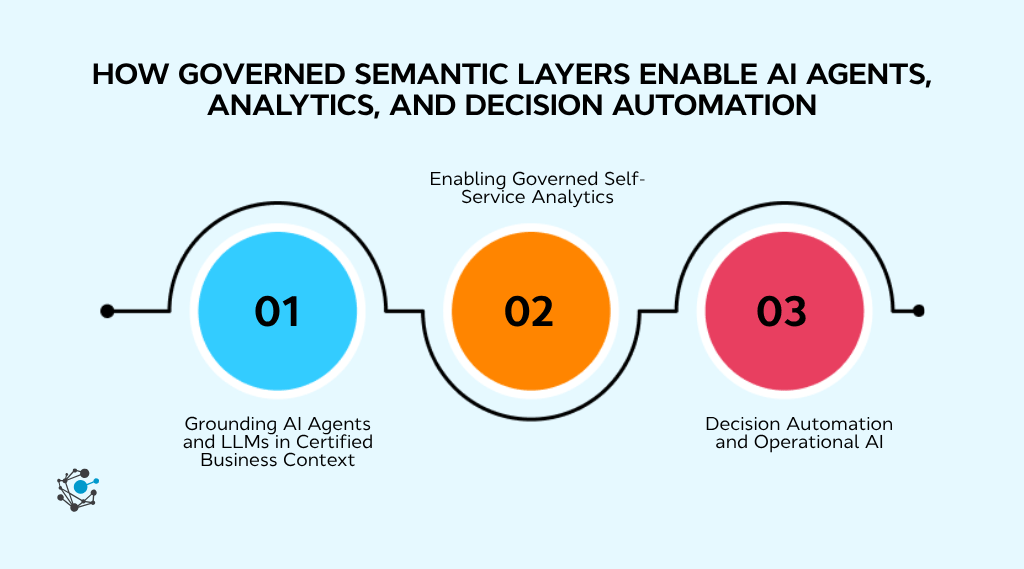
1. Grounding AI agents and LLMs in a certified business context
When an AI agent is asked, "What was our active customer count in EMEA last quarter?" It needs more than access to data. It needs the certified definition of "active customer," the approved join logic, the right fiscal calendar, and the correct access permissions. Without a governed semantic layer, it guesses. With one, it resolves.
Without semantic grounding, LLMs resolve ambiguity probabilistically, choosing the most statistically likely field interpretation, not the approved business definition. A governed semantic layer flips this to deterministic: metric definitions, join logic, fiscal calendars, and access rules are explicitly enforced before any query executes, making AI outputs reproducible and auditable rather than statistically plausible.
An emerging pattern takes this further. Semantic definitions are increasingly being served via MCP servers, meaning an AI agent can call a governed semantic endpoint at query time, retrieve the certified definition of "active customer," and apply it before generating a single SQL statement. The same definitions can also be embedded as vector context into LLM-based copilots, so the governed business logic travels with the agent across multi-turn reasoning sessions rather than being resolved once and forgotten.
2. Enabling governed self-service analytics
According to a Gartner survey released in 2024, the number of employees leveraging analytics and BI has increased 87%, yet most organizations still struggle to deliver true self-service access without routing requests through technical teams.
A governed semantic layer changes that dynamic. Analysts can query enterprise data in natural language without navigating raw schemas, and every answer still inherits approved definitions and access policies regardless of who is asking. A marketing analyst asking "what is our churn rate in the mid-market segment this quarter?" gets the same governed definition of churn that the finance team uses, not a local interpretation pulled from whichever table looked most relevant.
Self-service stops being a governance risk and starts being a controlled capability.
3. Decision automation and operational AI
Pricing engines, churn alerts, and fraud detection systems do not run on one-off queries. They require consistent, real-time context at machine speed. They run continuously, which means any definitional inconsistency gets compounded across every decision cycle, not just flagged once.
Without a governed semantic layer, automated decisions inherit the inconsistency of probabilistic schema interpretation and multiply it at scale. A pricing model resolving "active customer" differently from the churn model it depends on does not just return a wrong number; it systematically misprices offers to an entire customer segment.
With a governed semantic layer, every automated decision is grounded in deterministic business logic: repeatable, policy-compliant, and fully auditable. The same certified definitions that power a human analyst's dashboard are the ones powering the decision engine running at 3 am.
Use cases of governed semantic layers in the enterprise
A governed semantic layer is not a theoretical upgrade. Here is what it looks like when it is actually working, across three domains where inconsistent business context creates the most damage.
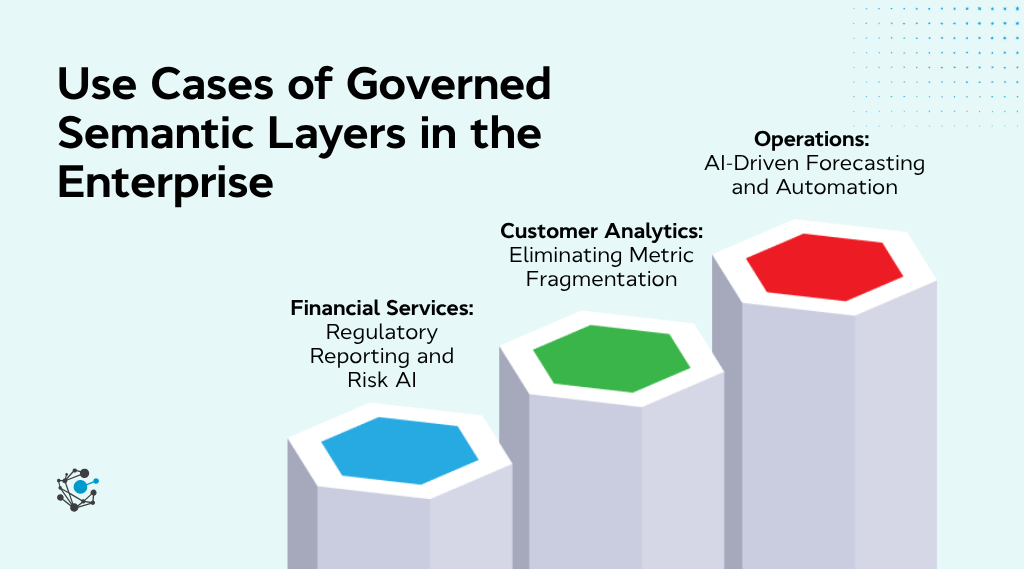
1. Financial services — regulatory reporting and risk AI
A global bank running credit, market, and operational risk models cannot afford three different definitions of "exposure." A governed semantic layer ensures every risk AI model and regulatory report resolves against the same certified definition, with end-to-end lineage to prove it.
This is not optional in regulated finance. BCBS 239 explicitly requires effective risk data aggregation, ownership, and auditability, exactly what a governed semantic layer operationalizes.
2. Customer analytics — eliminating metric fragmentation
Marketing defines "active customer" in one way. Finance defines it differently. Product defines a third. Each team runs its own models, and the AI confidently returns a different number to each one.
A governed semantic layer creates one certified definition: owned, versioned, and enforced across every customer-facing AI system and analytics tool. Churn prediction models, CLV engines, and personalization systems all operate on the same customer context, eliminating the metric fragmentation that erodes cross-functional trust.
3. Operations — AI-driven forecasting and automation
Supply chain AI and demand forecasting models live and die by definitional consistency. When "inventory," "lead time," and "fill rate" mean different things across systems, conflicting recommendations follow, and the consequences are operational, not just analytical.
Consider a practical scenario: the procurement system defines "inventory" as units on hand, while the forecasting model includes in-transit stock in the same field. The AI flags a reorder threshold as breached. Procurement acts. But the inventory was never actually low; the forecasting model was counting stock that was already on its way. The result is an unnecessary replenishment order, excess carrying costs, and a planning team that stops trusting the AI's recommendations entirely.
A governed semantic layer ensures that "inventory," "lead time," and "fill rate" resolve to the same certified definition across every system that touches them. When the AI says the reorder threshold is breached, every stakeholder, procurement, logistics, and finance, is working from the same definition of what that means. Coordination improves because the context underneath it is no longer ambiguous.
4. Who benefits from a governed semantic layer
The value cuts across functions, but the pain points differ by role:
-
CDOs and data leaders are under pressure to scale AI and analytics governance without proportionally scaling stewardship headcount. A governed semantic layer centralizes policy enforcement, so governance does not depend on every team doing the right thing independently.
-
AI leads and data architects need AI systems that return consistent, reproducible outputs. Building on probabilistic schema inference means every model is only as reliable as its last lucky guess. Deterministic business logic is the only foundation that holds at scale.
-
Business analysts spend a disproportionate amount of time either waiting for data access or second-guessing whether the numbers they pulled are the right ones. A governed semantic layer lets them self-serve in natural language with confidence that every result is returned against approved definitions, not a local interpretation.
-
Compliance and risk teams need answers that are not just accurate but defensible. End-to-end lineage and certified metric definitions mean every AI-generated output can be traced back to its source, its logic, and the steward who approved it, which is exactly what auditors and regulators ask for.
Challenges and considerations when implementing a governed semantic layer
Implementation is where most governed semantic layer projects stall. The tooling exists; the harder problems are organizational. Here are the three challenges that come up consistently, and how to approach them honestly.
1. Breaking down data silos and fragmented definitions
Most enterprises already have metric definitions, scattered across BI tools, spreadsheets, transformation pipelines, and application code. The problem is not the absence of definitions; it is the abundance of conflicting ones.
Consolidating them requires cross-functional alignment that finance, product, and engineering rarely arrive at naturally. The practical starting point is not a full inventory; it is identifying the 10 to 15 most-contested metrics, governing those first, and building credibility before scaling.
2. Establishing ownership and stewardship
A semantic layer without named owners degrades quickly. Definitions go stale, certifications lapse, and governance becomes theater. The real question is operational: who approves new metric definitions? Who is notified when upstream data changes? Who certifies definitions before AI agents consume them?
Platforms like OvalEdge can automate stewardship workflows, but organizational accountability has to come first. Technology enforces ownership. It cannot create it.
3. Integration complexity in heterogeneous data stacks
Modern enterprises run Snowflake, Databricks, legacy warehouses, SaaS sources, and streaming pipelines simultaneously. A governed semantic layer has to federate across all of them without requiring full data centralization, which is a significant integration challenge in practice.
The mitigation is to avoid proprietary semantic models locked inside a single BI tool. Open standards like the Open Semantic Interchange initiative and API-first semantic layer tools make it possible to integrate with existing catalogs and transformation frameworks rather than replacing them.
Most enterprises do not replace existing semantic layers; they extend them. A Looker model or dbt semantic layer already in production is a starting point, not a liability. The realistic path is auditing existing semantic assets, identifying governance gaps, and progressively enriching with stewardship workflows, lineage, and access controls, and not a greenfield rebuild.
Conclusion
Enterprise AI is only as reliable as the business context underneath it. Better models, faster infrastructure, and more capable agents all hit the same ceiling when the semantic layer beneath them is ungoverned.
A governed semantic layer is not a BI upgrade. It is the prerequisite infrastructure for AI that is consistent, explainable, and scalable, shifting the foundation from static reporting models to an active, policy-enforced context that AI agents can actually trust.
The shift from dashboards to agents is already underway. The organizations that will scale AI reliably are the ones that govern the context layer first.
A practical next step: audit your current semantic layer against four checkpoints: certified business definitions, active metadata, end-to-end lineage, and fine-grained access control. Any gap in those areas will surface as an AI trust problem eventually.
OvalEdge helps enterprises build and govern that layer, connecting business glossary, lineage, stewardship, and catalog integration into a single governed context platform for AI and analytics.

Book a demo to see how OvalEdge governs your semantic layer end-to-end.
FAQs
1. What is a semantic layer in data architecture?
A semantic layer is a business-facing abstraction layer between raw data stores and the tools or AI systems that consume them. It translates technical schemas into business-meaningful concepts like metrics, KPIs, and entities so analysts and AI agents work with consistent, governed definitions.
2. Why is a semantic layer important for AI?
Unlike human analysts, AI agents cannot rely on institutional knowledge to resolve data ambiguity. Without a semantic layer, LLMs select the most statistically likely field rather than the approved one. A semantic layer grounds AI outputs in deterministic business logic rather than probabilistic inference.
3. How does a semantic layer improve data governance?
By centralizing metric definitions, glossary terms, access policies, and lineage in a single governed layer, organizations apply governance consistently regardless of which tool or AI agent is querying data. Policy enforcement happens at the semantic layer rather than depending on individual tool configurations.
4. What is the difference between a semantic layer and a data catalog?
A data catalog manages discovery, documentation, and governance of data assets, covering what exists, where it lives, and who owns it. A semantic layer defines how that data should be interpreted. The two are complementary and most powerful when integrated together.
5. Can a governed semantic layer work with AI agents and LLMs?
Yes, and this is increasingly its primary use case. AI agents consume governed semantic definitions through APIs, MCP servers, or vector-embedded context, giving them access to certified business definitions and access policies at query time for deterministic, auditable, and consistent outputs.
6. Which tools are used to build a governed semantic layer?
Common tools include dbt, Looker, and Cube.dev for semantic modeling, and data catalogs such as OvalEdge, Collibra, and Databricks Unity Catalog for governance enrichment. The most robust implementations combine a semantic layer tool with a governed data catalog rather than relying on a single platform.
.png?width=1081&height=173&name=Forrester%201%20(1).png)
.png?width=1081&height=241&name=KC%20-%20Logo%201%20(1).png)