-Jan-20-2026-05-44-57-1862-AM.png)
Most analytics teams struggle with momentum because while dashboards load fast and queries run fine, decisions still take days. Since analytics remains manual, reactive, and fragmented, teams spend more time asking follow-up questions, validating numbers, and rebuilding reports than actually acting on insights.
This is where AI agents for analytics change the game. Instead of waiting for someone to ask the right question, these agents actively analyze data, monitor metrics, explain changes, and surface insights as they happen. They move analytics from static dashboards to autonomous, insight-driven workflows.
Agentic AI is already moving from hype to execution.
In fact, a 2025 McKinsey survey found 23% of organizations are already scaling agentic AI systems, and another 39% are experimenting with AI agents, which explains why analytics leaders are now evaluating agent-based workflows instead of just adding more dashboards.
In this post, we’ll break down what AI analytics agents are, how they work in real analytics environments, the best AI agent analytics tools to evaluate in 2026, and what it takes to adopt them responsibly at scale.
What AI analytics agents are and why they matter
AI agents for analytics are autonomous systems that monitor data, analyze metrics, and deliver actionable insights without constant human input. They query trusted datasets, explain KPI changes, detect anomalies, and recommend actions using governed business context.
Unlike traditional dashboards or BI copilots, AI analytics agents work proactively across analytics workflows. They do not replace data warehouses, BI platforms, or analysts. Instead, they automate repetitive analytical work while humans remain responsible for validating insights and making business decisions.
AI analytics agents fill the gap by asking questions humans rarely have time to ask and performing repeat analysis at machine speed. Compared to traditional analytics approaches, they:
-
Continuously monitor data instead of waiting for user queries
-
Adapt to changing context and evolving business questions.
-
Perform multi-step analysis to explain insights and identify root causes.
-
Surface actionable recommendations rather than simply displaying data
This autonomy depends on trusted metadata, semantic definitions, governance, and human oversight. Most enterprise-ready analytics agents operate on a layered architecture spanning data sources, data warehouses, semantic layers, governance and access-control layers, and an agent execution layer.
By working through these layers instead of querying raw data directly, agents reason over trusted metrics, respect enterprise policies, and generate insights teams can confidently act on.
Where AI analytics agents fit in the analytics lifecycle
AI analytics agents work across the full analytics lifecycle, not just at one stage. They support exploration by responding to open-ended questions. They assist analysis by correlating metrics and drilling into root causes. They generate insights by summarizing trends, changes, and risks. They support decisions by recommending next steps based on context.
These agents do not replace warehouses, semantic layers, or BI tools. Warehouses still store data, semantic layers still define metrics and business logic, and BI tools still visualize results. AI agents connect these layers and work continuously across them, assisting users before, during, and after analysis instead of appearing only at query time.
How AI agents change analytical roles and workflows
As AI agents take on routine analysis, analytical roles shift in meaningful ways. Analysts spend less time writing queries and more time validating insights, refining logic, and advising stakeholders. Data engineers deal with fewer ad-hoc requests and can focus on improving data quality, reliability, and performance.
Analytics workflows also change. Instead of reacting to questions after problems surface, teams receive early signals, explanations, and recommendations as part of their daily work. Humans stay in control, but they operate with better context, faster feedback, and far less manual effort.
Did you know? This shift also lines up with broader adoption trends. The Stanford AI Index 2025 reports that 78% of organizations used AI in 2024, up from 55% in 2023, which makes the move from ‘AI features’ to ‘AI agents’ a natural next step for analytics teams.
Core technologies powering analytics AI agents
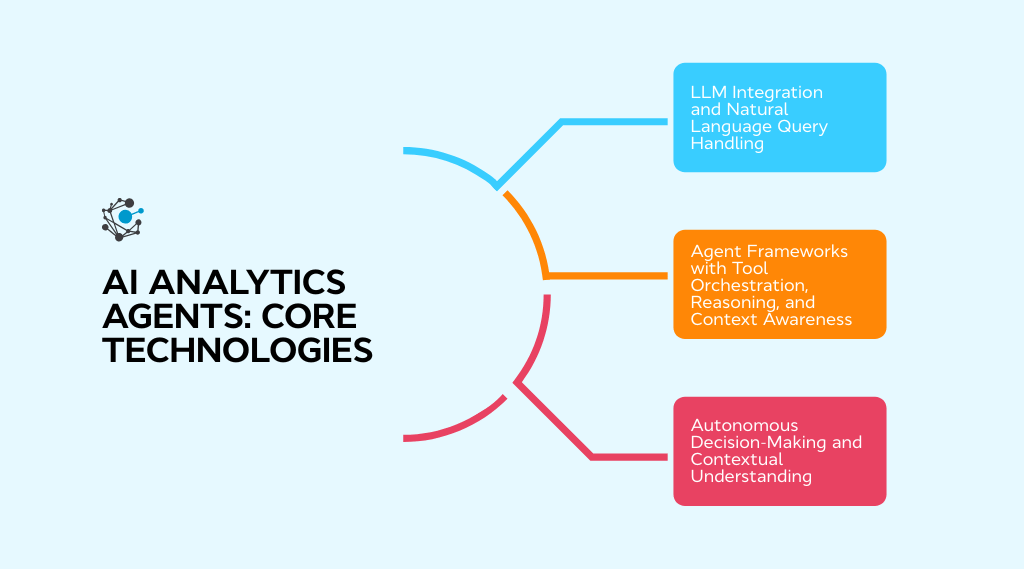
AI analytics agents may feel intelligent on the surface, but their effectiveness comes from a set of technologies working together behind the scenes. Understanding these building blocks helps teams evaluate tools realistically and avoid assuming that every “AI-powered” feature delivers true autonomy.
1. LLM integration and natural language query handling
Large language models give analytics agents the ability to understand business questions expressed in plain language. Instead of forcing users to think in SQL or dashboards, the agent interprets intent and translates it into structured analytical tasks tied to schemas, metrics, and data models.
Accuracy depends on grounding. Agents that lack access to metadata, metric definitions, or lineage often produce confident but incorrect answers. A strong metadata layer for AI provides the trusted business context needed to ground analytics agents. This is also why so many AI initiatives stall after the pilot stage.
A BCG global survey 2024 found 74% of companies still have not shown tangible value from AI, and only 4% qualify as consistent value-generating leaders.
Grounding and governance often make the difference between a demo and a dependable system. When agents operate with clear business context and governed definitions, their responses become more reliable, explainable, and useful for real decisions.
2. Agent frameworks with tool orchestration, reasoning, and context awareness
True analytics agents do more than run a single query. They rely on agent frameworks that can plan, reason, and act across multiple systems. An agent breaks a question into steps, chooses the right tools, evaluates results, and adjusts its approach until it reaches a meaningful outcome.
Context guides every step of this process. Effective agents account for data freshness, lineage, quality signals, access policies, and even how data is used across teams. This context-aware orchestration improves trust and clarity. It also helps agents decide when to validate results, retry analysis, enrich insights, or involve a human.
3. Autonomous decision-making and contextual understanding
Analytics agents continuously evaluate context to guide decisions. If a metric changes but data quality signals look weak, the agent highlights uncertainty. If recent pipeline changes appear in lineage, the agent includes that information in its explanation. When confidence is high, the agent summarizes insights or triggers alerts.
This ability to reason through context is what separates autonomous analytics agents from basic AI-powered analytics assistants. Instead of responding blindly, agents adapt their behavior based on what the data and environment actually indicate.
Also read: AI-Powered Data Intelligence: How AI Transforms Modern Analytics in 2026
Why AI analytics agents hallucinate without context
AI analytics agents hallucinate when they are forced to reason without enterprise context. Missing metric definitions, lineage, data quality signals, or access rules do not stop an agent from answering.
They simply make it answer wrongly while sounding confident. An agent that cannot see how a metric is defined or where the data came from has no way to judge whether its answer is right. This is why context, not model choice, determines whether an analytics agent is trustworthy.
This typically happens when agents operate directly on raw data or loosely defined schemas. Without semantic definitions, governance, and lineage, they cannot reliably interpret business meaning, assess data quality, or determine whether information is trustworthy. As a result, they generate answers that appear convincing but lack the enterprise context needed for accurate decision-making.
This is why enterprise teams focus on strengthening data context before scaling AI agents.
Implementation tip: Platforms like OvalEdge unify metadata, lineage, governance, and access controls into a shared foundation that analytics agents can rely on.
With this context in place, agents reason more accurately, explain results clearly, and operate within enterprise rules by default.
Key business benefits of AI agents for analytics
AI analytics agents are not just a technical upgrade. Their real value shows up in how teams work, how fast decisions happen, and how well analytics scales across the organization. These benefits of agentic analytics become even more apparent as organizations expand AI adoption across the enterprise.
-
Faster analysis and automated insight generation: AI agents shrink the gap between question and insight by continuously exploring data, detecting anomalies, and summarizing changes as they happen. Teams respond to risks and opportunities in near real time instead of waiting for scheduled reports or manual investigations.
-
Reduced dependence on specialized data teams: Analytics agents enable governed self-service by answering routine questions and explaining results without constant analyst involvement. Data teams stay in control through oversight and validation, while backlogs shrink and business users move faster with trusted insights.
-
Scalability across enterprise analytics workloads: As data volumes, users, and use cases grow, AI agents handle increasing analytical demand without requiring linear growth in headcount. They operate consistently across domains and business units, making analytics easier to scale across the enterprise.
Taken together, these benefits shift analytics from a bottleneck into a force multiplier. Teams spend less time producing insights and more time acting on them. As organizations grow, AI agents help ensure analytics keep pace without sacrificing trust or control.
Best AI agents for analytics tools in 2026
As AI agents become part of enterprise analytics, the focus has shifted from experimentation to choosing the right tools. Some solutions market themselves as analytics agents but stop at chat-based BI. Others focus on autonomy but struggle once governance, scale, and trust enter the picture.
In practice, the strongest analytics agents emerge where autonomous analysis meets rich data context. This is why platforms like OvalEdge play an important role in the ecosystem.
OvalEdge does not act as an analytics agent itself. Instead, it provides the metadata, lineage, governance, and business context that analytics AI agents rely on to operate accurately and safely at scale. Without this foundation, even the most advanced agents risk becoming noisy, inconsistent, or untrustworthy.
The growing ecosystem of agentic analytics tools reflects the different ways organizations are adopting autonomous analytics. To make this concrete, here are the categories of AI analytics agents teams are evaluating in 2026 and where each fits.
Categories of AI analytics agents in 2026
To make this concrete, here are the categories of AI analytics agents teams are evaluating in 2026, and where each fits.
1. Embedded BI agents
Built into the BI tool you already use. Examples include Power BI Copilot, ThoughtSpot Spotter, and Tableau Pulse. Best when you want insight generation and natural-language Q&A inside existing dashboards. Lighter on autonomous monitoring.
2. Warehouse-native agents
Run close to the data with no extra LLM layer. Examples include Snowflake Cortex and Databricks Genie. Strong for internal data teams and cost control; the end-user experience is usually minimal.
3. Standalone investigation agents
Purpose-built for autonomous analysis, anomaly detection, and root-cause work. Examples include Tellius and similar agentic analytics platforms. Best when monitoring and multi-step investigation matter more than dashboards.
4. Conversational and self-service agents
Focus on plain-language access for business users. Best for democratizing analytics without growing the data team.
The following table summarizes where each category fits in an enterprise analytics environment.
|
Agent type |
Best for |
Watch out for |
|
Embedded BI agents |
Insight + Q&A inside current BI |
Limited autonomous monitoring |
|
Warehouse-native agents |
Internal teams, cost control |
Minimal end-user UX |
|
Standalone investigation agents |
24/7 monitoring, root-cause analysis |
Heavier integration and governance lift |
|
Conversational / self-service |
Business-user access |
Needs strong semantic layer to stay accurate |
The pattern across all four is the same: the agent is only as reliable as the context it can reach. That is where the foundation underneath matters more than the agent brand.
Evaluation criteria for analytics AI agent tools
Before committing to any analytics AI agent, teams need to look beyond demos and feature lists. The most useful evaluation questions focus on how the agent behaves in real-world environments:
-
Level of autonomy: Can the agent operate continuously, or does it only respond to prompts? True agents monitor metrics and surface insights without being asked.
-
Reasoning depth and explainability: Does the agent show how it reached conclusions, or does it only present results? Explainability is essential for trust and adoption.
-
Governance and access control: Can the agent respect permissions, data masking, and policies across systems? Weak governance quickly becomes a blocker in enterprise environments.
-
Integration with existing analytics stacks: The agent should work with current warehouses, BI tools, semantic layers, and pipelines rather than requiring disruptive changes.
-
Operational sustainability: Teams should assess how agents behave over time, including cost control, monitoring, and ongoing maintenance.
For many organizations, success depends less on choosing the flashiest agent and more on ensuring the right foundations are in place.
Platforms like OvalEdge help establish those foundations by unifying metadata, lineage, governance, and business context. When analytics agents operate on top of this trusted layer, they become far more reliable, scalable, and enterprise-ready.
Building and adopting AI agents for analytics
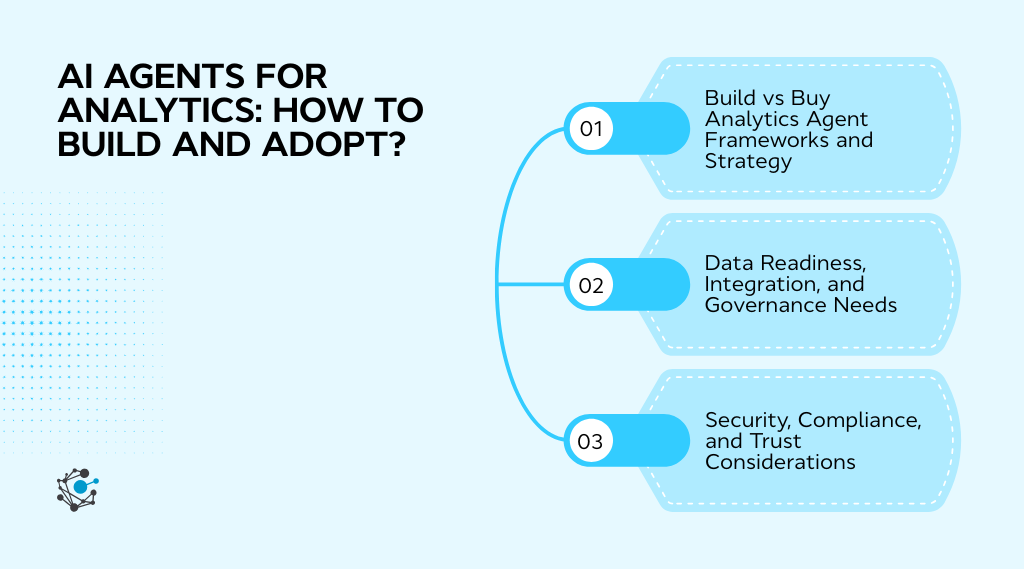
Adopting AI agents for analytics takes more than picking a tool and turning it on. The real work happens in strategy, data readiness, and trust. Teams that rush adoption without these foundations often end up with impressive demos but limited real-world impact.
1. Build vs buy analytics agent frameworks and strategy
Building analytics agents gives teams maximum control. You can tailor behavior, reasoning, logic, and integrations to your exact needs. The trade-off is effort. Teams must design orchestration flows, maintain models, manage security, and continuously refine performance over time.
Buying accelerates time-to-value. Prebuilt analytics agents and platforms handle much of the heavy lifting; however, success depends on how well these tools align with existing data architectures and governance models. Many enterprises take a hybrid approach, combining vendor capabilities with internal customization to balance speed and control.
2. Data readiness, integration, and governance needs
AI analytics agents are only as effective as the data context on which they operate. Accurate metadata, clear lineage, trusted metrics, and seamless integration with existing platforms are non-negotiable. Without this foundation, agents simply scale existing data quality and consistency problems.
This is where enterprise metadata and governance platforms become critical. Adoption is already high in sectors that run on data and analytics.
In fact, OECD reporting on EU 2024 data shows AI use reached around 45% among ICT firms and over 25% in professional, scientific, and technical services.
That makes governance and lineage more of a prerequisite for safe automation.
OvalEdge brings together metadata management, lineage, governance, and AI-driven intelligence into a single foundation. With this unified context in place, analytics agents can operate consistently, interpret data correctly, and respect organizational rules across the enterprise.
Ready to build a trusted foundation for AI analytics? Book a demo to see how OvalEdge helps organizations unify metadata, lineage, governance, and business context for reliable AI analytics.
3. Security, compliance, and trust considerations
Autonomous analysis raises real trust questions. Analytics agents must respect access controls, masking rules, and regulatory requirements at every step. Explainability and audit logs help teams understand how insights were generated and why actions were recommended.
Human oversight remains essential, especially for high-impact decisions. When teams balance autonomy with clear controls and accountability, AI agents become reliable partners rather than sources of risk.
How enterprise analytics stacks evolve with AI agents
As AI agents mature, enterprise analytics stacks do not disappear. They evolve. Instead of replacing existing platforms, organizations layer autonomous capabilities on top of what already works, changing how insights are generated, explained, and acted on.
1. Comparing AI analytics agents to traditional platforms
Traditional BI platforms and AI analytics agents solve different problems. As AI adoption matures, most organizations progress from traditional BI to AI-assisted analytics before adopting fully agentic analytics. Each stage adds new capabilities while building on existing analytics investments.
|
Capability |
Traditional BI |
AI-assisted analytics |
Agentic analytics |
|
Who drives the analysis |
Human-led |
Human-led with AI suggestions |
Agent-led with human oversight |
|
Time to decision |
Days |
Hours to minutes |
Minutes for defined signals |
|
Analyst effort per insight |
High |
Medium |
Low; humans handle exceptions |
|
Posture |
Reactive; shows what happened |
Faster, still query-driven |
Proactive; explains why it happened and what to do next |
|
What it runs on |
Dashboards and reports |
Copilots on top of BI |
Governed metrics, lineage, and business context |
Most enterprises do not replace their existing analytics stack. Instead, they build on it. Dashboards continue to provide visibility, AI-assisted analytics accelerates exploration, and agentic analytics adds continuous monitoring, investigation, and recommendations.
Together, these capabilities help organizations move from reactive reporting to proactive, autonomous decision support.
2. Integration with existing BI, data warehouse, and ETL
Analytics agents sit on top of existing analytics stacks rather than disrupting them. They query data from warehouses, rely on semantic layers to interpret metrics, and respect established ETL pipelines and data flows.
This layered approach protects prior investments while extending analytical capabilities. Teams keep their current tools but gain autonomous analysis, monitoring, and insight generation across the stack.
3. Measuring value and performance in enterprise contexts
The value of AI analytics agents shows up in daily work. Teams spend less time on repetitive analysis. More users engage with analytics confidently. Insights become faster, clearer, and easier to act on.
Tracking time saved, adoption, insight quality, and business impact helps organizations refine agent behavior and scale adoption responsibly.
As analytics stacks evolve, success depends on the foundation beneath the agents. Metadata, lineage, and governance determine whether autonomous analytics scales safely or introduces new risk.
Conclusion
Most analytics challenges come down to trust, context, and time. AI agents can accelerate analysis, but only when they operate on a governed foundation instead of disconnected data.
Before scaling adoption, identify where analytics teams lose time validating numbers, rebuilding reports, or chasing business definitions. Then address the metadata, lineage, and governance gaps that would make an agent guess instead of know.
With a trusted data foundation in place, AI agents can analyze, explain, and act confidently without becoming another source of risk.
OvalEdge helps organizations build that foundation by unifying metadata, governance, lineage, and business context for enterprise AI.

Book a demo to see how governed data enables reliable, scalable AI-driven analytics.
.png?width=1081&height=173&name=Forrester%201%20(1).png)
.png?width=1081&height=241&name=KC%20-%20Logo%201%20(1).png)