.png)
Regional sales began declining just days before a major holiday campaign, forcing analysts to investigate data across multiple systems under tight timelines. The challenge was not a lack of dashboards, but the inability to respond to business signals fast enough.
Business intelligence platforms have helped organizations centralize reporting for years, yet most analytics workflows still rely on static dashboards and reactive reporting cycles.
According to the 2025–2026 Business Intelligence Statistics report by DataStackHub, self-service BI adoption has increased by 31% year-over-year as business teams demand faster access to insights.
Agentic AI for business intelligence is emerging as the next evolution of analytics by enabling autonomous systems that continuously monitor data, surface insights proactively, and recommend actions in real time. Agentic BI changes how organisations interact with analytics systems, but it does not eliminate the need for governance, trusted data, or human oversight.
This guide explores how agentic BI works, its core capabilities, and why governed enterprise data remains essential for trusted AI-driven analytics.
What is agentic AI for business intelligence?
Agentic AI for business intelligence refers to autonomous AI systems that continuously analyze enterprise data, monitor business conditions, generate insights, and recommend actions without relying entirely on manual queries, dashboards, or scheduled reports.
Traditional BI platforms rely heavily on manual analysis and reactive reporting. Agentic BI introduces autonomous monitoring and decision support across operational and analytical systems.
Many AI-enabled BI tools today still function primarily as summarization or query-generation layers. True agentic BI goes beyond basic AI assistance by introducing reasoning, workflow orchestration, contextual memory, and autonomous decision support.
Instead of reacting to reports after issues occur, organizations can use agentic BI to detect risks earlier, automate insight generation, and support faster decision-making.
Agentic BI systems typically combine:
-
AI reasoning engines
-
Conversational analytics
-
Workflow automation
-
Real-time monitoring
-
Metadata intelligence
-
Governance controls
As enterprise data complexity increases across cloud, SaaS, and operational systems, organizations are also prioritizing governance, metadata visibility, and lineage to ensure AI-generated insights remain accurate and trustworthy.
How agentic AI differs from traditional BI and AI-assisted BI
The difference between traditional BI, AI-assisted BI, and agentic BI is not simply the level of automation. It is the role the analytics system plays inside the organization.
|
Capability |
Traditional BI |
AI-Assisted BI |
Agentic BI |
|
Analytics model |
Dashboard-driven |
Prompt-driven |
Autonomous and event-driven |
|
User involvement |
High |
Moderate |
Reduced for routine analysis |
|
Insight discovery |
Manual |
AI-assisted |
Proactive and continuous |
|
Reporting approach |
Scheduled reports |
Conversational summaries |
Real-time monitoring and recommendations |
|
Decision support |
Limited |
Guided insights |
Context-aware recommendations |
|
Workflow automation |
Minimal |
Partial |
Integrated orchestration and automation |
|
Response speed |
Reactive |
Faster exploration |
Continuous operational monitoring |
|
Governance dependency |
Moderate governance requirements |
Requires a trusted semantic context |
Highly dependent on governed, high-quality, and lineage-aware data |
|
Human role |
Report creation and analysis |
Prompting and validation |
Governance, oversight, and strategic interpretation |
For example, instead of identifying customer churn during a quarterly review, agentic BI systems can detect churn risks in real time, explain contributing factors, and trigger retention workflows automatically.
Human oversight remains essential because data governance, compliance validation, and strategic decision-making still require business context and accountability.
How agentic BI transforms traditional analytics workflows
Agentic BI transforms analytics workflows by shifting business intelligence from static, user-driven reporting environments into autonomous systems that proactively analyze, interpret, and respond to changing business conditions.
AI-assisted dashboards vs autonomous analytics
AI-assisted dashboards still operate within traditional analytics models. Users initiate interactions, ask questions, or request summaries from existing reports. While these systems improve accessibility, analysis still depends heavily on human direction and manual investigation.
Common limitations include:
-
Reporting delays affecting operational responsiveness
-
Analysts are overloaded with repetitive requests
-
Business users actively searching for insights instead of receiving proactive guidance
-
Limited ability to identify emerging operational risks continuously
Autonomous analytics changes this model by shifting from human-triggered analysis to event-driven monitoring.
AI agents continuously monitor enterprise metrics, operational events, and KPI fluctuations across systems. Instead of waiting for prompts, these systems proactively detect anomalies, identify patterns, prioritize operational risks, and trigger recommended actions in real time.
This shift helps organizations reduce reporting latency and respond faster to operational disruptions.
According to Accenture’s 2024 enterprise AI research, organizations adopting autonomous AI workflows reported improved responsiveness because systems could identify emerging disruptions earlier than traditional reporting processes.
Several industries are already implementing early forms of autonomous business intelligence:
-
Supply chain systems automatically escalating disruption risks
-
Retail analytics detecting unexpected revenue anomalies
-
Financial systems continuously monitor operational deviations
-
Customer experience platforms proactively identify churn patterns
The operational impact is significant because analytics teams spend less time producing recurring reports and more time focused on strategic decision-making and operational optimization.
From passive reporting to proactive insights
Many analytics environments are optimized for reviewing business performance after events have already occurred, which can slow response times during rapidly changing operational conditions. Teams often spend significant effort consolidating data, interpreting trends, and investigating issues before decisions can be made.
Agentic BI shifts analytics toward continuous intelligence. AI agents monitor enterprise activity in real time, identify anomalies, detect emerging risks, and surface contextual recommendations automatically.
|
For example, financial institutions use AI-driven anomaly detection to flag suspicious transactions before losses escalate, while marketing teams identify declining campaign performance early enough to optimize budgets and engagement strategies. |
This approach helps organizations:
-
Respond to issues faster
-
Improve operational agility
-
Reduce manual analysis effort.
-
Strengthen risk management
-
Increase decision-making speed
As a result, business intelligence evolves from static reporting into continuous, real-time operational monitoring.
Why agentic BI moves beyond visualization into decision support
Many analytics systems are highly effective at presenting data visually, but business teams still carry the responsibility of interpreting events, identifying root causes, and determining appropriate responses.
Even with advanced dashboards and KPI tracking, organizations often face delays between detecting a problem and deciding how to act on it.
Business users still spend time answering questions such as:
-
Why did this metric change?
-
Which operational factors contributed?
-
What actions should teams prioritize?
-
Which departments are affected?
Agentic BI introduces contextual reasoning into analytics workflows. These agentic AI solutions connect operational events, historical behaviors, metadata relationships, and business rules to explain changing conditions and recommend next steps.
|
For instance, instead of only showing declining inventory turnover, the system may identify supplier delays, regional demand shifts, and warehouse constraints simultaneously while suggesting corrective actions. |
As enterprises scale, autonomous analytics improves coordination by delivering prioritized, contextual insights faster than traditional reporting workflows.
However, this shift also increases the risk of poor-quality or poorly governed data because autonomous systems can amplify incorrect insights faster than traditional dashboards.
For example, if different departments define “customer churn” differently or metadata classifications are inconsistent across systems, an AI agent may incorrectly prioritize retention campaigns, escalate the wrong operational risks, or recommend inaccurate forecasting adjustments.
Core capabilities of agentic BI platforms
Agentic BI platforms combine conversational analytics, autonomous monitoring, reasoning capabilities, workflow automation, and contextual intelligence to create more adaptive and scalable analytics environments.
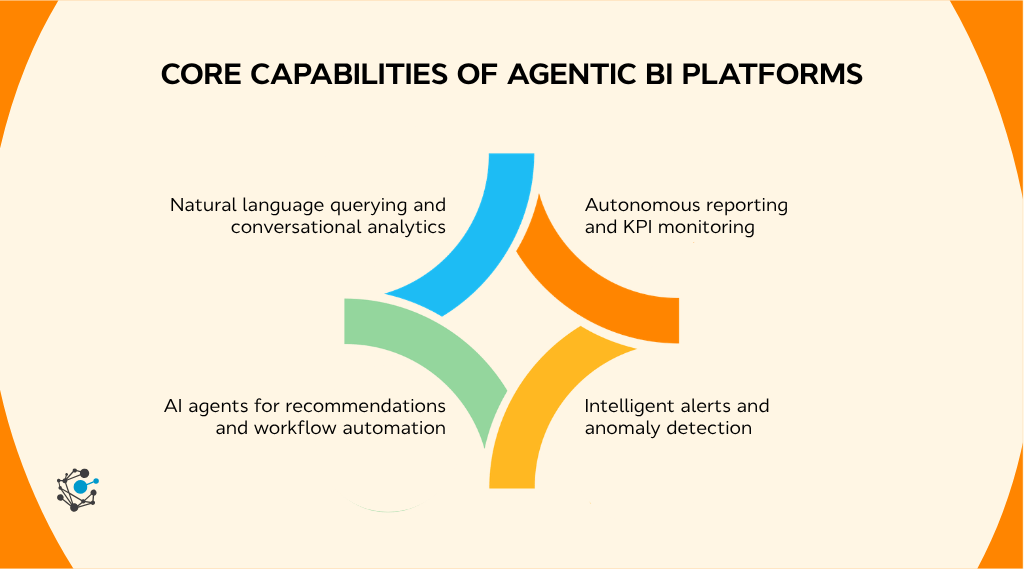
1. Natural language querying and conversational analytics
Conversational analytics enables business users to interact with analytics systems using natural language instead of SQL queries or complex dashboards.
Modern conversational BI capabilities include:
-
Context-aware query interpretation
-
Dynamic summarization
-
Follow-up questioning
-
KPI exploration
-
Business metric explanations
This improves self-service analytics adoption and allows business users to access insights more independently. However, conversational analytics depends heavily on governed semantic context, standardized KPI definitions, business glossary alignment, and metadata consistency to generate accurate and trustworthy responses.
|
For example, A sales manager can ask why quarterly revenue declined in a specific region and receive contextual explanations tied to customer churn, product mix, and operational performance without manually navigating dashboards. |
2. Autonomous reporting and KPI monitoring
AI agents continuously monitor KPIs, generate summaries, and track operational performance without relying on manual reporting cycles.
This includes:
-
Event-driven executive reporting
-
Continuous KPI monitoring
-
Automated operational summaries
-
Real-time anomaly escalation
-
Cross-functional performance tracking
This reduces repetitive reporting effort and helps analytics teams focus more on strategic analysis. It also improves visibility into rapidly changing business conditions through continuous monitoring supported by metadata management, data quality management, and centralized data governance.
|
What this looks like in practice
|
3. Intelligent alerts and anomaly detection
AI agents continuously evaluate enterprise behaviors, thresholds, trends, and operational patterns to identify abnormal business conditions proactively.
These systems commonly monitor:
-
Revenue fluctuations
-
Operational disruptions
-
Financial anomalies
-
Inventory imbalances
-
Forecast deviations
-
Customer behavior changes
Unlike traditional alert systems that generate excessive notifications, agentic BI platforms prioritize alerts using business context, estimated impact, and likely causes. This improves response quality while reducing alert fatigue.
|
For example, manufacturing organizations can identify equipment performance deviations early enough to reduce operational downtime and avoid costly maintenance disruptions. |
4. AI agents for recommendations and workflow automation
Agentic BI platforms support workflow orchestration by allowing AI agents to recommend actions and trigger downstream workflows automatically based on changing business conditions.
This extends analytics into operational execution, improving responsiveness, coordination, and decision-making across enterprise workflows. These workflows become more reliable when supported by governed metadata, data lineage visibility, and enterprise intelligence.
|
For example, systems can initiate customer retention actions when churn risks increase, escalate operational incidents in real time, generate executive KPI briefings automatically, or coordinate supply chain responses during disruptions. |
Why governed data matters for agentic BI
Agentic BI systems depend heavily on semantic consistency, business context, and trusted metadata because AI agents must interpret metrics, relationships, and operational meaning accurately across enterprise systems.
Without strong governance controls, organizations risk introducing conflicting metrics, incomplete context, and unreliable recommendations into autonomous decision-making processes.
Why AI agents need trusted enterprise data
AI agents rely on contextual enterprise intelligence to interpret business activity accurately. This includes business definitions, ownership visibility, stewardship information, usage history, classification metadata, and operational context supported by technologies such as a data catalog and centralized business glossary management.
Poor-quality or inconsistent data increases the risk of inaccurate recommendations, misleading insights, and AI hallucinations. As organizations scale AI-driven analytics, governance maturity, data quality management, and data governance become essential for maintaining analytical trust and operational reliability.
The role of metadata, lineage, and governance
Metadata provides the operational intelligence that autonomous analytics systems use to interpret enterprise data correctly. It helps AI agents understand data relationships, KPI definitions, governance classifications, and business context across systems.
Lineage visibility improves trust by enabling end-to-end traceability across analytics pipelines, helping organizations understand how data moves from source systems into dashboards and AI-generated outputs.
Governance ensures autonomous analytics operate within controlled and auditable frameworks through data quality controls, access management, compliance enforcement, and stewardship accountability.
|
Implementation tip: Enterprise governance platforms such as OvalEdge Data Catalog support these requirements through centralized metadata visibility, lineage tracking, and governance automation. |
How platforms like OvalEdge and askEdgi support trusted AI-driven analytics
As organizations adopt agentic BI, governed data platforms become essential for ensuring AI-generated insights remain accurate, explainable, and operationally trustworthy.
Key capabilities of Ovaledge supporting agentic BI
The following capabilities help platforms like OvalEdge support scalable, trusted, and governance-driven agentic BI environments across enterprise analytics ecosystems.
|
OvalEdge capability |
How it supports autonomous analytics |
|
Metadata management |
Helps AI agents understand business context, KPI definitions, and data relationships |
|
Data catalog |
Centralizes trusted enterprise data assets for analytics and AI workflows |
|
Standardizes enterprise terminology and reduces inconsistent metric interpretation |
|
|
Data lineage |
Enables traceability from source systems to dashboards and AI-generated outputs |
|
Governance workflows |
Supports stewardship accountability, compliance, and policy enforcement |
|
Data quality visibility |
Improves the reliability of AI-generated recommendations and analytics |
|
Access governance |
Helps control access to sensitive enterprise data |
|
Auditability and transparency |
Strengthens explainability for regulated analytics environments |
Best fit: Best suited for enterprises managing large-scale distributed data environments, fragmented KPI definitions, and complex governance requirements across analytics ecosystems. Particularly valuable for organizations building AI-ready metadata foundations, improving lineage visibility, and scaling governed autonomous analytics across departments.
Key capabilities of askEdgi supporting agentic BI
The following capabilities help askEdgi improve conversational analytics, contextual insight discovery, and governed self-service BI experiences across enterprise data environments.
|
askEdgi capability |
How it supports autonomous analytics |
|
Enables natural language interaction with enterprise data |
|
|
Context-aware responses |
Grounds AI-generated insights in governed metadata and business definitions |
|
Self-service analytics |
Reduces dependency on technical teams for routine insight requests |
|
KPI exploration |
Allows users to explore metrics conversationally without dashboards |
|
AI-assisted insight discovery |
Surfaces contextual analytics insights faster |
|
Semantic understanding |
Improves consistency in business metric interpretation |
|
Faster business access to insights |
Helps operational teams respond to issues more quickly |
Best fit: Best suited for organizations expanding self-service analytics and conversational BI adoption across business teams. Particularly valuable for enterprises improving governed insight accessibility while reducing dependency on SQL queries, dashboards, and technical analytics teams.
Together, OvalEdge and askEdgi help enterprises create trusted, scalable, and governance-driven foundations for agentic BI and AI-powered analytics.
Organizations looking to operationalize governed conversational analytics and autonomous BI workflows can book a demo to explore how OvalEdge and askEdgi support trusted AI-powered analytics across enterprise environments.
Challenges and risks of agentic AI in business intelligence
While agentic BI introduces major improvements in analytics automation and decision support, organizations must also address governance, accuracy, security, and operational risks before scaling autonomous analytics initiatives.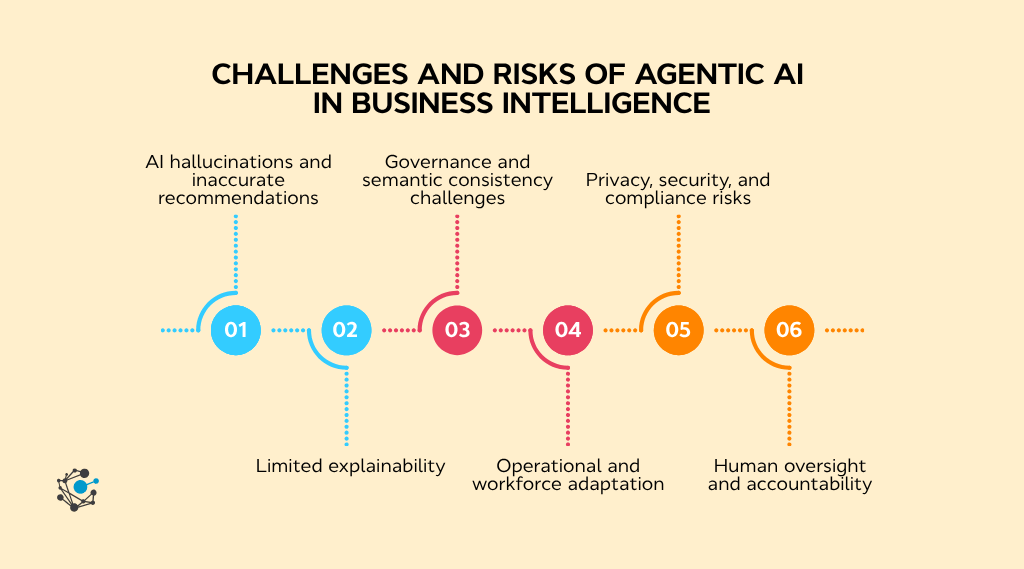
-
AI hallucinations and inaccurate recommendations: Poor-quality or inconsistent enterprise data can lead to misleading insights, incorrect recommendations, and reduced trust in autonomous analytics systems.
-
Limited explainability: Business users and executives may struggle to validate how AI-generated insights were produced, especially when decision logic lacks transparency or lineage visibility.
-
Governance and semantic consistency challenges: Scaling governance across departments becomes more complex as organizations must maintain consistent KPI definitions, metadata standards, stewardship accountability, and policy enforcement.
-
Operational and workforce adaptation: Analytics teams often face challenges transitioning from dashboard creation and manual reporting toward governance, contextual interpretation, and AI oversight responsibilities.
-
Privacy, security, and compliance risks: AI systems operating across enterprise environments require strict access controls, auditability, and data privacy compliance enforcement, especially when handling sensitive financial, healthcare, or customer data.
-
Human oversight and accountability: AI agents should augment analytics operations rather than replace governance accountability entirely. Analysts and governance teams still validate business context, operational impact, and strategic priorities.
Successful organizations, therefore, approach agentic BI as a governed augmentation strategy instead of a fully autonomous replacement model.
Conclusion
Agentic AI is reshaping business intelligence by moving analytics beyond static dashboards toward autonomous, context-aware decision support. As enterprise data complexity grows, organizations are adopting agentic BI to improve operational responsiveness, automate insight generation, and scale analytics more efficiently.
However, successful autonomous analytics still depends heavily on trusted data foundations. Metadata visibility, lineage traceability, governance workflows, and semantic consistency remain essential for ensuring AI-generated insights are accurate, explainable, and reliable.
Platforms like OvalEdge help organizations build these governance foundations through metadata management, data lineage, governance automation, and business glossary alignment.

Conversational analytics capabilities such as askEdgi further improve governed self-service analytics by enabling contextual interaction with trusted enterprise data.

Organizations exploring AI-driven analytics initiatives can also book a demo with OvalEdge to evaluate how governed metadata and conversational analytics support scalable agentic BI adoption.
FAQs
1. Can agentic BI work with existing business intelligence tools?
Yes. Most agentic BI solutions integrate with existing analytics ecosystems, including Tableau, Power BI, cloud warehouses, and enterprise data platforms. Organizations typically enhance their current BI stack with AI agents instead of replacing systems entirely, which helps reduce implementation complexity and improves analytics continuity.
2. What types of enterprise data can agentic BI analyze?
Agentic BI platforms can analyze structured, semi-structured, and operational enterprise data from databases, cloud platforms, CRM systems, ERP applications, and analytics warehouses. Advanced systems also combine historical, real-time, and contextual metadata to generate more accurate and business-aware insights for decision-making.
3. How does agentic BI support executive decision-making?
Agentic BI improves executive visibility by continuously monitoring KPIs, summarizing operational changes, identifying emerging risks, and delivering contextual recommendations. Instead of manually reviewing multiple dashboards, executives receive prioritized insights and business updates that support faster and more informed strategic decisions.
4. What skills do analytics teams need for agentic BI adoption?
Analytics teams need a stronger understanding of AI governance, metadata management, prompt engineering, and workflow orchestration alongside traditional reporting skills. Business communication and contextual interpretation also become increasingly important because teams shift from building dashboards toward validating and operationalizing AI-generated insights.
5. How does agentic BI impact self-service analytics adoption?
Agentic BI lowers technical barriers by enabling conversational analytics and automated insight generation. Business users can interact with data more naturally, reducing dependence on analytics teams for routine reporting requests. This often improves analytics accessibility and encourages broader enterprise-wide adoption of self-service business intelligence.
6. What should enterprises prioritize before scaling agentic BI initiatives?
Organizations should prioritize data quality, governance maturity, metadata visibility, and cross-functional alignment before scaling agentic BI. Enterprises also need clear oversight frameworks for AI-generated recommendations, access controls for sensitive analytics data, and operational processes that ensure accountability across autonomous analytics workflows.
.png?width=1081&height=173&name=Forrester%201%20(1).png)
.png?width=1081&height=241&name=KC%20-%20Logo%201%20(1).png)