.png)
Every support call, live chat, and email thread carries a signal. A billing complaint was raised by three hundred other customers also this month. A required disclosure an agent skipped under time pressure.
A product defect was described in a conversation that never made it into a formal ticket. Multiply those missed signals across thousands of weekly interactions, and the operational cost becomes concrete: retention problems diagnosed late, compliance gaps found in audits instead of in real time, and revenue patterns visible only in hindsight.
Conversation analytics applies artificial intelligence (AI) to that full volume, turning unstructured dialogue into structured, searchable outputs. The technology has matured past keyword spotting into nuanced sentiment, intent, and topic analysis across channels. Making it operationally useful, however, takes more than a transcription engine.
What is conversation analytics?
Conversation analytics is the application of natural language processing (NLP) and machine learning to customer interactions across calls, chats, emails, and social messages, converting unstructured dialogue into structured, searchable insights that customer experience (CX), sales, quality assurance (QA), and compliance teams act on.
A typical QA program reviews 2 to 5 percent of conversations. The remaining 95 percent contains escalation drivers, compliance gaps, and revenue signals that shape retention and regulatory exposure. Conversation analytics closes that visibility gap by processing the full volume continuously across every channel, surfacing patterns that sampling cannot reach.
How conversation analytics works
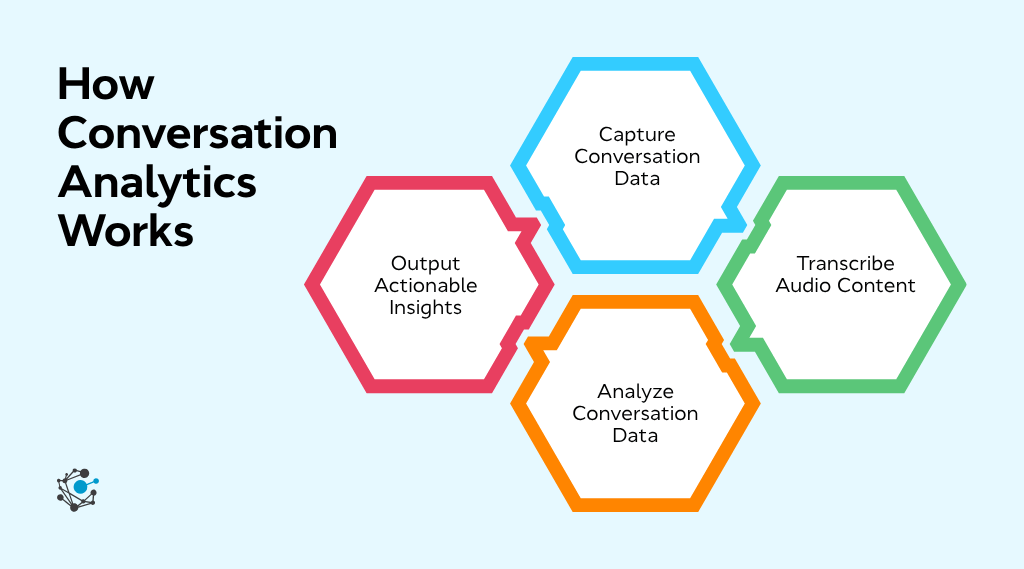
Conversation analytics follows a four-stage pipeline: capture, transcription, analysis, and output. Each stage transforms raw interaction data into progressively more structured insight.
1. Capture
Conversations arrive from phone systems, chat platforms, email servers, and social messaging channels. Each interaction carries metadata (timestamp, channel, agent ID, customer ID, session duration) that connects the unstructured content to its operational context.
2. Transcription
Automatic speech recognition (ASR) converts audio into text. Enterprise-grade ASR engines handle multiple languages, accents, overlapping speakers, and background noise, though accuracy still varies with call quality and domain-specific vocabulary. Teams in regulated industries often need custom vocabulary training to handle sector-specific terminology reliably.
3. Analysis
NLP models process the transcribed and written text across several dimensions simultaneously. Sentiment scoring identifies emotional shifts throughout a conversation, flagging points where frustration spikes or satisfaction drops. Intent classifiers determine what the customer is trying to accomplish, whether that is cancellation, upgrade, dispute, or inquiry.
Named entity recognition extracts product names, account references, and compliance-relevant terms. Topic clustering groups conversations by theme across large volumes, operating in a similar way to how metadata analytics surfaces patterns across structured datasets, except the source material is unstructured dialogue.
4. Output
Results surface through dashboards, alerts, agent scorecards, and exportable datasets. Systems that integrate findings into existing CRM records, QA scoring platforms, and coaching tools drive higher adoption than standalone reporting layers, because insights reach the teams that act on them without an extra step.
Teams evaluating how self-service analytics for customer service connects to conversation data often start here, at the output stage, where integration gaps become visible.
Conversation analytics vs speech analytics
Speech analytics analyzes voice calls for keywords, acoustic tone, and call-level sentiment. Conversation analytics covers voice alongside chat, email, and social messaging, adding intent classification, topic clustering, and cross-channel pattern detection that speech analytics does not support.
Where the distinction shows up operationally
A financial services firm handling a fee dispute illustrates the gap. A speech-only tool might show that call sentiment dropped on Tuesday. A cross-system analytics approach shows that the drop started in chat on Monday when the customer first questioned the charge, escalated to phone on Tuesday when the agent could not explain the fee structure, and generated a complaint email by Wednesday. The root cause (a poorly communicated policy change) surfaces only when every channel feeds the same analysis layer.
Organizations cataloging this conversation data alongside transactional records in a data catalog gain a single searchable inventory of both structured and unstructured datasets.
Quick comparison
|
Aspect |
Conversation Analytics |
Speech Analytics |
|
Channels |
Voice, chat, email, social messaging |
Voice calls only |
|
Data type |
Text and audio |
Audio only |
|
Analysis depth |
Sentiment, intent, topic clustering, cross-channel patterns |
Keywords, tone, call-level sentiment |
|
Interaction context |
Multi-channel customer journey |
Single-call |
|
Primary use cases |
CX, QA, sales intelligence, compliance |
Call-center QA, call handling |
When speech analytics is still sufficient
Outbound sales call centers focused on script adherence and talk-to-listen ratios operate well within speech-only tooling. Regulated advisory lines in insurance and wealth management, where every client interaction happens by phone and requires call recording, often need speech analytics depth (silence detection, acoustic stress scoring) more than cross-channel breadth.
Use cases for conversation analytics
The strongest applications fall into four categories. Each produces different outputs for different teams, but all draw from the same underlying pipeline.
Contact center optimization
Conversation analytics helps support leaders identify which issues drive the highest contact volumes, which agent responses lead to first-call resolution, and where interactions stall. The operational shift is moving from reviewing a sample of calls to seeing patterns across every interaction, making it possible to isolate the specific resolution pathways that reduce repeat contacts.
A healthcare payer processing claims inquiries, for example, can identify that a specific explanation-of-benefits (EOB) format generates a disproportionate share of calls. Without full-coverage analysis, that pattern stays buried in unreviewed transcripts. With it, the operations team routes the finding to the product team, and the call volume drops at the source. The downstream effect is measurable: shorter average handle times, fewer repeat contacts on the same issue, and coaching programs built on proven resolution pathways.
Sales intelligence
Sales teams use conversation analytics to understand which messages lead to conversion and which questions stall deals. The analysis identifies objection patterns across deal stages, detects product or pricing questions that signal purchase intent, and surfaces the behavioral differences between top-performing and average representatives.
In B2B software sales, teams often discover that high-converting representatives ask a small set of diagnostic questions early in the conversation that average performers skip. Once those questions are identified, sales enablement teams can build structured coaching programs around them, track adoption across the team, and correlate question usage with pipeline progression and close rates.
Voice-of-customer feedback loops
Conversation analytics captures customer feedback from everyday interactions rather than waiting for survey responses. Customers describe feature gaps, expectations, and frustrations during support calls and chats long before they respond to a feedback form, creating a faster loop between customer need and organizational response.
A retail organization tracking post-purchase calls can surface that a specific return policy creates confusion across hundreds of interactions, route that signal to the policy governance team within days, and measure whether the policy change resolves the contact pattern. Survey-dependent programs surface the same signal weeks later, if at all.
The operational advantage is cycle time: product and CX teams receive structured, volume-weighted feedback continuously instead of waiting for quarterly survey analysis.
Compliance and risk monitoring
Conversation analytics supports compliance teams by scanning every interaction for required disclosures, policy violations, and suspicious behavior. In regulated industries (financial services, healthcare, insurance), this replaces sample-based quality assurance with continuous monitoring, shifting detection from post-audit discovery to real-time identification.
A financial services compliance team can verify script adherence across every advisory call, detect unauthorized product recommendations automatically, and flag interactions where agents skip required risk disclosures. The operational change is coverage and speed: violations that previously surfaced during quarterly audits now trigger alerts within hours, giving compliance officers time to remediate before regulatory exposure compounds.
Organizations operating under GDPR, CCPA, or HIPAA requirements benefit from platforms where data privacy and compliance controls, including classification, redaction, and audit trails, are built into the analytics pipeline rather than applied after the fact.
How to choose the right conversation analytics tool
Choosing the right conversation analytics tool starts with matching the platform category to the team's primary use case rather than comparing feature lists across mismatched tools. Conversation analytics platforms fall into four categories, and starting with the wrong one leads to a poor fit regardless of individual capabilities.
|
Category |
Built for |
Representative capabilities |
|
Contact center analytics |
Voice and digital channels, QA, real-time coaching |
Full-channel transcription, agent scoring, real-time alerts, compliance flagging |
|
Sales conversation intelligence |
Recorded sales calls, deal coaching, revenue insights |
Deal analysis, competitive mention tracking, talk-to-listen ratios, CRM integration |
|
CX and voice-of-customer analytics |
Multi-channel sentiment, theme clustering, VoC programs |
Topic clustering, sentiment trending, survey integration, product feedback routing |
|
Customer support analytics |
Ticket and chat analysis, support quality scoring |
Ticket tagging, chat sentiment, resolution tracking, backlog analysis |
Evaluating transcription accuracy in production
Transcription accuracy should be tested on real calls from the team's actual environment, not on vendor-supplied demo audio. Production environments contain background noise, accents, crosstalk, and domain-specific jargon that degrade performance significantly below published benchmarks.
An insurance company evaluating tools for claims call analysis, for example, will find that medical terminology, policy-specific codes, and regional accents produce materially different accuracy from what the demo suggested. The only reliable evaluation is a controlled test with custom vocabulary training enabled for industry terms.
Evaluating integration depth
A conversation analytics platform should push findings into the systems teams already use, not require teams to check a separate dashboard. Evaluation should focus on whether insights flow into CRM records for sales, QA scorecards for contact centers, coaching tools for managers, and ticketing systems for support.
Platforms with broad connector coverage across data sources reduce the integration effort that otherwise stalls rollouts.
Evaluating governance controls
Every conversation analytics platform should support redaction, encryption at rest and in transit, configurable retention policies, and exportable audit trails before it reaches the evaluation shortlist. Conversations contain personally identifiable information (PII), protected health information (PHI), and payment card data by default, which means any platform analyzing that data inherits the same regulatory requirements as the source systems.
Teams in financial services and healthcare should verify redaction reliability on real conversation samples before committing.
Running a pilot that produces a real signal
A 30-day pilot on real conversation data, not curated samples, is the most reliable evaluation method. Score each platform on three dimensions: transcription accuracy against the team's actual audio conditions, quality of automated topic clustering and insight generation, and integration ease with existing workflows. Vendor claims based on demo-quality audio rarely reflect production conditions.
Conversation analytics vs conversational analytics
Conversation analytics processes customer dialogue across calls, chats, and email to extract operational insights. Conversational analytics refers to platforms that enable teams to query enterprise data across systems using natural language, asking questions of governed datasets rather than analyzing customer interactions.
The tools, data inputs, and use cases differ entirely, though the naming overlap causes confusion during procurement.
Common challenges in conversation analytics
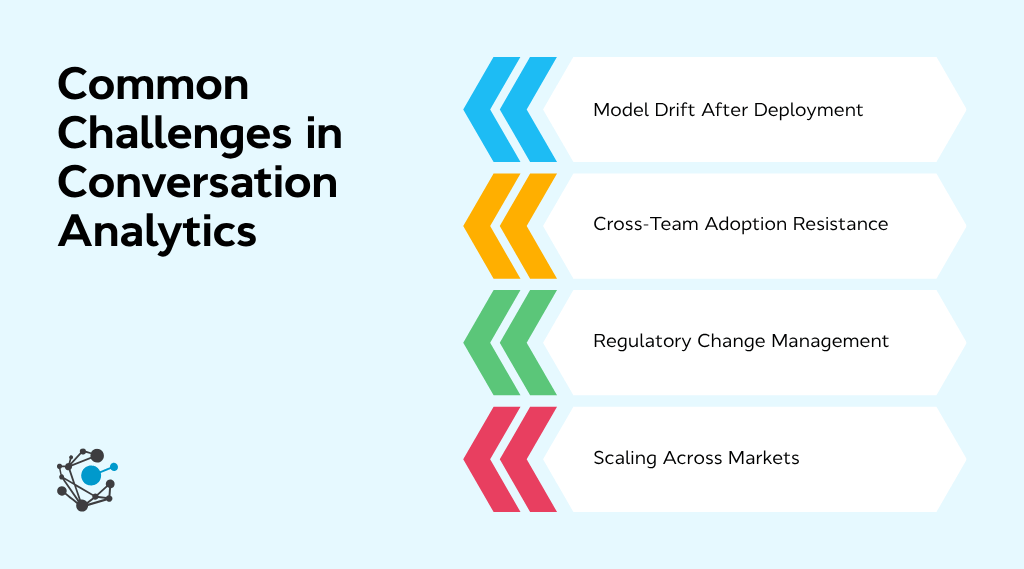
Most conversation analytics failures happen after deployment, not during evaluation. The platform works in the pilot, but operational value stalls when these post-implementation obstacles go unaddressed.
Model drift after deployment
Conversation analytics models degrade as products change, customer vocabulary shifts, and new issues emerge that the original training data did not cover. A fintech company that trained its intent classifier on pre-launch support calls will find that post-launch conversations introduce terminology and complaint patterns the model has never seen.
Tying a quarterly retraining cycle to product release milestones keeps classification accuracy aligned with actual customer language.
Cross-team adoption resistance
Conversation analytics generates value only when frontline teams act on the outputs. A platform configured for one team's workflow often fails to serve others, and the gap widens without shared context for what the outputs mean. Organizations that invest in data literacy programs alongside analytics deployment close that gap by equipping frontline teams to interpret and act on conversation-derived insights independently.
Regulatory change management
Privacy regulations evolve continuously, and conversation analytics pipelines must evolve with them. A healthcare organization that configured redaction rules for one set of PHI patterns at launch may find that expanding HIPAA enforcement, new state-level privacy laws, or updated FCC recording-consent rules require a broader redaction scope within months.
Automated governance agents that continuously reclassify and retag data as regulatory definitions change reduce the manual overhead of maintaining compliance across evolving requirements.
Scaling across languages and markets
Multinational organizations expanding conversation analytics beyond their primary market discover that models trained on one language perform poorly in others. An APAC expansion for a global insurance company, for example, requires separate vocabulary training, regionally calibrated sentiment models, and market-specific compliance rule sets that the original English-language deployment did not anticipate.
Planning for multi-language support during platform selection rather than retrofitting after deployment reduces rework significantly.
Why conversation analytics implementations fail
Most conversation analytics failures happen after deployment, not during evaluation. The platform works in the pilot, but operational value stalls when these post-implementation obstacles go unaddressed.
Conversation analytics model accuracy degrades over time
Conversation analytics models degrade as products change, customer language shifts, and new issues emerge that the original training data did not cover. A fintech company that trained its intent classifier on pre-launch support calls will find that post-launch conversations introduce complaint patterns and product references the model has never seen.
The degradation is gradual, which makes it dangerous: teams continue relying on outputs without realizing that classification accuracy has drifted below actionable thresholds. Tying a quarterly model review to product release milestones keeps intent and topic classification aligned with how customers actually speak.
Conversation analytics adoption stalls without cross-team alignment
Conversation analytics generates value only when frontline teams act on the outputs. A platform configured for one team's workflow often fails to serve others, and the gap widens without shared context for what the outputs mean. Organizations that invest in data literacy programs alongside analytics deployment close that gap by equipping frontline teams to interpret and act on conversation-derived insights independently.
Keeping conversation analytics pipelines compliant as regulations change
Privacy regulations evolve continuously, and conversation analytics pipelines must evolve with them. A banking institution that configured call recording consent rules for federal requirements at launch may find that new state-level biometric privacy laws and updated consumer protection mandates require broader consent collection and different data handling protocols within months.
Automated governance agents that continuously reclassify and retag data as regulatory definitions change reduce the manual overhead of keeping compliance configurations current across jurisdictions.
Scaling conversation analytics across languages and markets
Multinational organizations expanding conversation analytics beyond their primary market discover that models trained on one language perform poorly in others. An APAC expansion for a global insurance company, for example, requires separate vocabulary training, regionally calibrated sentiment models, and market-specific compliance rule sets that the original English-language deployment did not anticipate.
Each market also introduces different call recording consent requirements and data residency rules that affect where conversation data can be stored and processed.
Data governance for conversation analytics pipelines
Conversation analytics pipelines inherit every compliance obligation that applies to the source data they process, because sensitive customer information flows through them by default.
Classifying sensitive data in conversation analytics
Conversation data contains sensitive information (account numbers, health details, payment references) scattered unpredictably through free-form dialogue rather than stored in defined database fields. Pattern matching catches recognizable formats like credit card and Social Security numbers, but unstructured references that follow no fixed format require ML-based detection to classify reliably.
AI-powered classification using ML classifiers and configurable policies automates this detection across conversation datasets at scale. According to the Forrester TEI, organizations using this approach reduced the effort required to find, tag, and secure sensitive data by up to 75 percent.
Why data lineage matters for conversation analytics
Data lineage for conversation analytics traces every insight from its source conversations through transformation and scoring to its final reporting destination, giving compliance and analytics teams an auditable chain for every metric.
Without that chain, a compliance team investigating a flagged sentiment score has no way to determine which original conversations were included, whether redaction was applied correctly, or whether the scoring model was current. Source-to-consumption lineage derived from source code parsing maps these data flows from raw ingestion through processing to final consumption, with no manual mapping required.
Connecting conversation data to the enterprise data estate
Conversation analytics datasets need the same classification, access, and lineage governance as structured business data, applied through a unified framework rather than managed in isolation.
Unified data governance platforms like OvalEdge connect conversation data flows into the same Enterprise Context Graph that governs transactional and operational data, applying consistent controls across structured and unstructured sources. According to the Forrester TEI, organizations using this unified approach reduced the effort required to catalog metadata and fulfill data requests by up to 40 percent.
Conclusion
Conversation analytics helps teams understand what customers are saying across calls, chats, and emails. Start with one clear goal, such as improving support, finding common complaints, or checking if teams follow the right process. Use real customer conversations, track the results, and make sure the right teams can act on what they find.
As this data grows, it also needs clear rules for access, privacy, and tracking. OvalEdge helps teams manage conversation data along with the rest of their business data in one place.
Book a demo with OvalEdge to see how you can manage conversation data better, keep it secure, and make it easier for teams to use.
.png?width=1081&height=173&name=Forrester%201%20(1).png)
.png?width=1081&height=241&name=KC%20-%20Logo%201%20(1).png)