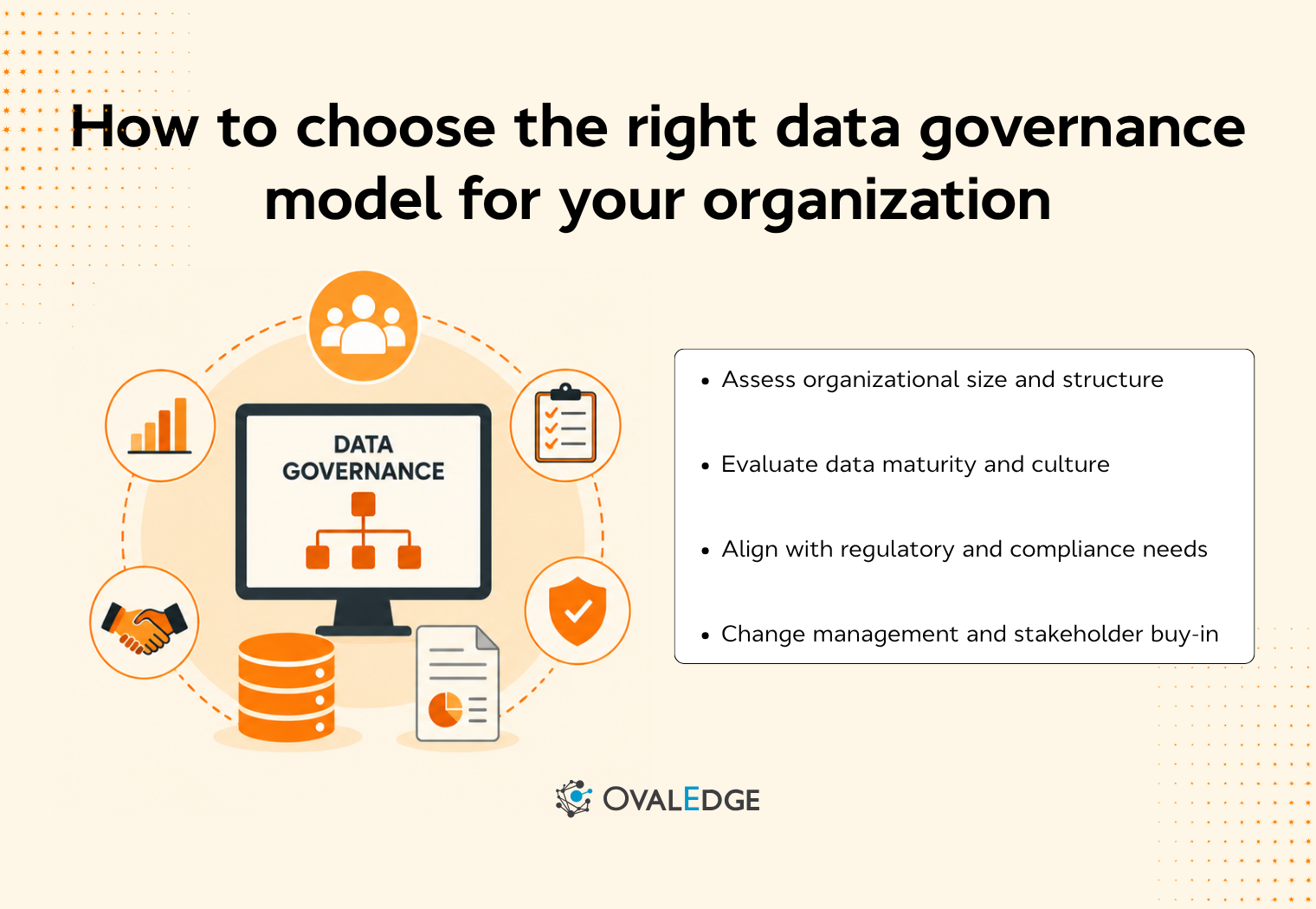
A data governance model is the operating structure an organization uses to decide who owns data, who enforces policy, and how those decisions actually get made, typically centralized, decentralized, or federated. Get the model wrong, and the policy stays a slide deck no one follows.
Most decisions happen in executive rooms, driven by compliance pressure or audit findings, with little input from the teams expected to apply the model daily. On paper, that feels efficient. In practice, it creates resistance and slow adoption.
As per Dresner Advisory Services' 2024 Data and Analytics Governance Study, 53% of organizations centralize governance, 31% use a hybrid approach, and 16% run a distributed model, yet structure alone doesn't guarantee success.
Choosing the right data governance model demands an honest read of decision rights, ownership, technical maturity, regulatory exposure, and cultural readiness. This blog breaks down the major models and how to pick the right fit.
What is a data governance model?
A data governance model defines how an organization governs data by assigning ownership, decision rights, and enforcement mechanisms across teams and systems.
The model determines who sets data policies, who manages data quality, and how compliance, access, and accountability are maintained at scale.
Common structures include centralized, decentralized, and federated models, each balancing control and flexibility differently.
The right data governance model aligns governance responsibilities with organizational structure, data maturity, and regulatory requirements to ensure trusted, compliant, and usable data across the enterprise.
Types of data governance models
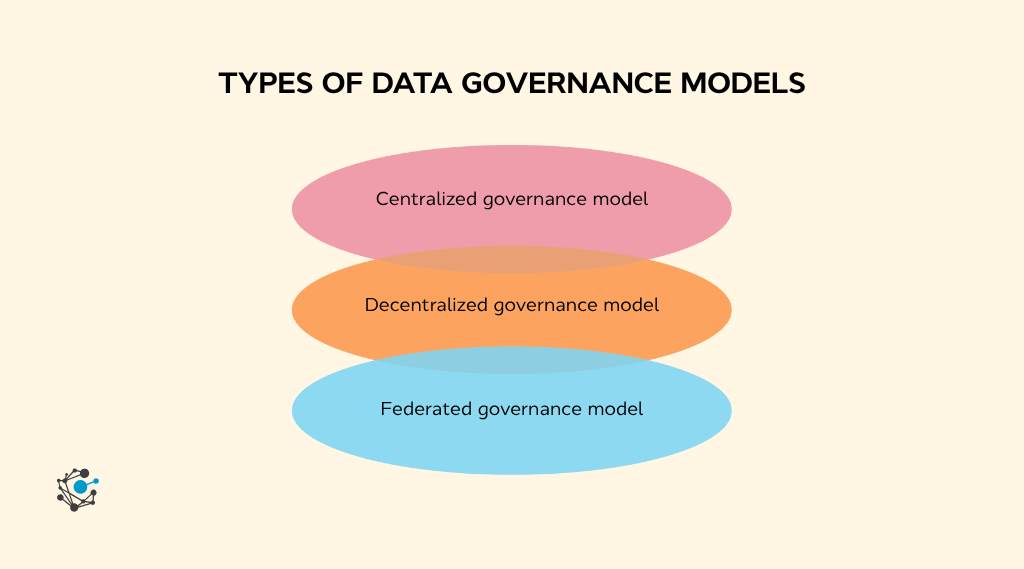
Most organizations structure data governance using one of three operating models:
-
Centralized
-
Decentralized, or
-
Federated
These models are not theoretical. They determine who defines data policies, who enforces them, and how consistency and accountability are maintained across systems.
Each model reflects a different way of assigning authority, ownership, and accountability for data assets. The right choice depends on organizational complexity, regulatory requirements, and how data flows through business operations.
1. Centralized governance model
A centralized data governance model places decision-making authority within a single enterprise function, such as a data governance office or a team led by a Chief Data Officer.
This team is responsible for defining and enforcing data policies, managing stewardship roles, and ensuring consistent data quality across the organization.
In this model, ownership of data standards, classification rules, and access controls is consolidated, often under corporate IT or enterprise data strategy teams. Centralization supports a strong compliance posture, as it allows for unified policy interpretation and easier auditability.
This model is most effective in organizations with highly regulated environments or low data maturity.
|
For example, global banks operating under strict frameworks like Basel III and SOX often use centralized governance to ensure consistency across all lines of business. Likewise, hospitals managing electronic health records under HIPAA benefit from centralized control over patient data access and classification. |
However, centralization has limits. Local teams may face slower response times for data access or clarification, and without stakeholder input, the model can feel restrictive, especially in fast-moving or product-led environments. Governance risks becoming a bottleneck, pushing teams toward shadow data practices outside approved systems.
Centralized governance only works if operational capacity keeps up with review demand. Without streamlined approval workflows, it tends to collapse under its own weight, driving business units to bypass it rather than wait weeks for decisions.
This is why many organizations eventually shift toward federated or hybrid models once centralized teams can no longer scale oversight effectively.
2. Decentralized (Business-led) governance model
In a decentralized governance model, responsibilities sit directly within business units. Each team manages its own data lifecycle, defining how data is collected, classified, accessed, and maintained, with a central team offering only loose oversight while decision authority stays with the domains.
This model supports speed, agility, and domain expertise. In fast-scaling SaaS companies or digital-native retailers, it lets product teams iterate quickly on analytics and automation, with Marketing managing its own segmentation models and Finance owning its reporting hierarchies.
But decentralization carries risk. Without strong alignment mechanisms, policies diverge: departments may define customer data differently, apply conflicting retention rules, or build duplicative dashboards that produce inconsistent KPIs. Data silos deepen, and interoperability suffers.
Organizations that pull this off tend to have mature data cultures, strong department-level accountability, and enterprise architecture that supports coordination without central control. Without those conditions, decentralized governance can erode data quality and weaken trust in reporting.
3. Federated (Hybrid) governance model
The federated governance model blends centralized standards with decentralized execution, making it the most scalable choice for complex, matrixed organizations where business units need autonomy but must still meet enterprise-wide compliance.
A central council sets high-level policies, classifications, and compliance guidelines, while domains implement them to fit their operations. Domain-level stewards handle day-to-day governance, and the central team ensures alignment, monitors compliance, and enables execution through tools and training. This model is widely adopted across global enterprises.
|
A multinational logistics company, for instance, may establish global standards for inventory data but allow each regional office to define warehouse-level processes. Similarly, telecom operators use federated governance to coordinate customer data policies across marketing, billing, and network operations. |
Federated models are especially well-suited to organizations building out data mesh architectures, which emphasize domain ownership of data products within a centralized governance framework.
This model supports faster innovation while preserving trust, as it embeds governance directly into the workflows of those closest to the data.
Still, federated governance requires significant investment in coordination. It only works when roles and responsibilities are clearly defined, and when enterprise tools like data catalogs, lineage platforms, and access control systems can support policy enforcement across domains. For a deeper look at how to balance control with scale, see federated data governance.
Without operational integration, federated models risk drifting toward decentralization, with all its downsides.
At a glance: how the three models compare
Seen side by side, the trade-offs between the three models become easier to weigh.
|
Dimension |
Centralized |
Decentralized |
Federated |
|
Decision authority |
Central team sets and enforces governance |
Business units control their own data decisions |
Central council sets standards; domains execute them |
|
Compliance strength |
High, with consistent controls and auditability |
Lower, with greater risk of inconsistent controls |
High when standards and domain accountability are enforced |
|
Speed and agility |
Lower because decisions route through a central team |
High because teams can act independently |
Balanced because domains operate within shared guardrails |
|
Best fit |
Regulated industries, smaller organizations, or lower governance maturity |
Fast-moving organizations with strong domain ownership |
Large, complex enterprises with distributed data ownership |
|
Main risk |
Bottlenecks and shadow data practices |
Silos, conflicting definitions, and duplicated work |
Weak execution can cause governance to become fragmented |
None of these models is universally right. The best fit depends on where your organization sits in terms of size, maturity, and regulatory exposure, which is exactly what the next section walks through.
Core components of an effective data governance model
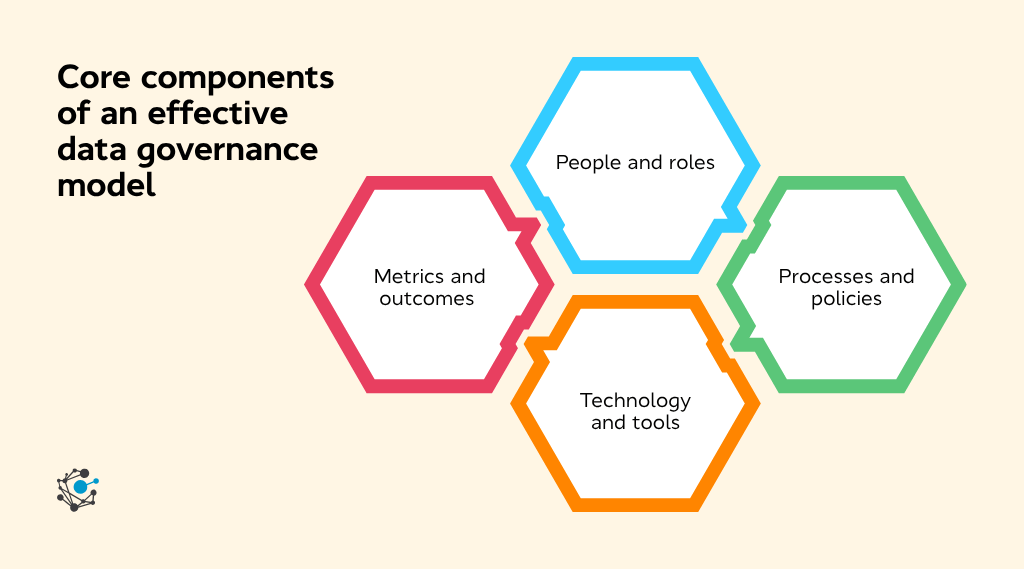
Regardless of whether your organization follows a centralized, decentralized, or federated model, successful data governance depends on four foundational pillars.
These components are the operational engine behind every governance initiative. Without them, even the best-designed model will falter in execution.
Each element plays a distinct role in creating accountability, enforcing policies, and ensuring that governance delivers measurable business value.
1. People and roles
The most common breakdown in data governance isn't technical. It's human. Without clearly defined roles and responsibilities, ownership becomes ambiguous, and governance policies are inconsistently applied.
That's why the first component of any data governance model is the formal assignment of roles.
A mature model includes:
-
Data owners: Accountable for specific datasets
-
Data stewards: Oversee the day-to-day quality and usability of data
-
Custodians: Manage infrastructure-level access and security
A cross-functional governance council often coordinates priorities across departments. A key challenge here is role clarity across matrixed organizations.
|
For example, if marketing and sales both rely on customer data but have no shared steward, inconsistencies in definitions and usage can create reporting conflicts. |
Role charters and RACI matrices are commonly used to clarify who decides, who executes, and who reviews at each stage of the data lifecycle.
Successful governance models include role alignment across both business and IT, ensuring that policy design and implementation stay connected to real operational needs.
2. Processes and policies
Well-defined processes are what turn governance from an abstract concept into repeatable, enforceable action. These include workflows for how data is accessed, classified, reviewed for quality, and monitored for issues. They also define how policies are created, updated, and sunsetted.
|
For example, a well-governed organization will have documented procedures for requesting access to sensitive data, with automated approvals based on role-based access control. It will also have a formal data issue resolution process with service-level agreements tied to incident types. |
One major pain point is policy sprawl: dozens of overlapping or outdated documents scattered across disconnected systems. Modern governance needs centralized policy repositories, regular reviews, and checkpoints built into data pipelines.
This gap between intent and execution shows up even in mature programs. Per Deloitte's 2026 federal CDO research, 85% of government data leaders call governance a top priority, yet 57% still struggle to mature it, proof that prioritizing governance and operationalizing it are different problems.
As data grows, governance must scale too, tracking granular policies, enabling smarter access controls, and enforcing quality standards. Organizations with automated policy enforcement are far more resilient in audits and regulatory reviews.
3. Technology and tools
While governance isn't tool-driven, technology operationalizes it at scale. Data catalogs, metadata management, lineage tools, and access controls turn policy into daily execution.
A data catalog like OvalEdge moves teams from abstract policy to action, unifying metadata so users can find trusted data, see ownership, and spot policy constraints before consumption, reducing friction between governance and business teams.
OvalEdge tracks schema changes, lineage shifts, and usage signals, giving teams the visibility to manage data responsibly as AI grows and to support compliance like GDPR and CCPA.
Isolated tools for access, quality, and lineage often cause duplicated work and inconsistent enforcement. OvalEdge unifies these in one platform, with prebuilt connectors across databases, data lakes, BI tools, and SaaS apps, ensuring governance flows wherever data lives, from Snowflake to Salesforce.
4. Metrics and outcomes
Governance without measurement is just policy on paper. To evaluate a model's effectiveness, organizations must track KPIs tied to both data quality and business performance.
Common governance KPIs include:
-
Percentage of critical datasets with assigned owners or stewards
-
Time to resolve data quality issues
-
Policy compliance rates by domain or system
-
Data access requests approved or denied within SLA
-
Audit readiness scores based on lineage completeness or classification accuracy
Organizations that treat these as operational metrics, not compliance afterthoughts, build stronger governance cultures. Enterprises that regularly monitor these KPIs are far more likely to maintain audit readiness and regulatory alignment over time.
But tracking alone isn't enough. Mature governance teams use these insights to continuously improve policies, workflows, and training, closing the loop between governance design and operational impact.
How to choose the right data governance model for your organization
Choosing a data governance model is not a one-time architectural decision. It's a strategic alignment exercise, matching how your organization manages accountability, risk, and growth with how it wants to govern data.
Many governance models fail not because the structure is wrong, but because it doesn't reflect how the organization actually functions.
The right model depends on more than size. It requires an honest evaluation of operational complexity, data culture, compliance risk, and stakeholder readiness. Below are four key lenses to guide this choice.
1. Assess organizational size and structure
Your operating model shapes how data flows. Smaller organizations with centralized reporting lines and limited systems often benefit from a centralized governance model.
It allows a single team to enforce standards, own stewardship, and manage compliance across all data assets with minimal overhead.
As organizations scale across regions, functions, or product lines, centralized governance tends to become a bottleneck. That's where federated models gain relevance.
|
For instance, an enterprise-scale organization's data governance strategy allows local teams to innovate within predefined global guardrails. This structure supports both accountability and autonomy by distributing governance roles without sacrificing enterprise-wide alignment. |
A matrixed enterprise with regional hubs, shared services, and multiple data platforms will struggle under a fully centralized model.
Without local decision rights, policies often fail to translate into action. A federated model allows business units to tailor governance to their context while still adhering to shared principles.
2. Evaluate data maturity and culture
Data maturity plays a critical role in governance success. Organizations early in their journey typically lack standard data definitions, ownership structures, and quality controls, so centralized governance is often the best starting point, helping establish foundational processes, define roles, and introduce basic accountability.
As maturity grows, marked by data catalogs, stewardship programs, and quality metrics, centralized control can start to hinder scale. Mature organizations with embedded ownership, trained stewards, and documented workflows are better suited for federated or business-led models.
Cultural alignment matters just as much. A governance model only works if it fits how the company actually makes decisions. Organizations with strong central control adapt quickly to centralized models, while entrepreneurial, product-led cultures often resist them and do better with federated or decentralized approaches built on local ownership and lightweight controls.
Running a structured data maturity assessment before finalizing your model ensures it fits both current capabilities and long-term goals, and feeds directly into your broader data governance strategy.
3. Align with regulatory and compliance needs
Governance isn't just about data quality. In regulated industries, it's also a legal and operational requirement.
Companies in financial services, healthcare, or government sectors often start with centralized governance to ensure strict compliance with regulations like GDPR, HIPAA, or Basel III.
Centralization enables clear accountability and traceability, both of which are essential during audits or investigations.
|
For example, a global pharmaceutical company subject to FDA reporting requirements might centralize policy enforcement, metadata standards, and lineage documentation to meet inspection-readiness criteria. |
That said, centralized control doesn't mean federated models are off the table. They can work, but only if compliance responsibilities are clearly defined and monitored across domains.
A federated model in a regulated environment requires strong oversight from a central council, along with consistent tooling for access control, retention, and policy enforcement.
The key is to define which aspects of governance must remain centralized, like compliance audits and regulatory reporting, and which can be adapted locally, such as metadata tagging or dashboard design.
4. Change management and stakeholder buy-in
Governance isn't a software implementation; it's a behavior shift. Even the best model fails without stakeholder support, executive sponsorship, and embedded incentives.
Most models fail as top-down mandates with little input from execution teams, making business units see governance as restrictive. Start with a targeted pilot where poor data quality caused visible pain, like failed campaigns or compliance fines, then expand from that win.
Transparency matters: stakeholders need to know not just what's changing but why, framed around less rework, faster insights, and lower risk. Align governance KPIs with business metrics, and let domain stewards help shape implementation, not just enforce it.
Successful models are co-created, not dictated. Embedding governance into existing decision-making, tools, and incentives drives higher adoption and lasting impact.
How AI agents change the governance model calculus
AI agents don't wait for a change request. They query data, generate summaries, and increasingly write back to systems in real time, which means your governance model now has to define machine-level access rights, not just human ones.
Centralized models tend to bottleneck AI adoption fastest, because every new agent integration route goes through the same policy team. Federated models generally adapt better: the central council defines what agents are allowed to see and do, and domain stewards enforce it against their own data, using tools built for AI agent data governance automation that can tell the difference between a person's access and an AI agent's access at the row and column level.
Whichever model you run, the newer governance question isn't only who owns the data. It's what an AI agent acting on someone's behalf is allowed to touch, and whether you can prove that after the fact.
Conclusion
Choosing a data governance model deserves the same scrutiny as selecting enterprise tools. Yet while vendors and architectures get evaluated in detail, governance models are often adopted based on trends or executive preference, creating structural risk.
A governance model defines decision rights, accountability, and enforcement patterns, shaping how data work happens across the organization. Unlike tools, it can't be swapped yearly without disrupting ownership, processes, and trust. The "try-and-buy" approach works for software; it fails for operating models, since each shift resets roles and expectations and creates fatigue among the teams depending on it.
Vet the model against organizational structure, data maturity, regulatory obligations, and cultural readiness. Be explicit about what stays centralized and where autonomy is required.
A well-chosen model doesn't chase flexibility; it creates stability that lets data, teams, and trust scale together.
Book a data governance demo to operationalize the right governance model for your organization.
.png?width=1081&height=173&name=Forrester%201%20(1).png)
.png?width=1081&height=241&name=KC%20-%20Logo%201%20(1).png)