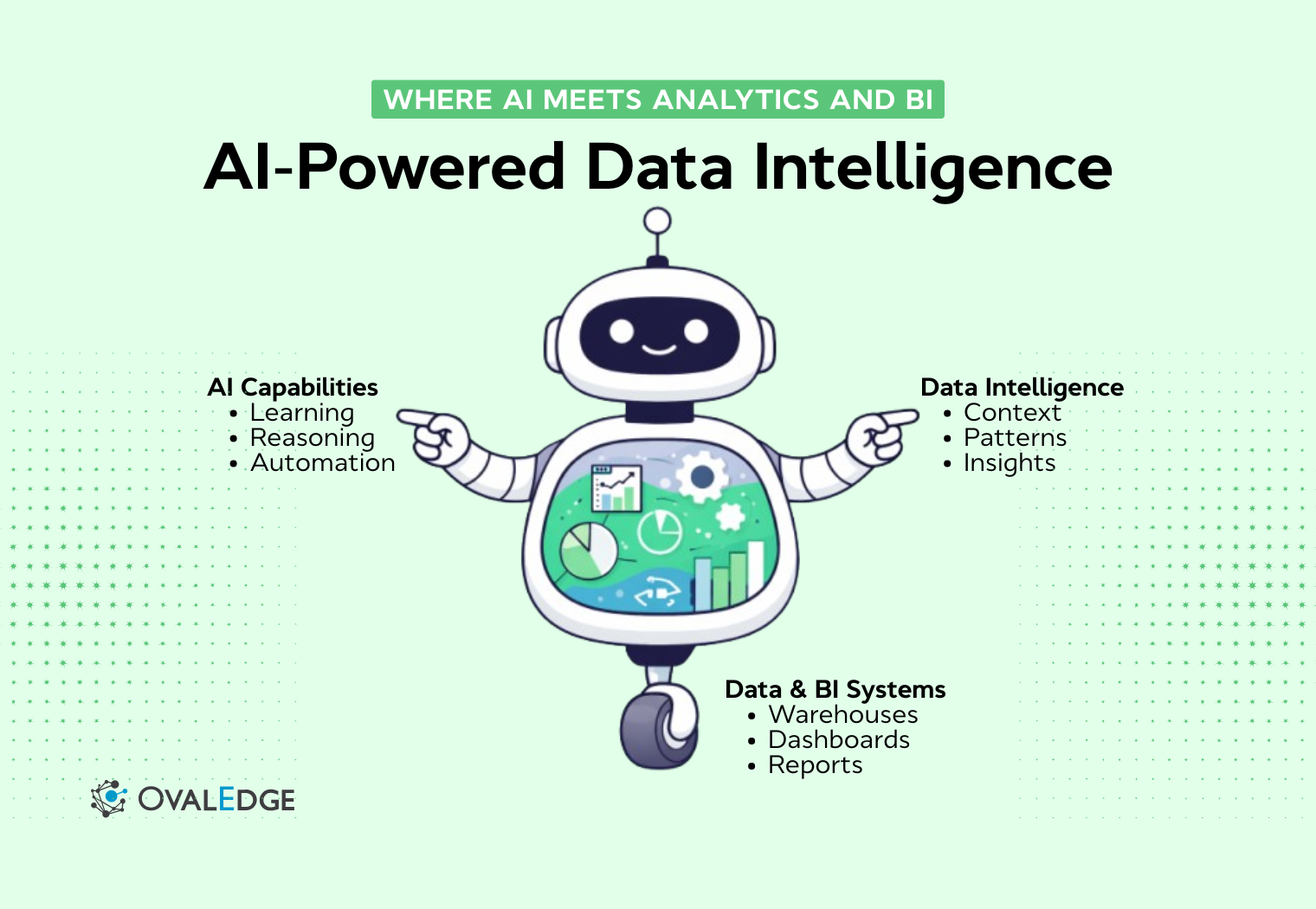
Many organizations have invested in AI tools and upskilled their teams, yet still face challenges when it comes to using data for confident decision-making. Insights often arrive too late, definitions remain inconsistent, and trust in data can break down at critical moments.
This challenge is widely recognized.
According to Gartner’s 2025 report “Lack of AI-Ready Data Puts AI Projects at Risk”, organizations will abandon 60% of AI projects that are not supported by AI-ready data.
This highlights how gaps in data readiness continue to limit the value of analytics and AI initiatives.
This is where AI initiatives tend to stall. In many cases, the issue is not the technology itself, but the underlying data foundation required to support consistent and reliable decisions. This shift is accelerating into 2026, where the gap between organizations that trust their data and those that don’t is becoming visible in business outcomes.
This guide explains how AI-powered data intelligence works in practice, what differentiates leading platforms, and where it delivers measurable value. It also examines how these capabilities integrate with BI systems and the key challenges organizations must address to scale them responsibly.
What is AI-powered data intelligence?
In many organizations, decisions are delayed because insights depend on manual reporting cycles. Data must be prepared, validated, and aligned across teams before it can be used, which means business teams often act after the moment to influence outcomes has already passed.
AI-powered data intelligence changes this by shifting analytics from periodic reporting to continuous insight generation. Instead of waiting for reports, it analyzes data as it moves through the business and surfaces relevant insights in real time.
This enables teams to detect anomalies earlier, identify trends as they emerge, and respond faster to changing conditions without relying on manual intervention.
The shift is clear. Before, decisions waited for reports. After, insights surface automatically and leaders act in time to change outcomes.
This transition is already underway. A 2025 Gartner press release mentions that 75% of new analytics content will be generated using GenAI by 2027, accelerating the move toward more contextual and action-oriented intelligence.
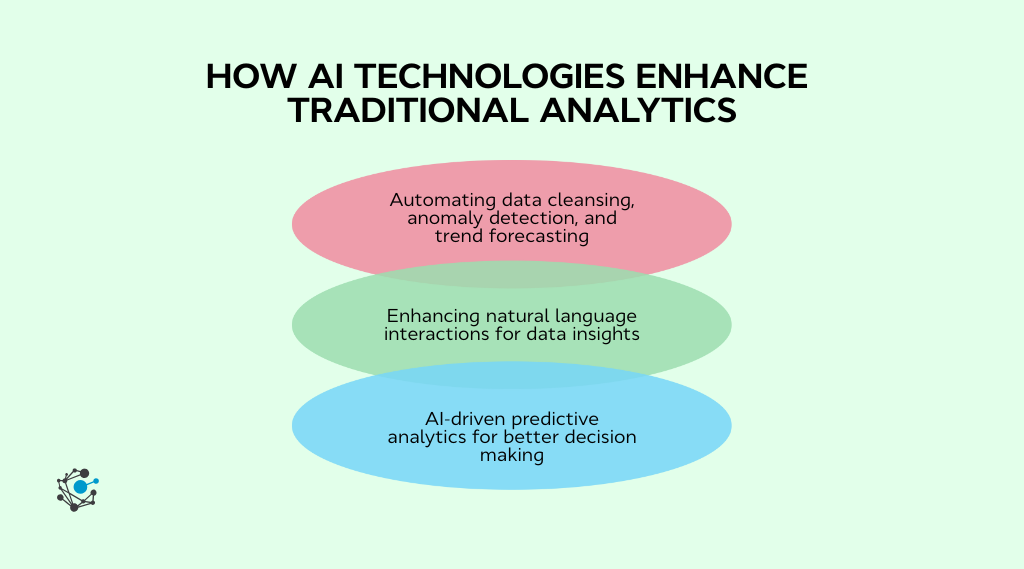
How AI technologies enhance traditional analytics
Traditional analytics was built to explain what has already happened. AI-powered data intelligence shifts the focus to what’s happening now and what’s likely to happen next, by automating the most time-consuming parts of analysis and surfacing insights continuously.
Instead of relying on manual preparation and static dashboards, AI works alongside analytics teams to deliver faster, more reliable answers at scale.
What this looks like in practice
In many organizations, AI tools are already in place, but analysts still spend significant time preparing and validating data before it can be used. Reports are delayed, and when they are delivered, business teams often question the results due to inconsistent definitions and data quality issues.
As a result, decision-making slows down. Teams wait for validation instead of acting, and opportunities are missed because insights arrive too late to influence outcomes.
|
How organizations operationalize this with platforms like OvalEdge
A leading entertainment group faced similar challenges, with thousands of inconsistent reports and conflicting definitions that made it difficult for leadership to trust the data. By standardizing definitions and consolidating reports, they improved data clarity and enabled more reliable decision-making. Once the data foundation was strengthened, the same AI capabilities began delivering measurable value. Analysts shifted from data preparation to analysis and interpretation. Anomalies were identified early through automated monitoring, and insights could be acted on without repeated validation. The result is a fundamental shift. Insights are no longer delayed by manual processes, and teams can act faster with greater confidence. |
Automating data cleansing, anomaly detection, and trend forecasting
Traditional analytics often stalls at the data preparation stage. Analysts spend hours fixing missing values, resolving duplicates, and validating inconsistencies before analysis even begins.
And it’s not just a workflow annoyance; IBM’s 2024 press release “Data Suggests Growth in Enterprise Adoption of AI is Due to Widespread Deployment by Early Adopters” highlights that data complexity (25%) and limited AI skills (33%) are among the top barriers holding enterprises back from successful AI adoption, which is exactly why automation and governed data foundations matter
AI changes this dynamic by automating data cleansing across large datasets, identifying errors early, and suggesting fixes before flawed data reaches dashboards. Anomaly detection adds another layer of intelligence. AI-powered systems continuously monitor metrics and spot deviations that are easy to miss in manual reviews.
Trend forecasting builds on this foundation. By analyzing historical data alongside real-time signals, AI improves forecast accuracy and shortens response times. Leaders gain earlier visibility into revenue trends, capacity constraints, and operational risks, allowing teams to act before issues become costly.
Enhancing natural language interactions for data insights
Natural language querying removes one of the biggest barriers to analytics adoption. Instead of navigating dashboards or submitting requests to analysts, users simply ask questions in everyday language.
Questions like “Why did customer churn increase last month?” or “Which products are underperforming this quarter?” receive immediate, contextual responses. Context-aware AI makes these interactions reliable. Systems interpret intent, recognize business terminology, and align answers with governed definitions.
This reduces confusion and increases trust in results. Conversational data insights also support follow-up questions, allowing users to explore data naturally without starting over. Platforms that combine NLP and large language models make analytics accessible to sales, marketing, and operations teams, without compromising governance or accuracy.
AI-driven predictive analytics for better decision making
Predictive analytics sits at the core of AI-powered data intelligence. AI models analyze historical patterns to forecast outcomes across revenue, demand, risk, and performance metrics. Real-time forecasting continuously updates these predictions as new data arrives.
Decision-making improves as AI uncovers relationships and signals that manual analysis often misses. For instance, cross-domain correlations become visible earlier, warning signs emerge faster, and leaders make decisions with greater confidence, supported by insights that evolve alongside the business.
|
Did you know? According to Gartner’s 2025 press release, 50% of business decisions will be augmented or automated by AI agents by 2027, which raises the bar for real-time, trusted analytics across the enterprise. |
Commercial AI-powered platforms and their integration with BI systems
As AI-powered data intelligence becomes mainstream, organizations are evaluating how platforms fit into their data stack and integrate with existing BI systems. Some platforms operate at the analytics layer, while others focus on the foundation layer, ensuring data quality and governance.
Most organizations need both, but without a strong data foundation, even advanced analytics tools cannot deliver consistent, actionable insights.
The platforms below illustrate how these capabilities come together across different layers of the data stack.
1. OvalEdge
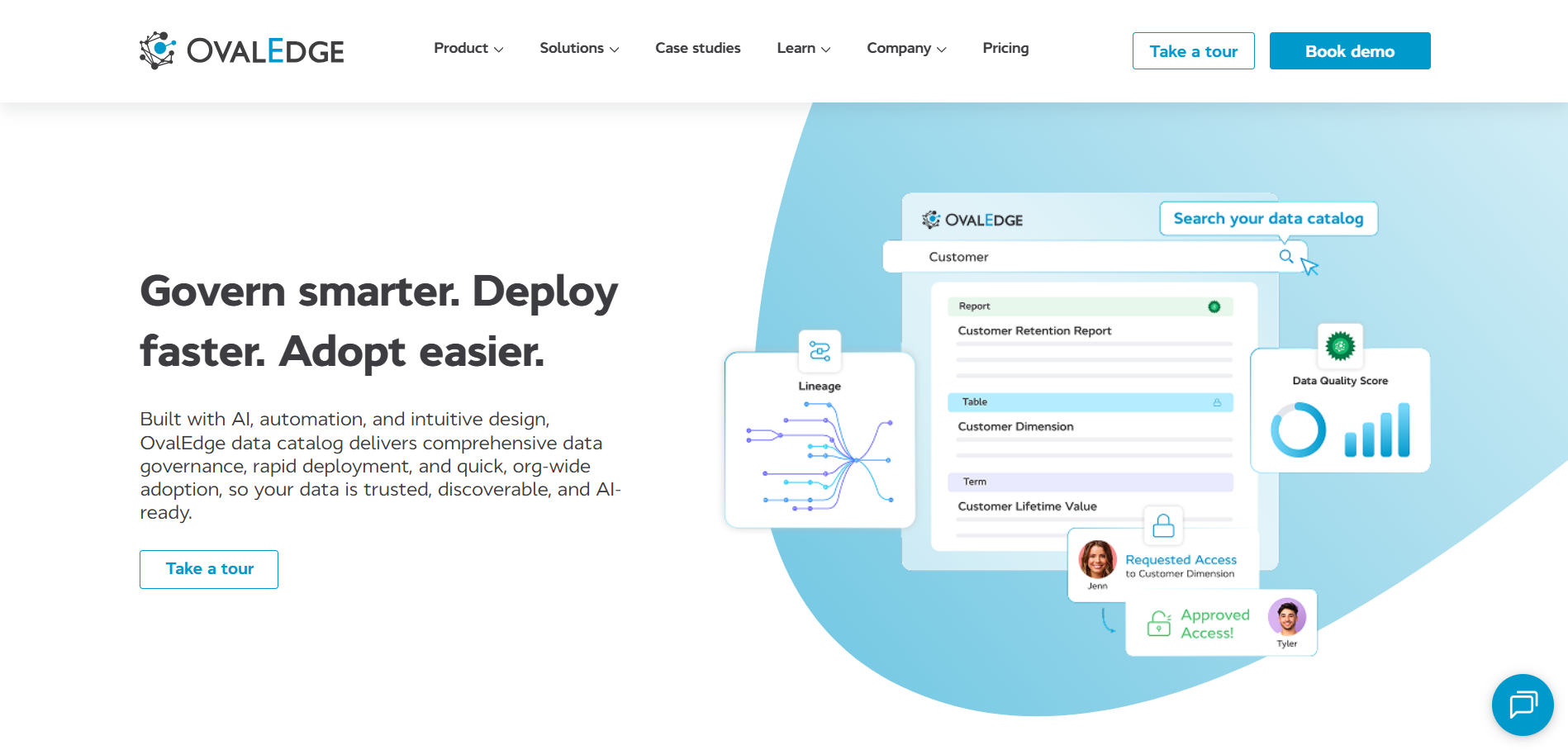
OvalEdge focuses on the foundation layer of AI-powered data intelligence. It ensures that data is understood, governed, and reliable before it is used by AI and BI tools.
Rather than replacing analytics platforms, OvalEdge strengthens them by improving data quality, standardizing definitions, and providing full visibility into how data flows across systems. This allows organizations to scale AI-driven insights with confidence, especially in environments where accuracy, transparency, and compliance are critical.
Core strengths:
-
Data governance and metadata management: Provides a centralized, business-friendly view of data assets, helping teams maintain data quality, consistency, and regulatory compliance.
-
Automated data lineage: Tracks how data moves and transforms across systems, giving full visibility into dependencies and downstream impact.
-
AI-driven insights: Applies machine learning to surface meaningful trends and anomalies across large datasets, making analysis faster and more actionable.
-
Self-service analytics: Enables business users to explore and understand data independently, reducing reliance on IT and analytics teams.
-
Collaboration and workflow automation: Integrates with tools like Slack and Microsoft Teams to streamline communication and approvals around data initiatives.
-
Anomaly detection: Continuously monitors data behavior to identify unusual patterns before they affect reports or decisions.
-
Data quality management: Proactively detects and resolves data issues, ensuring AI and analytics operate on trusted information.
For teams exploring AI-powered data intelligence, OvalEdge offers a practical starting point by aligning governance, data quality, and AI-driven insights in one platform. It’s especially relevant for organizations that want to move faster with AI, without compromising trust, transparency, or compliance.
Schedule a demo today and see how OvalEdge supports AI-powered data intelligence in practice.
2. ThoughtSpot
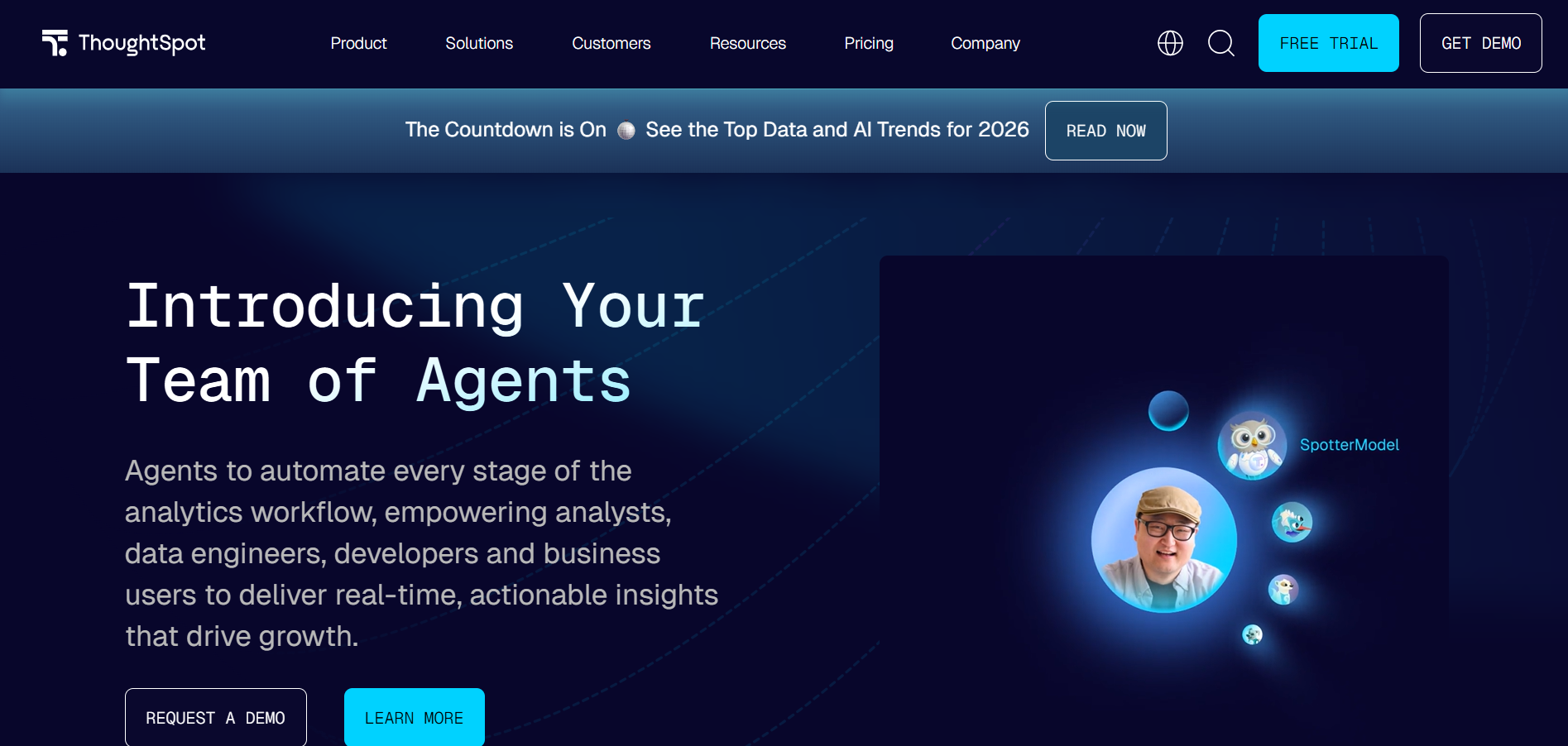
ThoughtSpot takes a search-first approach to analytics, making data exploration accessible beyond technical teams. Users interact with data through natural language, receiving instant insights without relying on predefined dashboards. The platform complements existing BI tools by accelerating discovery and insight generation.
Core strengths:
-
Search-driven analytics: Allows users to query data using natural language, making exploration intuitive and fast.
-
AI-powered recommendations: Surfaces insights automatically based on user behavior and data patterns.
-
Real-time visualizations: Generates charts and visuals instantly to support quick interpretation.
-
Automated insights: Applies machine learning to uncover hidden trends and correlations.
-
Enterprise scalability: Supports large datasets and broad user adoption across organizations.
3. Sisense
Sisense focuses on embedding analytics directly into applications and workflows where decisions happen. Instead of sending users to separate BI tools, it delivers insights in context. This approach works especially well for product teams and customer-facing analytics use cases.
Core strengths:
-
Embedded analytics: Integrates AI-powered insights directly into applications and digital products.
-
Data integration pipelines: Connects data from cloud platforms, on-prem systems, and APIs.
-
Machine learning models: Apply AI and ML to generate predictive and prescriptive insights.
-
Customizable dashboards: Allow teams to tailor visualizations to specific business needs.
-
Collaboration features: Supports shared analysis through annotations and shared reports.
4. IBM Watson Analytics
IBM Watson Analytics emphasizes AI-driven data discovery and ease of use. It helps teams explore complex datasets without deep technical expertise by combining predictive analytics with natural language interaction. The platform supports organizations looking to operationalize AI insights quickly.
Core strengths:
-
Predictive analytics: Uses machine learning to forecast trends and model future outcomes.
-
Natural language processing: Enables conversational querying for faster data exploration.
-
Automated data preparation: Cleans, normalizes, and integrates data with minimal manual effort.
-
Advanced visualization: Translates complex data into clear, interpretable visuals.
-
Automated insight generation: Highlights key trends, drivers, and anomalies automatically.
5. Microsoft Power BI
Microsoft Power BI extends traditional BI with embedded AI capabilities while integrating tightly with the Microsoft ecosystem. It enhances reporting with predictive insights and automation, making analytics more proactive. Power BI works best for organizations already invested in Microsoft tools.
Core strengths:
-
AI-powered visualizations: Adds forecasting and anomaly detection directly into reports.
-
Cognitive services integration: Enables advanced AI features such as sentiment analysis and image recognition.
-
Data modeling and transformation: Uses Power Query to prepare data for analytics and AI workflows.
-
Natural language querying: Allows users to ask questions in plain English.
-
Real-time analytics: Supports live dashboards for operational monitoring and alerts.
6. TIBCO Spotfire
TIBCO Spotfire combines advanced analytics with interactive visual exploration. It supports complex, data-intensive use cases that require predictive modeling and real-time analysis. The platform is widely used in industries that depend on time-sensitive and geospatial data.
Core strengths:
-
Data discovery and visualization: Enables interactive exploration through intuitive visuals.
-
Embedded machine learning: Integrates ML models directly into analytics workflows.
-
Advanced analytics: Supports statistical analysis, trend modeling, and time-series forecasting.
-
Geospatial analytics: Helps teams analyze and visualize location-based data.
-
Automation and collaboration: Streamlines workflows and supports shared decision-making.
What is changing in 2026
AI-powered data intelligence is moving beyond generating insights to taking actions automatically. Decisions that once required human review are increasingly being executed by AI systems in real time. Without strong governance, this shift introduces significant risk, as errors can scale as quickly as insights.
At the same time, regulations around data usage, privacy, and accountability are tightening. Organizations without clear data lineage, ownership, and auditability will face growing compliance challenges as AI adoption expands.
The gap between organizations with a governed data foundation and those without is also becoming more visible. Companies with reliable, well-structured data are already seeing faster decisions and more consistent outcomes, while others continue to struggle with trust and delays.
2026 is the point where this difference starts to show up clearly in business performance, not just in technical capability.
Benefits of AI-powered data intelligence for analyst workloads
As data volumes grow and expectations increase, many organizations find that insights still take too long to act on. Delays in validation, inconsistent definitions, and manual workflows slow decision-making and reduce confidence in outcomes.
AI-powered data intelligence changes this by improving how quickly and reliably decisions can be made across the business.
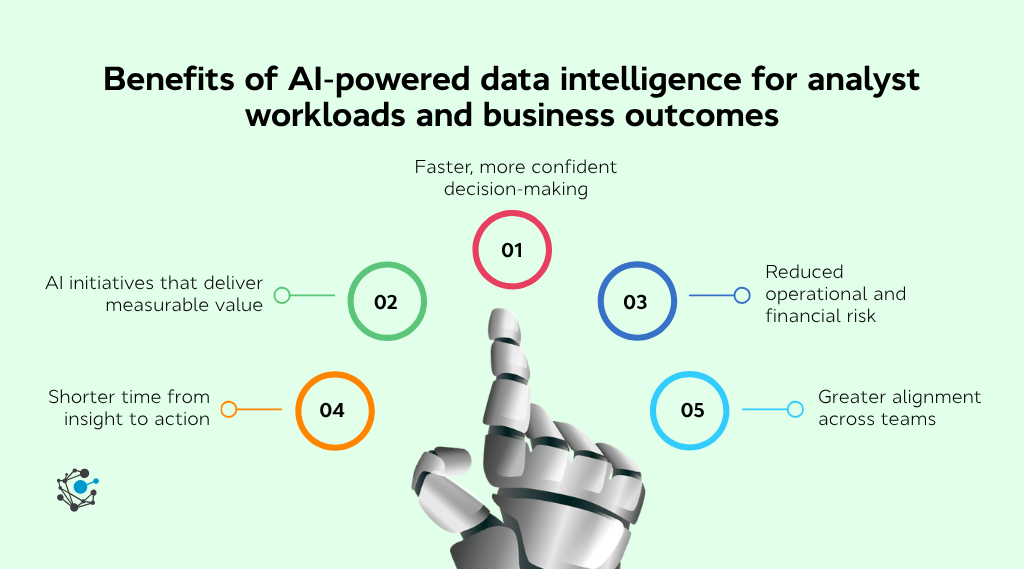
Key business outcomes include:
-
Faster, more confident decision-making: Leaders no longer have to wait for data validation or reconciliation before acting. Insights are delivered with context and consistency, enabling decisions to be made in time to influence outcomes.
-
AI initiatives that deliver measurable value: Many AI projects stall due to unreliable data. With consistent definitions and improved data quality, AI models produce outputs that teams can trust and use.
-
Reduced operational and financial risk: Early detection of anomalies and inconsistencies helps prevent errors from escalating into costly issues, whether in revenue forecasting, compliance, or operations.
-
Shorter time from insight to action: Insights are surfaced continuously, not just through scheduled reports, allowing teams to respond immediately to changes in performance, demand, or risk.
-
Greater alignment across teams: Standardized definitions and governed data reduce conflicting reports and rework, ensuring that business and analytics teams operate from the same version of truth.
As a result, organizations move from delayed, reactive decision-making to a more proactive and reliable approach, where insights directly support business outcomes at scale.
Challenges and ethical considerations in AI-powered data intelligence
As organizations adopt AI-powered data intelligence at scale, the focus can’t stay on speed and automation alone. Trust, fairness, and accountability play an equally important role, especially when AI-driven insights influence high-impact business decisions.
Addressing these challenges early helps organizations scale AI responsibly while maintaining confidence across teams and stakeholders. Key challenges and considerations include:
-
Bias in AI models: AI systems learn from historical data, and biased data can lead to biased outcomes. Regular model audits, diverse training datasets, and human-in-the-loop validation help reduce risk and improve fairness.
-
Data privacy and security: AI-powered analytics often process sensitive information, making strong access controls, encryption, and compliance frameworks essential to protect data.
-
Data governance and compliance: Clear data ownership, lineage visibility, and quality standards ensure AI operates on reliable inputs and meets regulatory requirements.
-
Transparency and explainability: Users need to understand how AI-generated insights are produced. Explainable AI, traceable logic, and clear documentation build confidence and accountability.
When these challenges are addressed through strong governance and transparency, AI-powered data intelligence becomes far more sustainable. Platforms like OvalEdge help organizations align governance, data quality, and AI insights in one place, making it easier to scale intelligence responsibly while maintaining trust.
Conclusion
Most data teams struggle because insights still arrive too late to change outcomes. Manual data preparation, inconsistent definitions, and slow analytics keep organizations reacting to problems instead of leading with confidence.
The next step is building a data intelligence foundation where AI operates with trust, context, and clarity. That starts with understanding where data breaks down today, which workflows benefit most from automation, and how governance and AI can work together rather than compete.
This is typically where OvalEdge starts with teams. Conversations focus on your current data landscape, governance maturity, and analytics goals. From there, OvalEdge helps map how metadata, lineage, data quality, and AI-driven insights can work together to support faster, more confident decision-making, without disrupting existing BI investments.
If you’re exploring how to make AI-powered data intelligence practical and scalable in your organization, the simplest next step is to talk it through. Schedule a demo with OvalEdge to see how governed, AI-driven data intelligence can support your goals.
FAQs
1. Why do most AI analytics projects fail to deliver results?
Most AI projects fail because the data behind them isn’t reliable or consistent. Models may be technically sound, but if definitions vary across teams or data quality issues go unresolved, outputs can’t be trusted. As a result, teams hesitate to act on insights, and AI becomes an experiment instead of a decision-making tool.
2. What needs to be in place before AI tools can work effectively?
AI tools depend on a strong data foundation. This includes consistent definitions, clear ownership, reliable data quality, and visibility into how data flows across systems. Without these elements, AI outputs remain inconsistent and difficult to trust. Getting this foundation right is often the difference between stalled initiatives and measurable business impact.
3. How do I know if our data foundation is the problem?
Look for signs such as conflicting reports across teams, frequent rework before decisions, or delays caused by data validation. If leadership questions numbers before acting, or if analysts spend more time fixing data than analyzing it, the issue is likely not the tools but the underlying data foundation.
4. What is the difference between a data governance platform and a BI tool?
BI tools focus on analyzing and visualizing data to generate insights. Data governance platforms focus on ensuring that the data behind those insights is accurate, consistent, and well-defined. One helps you explore data, the other ensures you can trust it. Most organizations need both, but governance typically needs to come first.
5. How long before we see business impact from AI-powered data intelligence?
The timeline depends on how mature your data foundation is. Organizations with well-governed, high-quality data can start seeing improvements in decision speed and confidence within weeks. If foundational issues exist, initial efforts will focus on fixing data quality and consistency before AI-driven insights begin to deliver meaningful results.
6. What should a decision maker ask when evaluating platforms in this space?
Focus on how the platform improves data reliability and decision-making, not just features. Ask how it handles data quality, enforces consistent definitions, provides lineage visibility, and integrates with existing systems. Most importantly, assess whether it helps teams trust and act on insights faster, because that is where real business value comes from.
.png?width=1081&height=173&name=Forrester%201%20(1).png)
.png?width=1081&height=241&name=KC%20-%20Logo%201%20(1).png)