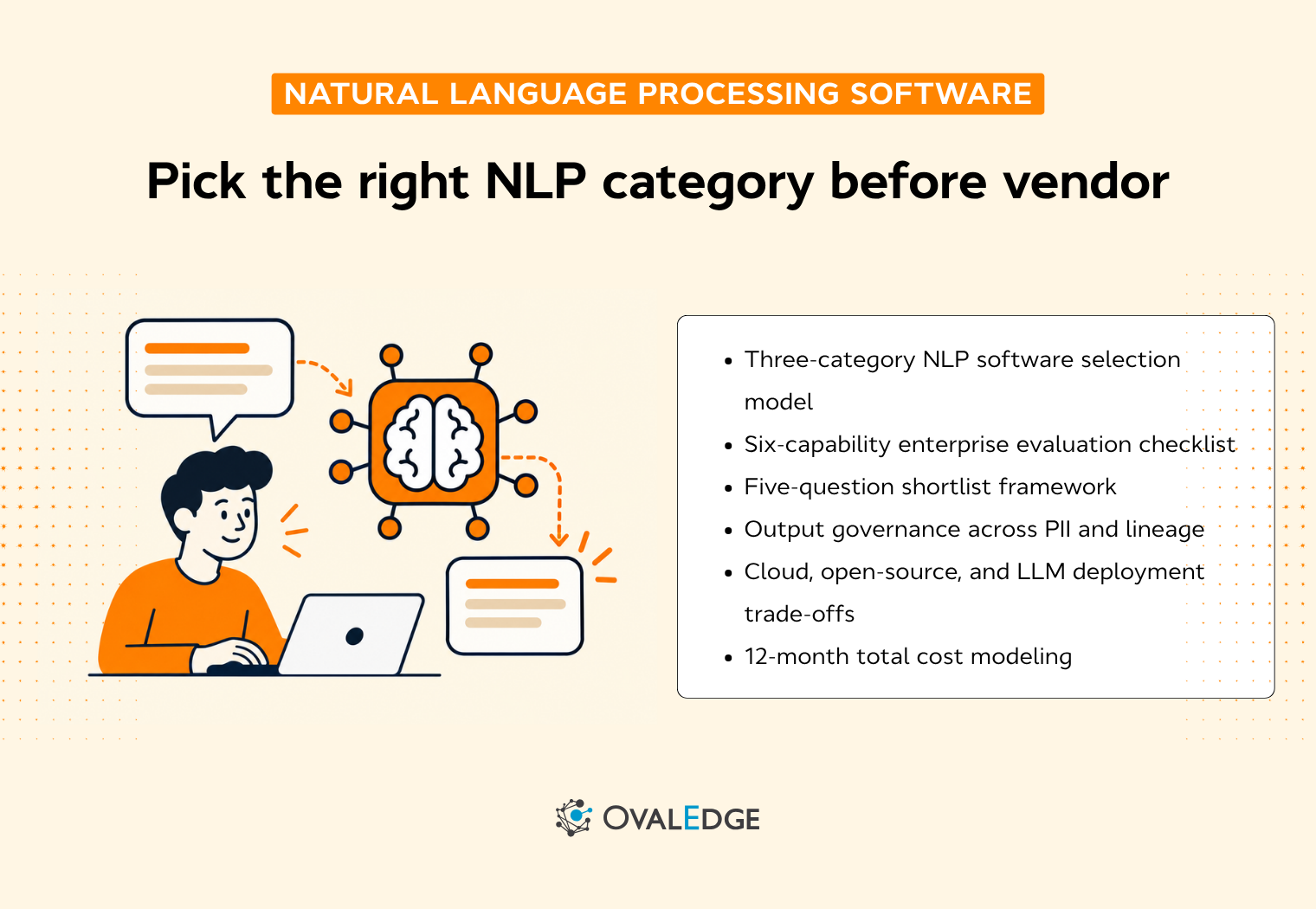
Natural language processing software turns unstructured text into structured signal your teams can search, measure, and act on. The market has split into three categories that solve different problems:
-
Cloud APIs like Google, AWS, Azure, and IBM Watson for scale and integration
-
Open-source libraries like spaCy, Hugging Face, NLTK, and Stanford CoreNLP for control and cost
-
Enterprise LLMs like OpenAI, Cohere, and Anthropic Claude for reasoning and generation
Picking the wrong category costs more than picking the wrong vendor inside a category.
This guide compares 11 NLP software tools across those three groups, with real pricing, deployment options, and per-vendor strengths. It also covers how to govern the outputs of NLP models once they're in production, including PII handling, lineage, and audit trails.
What natural language processing software does and how it works
Natural language processing software analyses human language so machines can process text the way people read it. It converts unstructured content like emails, chat logs, support tickets, and reviews into structured data your teams can search, sort, and measure at scale.
The core tasks fall into four buckets:
-
Classification: sorting text by topic or intent (customer complaint vs. billing question, positive vs. negative review)
-
Sentiment and emotion detection: scoring how a piece of text feels
-
Entity extraction: pulling named people, brands, products, locations, and dates out of unstructured prose
-
Summarisation: condensing long documents or ticket threads into short, decision-ready summaries
Modern platforms run these tasks using large language models and NLP libraries, which gives them consistent accuracy across millions of records. That's what makes NLP useful for customer experience, product analytics, compliance monitoring, and search relevance at enterprise scale.
Healthcare teams using NLP have cut documentation time by 40% and sped up claims handling by 50%, per Mordor Intelligence's 2025 NLP market report. Enterprises with high text volumes now treat NLP as core infrastructure.
Where NLP fits inside broader AI workloads
-
Search analytics: pair a cloud API like Google Cloud Natural Language or Azure AI Language with a semantic search or vector layer
-
Reasoning, long-context, and multimodal work: enterprise LLMs like OpenAI, Cohere, and Anthropic Claude
-
High-volume, cost-sensitive workloads: open-source libraries like spaCy and Hugging Face at a fraction of per-token API costs
Compare the top natural language processing software tools at a glance
The table below compares the top 11 NLP tools across pricing model, deployment options, primary strength, and best-fit buyer profile. Use it as a first-pass shortlist filter, then drop into the detailed reviews below for depth.
|
Tool |
Category |
Pricing model |
Deployment |
Primary strength |
Best for |
|
Google Cloud Natural Language API |
Cloud API |
$1 per 1,000 units, volume tiers |
Cloud only |
Multilingual coverage (100+ languages) |
Google Cloud-native teams processing global text |
|
Amazon Comprehend |
Cloud API |
$0.0001-$0.10 per unit by task |
Cloud only (AWS) |
PII detection, regulated workloads |
AWS-native compliance and data teams |
|
Microsoft Azure AI Language |
Cloud API |
Per 1,000 text records, tiered |
Cloud, hybrid, on-prem (container) |
Healthcare NLP, hybrid deployment |
Healthcare and life sciences on Azure |
|
IBM Watson NLU |
Cloud API |
Subscription, from $0.003 per NLU item |
Cloud, hybrid, on-prem (Cloud Pak) |
Linguistic depth, industry taxonomies |
Regulated enterprises (legal, finance, insurance) |
|
spaCy |
Open-source |
Free (Apache 2.0); Prodigy paid |
Self-hosted (cloud, on-prem, edge) |
Production speed, engineering control |
Engineering teams building custom NLP pipelines |
|
Hugging Face Transformers |
Open-source |
Free library; Inference API from $0.06/hour |
Self-hosted or managed Inference Endpoints |
Widest model catalogue (500K+ models) |
Teams fine-tuning and serving open models |
|
NLTK |
Open-source |
Free (Apache 2.0) |
Self-hosted |
Classical NLP methods, WordNet |
Research, education, rule-based pipelines |
|
Stanford CoreNLP |
Open-source |
Free (GPL v3) |
Self-hosted (JVM) |
Linguistic accuracy, coreference |
Legal, academic, government text analytics |
|
OpenAI |
Enterprise LLM |
Per-token; $2.50-$75 per 1M tokens by model |
Cloud only (API, Azure OpenAI) |
Reasoning, generation, multimodal |
Generative and agentic NLP workloads |
|
Cohere |
Enterprise LLM |
Per-token; private deployment available |
Cloud, private VPC, on-prem |
Enterprise-grade RAG, deployment flexibility |
Regulated RAG and semantic search buyers |
|
Anthropic Claude |
Enterprise LLM |
Per-token; $0.25-$75 per 1M tokens by model |
Cloud (API, AWS Bedrock, GCP, Azure) |
Long-context reasoning (200K tokens) |
Long-document analysis, agentic workflows |
How to read the table
Two signals matter more than any single row:
- Pricing models are structurally different: Cloud APIs charge per unit of text, open-source libraries are free but carry engineering cost, and enterprise LLMs charge per token. Compare them without adjusting for your actual volume and task type, and you'll land on the wrong shortlist.
- Deployment flexibility is the compliance filter: If your data cannot leave the customer perimeter, seven tools qualify: Azure AI Language, IBM Watson NLU, Cohere (private deployment), spaCy, Hugging Face self-hosted, NLTK, and Stanford CoreNLP. The other four are cloud-only.
Neither filter is the whole picture. The Enterprise Context Graph that governs NLP outputs sits below the model, not inside it. A tool that clears the deployment filter still has to feed a catalog, lineage, and policy layer capable of tracing every output back to its source.
OvalEdge expert insight: The tool a team picks matters less at audit time than what sits underneath it. Two enterprises can pick the same NLP vendor and end up in very different places six months in, depending on whether the Enterprise Context Graph beneath the model tracks outputs, versions, and lineage as first-class data assets.
Best natural language processing software in 2026
The NLP market has split into three categories that solve different problems, and picking the wrong category costs more than picking the wrong vendor inside a category. Here are the 11 tools worth shortlisting in 2026, grouped by category.
Cloud NLP APIs
Cloud APIs handle the infrastructure, model updates, and scaling for you. Charges are usage-based, integration is API-first, and time-to-first-result is measured in days rather than months.
The trade-off is limited control over model behaviour and predictable but rising costs at high volume. These four lead the category in 2026:
1. Google Cloud Natural Language API
Google Cloud Natural Language API leads the market on multilingual coverage, with production-grade support for entity recognition, sentiment analysis, and syntax parsing across 100+ languages. It carries the Google Knowledge Graph behind the scenes, so entity linking is more accurate than most competitors on branded and proper-noun-heavy text.
How it handles multilingual and entity-heavy workloads
-
Entity recognition wired directly into the Google Knowledge Graph for accurate brand, product, and location linking
-
AutoML Text for training custom classifiers without ML engineering headcount
-
Consistent accuracy across 100+ languages, useful for global CX and moderation teams
-
Native integration with BigQuery, Vertex AI, and the wider Google Cloud data stack
Where it fits and where it doesn't
Best for teams already on Google Cloud who need reliable multilingual NLP without building models from scratch. Costs rise steeply on high-volume streaming, and on-prem deployment isn't available.
2. Amazon Comprehend
Teams already invested in AWS reach for Amazon Comprehend when they need managed NLP with built-in PII detection and event extraction. It handles the same core tasks as Google Cloud (entity extraction, sentiment, topic modelling) with tighter integration into the AWS data pipeline and cleaner compliance controls out of the box.
How it handles PII detection and regulated workloads
-
Built-in PII detection tuned to HIPAA, PCI, and GDPR-relevant entity types
-
Comprehend Custom for domain-specific classifiers trained on your own labelled data
-
Event detection for identifying actions, participants, and outcomes inside document sets
-
Serverless deployment via AWS Lambda, with predictable scaling on bursty workloads
Where it fits and where it doesn't
Best for AWS-native data teams processing regulated text at scale, especially in healthcare, financial services, and insurance. Value drops sharply outside AWS, and streaming workloads get expensive fast at production volume.
3. Microsoft Azure AI Language
Microsoft Azure AI Language (formerly Text Analytics) has become the default for healthcare and regulated-industry NLP, largely because of its purpose-built clinical models and its hybrid deployment story. Enterprises use it to extract clinical terms from unstructured notes, redact PII from records, and layer semantic search across Azure Cognitive Search.
How it handles healthcare and regulated-industry text
-
Pre-trained healthcare NLP models for clinical terms, medications, conditions, and procedures
-
Automated PII redaction wired to healthcare-specific entity types
-
Semantic search enrichment through Azure Cognitive Search
-
Containerised deployment for on-prem, hybrid, and sovereign-cloud environments
How it handles deployment flexibility
Azure is the only cloud NLP API in this list that offers container-based on-prem deployment as a first-class option. Regulated industries with data residency constraints treat this as the deciding factor, since it lets them run the same models locally as they run in the Azure cloud.
Where it fits and where it doesn't
Best for healthcare, life sciences, and financial services teams on Azure who need clinical-grade NLP with hybrid deployment. Custom model flexibility trails Google AutoML and AWS Comprehend Custom, and pricing gets complex across Azure services.
4. IBM Watson Natural Language Understanding
IBM Watson NLU has stayed relevant in a generative-AI-dominated market by leaning into what it does better than the LLMs: deep linguistic feature analysis, industry-specific taxonomies, and metadata extraction on complex regulated text. Legal, insurance, and financial-services teams use it when they need explainable analysis with audit trails.
How it handles linguistic and metadata analysis
-
Fine-grained sentiment, emotion, and tone analysis with feature-level explainability
-
Pre-built industry taxonomies for finance, insurance, and healthcare
-
Metadata extraction across roles, obligations, risks, and legal contexts in contract-heavy workflows
-
Customisable scoring models for domain-specific document classification
How it handles regulated-industry deployment
Watson NLU supports cloud, hybrid, and on-prem deployment through IBM Cloud Pak for Data, which is why compliance-heavy enterprises still shortlist it in 2026. The explainability layer is more transparent than most LLM alternatives, useful when regulators ask how a classification decision was made.
Where it fits and where it doesn't
Best for large enterprises in finance, insurance, legal, and compliance-adjacent sectors that need auditable linguistic analysis. More complex to configure than Google Cloud or Amazon Comprehend, and the wrong pick for generative or conversational AI workloads.
Open-source NLP libraries
Open-source libraries trade managed infrastructure for full model control, cost predictability, and on-prem deployment as a default.
Teams pick this category when they need to fine-tune models on proprietary data, keep sensitive text off vendor infrastructure, or process high volumes at per-CPU cost instead of per-API-call cost.
The trade-off is engineering time: you own the deployment, the model updates, and the monitoring. These four lead the category in 2026:
5. spaCy
spaCy has become the production-grade default for open-source NLP in the enterprise, largely because it was built for shipping to production rather than for research. It handles tokenisation, part-of-speech tagging, dependency parsing, and named entity recognition with pretrained pipelines for 75+ languages, all optimised for speed on CPU as well as GPU.
How it handles production-scale text processing
-
Pretrained pipelines for 75+ languages with consistent APIs across all of them
-
Native support for custom NER training on domain-specific data through the spaCy CLI
-
Integration with Hugging Face Transformers for teams that want transformer models inside spaCy's pipeline structure
-
Prodigy, spaCy's paid annotation tool, closes the loop between labelling and training
Where it fits and where it doesn't
Best for engineering teams building production NLP pipelines that need speed, consistency, and full control over the model layer. Not the right pick for teams without ML engineering headcount, and generative or long-context reasoning belongs on an LLM.
6. Hugging Face Transformers
Hugging Face Transformers has effectively become the default distribution channel for open-source language models, from BERT and RoBERTa to Llama, Mistral, and Falcon. Teams use it less as a single library and more as an ecosystem: the Model Hub for pretrained weights, Transformers for inference and fine-tuning, and Datasets and Accelerate for the surrounding infrastructure.
How it handles model access and fine-tuning
-
500,000+ pretrained models available through the Model Hub, covering classification, generation, translation, summarisation, and embeddings
-
Consistent API for loading, fine-tuning, and running inference across model families
-
AutoTrain for no-code fine-tuning on custom datasets
-
Native support for PEFT (parameter-efficient fine-tuning) methods like LoRA and QLoRA
How it handles enterprise deployment
Inference Endpoints and Text Generation Inference (TGI) let teams deploy models to managed infrastructure without leaving the ecosystem. Private Hub deployments keep proprietary models and fine-tuned checkpoints inside customer VPCs, which is why regulated industries increasingly use Hugging Face as their model-serving layer.
Where it fits and where it doesn't
Best for teams that want access to the widest model catalogue in the industry and the infrastructure to fine-tune and serve those models cost-effectively. Requires engineering maturity to run reliably at scale, and model quality varies widely across the Hub.
7. NLTK
NLTK is the oldest actively maintained NLP library in Python, and it remains the standard reference implementation for classical NLP techniques: tokenisation, stemming, chunking, WordNet-based semantic analysis, and rule-based parsing. Universities still teach with it, and it still ships inside production systems for tasks where classical methods outperform transformer models on cost or interpretability.
How it handles classical NLP tasks
-
Comprehensive coverage of tokenisation, stemming, lemmatisation, POS tagging, and chunking
-
WordNet integration for lexical semantics, synonym expansion, and sense disambiguation
-
Rule-based grammar and parsing tools that transformer models cannot easily replicate
-
50+ corpora and lexical resources bundled directly with the library
Where it fits and where it doesn't
Best for teams building rule-based text pipelines, working on low-resource languages, or shipping to environments where model size is a hard constraint. Not the right pick for state-of-the-art accuracy on modern benchmarks, and performance trails spaCy on production workloads.
8. Stanford CoreNLP
Stanford CoreNLP is the academic-heritage NLP toolkit that has quietly stayed in production at scale, particularly in research-adjacent industries like legal tech, government analytics, and academic publishing. It ships mature implementations of coreference resolution, dependency parsing, and sentiment analysis, and it supports six languages with high linguistic accuracy on formal text.
How it handles linguistic-depth analysis
-
Coreference resolution across long documents, useful for legal contracts and academic writing
-
Constituency and dependency parsing with strong grammatical accuracy
-
Named entity recognition with fine-grained entity types beyond the standard person/organisation/location set
-
Bindings for Java, Python, and REST API deployment
Where it fits and where it doesn't
Best for teams processing long-form formal text where grammatical accuracy and coreference matter more than throughput, such as legal, academic, and government analytics. Setup and JVM overhead make it heavier to deploy than spaCy, and it underperforms on informal text.
Enterprise LLMs for NLP
Enterprise LLMs handle NLP as one capability inside a broader reasoning-and-generation model, which changes how teams use them. Classification, extraction, and summarisation still work, but the real value shows up on tasks the older category can't do well:
-
Long-context understanding
-
Multi-turn reasoning
-
Agentic workflows
-
Generation grounded in retrieved data
The trade-off is per-token cost, less predictable output structure, and tighter governance requirements around what the model sees. These three lead the category in 2026:
9. OpenAI
OpenAI has become the default reasoning-and-generation layer for enterprise NLP, with GPT-5 leading on general-purpose tasks and o-series models leading on structured reasoning. Enterprise teams use it less for classical NLP tasks (spaCy or Comprehend does those cheaper) and more for tasks that need multi-step reasoning, long-context understanding, or generation on top of retrieved data.
How it handles reasoning and generation
-
GPT-5 for general-purpose generation, classification, and multi-modal understanding across text, images, and audio
-
o-series models for structured reasoning on math, code, and analytical tasks
-
Function calling for reliable tool-use inside agentic workflows
-
Embedding models for semantic search, RAG pipelines, and clustering at enterprise scale
How it handles enterprise deployment
The ChatGPT Enterprise tier, Azure OpenAI Service, and the API's zero-data-retention option cover the three deployment patterns most enterprises need. Fine-tuning is available on GPT-4 and later models, though most teams get further with retrieval and prompt engineering than with fine-tuning for classical NLP tasks.
Where it fits and where it doesn't
Best for teams building generative and agentic workloads, semantic search, and reasoning-heavy NLP where classical models fall short. Per-token costs add up fast on long-context workloads, on-prem deployment isn't available, and governance falls entirely on the customer.
10. Cohere
Cohere positions itself as the enterprise-first LLM provider, and the shape of the product reflects that: strong retrieval models (Rerank, Embed), private deployment options that competitors don't offer, and a Command model family tuned for enterprise summarisation, generation, and RAG. Regulated industries use Cohere when OpenAI's cloud-only deployment is a compliance blocker.
How it handles retrieval and RAG
-
Rerank models for improving RAG relevance at the retrieval layer, widely used with existing vector stores
-
Embed models with strong performance on domain-specific retrieval tasks
-
Command R and Command R+ tuned for grounded generation with citation support
-
Native multilingual embedding across 100+ languages
How it handles enterprise deployment
Cohere is the only major LLM provider offering private deployment inside customer VPCs, on-prem, and across AWS, GCP, Azure, and Oracle Cloud. That flexibility is why financial services and healthcare buyers shortlist it against OpenAI and Anthropic. The trade-off is a smaller model catalogue and a shorter track record on general-purpose reasoning benchmarks.
Where it fits and where it doesn't
Best for regulated enterprises building RAG pipelines, semantic search, and grounded generation where data cannot leave the customer perimeter. Trails OpenAI and Anthropic on general-purpose reasoning, and the developer ecosystem is smaller.
11. Anthropic Claude
Anthropic Claude has become the enterprise LLM of choice for long-context reasoning and high-stakes text analysis, largely on the strength of Claude Opus and Sonnet's 200K-token context window and Anthropic's constitutional AI approach to safety. Legal, financial, and life-sciences teams use it for tasks that involve reading long documents end-to-end and reasoning across them.
How it handles long-context and high-stakes text
-
200K-token context window (roughly 500 pages) with strong recall across the full context
-
Claude Opus for maximum reasoning depth, Sonnet for balanced cost and speed, Haiku for high-throughput classification and extraction
-
Tool use and computer use for agentic workflows that combine reasoning with action
-
Prompt caching for reducing per-token costs on repeated long-context queries
How it handles enterprise deployment
Claude is available through Anthropic's API, AWS Bedrock, Google Vertex AI, and Microsoft Foundry, which covers the three major hyperscaler procurement paths without vendor lock-in. Zero-data-retention is available on the API, and enterprise tiers include SOC 2 Type II and HIPAA compliance. On-prem deployment is not available in 2026.
Where it fits and where it doesn't
Best for teams processing long documents (contracts, research, regulatory filings) or building agentic workflows where reasoning quality matters more than per-token cost. On-prem deployment isn't available, and output structure is less predictable than OpenAI's function-calling for strict-schema tasks.
How to govern the outputs of natural language processing software
Once an NLP tool is in production, the compliance surface shifts from the input data to the outputs. Every classification, extracted entity, summary, and generated response is a new data artifact that has to be governed.
Most enterprises pick their NLP tool carefully and leave the output layer ungoverned, which is where audit findings, PII leakage, and lineage gaps show up six months later.
Five controls decide whether an NLP deployment stays governable at scale:
-
PII detection on outputs: models sometimes surface sensitive attributes the source data didn't obviously contain, particularly on entity extraction and generation tasks. Output-side scanning catches what input-side controls miss.
-
Lineage from output back to source: when an NLP output triggers a business decision, audit teams need to trace which model produced it, which data trained the model, and which source records the output came from.
-
Model versioning tied to metadata: the same model version has to be recoverable months later for audit. Enterprise-grade
captures which model produced which output, when it was last retrained, and against which reference dataset.
-
Deployment perimeter enforcement: if your policy says clinical notes cannot leave the customer VPC, the NLP tool has to enforce that at the deployment layer. Cloud-only tools cannot meet this bar for regulated workloads.
-
Access policies on outputs: the people who can see raw source data are usually not the same people who should see the NLP outputs derived from it. Fine-grained access control on outputs closes a gap most deployments leave open.
OvalEdge runs this governance layer between the NLP tool and its downstream consumers through the Enterprise Context Graph:
-
Sift classifies outputs the moment they land and flags PII the source data didn't obviously carry.
-
Nexus traces every output back to source with column-level lineage.
-
Notary enforces access policies and retention rules on outputs the same way it enforces them on the underlying data.
All three run against the same catalog metadata the rest of the stack already trusts.
OvalEdge expert insight: The teams that survive their first NLP compliance audit governed outputs as first-class data assets from day one, not after the model was in production.
Teams building conversational data analytics workflows on this governance model get the same controls applied end-to-end, from natural-language query to output artifact.
Key features to expect in NLP software
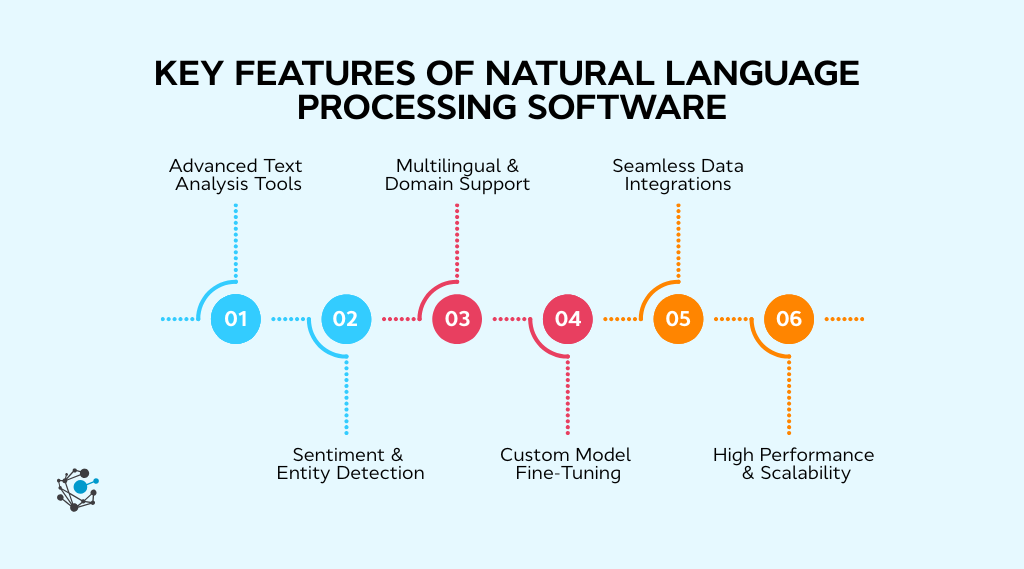
The 11 tools above vary widely on approach, but every serious NLP platform should ship six core capabilities. If a tool is missing more than one of these, it belongs in the early-stage or research-tool category rather than the enterprise-shortlist category.
-
Text analysis, sentiment scoring, and entity extraction: Classification, polarity or emotion scoring, and named entity recognition on standard entity types. Fine-grained types and domain-specific accuracy are where tools differentiate.
-
Multilingual coverage and domain adaptation: Reliable performance across languages, not just a language list. Domain adaptation for healthcare, legal, or financial services is separate from language coverage and usually needs fine-tuning.
-
Custom model training and fine-tuning: No-code options like Google AutoML and AWS Comprehend Custom, or code-first fine-tuning on Hugging Face and OpenAI. Pays for itself within six months on high-volume workloads.
-
Integration with data systems and applications: Native connectors to your data warehouse, CRM, ticketing, and BI stack. Platforms with 170+ pre-built connectors at the governance layer land NLP outputs inside existing analytics workflows without custom pipeline work.
-
Security, privacy, and compliance controls: Encryption in transit and at rest, SOC 2 Type II certification, and GDPR, HIPAA, or PCI DSS compliance where relevant. PII detection and redaction on inputs and outputs is table stakes for regulated workloads.
-
Performance, scalability, and monitoring: Throughput consistency at production volume, latency guarantees on real-time workloads, and model drift monitoring. Drift monitoring is the most commonly missed capability and the one that catches accuracy degradation before it hits business metrics.
How to choose the right NLP software: a 5-question framework
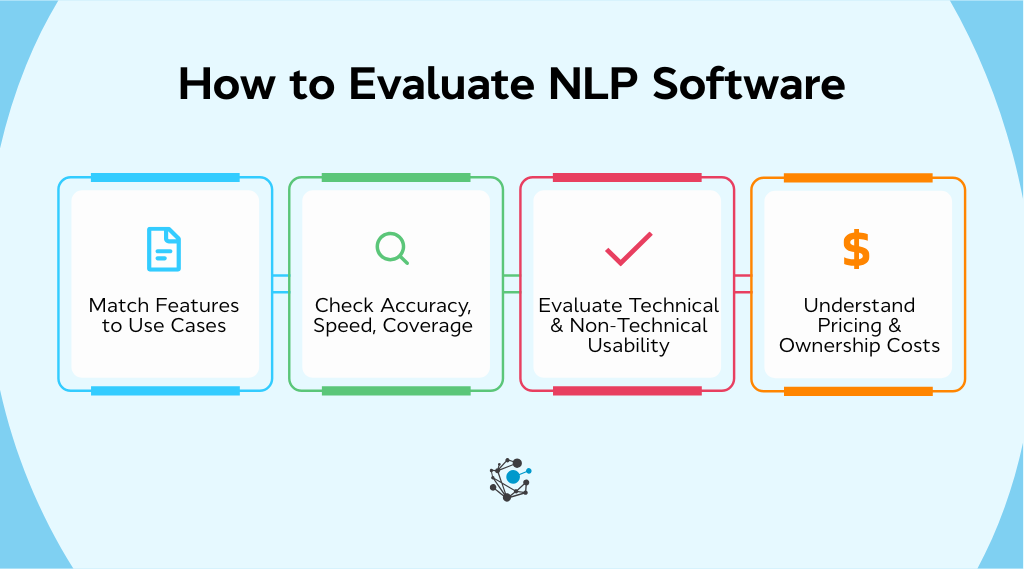
Every serious NLP shortlist comes down to five questions. Answering them in order narrows 11 tools to two or three before you sit through a single demo.
1. What is your data perimeter?
If your text data can go to a public cloud, all 11 tools are on the table. If it cannot leave the customer VPC (regulated data, PII-heavy workloads, sovereign-cloud requirements), you are down to seven:
-
Azure AI Language
-
IBM Watson NLU
-
spaCy
-
Hugging Face self-hosted
-
Cohere private deployment
-
NLTK
-
Stanford CoreNLP
2. What is the primary task type?
Classical NLP tasks, such as classification, sentiment, entity extraction, and summarisation on short text, run cheaper on cloud APIs or open-source libraries. Reasoning-heavy tasks (long-document analysis, agentic workflows, generation grounded in retrieval) need an enterprise LLM.
3. Who is the operator?
A team of ML engineers can extract full value from spaCy, Hugging Face, and the OpenAI API without a UI. However, data analysts and business teams need managed platforms with no-code training and visual monitoring, which points to Google AutoML, Azure AI Language, or IBM Watson NLU.
4. What is your compliance surface?
GDPR, HIPAA, PCI DSS, SOC 2, and industry-specific rules each carry their own audit expectations. The tool has to support the compliance framework, and the governance layer around the tool has to prove it during audit.
Model versioning, output lineage, and PII controls on outputs are the three requirements most enterprises underestimate at procurement.
All three collapse into a single question at audit time: does the Enterprise Context Graph underneath connect the output, the model that produced it, and the source data it came from in one traceable chain?
OvalEdge expert insight: Compliance is where NLP deployments most often break. The audit question is rarely "which model did you use" and almost always "can you trace this output back to the source data and prove the model version." That is a governance-layer question, not a model-layer one.
5. What is the 12-month total cost of ownership?
Sticker pricing on cloud APIs and LLMs misleads in both directions.
-
Per-token or per-unit pricing looks cheap on pilots and gets expensive on production volume.
-
Open-source libraries look free and cost engineering headcount to deploy and maintain.
Model a real 12-month scenario using your actual expected volume, retraining cadence, and monitoring overhead before you commit.
NLP in production: 3 deployments worth learning from
Three examples show what serious NLP looks like at scale.
-
Wimbledon and IBM watsonx. IBM has powered Wimbledon's digital fan experience for over three decades. In 2025, the partnership added Match Chat, an AI assistant that answers fan questions during live matches.
It runs on watsonx with IBM Granite models trained on the language of tennis, and powers the Match Insights and Draw Analysis features on wimbledon.com.
-
S&P Global and spaCy. S&P Global's commodities team built a pipeline on spaCy and Prodigy to pull market-moving events from unstructured news in near real time.
Explosion AI's case study covers how the team shipped a production NLP workflow inside S&P Global's high-security environment. -
Morgan Stanley and OpenAI. Morgan Stanley built an internal GPT-4 assistant that gives 16,000+ financial advisors natural-language access to 100,000 research documents.
Per OpenAI's customer story, 98% of advisor teams now use it, and the firm has launched a second GPT-4 tool that summarises client meetings.
All three follow the same pattern: one enterprise, one vendor, deep investment in fine-tuning, and a tool that changes how people work.
A counterpoint from the field is worth reading alongside them. A practitioner recently explained the parts of an enterprise NLP deployment that broke first: PDF parsing, chunking strategy, and data preparation.
The takeaway is that model choice matters less than the layer underneath it, and the teams that get the data preparation right outperform teams that spend the same time chasing better embeddings.
Build a governable NLP stack
NLP outputs are new data assets, and every one of them needs the same governance the source data already carries. PII controls, lineage, model versioning, and access policies on outputs are the difference between a deployment that survives its first audit and one that becomes a compliance problem six months later.
Platforms like OvalEdge run the governance layer alongside whichever NLP tool the team picks. The Enterprise Context Graph ties every model output back to source data, model version, and access policy inside the same catalog and lineage view the rest of the stack already runs on.
To see how the Enterprise Context Graph governs NLP outputs on live data, book a demo with OvalEdge today.
.png?width=1081&height=173&name=Forrester%201%20(1).png)
.png?width=1081&height=241&name=KC%20-%20Logo%201%20(1).png)