.png)
In most companies, a simple question often sits waiting in a queue. "Which campaigns actually drove pipeline last quarter?" Easy to ask, but the answer can take days, routed through a ticket, an analyst, and a dashboard that almost fits.
Conversational analytics software removes that delay. A question typed in plain language gets read by the system, matched to governed data, and answered in seconds: a chart, a number, or a short explanation.
The shift is gaining real momentum.
Grand View Research expects the conversational AI market to grow from $14.3 billion in 2025 to $41.39 billion by 2030, with analytics among its fastest-growing segments.
This guide covers how the software works, the seven platforms worth shortlisting in 2026, and the five features that separate a real NLQ tool from a chatbot bolted onto a dashboard.
This guide covers how conversational analytics software actually works, the seven platforms worth shortlisting in 2026, and the features that separate a real NLQ tool from a dashboard with a chat box bolted on.
Most tools can answer a question. The harder part is making sure the answer is right: that it pulled from the correct data, applied your definition of the metric, and respected who's allowed to see what. That's the gap askEdgi is built to close, which is why OvalEdge leads the list.
How conversational analytics software works
Conversational analytics software enables users to explore and analyze data simply by asking questions in natural language. Instead of relying on dashboards or writing SQL queries, users can type or speak their questions, and the system interprets the intent, retrieves the right data, and presents insights instantly.
These platforms use AI and NLP to understand user queries, map them to governed data sources, identify relevant metrics, and generate accurate insights. This empowers teams to improve decision-making, accelerate workflows, and democratize access to analytics across the business. Key benefits include real-time querying, self-service insights, and simplifying analytics for non-technical users.
Conversational analytics software supports various industries, including operations, sales, customer service, and analytics teams, by making data insight accessible and easy to interact with.
Conversational analytics vs conversation intelligence: What it is NOT
These terms get confused often enough to derail buying decisions, so it's worth being explicit.
Conversational analytics (this guide): Let users ask questions of their enterprise data in plain English. The conversation is between a person and their data. Examples: askEdgi, ThoughtSpot Spotter, Tellius.
Conversation intelligence (different category): Analyzes recorded customer interactions like sales calls and support chats for sentiment, talk-time, objection patterns, and coaching opportunities. The conversation is between two people, and the tool is the listener. Examples: Gong, CallMiner, Chorus, NiCE.
SentiSum and CallMiner cover the second category. This guide covers the first: querying data in plain English.
Core technologies: NLP, ML, voice & chat analysis
Conversational analytics software relies on a few core technologies to turn a plain-language question into an accurate answer. The main ones are Natural Language Processing (NLP), Machine Learning (ML), and a governed semantic layer that connects the question to the right data.
Each plays a distinct role:
-
Natural Language Processing (NLP): Works out what the user is actually asking, which metric they mean, and the time frame or filters implied. This is what lets someone type "revenue by region last quarter" and have the system read it correctly.
-
Machine Learning (ML): Identifies patterns, recommends relevant metrics, flags anomalies, and gets better at interpreting your team's phrasing over time.
-
Semantic layer: Maps the parsed question to governed data, applying your metric definitions, business glossary, and access rules, so the answer is consistent no matter who asks or how they word it.
Together, these turn an everyday question into a governed, defensible answer instead of a best guess.
Data sources and integration
One of the significant advantages of conversational analytics platforms is their ability to connect with a wide range of enterprise data sources. Whether the data lives in CRM systems, databases, warehouses, operational tools, or BI platforms, conversational analytics tools consolidate and query all of it through a unified interface.
This ensures that no insight remains siloed and allows businesses to gain a holistic view of their operations.
According to McKinsey’s 2025 report, 88% of organizations are already using AI in at least one business function, with sales, customer service, and analytics being among the top adopters of conversational AI technology.
For example, a business user might ask, “What were our top-performing regions last quarter?” and the system automatically pulls data from multiple sources, applies governance rules, and returns an accurate answer, without manual data gathering or cross-platform checks.
From raw conversation to actionable insight: Key steps
The power of conversational analytics lies not in analyzing customer conversations but in transforming user-initiated conversational queries into actionable insights. Here are the key steps involved in the process:
-
Understand the query: The system interprets the user’s natural-language question.
-
Map to data: It identifies the correct datasets, metrics, and definitions using governance rules.
-
Process & analyze: NLP and ML models determine the appropriate analysis or visualization.
-
Visualize insights: Dashboards, charts, or written explanations present insights clearly.
-
Act on insights: Teams use these insights to improve decision-making, optimize workflows, or automate routine analytics tasks.
In this way, conversational analytics software turns natural-language questions into strategic insights that drive operational efficiency, faster decisions, and better business outcomes.
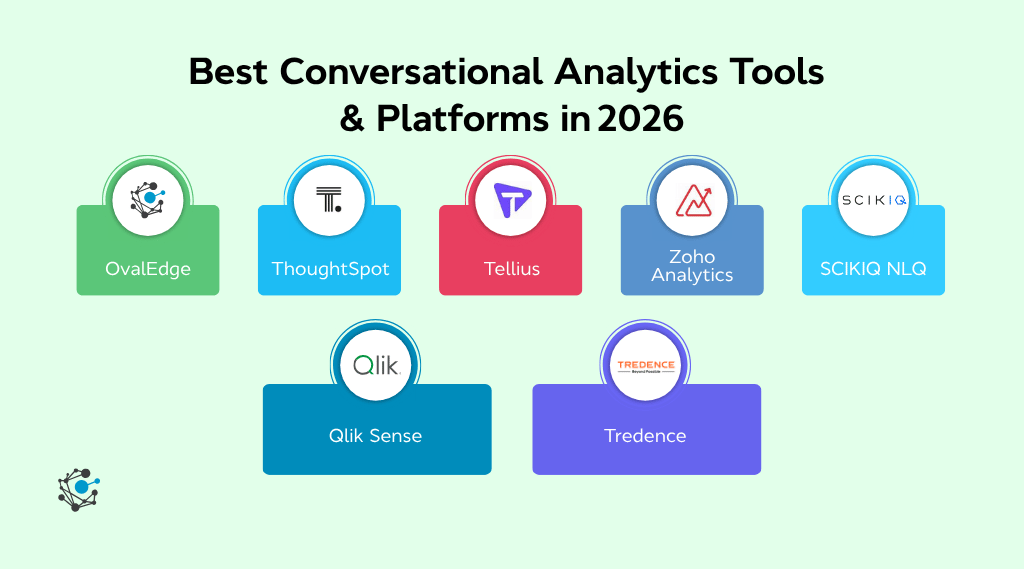
Top 7 conversational analytics tools & platforms in 2025
|
Platform |
Best for |
Semantic layer |
Governance + lineage |
Pricing model |
|
OvalEdge (askEdgi) |
Enterprises that need NLQ on governed data with audit trails |
Built-in via OvalEdge catalog |
Native (lineage, masking, access policies) |
Enterprise, custom |
|
ThoughtSpot (Spotter) |
Mature data teams with a cloud warehouse wanting broad agentic NLQ |
Yes (SpotterModel on warehouses) |
Mature, with RBAC and audit trails |
Enterprise, custom |
|
Tellius |
Mid-market BI teams wanting NLQ plus auto-insights |
Yes |
Limited governance features |
Tiered, annual |
|
Zoho Analytics (Zia) |
Teams already in the Zoho ecosystem |
Basic |
Standard role-based access |
Per-user, monthly |
|
SCIKIQ NLQ |
Compliance-heavy industries needing explainable NLQ |
Yes |
Strong, with lineage |
Enterprise, custom |
|
Qlik Sense |
Enterprises wanting NLQ on top of associative BI |
Yes (Qlik Sense engine) |
Standard |
Per-user, annual |
|
Tredence |
Large enterprises with custom-built analytics needs |
Custom-built per engagement |
Custom |
Services plus license |
The tools below differ most on three things: how strictly they enforce governance, how well their semantic layer handles ambiguous business terms, and how trustworthy the answers stay after the fifth follow-up question.
1. OvalEdge
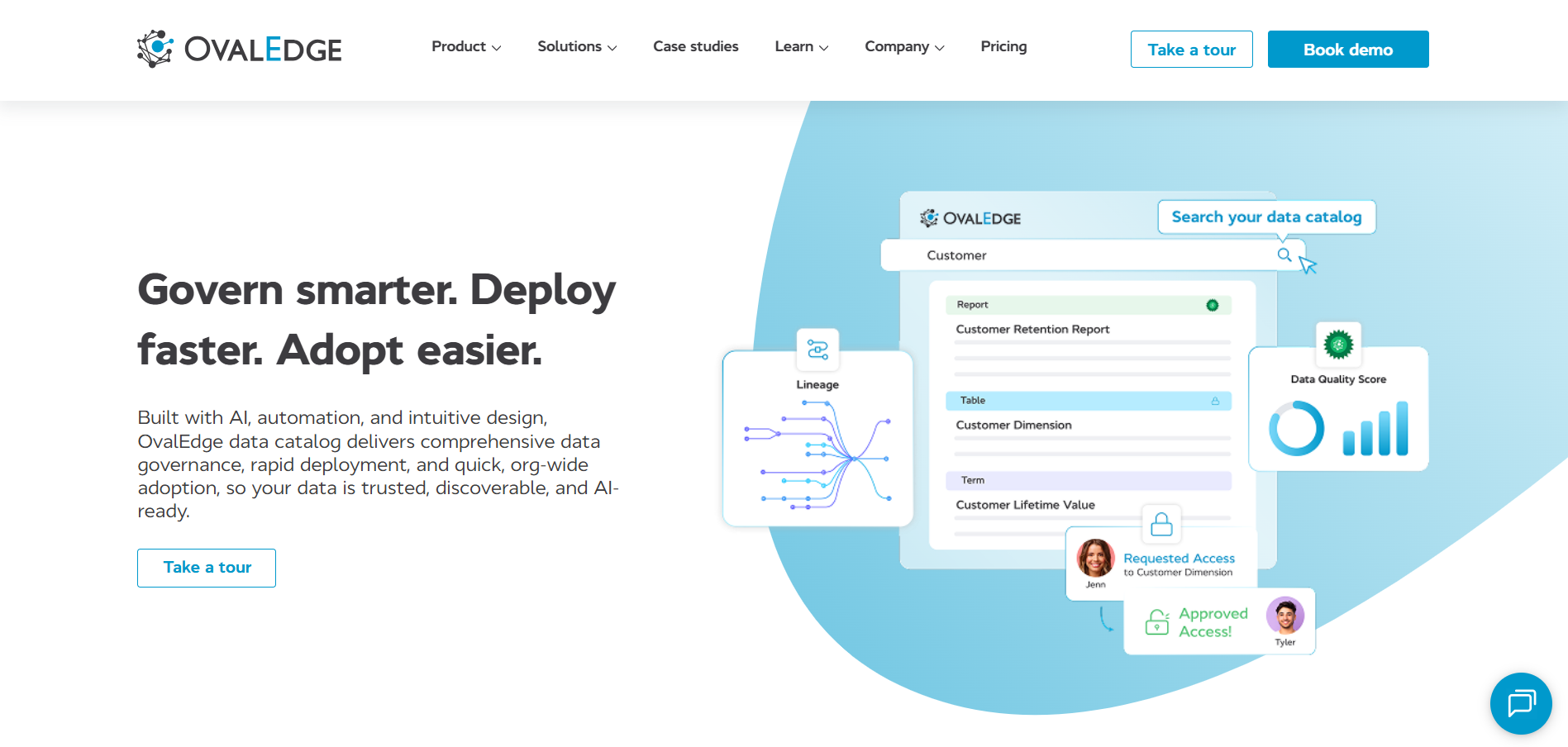
OvalEdge is an AI-powered data governance and analytics platform that simplifies data management while enabling businesses to leverage conversational analytics. With its unique askEdgi feature, users can query governed enterprise data in plain language, removing the need for complex coding. This makes it easy for both technical and non-technical users to access, explore, and analyze their data.
OvalEdge combines powerful data governance with conversational, agentic analytics, allowing users to interact directly with their data and generate insights without switching tools or writing queries. In addition to askEdgi, the platform offers a suite of governance, cataloging, and automation features that streamline data discovery, analysis, and action
Its AI-driven approach simplifies analytics and drives smarter decision-making with real-time insights. By integrating data governance with conversational analytics, OvalEdge enables businesses to break down silos and gain a unified, comprehensive view of their operations. Whether improving self-service analytics or managing data governance, OvalEdge offers a complete solution to enhance data intelligence and operational efficiency.
Key strengths:
-
Natural language querying: OvalEdge's "askEdgi" allows users to interact with data using natural language, making analytics accessible to everyone, regardless of technical background.
-
Integration capabilities: It integrates with a wide variety of data sources, including CRM systems, databases, and analytics tools, providing a unified view of all enterprise data.
-
Self-service analytics: Empower your team by allowing non-technical users to generate insights independently, reducing reliance on data experts and improving agility.
-
AI-driven insights: OvalEdge’s AI-powered features deliver advanced analytics that help businesses uncover hidden trends and patterns, enhancing decision-making processes.
-
Comprehensive data governance: The platform ensures data consistency, quality, and security across the organization, helping businesses maintain full control over their data assets.
-
Instant insight generation: By enabling fast, conversational analysis through askEdgi, OvalEdge helps teams act quickly on insights and make timely operational decisions.
-
Customizable dashboards: OvalEdge offers customizable dashboards that allow users to view and interact with their data in the most relevant and actionable format for their needs.
-
Scalable for growth: Whether you’re a small team or a large enterprise, OvalEdge scales effortlessly to meet evolving data and analytics needs, ensuring long-term value.
Best fit: OvalEdge is a perfect fit for enterprises or organizations looking for a unified platform that combines governed data, self-service analytics, and conversational (natural-language) analytics. Its ability to streamline data processes and provide actionable insights makes it ideal for businesses aiming to improve decision-making and operational efficiency.
If you're ready to see how OvalEdge can transform your data management and analytics, book a free demo today and experience the power of AI-driven insights.
2. ThoughtSpot

ThoughtSpot is the most established player in conversational analytics, built around its Spotter AI Analyst and a search-first interface. Users type questions in natural language, and ThoughtSpot returns visualizations and proactive insights pulled from a governed semantic layer.
Key strengths:
-
Spotter agent handles multi-turn conversations, follow-up questions, and proactive anomaly surfacing.
-
SpotterModel allows automated semantic modeling on top of cloud data warehouses (Snowflake, BigQuery, Databricks).
-
Strong embedded analytics story, with many SaaS platforms using ThoughtSpot inside their own product.
-
Mature governance, role-based access, and audit trails.
Best fit: ThoughtSpot suits enterprises with mature data engineering, a cloud warehouse already in place, and a need for the broadest agentic capabilities. The trade-off is depth of governance configuration. OvalEdge competes here by treating the catalog, lineage, and glossary as the foundation rather than as bolt-ons.
3. Tellius
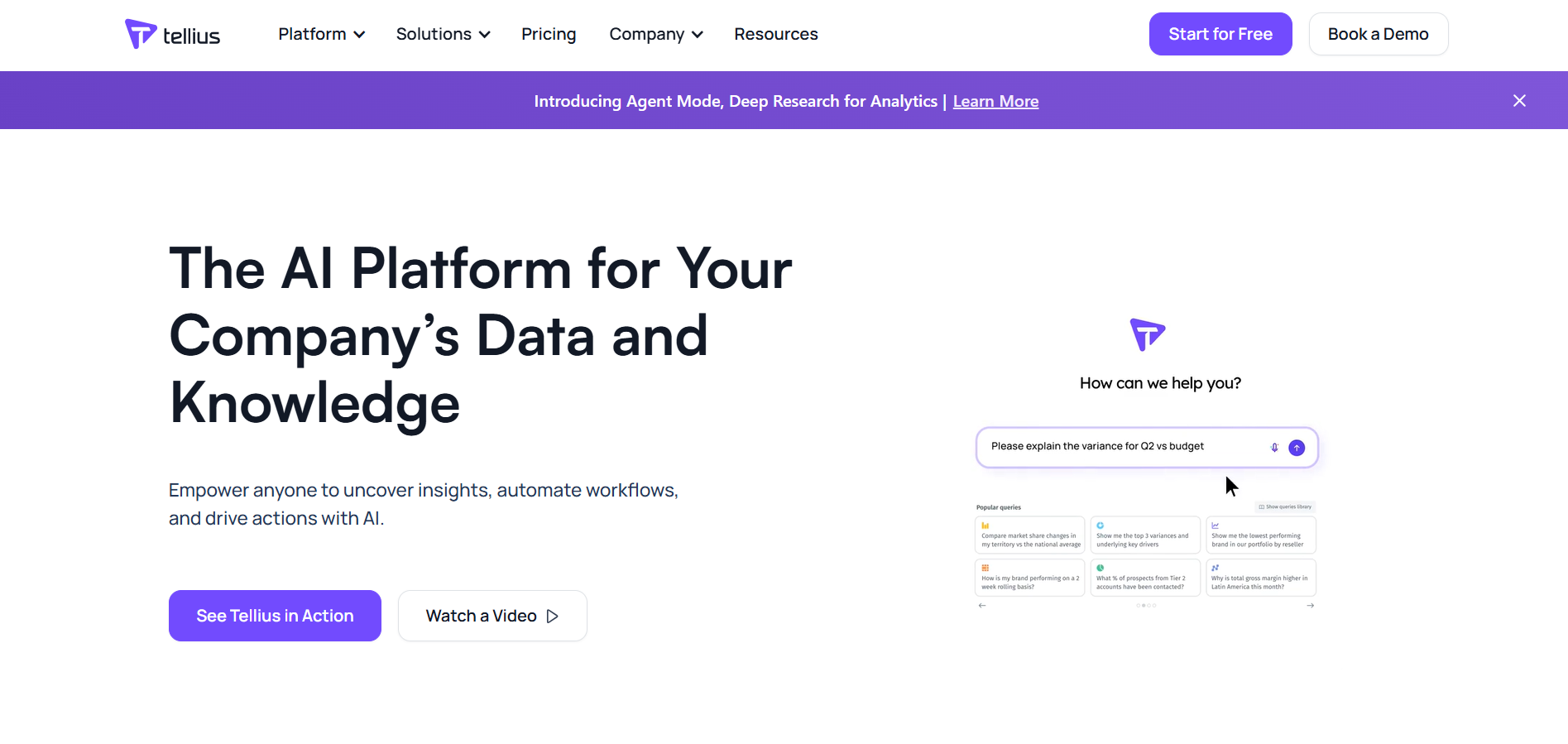
Tellius is an AI-powered analytics platform that enables users to explore data, run analysis, and uncover insights through natural-language conversations. Instead of relying on complex dashboards or SQL queries, users can ask questions directly in plain English and receive clear explanations, visualizations, and actionable insights. Its focus on automated insight discovery and guided NLQ makes Tellius a strong fit for organizations looking to modernize how teams interact with their data.
Key strengths:
-
Tellius offers natural-language querying, allowing users to ask questions conversationally and receive instant data insights.
-
Its AI engine automates insight discovery by highlighting trends, anomalies, and drivers behind key metrics.
-
The platform supports a wide range of data sources, delivering a unified and governed analytics layer.
-
Users benefit from guided suggestions, helping them explore data they may not know to ask about.
-
Built-in explainability ensures transparency by showing how answers were generated and which data was used.
Best fit: Tellius is ideal for organizations seeking a conversational, AI-driven analytics solution that empowers both technical and non-technical users to conduct meaningful exploration without writing queries or relying on analysts.
4. Zoho Analytics
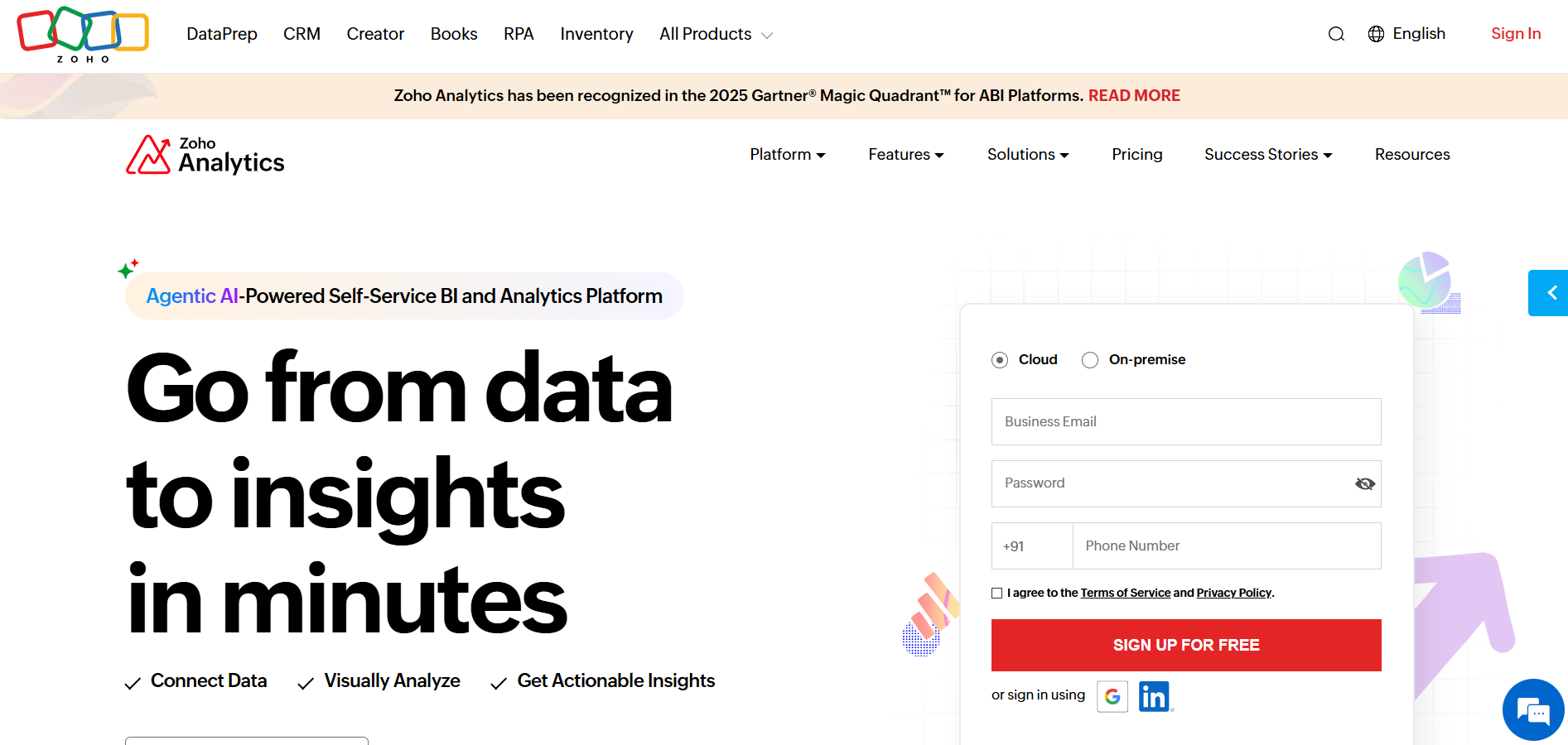
Zoho Analytics is a self-service BI and analytics platform that enables conversational analytics through its AI assistant, Zia. Users can interact with Zia in natural language to generate reports, dashboards, and insights without requiring technical expertise. The platform combines automated analytics with a strong visualization engine, making it suitable for teams looking to simplify and scale data access across the business.
Key strengths:
-
Zia, Zoho’s conversational AI assistant, allows users to ask data questions and receive visual insights instantly.
-
The platform integrates with hundreds of data sources, ensuring consistent and centralized data access.
-
Its automated insights feature highlights trends, correlations, and anomalies without manual analysis.
-
Zoho Analytics includes robust collaboration tools, enabling teams to share insights and work together seamlessly.
-
Advanced customization options allow users to tailor dashboards and reports to their specific workflows.
Best fit: Zoho Analytics is best suited for organizations seeking an accessible, conversational analytics layer on top of a modern BI platform, especially those already using Zoho’s ecosystem or looking for a cost-effective analytics solution.
5. SCIKIQ NLQ

SCIKIQ NLQ is a conversational analytics solution designed to make enterprise data accessible through natural language. The tool enables users to ask questions across governed datasets and receive accurate, context-aware insights instantly. Its emphasis on data governance, semantic understanding, and explainability makes it a strong fit for organizations that prioritize trust and compliance in analytics.
Key strengths:
-
SCIKIQ supports natural-language questions with context-driven, accurate responses based on governed data.
-
Its semantic layer ensures queries map to the correct data definitions, reducing ambiguity and errors.
-
The platform includes explainability features that show how answers were generated and which data sources were used.
-
SCIKIQ integrates with diverse enterprise systems, providing a consistent analytics experience across teams.
-
It offers out-of-the-box connectors and strong data lineage support for compliance-focused organizations.
Best fit: SCIKIQ NLQ is ideal for businesses that require governed, explainable conversational analytics and want to democratize data access without compromising accuracy or compliance.
6. Qlik Sense
Qlik Sense is a modern data analytics platform that supports conversational analytics through AI-augmented exploration. While known for its associative analytics engine, Qlik also enables users to interact with data using natural language, making it easier to uncover insights without advanced technical skills. Its combination of guided analytics, automation, and broad data integration makes it a powerful enterprise solution.
Key strengths:
-
Qlik’s conversational interface allows users to ask questions in natural language and generate insights instantly.
-
The associative engine uncovers hidden relationships in data that traditional query-based tools often miss.
-
AI-assisted analysis provides automated insights into trends, drivers, and anomalies.
-
Qlik integrates with a wide range of data sources, creating a unified analytics environment.
-
Its highly customizable dashboards and visualizations support advanced analytics workflows across teams.
Best fit: Qlik Sense is best suited for enterprises that need a scalable analytics platform combining conversational querying, automated insights, and robust visualization capabilities.
7. Tredence

Tredence offers AI-driven analytics solutions that incorporate conversational interfaces and agent-like capabilities to help users interact with complex data environments more intuitively. With a focus on data democratization, automation, and enterprise-scale analytics, Tredence enables teams to run analyses through natural language and receive actionable guidance powered by intelligent AI systems.
Key strengths:
-
Tredence supports conversational analytics through natural-language interfaces for exploring enterprise data.
-
Its AI-driven solutions automate key analytical tasks and accelerate insight generation.
-
The platform integrates seamlessly with large data ecosystems, supporting advanced use cases in operations, supply chain, sales, and more.
-
Tredence emphasizes explainability and trust, ensuring analytics outputs are transparent and enterprise-ready.
-
Strong consulting and implementation capabilities help organizations build custom conversational analytics experiences.
Best fit: Tredence is ideal for large enterprises seeking a blend of conversational analytics, AI-driven automation, and industry-specific analytical solutions that scale across business functions.
|
Where OvalEdge fits differently Most tools in this list are BI-first products with NLQ added on. OvalEdge is a data governance and catalog platform with askEdgi as the natural-language interface. The practical difference: every askEdgi answer is grounded in the same metadata, lineage, and access policies your data stewards already maintain. If you've already invested in catalog or governance, or if regulated data is in play, you avoid building a parallel semantic layer just to power conversational queries. |
Key features to look for in conversational analytics software
When evaluating tools, the difference between a real NLQ platform and a chatbot bolted onto a dashboard shows up in five places. Here's what to test for during a demo.
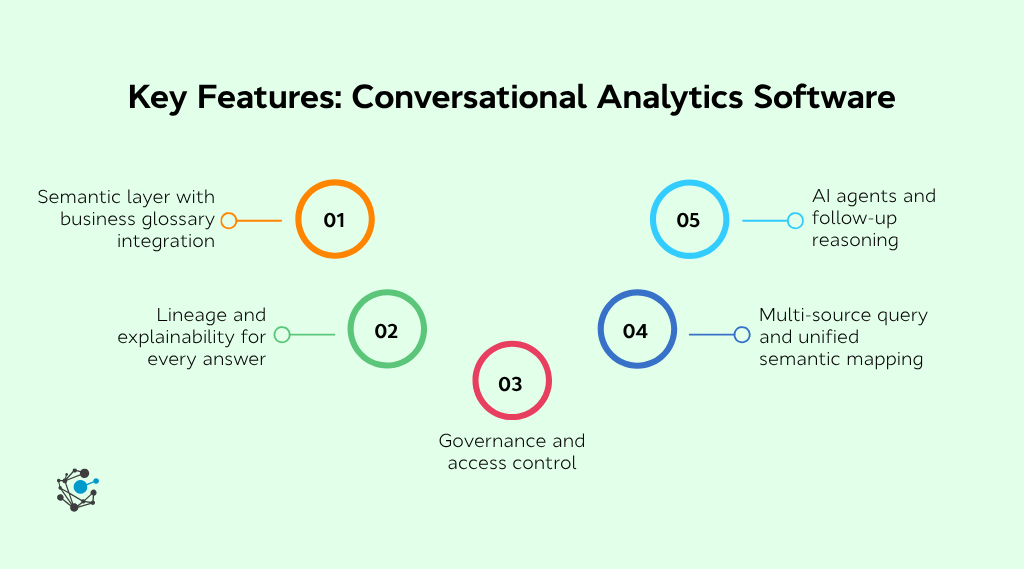
1. Semantic layer with business glossary integration
The semantic layer is the bridge between how your team talks and how your data is structured. If a sales rep types "ARR" and the system doesn't know that means "annual recurring revenue," defined as the sum of subscription contract values minus churn, the answer will be wrong. Look for tools that connect to a governed semantic layer, support synonyms, and let you define metric formulas in one place.
2. Lineage and explainability for every answer
A number without provenance is just a guess. The best conversational analytics platforms show you which datasets the answer came from, which transformations ran, and which metric definition was applied, capabilities that depend on enterprise data lineage being in place. This is non-negotiable for finance, regulated industries, or any answer that ends up in a board deck.
3. Governance and access control
Self-service is only safe when the underlying data follows your access policies. Confirm the tool respects row-level and column-level security from your warehouse, applies masking for PII fields, and logs every query for audit. Anything less is a compliance incident waiting to happen.
4. Multi-source query and unified semantic mapping
Most real questions span systems. A revenue question might pull from Salesforce, Stripe, and your warehouse. The platform should query across sources transparently, reconcile schemas using the semantic layer, and return one answer, not three contradictory ones.
5. AI agents and follow-up reasoning
Single-shot questions are table stakes. The differentiator in 2026 is agentic behavior: the platform remembers context, suggests follow-up questions, drills into anomalies, and explains why an answer changed quarter over quarter. Test this directly during demos by asking a vague question and seeing whether the system clarifies before answering.
How OvalEdge handles these five: askEdgi sits on top of OvalEdge's AI-ready data catalog, so every question is resolved against governed metadata, business-glossary definitions, and end-to-end lineage. Access policies from the source system are respected by default, and every answer carries an audit trail. If governance and traceability matter, this is where OvalEdge separates from BI-tool incumbents.
Conclusion
If you're struggling to make sense of all the customer interactions flooding your systems, you’re not alone. Many businesses still miss the opportunity to unlock valuable insights from customer conversations, which can lead to missed growth and optimization opportunities.
The right conversational analytics software can change that, turning everyday conversations into actionable data that drives better decisions. OvalEdge solves this problem by offering a powerful combination of data governance and conversational analytics. With features like askEdgi, it enables teams to interact with data using simple, natural language, no coding required.
OvalEdge integrates seamlessly with your existing systems, making it easy to capture, analyze, and act on real-time insights from voice, chat, and email interactions. This allows you to enhance customer service, improve agent performance, and optimize your workflows with ease.
Ready to see how OvalEdge can help you get more out of your customer conversations? Book a free demo today to transform your data into actionable insights.
FAQs
1. What's the difference between conversational analytics and conversation intelligence?
Conversational analytics lets users query enterprise data in natural language, like "what was Q3 revenue by region?" Conversation intelligence analyzes sales calls and support chats for sentiment and coaching. This guide covers the first. For call analysis, look at Gong, CallMiner, or NiCE.
2. Does conversational analytics replace traditional BI dashboards?
No. It sits on the same data layer with a different interface. Dashboards still suit fixed KPIs. Conversational analytics handles the ad-hoc questions that don't fit a dashboard, the ones that today take days through a ticket or never get asked.
3. Can conversational analytics software work with our existing data warehouse?
Yes. Most platforms connect to Snowflake, BigQuery, Databricks, Redshift, and SQL Server out of the box. The harder question is your semantic layer: if metric definitions live in dbt or a business glossary, the tool needs to read from that.
4. How does it stay accurate when our team uses different terms for the same thing?
Through the semantic layer. When finance says "bookings" and your CRO says "new logo ARR," it maps both to one metric definition with synonyms. Without it, the same question asked two ways returns two answers.
5. What about hallucinations? Can I trust the answers?
Hallucination risk depends on how strict the semantic layer and lineage controls are. Platforms that ground answers in governed metadata, rather than letting an LLM freestyle on raw tables, hallucinate far less. OvalEdge's askEdgi carries lineage back to the source on every answer.
6. Who on our team owns this: IT, data, or business?
Jointly owned. The data team owns the semantic layer and access controls. Business leaders define the metric vocabulary. IT runs the integration. It fails most often when one side deploys alone. Plan a 60-day rollout with everyone involved from week one.
.png?width=1081&height=173&name=Forrester%201%20(1).png)
.png?width=1081&height=241&name=KC%20-%20Logo%201%20(1).png)