-4.png)
BCBS 239 requires banks to strengthen risk data governance, aggregation, and reporting to ensure accuracy, completeness, and timeliness, especially during financial stress. For 2026, essential compliance steps include closing governance gaps, automating data validation, enabling end-to-end lineage, integrating systems, and establishing continuous monitoring to meet evolving regulatory expectations and supervisory scrutiny.
Financial institutions are facing more volatile market conditions than ever before. Economic uncertainty, geopolitical instability, and evolving financial risks are creating an environment where adaptability and resilience are key to survival.
On the other hand, customers are more cautious than ever, holding banks to higher standards and demanding greater transparency in risk management and compliance.
At the same time, regulators are tightening compliance requirements, making them more comprehensive and stringent.
The need for accurate, timely, and transparent reporting has never been more critical, as financial institutions are now expected to provide real-time insights into their risk exposure.
In this blog, we will discuss the BCBS 239 requirements, a vital regulation designed to ensure that financial institutions can effectively manage, aggregate, and report risk data.
BCBS 239 and its principles
The core objective of the BCBS 239 framework is to ensure that banks, especially globally systemically important banks (G-SIBs), can generate accurate, complete, and timely risk data to guide decision-making, particularly during periods of financial turbulence.
While the regulations initially applied to G-SIBs, their influence has expanded over time, affecting a broader set of financial institutions as the global financial system increasingly recognizes the importance of robust data management for operational resilience.
Key focus areas
BCBS 239 revolves around three primary focus areas, each critical to the overall framework:
1. Data governance
Establishing clear ownership and accountability for risk data across the organization is fundamental.
Data governance ensures that roles and responsibilities are defined, ensuring that data is handled by the appropriate stakeholders within the bank.
Without a robust governance framework, even the most sophisticated data systems fail to deliver value.
BCBS 239 demands that banks create well-documented stewardship processes, appoint data owners, and put in place appropriate escalation mechanisms.
|
For instance, accountability for the accuracy of data must rest with a senior executive, often a Chief Data Officer, who has the authority to make data-related decisions at the highest level. |
2. Data quality
This principle emphasizes the need for data to be accurate, complete, timely, and consistent across all systems.
In the context of risk management, poor data quality can lead to incorrect risk assessments, which can prove disastrous during times of financial uncertainty.
BCBS 239 mandates that banks must ensure that their risk data meets stringent quality standards.
This includes verifying that data is up-to-date, free from errors, and complete, critical when aggregating risk data across diverse sources, especially during periods of market stress.
The requirement to achieve high-quality risk data extends not just to raw data but also to metadata, ensuring transparency around data lineage and transformations.
3. Data management
Effective data management ensures that risk data is collected, integrated, and aggregated in a structured and controlled manner.
Banks must be able to aggregate risk data in real-time, spanning multiple legal entities, systems, and geographical regions.
This principle calls for the implementation of scalable, well-controlled data infrastructures that minimize manual intervention.
|
For instance, in large multinational banks, risk data might be spread across different regions and systems, so BCBS 239 calls for harmonizing these data sources into a centralized platform where they can be aggregated, validated, and reported with consistency and precision. |
BCBS 239 principles
The BCBS 239 framework is composed of 14 principles divided into three main categories:
a. Governance and oversight
b. Data capabilities, and
c. Reporting practices.
These principles serve as both a guideline for the development of risk data systems and a metric for assessing the maturity of a bank's data governance and risk reporting capabilities.
1. Governance and oversight principles:
These principles focus on the critical role of senior management and boards of directors in overseeing risk data aggregation processes.
Responsibility for ensuring data governance cannot be delegated down the organizational hierarchy. Top-level executives must be accountable.
|
An example of this in action would be the establishment of regular reviews by the board to assess the state of data quality and governance, as well as ensuring that data issues are escalated promptly. |
2. Data quality and management principles:
These principles highlight the need for accurate, complete, and timely data.
The bank's data management system must be able to adapt and scale, particularly under stressful conditions.
|
For example, during a financial crisis, banks must be able to access and aggregate real-time risk data for various types of risks (e.g., credit risk, market risk, liquidity risk) without delays or inconsistencies. |
3. Reporting principles:
Reporting principles ensure that the aggregated data is presented in a manner that is clear, comprehensive, and useful to decision-makers.
This includes ensuring that reports are standardized across the organization and compliant with regulatory requirements.
Furthermore, reports should be structured in a way that allows senior management and regulators to act upon them quickly, particularly during times of stress.
By focusing on data governance, data quality, and robust data management practices, BCBS 239 enables banks to improve their decision-making capabilities, enhance regulatory compliance, and avoid the pitfalls that led to the 2008 financial crisis.
BCBS 239 compliance requirements
Meeting BCBS 239 compliance is crucial for financial institutions, particularly global systemically important banks (G-SIBs), to ensure effective risk data management and reporting.
This set of regulations, developed by the Basel Committee on Banking Supervision, outlines specific requirements for aggregating and reporting risk data, emphasizing data quality, governance, and transparency.
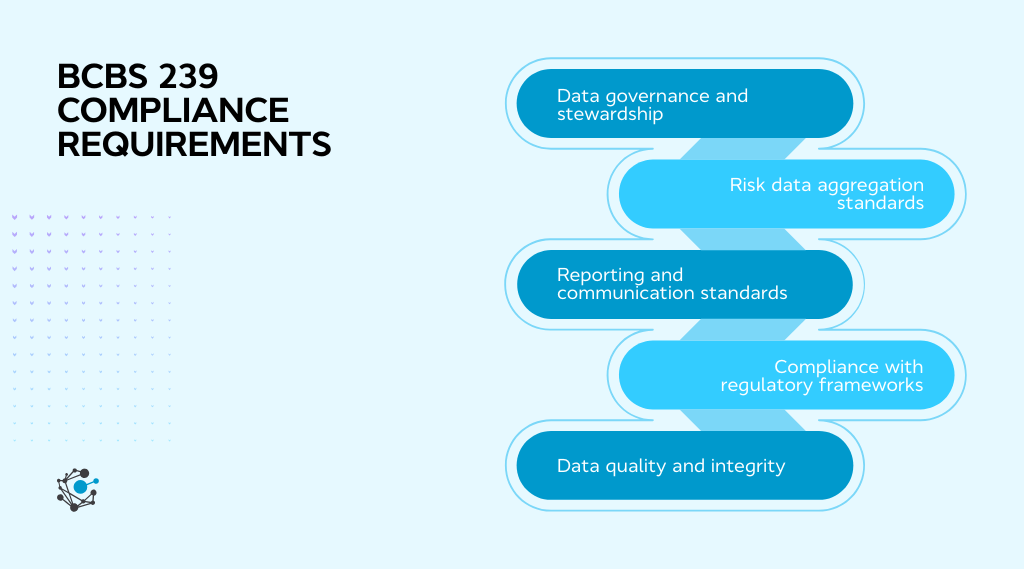
1. Data governance and stewardship
BCBS 239 compliance begins with establishing robust data governance frameworks.
These frameworks ensure clarity regarding the ownership of risk data, define accountability for its quality, and outline the process for escalating issues when they arise.
Without a clear governance structure, banks may struggle to maintain control over their data, leading to inefficiencies and errors that can have serious consequences.
Effective governance frameworks under BCBS 239 require:
a. Clear data ownership at domain and enterprise levels: It’s essential to define who is responsible for risk data at both the business domain level (e.g., credit risk, market risk) and across the enterprise.
This ensures there is no ambiguity regarding data stewardship.
In large, global banks, the complexity of data management demands ownership be distributed across different departments and geographic regions.
However, ultimate accountability should rest with senior management, particularly the Chief Data Officer (CDO) or similar role.
b. Formal data stewardship roles: Stewardship ensures that the data is not only accurate but also properly maintained throughout its lifecycle.
Stewardship roles should be well-defined and documented within the bank, specifying responsibilities for data quality, access control, and security.
c. Documented policies for metadata, definitions, and controls: To maintain consistency across the bank, BCBS 239 requires that all data definitions, data-related policies, and metadata management practices be formalized.
This includes developing a consistent approach to naming conventions, metrics, and how data transformations are handled.
These policies create transparency and ensure compliance across systems and geographies.
2. Risk data aggregation standards
Risk data aggregation is at the core of BCBS 239’s requirements. Banks must have the ability to aggregate risk data from different sources (business lines, products, geographies) accurately and promptly.
This capability becomes particularly critical in periods of stress when decision-makers must rely on up-to-the-minute risk information.
Key aspects of risk data aggregation include:
a. Consistent aggregation logic across systems: Banks must standardize the methods used to aggregate risk data, ensuring consistency across different systems and business units.
|
For example, how risk exposures are calculated for various asset classes should be uniform across the organization. Without this consistency, risk reports could be inaccurate or misleading. |
b. Ability to drill down from summary to source data: It’s not enough to generate high-level aggregated data.
Regulators expect banks to be able to trace aggregated risk data back to the individual transactions or positions that contributed to the risk exposure.
This requires strong data lineage capabilities, ensuring that risk data is traceable and auditable at every level of the aggregation process.
c. Minimal reliance on manual spreadsheets: While spreadsheets are commonly used for small-scale data aggregation, relying on them for critical risk reporting is inadequate, especially in large, complex banking institutions.
Manual processes introduce the risk of human error, and their time-consuming nature makes them unsuitable for real-time data aggregation.
Banks that rely too heavily on these manual systems often struggle during regulatory reviews
One of the most common pain points faced by banks in this area is integrating disparate systems and data sources.
Often, data is siloed in different departments or geographies, each with its own methods of aggregation.
Overcoming these silos requires building a robust data integration framework that can aggregate risk data efficiently and consistently across the entire enterprise.
3. Reporting and communication standards
BCBS 239 emphasizes the need for clear and actionable risk reporting.
Risk reports should not just be accurate but should also meet the specific needs of the intended audience, including senior management and regulators.
Poorly defined reporting standards can result in reports that are either overly technical or too vague to be useful for decision-making, making it harder for stakeholders to act on critical risk information.
Key elements of reporting and communication under BCBS 239 include:
a. Clear, comprehensive, and actionable reports: Reports must be tailored to the needs of the intended audience. Senior management needs concise, decision-ready insights that allow them to make informed strategic decisions.
On the other hand, regulators require transparency and traceability to ensure that the reported risk data is compliant and can be audited effectively.
b. Timeliness and accuracy: In times of stress, risk data needs to be available immediately.
Senior management and regulators must have access to timely, accurate data to respond swiftly. Delays in reporting can hinder decision-making, especially during crises.
c. Regulatory Alignment: Risk reporting must align with existing regulatory requirements, such as Basel III and stress testing regulations.
This ensures that the data presented is not only accurate but also fits the regulatory framework for liquidity, capital adequacy, and other financial stability metrics.
The lack of clarity and consistency in risk reporting can cause confusion, leading to poorly informed decisions and delays in regulatory compliance.
The goal is for risk reports to provide actionable insights that lead to rapid, well-informed decisions.
4. Compliance with regulatory frameworks
BCBS 239 complements and aligns with other critical regulatory frameworks such as Basel III and the General Data Protection Regulation (GDPR).
Banks that successfully implement BCBS 239 will also be better positioned to comply with these regulations, as BCBS 239 provides a comprehensive approach to managing and reporting risk data, which underpins many of the requirements of Basel III and GDPR.
Key aspects of this alignment include:
a. Capital and liquidity reporting: BCBS 239 helps banks align their data aggregation and reporting processes with Basel III requirements for capital adequacy and liquidity.
This ensures that the bank has the necessary data to manage and report on its capital and liquidity positions in compliance with global standards.
b. Stress testing and scenario analysis: BCBS 239 supports stress testing and scenario analysis by ensuring that risk data is aggregated and reported accurately.
Effective stress testing relies on the ability to model risk under various hypothetical scenarios, which requires consistent and comprehensive risk data across all lines of business.
c. Lawful data usage: BCBS 239 also dovetails with GDPR by ensuring that risk data is handled in a secure and compliant manner.
This includes ensuring that personal and sensitive data is protected, properly managed, and only accessible by authorized personnel.
5. Data quality and integrity
One of the most challenging aspects of BCBS 239 compliance is ensuring the ongoing quality and integrity of risk data.
Regulators expect banks to not only measure and monitor data quality but also to actively address any issues that arise.
Key considerations for maintaining data quality and integrity under BCBS 239 include:
a. Defined quality metrics: Banks must define and establish clear quality metrics for their risk data.
These metrics typically include measures of accuracy, completeness, timeliness, and consistency.
It is essential to track these metrics continuously to ensure that the data remains high quality throughout its lifecycle.
b. Automated validation rules: To minimize human error and improve efficiency, banks should implement automated validation rules that ensure data meets predefined quality standards before being used for reporting or decision-making.
These rules can check for issues such as data duplication, outliers, or incomplete entries.
c. Root-cause analysis for recurring issues: If data quality issues persist, it is crucial to conduct root-cause analysis to identify underlying problems.
Simply remediating individual issues without understanding their causes can lead to recurring problems.
By addressing the root causes, banks can build more robust data governance systems.
For financial institutions aiming to meet BCBS 239 standards, a strategic focus on governance, data aggregation, reporting, and data quality will help mitigate the risks associated with poor data management.
Implementation requirements for BCBS 239
Implementing BCBS 239 requires careful planning and execution to transform risk data processes across the bank.
In this section, we’ll outline the key implementation steps banks must take to achieve compliance, from conducting thorough gap assessments to automating data aggregation workflows.
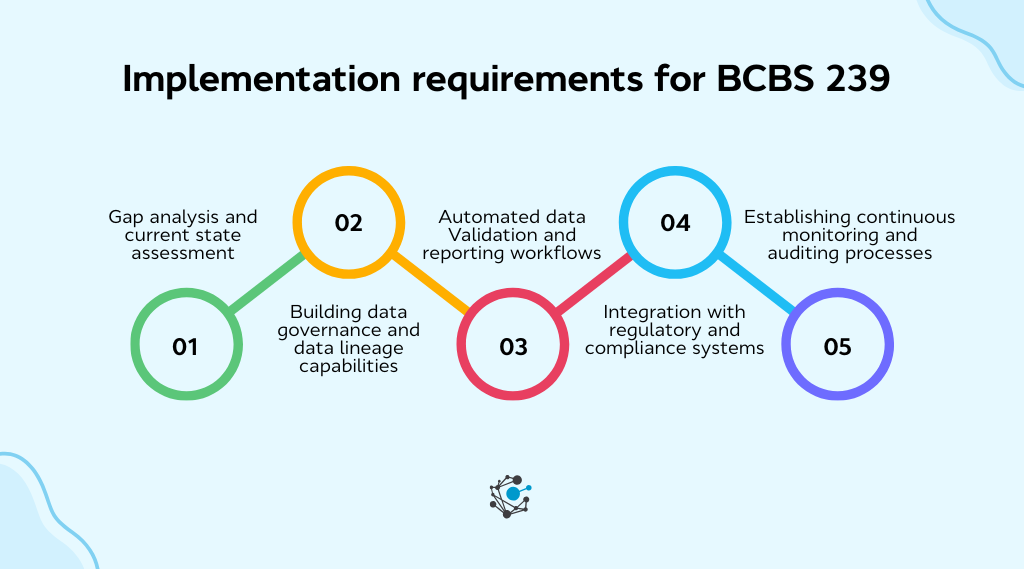
1. Gap analysis and current state assessment
The foundation of a successful BCBS 239 implementation lies in conducting a thorough gap analysis.
Without this initial assessment, financial institutions risk investing in solutions that do not address key areas of deficiency or miss critical compliance objectives.
An honest evaluation of the current data governance capabilities is crucial for determining where the bank’s processes fall short of the regulatory expectations outlined by BCBS 239.
According to a 2024 McKinsey Survey on State of AI, 70% of organizations report challenges with data governance, integrating data quickly into models, and defining consistent processes.
These issues often surface during early assessments and can significantly impede compliance efforts if left unaddressed
The gap analysis process typically covers several important areas:
a. Governance: Effective governance ensures there is accountability for data quality and integrity across the institution.
- Does the bank have a clearly defined data governance framework?
- Are roles and responsibilities for risk data clearly delineated at both the domain and enterprise levels?
b. Data architecture: BCBS 239 emphasizes the need for centralized, standardized systems that allow risk data to be processed quickly and accurately.
- How does the bank collect, store, and manage its data?
- Are there inefficiencies in data aggregation, or is data scattered across disparate systems?
c. Controls: Are there automated systems in place to ensure the accuracy and completeness of risk data?
Manual interventions, especially in large banking institutions, can introduce significant risks of human error.
A clear focus on automated controls can streamline data processes and improve regulatory compliance.
d. Reporting maturity: Gaps in reporting capabilities could delay regulatory responses and hinder critical decision-making during financial stress events.
- Is the bank capable of providing timely, accurate, and comprehensive risk reports?
- Do the reports support effective decision-making by both senior management and regulators?
The results of a gap analysis should guide the bank’s strategic decisions regarding investments in technology, processes, and personnel to meet the evolving demands of regulatory compliance.
2. Building data governance and data lineage capabilities
Data lineage has become an increasingly critical area of focus for regulators and supervisory bodies.
Under BCBS 239, supervisors expect banks to demonstrate a clear understanding of where their risk data originates, how it flows through different systems, and where it is ultimately reported.
The ability to trace data from its source to its final destination is crucial for transparency, auditability, and the overall integrity of risk data.
Building robust data lineage capabilities offers several advantages:
a. Improved transparency: Banks can provide regulators with a clear view of how risk data is processed and transformed across systems.
This transparency helps ensure that risk data is not only accurate but also traceable.
It enables supervisors to trust the integrity of the data without needing to rely on opaque systems or manual verification processes.
b. Reduced audit friction: During regulatory audits, institutions with poor data lineage face delays and challenges when explaining the origins and transformations of their data.
Clear lineage capabilities reduce the friction experienced during audits by providing an easily accessible trail of how data is aggregated and reported.
This streamlines the process, reduces regulatory burden, and ensures smoother interactions with auditors.
c. Accelerated issue resolution: When data quality issues arise, having a well-documented lineage allows for faster identification of the source of the problem.
Whether the issue lies with data entry, transformation, or aggregation, understanding where the error originated helps resolve it quickly.
3. Automated data validation and reporting workflows
Manual controls and processes are not sustainable in the context of BCBS 239.
The requirements of accurate and timely risk data aggregation, particularly during times of stress, demand automation to ensure efficiency, consistency, and scalability.
Key advantages of automated data validation and reporting workflows include:
a. Faster issue detection: Automated systems can flag data inconsistencies or errors in real-time, reducing the amount of time spent on manual checks.
This is critical when banks are under pressure to submit accurate reports during regulatory examinations or financial crises.
b. Consistent application of rules: By automating validation, banks ensure that the same rules are applied consistently across all datasets.
This removes the risk of human error, where different teams might apply different interpretations of data rules, leading to inconsistent results.
c. Reduced dependency on individual expertise: In large institutions, risk data validation often relies on individual expertise.
However, this introduces significant risks if the necessary personnel are unavailable or if knowledge is lost due to turnover.
Automated workflows standardize the validation process, ensuring that it continues smoothly regardless of personnel changes.
Automation also allows teams to focus on higher-value tasks such as data analysis and strategic decision-making, rather than spending time on repetitive and time-consuming manual data reconciliation.
4. Integration with regulatory and compliance systems
One of the key components of BCBS 239 implementation is ensuring that the risk data systems are integrated with the bank's existing regulatory reporting, risk, and compliance platforms.
Fragmented or siloed implementations often lead to duplication, inconsistent data definitions, and a lack of alignment with regulatory requirements.
According to IBM Data Differentiator, 2023, 82% of enterprises report that data silos disrupt critical workflows across teams and systems, hindering operational efficiency and cross-department visibility.
This underscores why siloed architectures not only complicate compliance efforts but also impair day-to-day risk operations. A disjointed approach can create inefficiencies and increase the risk of compliance failures.
Integrated systems offer several advantages:
a. Single source of truth: When risk data aggregation systems are integrated, there is a single source of truth for all risk-related data. This reduces inconsistencies and ensures that risk data is uniform across the bank’s systems.
It also simplifies regulatory reporting, as the same data can be accessed by both internal and external stakeholders.
b. Consistent definitions: Integration helps ensure that data definitions are consistent across different systems.
|
For example, the definition of risk exposure or capital adequacy must be the same whether the data is being used for internal decision-making or for regulatory reporting. |
This consistency reduces the likelihood of errors and discrepancies during reporting.
c. Efficient regulatory responses: Integrated architectures enable banks to respond more efficiently to regulatory requests and audits. Rather than manually reconciling data from multiple systems, banks can produce reports quickly from a unified platform, reducing response times and improving overall compliance.
5. Establishing continuous monitoring and auditing processes
BCBS 239 is not a one-time compliance project but an ongoing commitment to maintaining high standards of risk data aggregation and reporting. Regulators expect banks to continuously monitor and assess their risk data processes to ensure ongoing compliance and identify emerging gaps.
Continuous monitoring offers several benefits:
a. Identifying emerging gaps: Regular monitoring enables banks to spot potential issues before they evolve into compliance failures.
|
For example, it may reveal areas where data quality is deteriorating or where new regulatory requirements are not being met. |
b. Tracking remediation progress: Continuous monitoring also helps track the effectiveness of corrective actions taken in response to identified gaps.
This allows for a more agile approach to compliance, where the bank can adjust its processes and systems in real-time as new issues arise.
c. Demonstrating sustained maturity: Regulators expect banks to demonstrate that their data governance practices are continually improving over time.
Ongoing monitoring and internal audits provide the documentation needed to show that the bank is not just compliant at a point in time but is committed to maintaining and enhancing its risk data capabilities long-term.
Banks that embrace these requirements not only comply with regulations but also enhance their ability to make informed, data-driven decisions that improve risk management and regulatory confidence.
How does OvalEdge support BCBS 239 compliance?
Meeting BCBS 239 compliance requires financial institutions to adopt a comprehensive approach to data governance, aggregation, and reporting.
OvalEdge simplifies this process by offering an integrated platform designed to automate key tasks such as metadata management, data lineage tracking, and real-time risk data aggregation.
1. AI-Driven metadata management and automated lineage tracking
BCBS 239 compliance hinges on the ability to manage vast amounts of risk data and ensure its transparency, accuracy, and integrity.
One of the most critical aspects of meeting these requirements is the effective management of metadata and data lineage.
Manual metadata management is often time-consuming, prone to errors, and difficult to scale.
Furthermore, without automated lineage tracking, financial institutions struggle to prove the integrity and traceability of their risk data during audits, which can delay compliance and increase regulatory risks.
OvalEdge addresses this need by automating metadata discovery and tracking the end-to-end lineage of risk data.
With its automated crawlers, OvalEdge provides a clear view of data from its source to its final report, allowing organizations to maintain transparency and stay audit-ready.
2. Integration with data governance frameworks
Data governance is essential for ensuring that risk data is managed properly and consistently across an institution.
BCBS 239 requires a strong governance framework that assigns clear ownership of data, enforces policies, and ensures accountability.
In many organizations, data governance is fragmented, with different departments using varying systems to manage risk data.
This lack of centralized governance leads to inconsistencies in data handling and makes it difficult to ensure that all regulatory requirements are met consistently.
OvalEdge provides a unified platform that integrates with existing data governance frameworks, allowing banks to define ownership, stewardship roles, and escalation procedures for risk data.
Through its Stewardship Manager and Governance Workflow Engine, OvalEdge enforces governance policies and ensures that data is tracked and accountable throughout its lifecycle.
This streamlined approach ensures BCBS 239 compliance by aligning with the regulation’s focus on robust governance and clear data ownership, helping organizations avoid gaps in their risk data management processes.
3. Scalable infrastructure and real-time data aggregation
Legacy infrastructure often struggles to handle the large volumes of data required for BCBS 239 compliance.
Financial institutions relying on outdated systems face challenges in scaling their data aggregation processes, leading to delays in reporting and non-compliance with regulatory timelines.
OvalEdge’s scalable architecture, deployable on-premises or in the cloud, supports enterprise-wide data aggregation across disparate systems, meeting BCBS 239 requirements for accuracy, timeliness, and completeness.
Its ability to process and aggregate data in real-time allows banks to stay compliant even as data volumes increase, ensuring that risk data is always up-to-date and available for reporting.
4. Reporting and compliance features
Creating accurate risk reports manually is resource-intensive and prone to errors.
Additionally, banks often struggle with ensuring that reports meet regulatory standards across various departments and jurisdictions, leading to delays and compliance risks.
OvalEdge automates the creation of risk reports by integrating data from across the organization into a unified platform.
Its reporting features allow banks to easily generate BCBS 239-compliant reports that are clear, comprehensive, and tailored to the needs of both internal stakeholders and regulators.
The platform also tracks audit trails and maintains a history of changes, making it easier to demonstrate compliance during regulatory reviews.
By streamlining the reporting process, OvalEdge helps banks meet BCBS 239’s demanding standards while improving operational efficiency and audit readiness.
Many organizations attempt to implement BCBS 239 compliance using a patchwork of open-source tools and third-party solutions, which can lead to integration challenges, increased costs, and delays.
These fragmented solutions lack the depth and reliability needed for long-term compliance.
OvalEdge offers a full-stack, integrated platform that provides all the necessary features to meet BCBS 239’s requirements in one cohesive solution.
It combines automated metadata extraction, data lineage tracking, data governance enforcement, and audit readiness into a single platform, reducing the risk of gaps or integration issues.
By providing these capabilities in one place, OvalEdge helps organizations achieve BCBS 239 compliance more quickly and cost-effectively, ensuring that they remain audit-ready and able to scale as their needs grow.
Conclusion
Failure to comply with BCBS 239 can result in:
a. Regulatory penalties: Non-compliance can lead to fines or sanctions from regulators, damaging the institution’s reputation and financial standing.
b. Loss of regulatory confidence: Regulators may lose trust in a bank's ability to manage and report risk, leading to increased scrutiny and oversight.
c. Increased operational and financial risks: Poor data aggregation and reporting processes can prevent timely risk identification, leaving banks vulnerable to financial instability.
d. Impaired decision-making during stress events: Without reliable and transparent risk data, banks are unable to respond quickly or effectively in times of financial stress or crisis.
For financial institutions, BCBS 239 compliance is essential for maintaining the integrity of risk data management and ensuring the resilience of the organization in volatile market conditions.
Proper compliance ensures that risk data is accurate, complete, and timely, enabling informed decision-making.
This is critical, particularly during times of financial stress when timely and reliable data can be the difference between navigating a crisis successfully or exacerbating the risks.
Additionally, BCBS 239 helps establish a culture of data governance, transparency, and accountability within organizations.
This fosters long-term trust with regulators, investors, and stakeholders, reducing the potential for reputational damage.
Compliance with these standards also positions banks to enhance their operational efficiency and data quality, ultimately driving better business performance and reducing risk exposure.
Struggling to prove risk data lineage to regulators?

Don’t let fragmented systems and manual tracking derail your compliance efforts.

See how OvalEdge automates lineage down to the attribute level, bringing clarity, auditability, and confidence to your data.

Book a demo today.
FAQs
1. What are BCBS 239 requirements?
BCBS 239 outlines requirements for effective risk data aggregation and reporting in financial institutions. It mandates accurate, timely, and transparent reporting of risk data, supported by robust governance, data quality, and aggregation frameworks. It ensures that banks can manage and report risk effectively, particularly in times of financial stress.
2. Which countries implement BCBS 239 regulations?
BCBS 239 applies globally, with a focus on systemically important banks (G-SIBs) across countries regulated by the Basel Committee on Banking Supervision. While initially aimed at larger financial institutions, its principles influence broader financial markets and data governance standards worldwide, especially in regions like Europe, the U.S., and Asia.
3. What does BCBS stand for?
BCBS stands for the Basel Committee on Banking Supervision, an international body that provides banking supervision guidelines and regulatory frameworks. The BCBS aims to strengthen the regulation, supervision, and risk management practices of financial institutions globally to promote stability in the international banking system.
4. What are the types of risk addressed by BCBS 239?
BCBS 239 addresses several types of risk, including credit risk, market risk, liquidity risk, and operational risk. The regulation emphasizes the aggregation and accurate reporting of these risks to ensure that banks have a clear and real-time understanding of their risk exposure, aiding better decision-making and regulatory compliance.
5. What is the connection between BCBS 239 and Basel III?
BCBS 239 and Basel III are both frameworks designed to strengthen the banking sector. BCBS 239 focuses on the governance, aggregation, and reporting of risk data, while Basel III primarily addresses capital adequacy and liquidity requirements. Together, they ensure banks maintain financial stability and regulatory compliance.
6. What types of banks must comply with BCBS 239?
BCBS 239 applies primarily to global systemically important banks (G-SIBs) but also influences other financial institutions. These institutions must adhere to the regulation’s strict data governance, aggregation, and reporting standards to ensure they can manage and report their risk data accurately and comply with international financial regulations.
.png?width=1081&height=173&name=Forrester%201%20(1).png)
.png?width=1081&height=241&name=KC%20-%20Logo%201%20(1).png)