Enterprise data initiatives often stall not because of poor tools, but because of a fragmented context. Teams invest in warehouses, dashboards, and AI models, yet still struggle with inconsistent KPIs, unclear ownership, and slow access approvals.
When no single system connects metadata, governance, and lineage, decision-making becomes slower and risk increases.
As organizations expand across multi-cloud and SaaS environments, the gap between data creation and data control widens. Compliance teams need traceability, analytics teams need trust, and leadership needs clarity. Without a centralized metadata layer, those needs remain disconnected.
In this guide, we break down what a metadata management platform for enterprises is, why organizations are investing in one, how it differs from catalogs and governance tools, and how to evaluate the right solution for your architecture.
What is a metadata management platform for enterprises?
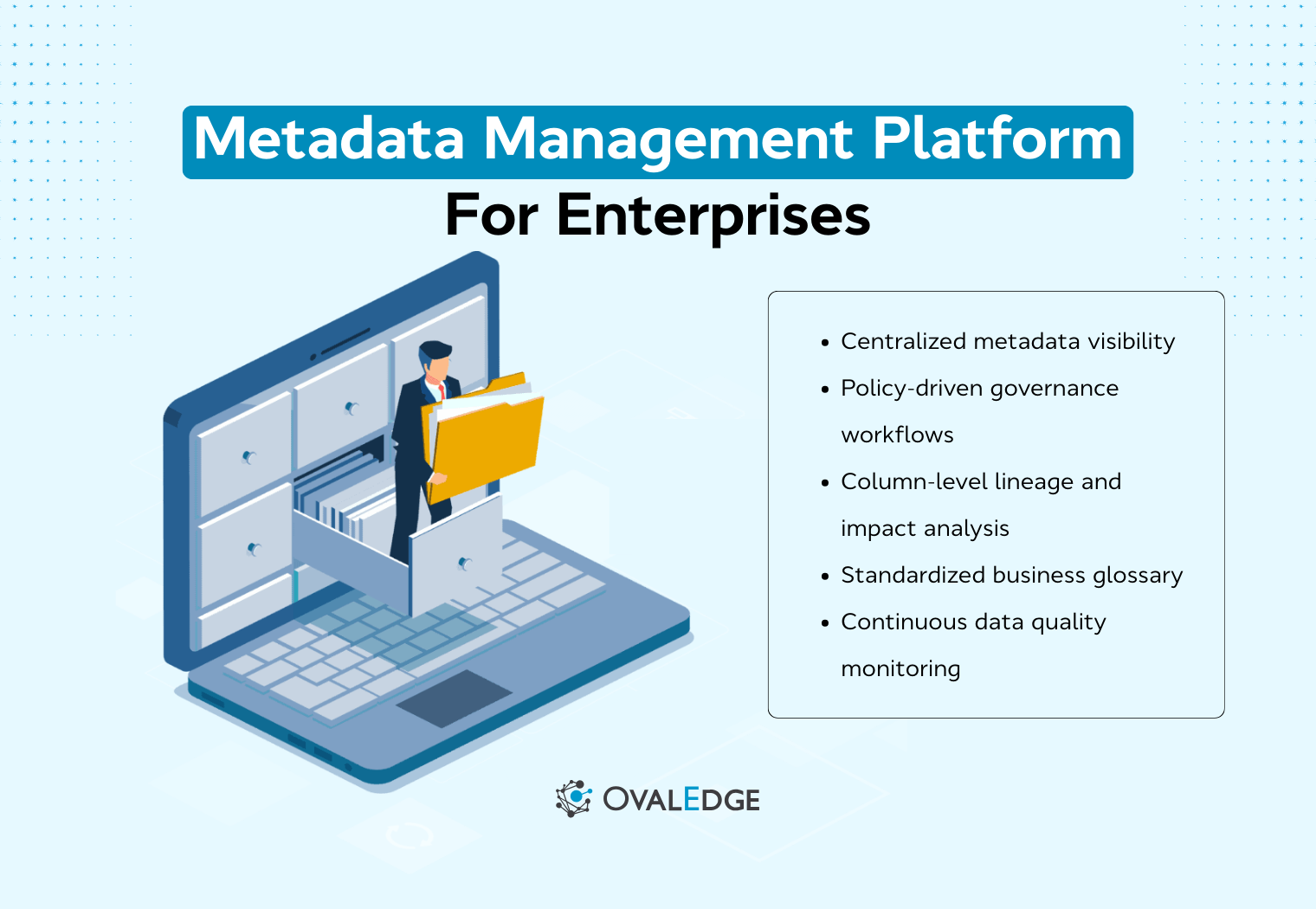
A metadata management platform for enterprises is a centralized system that catalogs, organizes, and governs metadata across distributed data sources. It enables metadata discovery, lineage tracking, schema management, and business glossary standardization. Enterprises use it to improve data visibility, compliance, analytics accuracy, and cross-functional collaboration.
At its core, the platform acts as the control layer across complex enterprise data environments. It captures technical metadata from databases, warehouses, APIs, dashboards, and SaaS systems. It also manages business metadata such as KPI definitions, data ownership, and policy documentation. By connecting both, enterprises move from fragmented documentation to operational governance.
How it differs from a basic data catalog
A basic data catalog primarily focuses on indexing datasets and enabling search. It helps users discover tables, dashboards, or reports. It may support tagging, comments, and simple documentation.
A metadata management platform goes further. It provides:
-
Automated cross-system metadata harvesting
-
End-to-end technical and business lineage
-
Schema management and impact analysis
-
Governance workflows and policy enforcement
-
Business glossary standardization
-
Sensitive data classification
-
Audit-ready documentation
In short, a catalog helps you find data. A metadata management platform helps you control, govern, and operationalize metadata across the enterprise.
Why enterprises are investing in metadata management platforms
Enterprises are not investing in metadata platforms for documentation alone. Data complexity, regulatory pressure, and analytics demands now exceed what manual governance can support. A centralized metadata layer reduces risk while enabling scale.
1. Growing data complexity across multi-source systems
Modern enterprises operate across hybrid and multi-cloud environments, including cloud warehouses, on-prem databases, ERP and CRM systems, SaaS tools, APIs, streaming platforms, and BI tools. Each generates its own metadata. Without integration, visibility breaks. A metadata management platform centralizes discovery, lineage, and schema tracking to provide a unified, cross-system view.
2. Compliance and governance requirements
Regulations require traceable lineage, audit logs, sensitive data classification, and enforceable policies. Without structured metadata, audits become reactive. A metadata platform maps data flows, classifies sensitive fields, and links policies to controls, improving compliance readiness.
3. Business metadata for analytics trust
Inconsistent KPI definitions erode executive trust. Centralized glossaries, standardized metrics, and clear ownership align dashboards and support scalable analytics and AI initiatives.
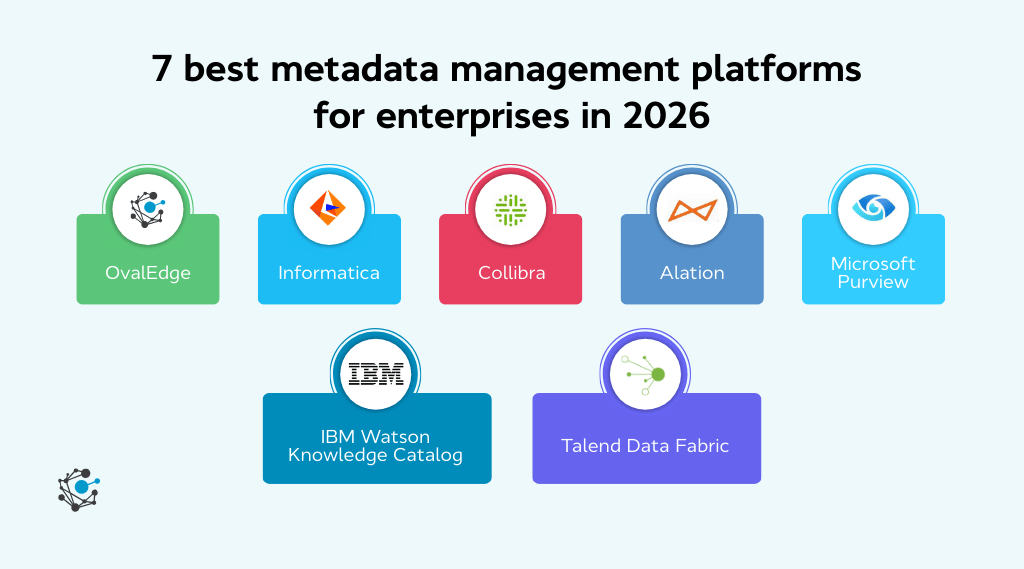
7 best metadata management platforms for enterprises in 2026
The enterprise metadata market includes platforms that range from discovery-first catalogs to governance-centric control layers. Below is a structured comparison of leading solutions used by mid-to-large enterprises.
1. OvalEdge
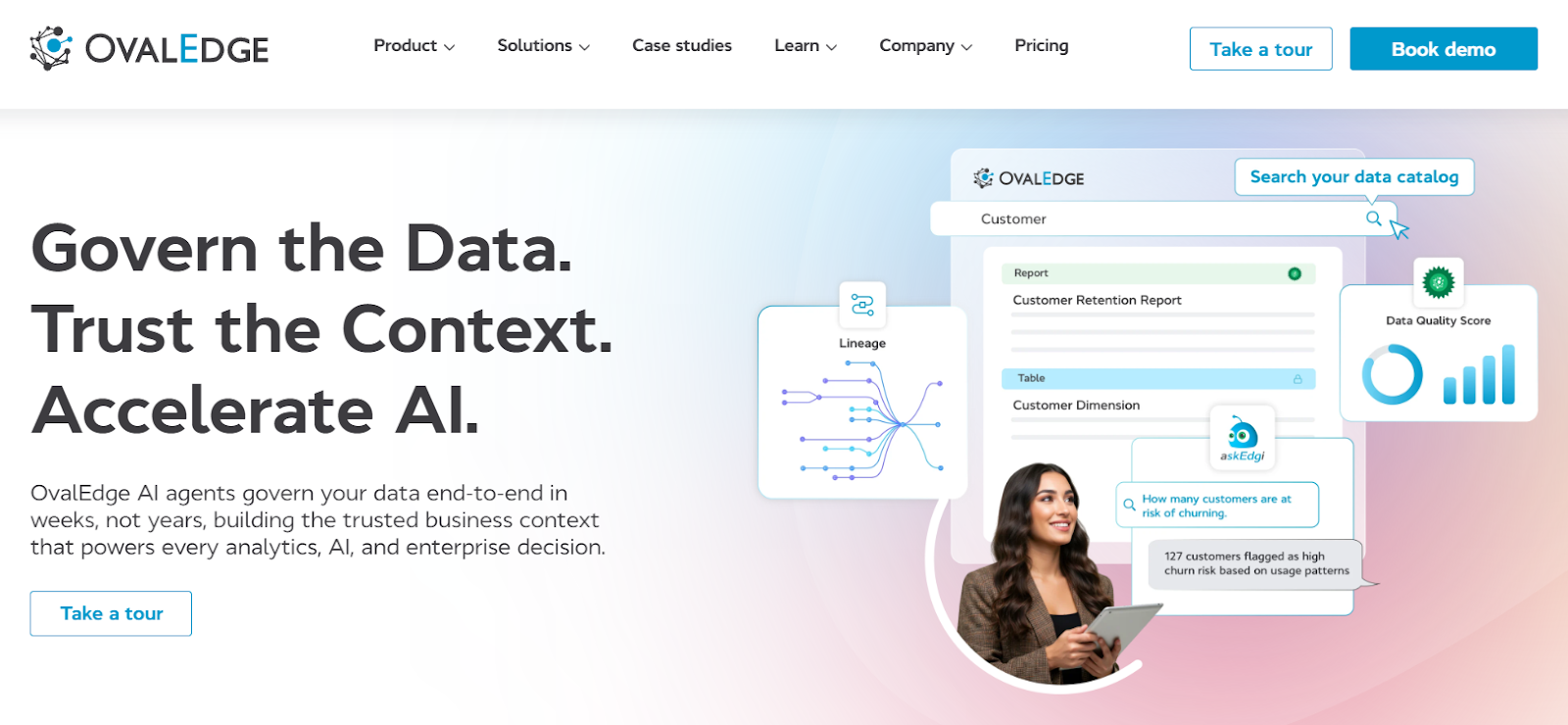
OvalEdge is an enterprise-grade metadata management platform designed to unify discovery, governance, lineage, compliance, and data quality within a single control layer. It combines AI-driven automation with structured human oversight, making it suitable for regulated and complex data environments.
Best features
-
AI-powered data discovery: AI agents automatically identify critical datasets, detect sensitive data, and suggest ownership based on usage patterns. This reduces manual documentation effort and accelerates metadata coverage across systems.
-
Column-level lineage with impact analysis: OvalEdge provides automated end-to-end lineage down to the column level. Teams can predict downstream impact before schema changes affect dashboards or reports.
-
Policy-to-control governance automation: Governance policies are converted into enforceable controls rather than static documentation. Privacy, regulatory, and stewardship workflows are operationalized directly within the platform.
-
Business glossary alignment: The platform aligns business terms with technical metadata to prevent KPI inconsistencies. This ensures departments operate using standardized definitions.
-
Continuous data quality monitoring: Integrated quality monitoring detects anomalies in production pipelines and triggers remediation workflows. This helps reduce dashboard discrepancies and downstream reporting errors.
Strengths
-
Strong balance between AI automation and human governance oversight
-
Designed for regulated industries requiring audit-ready traceability
-
Deep integration of governance, lineage, quality, and glossary management
-
Supports multi-cloud and hybrid enterprise environments
|
How OvalEdge works in a real enterprise environment
A global management consulting firm chose OvalEdge after evaluating 16 vendors through a structured proof of concept. The objective was to build true end-to-end governance across Snowflake, S3, Kafka, SAP SuccessFactors, APIs, and streaming systems, without slowing down data access. What changed with OvalEdge:
The result was stronger compliance, clearer ownership, and a scalable foundation for AI-driven initiatives. Explore the full case study to see how large enterprises operationalize governance at scale. |
Schedule a conversation with OvalEdge to explore how automated metadata governance, lineage, and access control can support your enterprise priorities.
Book a demo now!
2. Collibra
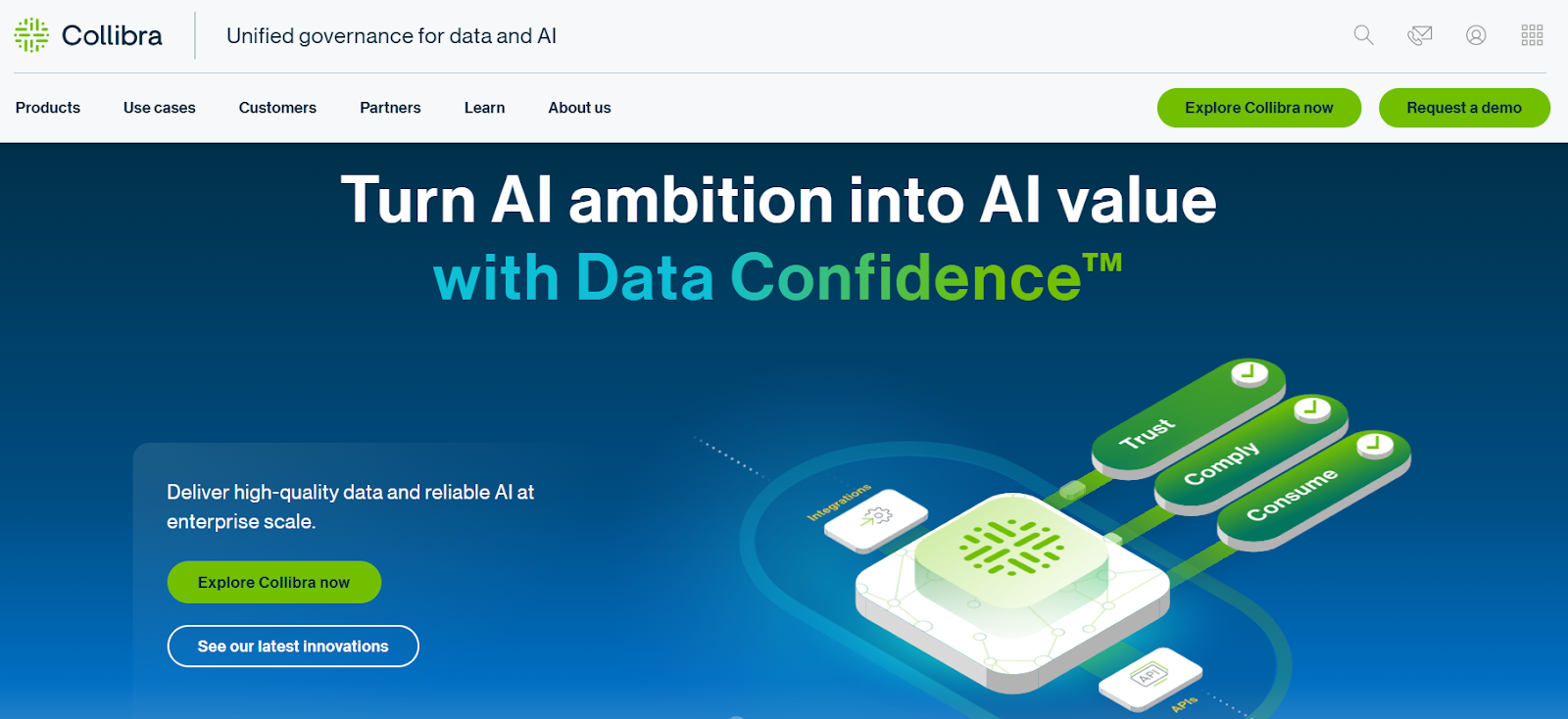
Collibra is an enterprise-focused data governance and metadata platform known for its structured stewardship workflows and policy-driven governance framework. It is widely adopted by large organizations building formal data governance programs.
Best features
-
Governance workflow management: Collibra provides configurable workflows for stewardship approvals, policy enforcement, and ownership tracking. This supports structured accountability across business domains.
-
Business glossary and policy management: The platform enables centralized glossary standardization and links business terms to governance policies. This helps align regulatory requirements with operational controls.
-
Data lineage visualization: Collibra offers technical lineage capabilities that allow enterprises to trace data movement across systems. This improves transparency and audit preparedness.
-
Role-based access governance: Granular role-based permissions ensure that access and governance responsibilities are clearly defined across teams.
Strengths
-
Strong governance maturity model suited for regulated industries
-
Scalable stewardship and policy workflows
-
Well-established enterprise presence and ecosystem integrations
-
Supports compliance documentation and audit readiness
Limitations
-
Implementation may require significant configuration and organizational alignment
-
Advanced automation and AI-driven capabilities may require additional modules
-
Can be resource-intensive during initial rollout
3. Alation
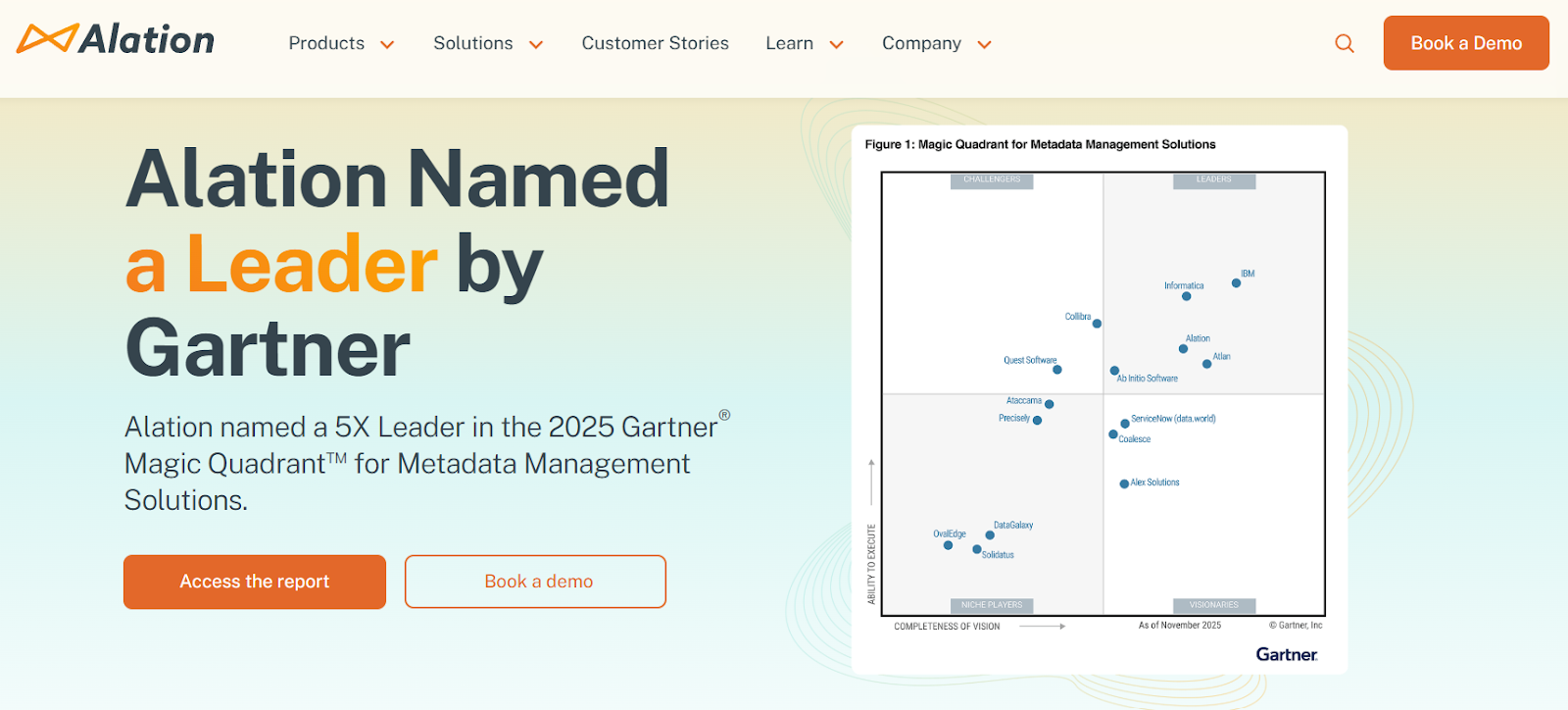
Alation is an enterprise data catalog platform focused on improving data discovery and analytics adoption. It emphasizes user engagement, collaboration, and behavioral intelligence to help teams find and trust the right data.
Best features
-
Behavioral metadata intelligence: Alation analyzes query logs and usage patterns to surface relevant datasets and highlight trusted assets. This helps users quickly identify commonly used and certified data.
-
Enterprise data catalog: The platform provides searchable indexing of datasets, dashboards, and reports across systems. It simplifies discovery through tagging, documentation, and collaboration features.
-
Business glossary integration: Alation supports glossary management to align business definitions with technical assets. This improves KPI consistency and shared understanding.
-
Data lineage visibility: It offers lineage tracking to help users understand how data flows from source to consumption, improving transparency in analytics workflows.
Strengths
-
Strong adoption among analytics and BI teams
-
Intuitive user experience focused on self-service discovery
-
Behavioral intelligence improves data relevance ranking
-
Supports collaboration between technical and business users
Limitations
-
Governance enforcement capabilities are lighter compared to governance-first platforms
-
Advanced compliance automation may require integrations or additional tooling
-
Best suited for discovery-led initiatives rather than full governance transformation
4. Informatica Enterprise Data Catalog
Informatica Enterprise Data Catalog is a metadata management solution designed to integrate tightly with Informatica’s broader data integration and governance ecosystem. It is suited for large enterprises managing complex, multi-system data architectures.
Best features
-
AI-powered metadata discovery: The platform uses machine learning to automatically scan, classify, and catalog metadata across cloud and on-prem systems. This accelerates large-scale metadata onboarding.
-
End-to-end technical lineage: Informatica provides detailed lineage tracking across ETL pipelines, databases, and reporting systems. This supports impact analysis and regulatory traceability.
-
Integrated data quality linkage: It connects cataloged assets with Informatica Data Quality tools. This allows enterprises to associate quality rules directly with metadata assets.
-
Enterprise-scale integration: Strong connectors across warehouses, integration pipelines, and enterprise applications enable broad metadata coverage.
Strengths
-
Deep integration with Informatica data integration and governance stack
-
Scalable for large, complex enterprise environments
-
Strong automation for metadata harvesting and classification
-
Suitable for enterprises with a mature data infrastructure
Limitations
-
Best value when used within the broader Informatica ecosystem
-
Implementation complexity can be high in heterogeneous environments
-
Licensing may scale with ecosystem adoption
5. IBM Watson Knowledge Catalog
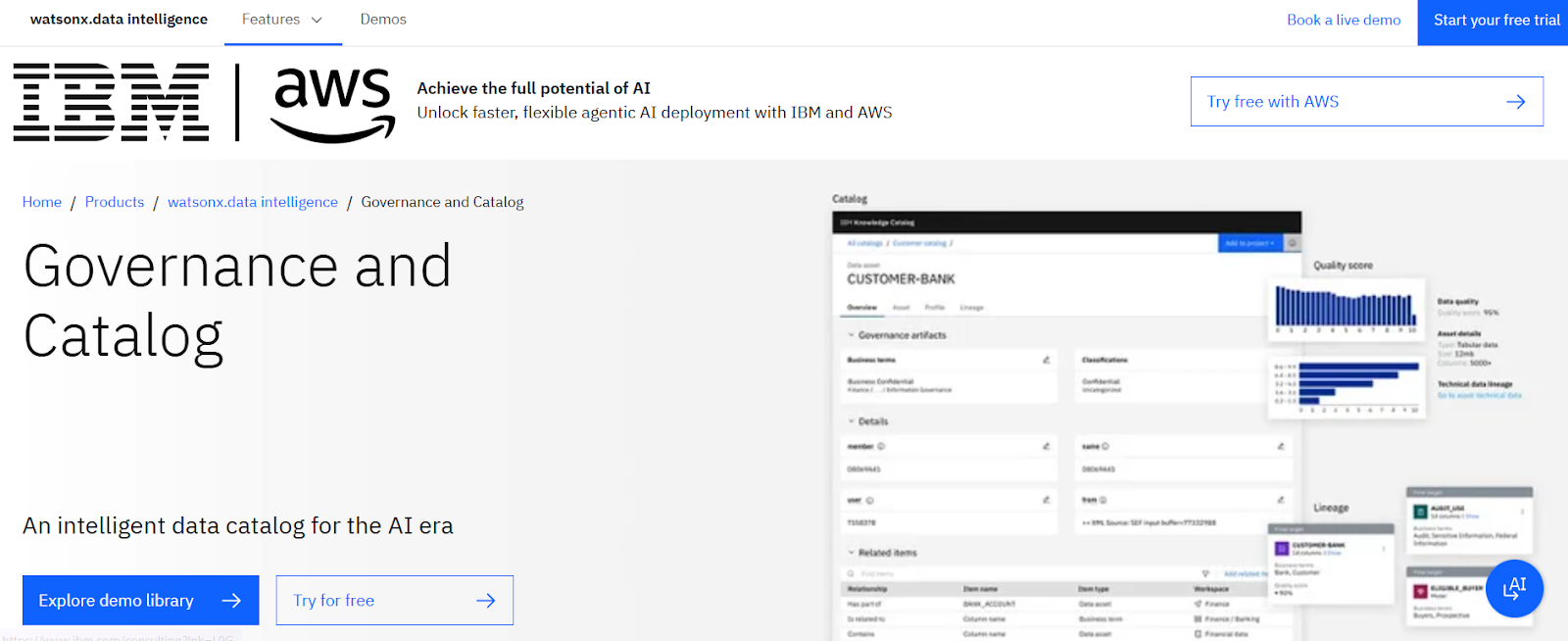
IBM Watson Knowledge Catalog is an enterprise metadata and governance solution designed to support hybrid and cloud-based data environments. It integrates closely with IBM’s data and AI ecosystem, making it suitable for organizations operating within IBM Cloud or mixed infrastructures.
Best features
-
AI-driven data classification: The platform uses machine learning to automatically classify sensitive data and apply governance policies. This improves regulatory compliance and reduces manual tagging.
-
Integrated governance and policy enforcement: Watson Knowledge Catalog links metadata with governance rules and access controls. This helps enforce enterprise data policies across systems.
-
Lineage and audit tracking: It provides lineage visualization and audit logs to support traceability requirements. This is critical for regulatory reporting and compliance audits.
-
Hybrid cloud support: The platform supports metadata management across on-prem and cloud environments, aligning with hybrid enterprise strategies.
Strengths
-
Strong governance and compliance capabilities
-
Tight integration with IBM data and AI services
-
Suitable for regulated industries with audit requirements
-
Scalable across hybrid architectures
Limitations
-
Strongest value within the IBM ecosystem environments
-
User experience may require training for broader adoption
-
Customization may increase implementation effort
6. Microsoft Purview

Microsoft Purview is a cloud-native metadata management and governance platform built primarily for Azure environments. It enables enterprises to scan, classify, and govern data across cloud and hybrid systems with strong integration into the Microsoft ecosystem.
Best features
-
Automated metadata scanning: Purview automatically scans data sources across Azure, Microsoft 365, and selected multi-cloud environments. This simplifies metadata onboarding at scale.
-
Built-in data classification: The platform includes predefined and customizable classification rules to identify sensitive data such as PII. This supports compliance and policy enforcement.
-
Data lineage tracking: Purview provides visual lineage across Azure data services, helping teams understand data movement and transformation.
-
Integration with Microsoft ecosystem: Tight integration with Azure, Power BI, and other Microsoft services enhances governance visibility within Microsoft-first architectures.
Strengths
-
Strong native integration with Azure services
-
Cloud-native scalability
-
Built-in classification policies for compliance support
-
Competitive pricing for Azure-based enterprises
Limitations
-
Best suited for Azure-centric environments
-
Cross-platform governance depth may require additional configuration
-
Advanced governance workflows may not match governance-first platforms
7. Talend Data Fabric
Talend Data Fabric is an integrated data platform that combines data integration, data quality, and metadata management capabilities. It is designed for enterprises that want metadata visibility embedded within broader data integration workflows.
Best features
-
Unified data integration and metadata management: Talend connects metadata management directly with ETL and data pipeline processes. This provides visibility into how data is transformed and moved across systems.
-
Built-in data quality tools: The platform integrates profiling and quality rules with metadata assets. This helps enterprises monitor data reliability alongside lineage and documentation.
-
Governance capabilities: Talend includes stewardship workflows and policy management features to support compliance initiatives.
-
Cloud and hybrid deployment: It supports deployment across cloud and on-prem environments, aligning with hybrid enterprise architectures.
Strengths
-
Strong integration between data pipelines and metadata tracking
-
Embedded data quality capabilities
-
Flexible deployment options
-
Suitable for integration-driven data strategies
Limitations
-
Governance depth may vary depending on configuration
-
Best value when leveraging Talend’s broader integration ecosystem
-
May require additional customization for advanced compliance automation
Key capabilities to look for in an enterprise metadata repository platform
Not all metadata platforms provide the same depth of control. Enterprise buyers should evaluate capabilities beyond basic discovery to ensure scalability, governance alignment, and long-term architectural fit.
1. Automated metadata discovery across structured and unstructured data
Enterprise environments include databases, warehouses, SaaS tools, APIs, and file systems. The platform should automatically scan and harvest metadata across structured and unstructured sources.
Evaluation checklist:
-
Does it support cloud, on-prem, and hybrid systems?
-
Are connectors native or API-based?
-
Can it scale scanning without a performance impact?
-
Does it continuously refresh metadata?
2. End-to-end lineage tracking and impact analysis
Lineage visibility is critical for compliance, analytics trust, and change management. Enterprises should look for column-level lineage and automated impact alerts.
Evaluation checklist:
-
Is lineage available at the table and column levels?
-
Can you trace data from the source to the dashboard?
-
Does the system predict downstream impact before schema changes?
-
Are lineage views audit-ready?
3. Integrated business glossary and data documentation
A centralized glossary prevents KPI inconsistencies and improves cross-functional alignment. It should link business terms directly to technical assets.
Evaluation checklist:
-
Can glossary terms map to datasets and dashboards?
-
Are ownership and stewardship clearly assigned?
-
Are approval workflows configurable?
-
Does it prevent duplicate or conflicting definitions?
4. AI-driven tagging and classification
Manual classification does not scale in large enterprises. Automated detection of sensitive data reduces compliance risk.
Evaluation checklist:
-
Does it auto-detect PII and regulated fields?
-
Are classification rules customizable?
-
Does it continuously monitor exposure risk?
-
Can policies trigger automated workflows?
5. Data mapping and schema management
Schema changes are common in dynamic environments. Enterprises need visibility into structural evolution and downstream dependencies.
Evaluation checklist:
-
Does the platform track schema versions?
-
Are schema changes logged historically?
-
Can you identify affected reports or pipelines?
-
Does it support impact-based alerts?
6. Role-based access and governance workflows
Metadata management must integrate with governance enforcement, not operate separately.
Evaluation checklist:
-
Are role-based permissions granular?
-
Can stewardship workflows be automated?
-
Are policy approvals documented?
-
Is access history auditable?
7. Enterprise catalog scalability
Metadata volume grows rapidly in large organizations. The platform must handle scale without degrading performance.
Evaluation checklist:
-
Can it support millions of metadata objects?
-
Is the architecture cloud-scalable?
-
Does it support multi-domain governance?
-
Can it handle multi-cloud environments simultaneously?
Evaluating these capabilities ensures that the platform functions as infrastructure rather than a standalone documentation tool.
How metadata management platforms enable governance, compliance, and analytics
Enterprise metadata platforms are not just discovery tools. They act as the control layer connecting governance policies, compliance documentation, data quality processes, and analytics enablement across distributed systems. By centralizing metadata, enterprises move from reactive documentation to operational control.
1. Strengthening enterprise data governance
Metadata acts as the enforcement backbone of governance. It centralizes ownership, connects policies to technical assets, and introduces accountability across domains. Rather than managing governance through spreadsheets or informal communication, enterprises embed governance directly into data workflows.
A modern metadata platform formalizes:
-
Data ownership and stewardship accountability
-
Policy-based access controls
-
Role-based governance workflows
-
Data classification and tagging standards
This structure creates measurable impact. Enterprises gain clarity around who owns what, reduce shadow data usage, and accelerate governance decision cycles. Instead of debating definitions or access rights, teams rely on documented, system-enforced controls.
|
Mini example: A finance dataset previously lacked a defined owner. The metadata platform assigns a steward, logs policy approvals, documents classification tags, and tracks access history. Governance becomes traceable rather than informal. |
2. Enabling regulatory compliance and audit readiness
Regulatory compliance increasingly depends on documented traceability. Enterprises must demonstrate where data originates, how it transforms, who accesses it, and how long it is retained. Without structured metadata, compliance efforts become manual and fragmented.
A metadata platform enables continuous compliance infrastructure by providing:
-
End-to-end lineage visibility
-
Data mapping for regulatory reporting
-
Centralized audit logs and change tracking
-
Automated classification of sensitive data
The result is faster audit preparation and reduced regulatory exposure.
|
Scenario: During an audit, leadership needs to demonstrate how PII moves from ingestion to reporting. The metadata platform surfaces lineage instantly, showing origin, transformation steps, and downstream usage. |
3. Improving data quality and trust in analytics
Analytics trust breaks down when metadata is inconsistent. If departments define KPIs differently or schema changes propagate without visibility, dashboards quickly lose credibility. Metadata management connects governance controls directly to analytics reliability.
By linking glossary definitions, lineage tracking, and schema monitoring, enterprises reduce discrepancies before they reach executive reporting.
Key capabilities typically include:
-
Documentation of quality rules
-
Impact analysis for schema changes
-
Standardized KPI definitions
-
Glossary alignment with BI dashboards
The impact is measurable. Teams operate with consistent definitions, discrepancies decline, and root cause analysis becomes faster.
|
Example: Sales defines revenue differently from finance. By aligning glossary terms to datasets and dashboards, the platform standardizes the metric and eliminates reporting conflicts. |
4. Preparing enterprise data for AI and advanced analytics
AI initiatives depend on structured, trusted metadata. Models trained on poorly documented datasets increase risk, reduce explainability, and slow experimentation. Metadata platforms provide the structured context required for responsible AI development.
They support:
-
Governed discovery for data science teams
-
Documentation of training datasets
-
Feature lineage tracking
-
Classification of sensitive attributes
With these controls in place, enterprises accelerate AI experimentation while reducing compliance and model risk. Data scientists spend less time searching and validating datasets, and leadership gains confidence in model transparency.
AI scalability is not simply a technology challenge. It is a metadata maturity challenge.
5. Supporting the data product lifecycle
As organizations adopt data mesh or domain-driven architectures, data is treated as a product with defined ownership, SLAs, and lifecycle management. Metadata platforms provide the infrastructure to support this shift.
They enable domain-level accountability, structured documentation, version tracking, and schema evolution monitoring. When schema changes occur, downstream dependencies are identified immediately, reducing operational disruption.
The result is stronger collaboration across domains, faster iteration cycles, and clearer accountability for data products. In distributed enterprise architectures, metadata becomes the backbone that keeps data products reliable and governed at scale.
How to evaluate a metadata management platform for your enterprise
Choosing a metadata management platform is not just a tooling decision. It directly affects governance maturity, compliance posture, analytics reliability, and AI scalability. Enterprises should evaluate platforms through the lens of long-term architecture, not short-term feature comparison.
Below is a structured evaluation framework aligned with enterprise buying intent.
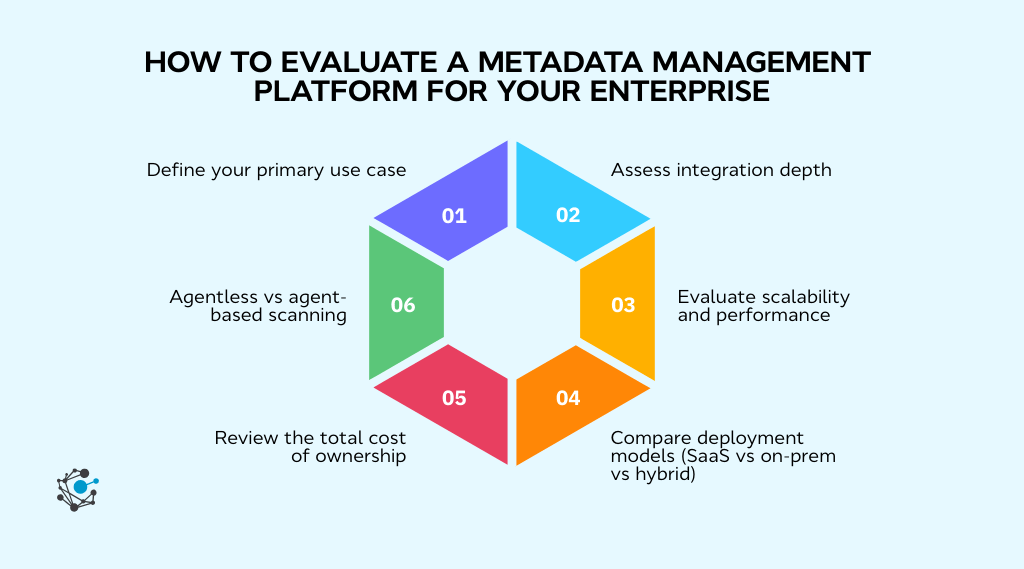
1. Define your primary use case
Before comparing vendors, clarify what problem you are solving first. The clearer the primary use case, the easier it becomes to eliminate platforms that do not align strategically.
Common primary drivers include:
-
Governance-first transformation
-
Regulatory compliance and audit readiness
-
Analytics trust and KPI standardization
-
AI and advanced analytics enablement
-
Data product strategy
2. Assess integration depth
A metadata platform must integrate deeply into your existing ecosystem. Surface-level connectors are not enough. Evaluate integration coverage across:
-
ERP systems
-
CRM platforms
-
Cloud warehouses
-
On-prem databases
-
BI tools
-
ETL and data pipelines
-
SaaS applications
Ask whether lineage extends across transformation layers, not just within individual systems. True enterprise metadata management requires cross-platform continuity.
3. Evaluate scalability and performance
Enterprise metadata volumes grow quickly. Millions of tables, columns, dashboards, and APIs can accumulate across global operations.
Assess:
-
Maximum supported metadata object volume
-
Performance impact of large-scale scanning
-
Real-time vs batch metadata refresh
-
Multi-domain governance support
-
Cross-region architecture compatibility
Scalability should be validated early, especially for global organizations operating across multiple business units.
4. Compare deployment models (SaaS vs on-prem vs hybrid)
Deployment flexibility affects both security posture and implementation speed.
-
SaaS models enable faster rollout and lower infrastructure overhead
-
On-prem deployments may be required for regulated or legacy-heavy environments
-
Hybrid models support mixed architectures
Enterprises operating in restricted environments should confirm whether the platform supports secure segmentation and regional data residency requirements.
5. Review total cost of ownership
Licensing cost alone does not reflect true investment.
Consider:
-
Implementation and integration effort
-
Governance process redesign
-
Training and adoption programs
-
Ongoing maintenance and scaling costs
-
Additional modules required for advanced capabilities
Platforms that require extensive customization may increase long-term operational costs.
6. Agentless vs agent-based scanning
Metadata discovery depends on how the platform connects to enterprise systems.
Agentless scanning extracts metadata through secure APIs and native connectors without installing software inside your infrastructure. This typically reduces deployment complexity and maintenance overhead.
Agent-based scanning requires lightweight agents deployed within your environment to collect and transmit metadata. This may provide deeper access in restricted or legacy systems.
When evaluating vendors, consider:
-
Security policies and internal compliance standards
-
Deployment speed requirements
-
Infrastructure overhead tolerance
-
Depth of on-prem system access
Cloud-first enterprises often prefer agentless approaches for agility. Highly regulated or legacy-heavy environments may require agent-based or hybrid models.
Metadata management platform vs data catalog vs data governance platform
These three terms are often used interchangeably, but they represent different layers of enterprise data control. Understanding the distinction helps prevent underinvestment in governance or overinvestment in tools that do not align with your maturity level.
Let’s break this down.
What is a data catalog?
A data catalog is primarily a discovery-first layer. Its main objective is to help users find, understand, and explore available datasets.
|
A catalog answers the question: What data do we have and where is it? It does not fully answer: Who owns it, how is it governed, and how does it move across systems? |
What is a data governance platform?
A data governance platform focuses on policy and control. It introduces structure around ownership, compliance, and risk management.
|
A governance platform answers: Are we controlling and protecting our data properly? |
What is a metadata management platform?
A metadata management platform acts as the integrated control layer across systems. It centralizes technical and business metadata while connecting governance, compliance, lineage, and analytics enablement.
|
A metadata management platform answers: What data do we have? Who owns it? How does it move? Is it compliant? Can we trust it for analytics and AI? |
Enterprise platform comparison table
|
Capability |
Metadata Management Platform |
Data Catalog |
Data Governance Platform |
|
Metadata discovery |
Advanced, automated, cross-system |
Basic indexing and search |
Limited |
|
Business glossary |
Integrated and governed |
Basic definitions |
Often separate |
|
Lineage tracking |
End-to-end technical and business lineage |
Limited or partial |
Often policy-focused |
|
Schema management |
Yes |
Minimal |
Rare |
|
Governance workflows |
Built-in and policy-driven |
Limited |
Core capability |
|
Regulatory traceability |
Comprehensive |
Limited |
Strong but documentation-focused |
|
Analytics enablement |
Strong |
Strong for discovery |
Indirect |
|
Multi-system integration |
Deep enterprise integration |
Moderate |
Depends on the architecture |
When to choose each
Choose a data catalog if:
-
Your primary goal is data discovery
-
You are early in metadata maturity
-
Governance requirements are minimal
Choose a data governance platform if:
-
Compliance enforcement is the top priority
-
You need structured policy workflows
-
Risk mitigation drives the investment
Choose a metadata management platform if:
-
You need discovery, governance, and lineage in one system
-
You operate across multi-cloud and on-prem environments
-
You require audit readiness and analytics trust at scale
-
You are building a data product or data mesh architecture
For most large enterprises, metadata management platforms become the long-term foundation because they unify capabilities that would otherwise require multiple disconnected tools.
How to choose the right enterprise metadata management platform
While choosing the right metadata management platform, the wrong choice can create governance gaps, integration challenges, or limited scalability. The right choice becomes foundational infrastructure for governance, analytics, and AI initiatives.
Below is a decision-driven framework based on common enterprise scenarios.
If governance is your priority
Enterprises undergoing governance transformation should prioritize platforms that provide strong policy enforcement, stewardship workflows, and audit-ready traceability.
Look for:
-
Built-in governance workflows with approval tracking
-
Role-based access controls
-
Data ownership mapping across domains
-
Automated classification of sensitive data
-
Policy-to-control enforcement mechanisms
Governance-first organizations should avoid discovery-only tools that lack enforcement capabilities. The platform must operationalize governance rather than simply document it.
If analytics enablement is your focus
Organizations prioritizing analytics adoption should focus on platforms that balance discovery, glossary alignment, and lineage transparency.
Key evaluation areas include:
-
Searchable, user-friendly catalog interface
-
Business glossary alignment with BI dashboards
-
Impact analysis for schema changes
-
Cross-system lineage visibility
-
Collaboration features for business and technical users
The goal is to reduce dashboard discrepancies, standardize KPIs, and improve trust in reporting without introducing excessive governance friction.
If you operate in a regulated industry
Highly regulated industries such as finance, healthcare, insurance, and pharmaceuticals require deep compliance capabilities.
Evaluate platforms based on:
-
End-to-end lineage traceability
-
Centralized audit logging
-
Automated PII detection and classification
-
Data mapping for regulatory reporting
-
Retention and policy documentation support
In these environments, compliance automation and audit readiness are non-negotiable. The platform must support structured documentation and traceable enforcement controls.
If you manage a multi-cloud architecture
Enterprises operating across AWS, Azure, GCP, and on-prem systems must prioritize integration depth and deployment flexibility.
Focus on:
-
Native connectors across cloud providers
-
Hybrid deployment support
-
Consistent metadata synchronization across environments
-
Performance at scale
-
Cross-domain governance support
Multi-cloud enterprises should validate that lineage extends across transformation pipelines, not just within isolated systems.
How metadata management supports governance and AI
Governance and AI are no longer separate initiatives. AI systems depend on well-governed, well-documented, and traceable data. Without structured metadata, organizations struggle with model explainability, regulatory exposure, and inconsistent results. Metadata management acts as the control layer that makes both governance enforcement and AI scalability possible.
Establishing policy-driven data governance
Metadata provides the structure required to operationalize governance policies. Instead of documenting rules in isolation, enterprises connect policies directly to data assets, ownership structures, and access controls.
A mature platform supports:
-
Data ownership and stewardship mapping
-
Policy-based access controls
-
Role-based governance workflows
-
Automated data classification and tagging
-
Centralized audit logs
This creates clear accountability across business units. Shadow data usage declines because ownership and policy enforcement become visible. Access is controlled systematically rather than informally, strengthening compliance posture across distributed systems.
Governance becomes embedded in data operations rather than managed as a parallel process.
Enabling traceability through end-to-end lineage
AI and regulatory frameworks both require visibility into how data flows across its lifecycle. Lineage tracking provides transparency from source systems to reporting layers and machine learning models.
With end-to-end lineage, enterprises can:
-
Trace transformations across pipelines
-
Map dependencies between systems
-
Perform impact analysis before schema changes
-
Document data flow for audit purposes
This level of traceability supports audit readiness and faster root cause analysis. It also strengthens AI explainability. If a model output is questioned, teams can trace the origin of input features and transformations that influenced predictions.
Lineage reduces operational risk while supporting responsible AI initiatives.
Improving data quality for analytics and AI models
AI performance and analytics reliability both depend on data quality. Metadata management connects profiling results, quality rules, and governance standards to the datasets being consumed.
Capabilities typically include:
-
Metadata-driven quality rule documentation
-
Integration with profiling tools
-
KPI definition standardization
-
Dataset validation prior to model training
The impact extends beyond dashboards. Reliable data reduces bias risk in models and increases confidence in predictions. When definitions are standardized and quality controls are documented, teams spend less time validating inputs and more time improving models.
Trust becomes measurable and repeatable.
Supporting responsible and explainable AI
Responsible AI requires documentation. Enterprises must demonstrate what datasets were used for training, how features were derived, and whether sensitive attributes were handled appropriately.
Metadata platforms support this by enabling:
-
Training dataset documentation
-
Feature lineage tracking
-
Classification of sensitive data within models
-
Version control for datasets
-
Documentation for regulatory review
This structure improves AI transparency and reduces compliance risk. Executives gain confidence in AI initiatives because data provenance and governance controls are clearly documented.
As regulatory scrutiny around AI increases, metadata maturity becomes a strategic advantage.
Accelerating AI experimentation with governed data discovery
AI teams often spend significant time searching for and validating datasets. A governed metadata repository reduces that friction.
By enabling searchable, tagged, and ownership-defined datasets, metadata platforms allow data scientists to discover approved data products quickly. Clear documentation and access controls enable faster experimentation without compromising governance.
The impact includes:
-
Faster model development cycles
-
Reduced data wrangling time
-
Controlled innovation at scale
Enterprises that invest in metadata management create a structured environment where AI innovation can scale without introducing unmanaged risk.
Conclusion
Enterprise metadata management is no longer optional. It directly impacts governance maturity, regulatory exposure, analytics reliability, and AI scalability. The right platform should centralize discovery, provide end-to-end lineage, standardize business definitions, and connect policies to enforceable controls across distributed systems.
For organizations operating in complex, regulated, or multi-cloud environments, automation and traceability are essential. OvalEdge combines AI-driven metadata discovery, column-level lineage, policy-to-control governance automation, and continuous data quality monitoring within a single enterprise platform. It moves metadata from passive documentation to active operational control.
If your enterprise is ready to eliminate KPI inconsistencies, improve audit readiness, and strengthen trust in analytics and AI, the next step is practical evaluation.

Book a personalized demo of OvalEdge to see how it can unify metadata, automate governance, and scale with your data ecosystem.
FAQs
1. What is the difference between a metadata management platform and a data catalog?
A data catalog focuses on discovering and indexing datasets. A metadata management platform goes further by enabling lineage tracking, governance workflows, schema management, and compliance documentation, providing enterprise-wide control across distributed systems.
2. Why do enterprises need a metadata repository platform?
Enterprises manage data across cloud, on-prem, and SaaS systems. A centralized metadata repository standardizes definitions, tracks lineage, assigns ownership, and documents compliance controls, reducing risk while improving analytics consistency and audit readiness.
3. How does metadata management improve data governance?
Metadata management connects ownership, classification, lineage, and access controls in one system. It enables policy-based workflows, stewardship tracking, and audit logging, making governance enforceable, transparent, and scalable across complex enterprise environments.
4. What features should an enterprise metadata solution include?
An enterprise solution should include automated metadata discovery, end-to-end lineage, business glossary management, schema impact analysis, governance workflows, sensitive data classification, and multi-cloud integration support to enable governance and analytics at scale.
5. Can metadata management platforms integrate with existing data warehouses?
Yes. Most enterprise platforms integrate with cloud warehouses, data lakes, BI tools, and ETL pipelines. Integration depth varies, so enterprises should validate connector coverage and cross-system lineage continuity during vendor evaluation.
6. How long does it take to implement an enterprise metadata management platform?
Implementation timelines vary based on architecture complexity and governance maturity. Many enterprises begin with a phased rollout focused on high-priority domains, followed by gradual expansion across departments and systems.
.png?width=1081&height=173&name=Forrester%201%20(1).png)
.png?width=1081&height=241&name=KC%20-%20Logo%201%20(1).png)