Even with the best dashboards in place, teams often wait days for updated metrics, refreshed reports, or insights that feel a step behind the business reality.
Every team, at some point, has experienced this friction. The lag between questions and answers. The over-reliance on analysts. The mental overhead of tracking down data that should already be available.
Self-service analytics emerged to close that gap. It gave non-technical teams the ability to explore data on their own, without needing SQL or IT tickets.
Accessing dashboards is only half the problem. Interpreting them, identifying what changed, and deciding what to do next still eats up time and demands context.
That’s where the next layer comes in, and AI-driven self-service analytics goes a step further to fill this gap. It doesn’t just show data. It helps make sense of it.
With AI agents, intelligent querying, and governed automation, these platforms reduce noise, surface meaningful insights, and offer proactive guidance in real time.
This blog explains what AI-driven self-service analytics actually means, how it works across the enterprise stack, and why implementation success hinges on more than just plugging in a chatbot.
What is AI-driven self-service analytics?
AI-driven self-service analytics combines artificial intelligence with intuitive interfaces to help users analyze data independently. It enables business users to ask questions in natural language, receive instant insights, and interact with dashboards without needing technical skills.
AI agents recommend actions, generate reports, and explain patterns. The platform ensures governed access, automates workflows, and scales across teams. This approach reduces reliance on data teams, shortens decision cycles, and democratizes analytics across the organization.
Core components of AI-driven self-service analytics
The effectiveness of AI-driven self-service analytics platforms depends on a well-integrated set of components that balance intelligence, governance, and interoperability.
Below are the foundational layers that distinguish robust platforms from underdeveloped ones.
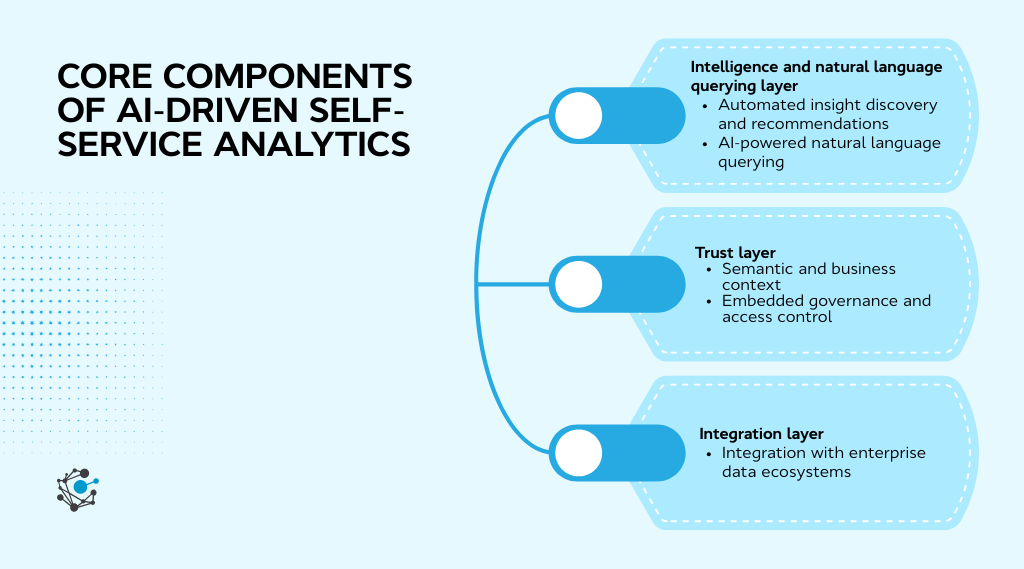
1. Intelligence and natural language querying layer
The intelligence and natural language querying layer combines machine learning with natural language processing to make data exploration intuitive and context-aware.
It shifts analytics from static dashboards to dynamic, conversational experiences, enabling teams to move faster, ask better questions, and uncover insights without technical overhead.
Automated insight discovery and recommendations
One of the most transformative features of AI-powered analytics is its ability to detect patterns without being explicitly prompted.
Instead of relying on users to sift through filters or build custom dashboards, the system continuously scans datasets for relevant changes, anomalies, or correlations. This includes identifying unexpected drops in sales, shifts in customer behavior, or operational inefficiencies.
This type of automated discovery significantly shortens the time between data generation and insight action.
|
For example, when marketing performance drops across a specific channel, the system can flag this trend and correlate it with campaign activity, helping teams take corrective action sooner. |
AI-powered natural language querying
Natural language querying (NLQ) has emerged as a core feature in AI self-service analytics tools, making data interaction more intuitive.
Rather than learning SQL or navigating complex report builders, users can type plain-language questions such as “What was our revenue growth last month by region?” and receive a visual answer backed by governed data.
What makes this truly valuable is the combination of NLP (natural language processing) with a governed semantic model. Without that, even sophisticated NLP engines risk misinterpreting intent or delivering inconsistent results.
askEdgi by OvalEdge reduces the risk of query misinterpretation by mapping user queries to the business context because it doesn’t just interpret questions. It understands the business context behind them.
Built on a metadata-rich AI catalog and a governed semantic layer, askEdgi auto-discovers relevant data, runs governance checks, and delivers precise answers in plain English.
With no setup or SQL required, business users get context-aware, governed analytics instantly and reliably.
2. Trust layer
As analytics becomes more accessible across roles, ensuring consistency, accuracy, and control is no longer optional.
The trust layer in AI-driven self-service analytics serves as the foundation that safeguards data integrity and aligns teams around a single version of truth.
Before users can confidently act on insights, this layer ensures that every metric, definition, and access point is governed, traceable, and reliable.
Semantic and business context
The semantic layer serves as the translator between raw data and business users. It defines shared KPIs, dimensions, and metric logic across the organization.
Without it, users may interpret fields differently, one team pulling revenue by transaction date, another by booking date, leading to inconsistencies and internal debates over accuracy.
In a governed AI analytics platform, the semantic layer ensures all queries draw from a single source of truth.
Embedded governance and access control
Democratized data access should never mean unrestricted access. Strong AI-driven self-service analytics platforms embed role-based permissions directly into the analytics workflow.
This includes restricting access to sensitive data fields, applying masking rules, and enforcing audit trails.
For instance, a sales operations user might have access to performance trends across all teams but be restricted from seeing individual customer pricing.
Governance controls ensure that such restrictions are enforced consistently, regardless of how the user accesses the data, via dashboard, NLQ, or embedded analytics.
3. Integration layer
No matter how intelligent an analytics tool is, its value is only as strong as its connection to enterprise systems. The integration layer is where AI-driven self-service analytics meets the real-world complexity of data ecosystems.
Integration with enterprise data ecosystems
AI-powered analytics cannot function in isolation. To deliver real-time, actionable insights, these platforms must integrate seamlessly with enterprise data environments.
That includes connections to cloud data warehouses like Snowflake, Redshift, or BigQuery, as well as operational systems such as CRMs, ERPs, and marketing automation platforms.
The value here lies in reducing data duplication and latency, instead of exporting data to separate BI environments, modern platforms query governed data in-place, preserving accuracy and freshness.
|
For example, when connected to Salesforce, a sales manager can use an embedded AI analytics tool to ask, “Which accounts are likely to churn this quarter?” pulling from real-time CRM signals without switching tools. |
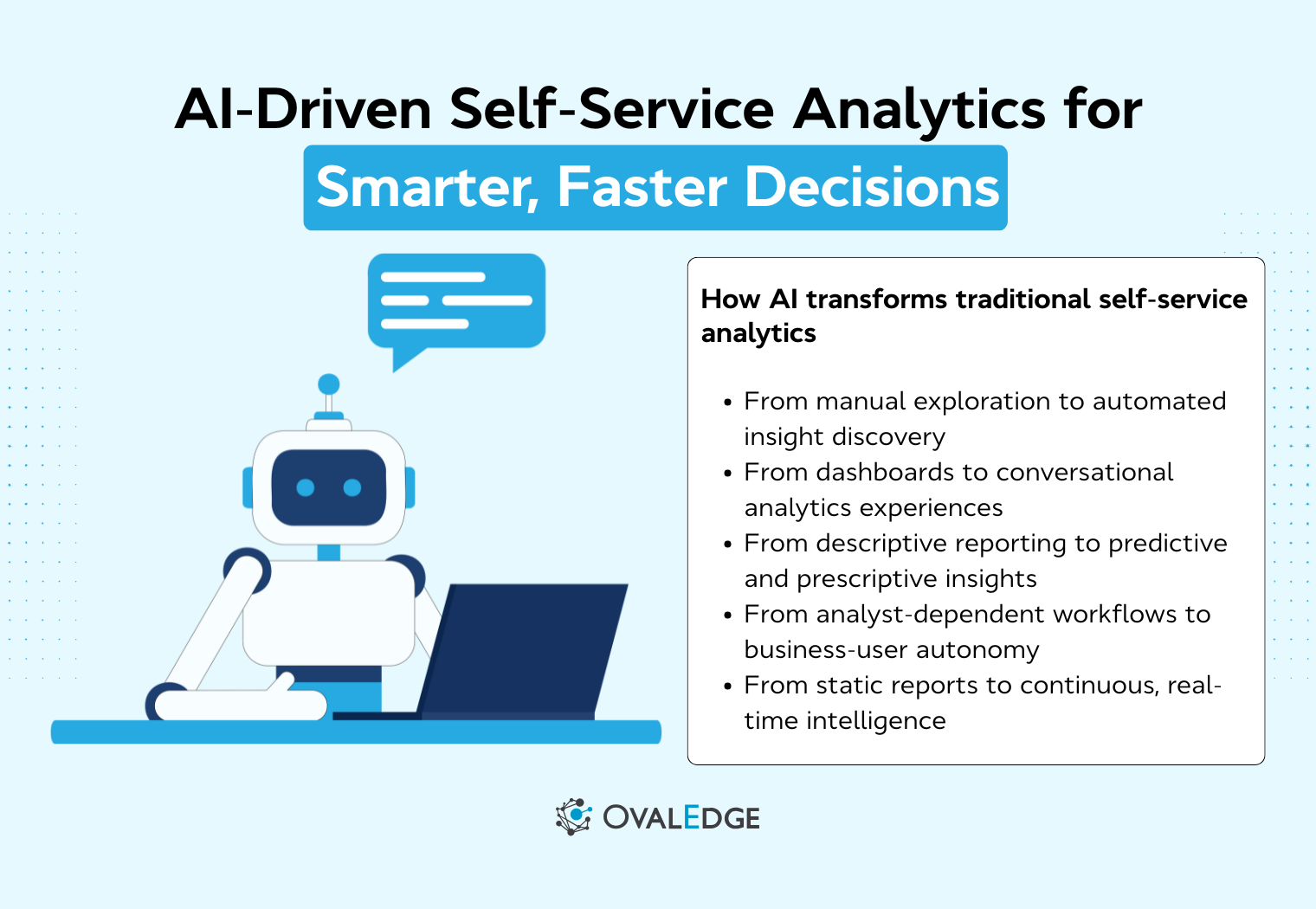
How AI transforms traditional self-service analytics
AI is not simply an add-on to existing self-service analytics platforms. It fundamentally reshapes how users access, interpret, and act on data.
Traditional BI platforms focused on creating dashboards and visual reports, but often left business users dependent on analysts to define filters, configure logic, or extract meaning. AI-driven self-service analytics eliminates those friction points by embedding intelligence throughout the analytics lifecycle.
1. From manual exploration to automated insight discovery
Traditional self-service platforms required users to ask the right question, build custom queries, or navigate dashboards to uncover patterns.
This process often delays decision-making and excludes non-technical users who lack the skills or confidence to explore data independently.
AI transforms this workflow by automatically detecting what matters and proactively surfacing it.
Instead of waiting for someone to notice a dip in performance or a spike in customer churn, AI agents continuously scan data to highlight anomalies, correlations, or emerging trends without user prompts.
|
For example, an AI-powered platform might detect a sharp increase in product return rates in a specific region and alert the operations team before the issue becomes systemic. |
This proactive approach is especially powerful in dynamic business environments, where reacting a few days too late can mean missed revenue or customer dissatisfaction.
By shifting from reactive querying to automated pattern recognition, AI significantly reduces time-to-insight and expands value to users who may not even know what to look for.
2. From dashboards to conversational analytics experiences
Dashboards have long been the default interface for business intelligence, but they require users to navigate filters, understand chart logic, and interpret visualizations.
It requires skills that are not always evenly distributed across departments. Static dashboards also struggle to keep pace with evolving questions, especially when business needs change mid-quarter.
AI-driven self-service analytics replaces this static model with dynamic, conversational interfaces that let users interact with data using natural language.
Instead of opening a dashboard and applying filters manually, a user can ask, “How did our Q2 sales in the Northeast compare to Q1?” and receive a clear, contextualized answer in seconds.
This not only increases adoption among non-technical users but also fosters a more fluid, question-driven approach to data exploration.
Business leaders can iterate rapidly through questions during a live meeting, getting answers in real time without needing an analyst in the room or a follow-up email chain.
The shift from static dashboards to conversational analytics is more than a UI change. It reflects a broader movement toward contextual, user-centric decision-making, where insights are not just available but accessible and explainable at the moment of need.
Traditional dashboards demand users know where to look and how to interpret static visuals. askEdgi from OvalEdge reimagines this. Built on an AI contextual data catalog, askEdgi replaces static interfaces with a dynamic, conversational experience.
Business users can simply ask questions in plain English, and askEdgi fetches, analyzes, and visualizes governed data on the fly. No filters, no manual slicing, just real-time, governed answers aligned with business context.
3. From descriptive reporting to predictive and prescriptive insights
Most traditional BI tools are designed for descriptive analytics. They tell you what happened using static charts and backward-looking reports.
This approach is useful for historical performance reviews but falls short when timely decisions are needed in fast-changing environments.
AI-driven self-service analytics platforms extend the value of traditional reporting by enabling predictive and prescriptive capabilities.
Predictive analytics uses historical data to forecast likely outcomes, such as which customer segments are likely to churn or which regions might miss sales targets. Prescriptive analytics goes a step further by recommending specific actions based on those forecasts.
|
For example, Databricks’ Lakehouse AI platform allows teams to build customer churn models that not only predict at-risk accounts but also simulate how different retention strategies could improve outcomes. |
This supports forward-looking, data-backed decision-making that helps business users act before problems escalate.
This evolution from insight to foresight reduces guesswork, aligns decisions with business goals, and creates a continuous feedback loop between analysis and action.
4. From analyst-dependent workflows to business-user autonomy
In many organizations, data access is still a gated process. Business users request reports through ticketing systems, and analysts build custom dashboards based on those requests.
This model creates delays, increases the workload on data teams, and often results in reports that are outdated by the time they’re delivered.
AI-driven self-service analytics platforms reduce this dependency by giving business users the ability to explore data on their own terms.
Natural language querying, guided recommendations, and AI-generated visualizations allow users to find answers without waiting for technical support.
This autonomy transforms the role of analysts as well. Rather than fielding repetitive ad hoc queries, analysts can focus on building strategic models, improving data pipelines, and enabling data governance.
Business users, meanwhile, become empowered to make informed decisions faster.
|
For example, a regional sales leader who needs to understand pipeline velocity, instead of requesting a report from central analytics, can ask the platform directly: “What is the average sales cycle length for Q3 compared to Q2?” The answer is immediate, contextualized, and based on governed definitions. |
This shift from centralized dependency to decentralized access is at the heart of what makes AI self-service analytics transformative. It democratizes insight generation while maintaining trust in the underlying data.
5. From static reports to continuous, real-time intelligence
Static reports have long been the backbone of business performance tracking, but their relevance is fleeting.
In fast-moving markets, decisions made on last week’s data can already be misaligned with current conditions. Scheduled reports delivered via email or dashboards that refresh weekly are no longer sufficient.
AI-driven self-service analytics platforms offer real-time data ingestion, continuous monitoring, and adaptive insights that evolve as new information becomes available. These systems don’t just update dashboards. They generate alerts, surface anomalies, and revise predictions as data flows in.
This real-time model of insight delivery ensures that business decisions are always grounded in the most current data, reducing risk and increasing responsiveness.
How to implement AI-driven self-service analytics
Successfully adopting AI-driven self-service analytics requires more than deploying new tools. It involves rethinking data accessibility, aligning AI capabilities with business needs, and creating an environment where users feel confident using data without relying on specialists.
Below are the foundational steps organizations should take to build a scalable, governed, and impactful implementation.
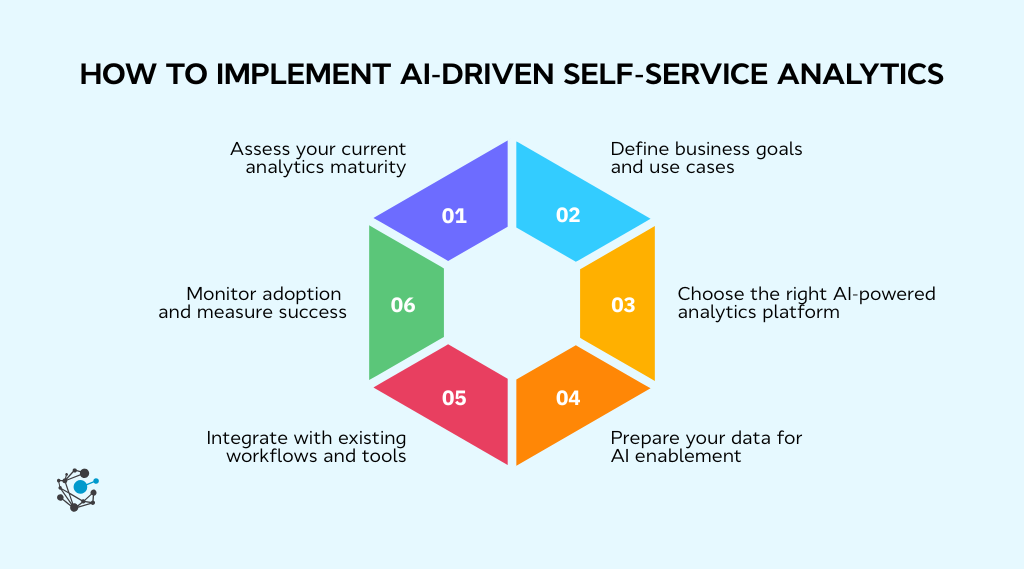
1. Assess your current analytics maturity
Before selecting platforms or building AI models, organizations need a clear picture of their current data and analytics maturity. This assessment includes evaluating:
-
User readiness: Do teams understand data terminology? Can non-technical users interpret visualizations and act on insights? If not, AI features like natural language querying or auto-insights may be underutilized or misused.
-
Data quality and accessibility: Are the data sources centralized, governed, and up to date? Fragmented systems, inconsistent definitions, or stale data can degrade the performance of AI-powered analytics, regardless of the platform.
-
Governance frameworks: Are there clear policies around data ownership, access controls, and usage? Without governance in place, scaling self-service can lead to duplication, conflicting metrics, and compliance risks.
Organizations that skip this step often face low adoption rates, inaccurate insights, or failed integrations due to mismatched expectations between tools and teams.
2. Define business goals and use cases
AI-driven self-service analytics only delivers value when tied to specific business outcomes. That’s why defining targeted use cases is one of the most critical early steps.
Rather than rolling out enterprise-wide access with no clear direction, start with focused, high-value use cases that demonstrate impact and generate momentum. These may include:
-
Sales forecasting to identify pipeline risks early and support revenue planning
-
Marketing campaign optimization using real-time insights on channel performance and customer behavior
-
Inventory or logistics monitoring with predictive alerts for disruptions or delays
-
Customer segmentation and lifetime value prediction to support retention and personalization strategies
Selecting the right use cases also ensures that the platform's AI features, like automated insight generation, predictive modeling, and natural language interfaces, are applied in ways that resonate with daily workflows.
It moves AI from a conceptual capability to a practical enabler of decision-making.
3. Choose the right AI-powered analytics platform
Selecting an AI-driven self-service analytics platform requires aligning the platform’s architecture with the organization’s data strategy, user needs, and governance requirements.
Many tools claim AI capabilities, but only a few offer the depth and interoperability needed to support enterprise-scale adoption.
At a minimum, the right platform should support:
-
Natural language querying that accurately interprets user intent and maps questions to governed metrics
-
Automated insight generation to surface relevant anomalies, correlations, or trends without manual prompting
-
Semantic modeling that ensures consistent logic, terminology, and metric definitions across teams
-
Built-in governance features such as row-level security, data lineage, and audit trails to manage access and compliance
One common implementation pitfall is selecting tools based solely on UI simplicity or generative AI demos without considering how well they align with your data infrastructure, role-based access policies, and business-specific metrics.
To avoid shelfware and underutilization, organizations should conduct pilot tests with real users and real data across varied use cases from sales enablement to operations risk monitoring.
Choosing the right platform is about finding a balance between intelligence, usability, and governance. A platform that’s too open can create chaos, while one that’s too locked down defeats the purpose of self-service.
4. Prepare your data for AI enablement
AI-driven self-service analytics is only as good as the data feeding it. High-quality, well-governed data is the foundation that enables AI systems to generate accurate, contextual, and explainable insights.
Yet most organizations are still struggling to get that foundation right.
According to a 2024 McKinsey Survey on “The State of AI,” 70% of companies report difficulties with data, from establishing governance processes to integrating datasets into models and ensuring access to sufficient training data.
These gaps directly impact the quality and trustworthiness of AI-generated outputs.
Many organizations make the mistake of introducing AI capabilities without addressing upstream data fragmentation or inconsistency. This often leads to misleading predictions, duplicated metrics, or loss of user trust.
To prepare data for AI enablement, organizations should:
-
Clean and normalize datasets to remove inconsistencies, duplication, and null values across systems
-
Centralize data access through governed cloud warehouses or data lakes, rather than relying on isolated spreadsheets or siloed BI exports
-
Define business metrics and hierarchies in a semantic layer to ensure all users reference the same logic when querying KPIs
-
Implement data governance policies, including ownership, access control, and auditability, ensuring AI-generated outputs meet regulatory and security standards
Preparing your data infrastructure requires cross-functional alignment between IT, data engineering, and business stakeholders.
It also requires investing in tools that support automated data quality checks, lineage tracking, and schema evolution, all of which sustain AI performance over time.
In short, AI-driven self-service analytics cannot function effectively on fragmented, ungoverned, or misunderstood data.
Laying the foundation early ensures that the AI doesn’t just generate more data noise but delivers insights that drive action and accountability.
5. Integrate with existing workflows and tools
Deploying an AI-driven self-service analytics platform in isolation rarely leads to adoption at scale.
The most successful implementations are those where analytics is not treated as a separate destination, but embedded directly into the tools and workflows users already rely on.
Rather than asking sales managers to log into a separate dashboard portal or train marketers on new interfaces, modern platforms allow insights to surface where decisions are made within CRM systems, collaboration tools, or productivity apps.
This shift is critical because the perceived friction of switching platforms, even for small tasks, often results in underutilization of analytics features.
|
For example, when an AI-powered insight appears directly in Salesforce, alerting a rep that a high-value account is likely to churn based on behavior patterns, the information is not just timely but actionable. |
Similarly, integrating AI-driven analytics with Slack or Microsoft Teams enables real-time collaboration around insights, where users can ask natural language questions or receive alerts inside the same chat environments where they plan and execute.
This approach increases adoption by meeting users where they work, ensuring the data remains governed and up to date, and positions analytics as a seamless part of operational workflows rather than a siloed task.
6. Monitor adoption and measure success
The deployment of an AI-driven self-service analytics platform is not a one-time milestone, but a continuous journey.
Measuring adoption and performance is essential for understanding whether the system is delivering business value, identifying user friction, and guiding future investments.
Organizations should establish KPIs that go beyond basic usage metrics. These might include:
-
Time-to-insight: How quickly can users go from a question to an actionable answer without analyst support?
-
Reduction in ad hoc report requests: Are business users becoming more autonomous in exploring data?
-
Engagement by role or department: Which teams are adopting the platform actively, and where is uptake lagging?
-
Insight-to-action cycles: Are AI-generated insights actually influencing decisions or operations?
Organizations should also collect qualitative feedback from end-users.
-
Are they finding insights useful and relevant?
-
Are AI explanations clear and trustworthy?
-
Are there areas where the tool’s recommendations are being ignored or overridden?
These insights help teams refine onboarding, improve training materials, and adjust semantic models or governance rules to better fit evolving needs.
By treating adoption metrics as ongoing diagnostics, not just project closeout criteria, organizations can ensure that their AI-driven analytics investments translate into real-world impact and scalable decision intelligence.
Common pitfalls to avoid in AI-driven self-service analytics
Even though AI-driven self-service analytics promises faster insights and broader data access, many implementations fall short because teams underestimate the operational and organizational challenges involved.
1. Assuming AI will fix bad data
One of the most common misconceptions is that AI can compensate for poor data quality. In reality, AI-driven analytics systems magnify existing data problems rather than correcting them.
When datasets contain duplicate records, inconsistent definitions, missing fields, or outdated values, AI models still generate insights, but those insights are unreliable.
|
For example, if customer data is fragmented across CRM, billing, and support systems with mismatched identifiers, AI-generated churn predictions may flag the wrong accounts or miss critical warning signals altogether. |
This quickly erodes confidence among business users, who may stop trusting the platform entirely after encountering contradictory or incorrect insights.
Top-performing analytics programs address this by prioritizing data hygiene and governance before scaling AI capabilities.
This includes defining ownership for critical datasets, standardizing metric logic in a semantic layer, and implementing automated data quality checks.
AI-driven self-service analytics works best when the underlying data foundation is clean, well-documented, and consistently governed. Without that, automation simply accelerates confusion.
2. Over-relying on automation without validation
One of the most overlooked risks in AI-driven self-service analytics is placing blind trust in the outputs generated by automated systems.
While AI models can analyze vast datasets and surface patterns much faster than humans, they are not immune to contextual errors, bias, or misinterpretation of edge cases.
|
For instance, a predictive model might suggest reallocating sales resources away from a region showing a recent dip in conversion rates. Without human validation, teams might follow this advice, only to later discover that the downturn was due to a short-term system outage rather than a sustained trend. |
Automated insights, especially when driven by machine learning models or statistical anomaly detection, need to be paired with human-in-the-loop workflows.
This ensures that recommendations are validated by domain experts who understand the nuances of business context, seasonality, or unstructured external factors that AI systems can’t always interpret.
3. Skipping the semantic layer or governance setup
The semantic layer is the backbone of consistency in AI-driven self-service analytics. Without it, users define KPIs like “customer churn,” “net revenue,” or “active users” differently across teams, leading to duplicated metrics, mismatched dashboards, and internal disputes over which number is correct.
AI agents and natural language interfaces rely on this layer to interpret user queries correctly and return contextually valid results.
When it’s missing or poorly defined, even simple questions like “What were sales last quarter?” can yield conflicting answers based on the filters, fields, or logic each team applies.
Governance plays a parallel role. Without role-based access controls, audit trails, and lineage tracking, self-service analytics can devolve into chaos, where unauthorized users view sensitive data, create conflicting dashboards, or act on unverified insights.
Organizations that overlook these foundational elements often find that adoption stalls not because the technology is flawed, but because users don’t trust the numbers.
To prevent this, teams should prioritize semantic modeling and establish governance rules before enabling widespread access.
4. Treating AI self-service as a tool, not an operating model change
Many organizations treat AI-driven self-service analytics as a technology rollout, install the platform, plug in data sources, and let users explore. But this mindset misses the real shift required: redefining how decisions are made, validated, and governed.
Without intentional changes to decision workflows, ownership structures, and accountability models, AI insights often sit idle. Teams either don’t trust them, don’t know how to act on them, or don’t feel responsible for the outcomes.
Self-service analytics changes not just what decisions are made, but who makes them and under what guardrails. Organizations that succeed treat AI as a catalyst for redesigning decision rights, escalation paths, and validation loops. Without this operating model shift, tooling investments struggle to drive lasting impact.
Conclusion
The future of decision-making is moving fast, and AI agents are driving that change. According to a 2025 Gartner survey on Data & Analytics Trends, by 2027, half of all business decisions will be augmented or automated by AI agents focused on decision intelligence. But not all tools positioning themselves for this future are ready for it.
Don’t choose an AI-driven self-service analytics platform just because it checks the “AI” box. The label means little without real, functional depth. The market is flooded with tools claiming intelligence, but few truly deliver on it.
The difference between a strong platform and a weak one is significant. Strong platforms build intelligence into the core experience. They use metadata to drive context-aware recommendations, maintain lineage, and ensure consistency across metrics.
Governance isn’t an afterthought. It’s fundamental. Access control, audit trails, and data quality checks are embedded to support trust and compliance at scale.
Integration spans across your entire stack, from CRMs to data lakes, enabling seamless workflows and embedded insights where people actually work.
In contrast, weak tools offer surface-level features. They may respond to natural language or auto-generate charts, but they fail under real enterprise demands.
They lack contextual awareness, miss critical integrations, and often can't support multiple teams with clarity or control.
Choosing the right platform means going beyond demos and feature lists. Look for depth, adaptability, and enterprise readiness, not marketing language.
Book a demo to see how askEdgi replaces static dashboards with governed, conversational insights, powered by metadata, enforced by governance, and ready for scale.
FAQs
1. What’s the difference between AI-driven self-service analytics and traditional BI tools?
Traditional BI tools rely heavily on static dashboards and require technical skills to query data. AI-driven self-service analytics adds automation, natural language interfaces, and contextual recommendations, allowing non-technical users to generate insights instantly with minimal support.
2. Can AI-driven self-service analytics and traditional BI use the same tools?
Some platforms combine both approaches, offering AI-driven features on top of standard BI capabilities. However, not all BI tools support AI-native functions like conversational querying or automated insight generation. Choosing a hybrid or AI-augmented platform ensures better flexibility.
3. Do AI analytics agents replace data analysts?
No, AI agents assist but don’t replace analysts. They handle repetitive tasks like data summarization or alerting, allowing analysts to focus on deeper analysis, strategy, and governance. It’s a collaborative augmentation, not a full replacement.
4. How do AI-driven analytics handle data bias or errors?
Advanced platforms include explainability tools and validation rules to detect outliers, inconsistencies, or biased patterns. However, human oversight is still crucial. Data teams should monitor AI outputs to ensure accurate, fair, and actionable insights.
5. What skills are needed to use AI-driven self-service analytics tools?
Most platforms are designed for non-technical users. Familiarity with basic business metrics and data concepts is helpful, but users don’t need to know SQL or coding. Natural language interfaces and AI suggestions guide users through analysis.
6. Can these platforms work with unstructured data like emails or support tickets?
Some advanced platforms integrate NLP and AI models to extract insights from unstructured sources like text, documents, or customer feedback. This expands analytics beyond traditional structured databases.
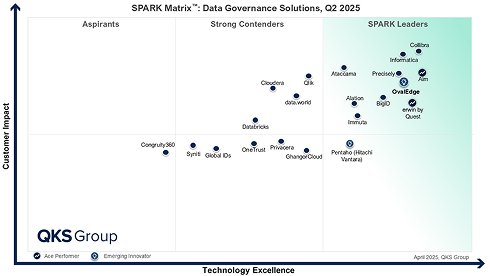
.png?width=1081&height=173&name=Forrester%201%20(1).png)
.png?width=1081&height=241&name=KC%20-%20Logo%201%20(1).png)