.png)
The same AI system that automates a credit decision in the morning can trigger a regulatory investigation by afternoon, and most enterprises would not see it coming.
An AI risk management framework is how organizations get ahead of that exposure.
With EU AI Act enforcement arriving in August 2026 and the average cost of a data breach hitting $4.88 million in 2024, according to a 2024 IBM report, AI risk management is now a board-level priority, not a future-state aspiration.
Organizations are accountable for the decisions their AI systems make, the data those systems consume, and the audit evidence they can produce on demand. This guide covers core AI risk categories, how NIST AI RMF, EU AI Act, and ISO/IEC 42001 work together, how to build a framework step by step, and how data governance strengthens AI risk controls at their source.
What is an AI risk management framework?
An AI risk management framework is a structured process for identifying, assessing, controlling, monitoring, and documenting risks across the AI lifecycle. It connects governance policies to operational controls so organizations can manage risks related to bias, privacy, model drift, explainability, security, and compliance, and produce the audit evidence to prove it.
A complete framework covers an AI system inventory, risk classification, ownership assignment, structured risk assessments, preventive and detective controls, compliance mapping, continuous monitoring, audit trails, and incident response. It should answer three questions at any point: which AI systems exist, what risks they carry, and what evidence proves those risks are being managed.
AI risk management vs. AI governance framework
These two terms are frequently used interchangeably, but they serve different functions. Governance sets the rules; risk management enforces and evidences them. Both are necessary; one without the other leaves either policy without accountability or controls without authority.
|
Area |
AI governance framework |
AI risk management framework |
|
Primary focus |
Accountability and oversight |
Risk identification and control |
|
Outputs |
Policies, roles, decision rights |
Risk assessments, controls, and audit evidence |
|
Questions it answers |
Who owns this? What is permitted? |
What could go wrong? How is it prevented and detected? |
|
Regulatory relevance |
Responsible AI, EU AI Act governance requirements |
EU AI Act conformity, NIST AI RMF, ISO/IEC 42001 |
|
Relationship |
Sets the rules |
Enforces and evidences the rules |
Core AI risk categories every framework must address
AI risk surfaces across data pipelines, model behavior, security boundaries, and vendor relationships, often in combinations that no single team owns. A complete framework identifies and controls risk across five categories.
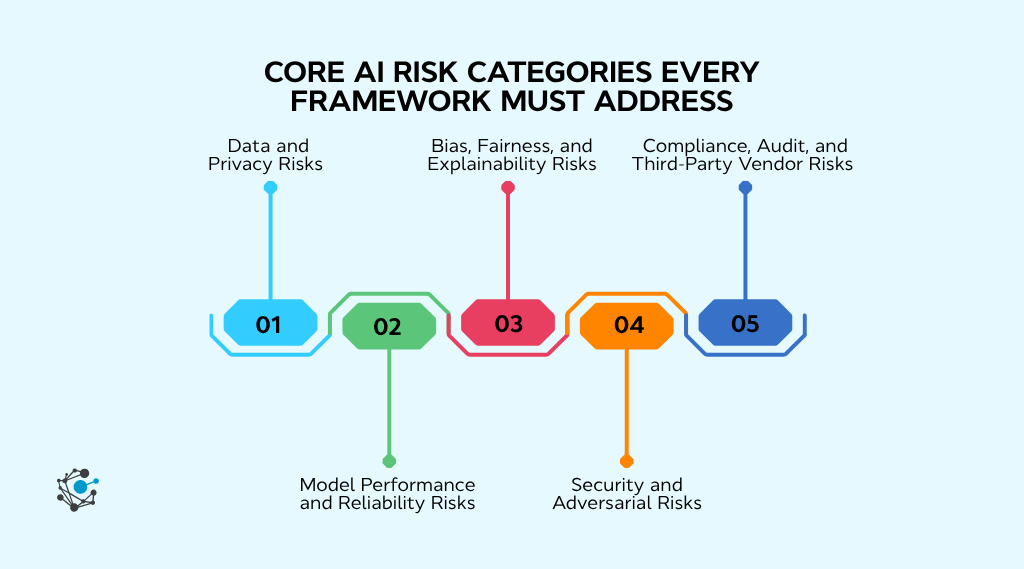
Data and privacy risks
Risk source: Poor data quality, unknown lineage, unclear ownership, missing retention controls, and sensitive data, PII, PHI, and financial records used without proper classification or consent.
Operational impact: Models consuming ungoverned data produce unreliable outputs. Organizations cannot trace decisions back to their origin when regulators or auditors ask. Regulatory exposure under GDPR, CCPA, and HIPAA follows when personal data enters AI pipelines without documented consent or classification.
Governance implication: Data controls, classification, lineage, access, consent, and ownership must be in place before a model is deployed, not retrofitted after an incident. Data risk is upstream of model risk. Most AI failures have a data origin, not a model one.
Model performance and reliability risks
Risk source: Data drift, concept drift, and overfitting, all of which intensify as real-world conditions diverge from what the model was trained on.
Operational impact: Accuracy degrades, outputs become inconsistent, and user trust erodes silently until a decision failure surfaces. During the COVID-19 pandemic, healthcare AI models trained on pre-pandemic data failed at scale because input distributions shifted faster than monitoring systems could flag.
Governance implication: Validation cannot stop at deployment. Monitoring thresholds, retraining triggers, and documentation standards must be defined, assigned to owners, and reviewed continuously. A model that performed well at deployment will not necessarily perform well six months later.
Bias, fairness, and explainability risks
Risk source: Historically biased training data and the absence of fairness testing before deployment.
Operational impact: Adverse outcomes for protected groups in high-stakes decisions, credit, hiring, healthcare, and benefits, creating regulatory liability and reputational exposure. Fairness gaps that go undetected in development do not stay hidden; they surface in a compliance event or a public incident.
Governance implication: Fairness testing and explainability requirements must be embedded in the risk assessment process before deployment, not treated as optional quality checks. The EU AI Act treats explainability as a conformity requirement, not a best practice.
Security and adversarial risks
Risk source: Prompt injection, data poisoning, model extraction attacks, and uncontrolled submission of internal data to third-party model providers.
Operational impact: Manipulated outputs, corrupted training sets, proprietary model exposure, and sensitive data leakage through fine-tuning processes or API integrations, risks that traditional security controls were not designed to detect or prevent.
Governance implication: AI security reviews must extend beyond access controls to cover adversarial attack vectors, vendor terms, prompt handling, and output monitoring. Generative AI introduces a class of adversarial risk that conventional model security was not built to address.
Compliance, audit, and third-party vendor risks
Risk source: Insufficient documentation, unclear regulatory mapping, shadow AI embedded in SaaS tools, and ungoverned vendor relationships where model retraining, version updates, and subprocessor data sharing occur without notification or contractual controls.
Operational impact: Organizations cannot demonstrate conformity when regulators ask. Audit trails have no named owners. SaaS-embedded AI operates entirely outside governance visibility. Vendor model changes silently alter system behavior without triggering an internal review.
Governance implication: Compliance mapping, vendor assessment, and audit trail collection must be standing processes with defined owners, not one-time procurement checks. Third-party AI risk is invisible until an incident makes it visible.
AI risk management frameworks
No single framework covers every dimension of AI risk. The strongest programs use multiple frameworks as layers, each serving a distinct purpose. Understanding what each covers and how they fit together is the foundation of a defensible AI risk program.
NIST AI RMF: Govern, map, measure, manage
The NIST AI RMF is a voluntary framework developed by the National Institute of Standards and Technology to help organizations manage AI risk and build trustworthy AI systems. It is structured around four core functions:
-
Govern establishes the organizational foundation, policies, accountability structures, risk tolerance, AI oversight committee, and reporting lines. Without govern in place, the remaining three functions have no authority to operate.
-
Map identifies AI system context, data sources, stakeholder groups, use case purpose, potential harms, and risk classification. This is where AI inventory connects to risk.
-
Measure assesses identified risks through bias testing, model validation, explainability assessment, security testing, privacy review, and performance monitoring.
-
Manage applies controls, remediation plans, human oversight requirements, incident response procedures, and continuous improvement cycles.
The NIST AI RMF also defines seven characteristics of trustworthy AI that measure and manage work toward: valid and reliable, safe, secure and resilient, accountable and transparent, explainable and interpretable, privacy-enhanced, and fair with managed bias.
Framework comparison: NIST AI RMF, EU AI Act, ISO/IEC 42001, and OECD AI principles
Each framework was built for a different primary purpose. Using them as alternatives creates gaps. The table below clarifies where each fits in a combined program.
|
Framework |
Type |
Applies to |
Core focus |
Best used for |
|
NIST AI RMF |
Voluntary framework |
Any organization |
Govern, Map, Measure, Manage |
Operating structure for AI risk management |
|
EU AI Act |
Regulation (enforceable Aug 2026) |
Organizations operating in EU markets |
Risk classification, prohibited uses, conformity obligations |
Legal compliance baseline and risk tiering |
|
ISO/IEC 42001 |
Management system standard |
Any organization |
Policies, processes, and continuous improvement |
Audit readiness and certification |
|
OECD AI Principles |
Principles framework |
Any organization |
Human-centered, transparent, accountable AI |
Responsible AI alignment and policy framing |
How to use multiple frameworks together
These frameworks are complementary, not competing. Use NIST AI RMF as the operating backbone. Layer the EU AI Act for legal risk classification, ISO/IEC 42001 for management-system discipline and audit readiness, and OECD AI Principles for responsible AI alignment. GDPR, HIPAA, and CCPA map at the data and model level; they apply regardless of which frameworks an organization adopts.
How to build an AI risk management framework: A step-by-step approach
A framework is only operational when it is embedded in workflows, not when it exists as a policy document. The six steps below move from visibility to control, covering the full arc from AI system discovery to continuous monitoring and audit evidence.
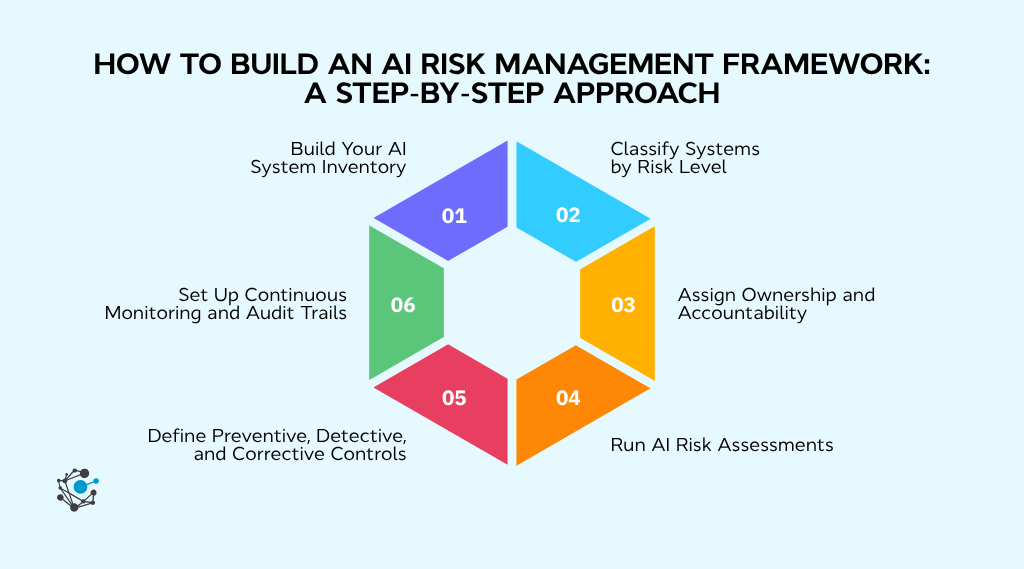
Step 1 — Build your AI system inventory
An AI risk program cannot govern what it cannot see. The inventory is the foundation; without it, risk classification, ownership assignment, and monitoring have nothing to operate on.
Every inventory entry should capture:
|
Field |
Purpose |
|
AI system name |
Identification |
|
Business owner |
Accountability |
|
Technical owner |
Operational responsibility |
|
Data sources |
Data risk scoping |
|
User group |
Impact scoping |
|
Decision type (advisory vs. automated) |
Human oversight requirement |
|
Vendor involvement |
Third-party risk flag |
|
Risk level |
Controls prioritization |
|
Applicable regulations |
Compliance mapping |
|
Monitoring owner |
Ongoing oversight |
According to 2025 Gartner insights, by 2030, more than 40% of enterprises will experience security or compliance incidents linked to unauthorized shadow AI, making active discovery of ungoverned AI systems a foundational, not optional, step. Shadow AI embedded in SaaS tools, browser extensions, and team-level subscriptions must be actively discovered, not assumed absent.
Step 2 — Classify systems by risk level
Risk classification determines the depth of assessment, the controls required, and the approval authority needed before deployment.
-
Low risk — informational tools, internal productivity use cases with no downstream decision impact
-
Medium risk — customer-facing outputs, internal decisions with moderate consequences, limited regulatory exposure
-
High risk — decisions affecting rights, access, money, employment, health, or safety; significant regulatory obligation
-
Critical or prohibited — EU AI Act prohibited use cases; systems with unacceptable harm potential requiring escalation or blocking.
EU AI Act Annex III provides the reference list for high-risk AI system classifications. Organizations should map their inventory against it before August 2026.
Step 3 — Assign ownership and accountability
Every AI system needs named owners across functions:
-
AI governance council — sets policy, approves high-risk deployments, reviews incident escalations
-
Business owner — accountable for use case purpose and policy compliance
-
Data owner — responsible for data quality, classification, lineage, and access controls
-
Model owner — responsible for validation, documentation, and performance monitoring
-
Risk owner — maintains the risk register, tracks open issues
-
Legal and compliance reviewer — maps applicable regulations, signs off on high-risk systems
-
Security owner — assesses adversarial risk and access controls
-
Internal audit — reviews evidence, tests controls, and validates documentation completeness
Shared accountability is not the same as unclear accountability. Each role needs a named individual, not a team.
Step 4 — Run AI risk assessments
A structured AI risk assessment should examine use case purpose, decision impact, data sensitivity, lineage completeness, bias risk, privacy basis, explainability needs, security exposure, vendor dependency, human oversight requirements, and regulatory mapping.
AI risk assessment checklist:
-
Use case is documented with business justification
-
The system owner is assigned
-
Data sources are identified and approved
-
Sensitive or regulated data is classified
-
The system is classified by risk level
-
Bias testing has been completed or scheduled
-
Model outputs can be explained to affected parties
-
Human oversight threshold is defined
-
Monitoring thresholds and owners are set
-
Vendor risk has been reviewed
-
Compliance mapping is complete and signed off
AI risk scoring matrix:
|
Impact |
Likelihood |
Risk rating |
Required action |
|
Low |
Low |
Low |
Document and monitor lightly |
|
Medium |
Medium |
Medium |
Apply controls, periodic review |
|
High |
Medium |
High |
Formal approval required before deployment |
|
High |
High |
Critical |
Escalate: redesign, restrict, or block |
Step 5 — Define preventive, detective, and corrective controls
Controls map to the risk lifecycle before deployment, during operation, and after detection. An undocumented control is not a control from an audit perspective. Every control needs an owner, a review frequency, and evidence.
|
Control type |
Purpose |
Examples |
|
Preventive |
Stop risk before deployment |
Access controls, model validation gates, vendor due diligence, data classification review, bias testing before release |
|
Detective |
Identify risk during operation |
Drift monitoring, bias alert thresholds, output quality sampling, usage and access logs, anomaly detection |
|
Corrective |
Address risk after detection |
Model rollback, retraining triggers, incident response activation, remediation documentation, and user notification |
Step 6 — Set up continuous monitoring and audit trails
Most governance efforts concentrate on pre-deployment approval. But model risk changes after release through drift, retraining, vendor updates, and shifting user behavior. Continuous monitoring must track:
-
Data drift — changes in input distributions that may degrade model performance
-
Model drift — degradation in output accuracy or consistency over time
-
Bias indicators — emerging disparities across demographic or protected groups
-
Output quality — flagged outputs, user complaints, escalation rates
-
Security anomalies — unusual query volumes, API abuse signals, access pattern changes
-
Incident log — all detected issues, response actions, and resolution timelines
Audit trail documentation must include deployment approval records, completed risk assessments with sign-offs, model cards, data lineage documentation, testing and validation reports, incident records, and monitoring threshold reviews.
Audit trails are not a post-hoc exercise. They must be built into the workflow from approval through deployment, collected as work happens, not reconstructed when a regulator asks.
How data governance strengthens AI risk management
Most AI governance failures do not originate in the model layer. They originate upstream in poorly governed data environments where weak lineage, inconsistent metadata, unclear ownership, and low-quality training data become model risk long before anyone recognizes them as governance gaps. Data governance is not a parallel workstream to AI risk management. It is the foundation that determines whether AI systems are trustworthy, auditable, and scalable.
Why most AI risk originates in data
Models trained on poor-quality data produce unreliable outputs regardless of how sophisticated the model is. Unknown data lineage means organizations cannot trace a model's decision back to its source, a critical gap for both explainability and audit. Sensitive data appearing in training sets without proper classification creates privacy and regulatory exposure under GDPR, HIPAA, and CCPA.
Unclear data ownership means no one is accountable when quality degrades or consent lapses. Inconsistent business definitions produce inconsistent model inputs; two systems using "customer" with different scopes, for example, will produce results that cannot be meaningfully compared. Missing retention controls leave expired or revoked data active in training pipelines.
Data governance is not a prerequisite for organizations to complete before starting AI risk management. It runs alongside it, and AI risk management should surface data governance gaps as a direct output.
Role of data catalogs, lineage, and metadata in AI assurance
Data governance capabilities map directly to AI risk controls:
-
Data catalog — provides the AI system-to-data mapping required for risk scoping. Without it, teams cannot reliably identify what data a model consumed or where it came from
-
Data lineage — enables tracing of model inputs back to source systems, validating that approved data was used, and detecting when upstream changes may have affected model behavior.
-
Sensitive data discovery — surfaces PII, PHI, and regulated data appearing in datasets intended for AI use — a prerequisite for any privacy risk assessment.
-
Business glossary — ensures consistent data definitions across teams, reducing the definitional inconsistencies that produce biased or unreliable inputs.
-
Data quality context — provides model owners with input-quality signals needed to validate that training and inference data meet documented standards.
-
Governance workflows — create the documented approval chain for data use in AI systems, producing audit evidence automatically.
Where OvalEdge fits in an AI risk management program
OvalEdge functions as the data governance layer that makes AI risk controls executable where risk actually originates in the data. For AI risk programs specifically, that means three things: tracing every AI system back to its data sources, discovering regulated data before it creates compliance exposure, and generating the audit evidence that the EU AI Act and ISO/IEC 42001 conformity requires.
- Data catalog — maps AI systems to their data sources, enabling AI inventory enrichment with full data context
- Data lineage — provides end-to-end traceability from source to model input, supporting explainability and audit requirements
- Sensitive data discovery — automatically identifies regulated and sensitive data appearing in AI-relevant datasets before it creates exposure
- Data quality — surfaces quality scores and anomalies for data feeding AI systems, enabling input validation as a standing control
- Policy and governance workflows — documents data approvals, owner sign-offs, and classification decisions, creating the audit evidence required by EU AI Act and ISO/IEC 42001
- Metadata management — maintains the business context that makes AI system documentation meaningful to auditors and regulators
|
Did you know: Facing PII dispersed across 300+ data sources, Upwork used OvalEdge to catalog all metadata, classify sensitive data, and automate CCPA compliance workflows, achieving full governance coverage within weeks. The same data visibility that enabled regulatory compliance is precisely what AI risk assessments and audit trails require. |
AI risk management tools and implementation considerations
Building an AI risk management program requires tooling that makes governance workflows operational at scale. The right stack depends on where your current program has gaps, not on a generic feature checklist.
What to look for in AI governance tools
Strong AI governance tools should support:
-
AI system inventory and classification management
-
Risk assessment workflows with sign-off and versioning
-
Data lineage and catalog integration for AI-to-data mapping
-
Sensitive data discovery across AI-relevant datasets
-
Policy documentation and compliance mapping
-
Evidence collection and audit trail management
-
Control monitoring with alerting thresholds
-
Vendor AI assessment workflows
-
Integration with GRC platforms and data governance systems
-
Role-based access for governance council, data owners, model owners, and auditors
Evaluate tools against the specific workflow gaps in your current program, not against a generic feature checklist.
AI governance tools: A comparison
|
Tool |
Primary strength |
Best suited for |
|
OvalEdge |
Data catalog, lineage, quality, and governance workflows |
Organizations anchoring AI risk management in data governance |
|
Collibra |
Enterprise data governance and policy stewardship |
Large enterprises with complex data ownership structures |
|
Microsoft Purview |
Discovery, classification, and compliance in Microsoft environments |
Organizations with a deep Microsoft ecosystem investment |
|
OneTrust |
Privacy assessments and regulatory alignment workflows |
Organizations with strong privacy program foundations |
|
IBM OpenPages |
Enterprise GRC, model risk management, and audit workflows |
Financial services and heavily regulated industries |
These tools are not mutually exclusive. Many organizations use a data governance platform alongside a GRC or privacy platform to cover both data-layer and risk-layer requirements.
Common implementation challenges
The gap between AI deployment and AI governance is not a strategy problem; it is an execution problem. According to McKinsey's 2024 State of AI survey, just 18% of organizations have an enterprise-wide council with authority over responsible AI governance decisions. Four challenges explain most of it:
-
No complete AI inventory. Teams cannot govern what they cannot see. Shadow AI embedded in SaaS tools is typically the largest blind spot, and without inventory, risk classification, ownership, and monitoring, it has nothing to operate on.
-
Unclear ownership. AI sits at the intersection of data, technology, legal, risk, security, and business functions. Without explicit role assignment, accountability defaults to no one, and audit evidence has no named owner.
-
Manual assessments that don't scale. Spreadsheet-based risk assessments break down as AI use cases multiply. Version control, sign-off tracking, and evidence collection require workflow tooling, not document management.
-
Weak monitoring after deployment. Most governance efforts concentrate on pre-deployment approval. Post-deployment drift, retraining events, and shifting user behavior change the risk profile of a system without triggering a new review unless monitoring thresholds are defined and owned from the start.
Conclusion
AI risk management is no longer a future-state initiative. EU AI Act enforcement in August 2026, rising regulatory scrutiny, and the operational cost of failed AI deployments have made it an enterprise priority that boards and leadership teams cannot defer.
The strongest programs use NIST AI RMF as the operating structure, the EU AI Act for risk classification, ISO/IEC 42001 for audit readiness, and data governance as the execution layer where risk controls become real. Inventory, classification, ownership, assessment, controls, monitoring, and audit evidence are not parallel workstreams; they are one connected program.
The immediate next step is straightforward: inventory the AI systems currently in use, classify each by risk level, and identify where governance workflows, evidence trails, and monitoring have gaps. That baseline is where a defensible AI risk management program begins.
Book a demo to see how OvalEdge gives you the data governance foundation to build it.
FAQs
1. What is an AI risk management framework?
A structured process for identifying, assessing, controlling, monitoring, and documenting AI risks across the lifecycle, covering bias, privacy, drift, explainability, security, and compliance, that connects governance policies to operational controls and produces measurable audit evidence.
2. What are the four functions of the NIST AI RMF?
Govern sets policies and accountability. Map identifies the AI system context and potential harms. Measure assesses risks through testing and validation. Manage applies controls, and continuous improvement. Together, they form a complete operating cycle for AI risk management.
3. How is AI risk management different from AI governance?
Governance sets policies and decision rights. Risk management operationalizes them into controls and evidence. Both are required; one without the other leaves either policy without enforcement or controls without authority.
4. How does the EU AI Act affect AI risk management?
Enforceable Aug 2026. High-risk systems require a documented risk management system, technical documentation, human oversight, and post-market monitoring. Conformity requires the inventory, assessments, controls, and audit trails that a framework produces.
5. How can organizations implement an AI risk management framework?
Sequence: inventory → classify by risk level → assign ownership → run assessments → define controls → set up monitoring and audit trails. Use NIST AI RMF as the operating structure, EU AI Act for high-risk classification.
6. What is a high-risk AI system under the EU AI Act?
Define high-risk classification per EU AI Act Annex III, systems used in areas such as employment, credit, education, healthcare, law enforcement, and critical infrastructure. These systems carry mandatory conformity obligations. Note the practical implication: organizations need a classification process that maps their AI inventory against Annex III categories before August 2026.
.png?width=1081&height=173&name=Forrester%201%20(1).png)
.png?width=1081&height=241&name=KC%20-%20Logo%201%20(1).png)