.png)
Poor data leads to poor decisions.
A 2025 SoftServe and Wakefield Research study found that 58% of business leaders say their organizations make important decisions using inaccurate or inconsistent data.
As AI-powered analytics becomes more common, inconsistent business metrics don't just create reporting errors; they also produce conflicting insights across dashboards and AI applications.
The Snowflake Semantic Layer helps address this challenge by standardizing business metrics through Snowflake Semantic Views, semantic models, and Snowflake Cortex Analyst.
While these capabilities establish trusted definitions within Snowflake, most enterprises also manage governance, lineage, metadata, and business glossaries across multiple platforms.
This guide explains how Snowflake's semantic layer works, compares the leading approaches available today, and explores when a governance and catalog layer is needed to deliver trusted analytics and AI across the enterprise.
What is the Snowflake semantic layer?
The Snowflake Semantic Layer provides a shared business framework that helps analytics tools and AI applications interpret data consistently. Instead of exposing raw tables and technical schemas, it organizes business concepts such as metrics, dimensions, and relationships into reusable semantic definitions.
Snowflake delivers these capabilities through Semantic Views, Semantic Models, and Snowflake Cortex Analyst, enabling SQL queries, BI tools, and natural language interfaces to reference the same approved business logic.
This improves reporting consistency, simplifies self-service analytics, and reduces ambiguity when business users and AI interact with enterprise data.
Semantic Layer vs. Data Governance
Although they work together, a semantic layer and data governance serve different purposes. A semantic layer focuses on business meaning by defining how metrics should be calculated and interpreted. Data governance focuses on accountability by ensuring data remains accurate, secure, compliant, and traceable throughout its lifecycle.
|
Feature |
Snowflake Semantic Layer |
Data Governance |
|
Primary purpose |
Standardizes business metrics and definitions |
Establishes trust, ownership, policies, and compliance |
|
Focus |
What business metrics mean |
Whether data is trusted and fit for use |
|
Scope |
Primarily within Snowflake |
Across the enterprise data ecosystem |
|
Key capabilities |
Semantic models, metric definitions, business logic |
Lineage, ownership, data quality, stewardship, access control |
|
Primary users |
Analysts, BI tools, AI applications |
Data stewards, governance, compliance, IT teams |
|
Outcome |
Consistent analytics and AI responses |
Trusted, governed, and auditable data |
Rather than competing, these capabilities complement one another. A semantic layer provides consistent business definitions, while governance ensures those definitions remain reliable as data moves across the enterprise.
While evaluating broader data architectures, OvalEdge’s guide to semantic layer vs data fabric explains how these technologies complement modern analytics platforms.
Semantic Layer vs. a Data Catalog
A semantic layer helps standardize business logic, whereas a data catalog helps users discover, understand, and evaluate enterprise data assets. Together, they simplify both data consumption and data discovery.
|
Feature |
Snowflake Semantic Layer |
Data Catalog |
|
Primary purpose |
Standardizes business metrics |
Discovers and documents enterprise data |
|
Focus |
Business logic for metrics and dimensions |
Metadata, ownership, lineage, and documentation |
|
Scope |
Snowflake analytics and AI workloads |
Data assets across multiple platforms |
|
Key capabilities |
Semantic models, metric definitions, AI-ready context |
Search, business glossary, metadata, lineage, data quality |
|
Primary users |
BI teams, analysts, AI applications |
Business users, analysts, engineers, governance teams |
|
Outcome |
Consistent metric calculations |
Faster data discovery and greater trust in enterprise data |
A semantic layer solves metric consistency within Snowflake. A data catalog solves enterprise-wide discovery and understanding. As organizations expand beyond a single data platform, many combine a semantic layer with a governance and catalog solution to deliver trusted context across the entire data estate.
See how OvalEdge Data Catalog helps organizations discover trusted data assets, connect business glossaries with technical metadata, and provide governed context for analytics and AI.
Snowflake semantic layer options compared
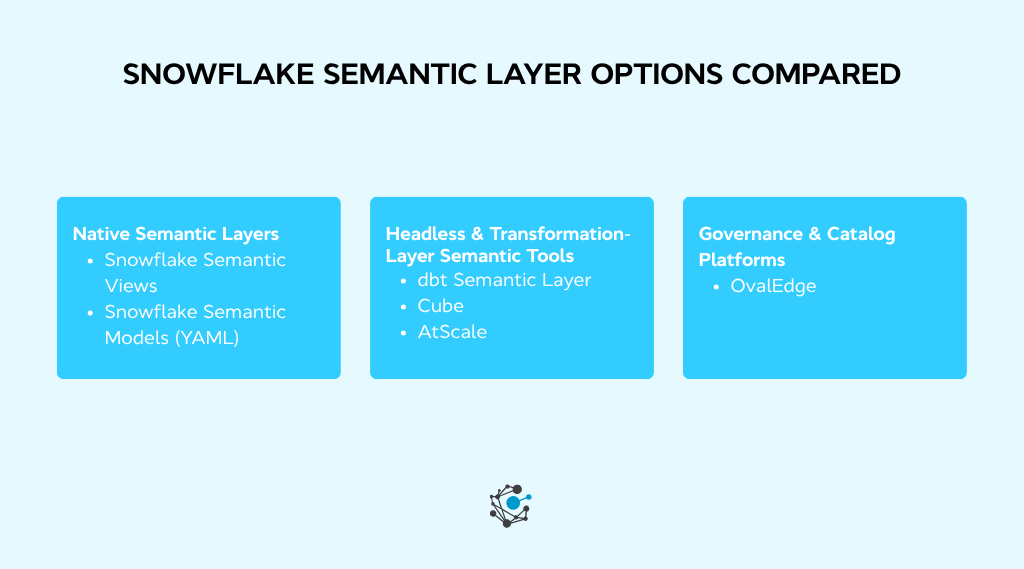
Not every tool in the semantic layer ecosystem solves the same problem. Some define business metrics natively within Snowflake, others provide a headless metrics layer that serves multiple BI tools and data warehouses, while governance platforms complement semantic layers by adding enterprise-wide discovery, lineage, and trusted business context.
The right choice depends less on selecting a single "best" platform and more on matching the solution to your architecture, analytics strategy, and governance requirements.
|
Platform |
Category |
Primary focus |
Best for |
Pricing |
|
Snowflake Semantic Views |
Native semantic layer |
Native semantic definitions for analytics and AI |
Snowflake-first organizations |
Included with Snowflake |
|
Snowflake Semantic Models (YAML) |
Native semantic layer |
YAML-based semantic modeling for Cortex Analyst |
Teams using Cortex Analyst or migrating existing semantic models |
Included with Snowflake |
|
dbt Semantic Layer |
Transformation-layer semantic tool |
Metrics-as-code with MetricFlow |
Organizations using dbt for data transformation |
Commercial |
|
Cube |
Headless semantic layer |
API-first semantic layer for multi-tool analytics |
Embedded analytics and multi-warehouse environments |
Commercial |
|
AtScale |
Headless semantic layer |
Enterprise semantic layer for BI and OLAP |
Large-scale Power BI, Tableau, and Excel deployments |
Custom pricing |
|
OvalEdge |
Governance & catalog platform |
Enterprise metadata, governance, and business context |
Organizations needing governed discovery across multiple data sources |
Custom pricing |
Choosing between these platforms isn't about finding a winner. It's about understanding which layer solves which problem in your enterprise architecture. Many organizations combine a semantic layer with enterprise governance to deliver both consistent business definitions and trusted business context.
Native semantic layers
Native semantic layers define business metrics directly within Snowflake, allowing SQL, BI tools, and AI applications to reference a shared business model without moving data or deploying additional infrastructure.
They are particularly well suited for organizations whose analytics workloads primarily run within the Snowflake ecosystem.
1. Snowflake Semantic Views
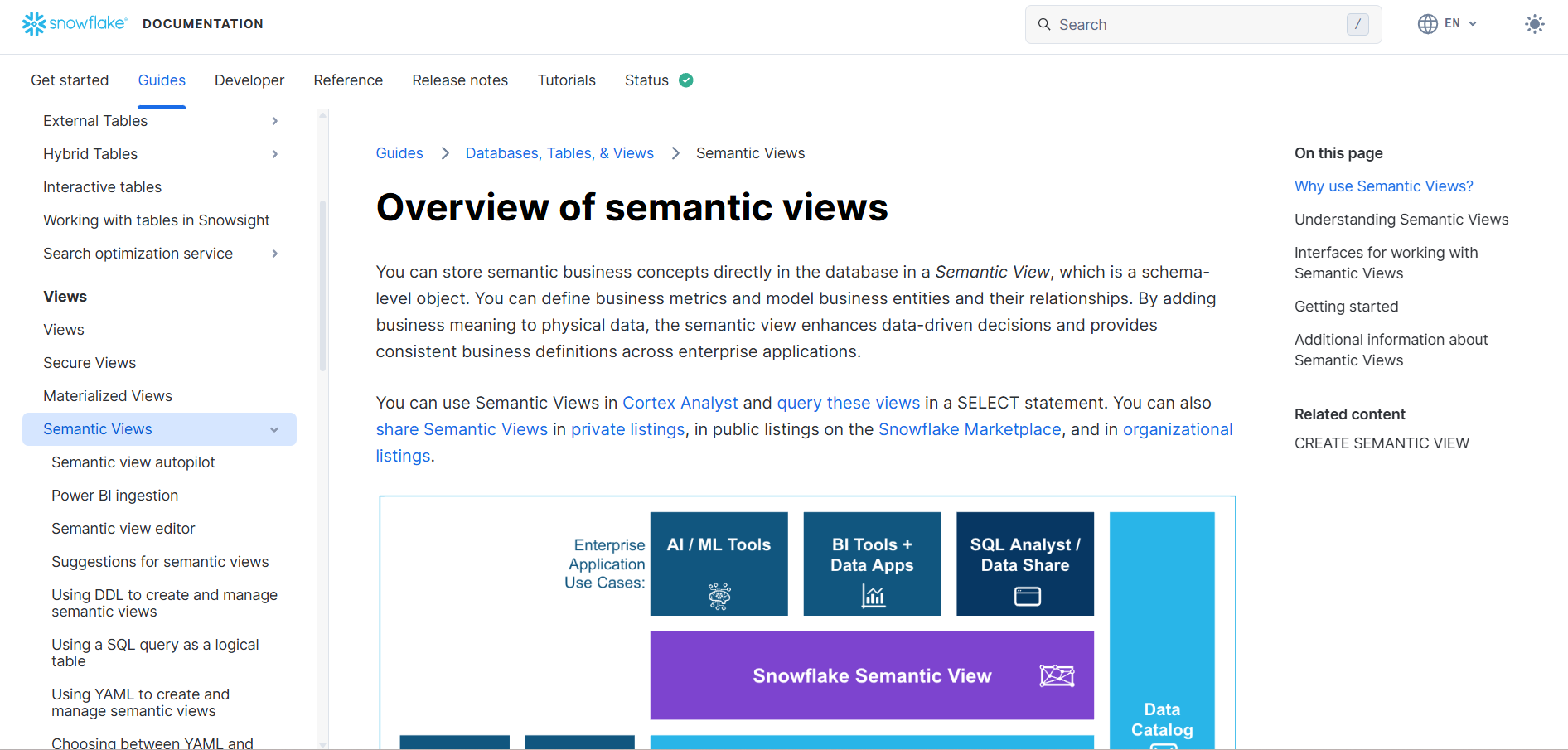
Snowflake Semantic Views are the platform's native semantic layer for defining business metrics, dimensions, and relationships directly within Snowflake. Because semantic definitions live alongside the data, they integrate seamlessly with SQL, BI tools, and Snowflake Cortex Analyst without requiring additional infrastructure.
Key capabilities
-
Native semantic modeling: Create governed semantic models using CREATE SEMANTIC VIEW SQL statements.
-
Fail-fast validation: Detect semantic modeling errors during object creation rather than at query time.
-
Business metrics and dimensions: Define facts, dimensions, measures, relationships, and calculated metrics in one semantic model.
-
Cortex Analyst integration: Enable AI assistants to answer natural language questions using approved business definitions.
-
Built-in security: Apply Snowflake RBAC and control visibility using public or private semantic views.
Pros
-
Fully integrated with the Snowflake platform.
-
Strong AI integration through Cortex Analyst.
-
No additional infrastructure or data movement required.
Cons
-
Limited to Snowflake workloads.
-
Does not provide enterprise-wide governance or data discovery across external platforms.
2. Snowflake Semantic Models (YAML)
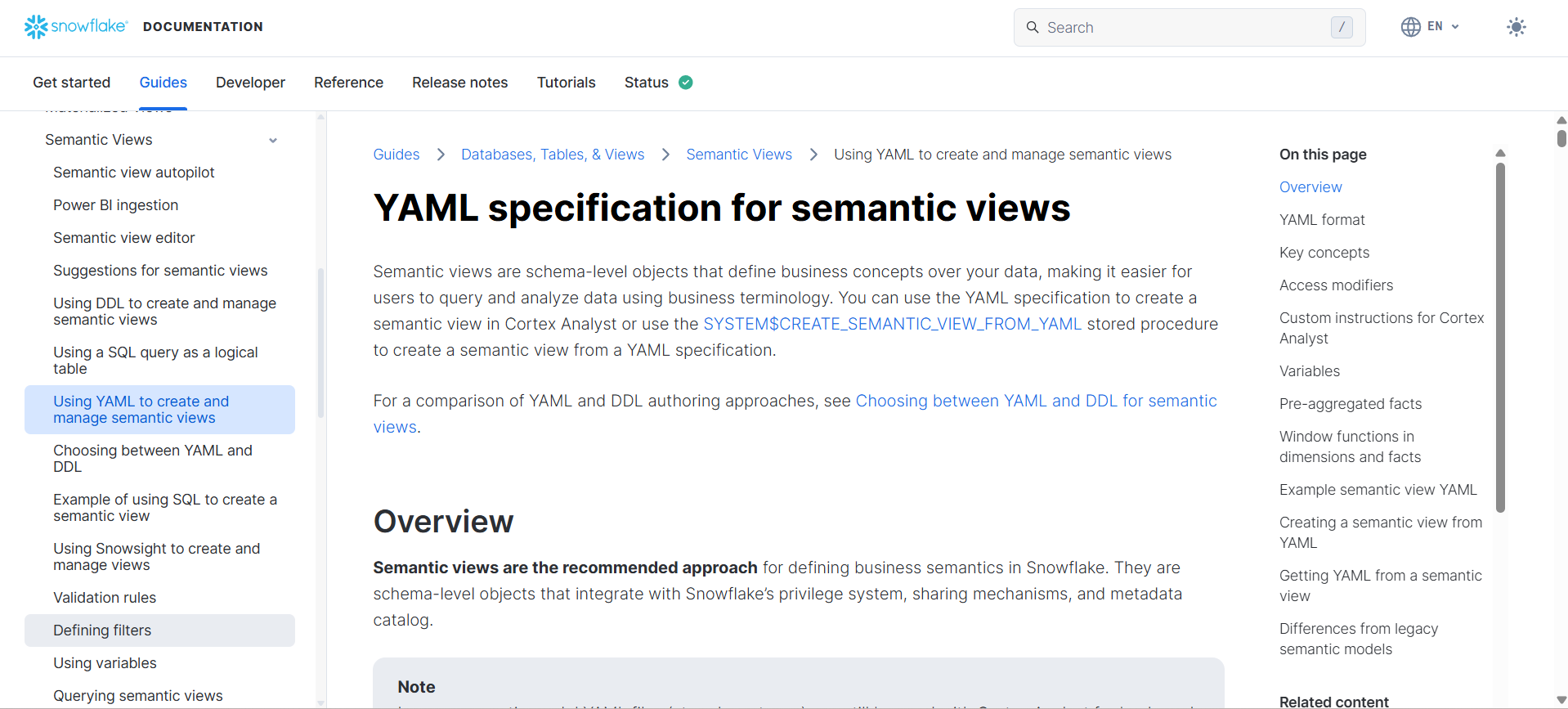
Snowflake Semantic Models use YAML files to define business concepts for Cortex Analyst and semantic applications. They offer a portable approach that supports version control and gradual migration to Snowflake's semantic capabilities.
Key capabilities
-
YAML-based definitions: Model business entities, dimensions, measures, and relationships in YAML.
-
Version control: Store semantic models in Git and integrate with development workflows.
-
Natural language support: Configure synonyms and business terminology for Cortex Analyst.
-
Reusable models: Share semantic definitions across supported applications.
-
Migration flexibility: Simplify adoption for organizations with existing semantic models.
Pros
-
Easy to manage with source control.
-
Supports incremental migration strategies.
-
Flexible development workflow.
Cons
-
Validation occurs during query execution.
-
Less integrated than Semantic Views.
Headless & transformation-layer semantic tools
These platforms define metrics independently of a single data warehouse and serve them consistently across multiple BI tools, applications, and analytics environments. They are well suited for organizations operating across multiple warehouses or delivering embedded analytics.
1. dbt Semantic Layer
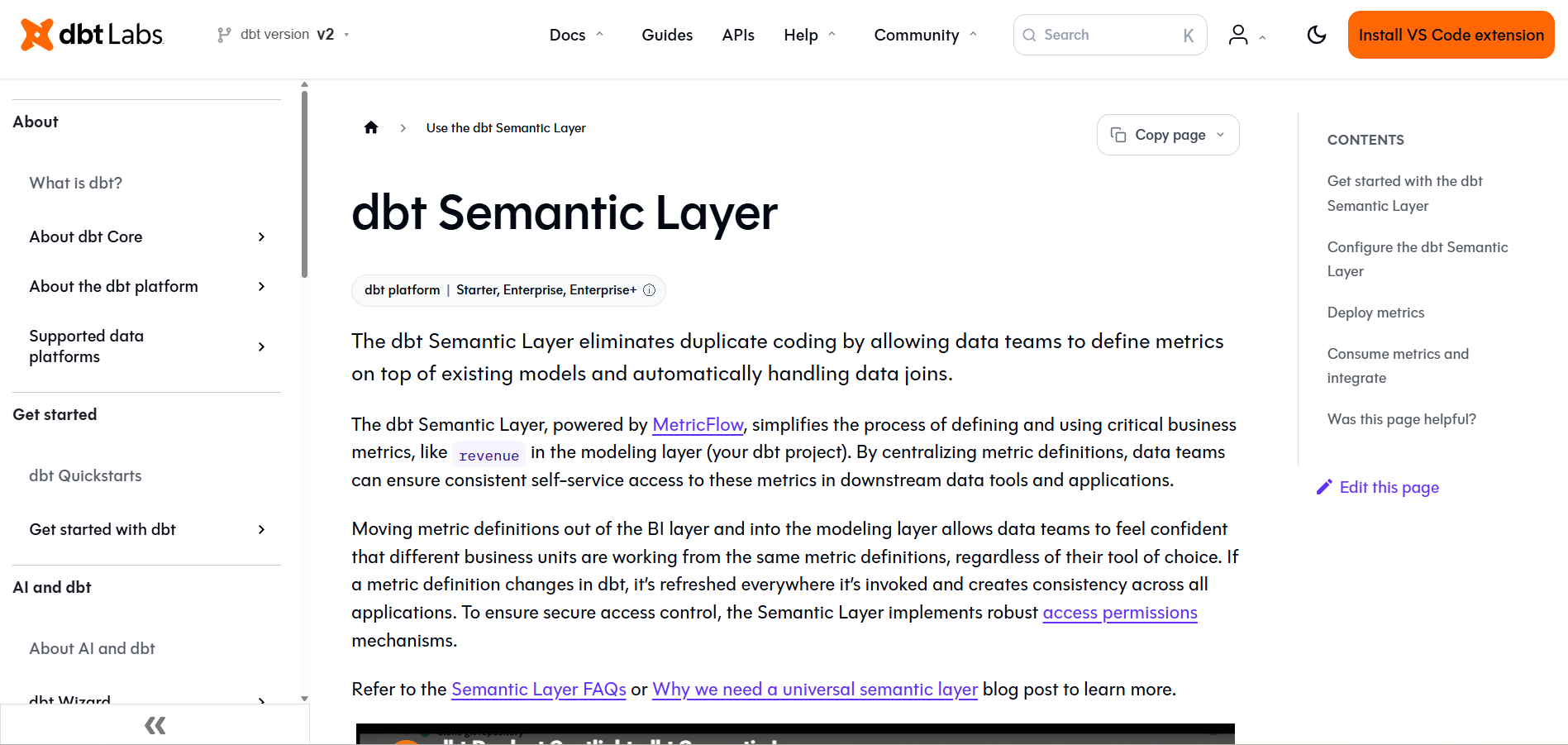
The dbt Semantic Layer extends the dbt ecosystem by managing business metrics as code through MetricFlow. It centralizes metric definitions while integrating closely with dbt transformation workflows.
Key capabilities
-
Metrics-as-code: Define reusable business metrics using MetricFlow.
-
Centralized business logic: Maintain one metric definition across analytics tools.
-
dbt integration: Build directly on dbt models and transformations.
-
Automated SQL generation: Translate metric definitions into optimized SQL.
-
Cloud delivery: Serve governed metrics through dbt Cloud.
Pros
-
Ideal for dbt-centric teams.
-
Encourages reusable business logic.
-
Strong developer experience.
Cons
-
Requires dbt Cloud for full functionality.
-
Needs downstream tools to consume metrics.
2. Cube
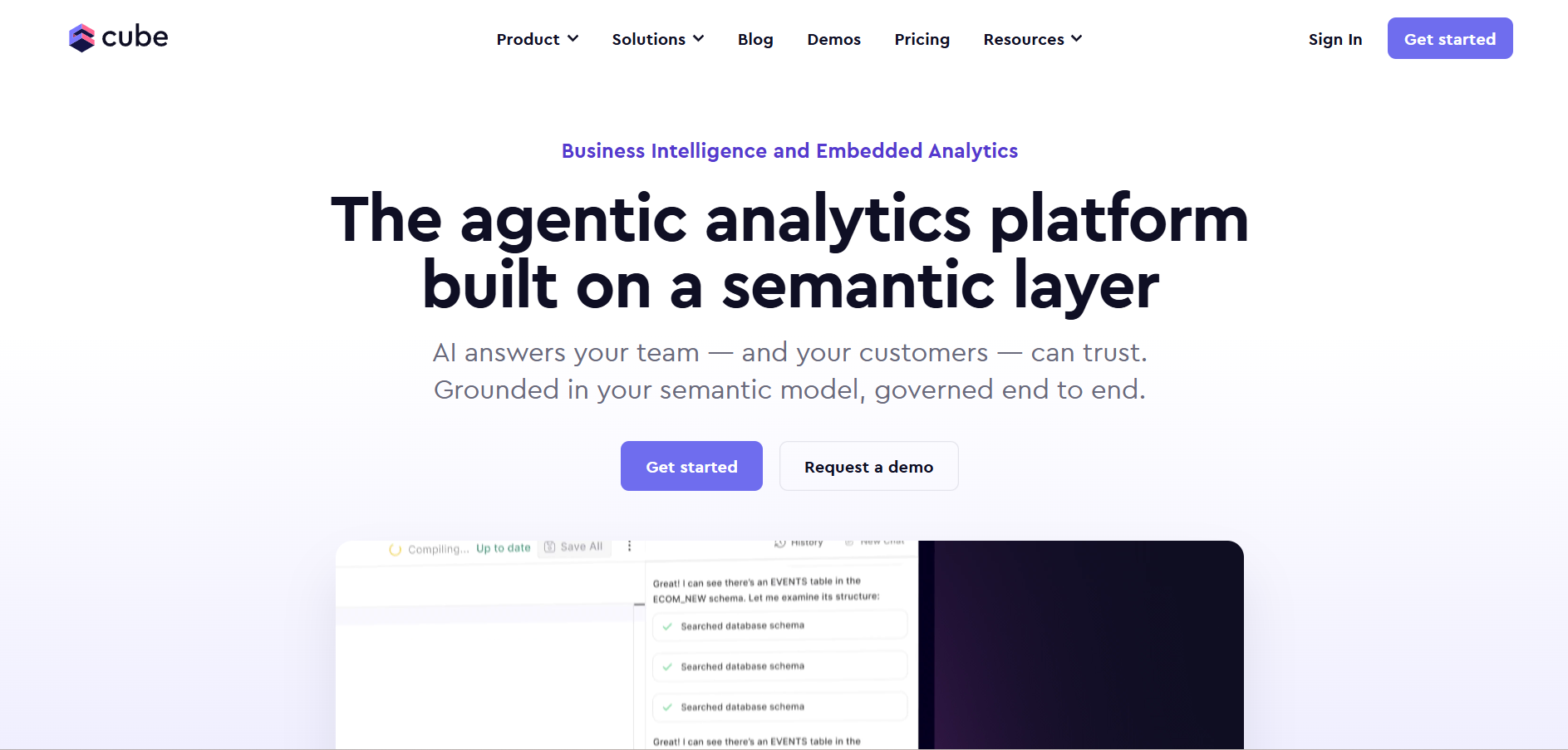
Cube is a headless semantic layer that exposes governed metrics through APIs, making it suitable for embedded analytics, customer-facing applications, and AI workloads spanning multiple warehouses.
Key capabilities
-
API-first architecture: Serve metrics through SQL, REST, GraphQL, and MCP.
-
Multi-warehouse support: Connect multiple analytical databases.
-
Semantic modeling: Centralize business metrics outside BI tools.
-
Query acceleration: Improve performance with intelligent caching.
-
Security controls: Support row-level security and multi-tenant environments.
Pros
-
Excellent for embedded analytics.
-
Supports multiple warehouses.
-
Flexible API ecosystem.
Cons
-
Requires additional infrastructure.
-
Higher operational complexity than native solutions.
3. AtScale
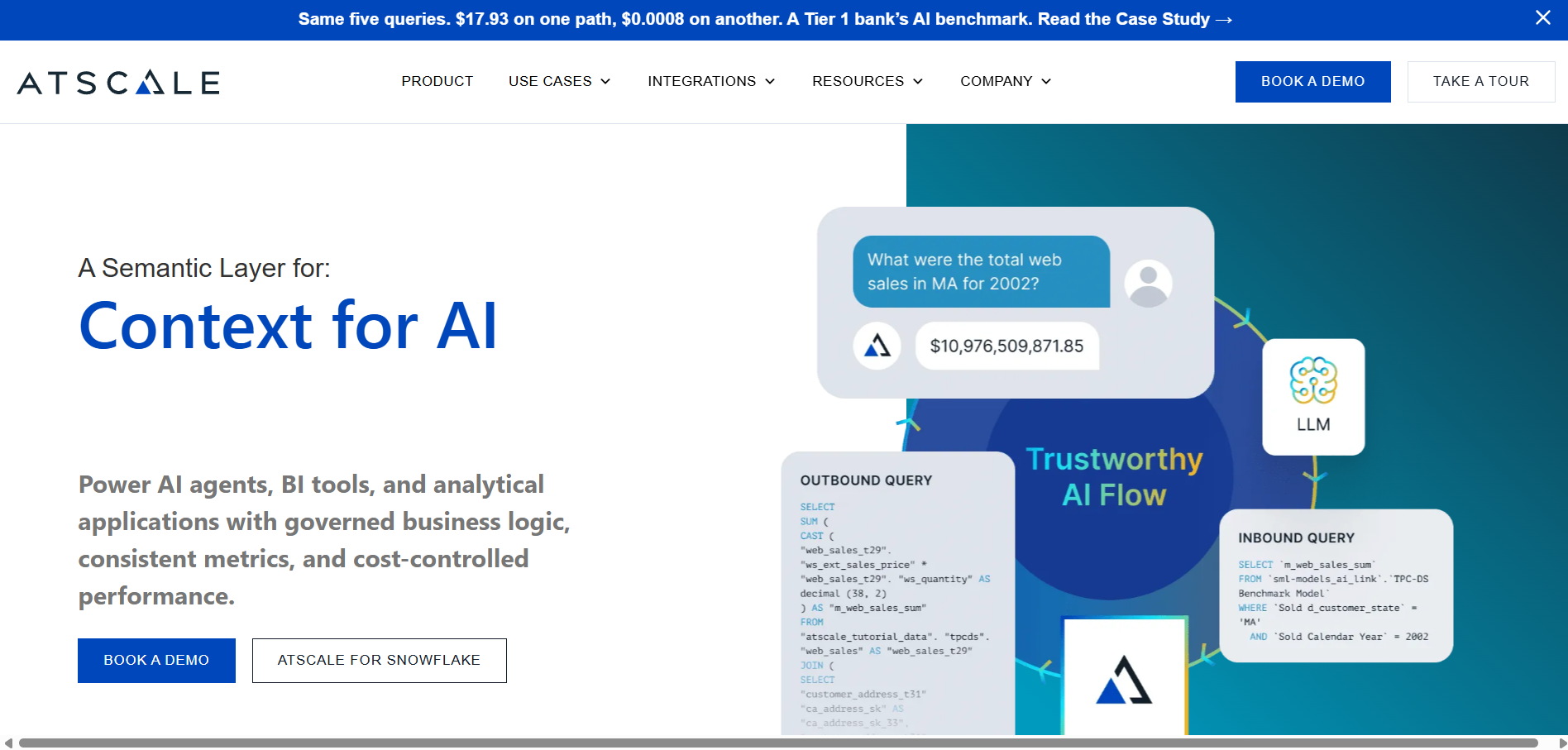
AtScale provides an enterprise semantic layer that optimizes analytical workloads while delivering consistent business metrics across leading BI platforms. It is designed for large organizations with complex reporting environments.
Key capabilities
-
Enterprise semantic modeling: Standardize metrics across BI tools.
-
Aggregation optimization: Improve query performance at scale.
-
Broad BI connectivity: Integrates with Power BI, Tableau, Excel, and more.
-
Live query support: Query source systems without moving data.
-
Performance optimization: Reduce latency for enterprise reporting.
Pros
-
Strong enterprise BI support.
-
Optimized for large-scale analytics.
-
Mature semantic modeling capabilities.
Cons
-
Longer implementation cycle.
-
Higher cost than lightweight alternatives.
Governance & catalog platforms
Governance platforms do not replace semantic layers. Instead, they complement them by providing trusted business context, metadata, lineage, and governance across every data source that feeds analytics and AI.
1. OvalEdge
OvalEdge is an enterprise data governance and catalog platform that complements the Snowflake Semantic Layer by extending trusted business context beyond a single data warehouse. While Snowflake standardizes business metrics within the warehouse, OvalEdge connects those metrics to governance, metadata, lineage, ownership, and business definitions across the enterprise.
How OvalEdge extends a semantic layer
-
AI-ready business glossary: Connect business metrics to governed definitions, approved calculation rules, and business terminology so users and AI interpret metrics consistently.
-
Enterprise trust signals: Enrich semantic metrics with lineage, certifications, ownership, data quality, and governance policies, helping AI determine which information can be trusted.
-
End-to-end lineage: Trace data from source systems through Snowflake semantic models into dashboards and AI applications, simplifying validation, impact analysis, and audits.
-
Cross-platform business context: Extend semantic consistency beyond Snowflake by connecting metadata, business glossaries, and governance across cloud, SaaS, and on-premises data sources.
-
AI-ready governance: Provide governed context that AI assistants and agents can consume, enabling explainable analytics, trusted responses, and policy-aware decision-making.
Key differentiators
-
Extends semantic trust beyond a single data platform.
-
Combines business glossary, metadata, lineage, governance, and trust signals in one platform.
-
Makes enterprise data governance consumable by both business users and AI agents.
Looking to extend trusted business context beyond Snowflake?

 Book a demo to see how OvalEdge combines governance, metadata, lineage, and AI-ready business context in a single platform.
Why semantic layers matter for modern enterprises
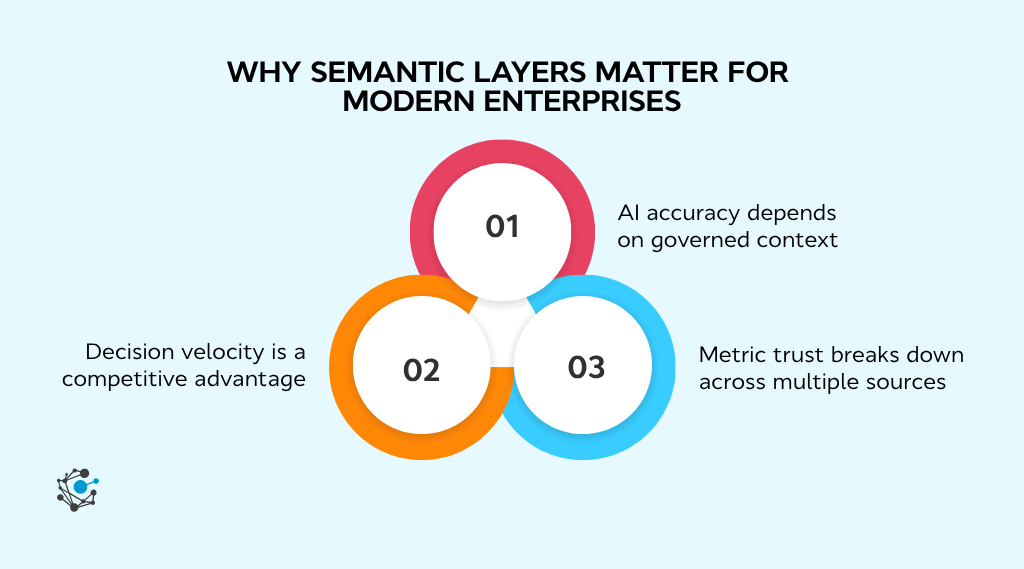
Organizations are adopting AI assistants and self-service analytics faster than ever, increasing the need for consistent business definitions across reports, dashboards, and natural language interfaces. As AI becomes part of everyday decision-making, ensuring every system interprets business metrics the same way is essential.
OvalEdge expert insight: Enterprise AI isn't replacing data governance. It's changing who consumes it.
Dashboards and business users still rely on standardized metrics, but AI assistants and agents now consume business glossaries, lineage, certifications, ownership, and governance policies directly. A semantic layer provides consistent definitions, while governance supplies the trust signals AI needs before generating answers or taking action.
As organizations move from traditional analytics to AI-driven decision-making, an enterprise context layer for AI governance extends semantic definitions with governance, lineage, and trusted business context, enabling AI assistants and agents to generate more explainable and trustworthy responses.
1. AI accuracy depends on governed context
A business analyst asks Snowflake Cortex Analyst, "Which product generated the highest recurring revenue last quarter?" The AI returns a different answer from the finance dashboard because multiple revenue definitions exist across business units.
A semantic layer helps establish a single business definition. Governance then enables AI to determine which definition is approved, which dataset is certified, and whether the response complies with organizational policies.
2. Decision velocity is a competitive advantage
When executives spend meetings reconciling conflicting reports instead of discussing strategy, productivity suffers. Consistent business definitions reduce unnecessary validation, allowing teams to make faster, more confident decisions.
3. Metric trust breaks down across multiple sources
Business decisions rarely rely on a single platform. Customer, finance, and operational data often originate from different systems, making consistency difficult to maintain as analytics environments grow.
Combining a semantic layer with enterprise governance helps preserve business meaning across these systems, ensuring both people and AI can work from a common understanding of enterprise data.
What to look for in a semantic layer strategy
Choosing a semantic layer is about more than comparing product features. The right solution should align with your data architecture, analytics strategy, and long-term AI roadmap.
Does it support your architecture?
Consider whether the platform fits your existing data landscape and can evolve as new data sources and analytics workloads are introduced.
Can it simplify metric management?
Look for centralized business definitions that eliminate duplicate calculations across dashboards, reports, and AI applications.
Does it improve transparency?
Business users should be able to understand how metrics are calculated, where they originate, and which definitions are considered authoritative.
Is it prepared for future AI initiatives?
As AI adoption grows, evaluate whether the platform can support trusted, explainable analytics without requiring extensive redesign.
How to choose the right approach for your organization
There is no one-size-fits-all semantic layer strategy. The right approach depends on your architecture, users, and business priorities.
1. Start with a high-value business domain
Choose an area such as sales, finance, or customer analytics where inconsistent metrics create measurable business impact. Establish shared business definitions before expanding to other domains.
2. Understand how metrics are consumed
Different consumers have different requirements. BI dashboards, AI assistants, embedded applications, and executive reporting may all rely on the same business definitions but access them differently.
3. Expand incrementally
Avoid modeling every metric at once. Validate definitions with business stakeholders, measure adoption, and gradually extend the semantic layer across additional domains.
Decision matrix
The table below summarizes which approach is generally the best fit for common enterprise scenarios.
|
Scenario |
Best-fit approach |
Why |
|
Snowflake-only analytics |
Snowflake Semantic Views |
Native integration with minimal operational overhead |
|
Multi-cloud or multi-warehouse environment |
dbt Semantic Layer or Cube |
Define metrics once and serve them across multiple platforms |
|
AI initiatives spanning multiple data sources |
Snowflake Semantic Layer + OvalEdge |
Combine semantic consistency with governed business context |
|
Embedded or customer-facing analytics |
Cube |
API-first architecture designed for embedded applications |
|
Enterprise-wide governance and compliance |
Snowflake Semantic Layer + OvalEdge |
Extend lineage, ownership, and governance beyond Snowflake |
Most enterprises don't choose either a semantic layer or a governance platform. They use both, combining standardized business metrics with enterprise-wide governance to create a trusted foundation for analytics and AI.
Conclusion
As AI becomes a core part of enterprise analytics, consistent business metrics are no longer optional. Organizations need a shared understanding of their data so dashboards, reports, and AI assistants produce answers that business teams can trust.
Choosing the right semantic layer is only part of the equation. As data expands across cloud platforms, SaaS applications, and operational systems, governance, lineage, and business context become equally important for maintaining trust at scale.
By combining Snowflake's semantic capabilities with enterprise governance platforms like OvalEdge, organizations can deliver consistent, explainable, and trusted insights across both analytics and AI.
Ready to extend trusted business context beyond Snowflake? Schedule a data governance demo to see how OvalEdge helps govern data, metadata, and AI across your entire enterprise.
.png?width=1081&height=173&name=Forrester%201%20(1).png)
.png?width=1081&height=241&name=KC%20-%20Logo%201%20(1).png)