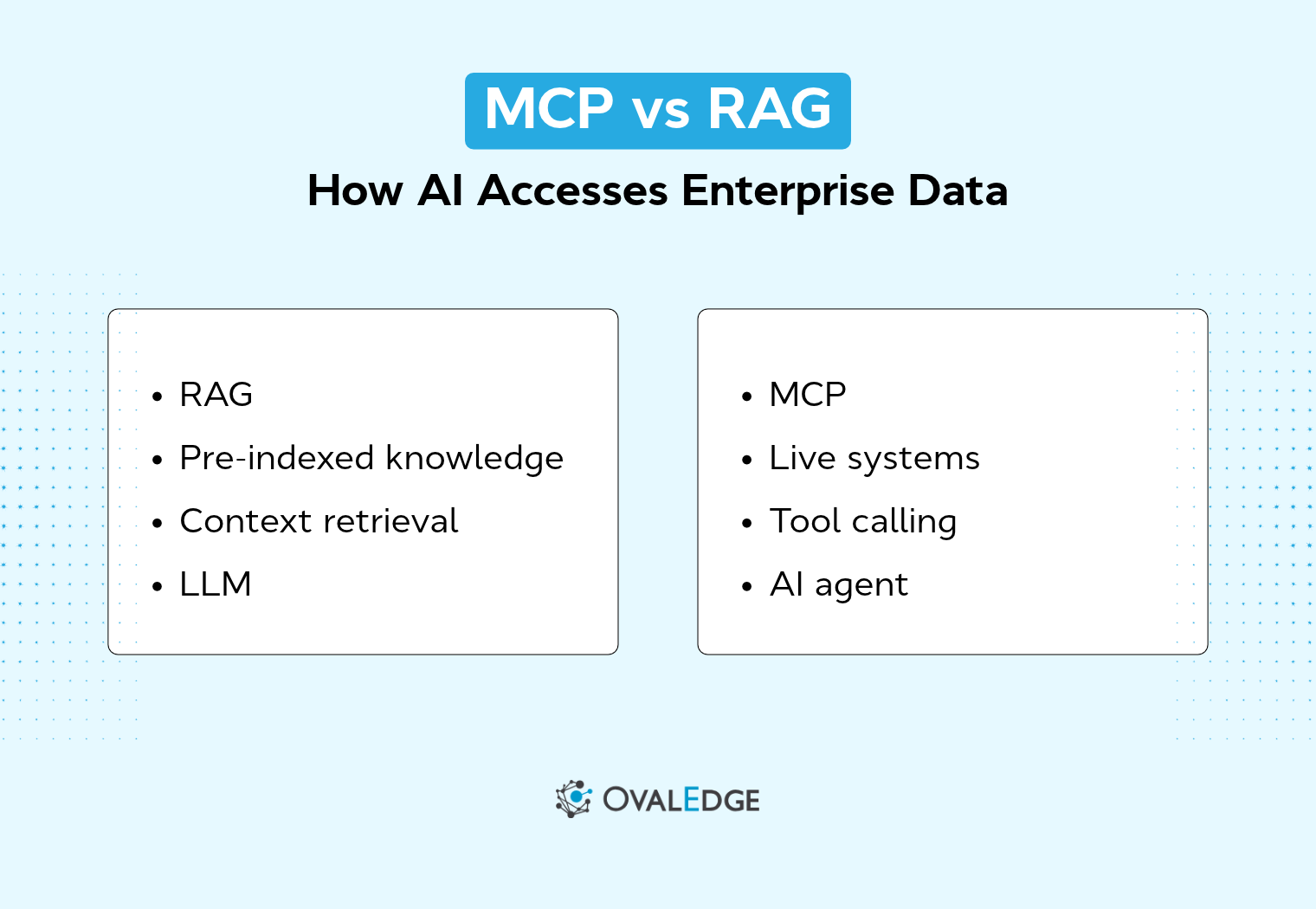
The MCP vs RAG debate is framing the wrong question. Retrieval-augmented generation and Model Context Protocol are not competing architectures. They solve fundamentally different data access problems, and treating them as interchangeable leads to systems that are either stale, ungoverned, or disconnected from the enterprise systems where decisions actually happen.
Enterprise AI needs context from many sources, and each source has a different access pattern. A pre-indexed knowledge base and a live database query require different retrieval mechanisms, and selecting the wrong one creates a trust gap that no amount of prompt engineering can close.
This guide covers how RAG and MCP work, where they differ, when each fits, how enterprises combine them, and why governed metadata is the foundation that makes both trustworthy.
What is retrieval-augmented generation (RAG)?
Retrieval-augmented generation (RAG) is a technique that retrieves relevant documents or data chunks from an external source and passes them to a language model as additional context before it generates a response.
RAG solves a fundamental limitation of large language models: their training data is static. An LLM trained six months ago has no knowledge of policy updates, product changes, or new compliance requirements that happened last week.
Rather than retraining the model (which is expensive and slow), RAG gives it access to current, domain-specific information at query time by pulling from an external knowledge base.
What RAG does not do is equally important. RAG does not connect to live systems. It does not execute actions or call external tools. It does not write data back to enterprise applications. RAG retrieves pre-indexed content and delivers it as read-only context to the model.
How RAG works
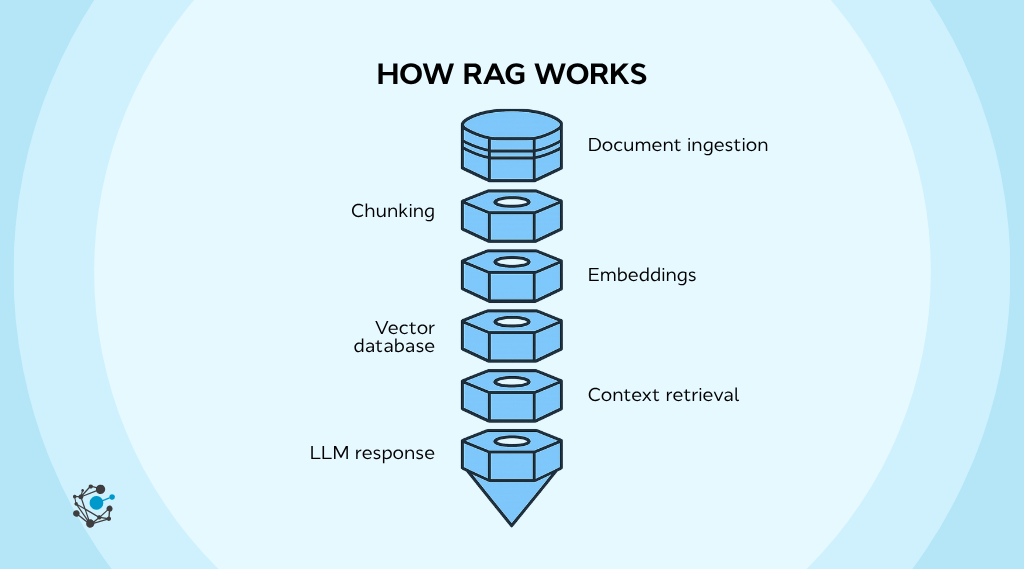
The RAG pipeline follows a five-step process:
-
Document ingestion
-
Chunking
-
Embedding
-
Vector storage
-
Retrieval plus generation
A user’s query is embedded, matched against stored vectors, and the closest chunks are injected into the model’s prompt as context. Key design decisions, including chunk size, embedding model, and retrieval strategy, directly affect output quality. The critical limitation: RAG output quality depends entirely on what was indexed, how it was chunked, and whether the source data was accurate and current when ingestion ran.
For a deeper look at how governance shapes each step of this pipeline, see data governance for RAG systems.
What is Model Context Protocol (MCP)?
Model Context Protocol (MCP) is an open standard developed by Anthropic that gives AI models a standardized way to connect to external tools, data sources, and systems through a client-server architecture using JSON-RPC.
Before MCP, every AI-to-tool integration required a custom, point-to-point connection. Each new data source meant new integration code, new authentication handling, and new maintenance overhead. MCP standardizes that interface so a single protocol handles connections across databases, APIs, file systems, and enterprise applications.
The difference from RAG is structural. MCP enables live data access, tool calling, and write operations. An MCP-connected agent can query a live database, update a record, or trigger a workflow. RAG cannot do any of these. MCP is a connection protocol, not a retrieval technique, and it does not handle retrieval from pre-indexed knowledge bases.
How MCP works
MCP operates through a three-role architecture: the host (the AI application), the client (manages connections), and the server (exposes tools and data).
Servers expose resources for reading, tools for executing, and prompts for templated interactions, all through JSON-RPC 2.0. Instead of pre-indexing content, MCP lets the model discover available tools and data at runtime and decide what to access based on the task. MCP defines how to connect.
It does not define what data to serve or whether that data is trustworthy. For implementation details on building MCP servers for enterprise data, that guide covers what a production deployment requires.
OvalEdge expert insight: MCP standardizes how AI connects to data sources, but it says nothing about whether the data behind those connections is accurate, classified, or authorized. That is a governance problem, not a protocol problem.
MCP vs RAG: how they differ
The comparison is natural because both RAG and MCP are about delivering external context to an LLM. The mechanism and scope, however, are fundamentally different. The three dimensions that matter most for enterprise decisions are architecture, data freshness, and governance.
Architecture and data flow
|
Dimension |
RAG |
MCP |
|
Data flow |
Pull: query → retrieve from index → inject into prompt |
Connect: discover → call → receive structured response |
|
Data source |
Pre-indexed corpus (vector database, document store) |
Live systems (APIs, databases, tools) |
|
Access pattern |
Read-only (retrieves content) |
Read and write (can execute actions) |
|
Integration model |
Embedding pipeline + retrieval layer |
Client-server protocol (JSON-RPC) |
|
Context delivery |
Retrieved chunks concatenated into prompt |
Structured responses from tool calls |
The practical implication of this architectural difference is straightforward. RAG works with a snapshot of your data. Whatever was true when the indexing pipeline last ran is what the model sees. MCP works with data as it exists right now, querying live systems at the moment of the request.
For enterprise use cases where accuracy depends on recency (compliance status, inventory levels, financial positions), this distinction directly affects whether the AI system's output can be trusted for decision-making.
Data freshness and access scope
RAG freshness depends entirely on indexing cadence. If source documents change hourly but re-indexing runs nightly, the model serves stale data for up to 23 hours. For stable knowledge bases like policy documents or training materials, that lag is acceptable. For fast-moving data, it creates a gap between what the model says and what is actually true.
MCP freshness is real-time by design. It queries source systems at request time, so the response reflects the current state.
The access scope difference compounds this:
- RAG typically accesses one source type: documents
- MCP can connect to databases, APIs, file systems, and tools simultaneously
- An MCP-connected agent can check a data catalog, query a warehouse, and validate against business rules in a single interaction
For regulated industries, stale data is not just an accuracy problem. When regulations like SOX, HIPAA, and GDPR mandate traceability, the choice of delivery mechanism has direct governance consequences. Effective data quality management for AI requires knowing exactly how current your data sources are and whether that currency meets regulatory thresholds.
Data freshness is a governance question, not just a performance metric. Whether an AI agent uses RAG or MCP, the organization needs to know how current its data sources are and whether that currency meets the thresholds its regulators and business rules require.
Governance, security, and compliance
Neither MCP nor RAG has built-in governance. This is the gap most comparisons skip, and it matters most in enterprise deployments.
The security risks are parallel but different:
- RAG risk: If sensitive documents get indexed without access controls, any user query can surface them. The retrieval layer has no native concept of user permissions unless explicitly built in.
- MCP risk: MCP servers expose tools and data to any connected agent. If an MCP server connects to a warehouse without row-level security, the AI agent inherits unrestricted access.
The common denominator: both need a governed metadata layer underneath.
Example: A bank’s trading desk and compliance team define “high-risk counterparty” using different thresholds. An AI agent pulling credit exposure through MCP and compliance documents through RAG blends both definitions without flagging the conflict. Without governed metadata specifying which definition applies in each context, neither delivery mechanism prevents the error.
The elements that determine trustworthiness are the same regardless of delivery mechanism: classification, access policies, lineage, and quality scores. For a full treatment of how these governance controls apply specifically to retrieval pipelines, see data governance for RAG systems.
According to the Precisely and Drexel University 2025 Data Integrity Trends report, 62% of organizations cite a lack of data governance as the primary challenge inhibiting AI initiatives, and 64% name data quality as their top data integrity concern.
The challenge is that this prioritization rarely extends to the delivery mechanisms that actually serve data to AI systems.
This is the gap most enterprises discover once AI systems go live. The governance elements- data classification, lineage, quality scores, and access policies- often exist across separate tools. But they are not connected into a single foundation that both MCP and RAG delivery mechanisms can draw from at runtime.
OvalEdge expert insight: The question is not whether to use MCP or RAG. The question is whether the data they access is cataloged, classified, and governed. Without that foundation, both approaches surface ungoverned information faster. For data-driven use cases like forecasting, risk scoring, and churn analysis, this governance gap has direct compliance consequences.
When to use MCP vs RAG for enterprise data
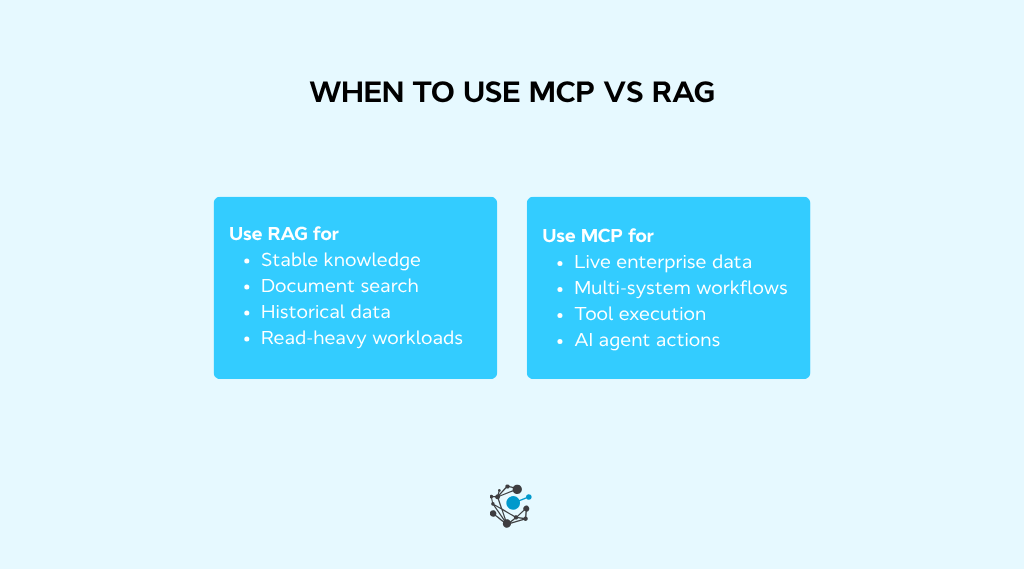
The right architecture depends on the data access pattern, not on which technology is newer. These two sections break down the practical decision criteria.
When RAG is the better fit
RAG is the stronger choice when the data is stable, the access pattern is read-only, and query volume makes pre-indexing cost-effective.
-
Knowledge-intensive Q&A: Internal policy lookup, customer support knowledge bases, regulatory FAQ systems. The content changes infrequently and can be pre-indexed reliably.
-
Document search and summarization: Large corpora of contracts, research papers, or historical reports where users need specific passages surfaced quickly.
-
Offline or batch processing: Use cases that do not need real-time data and benefit from pre-computed embeddings for fast retrieval.
-
Cost-sensitive deployments: RAG can be cheaper for read-heavy workloads because retrieval is a single vector lookup rather than a live API call per request.
The decision criteria are straightforward: if the data rarely changes, users only need to read it, and the query volume justifies the upfront indexing cost, RAG is the simpler and more cost-efficient path.
When MCP is the better fit
MCP is the stronger choice when the use case requires real-time data, write access, or coordination across multiple enterprise systems.
-
Agentic workflows requiring live data: AI agents that need current inventory, real-time pricing, or live dashboard metrics. The data changes too fast for indexing to keep up.
-
Multi-system orchestration: Tasks that span multiple enterprise systems in a single agent flow, such as querying a database, checking a catalog, validating against business rules, and writing results back.
-
Action-oriented use cases: Scenarios where the AI needs to execute, not just retrieve. Creating tickets, updating records, triggering approval workflows.
-
Standardized tool integration at scale: Organizations with many internal tools and APIs benefit from MCP's standardized protocol, which reduces the maintenance burden compared to custom connectors for each MCP server for enterprise data.
The decision criteria: if you need real-time data, write access, multi-system coordination, or a standardized integration layer for enterprise-ready AI agents, MCP is the architecture to evaluate. For a deeper look at what enterprise-grade MCP deployment requires, see this guide on MCP servers for enterprise data.
For example: An AI agent helping a data steward could use MCP to query the data catalog for column-level lineage, check classification tags, and flag datasets missing quality scores, all in one conversation.
How to use MCP and RAG together
Most enterprise AI architectures are not MCP-only or RAG-only. They combine both based on data access patterns. The real design question is not which to choose, but how to integrate them so each handles what it does best.
The hybrid architecture pattern
The practical pattern looks like this: the AI agent uses MCP as its primary interface to enterprise systems. Different MCP servers handle different data access patterns behind the scenes.
-
MCP Server A wraps a RAG pipeline for document retrieval (policies, knowledge base articles, historical records)
-
MCP Server B connects directly to a live database for current metrics and transactional data
-
MCP Server C connects to a ticketing or workflow system for action-oriented tasks
The agent does not need to know whether it is pulling from a pre-indexed corpus or a live system. The MCP protocol abstracts the retrieval mechanism. The agent calls tools; the tools handle data access.
This abstraction has a practical advantage: adding a new data source means deploying a new MCP server, not rewriting agent logic. A new RAG corpus is just another MCP server that wraps it. A new live system is another MCP server that connects to it. The metadata layer for AI stays consistent, no matter how many sources sit behind it.
Why governed metadata matters for both
Whether data arrives through RAG retrieval or MCP tool calls, the AI agent has no way to evaluate its trustworthiness without metadata. On its own, the agent cannot answer basic governance questions:
-
Is this data current enough for the decision it is informing?
-
Is the requesting user authorized to see it?
-
Where did it come from, and what transformations has it been through?
-
Has it been classified for sensitivity?
-
Does it meet the quality thresholds this use case requires?
The governed metadata layer described in the governance section above answers all of these. What changes is how each architecture uses it.
This layer shapes both architectures differently. For RAG, it tells the indexing pipeline what to index, how to chunk it (respecting document boundaries and classification), and who should see the results. For MCP, it tells servers what data to expose, which quality thresholds to enforce, and how to apply row-level access controls.
When this governed metadata is connected into a queryable, traversable structure, it becomes what OvalEdge calls an Enterprise Context Graph (ECG): the connected set of catalog metadata, business definitions, lineage, quality scores, and access policies that people and AI agents can query.
A governed knowledge graph also enables graph RAG, where retrieval follows relationship paths rather than vector similarity alone, improving accuracy for questions that require traversing connected data.
For data-driven analytical AI use cases like forecasting, risk scoring, and churn analysis, this governed metadata foundation is not optional. It is the difference between an AI agent that surfaces a number and one that surfaces a number the business can trust.
Is RAG obsolete with MCP?
No. RAG is not obsolete with MCP. They solve different problems in how AI systems access enterprise data, and most production architectures will use both.
The question keeps coming up because MCP's real-time, action-oriented capabilities make RAG look limited by comparison. Early MCP hype suggested it could replace RAG entirely. In practice, that is not how enterprise AI systems work.
RAG persists for three reasons:
- Speed and cost: Pre-indexed retrieval is faster and cheaper for stable knowledge bases. A vector lookup costs a fraction of a live API call per query.
- Unstructured content: Not all enterprise data lives in queryable systems. PDFs, contracts, historical reports, and policy documents need embedding and vector retrieval. MCP cannot index and semantically search these corpora.
- High-volume read workloads: When thousands of users query the same knowledge base daily, RAG handles the volume more efficiently than routing every request through a live connection.
The hybrid architecture above shows the real relationship: MCP wraps and routes to RAG, treating it as one of several tools an agent can call.
The real obsolescence risk is not RAG vs MCP. It is ungoverned RAG vs governed RAG. Pipelines that index data without classification, lineage, or access controls are the ones at risk, because they cannot meet enterprise compliance and trust requirements regardless of how fast they retrieve. For data-driven analytical AI, forecasting, risk scoring, churn analysis, and revenue analysis, this governance gap directly undermines the accuracy of every output the business acts on.
OvalEdge expert insight: The risk is not that MCP replaces RAG. The risk is that organizations adopt either approach without a governed metadata foundation underneath. When data-driven analytical AI depends on context that was never classified, never assigned an owner, and never quality-scored, ungoverned retrieval creates compliance exposure regardless of the delivery mechanism.
Connect your governance foundation to both RAG and MCP
RAG retrieves pre-indexed knowledge. MCP connects to live systems and tools. Both are delivery mechanisms, and choosing between them depends on the data access pattern, not on which technology arrived more recently. Most enterprise architectures will use both.
What makes either approach enterprise-ready is the governed metadata foundation underneath. Most enterprises already have much of it from existing data governance programs. The gap is connecting it so AI systems can actually use it.
OvalEdge closes that gap through the Enterprise Context Graph. For RAG pipelines, the ECG ensures indexing respects classification and retrieval enforces access controls. For MCP-connected agents, OvalEdge’s MCP server exposes governed catalog metadata, lineage, and business definitions directly, no custom integration required.
The result: data-driven analytical AI, from forecasting and risk scoring to churn and revenue analysis, that runs on context the business can trust. The foundation exists. OvalEdge connects and activates it. See how it works for your analytical AI use case.