-Jul-29-2026-04-52-24-8150-AM.png)
Data-centric AI agents need trusted enterprise context before answering business questions or acting. Raw tables, dashboards, and documents provide access but do not indicate whether information is current, approved, restricted, or certified. As agents support data discovery, SQL generation, RAG, analytics, recommendations, and governance workflows, choosing an AI agent metadata platform becomes a governance decision.
Microsoft’s 2025 Work Trend Index found that 81% of leaders expect agents to be moderately or extensively integrated into their organization’s AI strategy within 18 months.
This growth increases the need for metadata that prevents agents from using outdated, conflicting, or restricted information.
A metadata platform turns scattered metadata into governed, machine-readable context by supplying meaning, ownership, lineage, quality, policy, and permission signals.
This guide explains the metadata agents require, how it improves reasoning and retrieval, how to build the foundation, and how to evaluate platforms.
Why data-centric AI agents need a metadata foundation
Enterprise data contains context that experienced employees understand but software cannot infer. Analysts may know which revenue dashboard finance trusts or which customer table is experimental, while agents need those distinctions encoded through meaning, ownership, lineage, quality, certification, and policy.
Without this foundation, an agent may select an unapproved source, apply the wrong metric, query data at the wrong grain, or expose restricted information.
Gartner’s 2025 research into agentic AI viability predicts that more than 40% of projects will be canceled by the end of 2027 because of rising costs, unclear value, or inadequate risk controls.
Governed metadata addresses part of this risk by identifying approved sources, usage boundaries, and accountable owners.
Metadata as a foundational context layer for AI
Metadata sits between enterprise data systems and data-centric agents, explaining what an asset represents, how it relates to other assets, who owns it, whether it is current and certified, and which rules govern its use.
A connected metadata graph can link columns to business terms, policies, access rules, owners, dashboards, and AI outputs. At OvalEdge, we believe the governed context used by analysts and stewards should also be available programmatically to agents.
The essential metadata AI agents rely on
No single metadata category is enough. Metadata-aware agents need an enterprise metadata management strategy that brings technical structure, business meaning, provenance, policy, and AI lifecycle context together.
|
Metadata type |
Why AI agents need it |
|
Technical metadata |
Explains schemas, columns, APIs, dashboards, joins, data types, and table grain. |
|
Business metadata |
Defines terms, KPIs, formulas, synonyms, acronyms, and domain meaning. |
|
Lineage and provenance metadata |
Shows where data originated, how it changed, and where it is used downstream. |
|
Policy and access metadata |
Carries privacy rules, sensitivity labels, role permissions, consent, and usage policies. |
|
AI and model metadata |
Documents models, prompts, grounding datasets, outputs, evaluations, and agent actions. |
Together, these types show what an agent used, why it used it, and what happened next.
How metadata improves AI reasoning
Metadata improves AI reasoning by narrowing the search space, resolving ambiguous terms, comparing trust signals, and making outputs easier to explain. Enterprise answers may vary by department, reporting period, approved formula, freshness, and permissions.
1. Better context for AI decision-making
Before answering, an agent must identify the applicable definition, authoritative source, and access conditions. Glossary, ownership, certification, and quality signals help it prioritize reviewed assets.
McKinsey’s 2026 research into trust and risk in agentic AI found that 74% of respondents viewed inaccuracy as highly relevant, while 72% said the same about cybersecurity.
Lineage and policy metadata help verify sources and control what agents may retrieve, summarize, mask, or withhold.
For “monthly active customers,” the agent should retrieve the approved definition, certified source, reporting window, grain, owner, freshness status, and requester permissions.
OvalEdge expert insight: Agent accuracy often depends less on adding documents than on resolving conflicts between sources. Certification, ownership, quality, and lineage help determine which asset should win. AI-ready metadata programs should begin with critical business questions and the trust signals needed to answer them consistently.
2. Stronger RAG and agent grounding
Retrieval-augmented generation (RAG) performs better when metadata filters retrieval beyond semantic similarity. RAG finds what is relevant; governed metadata helps determine what is trustworthy for the user and task. Domain, freshness, certification, ownership, sensitivity, and business meaning reduce outdated or loosely related results.
For SQL generation, schemas show available fields, while joins, formulas, table grain, lineage, and access rules explain how to use them.
|
AI use case |
Metadata that improves it |
|
RAG retrieval |
Domain, freshness, owner, certification, and sensitivity labels. |
|
Agent grounding |
Lineage, glossary terms, source metadata, and ownership. |
|
SQL generation |
Schemas, joins, formulas, table grain, quality status, and access rules. |
|
Policy enforcement |
Privacy tags, role permissions, consent, retention, and usage policies. |
|
Explainability |
Lineage, provenance, source references, audit logs, and model metadata. |
For “What caused churn to increase last quarter?”, governed retrieval can locate the approved definition, certified dataset, latest dashboard, and source lineage, helping the agent separate supported explanations from unapproved correlations.
OvalEdge Data Lineage traces data across source systems, transformations, and reporting layers so reviewers can investigate inconsistencies and confirm a metric’s origin before an agent relies on it.
How to build an AI-ready metadata foundation
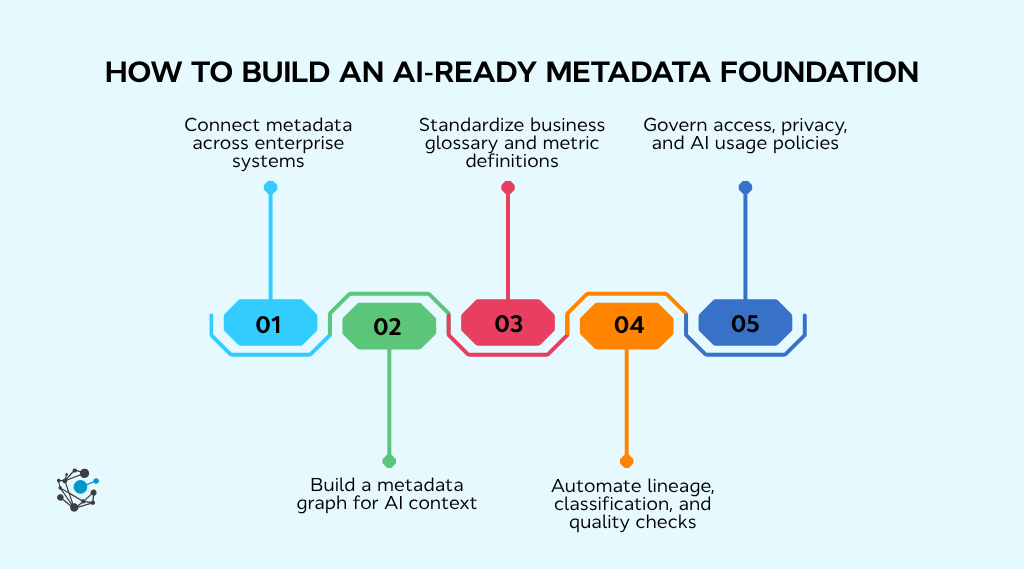
An AI-ready metadata foundation combines automated ingestion, connected relationships, governed definitions, current lineage, quality signals, and policy controls. RAG, context assembly, agent memory, MCP servers, tool authorization, and action governance should consume this trusted foundation rather than replace it.
IBM’s 2025 CEO study found that only 25% of enterprise AI initiatives had delivered expected ROI and 16% had scaled enterprise-wide, reinforcing the need for dependable context and controls before adoption expands.
1. Connect metadata across enterprise systems
Create a connected inventory across databases, warehouses, lakes, BI tools, pipelines, SaaS applications, AI systems, and governance tools. Agents need relationships across the full data estate, and not a catalog limited to one warehouse.
Automated crawling should collect schemas, usage, classifications, lineage, and operational signals. OvalEdge supports automated discovery and more than 150 connectors to bring distributed assets into a shared catalog and governance environment.
2. Build a metadata graph for AI context
A metadata graph should connect assets to glossary terms, terms to policies, policies to access rules, reports to source tables, datasets to owners, and models to their grounding data and outputs.
When these relationships are spread across separate governance assets, the OvalEdge Enterprise Context Graph brings glossary, lineage, catalog, quality, and policy into one connected graph, giving human users and AI agents the same governed business context.
This lets an agent understand that a dashboard uses a certified metric derived from a governed table containing restricted fields. The graph should preserve relationship direction and timestamps so the agent can distinguish current dependencies from historical ones.
3. Standardize business glossary and metric definitions
A governed glossary prevents agents from treating similar words as interchangeable. It should include approved terms, KPI definitions, formulas, synonyms, acronyms, domains, owners, and workflow statuses such as draft, approved, deprecated, or disputed.
If “revenue” means booked revenue for sales and recognized revenue for finance, the agent must know which definition applies to the user, task, and reporting period. Linking each definition to the assets and calculations that implement it turns documentation into usable business context.
4. Automate lineage, classification, and quality checks
Agent-ready metadata must stay current as schemas, pipelines, dashboards, policies, and models change. Automated lineage provides source-to-report traceability and impact analysis. Classification detects sensitive fields, while quality rules, freshness checks, and anomaly alerts show whether an asset remains fit for use.
Certification workflows should combine these signals into a clear trust status. OvalEdge brings lineage, quality, privacy, and Certification Manager capabilities into the same governance environment, allowing reviewed assets to be distinguished from those that require caution.
5. Govern access, privacy, and AI usage policies
AI-ready metadata must tell an agent what it may do, not only what data exists. This includes role-based access, PII, PHI, and PCI tags, sensitivity labels, consent conditions, retention rules, usage limits, approvals, and audit logs.
Policy decisions should follow the requester’s identity and purpose. An agent may summarize aggregated sales performance while blocking or redacting customer-level personal data for a user without permission. The policy layer should also record which assets, prompts, tools, and actions were involved.
At OvalEdge, we believe enterprises should govern shared data context once and make it reusable across analytics and data-centric AI agents. Retrieval methods, workflow context, and action controls may differ by use case, but duplicating business definitions and data policies across agents increases inconsistency and makes audits harder.
Best AI agent metadata platforms to evaluate
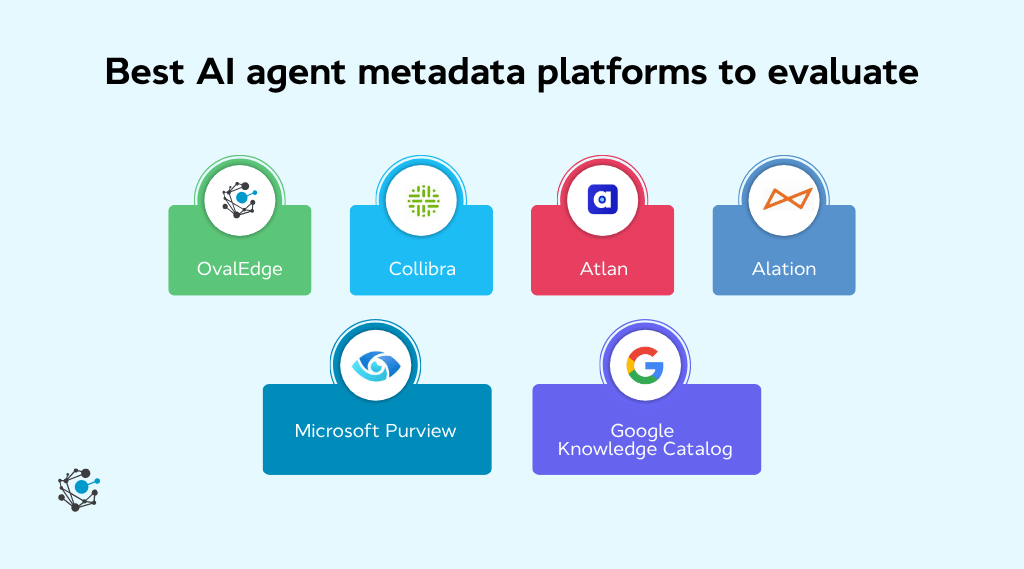
The strongest platforms centralize metadata, connect it through lineage, apply governance controls, and make trusted context usable by AI workflows. Buyers should compare governance depth as carefully as agent access methods.
|
Platform |
Best fit |
Key AI metadata strengths |
Governance depth |
Agent readiness |
|
OvalEdge |
Enterprises seeking unified metadata and governance. |
Catalog, glossary, lineage, quality, privacy, certification, AI governance, and governance-aware analytics. |
High. |
Strong for governed context and natural-language access. |
|
Collibra |
Large enterprises with mature governance programs. |
Workflows, business context, lineage, policy metadata, and AI governance. |
High. |
Strong for governed metadata delivery. |
|
Atlan |
Modern data teams focused on active metadata. |
Enterprise data graph, active metadata, cataloging, and MCP context. |
Medium to high. |
Strong for metadata activation. |
|
Alation |
Teams prioritizing trusted search and stewardship. |
Metadata-driven search, catalog, governance, lineage, and quality. |
Medium to high. |
Strong for discovery and data intelligence. |
|
Microsoft Purview |
Microsoft and Azure-centered enterprises. |
Unified Catalog, Data Map, glossary, quality, access, and data health. |
High within Microsoft. |
Strong for Microsoft-native workflows. |
|
Google Knowledge Catalog |
Google Cloud-centered organizations. |
Context graph, harvesting, semantics, lineage, quality, and agent access. |
Medium to high within Google Cloud. |
Strong for Google Cloud agents and analytics. |
1. OvalEdge
OvalEdge is a unified data governance platform for enterprises that need trusted, machine-readable context for data-centric AI agents. It connects cataloging, business definitions, lineage, quality, privacy, access, certification, and stewardship, helping teams determine which data an agent should use, why it can be trusted, and whether access is permitted.
Key features
-
Data Catalog and Metadata Management: Centralizes technical, operational, and business metadata across more than 150 connectors.
-
Business Glossary: Links approved terms, KPIs, formulas, owners, and governed assets.
-
End-to-End Data Lineage: Traces data through sources, transformations, reports, and AI workflows.
-
Data Quality and Certification: Monitors reliability and distinguishes approved assets from unverified sources.
-
Privacy and Access Governance: Connects sensitive-data classifications with policies, approvals, and audit records.
-
Agentic Governance: Uses built-in agents to support discovery, classification, lineage, and quality while retaining human oversight.
Pros: Extensive connector coverage, intuitive catalog and glossary capabilities, flexible customization, and responsive customer support.
Cons: Partial-term search and discovery across some unstructured data sources may require improvement.
Best for: Enterprises seeking one governed metadata foundation for analytics, RAG, natural-language access, and data-centric AI agents.
See how OvalEdge maps your metadata, lineage, and access policies into one governed layer. Book a Demo now.
2. Collibra
Collibra is an enterprise data and AI governance platform that connects metadata, policies, workflows, lineage, quality, and ownership across complex data estates.
Key features
-
Data and AI Catalog: Centralizes governed assets, business context, and ownership.
-
Governance Workflows: Coordinates policies, stewardship, approvals, and compliance activities.
-
Lineage and Quality: Connects provenance and trust signals with data and AI use cases.
-
Agent Access: Makes governed metadata and glossary context available through its MCP server.
Pros: Strong governance capabilities, centralized data assets, effective collaboration, and integrated data quality workflows.
Cons: Steep learning curve, complex implementation, and significant configuration requirements.
Best for: Large enterprises with mature governance programs and complex regulatory requirements.
3. Atlan
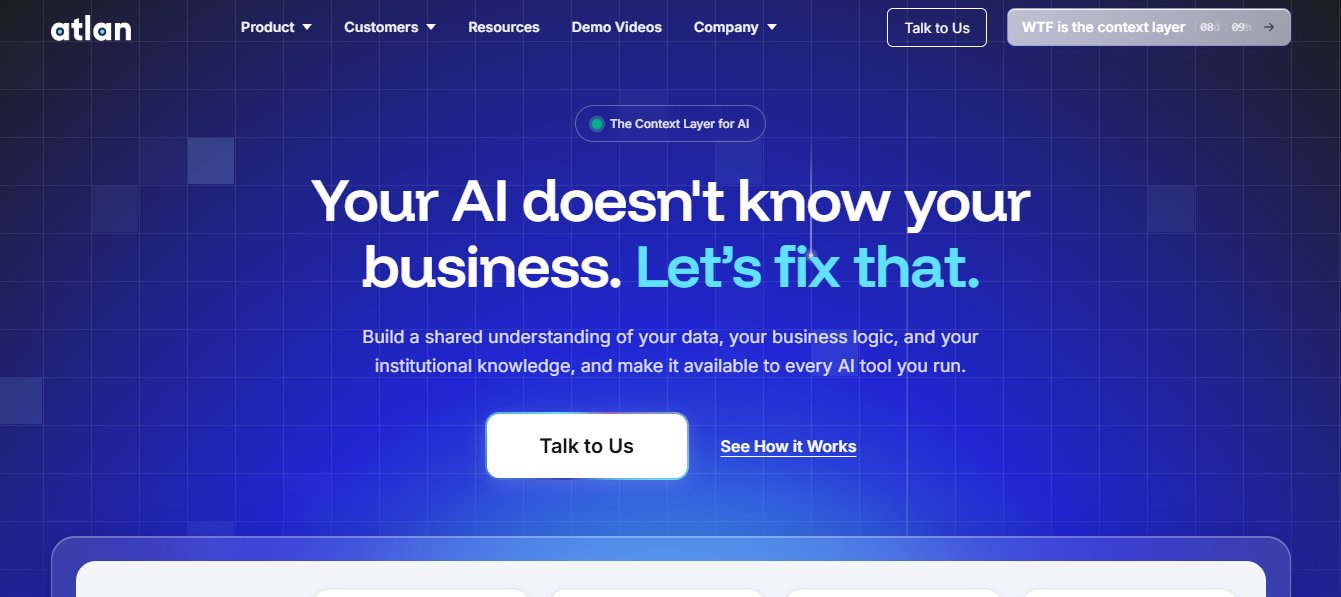
Atlan is an active metadata and enterprise context platform for modern data teams that want metadata embedded in operational workflows and AI tools.
Key features
-
Enterprise Data Graph: Connects assets, definitions, lineage, policies, and usage context.
-
Active Metadata: Pushes metadata and governance signals into operational workflows.
-
Discovery and Lineage: Supports search, collaboration, and technical traceability.
-
MCP Access: Exposes governed context to compatible AI agents and developer tools.
Pros: User-friendly interface, strong data discovery and lineage, effective collaboration, and relatively straightforward implementation.
Cons: Learning curve for some users, integration gaps, limited interface customization, and usability challenges for nontechnical teams.
Best for: Modern data teams prioritizing active metadata, collaboration, and agent-facing context.
4. Alation
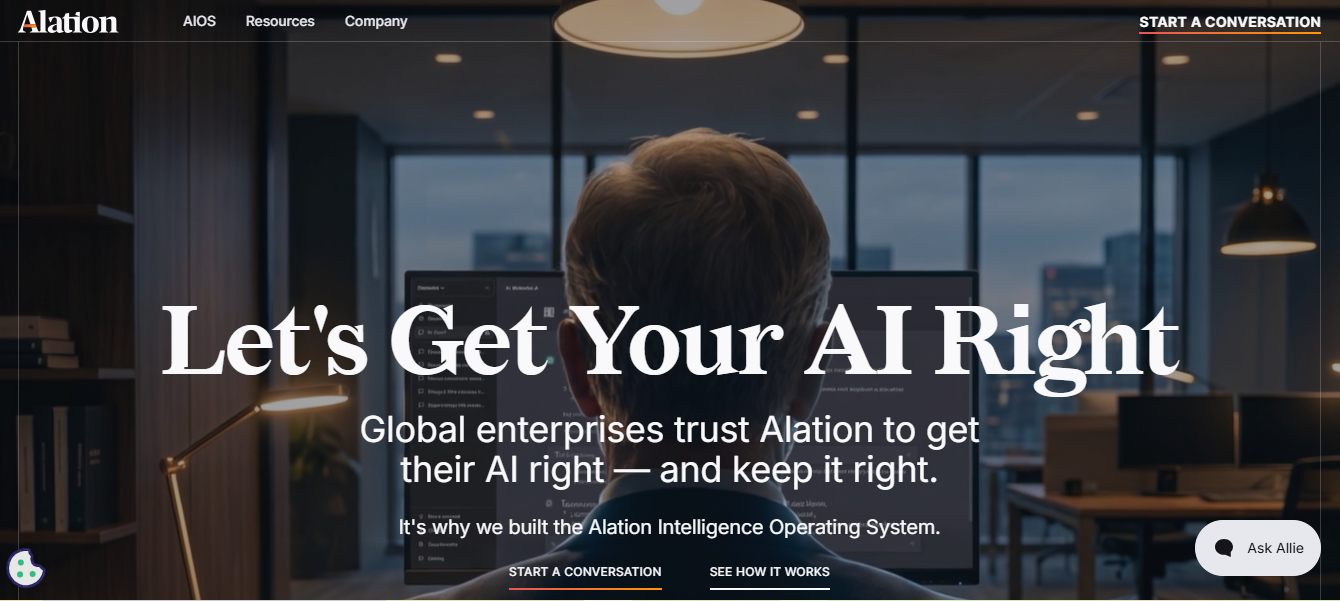
Alation is a data intelligence platform focused on trusted search, metadata-driven discovery, stewardship, governance workflows, and collaboration between technical and business users.
Key features
-
Metadata Search: Uses search, popularity, and usage signals to help users identify relevant assets.
-
Governance and Stewardship: Connects ownership, policies, workflows, and business documentation.
-
Lineage and Quality Context: Adds provenance and trust information to discovered data.
-
AI-Assisted Discovery: Supports natural-language access and AI-enabled catalog workflows.
Pros: Strong search experience, intuitive data catalog, effective collaboration, and robust governance workflows.
Cons: Limited workflow flexibility, additional configuration for certain integrations, and occasional lineage or metadata-freshness issues.
Best for: Enterprises prioritizing trusted discovery, stewardship, and broad business-user adoption.
5. Microsoft Purview
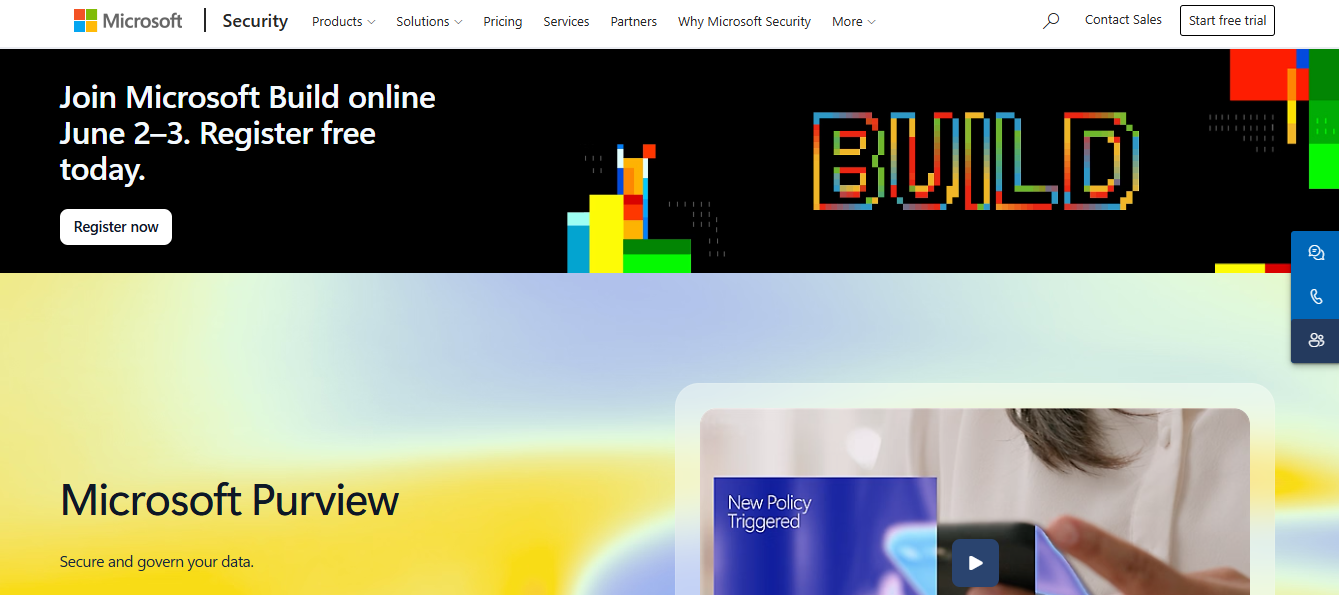
Microsoft Purview combines Data Map and Unified Catalog capabilities for discovering, governing, classifying, and monitoring metadata across Microsoft and connected data environments.
Key features
-
Data Map and Unified Catalog: Creates a searchable inventory and business governance layer.
-
Data Quality and Health: Profiles assets, applies quality rules, and monitors governance outcomes.
-
Classification and Access: Connects sensitive-data labels, policies, and access processes.
-
Microsoft Integration: Works closely with Azure, Fabric, Microsoft 365, and related services.
Pros: Unified data governance, deep Microsoft ecosystem integration, automated classification, and strong information-protection capabilities.
Cons: Complex setup, limited customization, and slower scanning or search performance in large environments.
Best for: Enterprises centered on Microsoft Azure, Fabric, and Microsoft 365.
6. Google Knowledge Catalog
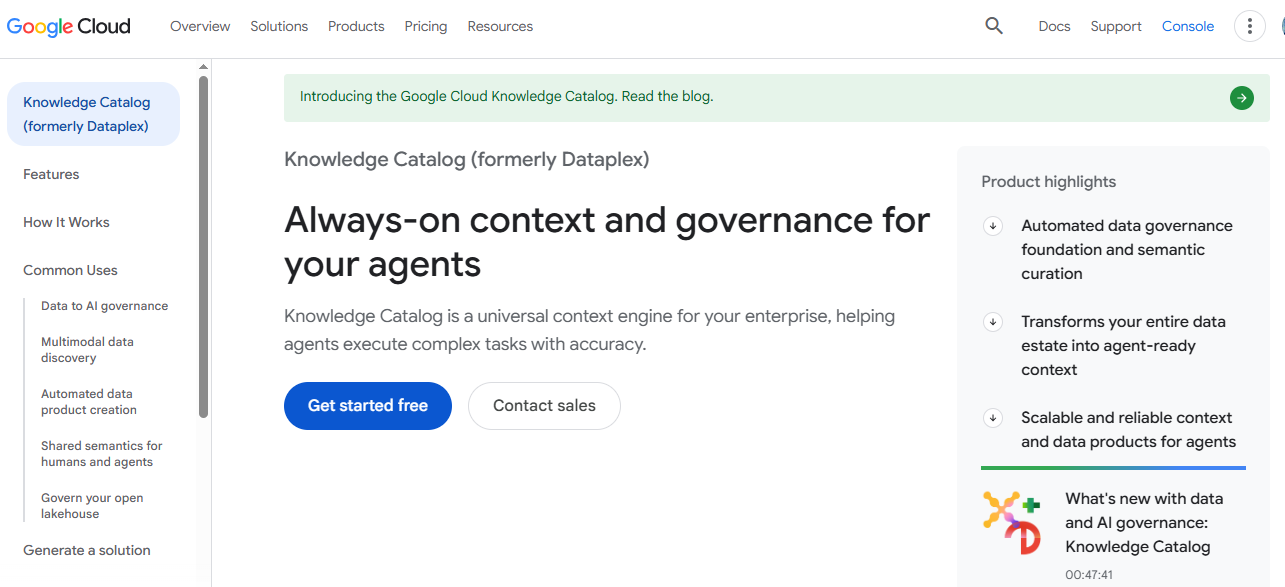
Google Knowledge Catalog, formerly Dataplex Universal Catalog, is a Gemini-powered context and governance platform that turns structured, unstructured, SaaS, and partner metadata into agent-ready business context.
Key features
-
Context Graph: Connects technical metadata, semantics, relationships, policies, and usage signals.
-
Automated Enrichment: Uses Gemini to harvest metadata, generate context, and identify relationships.
-
Lineage and Quality: Adds provenance, profiling, quality checks, and anomaly detection.
-
Agent Access: Provides semantic search, context APIs, and MCP tools for AI applications.
Pros: Automated context enrichment, strong Google Cloud and AI integration, prebuilt queries, and enterprise-wide metadata context.
Cons: Limited independent review coverage and a newer product experience that requires proof-of-concept validation.
Best for: Google Cloud organizations using BigQuery, Looker, Gemini, and related analytics services.
How to choose the right AI agent metadata platform
Do not choose a metadata platform for AI agents based only on search quality or the presence of an MCP endpoint. The central question is whether it can keep context governed, connected, current, permission-aware, and usable by both people and machines.
|
Evaluation area |
Questions to ask |
|
Metadata coverage |
Does it connect to databases, warehouses, lakes, BI tools, pipelines, SaaS applications, and AI systems? |
|
Automation |
Can it automate crawling, classification, lineage, quality checks, enrichment, and change detection? |
|
Business glossary |
Can it manage approved terms, KPIs, formulas, synonyms, owners, statuses, and workflows? |
|
Lineage |
Can it show source-to-report and column-level lineage with impact analysis? |
|
Data quality |
Can it expose freshness, completeness, anomalies, issues, and certification status? |
|
Policy metadata |
Can it manage privacy tags, sensitivity, roles, consent, retention, and permitted uses? |
|
AI governance |
Can it document models, datasets, prompts, outputs, evaluations, agents, and actions? |
|
Architecture fit |
Can the platform expose governed metadata to RAG, MCP, and agent runtimes while clearly separating metadata governance from runtime orchestration and action execution? |
|
Agent readiness |
Can agents access metadata through APIs, natural language, or MCP-style workflows while preserving identity and policy? |
|
Adoption |
Can business users, stewards, engineers, security teams, and AI teams share one operating model? |
|
Support |
Does the vendor provide implementation guidance, training, and long-term support? |
|
Scalability |
Can it handle your data estate, metadata change rate, and planned AI use cases? |
Start with two or three high-value scenarios, such as answering governed finance questions, generating SQL for approved metrics, or recommending datasets without exposing sensitive fields. Test whether each platform can resolve the correct definition, choose a certified source, enforce access, show lineage, and produce an audit trail.
The final decision should reflect governance maturity and technical architecture. A broad platform may still require ownership and policy work, while a focused context tool may leave quality, privacy, certification, and accountability in separate systems.
Conclusion
The value of enterprise AI depends on whether agents can interpret and use data within the right business and governance context. Without governed metadata, they may select the wrong source, misread business terms, generate unreliable SQL, or expose restricted information.
Organizations should assess whether critical datasets are certified, definitions are consistent, ownership is clear, lineage is current, and access policies can follow each user and use case. These controls strengthen RAG, data recommendations, analytics, and automated governance workflows.
OvalEdge helps organizations make metadata usable by people and data-centric AI agents by connecting cataloging, glossary, lineage, quality, privacy, certification, and AI governance. AskEdgi applies this governed context to natural-language analytics, helping users obtain more consistent answers across fragmented data systems.
Ready to build an agent-ready metadata foundation for data-centric enterprise AI?

Schedule a data governance demo to see how OvalEdge helps organizations turn governed metadata, lineage, quality signals, and access policies into trusted data context for AI agents.
.png?width=1081&height=173&name=Forrester%201%20(1).png)
.png?width=1081&height=241&name=KC%20-%20Logo%201%20(1).png)