.png)
Knowledge graphs are rapidly moving from niche technology to a core part of enterprise data and AI strategies.
According to the WorldMetrics report 2026, 65% of large enterprises have adopted knowledge graphs as part of their digital transformation initiatives, up from 40% in 2020.
As organizations scale AI, they need more than access to data. They need connected business context that helps people and AI understand how information, business concepts, ownership, and governance relate across increasingly complex data ecosystems.
The growing market reflects this shift. From graph databases and semantic graph platforms to AI GraphRAG frameworks and governed metadata platforms, each category addresses a different enterprise need.
This guide compares the leading knowledge graph tools, explains where each platform fits, and highlights the capabilities that matter most when evaluating solutions for enterprise AI, analytics, and data governance.
What are knowledge graph tools?
Knowledge graph tools help organizations connect data, business definitions, metadata, relationships, and governance information into a unified layer of enterprise knowledge. By linking these connections, they enable people and AI systems to understand what data means, where it comes from, how it relates to other assets, and whether it can be trusted.
For example, a revenue metric can be connected to its business definition, source tables, data owner, lineage, quality score, certified dashboard, and AI usage policy. This connected context improves data discovery, governance, analytics, and AI decision-making.
Many of these capabilities are built on effective metadata management, which helps organizations organize, govern, and discover enterprise data across distributed systems.
Knowledge graph tools vs. graph databases: What should buyers know?
Although the terms are often used interchangeably, they serve different purposes. A graph database stores and queries connected data, while a knowledge graph tool enriches that data with business meaning, metadata, ontology, and contextual relationships.
For enterprise AI, graph relationships alone are rarely enough. Organizations also need business definitions, governance signals, and metadata that help AI systems retrieve the right information, interpret it correctly, and use it with confidence across analytics and decision-making workflows.
|
Comparison point |
Graph database |
Knowledge graph tool |
|
Primary purpose |
Store and query connected data |
Connect data with business meaning and context |
|
Core users |
Developers and data engineers |
AI teams, governance teams, data architects, and business users |
|
Data model |
Nodes, edges, and properties |
Entities, metadata, business terms, ontology, and relationships |
|
Query support |
Cypher, Gremlin, GSQL |
SPARQL, RDF, OWL, APIs, metadata models |
|
Governance capabilities |
Typically external |
Often includes lineage, ownership, policies, and trust signals |
|
Best fit |
Graph applications and traversal |
AI, semantic search, governance, compliance, and analytics |
Many organizations also evaluate how knowledge graph tools complement an enterprise data catalog to improve data discovery, business context, and AI readiness.
What are the main types of knowledge graph tools?
Knowledge graph tools fall into several categories, each designed for a different purpose. Some focus on metadata and governance, others specialize in semantic modeling, graph infrastructure, or AI retrieval. Understanding these categories makes it easier to identify the right type of platform before comparing individual vendors.
1. Governed metadata graph platforms
These platforms connect metadata, business glossary, lineage, and governance information to improve data discovery, compliance, analytics, and enterprise AI.
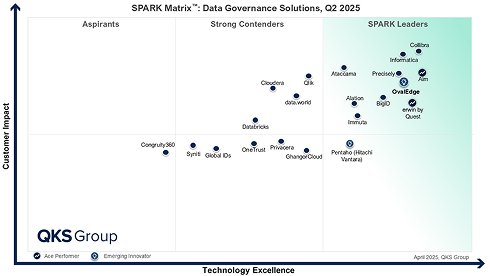
Examples: OvalEdge, data.world, Atlan, Collibra, DataHub.
2. RDF and semantic graph platforms
These platforms focus on ontology management, semantic reasoning, and standards such as RDF, OWL, and SPARQL.
Examples: Stardog, Ontotext GraphDB, AllegroGraph, Graphwise.
3. Graph databases
These platforms are optimized for storing and querying highly connected data used in graph applications such as fraud detection, recommendation engines, and network analysis.
Examples: Neo4j, Amazon Neptune, TigerGraph, ArangoDB.
4. AI knowledge graph and GraphRAG tools
These tools combine graph relationships with retrieval techniques to improve how large language models discover and use enterprise information.
Examples: Microsoft GraphRAG, LlamaIndex, LangChain, Zep.
GraphRAG complements rather than replaces business glossary management, data lineage, data ownership, data quality, metadata governance, policies, stewardship workflows, and certification and trust signals.
It delivers the best results when these governance assets already exist and can be supplied as trusted, machine-readable context during retrieval and reasoning.
-2.png?width=1024&height=569&name=info%201%20(1)-2.png)
When should you choose a governed metadata platform?
Graph databases, semantic platforms, GraphRAG frameworks, and governed metadata platforms solve different problems. Before comparing vendors, identify the category that best matches your primary use case.
|
If your goal is... |
Best fit |
|
Build graph applications |
Graph database |
|
Model ontologies and semantic reasoning |
Semantic graph platform |
|
Improve LLM retrieval |
GraphRAG framework |
|
Govern enterprise AI and business context |
Governed metadata platform |
Choose a governed metadata platform when:
-
AI requires trusted business context.
-
Business glossary, lineage, ownership, and quality must remain connected.
-
Governance, analytics, and AI need a shared, governed foundation.
Best knowledge graph tools and platforms to evaluate
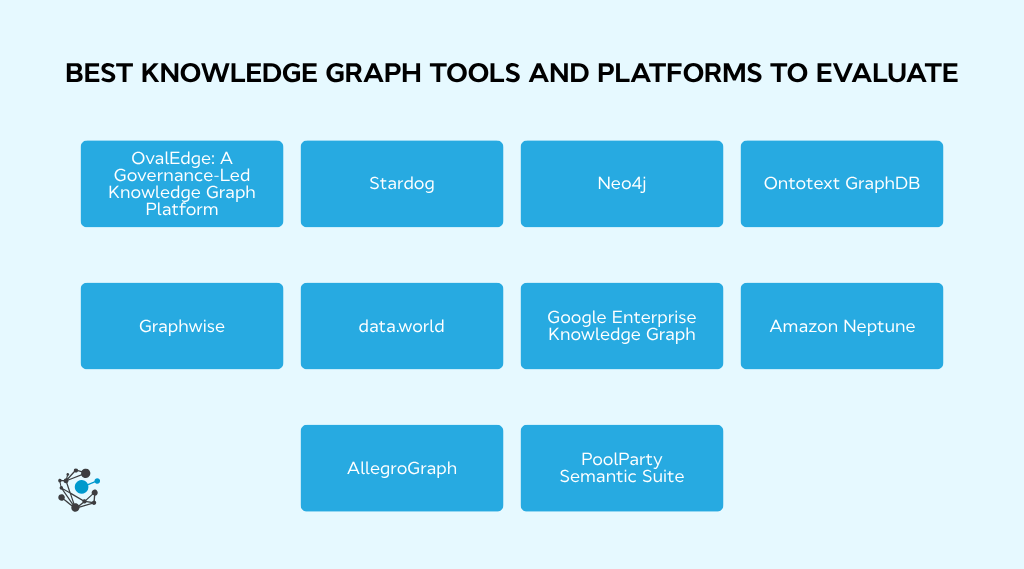
The best knowledge graph platform depends on the problem an organization needs to solve. Some platforms specialize in semantic modeling, others provide graph infrastructure, while governed metadata platforms connect business meaning, lineage, quality, ownership, and policy signals to create trusted enterprise context.
The comparison below helps buyers distinguish between tools built for graph applications, semantic reasoning, metadata management, and AI-ready enterprise context.
|
Platform |
Category |
Primary use case |
Pricing |
Why it stands out |
|
OvalEdge |
Governed metadata graph platform |
AI-ready data governance |
Custom quote |
Unified governance, metadata, lineage, and AI context |
|
Stardog |
Semantic graph platform |
Ontology and semantic reasoning |
Custom quote |
Strong RDF, OWL, and SPARQL support |
|
Neo4j |
Graph database |
Graph applications |
Free & paid enterprise |
Large developer ecosystem and graph analytics |
|
Ontotext GraphDB |
RDF graph database |
Linked data and semantic search |
Free & paid enterprise |
Standards-based semantic graph platform |
|
Graphwise |
Semantic graph platform |
Enterprise semantic modeling |
Contact sales |
AI-ready semantic knowledge graphs |
|
data.world |
Metadata graph platform |
Data discovery and collaboration |
Contact sales |
Collaborative knowledge graph catalog |
|
Google Enterprise Knowledge Graph |
Cloud knowledge graph |
Entity resolution |
Usage-based |
Google Cloud integration |
|
Amazon Neptune |
Managed graph database |
AWS graph workloads |
Usage-based |
Fully managed cloud service |
|
AllegroGraph |
RDF graph database |
Semantic and temporal reasoning |
Contact sales |
Advanced semantic analytics |
|
PoolParty Semantic Suite |
Semantic graph platform |
Taxonomy, ontology, and knowledge management |
Contact sales |
Enterprise semantic modeling with AI-powered content enrichment |
1. OvalEdge
OvalEdge is an AI-ready data governance platform that connects business and technical metadata into a unified layer of governed enterprise context. It combines data cataloging, business glossary, lineage, data quality, privacy, certification, ownership, and AI governance to help organizations discover, understand, trust, and operationalize enterprise data for analytics and AI.
Key features
-
Automated metadata discovery: Crawls metadata from 150+ enterprise data sources to create a centralized data catalog.
-
Business glossary: Connects business terms with technical assets to establish consistent business definitions.
-
End-to-end data lineage: Visualizes data movement across systems for impact analysis, compliance, and troubleshooting.
-
Integrated data trust: Combines data quality, sensitive data discovery, and certification to improve confidence in enterprise data.
-
AI-ready governance: Delivers governed context for AI assistants, semantic search, GraphRAG, and enterprise AI initiatives.
Best for
Organizations that need to operationalize data governance for enterprise AI, analytics, compliance, and trusted data discovery.
Pros
-
Unifies governance and metadata capabilities.
-
Delivers machine-readable business context for AI.
-
Integrates across modern enterprise data ecosystems.
Why OvalEdge stands out
Unlike standalone graph databases or semantic graph platforms, OvalEdge focuses on making enterprise metadata operational for AI. Rather than simply connecting relationships, it combines governance, trust, and business context so AI systems can retrieve information with the right definitions, lineage, ownership, quality, and access controls already attached.
With automated metadata discovery, 150+ prebuilt connectors, configurable workflows, and modular deployment, organizations can strengthen governance without replacing existing data platforms.
This approach helps transform existing governance investments into machine-readable context that supports AI assistants, GraphRAG, semantic search, and other data-centric AI applications.
Organizations building AI-ready architectures can also explore how a Context Layer for AI Agents delivers governed business context during AI retrieval and reasoning.
Ready to see OvalEdge in action?
Book an OvalEdge Data Governance Demo to see how governed metadata, lineage, and business context create a trusted foundation for enterprise AI.
2. Stardog
Stardog is a semantic graph platform that helps organizations build enterprise knowledge graphs using RDF, OWL, and SPARQL. It combines semantic reasoning with data virtualization to create connected knowledge without requiring all data to be physically moved.
Key features
-
Semantic reasoning: Infers new relationships using ontology-based reasoning.
-
Data virtualization: Queries multiple data sources without replication.
-
Standards support: Supports RDF, OWL, and SPARQL for semantic interoperability.
-
Knowledge graph management: Builds and manages ontology-driven enterprise knowledge graphs.
-
Flexible deployment: Available for cloud, on-premises, and hybrid environments.
Best for
Organizations building ontology-driven knowledge graphs and semantic AI applications.
Pros
-
Strong semantic reasoning capabilities.
-
Excellent support for open standards.
-
Supports data virtualization.
Cons
-
Requires semantic modeling expertise.
-
Higher learning curve for business users.
3. Neo4j
Neo4j is a leading graph database designed to store and query highly connected data. It is widely used to build graph-powered applications that require fast relationship traversal and graph analytics.
Key features
-
Property graph model: Represents data as nodes, relationships, and properties.
-
Cypher query language: Simplifies graph querying and analysis.
-
Graph analytics: Supports pathfinding, centrality, and community detection.
-
Scalable architecture: Handles large connected datasets efficiently.
-
Developer ecosystem: Extensive libraries, documentation, and community support.
Best for
Developer teams building graph applications such as fraud detection, recommendations, and customer 360.
Pros
-
Mature graph database platform.
-
Strong developer community.
-
Excellent graph performance.
Cons
-
Governance capabilities require additional tools.
-
Business glossary and lineage are not native features.
4. Ontotext GraphDB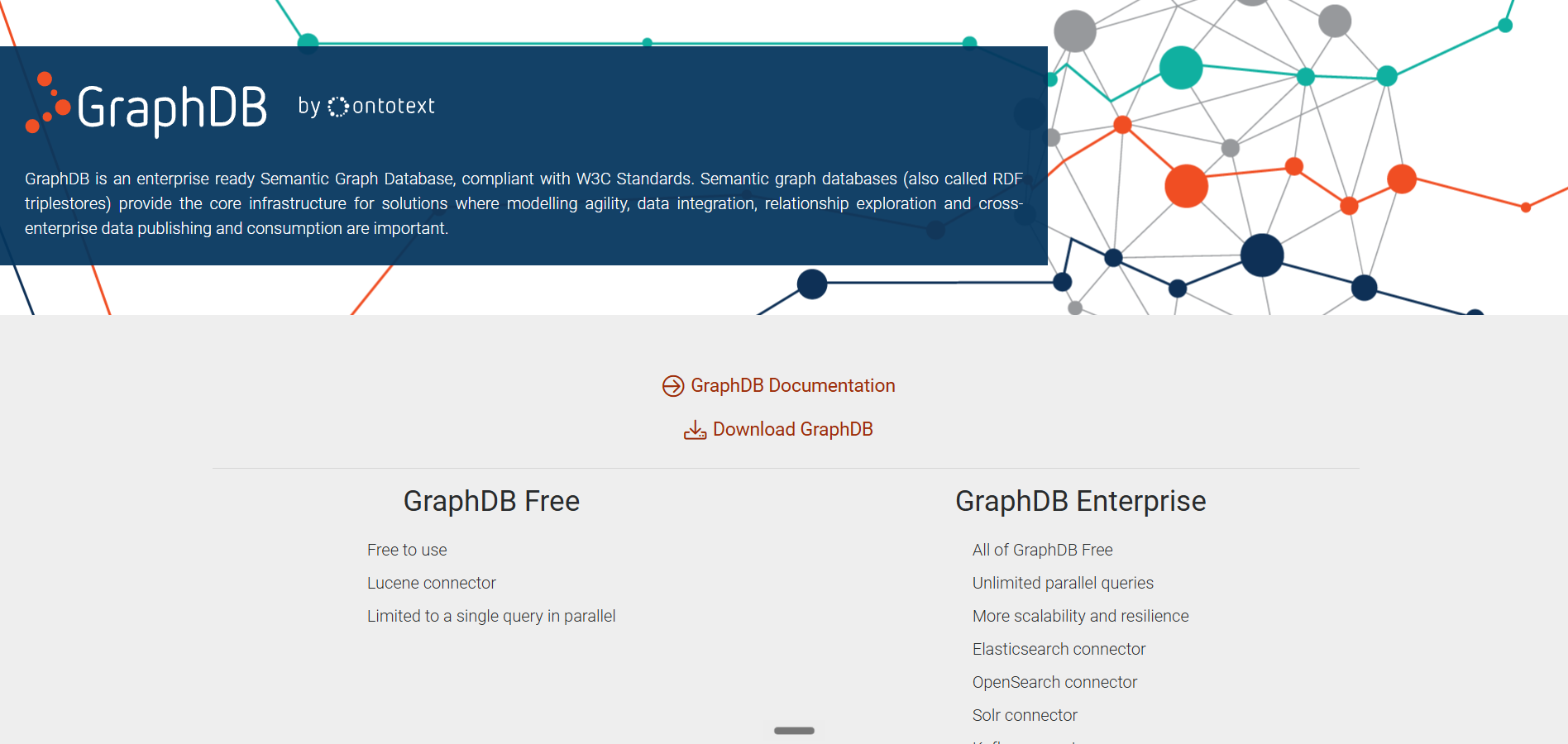
Ontotext GraphDB is an RDF graph database built for semantic search, linked data, and standards-based knowledge management. It enables organizations to model and query complex semantic relationships.
Key features
-
RDF storage: Optimized for large RDF datasets.
-
SPARQL engine: Executes complex semantic queries efficiently.
-
OWL reasoning: Supports ontology-based inference.
-
Linked data management: Connects distributed semantic datasets.
-
Semantic search: Improves information discovery through relationships.
Best for
Organizations implementing semantic web standards and linked data initiatives.
Pros
-
Strong RDF capabilities.
-
Mature semantic technology.
-
Reliable reasoning engine.
Cons
-
Requires semantic expertise.
-
Limited governance functionality.
5. Graphwise
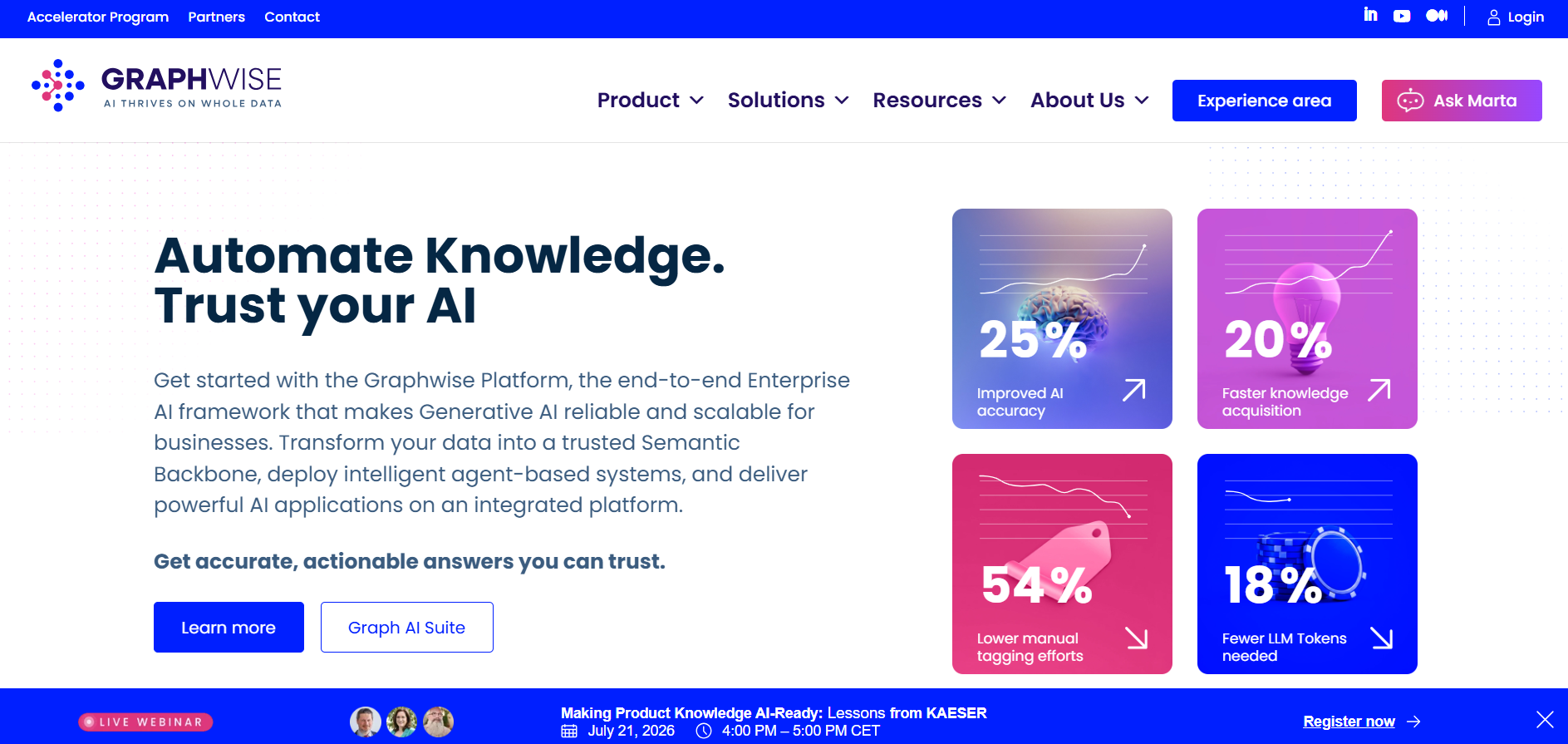
Graphwise is a semantic graph platform designed to connect enterprise knowledge across domains for AI, search, and analytics. It emphasizes semantic enrichment and knowledge-driven AI.
Key features
-
Semantic modeling: Builds enterprise knowledge graphs with rich relationships.
-
Ontology management: Supports structured business concepts.
-
AI context: Enhances AI applications with connected knowledge.
-
Knowledge integration: Connects data across multiple domains.
-
Semantic search: Improves discovery through contextual relationships.
Best for
Organizations building semantic knowledge graphs for enterprise AI and search.
Pros
-
Strong semantic capabilities.
-
AI-focused architecture.
-
Supports complex enterprise domains.
Cons
-
Limited governance workflows.
-
Best suited for semantic use cases.
6. data.world
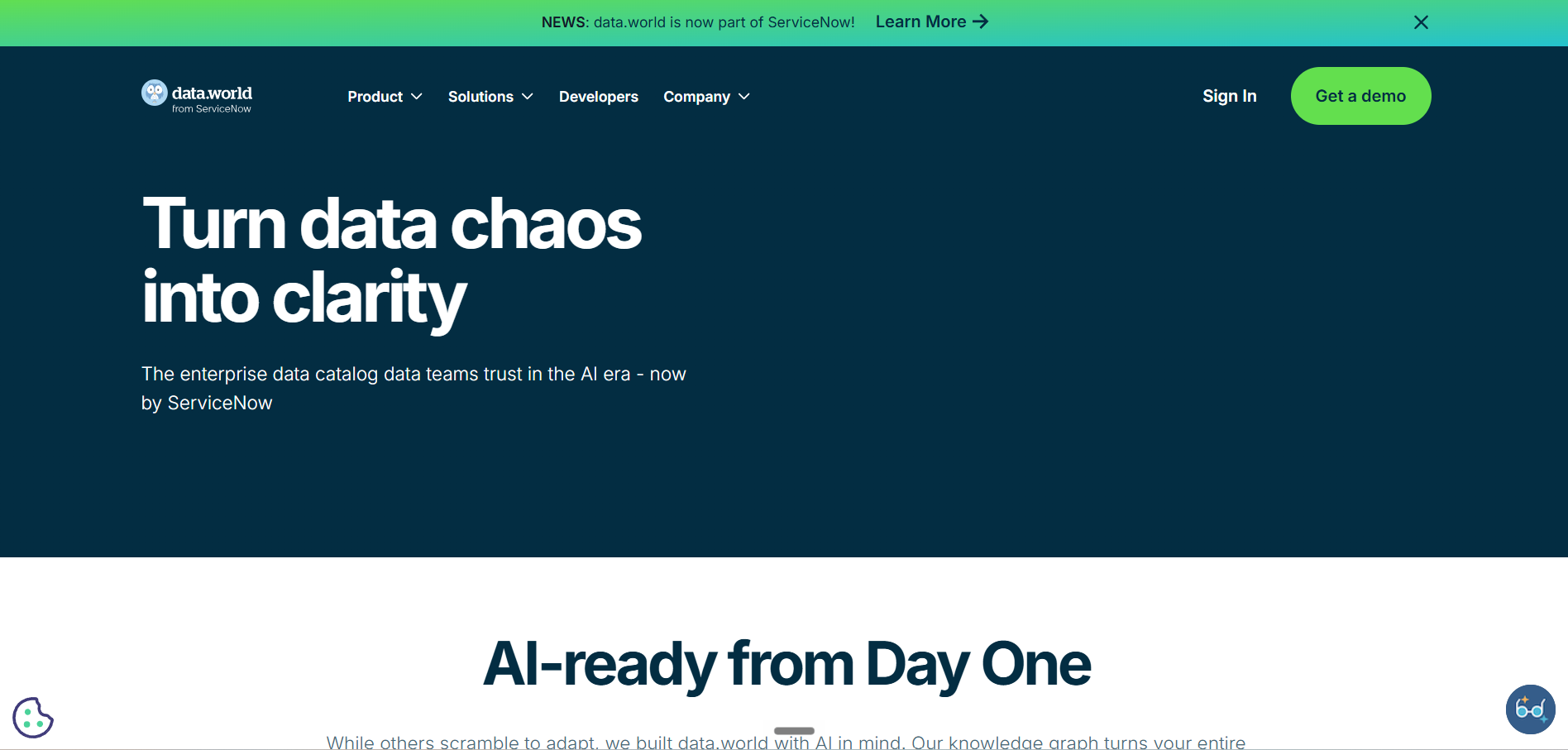
data.world is a cloud-native metadata platform that uses a knowledge graph foundation to improve data discovery, collaboration, and metadata management across organizations.
Key features
-
Data catalog: Centralizes enterprise metadata.
-
Knowledge graph foundation: Connects business and technical metadata.
-
Collaborative governance: Enables shared documentation and stewardship.
-
Business glossary: Standardizes business terminology.
-
Search and discovery: Helps users quickly find trusted data.
Best for
Organizations prioritizing collaborative data discovery and metadata management.
Pros
-
User-friendly interface.
-
Strong collaboration features.
-
Cloud-native deployment.
Cons
-
Advanced governance may require additional capabilities.
-
Enterprise pricing is not publicly available.
7. Google Enterprise Knowledge Graph
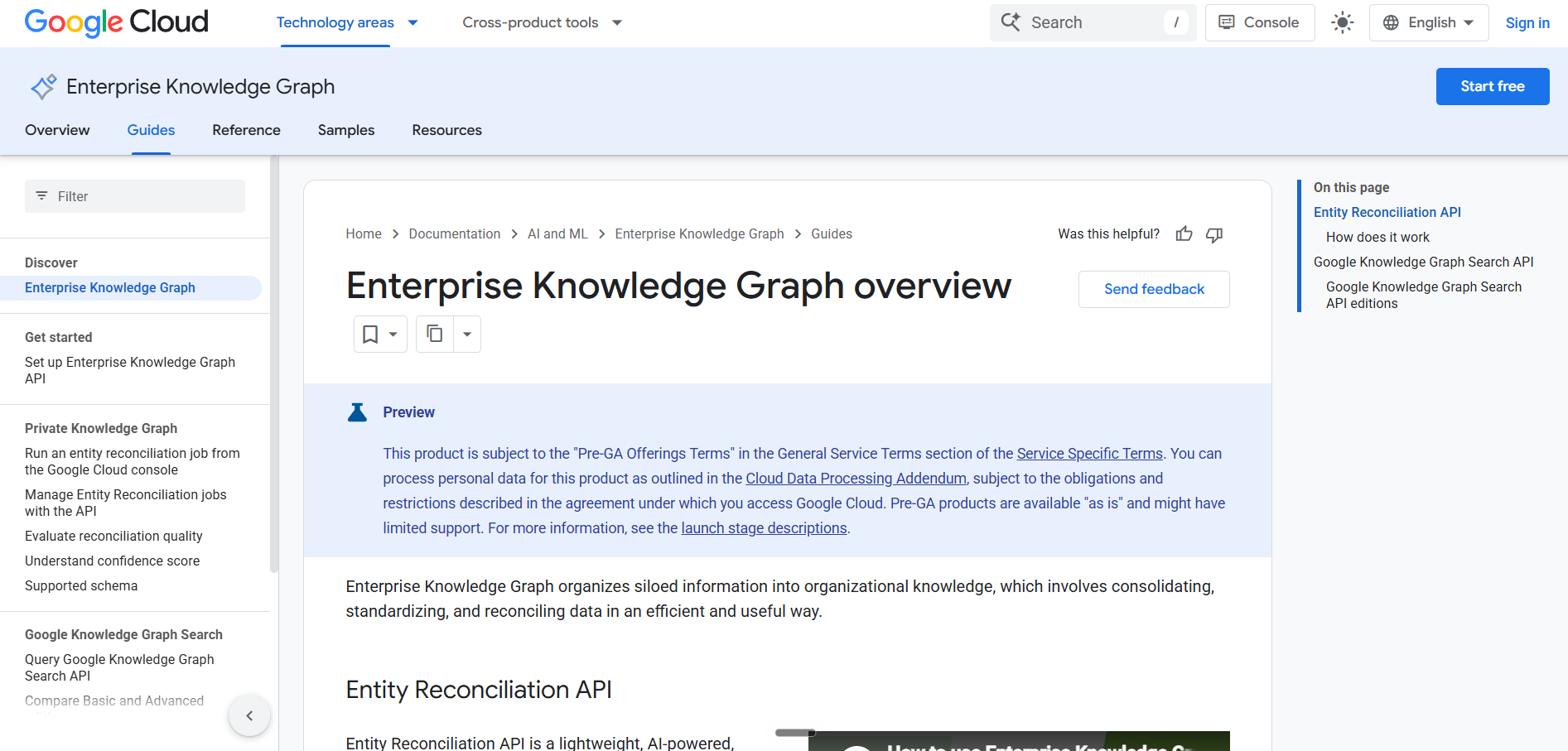
Google Enterprise Knowledge Graph helps organizations reconcile entities across multiple systems to improve search, enrichment, and master data consistency within Google Cloud environments.
Key features
-
Entity reconciliation: Matches duplicate entities across systems.
-
Data enrichment: Improves entity completeness.
-
Relationship mapping: Connects related business entities.
-
Cloud integration: Works with Google Cloud services.
-
Scalable processing: Handles large enterprise datasets.
Best for
Organizations focused on entity resolution within Google Cloud.
Pros
-
Strong entity matching.
-
Native Google Cloud integration.
-
Scalable architecture.
Cons
-
Limited governance capabilities.
-
Best suited for Google Cloud users.
8. Amazon Neptune
Amazon Neptune is a fully managed graph database service that supports both RDF and property graph models for cloud-native graph applications.
Key features
-
Dual graph models: Supports RDF and property graphs.
-
Managed service: Eliminates infrastructure management.
-
AWS integration: Connects with AWS analytics and AI services.
-
High availability: Built for enterprise-scale workloads.
-
Secure deployment: Integrates with AWS security services.
Best for
Organizations building graph applications within AWS.
Pros
-
Fully managed service.
-
Supports multiple graph models.
-
Tight AWS ecosystem integration.
Cons
-
Governance requires additional platforms.
-
Optimized primarily for AWS environments.
9. AllegroGraph
AllegroGraph is an RDF graph database designed for semantic reasoning, temporal analytics, and complex knowledge graph applications that require advanced relationship analysis.
Key features
-
Temporal reasoning: Models relationships over time.
-
Entity-event graphs: Connects entities with historical events.
-
Semantic inference: Supports ontology-based reasoning.
-
Knowledge graph analytics: Explores complex graph relationships.
-
RDF support: Uses semantic web standards.
Best for
Research-intensive industries such as healthcare, finance, and life sciences.
Pros
-
Advanced semantic analytics.
-
Strong temporal capabilities.
-
Mature RDF platform.
Cons
-
Steeper implementation effort.
-
Requires specialized expertise.
10. PoolParty Semantic Suite
PoolParty Semantic Suite is an enterprise semantic graph platform that helps organizations build and manage taxonomies, ontologies, and knowledge graphs. It combines semantic modeling with AI-ready knowledge management to improve enterprise search, content enrichment, and information discovery.
Key features
-
Taxonomy management: Creates and maintains controlled vocabularies and classification schemes.
-
Ontology modeling: Builds semantic relationships between business concepts and entities.
-
Knowledge graph creation: Connects structured and unstructured data into a unified semantic graph.
-
Semantic enrichment: Automatically tags and enriches content using AI and NLP.
-
Enterprise search integration: Improves search relevance with semantic context.
Best for
Organizations implementing semantic search, knowledge management, and ontology-driven AI applications.
Pros
-
Comprehensive semantic management capabilities.
-
Strong support for enterprise search.
-
Built for ontology-driven knowledge graphs.
Cons
-
Requires semantic modeling expertise.
-
Less focused on end-to-end data governance than governance-led platforms.
How knowledge graph tools support AI and governance
Knowledge graph tools organize business knowledge into connected, machine-readable context that improves how people and AI discover, understand, and use enterprise information. Their impact extends across industries.
According to the ZipDo Education Report 2026, 62% of organizations use knowledge graphs to integrate electronic health records (EHRs) and clinical trial data, reducing time-to-treatment by 20%.
This demonstrates how connecting data with business context can improve operational efficiency and accelerate better decision-making in data-intensive environments.
-
Improve AI applications: Connect entities, definitions, relationships, and metadata to strengthen GraphRAG, semantic search, and AI assistants.
-
Strengthen data governance: Link glossary terms, lineage, ownership, quality, certification, and policies across enterprise assets.
-
Enhance analytics: Connect approved metrics with source data, definitions, and trusted reports to improve consistency.
-
Support compliance: Trace sensitive data, applicable policies, permissions, and accountability across systems.
As AI agents become consumers of governance, these connections help turn existing governance assets into context that AI can retrieve and apply.
How to choose the best knowledge graph tool
Selecting the right knowledge graph tool starts with understanding your business objectives rather than comparing features alone. Use the following considerations to evaluate which platform best aligns with your organization's AI, analytics, and governance requirements.
1. Start with the business use case
Identify the primary problem you want to solve. Whether your goal is AI readiness, GraphRAG, semantic search, data governance, compliance, or graph analytics, the right platform should align with that specific use case.
2. Match the tool type to your users and graph model
Consider who will use the platform and the type of graph it supports. Governance teams may benefit from metadata graph platforms, while developers and semantic engineers may require graph databases or RDF-based semantic platforms.
3. Check governance, lineage, and trust capabilities
Evaluate whether the platform connects business glossary, metadata, lineage, ownership, quality, privacy, and governance policies. These capabilities are essential for building trusted enterprise AI and analytics.
Understanding how data lineage provides end-to-end visibility into data movement can also help you assess a platform's impact analysis, governance, and compliance capabilities.
4. Evaluate AI readiness and enterprise integrations
Look for support for AI use cases such as GraphRAG, semantic search, and AI assistants, along with integrations across data warehouses, lakes, BI tools, SaaS applications, and enterprise data platforms.
5. Compare implementation effort, support, and total cost
Assess deployment options, implementation complexity, vendor support, scalability, and pricing. Choose a platform that can grow with your governance maturity while supporting future AI initiatives.
Organizations making this investment also evaluate the data catalog ROI to understand how metadata and governance initiatives improve data discovery, operational efficiency, and AI readiness over time.
Should you extend your existing graph database?
Many organizations already use graph databases such as Neo4j or Amazon Neptune for operational applications. The decision is often whether to expand the graph or complement it with a governed metadata platform.
Extend your graph database when:
-
Your focus is graph applications and relationship traversal.
-
Developers are the primary users.
-
Governance is managed through separate tools.
Add a governed metadata platform when:
-
AI needs trusted business definitions and context.
-
Business glossary, lineage, ownership, and quality must stay connected.
-
Multiple AI and analytics use cases require consistent, governed knowledge.
For many enterprises, the best approach is to use both. The graph database powers graph applications, while a governed metadata platform delivers trusted enterprise context for analytics, AI assistants, GraphRAG, and governance.
Future trends: How AI agents will consume knowledge graphs
Knowledge graphs are evolving from supporting search and analytics to providing operational context for AI agents. As enterprise AI adoption grows, AI agents will consume knowledge graphs differently from traditional users.
|
Consumer |
Primary use |
|
BI tools |
Discover trusted reports, metrics, and relationships |
|
Enterprise search |
Improve relevance, connect related content, and resolve entities |
|
AI agents |
Retrieve business definitions, validate lineage, apply governance policies, and use trusted enterprise context during reasoning |
As AI agents become embedded in enterprise workflows, knowledge graphs will increasingly serve as machine-readable context rather than simply connected data. Combining graph technologies with governed metadata helps deliver trusted, explainable, and policy-aware context for enterprise AI.
Conclusion
Knowledge graph tools support different enterprise needs. Graph databases are suited to connected applications, semantic platforms support ontology and reasoning, and governed metadata platforms help organizations establish trusted context for analytics and AI.
The right choice depends on the use case, information assets, users, governance maturity, and deployment requirements. For data-centric AI, connected data alone is insufficient. AI systems also need approved definitions, lineage, quality, ownership, policies, and permissions so they can retrieve and use enterprise information responsibly.
While evaluating platforms, focus on whether the tool can turn enterprise knowledge into governed, machine-usable context.

 Book an OvalEdge Data Governance demo to see how governed metadata, lineage, and business context create a trusted foundation for enterprise AI.
.png?width=1081&height=173&name=Forrester%201%20(1).png)
.png?width=1081&height=241&name=KC%20-%20Logo%201%20(1).png)