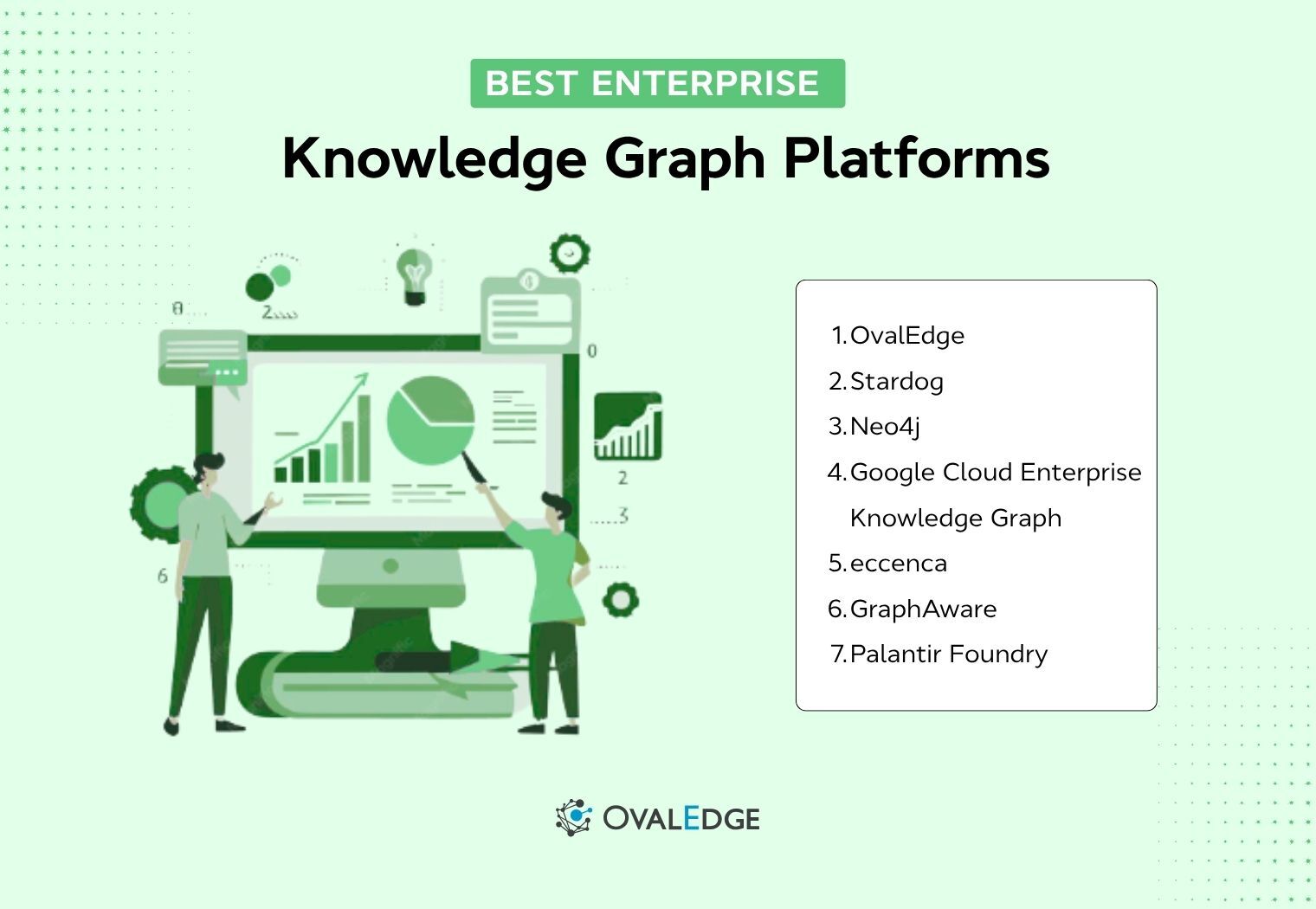
Enterprise knowledge graph platforms connect business entities, relationships, and governed context so AI systems can reason with richer enterprise knowledge instead of isolated data. Adoption is accelerating as organizations deploy AI agents, GraphRAG, and semantic search. Data silos and integration complexity, however, remain the biggest barriers to making connected knowledge effective.
Connected relationships alone are not enough. AI systems also need trusted business definitions, ownership, lineage, quality, and governance to determine which information they can rely on.
The challenge is no longer simply connecting enterprise knowledge. It is making that knowledge governed, explainable, and ready for AI. Enterprise knowledge graph platforms address this challenge in different ways. Some specialize in semantic modeling and graph databases, while others extend connected knowledge with governed business context for enterprise AI.
The guide below compares leading platforms and explains how to choose the right solution for your AI and governance strategy.
Why enterprises are adopting knowledge graph platforms for AI
Enterprise AI depends on more than connected data. It needs connected business context to understand how customers, products, suppliers, policies, and business processes relate to one another. Traditional databases and search systems store information efficiently, but they rarely capture these relationships or the business meaning behind them.
As organizations deploy AI agents, GraphRAG, and semantic search, the role of knowledge graphs is expanding.
Gartner press release in 2025 predicts that 40% of enterprise applications will feature task-specific AI agents by the end of 2026, up from less than 5% in 2025.
As more enterprise applications begin relying on agents to perform tasks and make decisions, those agents need connected business context they can retrieve and reason over.
Knowledge graphs help provide that context by connecting enterprise entities, relationships, and business concepts. They are becoming part of the context AI uses to reason, retrieve information, and explain its decisions.
OvalEdge perspective: Enterprise AI does not replace data governance. It changes the consumer of governance. The catalogs, glossaries, lineage, and policies that once helped human users must now become machine-readable context that analytical AI applications can retrieve and apply.
Data lineage is one of the trust signals that makes connected knowledge usable for AI. It shows where information originated, how it changed, and whether it can be relied on for analytics and decision-making.
Organizations are investing in enterprise knowledge graph platforms to:
-
Connect fragmented enterprise data across applications, databases, documents, and APIs.
-
Resolve duplicate entities to create a consistent view of customers, products, suppliers, and business assets.
-
Improve GraphRAG and semantic search by combining connected relationships with business context.
-
Enable multi-hop reasoning across complex enterprise processes.
-
Strengthen AI governance with lineage, ownership, quality, and policy controls.
As AI adoption accelerates, knowledge graphs are evolving from relationship modeling tools into a key component of a broader enterprise context strategy.
What capabilities should an enterprise knowledge graph platform provide?
Enterprise knowledge graph platforms vary widely in their strengths. Some focus on semantic modeling, others on graph analytics or AI, while governance capabilities also differ significantly. Before comparing vendors, evaluate whether the platform provides these core capabilities.
-
Semantic modeling and ontology management: Represent business concepts and relationships using RDF, OWL, property graphs, or hybrid models.
-
Data integration and entity resolution: Connect enterprise data across systems while creating a unified view of business entities.
-
Search, query, and retrieval: Support graph traversal, semantic search, APIs, and hybrid retrieval for AI applications.
-
Governance, lineage, and security: Provide ownership, lineage, quality monitoring, policy enforcement, and auditability.
-
AI and enterprise integration: Integrate with GraphRAG, AI agents, data catalogs, governance platforms, and analytics tools.
OvalEdge expert insight: Selecting a knowledge graph platform is no longer only about graph technology. Enterprises should evaluate how well the platform delivers governed context that AI systems can understand, trust, and explain.
How enterprise knowledge graph platforms power AI
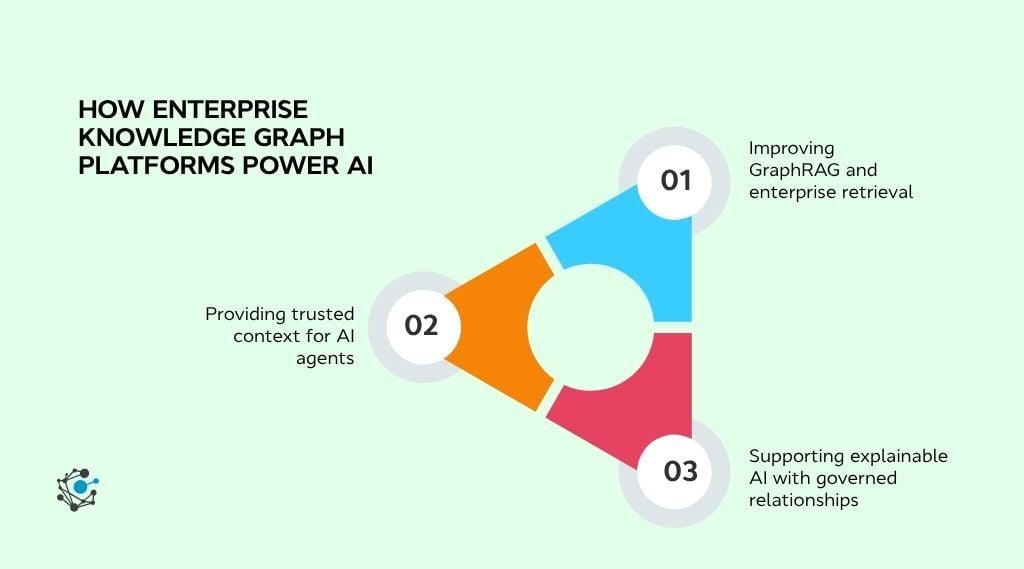
Enterprise knowledge graph platforms improve AI by connecting data with business relationships and context. Instead of retrieving isolated documents, AI can understand how people, products, contracts, policies, and business processes relate to one another. This enables more accurate retrieval, better reasoning, and greater transparency across enterprise AI applications.
1. Improving GraphRAG and enterprise retrieval
GraphRAG combines vector search with graph relationships to retrieve information that is both relevant and connected. While vector search finds documents with similar meaning, the knowledge graph identifies how entities relate across the enterprise.
For example, if an AI assistant is asked, "Which customers will be affected if Supplier X experiences a disruption?", GraphRAG can traverse relationships between suppliers, products, manufacturing sites, contracts, and customers to produce a complete answer instead of returning unrelated documents.
The result is more accurate retrieval for supply chain analysis, regulatory investigations, and enterprise search.
2. Providing trusted context for AI agents
AI agents need more than connected data. They also need business context to understand which information is accurate and trustworthy. A knowledge graph provides relationships, while governed metadata adds business definitions, ownership, lineage, quality, and access policies.
This need is becoming more urgent as enterprises move AI agents into operational workflows.
Gartner predicts that by 2027, 40% of enterprises will demote or decommission autonomous AI agents because of governance gaps identified only after production incidents.
This highlights why AI systems need governance and trust signals alongside the connected information they retrieve.
For instance, when an analyst asks an AI agent for Annual Recurring Revenue (ARR), the agent can retrieve the approved definition from a business glossary, identify the certified dataset, verify its lineage, and use only authorized data.
This helps ensure business terms are interpreted consistently while reducing inconsistent answers and improving confidence in AI-generated insights.
3. Supporting explainable AI with governed relationships
Enterprise AI must be able to explain how it arrived at a recommendation or decision. Knowledge graphs improve explainability by exposing the relationships between entities and linking answers back to their supporting sources.
For example, if an AI system flags a customer as high risk, users can trace the decision through connected entities such as payment history, contract status, regulatory records, and supplier relationships.
When these relationships are supported by lineage, ownership, and governance, organizations can validate AI outputs more easily and satisfy audit and compliance requirements.
Enterprise knowledge graph platform comparison
Enterprise knowledge graph platforms approach connected data from different perspectives. Some specialize in semantic modeling and ontology management, while others focus on graph-native application development, operational intelligence, or governed enterprise metadata. The right choice depends on whether your priority is AI, governance, entity resolution, or graph engineering.
|
Platform |
Primary strength |
Graph approach |
Governance |
AI support |
|
OvalEdge |
Governed context for analytical AI |
Metadata-driven context graph |
High |
Excellent |
|
Stardog |
Semantic knowledge graphs |
RDF and OWL |
High |
Excellent |
|
Neo4j |
Graph database and analytics |
Property graph |
Moderate |
Excellent |
|
Google Cloud Enterprise Knowledge Graph |
Managed entity resolution |
Managed enterprise graph |
Moderate |
High |
|
eccenca |
Semantic knowledge automation |
RDF and knowledge graph |
High |
High |
|
GraphAware |
Relationship intelligence |
Property graph |
Moderate |
High |
|
Palantir Foundry |
Operational ontology |
Ontology-driven platform |
High |
Excellent |
1. OvalEdge: AI-ready governed business context
OvalEdge is a data governance platform that helps enterprises connect and activate their existing governed data foundation for analytical AI. It brings together data cataloging, business glossary, lineage, data quality, privacy, certification, ownership, and governance policies into the Enterprise Context Graph, a connected, governed set of data artifacts that analytical AI applications can query using natural language.
Key features
-
Automated metadata discovery: Crawls metadata from 170+ enterprise data sources to populate a centralized repository.
-
Business glossary: Connects business terms with technical assets to establish consistent definitions across analytics and AI.
-
End-to-end data lineage: Visualizes data movement across systems for impact analysis, compliance, and explainability.
-
Data quality and certification: Combines quality scoring, sensitive data discovery, and certification to build confidence in enterprise data.
-
Governed AI context: Delivers governed metadata, lineage, ownership, and policy signals that analytical AI applications like forecasting, risk analysis, and financial reporting can retrieve and apply.
Best fit: Enterprises with an existing data governance foundation that need to connect governed metadata, lineage, and business context for analytical AI, forecasting, compliance, and enterprise analytics.
How OvalEdge approaches enterprise context
Most knowledge graph platforms focus on modeling and querying relationships across data. OvalEdge takes a different starting point: the governed data foundation an enterprise has already built through its data governance programs.
Rather than requiring organizations to construct an entirely new context layer, OvalEdge connects existing definitions, lineage, quality scores, ownership, and access policies into governed context that analytical AI applications can retrieve with business meaning already attached.
With automated metadata discovery, configurable workflows, and modular deployment, organizations can extend governance into machine-readable context without replacing existing data platforms.
Organizations building governed AI architectures can also explore how a context layer for AI agents delivers trusted business context during AI retrieval and reasoning.
2. Stardog
Stardog is an enterprise knowledge graph platform that helps organizations integrate, model, and query connected enterprise data using semantic web standards. It combines graph technology, virtual knowledge graphs, and reasoning capabilities to support AI, data integration, and semantic search without requiring organizations to move all their data into a single repository.
Key features
-
Knowledge graph virtualization: Connects distributed data sources without physically replicating data.
-
Ontology management: Supports RDF, OWL, and SPARQL for building and managing semantic models.
-
Reasoning engine: Infers new relationships and insights using semantic reasoning.
-
Enterprise data integration: Combines structured and unstructured data into a unified semantic layer.
-
AI and GraphRAG support: Provides semantic context for enterprise search, retrieval, and AI applications.
Pros
-
Strong semantic modeling and reasoning capabilities
-
Supports open semantic web standards
-
Suitable for complex enterprise knowledge graphs
Cons
-
Requires expertise in semantic technologies such as RDF, OWL, and SPARQL
-
Governance capabilities are less comprehensive than dedicated metadata governance platforms
Best fit: Enterprises building semantic knowledge graphs for complex data integration, reasoning, and AI applications.
3. Neo4j
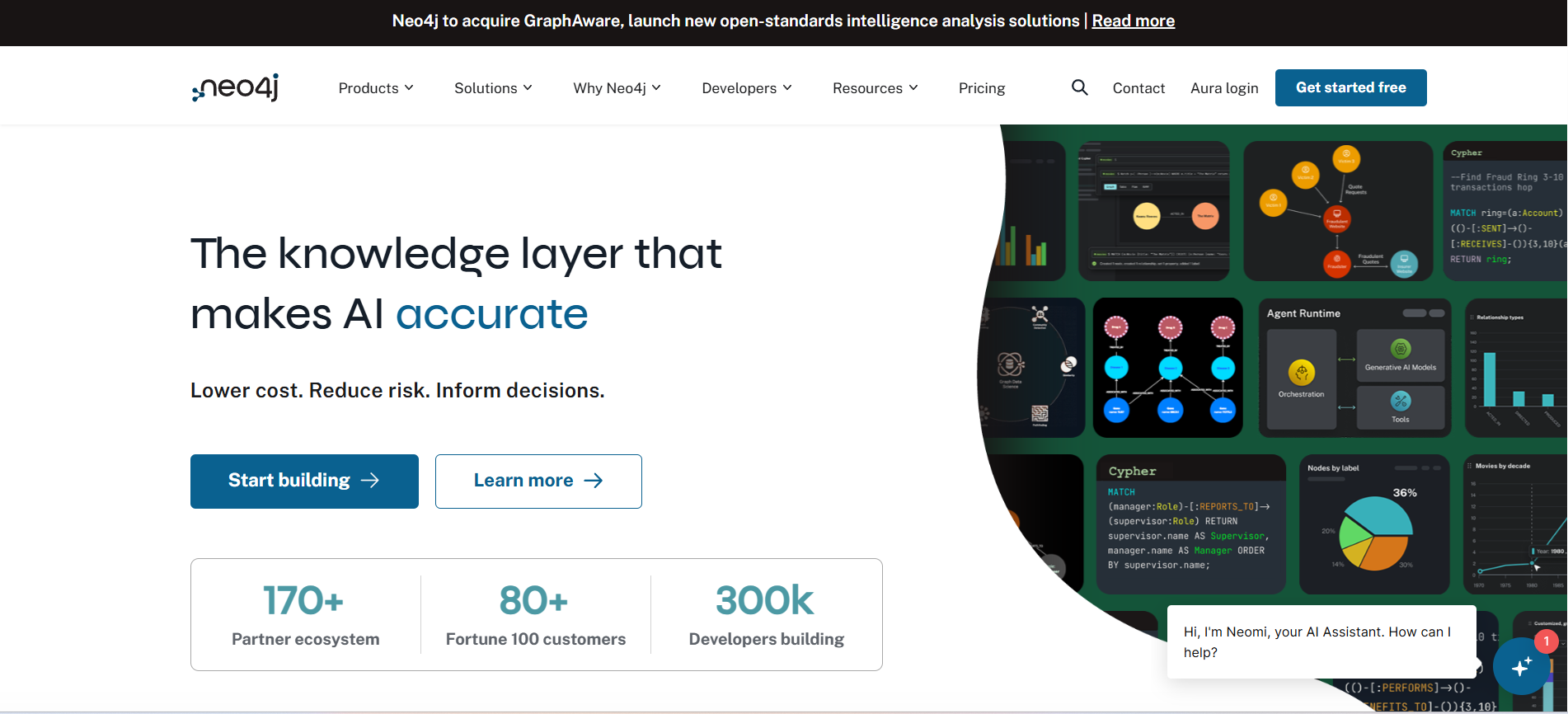
Neo4j is a native graph database platform designed to store, query, and analyze highly connected data. Using a property graph model and the Cypher query language, it enables organizations to build knowledge graphs, detect complex relationships, and support graph-powered AI, fraud detection, recommendations, and network analysis.
Key features
-
Native property graph database: Optimized for storing and querying connected data at scale.
-
Cypher query language: Simplifies graph queries for exploring complex relationships.
-
Graph Data Science library: Provides built-in algorithms for link prediction, recommendations, community detection, and similarity analysis.
-
Knowledge graph development: Supports the creation of enterprise knowledge graphs for AI and analytics.
-
Enterprise scalability: Offers clustering, security, and high availability for production deployments.
Pros
-
Industry-leading graph database performance
-
Mature ecosystem with extensive developer support
-
Rich graph analytics and data science capabilities
Cons
-
Requires additional tools for metadata governance, lineage, and business glossary management
-
Property graph model may require integration with semantic technologies for standards-based interoperability
Best fit: Enterprises building high-performance knowledge graph applications, graph analytics, and AI solutions that rely on complex relationship analysis.
4. Google Cloud Enterprise Knowledge Graph
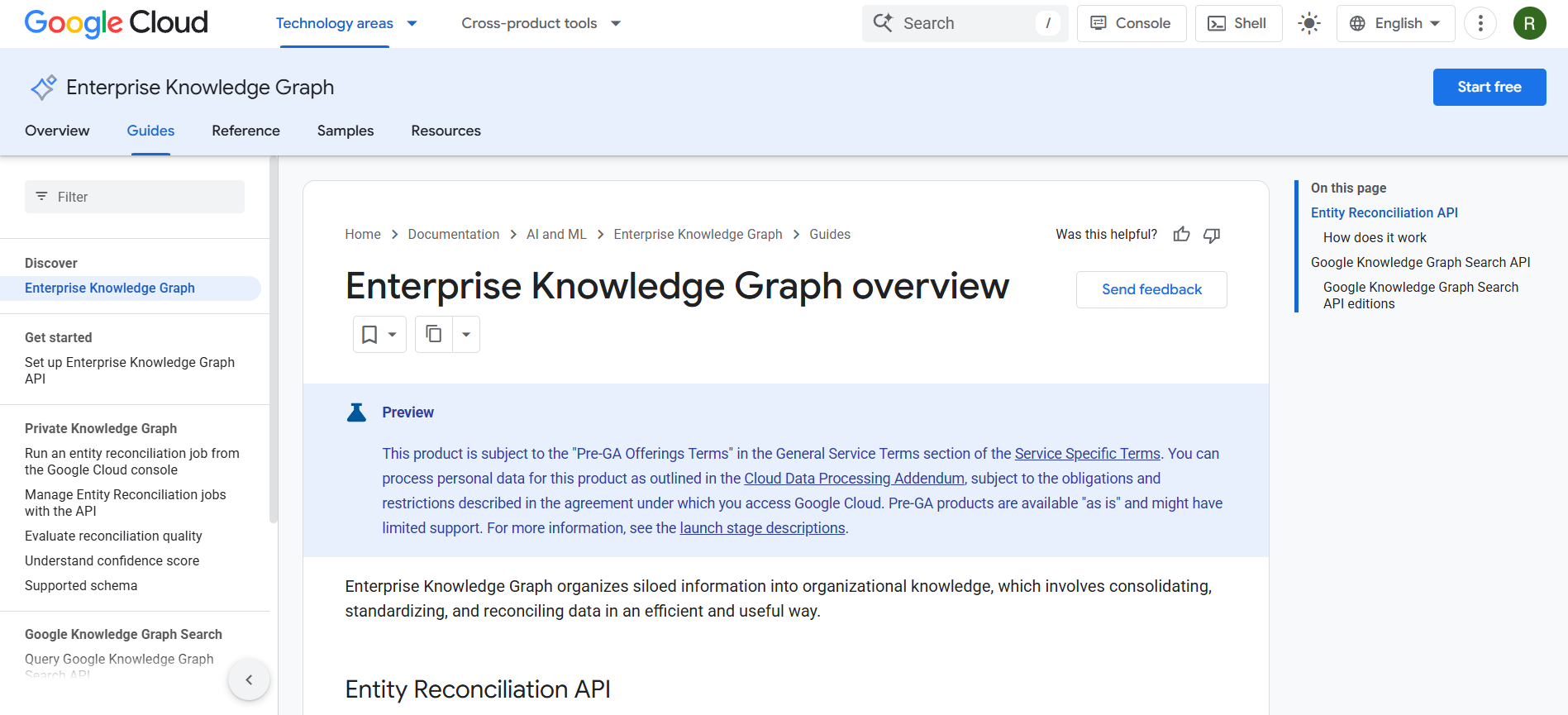
Google Cloud Enterprise Knowledge Graph helps organizations unify enterprise data and external knowledge into a connected graph for AI-powered search, recommendations, and intelligent applications. As a managed cloud service, it integrates with the Google Cloud ecosystem to simplify knowledge graph deployment and maintenance.
Key features
-
Managed knowledge graph service: Reduces infrastructure management with a fully managed cloud offering.
-
Entity resolution: Connects related entities across multiple enterprise and external data sources.
-
Google Cloud integration: Works with BigQuery, Vertex AI, and other Google Cloud services.
-
Semantic search: Improves enterprise search by understanding relationships between entities and concepts.
-
AI-ready foundation: Supports AI applications with connected enterprise knowledge and contextual relationships.
Pros
-
Fully managed cloud service with minimal operational overhead
-
Strong integration with the Google Cloud ecosystem
-
Simplifies enterprise search and AI use cases
Cons
-
Best suited for organizations invested in Google Cloud
-
Less focused on enterprise metadata governance, lineage, and business glossary capabilities
Best fit: Organizations using Google Cloud to build AI-powered search, connected data experiences, and knowledge-driven applications.
5. eccenca
eccenca is a semantic data management platform that enables organizations to build, manage, and govern enterprise knowledge graphs. It combines semantic technologies, data integration, and ontology management to support AI, master data management, and enterprise data interoperability.
Key features
-
Knowledge graph management: Builds and manages enterprise knowledge graphs using semantic web standards.
-
Ontology and vocabulary management: Supports RDF, OWL, SKOS, and SPARQL for semantic modeling.
-
Semantic data integration: Connects and harmonizes data from multiple enterprise sources.
-
Data quality and validation: Improves data consistency through validation rules and semantic enrichment.
-
Enterprise AI support: Provides semantic context for AI, GraphRAG, and knowledge-driven applications.
Pros
-
Strong support for semantic web standards
-
Comprehensive ontology and vocabulary management
-
Combines knowledge graphs with semantic data integration
Cons
-
Requires expertise in semantic technologies and knowledge graph modeling
-
Metadata governance capabilities are not as extensive as dedicated enterprise governance platforms
Best fit: Organizations building semantic knowledge graphs for enterprise data integration, interoperability, and AI applications.
6. GraphAware
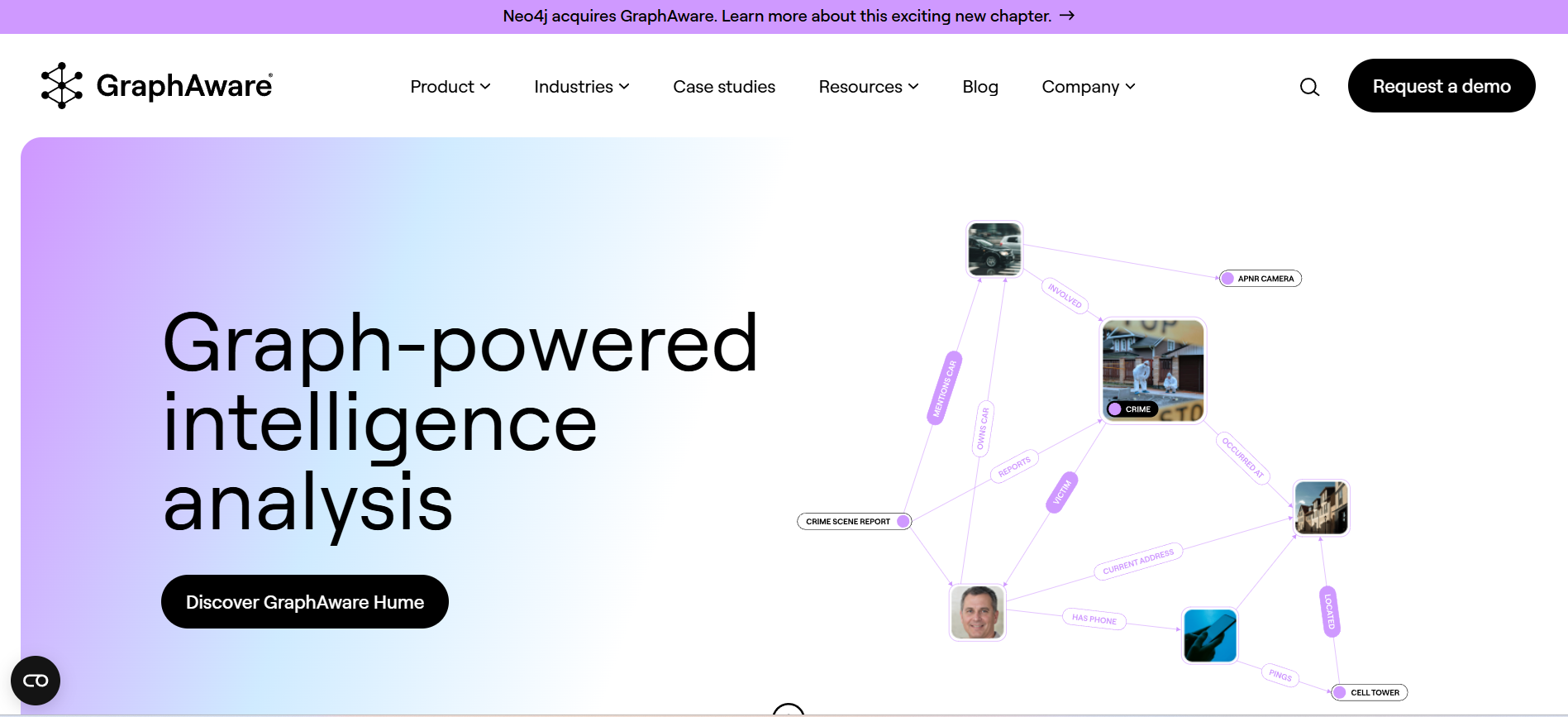
GraphAware is a graph technology platform that helps organizations build graph-powered applications using relationship analytics, knowledge graphs, and graph data science. Built on Neo4j, it provides frameworks and solutions for fraud detection, recommendations, network analysis, and enterprise AI use cases.
Key features
-
Graph analytics: Identifies hidden relationships and patterns across connected data.
-
Knowledge graph development: Supports the design and deployment of enterprise knowledge graph solutions.
-
Graph Data Science integration: Leverages graph algorithms for recommendations, anomaly detection, and link analysis.
-
Neo4j ecosystem support: Extends Neo4j with enterprise frameworks, tools, and consulting expertise.
-
AI-powered relationship intelligence: Enables graph-driven insights for search, decision-making, and intelligent applications.
Pros
-
Strong expertise in graph analytics and relationship intelligence
-
Deep integration with the Neo4j ecosystem
-
Well-suited for graph-powered AI and advanced analytics
Cons
-
Relies on Neo4j for core graph database capabilities
-
Not designed as a comprehensive enterprise metadata governance platform
Best fit: Organizations using Neo4j to build knowledge graph applications, graph analytics, and AI solutions that depend on relationship intelligence.
7. Palantir Foundry
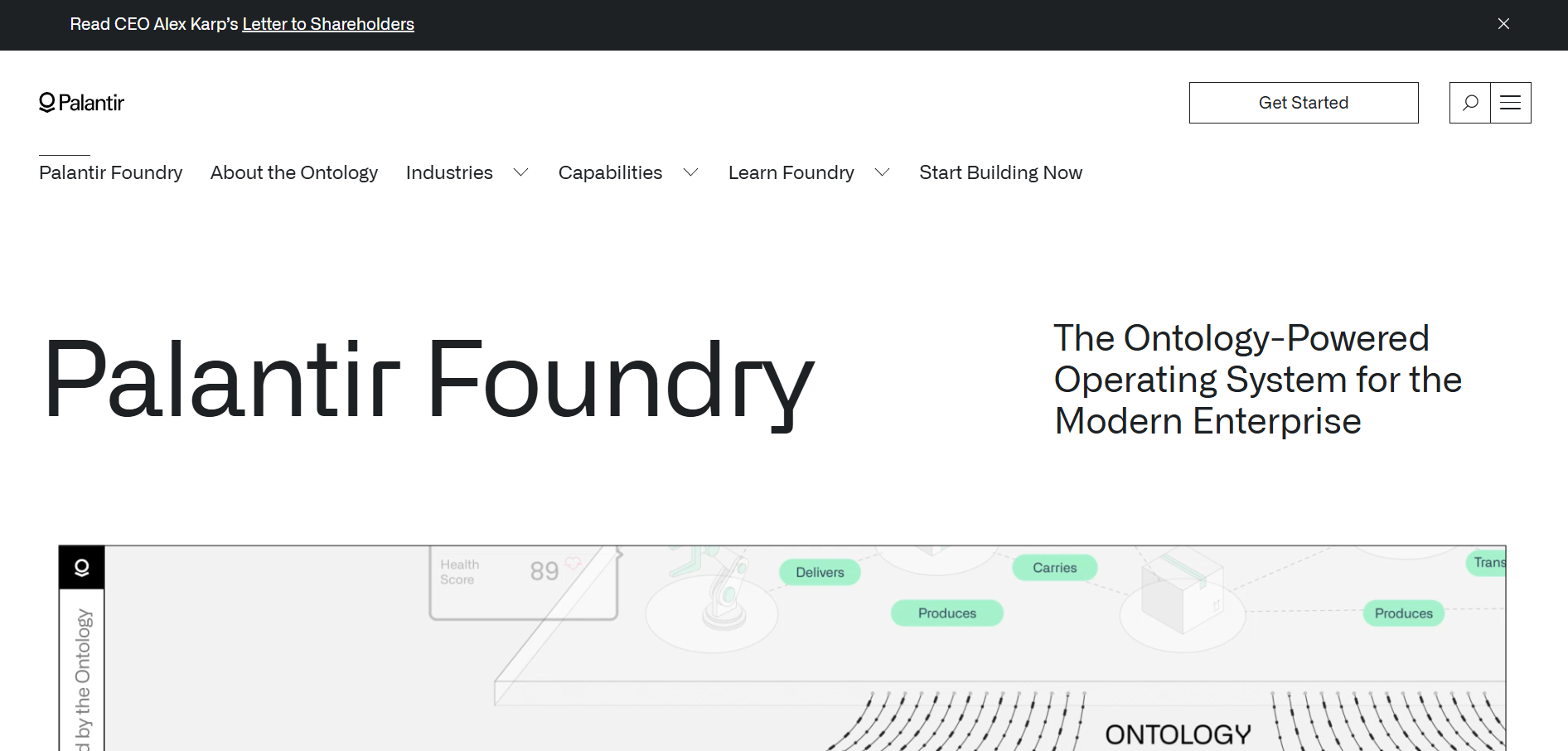
Palantir Foundry is an enterprise data platform that combines data integration, analytics, AI, and an operational ontology to help organizations model business entities, relationships, and processes. It enables organizations to build digital twins, operational applications, and AI-driven decision support across complex enterprise environments.
Key features
-
Operational ontology: Models business objects, relationships, and workflows to provide a shared operational view.
-
Enterprise data integration: Connects and transforms data from diverse enterprise systems.
-
AI and decision intelligence: Supports AI applications with contextual business models and operational insights.
-
Low-code application development: Enables users to build operational applications on top of the ontology.
-
Governance and security: Provides role-based access control, auditing, and enterprise-grade security.
Pros
-
Combines ontology, analytics, AI, and operational workflows in a single platform
-
Strong support for complex enterprise and mission-critical use cases
-
Comprehensive data integration and application development capabilities
Cons
-
Implementation can be complex and resource-intensive
-
Higher cost and broader platform scope than organizations may need for standalone knowledge graph initiatives
Best fit: Large enterprises seeking an integrated platform for operational intelligence, enterprise AI, digital twins, and ontology-driven decision-making.
Build vs. buy an enterprise knowledge graph platform
The choice between building and buying depends on your resources, timeline, and business goals. Here's how the two approaches compare.
|
Evaluation area |
Build internally |
Buy a platform |
|
Time to value |
Months or years |
Weeks or months |
|
Customization |
Complete flexibility |
Configuration-based |
|
Technical expertise |
Requires graph and ontology experts |
Minimal specialist skills needed |
|
Data integration |
Build custom connectors |
Prebuilt connectors available |
|
Governance |
Build separately |
Built into the platform |
|
AI readiness |
Custom AI integrations |
Native AI and GraphRAG support |
|
Maintenance |
Managed internally |
Vendor-managed |
|
Scalability |
Design and scale yourself |
Enterprise-ready out of the box |
|
Total cost |
Higher long-term engineering cost |
Predictable licensing and support costs |
|
Best suited for |
Highly specialized use cases |
Faster enterprise adoption |
For most enterprises, buying a platform provides faster deployment, built-in governance, and lower operational overhead. Building is better suited for organizations with unique requirements and dedicated graph engineering expertise.
How to choose the right enterprise knowledge graph platform
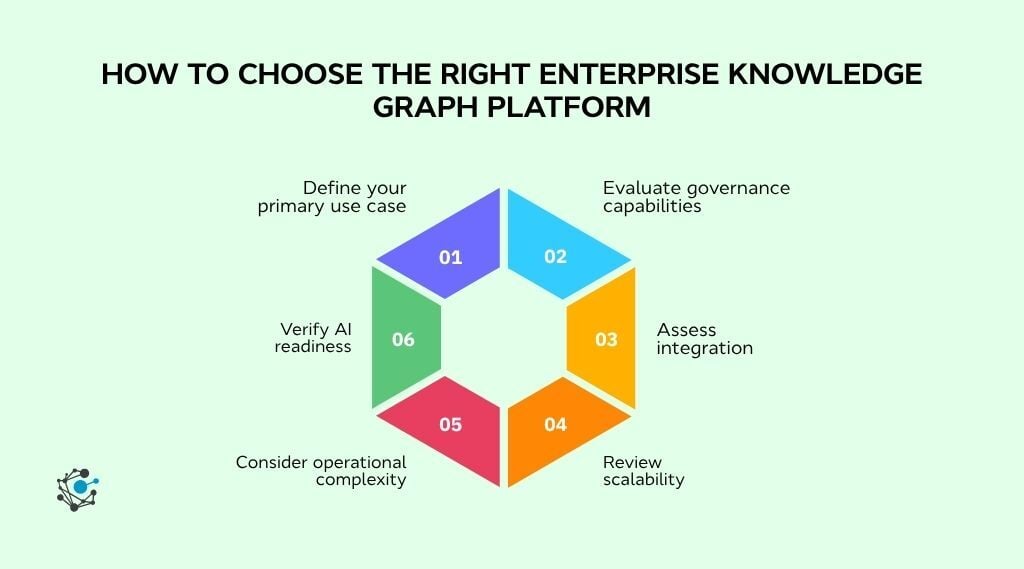
When evaluating enterprise knowledge graph platforms, consider the following:
-
Define your primary use case: Choose a platform that aligns with your goals, whether graph analytics, AI agents, GraphRAG, semantic search, or enterprise search.
-
Evaluate governance capabilities: Look for metadata management, business glossary, lineage, data quality, stewardship, and policy enforcement.
-
Assess integration: Ensure the platform connects seamlessly with your databases, cloud platforms, data warehouses, BI tools, and AI ecosystem.
-
Verify AI readiness: Prioritize support for AI agents, GraphRAG, semantic search, explainability, and permission-aware retrieval.
-
Review scalability: Confirm the platform can support enterprise-scale deployments across cloud, on-premises, or hybrid environments.
-
Consider operational complexity: Evaluate the implementation effort, required expertise, and long-term maintenance needs.
The right platform should do more than connect data. It should deliver governed business context, strong lineage, and trusted metadata that analytical AI applications need for accurate forecasting, risk analysis, and financial reporting.
Why governed metadata matters more than the graph itself
A knowledge graph shows how enterprise entities connect. Governed metadata explains what those relationships mean, whether they are trusted, and when they should be used.
The role of metadata, ontology, and lineage
Each component contributes a different layer of enterprise knowledge.
-
Metadata describes enterprise assets and their trust signals.
-
Ontology defines business concepts and relationships.
-
Lineage shows where information originated and how it changed.
Together, they help AI systems retrieve connected information with greater accuracy and explainability.
OvalEdge expert insight: Relationships alone rarely make enterprise AI trustworthy. AI agents also need approved business definitions, lineage, ownership, quality, and governance before those relationships become reliable business context.
How semantic layers and knowledge graphs work together
A semantic layer establishes consistent business definitions and metrics, while a knowledge graph connects those concepts across enterprise entities and processes.
Used together, they deliver consistent business meaning for analytics while providing the connected context needed for enterprise AI and intelligent search.
Conclusion
Enterprise knowledge graph platforms connect business entities, relationships, and context in ways that traditional data platforms cannot. For analytical AI use cases like forecasting, risk scoring, and financial analysis, these connections become especially valuable. Connected relationships alone, however, are not enough.
Analytical AI applications need governed definitions, lineage, quality, ownership, and policies attached to the data they consume. Without these trust signals, AI retrieves data without the business meaning needed to produce accurate, explainable results.
Many enterprises already have much of this governed foundation through their data governance programs. The opportunity is to connect and activate that foundation so analytical AI applications can retrieve enterprise data with the right business context in place.
OvalEdge connects this existing governed foundation through the Enterprise Context Graph, making catalog metadata, business definitions, lineage, quality scores, ownership, and access policies available as machine-readable context for analytical AI.
Book a data governance demo to see how your existing governance investment can power trusted, explainable analytical AI.
.png?width=1081&height=173&name=Forrester%201%20(1).png)
.png?width=1081&height=241&name=KC%20-%20Logo%201%20(1).png)