.jpg)
Enterprise data problems rarely start with a lack of data. They start when different teams define the same data differently. A customer, product, policy, asset, transaction, or revenue metric may mean one thing in finance and another in marketing, operations, or compliance.
This becomes riskier with AI. An enterprise ontology platform helps solve this by defining shared business meaning, modeling relationships, and connecting terms to trusted data assets.
In this blog, we explain how enterprise ontology platforms work, what features to evaluate, which tools to compare, and how enterprises can implement ontology management for AI-ready governance.
What is an enterprise ontology platform?
An enterprise ontology platform is software that helps organizations define, manage, and govern business concepts, entities, relationships, rules, and meanings across the business. It creates a shared knowledge model so data teams, business users, BI tools, semantic layers, knowledge graphs, and AI agents can understand enterprise data in the same way.
An enterprise ontology platform helps us:
-
Define business concepts such as customer, product, revenue, asset, risk, and policy.
-
Map relationships between business terms, data assets, owners, systems, and rules.
-
Build a governed context graph for analytics, compliance, and AI.
-
Reduce confusion caused by inconsistent definitions.
-
Give AI agents trusted business context.
A glossary and an ontology are related, but they are not the same. A business glossary defines approved terms. An ontology defines terms, relationships, rules, hierarchies, and context.
At OvalEdge, we believe The most common mistake is treating a glossary as if it were an ontology. A glossary names the terms. An ontology connects them to the data, rules, and relationships that make those terms usable.
For example, a glossary may define “customer.” An ontology connects “customer” to account, transaction, consent status, region, product, revenue, support ticket, and risk score. That connection helps teams understand not only what the term means, but also how it affects reporting, governance, analytics, and AI outputs.
Why enterprises need ontology management for AI
Enterprises need ontology management because business meaning often gets fragmented across departments, reports, platforms, and AI systems.
IBM reports that 45% of business leaders see concerns about data accuracy or bias as a leading barrier to scaling AI initiatives. Without a shared knowledge model, teams may use the same term in different ways, calculate metrics differently, and make decisions from inconsistent context.
AI makes this more urgent because AI agents need more than access to data. They need to understand what the data means, which definitions are approved, which sources are trusted, and which policies apply before they generate an answer or support a decision.
OvalEdge expert view: AI agents need governed meaning, not ontology by default. If meaning breaks at definitions, we start with a business glossary. If it breaks at categorization, we start with taxonomy. If it breaks at relationships, rules, constraints, safety, or regulatory logic, ontology becomes core infrastructure. The goal is to choose the layer where meaning actually breaks.
The challenge usually shows up in a few common ways:
-
Different teams define the same business concept differently.
-
BI dashboards show conflicting numbers for the same metric.
-
Data catalogs list assets without enough business context.
-
AI tools return inaccurate answers when terms are unclear.
-
Compliance teams lack clear ownership, lineage, and policy context.
-
Business users struggle to find data in the language they use every day.
For example, a global bank found that "high-risk counterparty" meant different things across sanctions screening, PEP lists, and transaction monitoring. Each team flagged different entities, creating blind spots in compliance reporting. Standardizing the term through ontology management gave every system and every AI workflow the same governed definition.
For AI agents, ontology acts as a business meaning layer. It helps AI systems understand key relationships before using enterprise data:
|
Relationship AI needs to understand |
Example |
|
Approved metric |
Which revenue definition should be used in executive reporting |
|
Trusted dataset |
Which customer table has been certified for analytics |
|
Business domain |
Whether a term belongs to finance, marketing, risk, or operations |
|
Policy context |
Which privacy rule applies to sensitive customer data |
|
Source selection |
Which system should answer a specific business question |
This is where ontology connects directly to data governance, data literacy, and data quality. Data governance sets controls around data and AI use. Data literacy helps teams understand and use governed terms. Data quality confirms whether the assets connected to those terms are accurate, complete, and fit for use.
What are the core features to look for in an enterprise ontology platform?
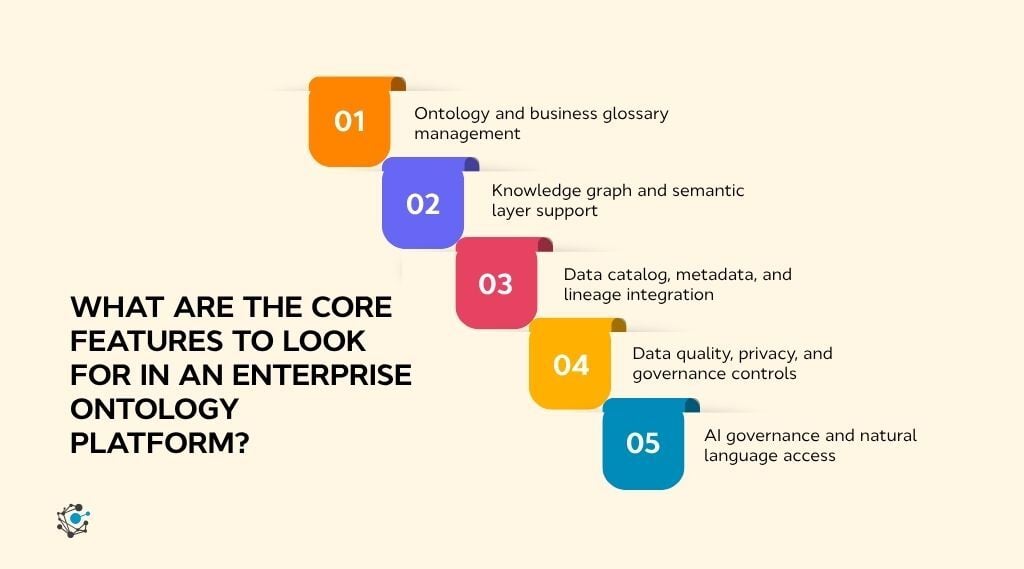
An enterprise ontology platform should not work as a separate modeling tool. It should connect business meaning to real data assets, metadata, lineage, quality rules, policies, certified assets, and AI workflows.
1. Ontology and business glossary management
The platform should help us define business concepts, entities, relationships, rules, and approved terms in one governed place. Strong business glossary support should include synonyms, domain terms, metric definitions, owners, and approval workflows.
For example, a hospital network discovered that "readmitted patient" used a 30-day window in CMS reporting, a 15-day window in internal quality dashboards, and no fixed window in finance. Governing the term through a shared ontology gave clinical, compliance, and finance teams one approved definition tied to its source data.
This becomes the foundation for shared enterprise meaning. Without it, teams may still use the same word in different ways across reports, systems, and AI prompts.
2. Knowledge graph and semantic layer support
The platform should connect concepts, assets, owners, systems, and policies through relationships. Knowledge graph and semantic layer support help us show how a customer connects to an account, transaction, product, region, risk score, or policy.
This helps BI tools and AI agents use business context instead of reading data assets as isolated tables.
3. Data catalog, metadata, and lineage integration
Ontology should connect to actual data assets through data catalog and metadata integration. Automated crawling, column mapping, table mapping, data lineage, and impact analysis show where data comes from, where it moves, and which reports it affects.
4. Data quality, privacy, and governance controls
A strong platform should connect ontology terms to data quality, trust scores, certified assets, data privacy and access controls, sensitive data classification, and governance workflows. This helps us confirm that approved terms are tied to compliant and usable data.
At OvalEdge we believe, Ontology without quality signals is incomplete. If a governed term points to a dataset with failing quality checks, the definition is correct but the data behind it is not trustworthy.
5. AI governance and natural language access
For AI use cases, the platform should connect governed datasets, model oversight, natural language search, AI assistants, and trusted business context. AI governance helps ensure AI systems use approved definitions, trusted sources, and policy-aware context instead of guessing from raw data.
With askEdgi, we can make this governed context easier for business users to access. Users can search for data, understand approved terms, and find trusted assets through natural language instead of manually checking tables, columns, and glossary entries. This helps ontology management move from a technical model to a usable layer for analytics, governance, and AI workflows.
Best enterprise ontology tools and platforms to evaluate
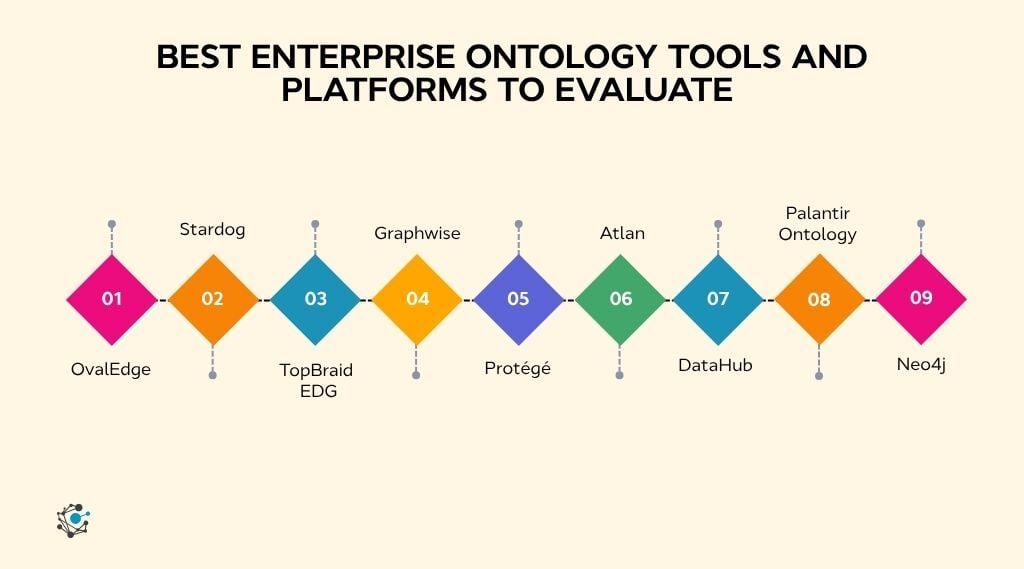
The best enterprise ontology tools do not all solve the same problem. Some are built for formal OWL and RDF ontology work. Others focus on governance, metadata, knowledge graphs, semantic AI, or operational decision-making. Use the table below to compare fit before reviewing each option.
|
Category |
Platform |
Core architecture |
Governance depth |
|
Governance and metadata |
OvalEdge |
Unified catalog, glossary, lineage, and quality connected through an Enterprise Context Graph |
Full: stewardship, classification, privacy, access controls, quality scoring, approval workflows |
|
Governance and metadata |
Atlan |
Metadata catalog with glossary, lineage, and active metadata automation |
Partial: glossary and ownership workflows; limited formal ontology modeling |
|
Governance and metadata |
DataHub |
Open-source metadata graph with discovery, lineage, and observability |
Partial: community-driven governance features; requires engineering for customization |
|
Knowledge graph and semantic AI |
Stardog |
Knowledge graph with RDF, SPARQL, data virtualization, and reasoning engine |
Limited: strong semantic modeling; glossary, stewardship, and quality workflows need separate tooling |
|
Knowledge graph and semantic AI |
Neo4j |
Native graph database with Cypher querying, vector search, and GraphRAG |
Limited: graph infrastructure only; no built-in glossary, lineage, or privacy controls |
|
Knowledge graph and semantic AI |
Graphwise |
RDF-based enterprise knowledge graph for search and analytics |
Limited: graph context layer; broader governance functions need separate assessment |
|
Ontology and taxonomy modeling |
TopBraid EDG |
OWL/RDF/SHACL ontology editor with taxonomy and vocabulary governance |
Moderate: governance workflows for semantic assets; requires semantic maturity to adopt |
|
Ontology and taxonomy modeling |
Protégé |
Open-source OWL ontology editor with reasoner support and plugin ecosystem |
None: modeling and prototyping only; no catalog, lineage, quality, or stewardship |
|
Operational ontology |
Palantir Ontology |
Object modeling with action framework and operational applications on Foundry |
Separate: platform-level security and access controls; not built for semantic governance or glossary adoption |
1. OvalEdge
OvalEdge is a unified data governance platform that connects the governed foundation enterprises need before ontology, taxonomy, or knowledge graph programs can deliver value. Rather than starting with a blank semantic model, OvalEdge connects approved business meaning, metadata, lineage, quality, privacy, and ownership into an Enterprise Context Graph, a connected, governed set of data artifacts that people and AI can query for trusted answers.
Key features:
- Governed business glossary: Standardizes terms, definitions, roles, responsibilities, and classifications so semantic models start from approved meaning.
- Connected data catalog: Brings enterprise metadata into a searchable catalog where teams can understand assets, usage, ownership, and business context.
- Automated data lineage: Maps data movement across platforms, ETL, BI, applications, and streaming systems, helping teams trace impact before terms, models, or reports change.
- Data quality and trust controls: Connects quality scoring, data access controls, classification, ownership, and governance workflows so governed metadata stays usable and accountable.
- AskEdgi for governed context access: AskEdgi lets business users ask questions, discover trusted assets, and retrieve governed context for analytical AI workflows (revenue analysis, churn prediction, demand forecasting, risk scoring) without manually checking every table, column, or glossary entry.
Why OvalEdge stands out:
OvalEdge is strongest when ontology work depends on a reliable governance base. Most enterprises already have catalog, glossary, lineage, quality, and policy controls in place. The challenge is connecting and activating that foundation so AI systems can use it. OvalEdge's governance agents help automate that connection, turning existing governance investments into trusted context for analytical AI.
Before comparing other platforms, it is worth seeing whether the core issue is ontology modeling or the governed foundation behind it.
2. Stardog
Stardog supports ontology-heavy programs where teams need semantic modeling across distributed enterprise data. It is built around a knowledge graph-powered semantic layer that connects data meaning, relationships, and AI context.
Key features:
-
Knowledge graph foundation: Represents business concepts, entities, and relationships in a semantic graph.
-
RDF and SPARQL support: Supports standards-based semantic modeling and querying.
-
Data virtualization: Connects data across warehouses, lakes, and other enterprise systems without always copying it.
-
Reasoning support: Helps infer relationships from modeled knowledge.
-
AI context layer: Gives AI systems structured business context for more reliable answers.
Things to consider:
Stardog works best when we have semantic web expertise or a team ready to build it. It may be more technical than governance-first platforms, especially when business users need simple workflows for glossary, stewardship, data quality, and privacy controls.
3. TopBraid EDG
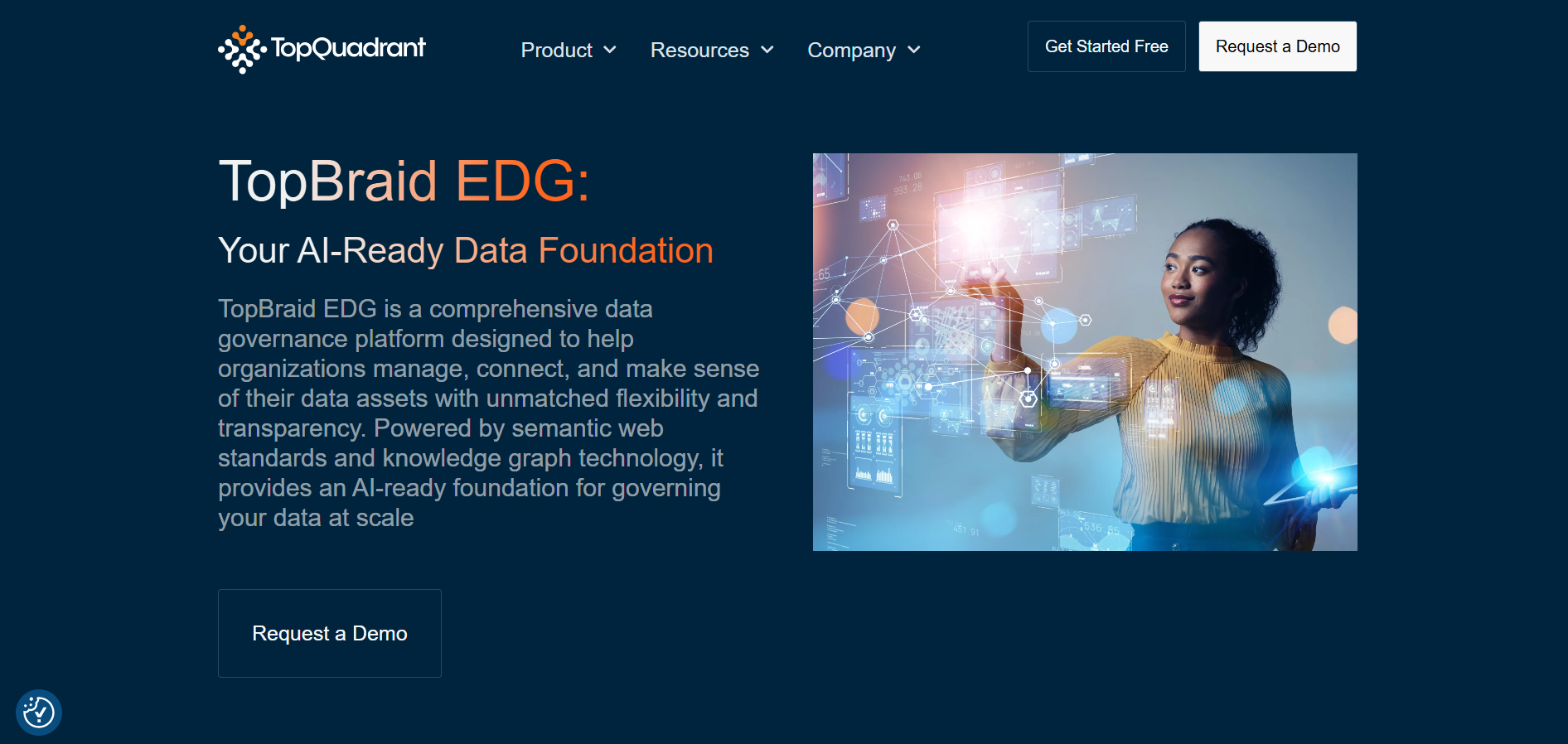
TopBraid EDG supports semantic governance programs built around ontologies, taxonomies, business glossaries, reference data, and knowledge graph technology. It is designed as an AI-ready data foundation powered by semantic web standards.
Key features:
-
Ontology management: Maintains formal semantic models for enterprise use cases.
-
Taxonomy and vocabulary governance: Manages controlled vocabularies, categories, and reference data.
-
Business glossary support: Connects business definitions with semantic models.
-
Knowledge graph technology: Uses graph structures to connect data, metadata, and meaning.
-
Governance workflows: Supports review, approval, and control processes for semantic assets.
Things to consider:
TopBraid EDG can require strong semantic governance maturity. We should plan for business participation, modeling standards, and implementation effort so the platform does not become limited to a small technical team.
4. Graphwise
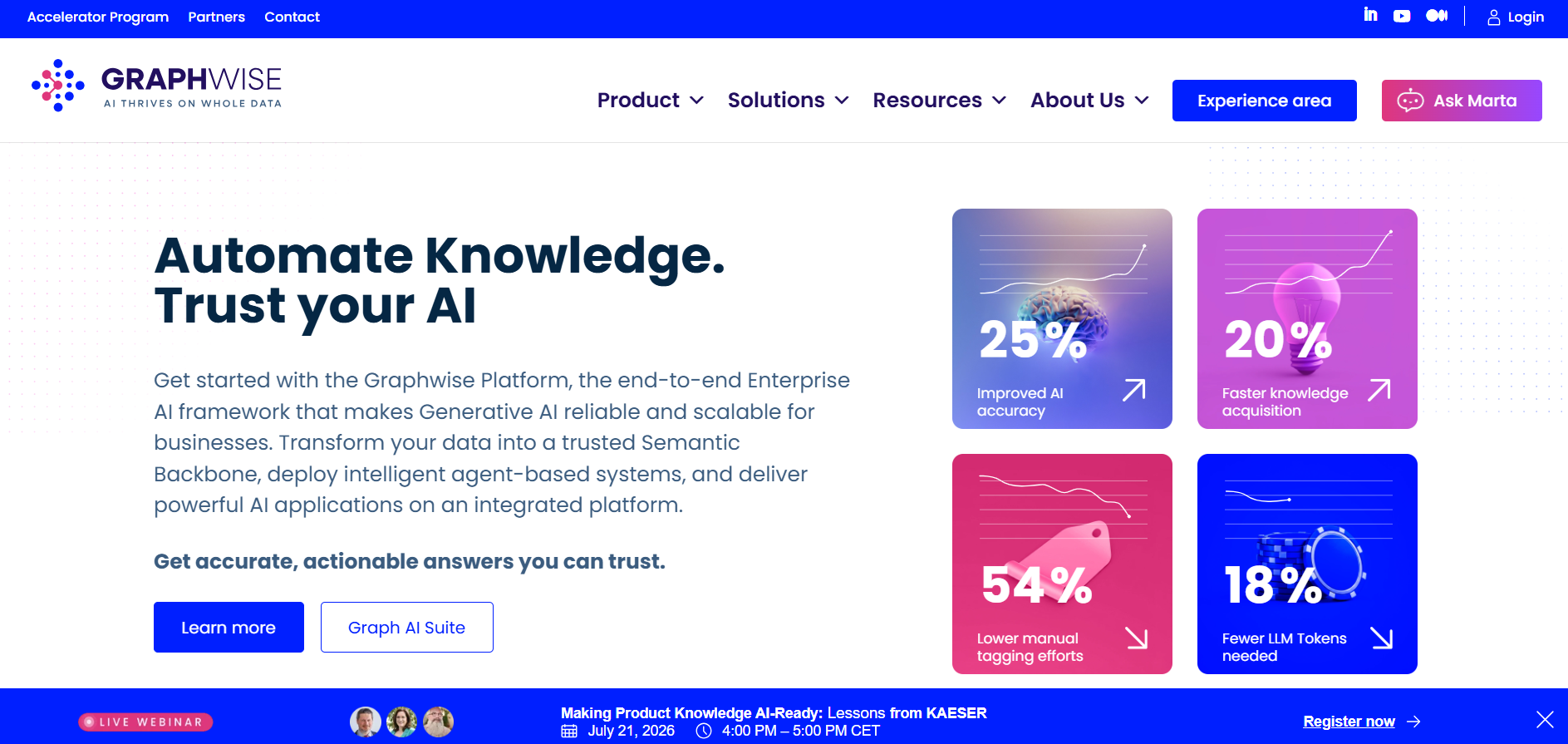
Graphwise focuses on trusted enterprise knowledge graphs for search, analytics, and AI. It positions its platform around turning fragmented data into governed graph context for reliable AI applications.
Key features:
-
Enterprise knowledge graph: Connects data silos through governed relationships.
-
Semantic AI context: Gives AI applications structured context instead of isolated records.
-
RDF graph capabilities: Supports semantic graph modeling for relationship-heavy domains.
-
Search and analytics support: Improves discovery by connecting concepts, assets, and context.
-
Governed context layer: Helps teams maintain consistent meaning across AI and analytics use cases.
Things to consider:
Graphwise fits teams that already see knowledge graphs as a core architecture choice. We should assess whether the organization also needs broader governance functions such as stewardship, privacy workflows, quality rules, and business glossary adoption.
5. Neo4j
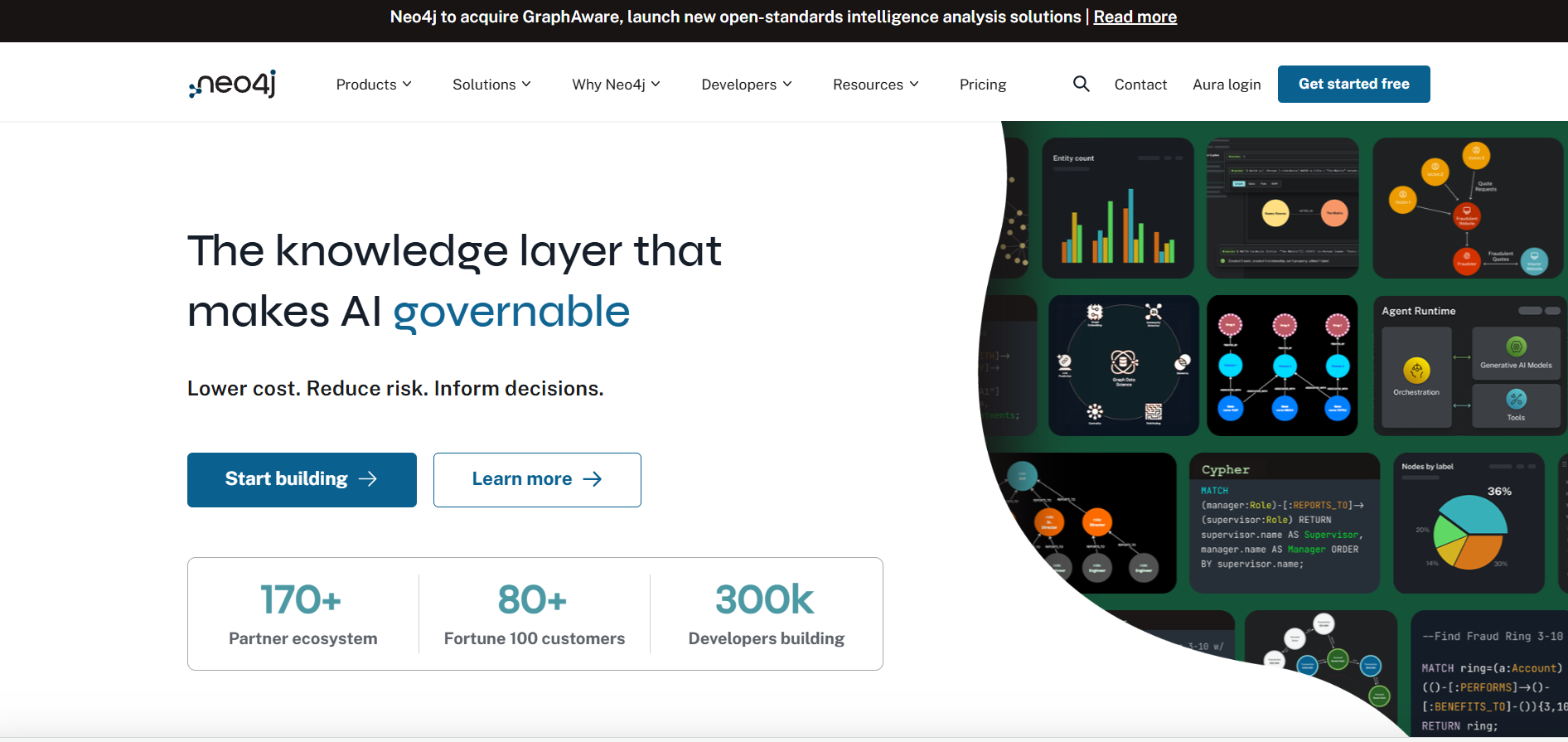
Neo4j is a graph database platform used to model and query highly connected data. It is relevant when ontology work needs a graph layer for connected entities, relationship traversal, GraphRAG, semantic search, recommendations, or fraud analysis. Neo4j also positions its platform around knowledge graphs, vector search, and graph data science for GenAI applications.
Key features:
-
Graph database foundation: Stores connected data as nodes and relationships.
-
Knowledge graph modeling: Represents entities such as customers, products, suppliers, claims, transactions, and policies.
-
Cypher querying: Lets teams query connected data patterns directly.
-
GraphRAG support: Adds graph context to retrieval workflows for AI applications.
-
Graph analytics: Supports relationship-based analysis for fraud, recommendations, supply chain, and risk use cases.
Things to consider:
Neo4j is graph infrastructure, not a full ontology governance platform. We still need a plan for glossary ownership, stewardship, lineage, data quality, privacy, approval workflows, and semantic standards if those requirements are part of the program.
6. Protégé and WebProtégé
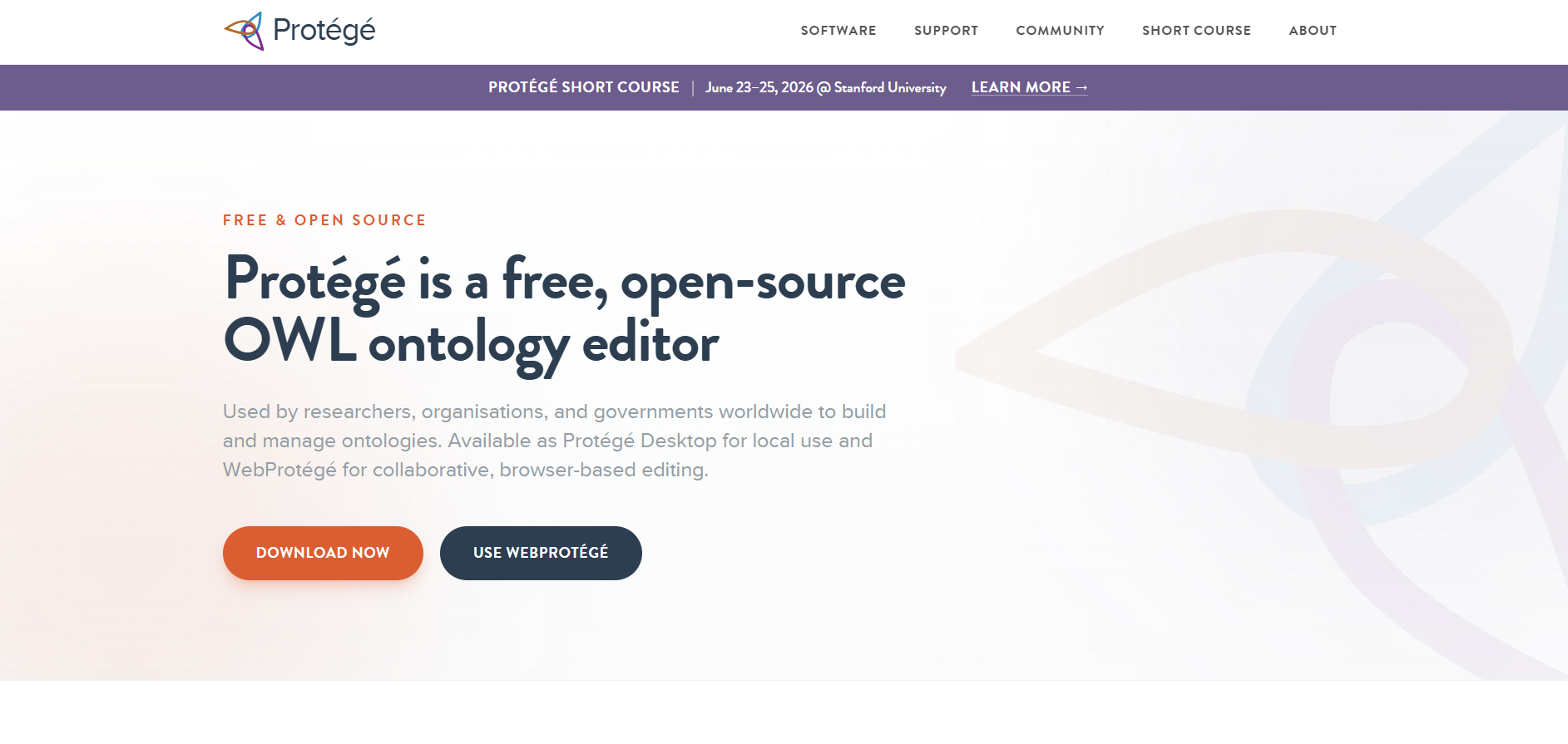
Protégé is a free, open-source ontology editor from Stanford. It is widely used for OWL ontology development, while WebProtégé adds browser-based collaborative editing for shared ontology workspaces.
Key features:
-
OWL ontology editing: Builds formal ontology models using classes, properties, relationships, and constraints.
-
Model inspection: Helps teams review ontology structures during development.
-
Reasoner compatibility: Supports logical consistency checks through compatible reasoners.
-
Plugin ecosystem: Extends the editor for specialized ontology workflows.
-
WebProtégé collaboration: Allows multiple users to work on ontology models in a browser-based environment.
Things to consider:
Protégé is strong for ontology engineering but limited for enterprise operations. It does not provide built-in catalog, lineage, privacy, data quality, identity, deployment, certification, or stewardship workflows at the level many enterprises need.
7. Atlan
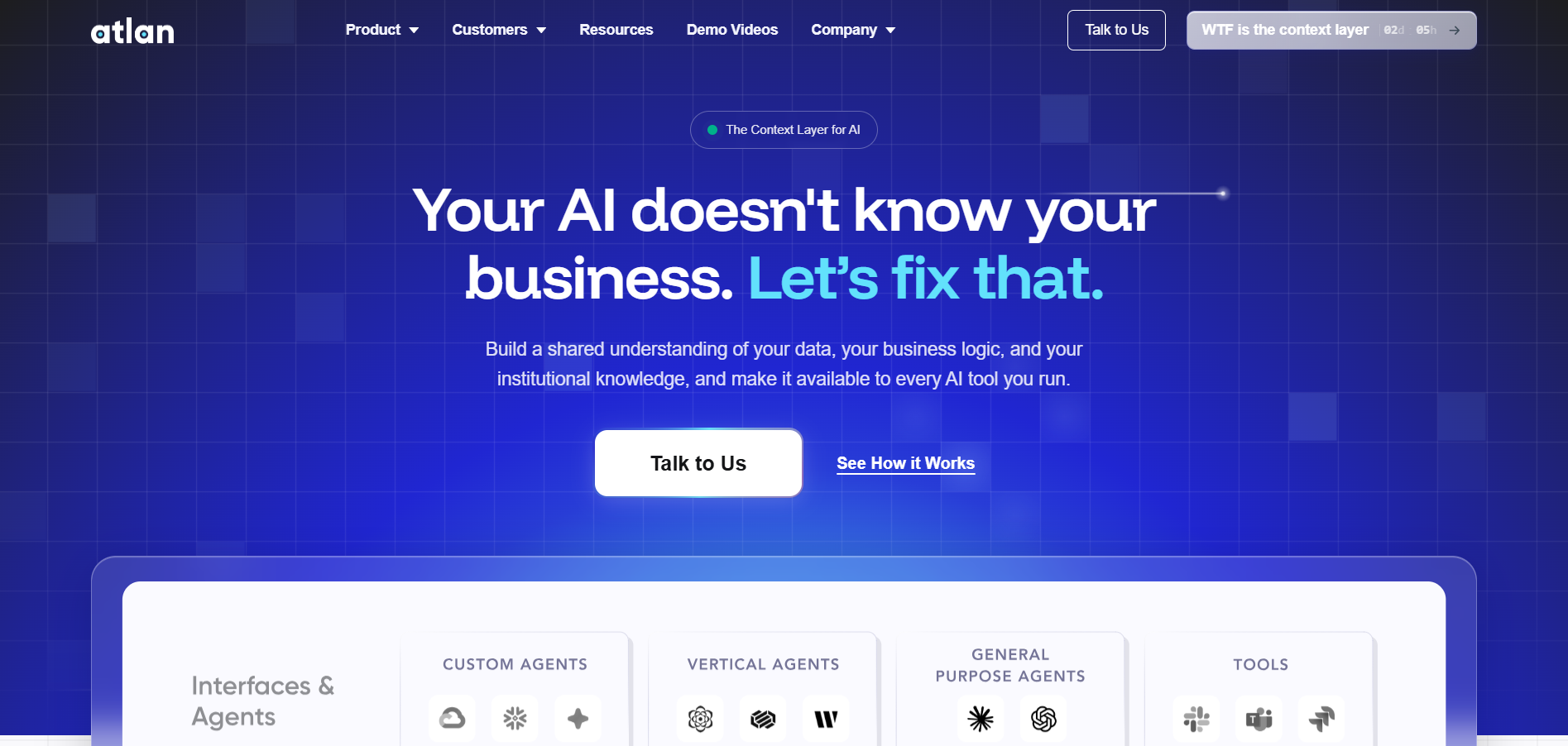
Atlan is a data catalog and metadata platform that helps teams find, understand, and trust data assets. Its data catalog content emphasizes searchable metadata, discovery, lineage, governance, and collaboration.
Key features:
-
Data catalog: Centralizes metadata for tables, dashboards, reports, and data assets.
-
Business glossary: Helps teams define and organize business terms.
-
Lineage context: Shows where data comes from and where it is used.
-
Collaboration workflows: Supports discussion, ownership, and data team coordination.
-
Active metadata: Brings metadata context into daily data workflows.
Things to consider:
Atlan is useful for metadata-led context, but we should verify the depth of formal ontology modeling. If the program requires OWL, RDF, reasoning, and semantic constraints, a dedicated ontology or knowledge graph tool may still be needed.
8. DataHub
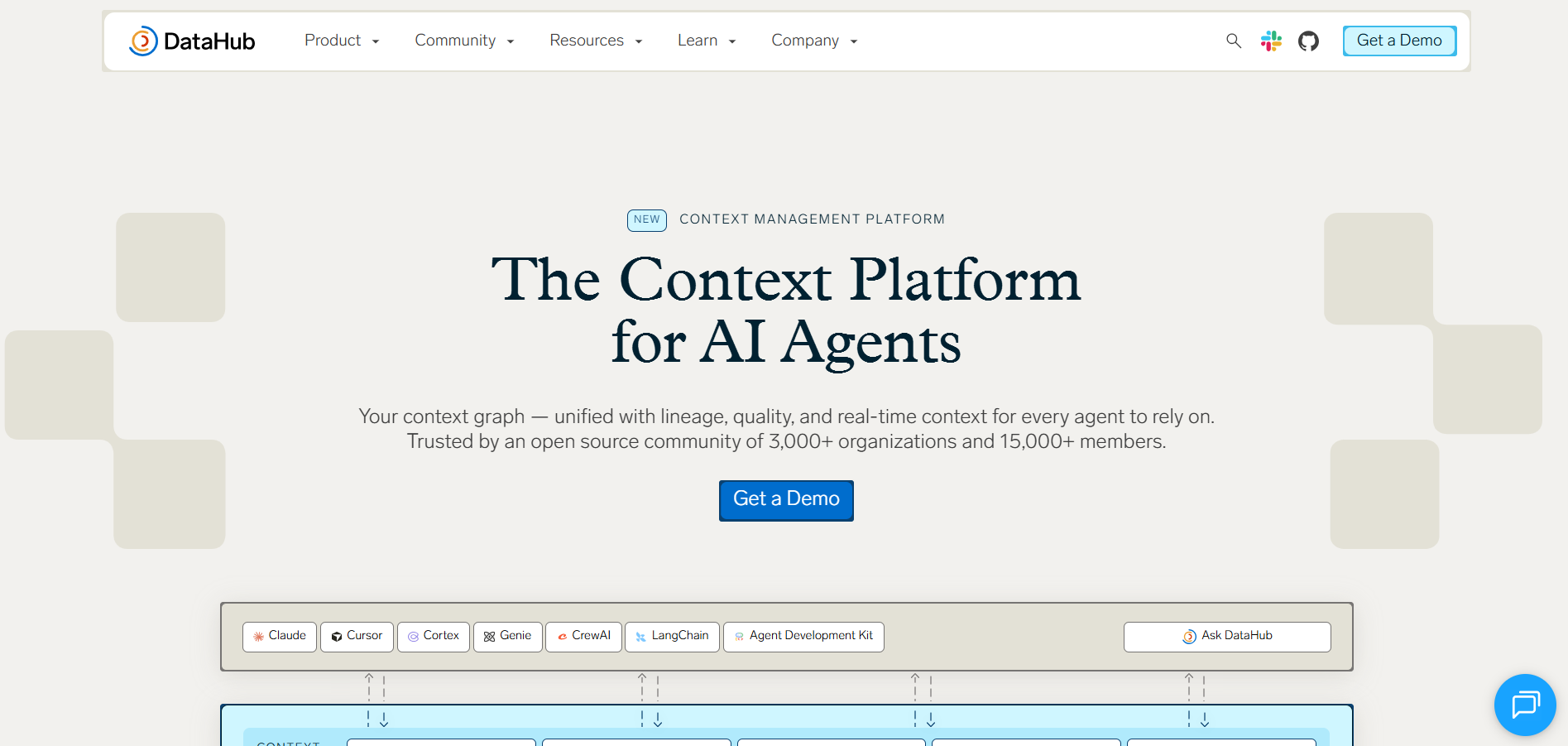
DataHub is an open-source metadata platform for discovery, governance, observability, lineage, and AI context management. Its platform positions itself around keeping context relevant and reliable across the data estate.
Key features:
-
Open-source metadata foundation: Gives technical teams control over metadata architecture.
-
Data discovery: Helps teams find and understand assets across the data stack.
-
Lineage and quality context: Connects assets to usage, movement, and trust indicators.
-
Context graph: Represents relationships across assets, owners, domains, and governance signals.
-
AI context management: Helps deliver governed data context to AI and agent workflows.
Things to consider:
DataHub can require engineering resources for deployment, customization, integration, and long-term maintenance. We should assess whether internal teams can support it before using it as the foundation for enterprise ontology management.
9. Palantir Ontology
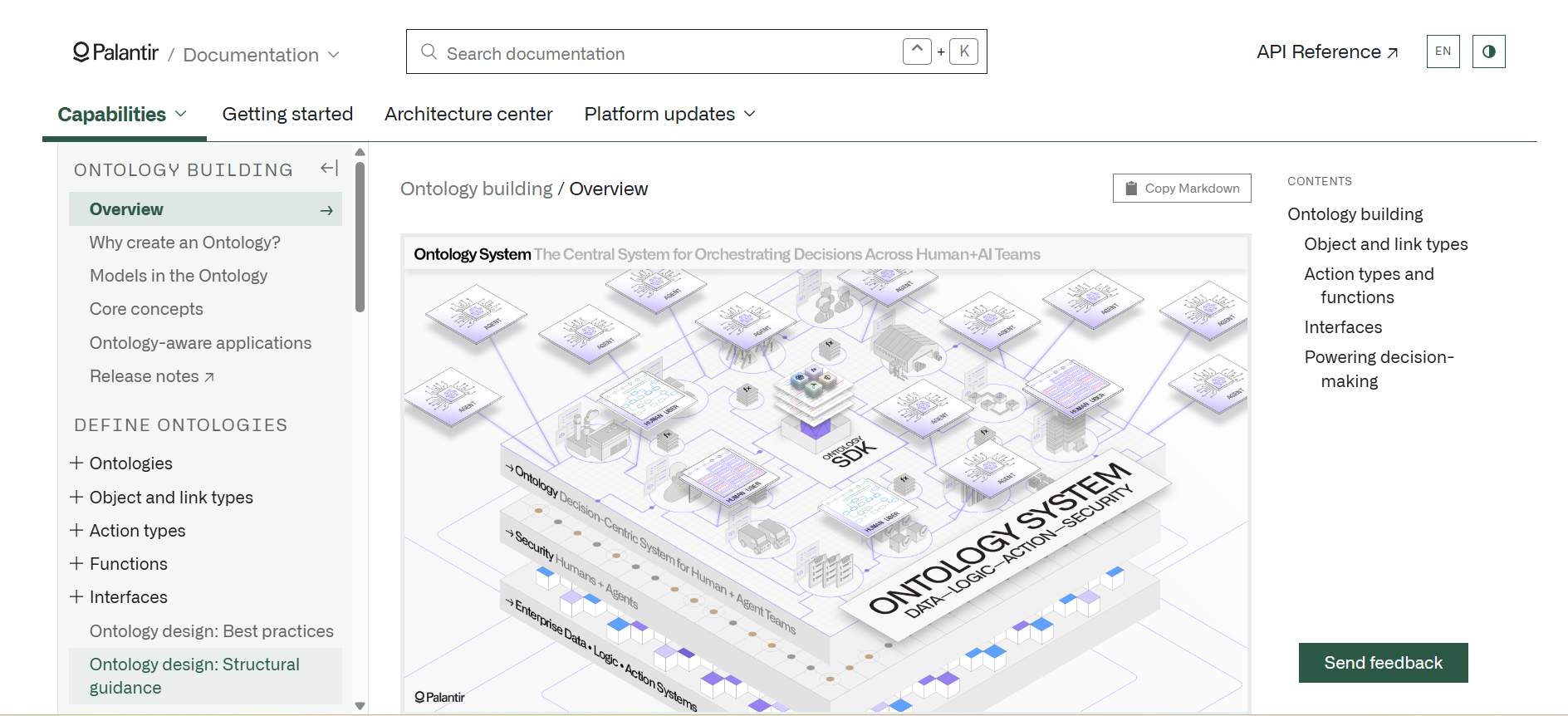
Palantir Ontology is part of the Palantir Foundry platform. It models real-world business objects, actions, and workflows so teams can build operational applications on top of enterprise data. Its ontology layer is designed to drive decisions and actions, not only describe data meaning.
Key features:
-
Object modeling: Represents business entities such as orders, patients, assets, routes, and supply chain nodes as actionable objects.
-
Action framework: Lets teams define business logic and trigger workflows directly from ontology objects.
-
Operational applications: Supports building decision apps on top of the ontology layer.
-
AI and LLM integration: Connects ontology objects to AI workflows for context-aware agent applications.
-
Enterprise security: Applies role-based and object-level access controls across the platform.
Things to consider:
Palantir Ontology is built for operational decision-making and action-driven workflows. If the primary need is semantic governance, business glossary adoption, metadata management, data quality, or lineage for analytical AI, a governance-first platform may be a better starting point.
How to choose the right ontology management platform?
A good ontology management platform should match our governance maturity, data architecture, AI goals, and internal ownership model. Some enterprises need formal RDF, OWL, SKOS, SHACL, and SPARQL support. Others need a practical platform that connects approved terms, metadata, lineage, quality, privacy, and AI governance.
Use these checks before shortlisting vendors:
|
Evaluation area |
What to check |
|
Business meaning |
Can teams define, approve, and manage terms through a business glossary? |
|
Ontology depth |
Can the platform model entities, relationships, hierarchies, rules, and standards if needed? |
|
Catalog connection |
Can terms connect to datasets, dashboards, reports, pipelines, and owners through a data catalog? |
|
Trust and compliance |
Can terms connect to data lineage, data quality, privacy, and access controls? |
|
AI readiness |
Can AI tools use approved definitions, trusted sources, and governed context? |
|
Adoption and support |
Can business users contribute, and does the vendor support implementation and scaling? |
Common mistakes include treating ontology as only a glossary, starting with a model that is too large, ignoring ownership, choosing an editor when governance adoption is the real need, or building a model that AI tools cannot use.
OvalEdge expert insight: Start with the five highest-impact terms in one business domain. Prove that governed definitions improve report trust and AI accuracy before scaling the ontology program across the enterprise.
Conclusion
Enterprise ontology management starts with a familiar problem: different teams, different definitions, different answers from the same data. As enterprises push toward AI-driven analytics, churn prediction, revenue analysis, demand forecasting, and risk scoring, that fragmentation becomes a direct obstacle. AI agents cannot deliver trusted answers when business meaning is inconsistent, ungoverned, or disconnected.
Most enterprises already have pieces of the foundation in place: a catalog, a glossary, lineage, quality rules, ownership assignments. The gap is not building more governance artifacts. It is connecting and activating them so AI can use the meaning, trust signals, and rules that governance teams have already established.
OvalEdge's Enterprise Context Graph connects approved terms, metadata, lineage, quality, privacy, ownership, and policies into a governed set of data artifacts that people and AI agents can query.
Instead of adding another standalone modeling tool, OvalEdge turns existing governance into a trusted context for analytical AI. Schedule a demo to see how.
.png?width=1081&height=173&name=Forrester%201%20(1).png)
.png?width=1081&height=241&name=KC%20-%20Logo%201%20(1).png)