-1.png)
A privacy request reaches the legal team, and the clock starts immediately. The deadline is clear, but the data is not. Customer details are spread across the CRM, data warehouse, support platform, backups, and vendor systems. Teams cannot quickly verify which records are accurate, who owns them, why they are retained, or when they should be deleted.
This is where GDPR becomes a data governance challenge. Legal obligations can only be fulfilled when personal data is easy to find, understand, control, and track throughout its lifecycle. The stakes are high.
European supervisory authorities issued approximately €1.2 billion in GDPR fines during 2025, according to DLA Piper’s January 2026 survey.
Yet the effects of weak governance emerge long before a fine is issued, delaying responses to rights requests and complicating breach investigations and audits.
This guide explains how GDPR data governance connects legal duties with the ownership, controls, workflows, and evidence required for continuous compliance.
What is GDPR data governance?
GDPR data governance is the roles, policies, processes, and controls used to handle personal data in line with the General Data Protection Regulation. It makes processing accountable by defining what data exists, why it is used, who owns or accesses it, where it flows, how long it remains, and what proves compliance.
Personal data governance turns transparency, minimization, accuracy, storage limitation, security, and accountability into operating rules. For a broader context, read the data privacy compliance guide.
Its role becomes clearer when compared with general data governance and the similarly named EU Data Governance Act.
How GDPR data governance differs from general data governance
General governance covers enterprise data and prioritizes quality, ownership, discovery, and usability. GDPR governance focuses on personal data and adds accountability for lawful processing, individual rights, breach response, and DPO oversight.
GDPR data governance vs. the EU Data Governance Act
The European Commission's guidance shows why these similar names describe different regulations.
|
Dimension |
GDPR |
EU Data Governance Act |
|
Purpose |
Protect people when personal data is processed. |
Increase trust in data sharing and reuse. |
|
Scope |
Personal-data processing. |
Protected public-sector data reuse, intermediaries, and data altruism. |
|
Core mechanism |
Principles, lawful bases, rights, duties, and accountability. |
Conditions and structures for trusted sharing. |
|
Enforcement |
Independent supervisory authorities and GDPR penalties. |
National competent authorities and member-state penalties. |
Therefore, the two are complementary: GDPR protects personal data, while the Data Governance Act creates trusted routes for making more data available.
Why data governance matters for GDPR compliance
GDPR states the obligations. Governance supplies the infrastructure needed to perform and prove them across changing systems. Without it, even a well-written privacy policy can become disconnected from daily data use.
Weak governance usually appears as operational friction:
-
Teams cannot produce a complete personal data inventory.
-
DSAR searches depend on emails, spreadsheets, and individual memory.
-
Consent and retention rules disappear across downstream copies.
-
Breach teams lose time establishing affected data, access, systems, and subjects.
The link between the regulation and the required capability becomes clearer at the Article level.
Which GDPR Articles depend on data governance?
Each GDPR article establishes a specific requirement for managing personal data. The table below maps these requirements to the governance capabilities needed to meet them.
|
Article |
Requirement |
Governance capability needed |
|
Principles and accountability. |
Purpose tags, classification, quality rules, retention controls, and evidence |
|
|
Records of processing activities. |
Living inventory, owners, purposes, recipients, retention, and lineage. |
|
|
Access, correction, erasure, restriction, portability, objection, and safeguards. |
Identity-linked discovery, request workflows, deadlines, and action logs. |
|
|
Data protection by design and by default. |
Privacy controls embedded in system and data lifecycles. |
|
|
Breach notification and communication. |
Sensitive-data maps, lineage, incident ownership, impact analysis, and decision records. |
Governance as accountability, not just a legal checkbox
Accountability means showing that controls work continuously. A policy cannot prove that yesterday’s new SaaS integration inherited the correct retention rule or that withdrawn consent reached every downstream system.
A maintained ROPA and privacy automation workflow provides ongoing evidence that processing records and controls remain current.
Repeatable GDPR data discovery helps verify that those controls extend to new and downstream data.
|
OvalEdge POV: Measure time to evidence A revealing maturity measure is how long it takes to prove what personal data exists, why it is processed, where it moved, who accessed it, and whether it should remain. Shorter time to evidence signals operational compliance. |
Core components of a GDPR data governance framework
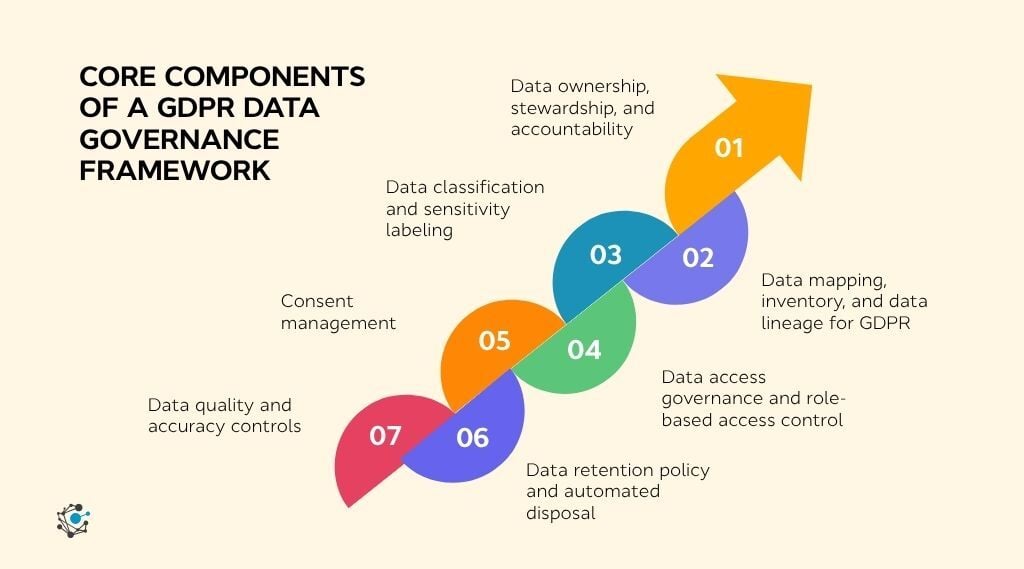
Although implementation depth varies, every organization needs the following connected building blocks. Together, they connect legal requirements to named decisions, system controls, and evidence that can survive changes in data, technology, and personnel.
1. Data ownership, stewardship, and accountability
The DPO advises, monitors, and challenges independently. Operational ownership remains with data owners, who approve purpose, access, and risk decisions, while stewards maintain definitions, classifications, and controls.
Here is a breakdown:
|
Data domain |
Owner |
Steward |
DPO oversight |
|
Customer |
Sales operations lead |
CRM steward |
Lawful basis and rights handling. |
|
Employee |
HR director |
HR data steward |
Special-category data and retention. |
|
Supplier |
Procurement lead |
Vendor data steward |
Processor and transfer controls. |
2. Data mapping, inventory, and data lineage for GDPR
An inventory shows what exists; data lineage shows how it moves and changes. For example, an email captured in a web form may enter the CRM, flow to a warehouse, appear in a campaign audience, and pass to an email processor. Lineage makes that chain visible for Article 30 records, DSARs, impact analysis, and breach scoping.
3. Data classification and sensitivity labeling
Classification separates public, internal, personal, and special-category data. The last tier covers sensitive fields under Article 9, including health, biometric, and political-opinion data. As a result, stronger access, purpose, and monitoring controls can follow the label.
4. Data access governance and role-based access control
Least privilege limits access to what a role needs. RBAC, approval workflows, periodic certification, masking, and audit logs then make the policy enforceable. Here, the data access governance connects classification with policy-based access and monitoring.
|
Role |
Illustrative access level |
|
Support agent |
Masked profile and active case data. |
|
Marketing analyst |
Consented audience attributes, no direct identifiers. |
|
Privacy officer |
Approved case access with full audit logging. |
5. Consent management
Consent must be captured, time-stamped, tied to a specific purpose, and easy to withdraw. Consent Management Platforms can manage preference collection, but governance must also propagate the current status to downstream datasets and processing workflows.
6. Data retention policy and automated disposal
Storage limitation requires a defensible schedule plus execution. The periods below are illustrative and must be validated against purpose, contracts, legal holds, and local law.
|
Data type |
Illustrative retention period |
Deletion trigger |
|
Unsuccessful applicant file |
6–24 months |
The recruitment process closes and the local period expires. |
|
Support ticket |
12–24 months |
Case closes and claim period expires. |
|
Marketing profile |
Defined consent lifecycle |
Withdrawal or purpose expiry. |
Automation should archive, anonymize, or delete data and retain proof of the action.
7. Data quality and accuracy controls
Validation rules, deduplication, owner reviews, and correction workflows protect the accuracy principle. Crucially, a correction made through a DSAR should reach the source record and every dependent system. Teams should also monitor failed validations, unresolved duplicates, and correction age so accuracy becomes measurable.
How to build a GDPR data governance framework: Step-by-step
A strong framework begins with a bounded use case and expands through repeatable controls. The following sequence keeps legal, business, and technical work aligned.
-
Secure leadership sponsorship: Define the risk, outcomes, decision rights, budget, and executive sponsor.
-
Audit personal data: Discover systems, datasets, processors, transfers, purposes, lawful bases, and retention obligations.
-
Classify data: Apply consistent personal and special-category labels, then prioritize high-risk processing.
-
Assign accountability: Name owners and stewards by domain; document the DPO's independent oversight role.
-
Document policies: Convert GDPR principles into rules for collection, use, quality, sharing, access, retention, and disposal.
-
Implement access and consent controls: Apply least privilege, approvals, periodic reviews, purpose tags, and withdrawal propagation.
-
Automate retention and deletion: Connect schedules to system actions, exceptions, legal holds, and completion evidence.
-
Establish monitoring and audits: Track DSAR time, stale access, unclassified data, policy exceptions, ROPA freshness, and failed deletions.
-
Train by role: Give stewards, engineers, marketers, support teams, and approvers scenario-based guidance tied to their decisions.
Before scaling, test the framework on one personal-data journey, such as customer onboarding through deletion. This reveals handoff failures that a document review will miss.
Then track inventory coverage, owner assignment, request completion time, stale access, overdue deletion, and evidence retrieval time. These measures show whether controls work under operational pressure. A privacy compliance checklist can support the review. During platform evaluation, prioritize evidence, integrations, and adoption.
Sample GDPR data governance policy framework outline
Use a short policy architecture that points to executable standards and procedures:
-
Purpose and scope: Data, systems, entities, jurisdictions, and exclusions.
-
Roles and responsibilities: Controller, processor, DPO, owners, stewards, custodians, and approvers.
-
Classification schema: Personal-data tiers, labeling rules, and handling requirements.
-
Access control policy: Least privilege, RBAC, approvals, reviews, logging, and exceptions.
-
Consent and retention policy: Lawful basis, purpose, withdrawal, schedules, legal holds, and disposal evidence.
-
Review and audit cadence: Metrics, control testing, issue escalation, change triggers, and policy approval.
Common challenges in GDPR data governance (and how to solve them)
GDPR data governance programs often stall when data moves faster than ownership and controls can keep pace. Closing this gap requires a focused, risk-based approach.
Start with areas that combine sensitive data, high processing volumes, external sharing, unclear ownership, or time-bound data subject rights. Prioritizing these risks makes early governance efforts visible and defensible. Meanwhile, metrics such as exception age and unresolved ownership can reveal emerging gaps before they cause delays.
The following table explains the most common challenges, why they occur, and how to address them.
|
Challenge |
What it happens |
Practical fix |
|
Data silos and legacy systems |
Limited connectors and undocumented exports. |
Prioritize high-risk sources, crawl metadata, and document manual flows. |
|
Incomplete inventory |
One-time interviews miss copies and shadow tools. |
Combine automated discovery with owner attestation and exception queues. |
|
Fast-changing data flows |
Pipelines, vendors, and SaaS tools change constantly. |
Trigger lineage and ROPA reviews from system, schema, or vendor changes. |
|
Cross-department buy-in gaps |
Privacy work feels detached from team goals. |
Give each role clear decisions, SLAs, and outcome metrics. |
|
Access versus security |
Broad access is convenient; blanket restriction blocks work. |
Use sensitivity, purpose, role, time, and approval context to grant access. |
Consider a retailer responding to an erasure request. The CRM record is deleted, yet the email remains in a campaign extract and a service provider's audience.
A governed workflow traces every copy, checks retention exceptions, routes actions to owners, and records completion. Without that chain, “deleted” covers one system while the wider data journey remains unresolved. Tracking incomplete actions by the system exposes the remaining risk.
The scale can be substantial. In an OvalEdge case study, Upwork cataloged personal data across more than 300 sources and automated privacy requests within a broader CCPA program. Although the regulation differs, the operational lesson transfers directly: discovery, classification, ownership, and workflow must work together.
Benefits of strong GDPR data governance beyond compliance
.jpg?width=1024&height=569&name=Info%202%20(2).jpg)
Once the controls become reusable, they create value beyond avoiding penalties:
-
Faster regulatory response: Current inventories, ROPA records, and evidence reduce reconstruction work.
-
More reliable rights handling: Search, correction, restriction, and deletion become traceable workflows.
-
Better analytics and AI inputs: Accuracy, provenance, purpose, and permission travel with the data.
-
Stronger customer trust: Teams can explain data use and act consistently on preferences.
-
Easier due diligence: Buyers and partners can assess ownership, risk, transfers, and control maturity faster.
These capabilities also reduce duplicated compliance work by creating a reusable control foundation for adjacent standards and regulations.
How GDPR data governance supports other frameworks (CCPA, HIPAA, ISO 27001)
GDPR data governance provides discovery, access, retention, and audit capabilities that also support CCPA, HIPAA, and ISO 27001. Although requirements differ, this shared foundation reduces duplicated effort.
|
Framework |
Overlap with GDPR governance |
|
UK GDPR |
Principles, lawful bases, rights, accountability, ROPA, and breach controls. |
|
CCPA/CPRA |
Personal-information inventory, access, deletion, correction, opt-out, and sensitive-data controls. |
|
HIPAA |
PHI classification, role-based access, integrity, audit logs, and lifecycle controls. |
|
ISO 27001 |
Asset inventory, risk ownership, access control, logging, incident response, and assurance evidence. |
The same controls can support several obligations, but scope, definitions, deadlines, and legal tests must still be mapped separately.
Build continuous GDPR compliance through data governance
GDPR compliance becomes sustainable when teams can answer privacy questions from current evidence before a request, audit, or breach forces reconstruction. Clear ownership, automated discovery, lineage, classification, access controls, consent context, retention workflows, and quality checks turn policy into everyday capability.
The result is a program that responds faster, exposes gaps earlier, and gives every control a clear owner. In turn, teams remain audit-ready between formal review cycles.
OvalEdge brings those functions into one unified data governance platform. Its privacy and compliance solution connects cataloging, sensitive-data detection, lineage, access governance, DSAR workflows, and audit logging, helping teams maintain context as data and systems change.
Book a demo to see how it can simplify your GDPR data governance.
.png?width=1081&height=173&name=Forrester%201%20(1).png)
.png?width=1081&height=241&name=KC%20-%20Logo%201%20(1).png)