-2.png)
Data privacy compliance is no longer just about ticking off legal boxes; it has become a critical operational necessity for businesses.
With the rise of global privacy regulations like GDPR, CCPA, and state privacy laws, organizations are under immense pressure to ensure compliance while efficiently managing the complexities of modern data ecosystems.
As the landscape continues to evolve, privacy management has shifted from being reactive and audit-driven to continuous and automated. The manual, fragmented approaches of the past are no longer sufficient to keep up with the demands of modern data governance.
According to Research Intelo, the global privacy compliance automation market is expected to grow from USD 3.2 billion in 2024 to around USD 27.2 billion by 2033 at a CAGR of 23.8%, reflecting accelerating investment in automation tools to streamline privacy processes and reduce manual compliance burdens.
This underscores the growing importance of data privacy compliance automation to meet the demands of modern data governance.
In this blog, we’ll explore the essential components of data privacy compliance automation, its role in ensuring privacy governance, the benefits of automation, and how it can overcome common data privacy challenges.
What is data privacy compliance automation?
In a nutshell, data privacy compliance automation refers to the use of technology to manage and streamline the tasks associated with ensuring data privacy compliance.
This includes automating processes like data classification, privacy impact assessments, data subject access requests (DSARs), consent management, and other key compliance tasks.
Why automation is needed for data privacy
As the volume and complexity of data grow, managing compliance manually becomes increasingly difficult and resource-intensive. Organizations are processing more data across multiple platforms, making it nearly impossible to track privacy obligations using traditional methods. With automation, companies can:
-
Streamline compliance efforts: Automate repetitive tasks like consent management, DSAR fulfillment, and data classification, reducing the burden on compliance teams.
-
Maintain accuracy and consistency: Minimize the risk of human error by automating data protection processes that require attention to detail, such as tracking consent or monitoring data subject rights.
-
Ensure real-time compliance: Automation tools enable real-time tracking of data and privacy events, which is critical as regulatory requirements change frequently.
How compliance automation works
Data privacy tools and AI-based solutions enable organizations to continuously monitor, track, and report on compliance with data privacy laws.
-
Classify data: Automatically detect and classify personal and sensitive data across systems.
-
Manage consent: Ensure that consent collection, storage, and preferences are accurately tracked and aligned with regulatory requirements.
-
Fulfill DSARs: Automatically handle data subject requests, verifying identity and ensuring timely responses.
-
Conduct privacy impact assessments (PIAs): Trigger PIAs based on data processing changes or new systems to ensure ongoing compliance.
|
Also read: Master Data Privacy Compliance and Reduce Risk Today |
Core components of data privacy compliance automation
The success of data privacy automation relies on a few key components that ensure thorough, scalable compliance efforts across your organization’s entire data ecosystem. These components work together to automate the entire compliance lifecycle, making data privacy management more efficient and reliable.
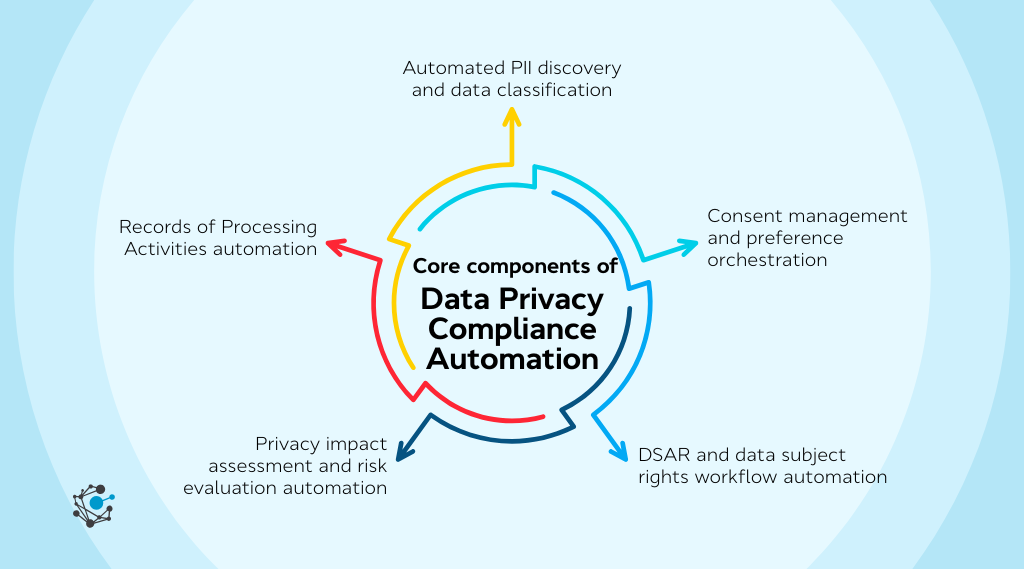
Automated PII discovery and classification
One of the core functions of data privacy automation is the ability to continuously scan and classify personal data (PII) across both structured and unstructured data sources. This allows organizations to:
-
Discover sensitive data: Identify where personal and sensitive data resides, including in cloud storage, databases, and third-party systems.
-
Tag and categorize: Automatically tag and categorize data based on regulatory policies and legal requirements (e.g., GDPR, CCPA).
-
Ensure visibility: Maintain an up-to-date inventory of personal data for better compliance tracking and risk mitigation.
Consent and preference management
Automation tools are essential for managing consent and user preferences across multiple systems and touchpoints. These tools ensure that consent is captured, stored, and enforced consistently across your organization.
-
Track consent across systems: Automation tools capture and store consent across websites, applications, and marketing platforms, ensuring that data usage aligns with user preferences.
-
Enforce preferences: Automated systems ensure that user preferences are enforced consistently across systems like analytics, marketing, and processing systems.
-
Maintain audit-ready records: Keep verifiable records of consent and preferences for future audits or regulatory inquiries.
DSAR and data rights automation
Data Subject Access Requests (DSARs) are crucial for privacy rights under regulations like GDPR and CCPA. Automating DSAR processes ensures that requests are fulfilled promptly and efficiently:
-
Automated intake and verification: Automatically capture and verify DSARs, ensuring the identity of the requester and their eligibility.
-
Enforce timelines: Automatically track and enforce statutory response deadlines for DSARs, reducing the risk of non-compliance.
-
Manage workflows: Automate workflows to ensure requests are processed accurately, reducing manual coordination across teams.
Privacy impact and risk assessment automation
Privacy Impact Assessments (PIAs) are essential for identifying and mitigating risks to individuals’ privacy. Automation can help streamline the process of conducting PIAs:
-
Trigger PIAs automatically: Automatically initiate PIAs when changes occur to data processing, such as introducing new vendors or systems.
-
Standardize risk scoring: Use automated tools to standardize risk scoring and mitigation tracking, ensuring a consistent approach to data protection.
-
Continuous assessments: Position PIAs as continuous, not static exercises, to ensure ongoing compliance with data protection regulations.
Records of processing activities (ROPA) automation
Maintaining accurate Records of Processing Activities (ROPA) is a core GDPR requirement. Automating ROPA creation and maintenance helps ensure compliance and audit readiness:
-
Automate ROPA generation: Automatically generate and update ROPA based on data flows, processing purposes, and legal bases.
-
Track data flows: Map and track data flows across your systems, identifying where personal data is processed and by whom.
-
Ensure regulatory transparency: Keep ROPA records up-to-date and accessible for audits or regulatory inquiries.
Best practices for implementing data privacy compliance automation
Implementing data privacy compliance automation effectively requires a strategic approach that aligns with both regulatory requirements and business needs. By following best practices, organizations can ensure that automation tools are seamlessly integrated into their workflows, ultimately leading to improved efficiency and compliance.
Here are the key best practices to consider when implementing privacy compliance automation.
|
Key Insight: The UK Information Commissioner's Office (ICO) guidance on "Privacy by Design" explicitly advocates for tools and automation to ensure data protection is integrated into processing activities and IT systems from the design phase. This proactive approach ensures that privacy is embedded at every stage of data handling, reducing the risk of non-compliance and safeguarding data at the earliest point in the process. |
Aligning with privacy laws and business needs
Automation tools should be tailored to fit both regulatory requirements (e.g., GDPR, CCPA) and your organization’s unique privacy needs. Customizing workflows for different business functions ensures that privacy policies are followed across all departments.
-
Understand specific regulations: Ensure that your automation platform is configured to comply with the relevant data protection laws in your jurisdiction.
-
Integrate with internal processes: Customize workflows to align with existing data governance and business processes across various teams.
-
Regular updates: Stay updated on changes in regulations to adapt workflows and automation features accordingly.
Building a metadata foundation
A solid metadata foundation is key to making privacy compliance automation successful. Metadata helps organize data, track transformations, and provides transparency into data flows.
-
Centralize metadata: Create a centralized metadata catalog to support consistent tracking of data and privacy activities.
-
Use metadata-driven automation: Leverage metadata to automate processes like data discovery, classification, and compliance checks.
-
Ensure reliable reporting: Standardize metadata to ensure that reports generated by automated systems are consistent and accurate.
Integrating with security systems
For data privacy automation to work effectively, it must be seamlessly integrated with your security systems, data lakes, and cloud platforms. This ensures that privacy and security efforts are aligned, reducing redundancy and improving compliance coverage.
-
Ensure compatibility: Choose privacy automation tools that integrate with your existing security systems and infrastructure.
-
Synchronize policies: Sync privacy policies and security controls to ensure that data protection measures are consistently applied across systems.
-
Overcome integration hurdles: Address common integration challenges, such as data fragmentation and siloed systems, to create a unified privacy compliance ecosystem.
Common challenges in implementing privacy compliance automation
While data privacy compliance automation offers numerous benefits, organizations often encounter challenges during the implementation phase. Addressing these hurdles proactively ensures a smoother rollout and more efficient compliance processes. Here are the key challenges organizations face and how to tackle them:
Data fragmentation and visibility gaps
One of the primary obstacles in implementing data privacy automation is data fragmentation. Organizations often have data spread across multiple systems, including SaaS platforms, cloud storage, on-premise databases, and third-party tools, making it difficult to maintain a unified view of data.
-
Siloed data sources: Data scattered across different systems can lead to inconsistent tracking and incomplete lineage, which hampers compliance efforts.
-
Integration-first approach: Ensure that automation tools integrate with existing systems, enabling centralized visibility and streamlined data management.
-
Implement centralized catalogs: Create a unified data catalog to centralize metadata, ensuring all systems are connected, and compliance data is easily accessible.
|
Example: Bedrock leveraged OvalEdge to centralize metadata, standardize data definitions, and improve reporting accuracy, helping close visibility gaps and strengthen privacy compliance. |
Policy complexity and enforcement issues
Translating complex legal language into actionable privacy rules for automation can be a significant challenge. Many organizations struggle to apply legal requirements effectively across their data systems, risking non-compliance.
-
Difficulty in rule enforcement: Ambiguities in interpreting regulations can lead to inconsistent or incomplete rule enforcement.
-
Standardize compliance policies: Work with legal teams to standardize policies, translating legal language into clear, actionable workflows for automation tools.
-
Ongoing legal reviews: Regularly review policies to ensure they align with evolving regulations and are correctly implemented across all systems.
Integration with existing systems
Most organizations already have a set of legacy systems and security tools in place, and integrating new automation tools with these systems can pose significant challenges. Lack of compatibility and synchronization can lead to data gaps and operational inefficiencies.
-
Legacy system limitations: Older systems may not support easy integration with modern automation platforms, causing gaps in data lineage and compliance coverage.
-
Choose compatible solutions: Select privacy automation tools that offer strong integration capabilities, especially with legacy platforms, to ensure a smooth workflow.
-
Invest in modular tools: Use tools that can be gradually integrated into your existing system architecture, allowing for seamless expansion.
|
Industry insights: A Deloitte analysis highlights that many privacy compliance efforts remain fragmented and operationally ineffective, with teams struggling to embed GDPR rules into daily practices due to disconnected data systems and processes. |
How to evaluate data privacy compliance automation tools
When selecting data privacy compliance automation tools, it’s essential to assess their capabilities to ensure they meet your organization’s needs for scalability, flexibility, and integration. With numerous options available, choosing the right tool can significantly impact the efficiency of your compliance efforts. Here are key factors to consider when evaluating privacy compliance automation tools.
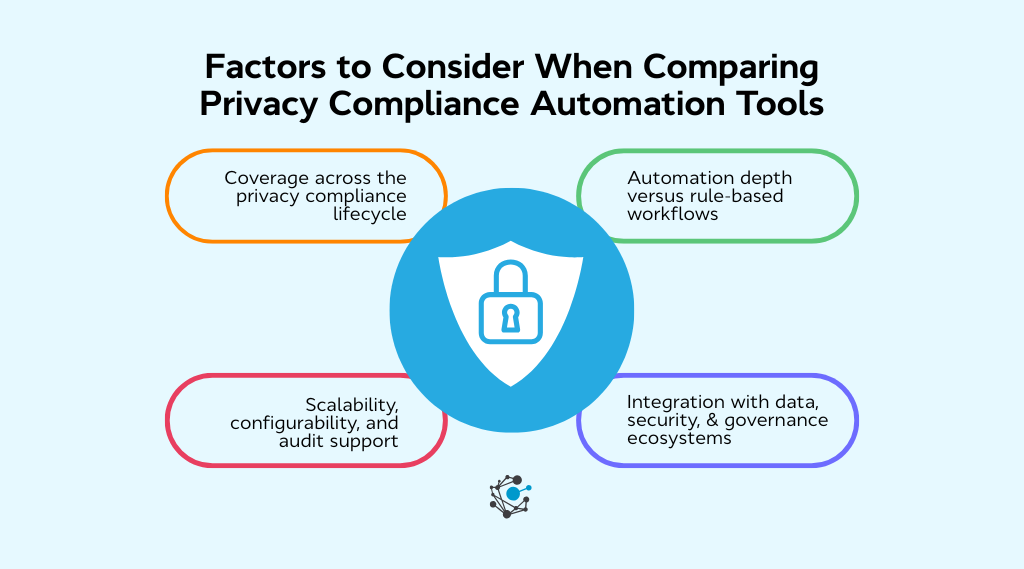
Coverage across the compliance lifecycle
A comprehensive tool should offer end-to-end automation rather than focusing on a single aspect of privacy compliance. Look for platforms that can handle all stages of the compliance lifecycle, from data classification to DSAR management, and everything in between.
-
End-to-end automation: Ensure the tool covers everything from consent management and risk assessments to record-keeping and reporting.
-
Address all compliance needs: The tool should help manage not just GDPR but also other regulations like CCPA, HIPAA, and more, depending on your organization's scope.
-
Continuous updates: The tool must adapt to evolving regulations and emerging data privacy requirements.
Automation depth vs. rule-based workflows
Not all automation is created equal. Some tools rely solely on rule-based workflows, while others use intelligent automation powered by AI and machine learning to adapt to dynamic data environments.
-
Rule-based vs. intelligent automation: Rule-based tools only execute predefined actions, while intelligent tools can adapt to changes in data and regulation without manual intervention.
-
Adaptability: Choose a tool that learns and evolves as your business processes and data change, ensuring your compliance practices remain robust.
-
Efficiency: Intelligent automation is more efficient at scaling and reducing manual work compared to rule-based workflows.
Integration with security and data systems
Data privacy compliance doesn't operate in a silo; it needs to work seamlessly with your existing security, identity, and data systems. Evaluating the tool’s integration capabilities is crucial to ensuring that your entire ecosystem is aligned for compliance.
-
Metadata and lineage integration: A good tool should integrate with your metadata management and data lineage systems to track and manage privacy data efficiently.
-
Compatibility: Check how well the automation tool integrates with your security platforms, data lakes, and cloud environments to ensure it complements your existing tech stack.
-
Reduced duplication: The tool should prevent redundant processes by leveraging existing data systems, reducing operational inefficiencies.
How metadata tools like OvalEdge support compliance
Metadata tools like OvalEdge can greatly enhance your data privacy compliance efforts by streamlining data discovery, lineage, and compliance workflows.
-
Automated lineage and classification: OvalEdge automates data lineage extraction and categorizes data based on regulatory requirements, making it easier to track data across systems.
-
Cross-platform integration: It integrates with various data systems, ensuring consistent compliance across on-premise, cloud, and hybrid environments.
-
Audit readiness: OvalEdge provides a unified view of compliance status, making audits simpler and ensuring that all records are up-to-date and traceable.
Conclusion
Data privacy compliance automation has become an essential strategy for organizations navigating the complexities of modern data regulations. By automating key tasks like data classification, consent management, and DSAR processing, businesses can not only streamline their privacy operations but also enhance accuracy and ensure continuous compliance.
As regulations evolve, relying on manual processes is no longer viable. Automation empowers organizations to stay ahead of compliance requirements, mitigate risks, and avoid costly penalties.
A structured automation framework fosters transparency, ensures timely reporting, and supports audit readiness, building trust with regulators and customers.
With tools like OvalEdge that integrate metadata, data lineage, and compliance automation, organizations can achieve better operational efficiency and long-term success in data privacy management.
Ready to take your compliance to the next level? Book a demo with OvalEdge to see how our platform can automate your privacy compliance journey.
FAQs
1. Is data privacy compliance automation suitable for small and mid-sized organizations?
Yes. Automation helps smaller teams manage compliance without hiring dedicated specialists. It replaces manual tracking with scalable workflows, making it easier to meet regulatory requirements even with limited resources and growing data volumes.
2. Does privacy compliance automation require replacing existing security tools?
No. Most privacy compliance automation solutions integrate with existing security, identity, and data platforms. They orchestrate policies and workflows on top of current tools rather than replacing established security infrastructure.
3. How does privacy compliance automation support ongoing regulatory changes?
Automation platforms allow policies, workflows, and rules to be updated centrally. This enables organizations to adapt quickly to new regulations or amendments without rebuilding compliance processes from scratch.
4. Can automated privacy compliance reduce audit preparation time?
Yes. Automated systems continuously collect evidence, maintain records, and track compliance activities. This reduces last-minute audit preparation by providing ready access to documentation, logs, and regulatory reports.
5. What data sources can be covered by privacy compliance automation tools?
Privacy compliance automation can cover cloud data platforms, SaaS applications, databases, file systems, and APIs. Coverage depends on integration capabilities and discovery mechanisms built into the automation platform.
6. How long does it take to implement data privacy compliance automation?
Implementation timelines vary by data complexity and integrations, but many organizations see operational automation within weeks. Phased rollouts allow teams to prioritize high-risk data and expand coverage gradually.
.png?width=1081&height=173&name=Forrester%201%20(1).png)
.png?width=1081&height=241&name=KC%20-%20Logo%201%20(1).png)