-1.png)
Data privacy compliance checklist guides organizations through key steps covering identification of applicable laws, personal data inventories, consent management, DSAR workflows, DPIAs, vendor controls, and retention policies.
It helps streamline privacy processes, reduce risk, and stay audit-ready under evolving global regulations like GDPR, CCPA, and DPDP.
As data continues to drive business decisions, privacy compliance is no longer just a legal requirement; it's a critical operational necessity.
As global privacy regulations like GDPR, CCPA, and state privacy laws continue to evolve, organizations face mounting pressure to not only meet these standards but to demonstrate proactive compliance.
But many businesses struggle to stay on top of ever-changing requirements, leaving them vulnerable to regulatory penalties, operational delays, and loss of customer trust.
According to Businesswire, up to 71% of companies could fail a cyber or compliance audit due to fragmented workflows, manual evidence gathering, and poor collaboration between teams, revealing significant operational gaps in current compliance programs.
This highlights the urgent need for a structured, actionable approach to privacy management.
In this blog, we’ll walk you through a data privacy compliance checklist—a step-by-step guide designed for privacy teams, DPOs, and compliance leaders to tackle these challenges head-on.
By the end, you’ll have a solid framework to operationalize privacy compliance across your organization.
What is Data Privacy Compliance?
Data privacy compliance is the practice of ensuring that an organization collects, processes, stores, and shares personal data in accordance with applicable laws, regulations, and industry standards.
It involves implementing policies, controls, and governance frameworks to protect individuals’ personal information, uphold their privacy rights, and reduce the risk of data breaches, penalties, and reputational damage.
Compliance requirements vary by region (such as GDPR, CCPA, and DPDP), but they all emphasize transparency, accountability, and responsible data handling.
Why does a structured data privacy compliance checklist matter?
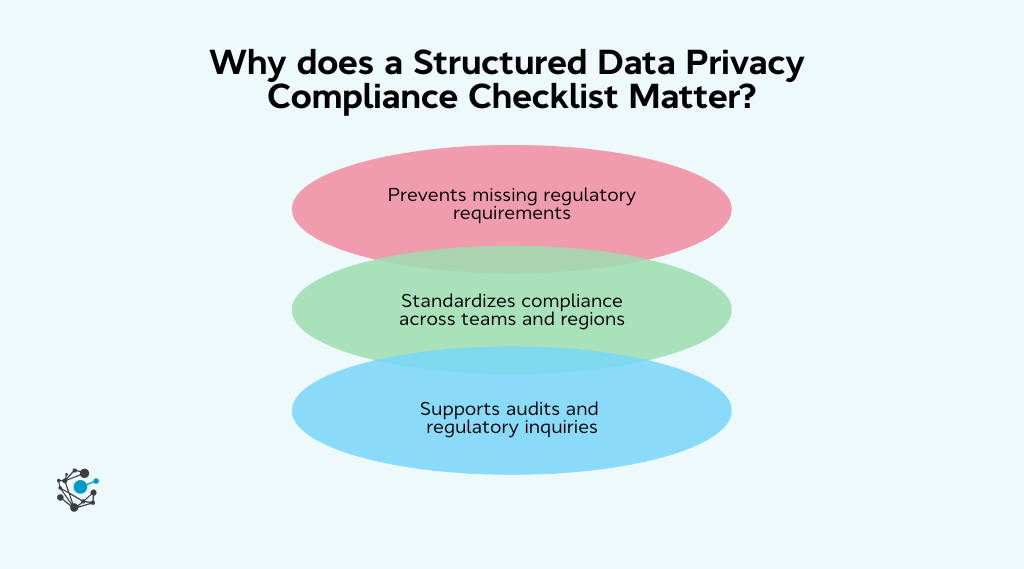
A structured data privacy compliance checklist is more than a tool for ticking off regulatory boxes. It’s the backbone of an effective, ongoing privacy program.
It ensures organizations stay on track as regulations evolve and data processing grows.
With increasing scrutiny from regulators, it’s no longer enough to claim compliance; businesses must demonstrate active, continuous effort in managing privacy and protecting data, and here’s why a checklist is essential for privacy teams.
a. Prevents missing regulatory requirements: A comprehensive checklist ensures all necessary actions are completed, helping teams track tasks, document progress, and avoid overlooking any compliance obligations.
b. Standardizes compliance across teams and regions: It provides consistency in how privacy policies and actions are executed, ensuring all teams, regardless of location, are aligned with legal requirements.
c. Supports audits and regulatory inquiries: A well-maintained checklist offers clear documentation of compliance efforts, making it easier to respond to audits and regulatory inquiries with verifiable evidence.
Now that we've covered why a structured data privacy compliance checklist is essential, let's walk through the key steps you need to take to build and implement one. This checklist will guide privacy teams, DPOs, and compliance leaders in operationalizing privacy compliance effectively across your organization.
|
Pro tip: Gartner predicts that 80% of data governance initiatives will fail by 2027 due to a lack of real business alignment and cohesive processes, underscoring how fragmented compliance efforts struggle without structured frameworks and clear accountability. |
Data privacy compliance checklist
Creating and maintaining a comprehensive data privacy compliance checklist is essential to ensure that privacy obligations are consistently met and managed across your organization.
Let’s break down the key steps involved in building and implementing an effective data privacy compliance checklist.
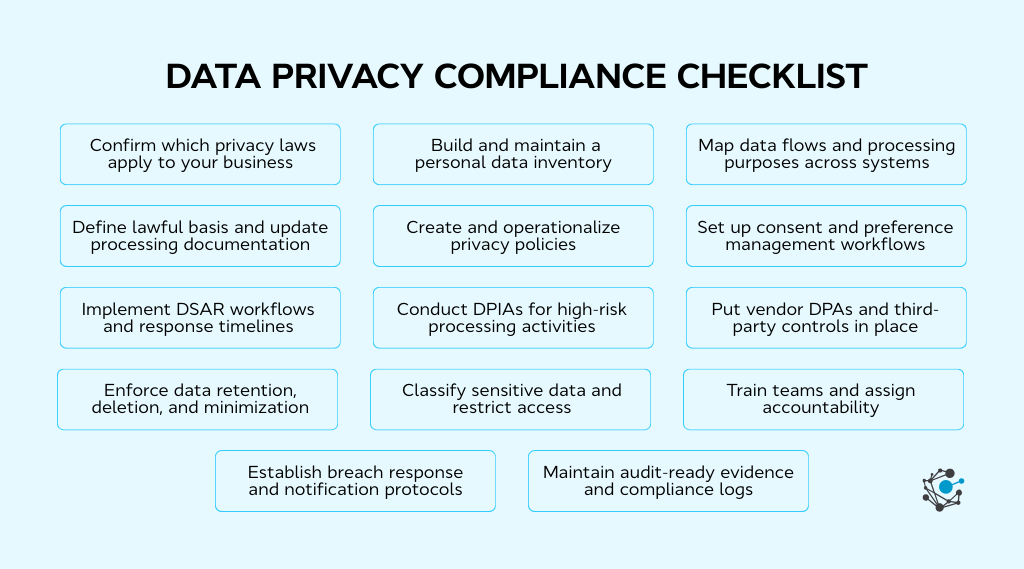
Step 1: Confirm which privacy laws apply to your business
Identify the privacy regulations that apply to your organization based on geography, customer base, and data processing activities. This helps in ensuring you're compliant with all relevant laws and regulations.
a. Assess applicable regulations: Identify the regions where your business operates and the data you collect, as laws like GDPR apply to EU citizens, while CCPA applies to California residents.
b. Consider your customer base and data processing activities: Your customer base might trigger specific laws based on their location or the type of data you handle. For example, if you process health data, HIPAA may apply in addition to other regulations.
c. Document regulatory scope for audit readiness: Maintain a clear record of applicable regulations and any assumptions made during this process, so you can easily prove your compliance during audits or inquiries.
|
Compliance Success Story: Upwork, a global freelancing platform, used OvalEdge to streamline its CCPA compliance efforts. By centralizing its data governance, Upwork not only met the regulatory requirements but also secured sensitive customer data across various systems. |
Step 2: Build and maintain a personal data inventory
Keep track of all personal and sensitive data assets across your systems to understand and manage privacy risks. This step helps identify where data resides, how it's processed, and who has access to it.
a. Catalog all personal and sensitive data: List all the types of personal data you collect, store, and process. This includes customer information, employee records, financial details, and more sensitive data such as health information.
b. Record data sources and processing purposes: Ensure you capture where the data originates from and the specific purpose for which it’s processed. This will help with transparency and demonstrate accountability.
c. Keep the inventory continuously updated: Data flows change over time as new systems, vendors, or processing purposes are introduced. Regular updates ensure that your inventory is always current and audit-ready.
Step 3: Map data flows and processing purposes across systems
Visualizing how personal data moves between systems helps identify potential risks in data processing. This ensures you understand where data is transferred, who has access to it, and how it's processed.
a. Visualize data movement across systems and vendors: Use tools or diagrams to map how personal data flows between departments, systems, third-party vendors, and across borders. This will help identify weak points in your data management processes.
b. Link data flows to defined business purposes: Each data flow should be tied to a legitimate business purpose and legal justification (e.g., contractual necessity, consent, or legitimate interest). This ensures compliance with privacy regulations.
c. Identify unnecessary data collection or risky transfers: Use your mapping to identify any data you are collecting unnecessarily or risky transfers of data that don’t align with business needs or legal justifications.
Step 4: Define lawful basis and update processing documentation
For each data processing activity, define the legal basis under which you are processing personal data. This is a core requirement for ensuring compliance, especially under regulations like GDPR.
a. Assign lawful bases to each processing activity: Identify the lawful basis for each type of processing (e.g., consent, contract necessity, legitimate interest, etc.), and document this for each activity.
b. Maintain clear supporting documentation: Keep records of your decisions and the rationale behind each lawful basis to provide evidence of compliance during audits or investigations.
c. Ensure consistency across privacy notices and records: Your privacy notices and internal documentation should align with the lawful bases and processing activities to ensure transparency and accuracy.
Step 5: Create and operationalize privacy policies
Clear, accessible privacy policies are essential for demonstrating compliance and ensuring that all employees understand their responsibilities. These policies should reflect regulatory requirements and be translated into actionable procedures.
a. Develop both internal and external privacy policies: Create policies that are aligned with the privacy regulations that apply to your business. These policies should be easily accessible to both employees and customers.
b. Translate policies into operational procedures: Make sure the policies are more than just legal documents; they should be translated into day-to-day procedures that employees can follow. This ensures that privacy practices are embedded in business operations.
c. Review and update policies regularly: As regulations or processing activities change, regularly update your privacy policies to ensure they remain relevant and compliant with the latest legal requirements.
|
Also Read: How to Automate Data Privacy Compliance with OvalEdge explores how automation can support privacy teams in efficiently managing data protection efforts, ensuring that compliance becomes a seamless part of your organization’s operations. |
Step 6: Set up consent and preference management workflows
Establish workflows to manage user consent and preferences, ensuring compliance with data privacy regulations. Capture, store, and manage consent across all relevant channels to respect user rights.
a. Capture, store, and manage consent across channels: Implement systems that allow you to capture and store consent from customers across all relevant touchpoints, such as website forms, email opt-ins, and other data collection methods.
b. Enforce user preferences across systems: Ensure that user preferences are respected across all platforms, including marketing, analytics, and data processing systems.
c. Maintain verifiable consent records: Keep accurate and verifiable records of user consent for regulatory review, ensuring you can demonstrate that consent was obtained in accordance with the law.
Read More: Top 10 Data Privacy Management Software for Risk Mitigation
Step 7: Implement DSAR workflows and response timelines
Data Subject Access Requests (DSARs) are a crucial part of privacy rights. Establishing workflows for managing these requests ensures compliance with privacy laws.
a. Standardize processes for receiving, verifying, and fulfilling DSARs: Establish workflows that ensure DSARs are handled promptly and accurately, including verification of identity and proper handling of the request.
b. Track statutory response deadlines: Be aware of the legal timelines for responding to DSARs (e.g., 30 days for GDPR) and ensure that all requests are processed within those limits.
c. Maintain DSAR action records: Keep records of all DSAR actions, including the response given, for compliance and audit purposes.
Step 8: Conduct DPIAs for high-risk processing activities
Conducting Data Protection Impact Assessments (DPIAs) helps identify and mitigate risks to individuals’ privacy, particularly for high-risk processing activities. This is a core requirement under regulations like GDPR.
a. Identify processing activities that trigger DPIAs: DPIAs should be conducted for activities such as large-scale data processing, sensitive data handling, or new technologies involving personal data.
b. Assess risks to individuals: Evaluate how the processing could affect individuals, including potential risks to their privacy and security.
c. Document mitigation measures: Record the steps taken to mitigate identified risks, ensuring that the processing activity can proceed in compliance with legal requirements.
Step 9: Put vendor DPAs and third-party controls in place
Vendors who process personal data on your behalf must be bound by Data Processing Agreements (DPAs) to ensure they meet privacy and security requirements.
a. Identify vendors processing personal data: Review all third-party relationships and identify vendors that handle personal data as part of your operations.
b. Execute Data Processing Agreements (DPAs): Ensure that DPAs are in place with vendors to define their responsibilities, security obligations, and compliance with privacy laws.
c. Monitor third-party compliance: Regularly review and assess third-party compliance with your data privacy requirements through audits or ongoing assessments.
Step 10: Enforce data retention, deletion, and minimization
Data retention policies are crucial for ensuring that personal data is not stored longer than necessary. This also reduces the risk of unauthorized access and ensures compliance with data protection principles.
a. Define retention schedules: Establish clear data retention policies based on legal, regulatory, and business needs. Ensure that data is kept only for as long as necessary.
b. Automate deletion and anonymization: Where possible, automate processes to delete or anonymize personal data when it is no longer needed.
c. Limit data collection to what is necessary: Adhere to the principle of data minimization by collecting only the data necessary for the specific purpose.
Step 11: Classify sensitive data and restrict access
Sensitive personal data requires special handling and stricter access controls. Identifying and restricting access to this data is crucial for maintaining compliance and minimizing risks.
a. Identify special categories of data: Ensure that sensitive data, such as health information or financial records, is clearly classified and treated with additional care.
b. Apply stricter access controls: Limit access to sensitive data based on roles, ensuring that only authorized personnel can access it.
c. Align access with role-based responsibilities: Define access permissions according to job responsibilities to ensure that sensitive data is protected at all times.
|
Did you know: OvalEdge enables centralized data access and policy enforcement with Data access management. |
Step 12: Train teams and assign accountability
Training is a vital part of ensuring privacy compliance is understood and integrated across your organization. Clear accountability helps ensure privacy is taken seriously at every level.
a. Educate employees on privacy responsibilities: Regular training ensures that all employees understand their role in protecting personal data and complying with privacy policies.
b. Assign clear ownership for data assets: Make sure that each data asset or processing activity has a designated owner responsible for ensuring compliance and accountability.
c. Reinforce accountability through governance structures: Establish clear reporting and escalation structures to ensure privacy issues are addressed promptly.
Step 13: Establish breach response and notification protocols
Being prepared for a data breach is crucial for minimizing its impact. An effective breach response plan helps ensure that incidents are detected, contained, and reported promptly.
a. Define incident detection and escalation procedures: Establish clear procedures for identifying, reporting, and escalating data breaches to the appropriate teams.
b. Establish notification timelines: Set timelines for notifying regulators and affected individuals, ensuring compliance with breach notification requirements.
c. Test breach response readiness: Regularly test breach response protocols through simulations or tabletop exercises to ensure readiness.
Step 14: Maintain audit-ready evidence and compliance logs
Keeping accurate and up-to-date records of your compliance activities is critical for demonstrating ongoing privacy efforts during audits or investigations.
a. Retain documentation of compliance activities: Maintain records of policies, DPIAs, DSAR logs, and training sessions to provide evidence during audits.
b. Centralize compliance evidence: Store all compliance documentation in a central location for easy access during audits or regulatory inquiries.
c. Ensure evidence remains current: Regularly update compliance records to ensure they reflect current practices, systems, and regulations.
Conclusion
Privacy compliance isn’t a one-time task; it’s an ongoing commitment that requires continuous effort.
With the growing complexity of global privacy regulations, relying on reactive or fragmented approaches can put your organization at risk.
By implementing a checklist, you not only streamline your compliance efforts but also create a consistent, repeatable process that can be scaled as your business grows.
This systematic approach not only mitigates risks but also builds trust with regulators and customers, showing that you take privacy seriously.
As privacy regulations evolve, tools like OvalEdge play a crucial role in automating and streamlining compliance tasks.

OvalEdge’s data governance platform helps you centralize and manage compliance efforts, making it easier to track data assets, manage workflows, and ensure audit readiness.

Book a Demo with OvalEdge today to see how our platform can simplify and strengthen your privacy compliance journey.
FAQs
1. How often should a data privacy compliance checklist be reviewed?
A data privacy compliance checklist should be reviewed at least quarterly or whenever regulations, data systems, vendors, or processing activities change. Regular reviews help organizations stay aligned with evolving laws and operational realities.
2. Can small businesses use the same data privacy compliance checklist as enterprises?
Yes. The core compliance steps remain the same, but smaller organizations can simplify execution based on data volume, risk exposure, and regulatory scope while maintaining documentation, accountability, and response readiness.
3. Does data privacy compliance require dedicated privacy software?
Privacy software is not mandatory, but it significantly reduces manual effort. Automation improves data discovery, request tracking, evidence management, and audit readiness, especially when compliance spans multiple regulations and systems.
4. What is the biggest mistake companies make with privacy compliance checklists?
The most common mistake is treating the checklist as a one-time task. Compliance requires continuous updates, ownership, and monitoring as data flows, vendors, and regulatory expectations evolve.
5. How does a privacy compliance checklist support regulatory audits?
A structured checklist creates consistent documentation, traceable actions, and verifiable evidence. This reduces audit preparation time and helps organizations clearly demonstrate accountability, risk management, and compliance maturity to regulators.
6. Are data privacy compliance checklists different for US and EU regulations?
The principles overlap, but requirements differ in scope, rights, and enforcement. A strong checklist adapts core controls to meet GDPR, CCPA, and emerging US state privacy laws without duplicating effort.
.png?width=1081&height=173&name=Forrester%201%20(1).png)
.png?width=1081&height=241&name=KC%20-%20Logo%201%20(1).png)