-3.png)
Enterprise AI agents have moved from stateless to stateful, persisting business definitions, user preferences, prior decisions, and workflow context across sessions.
Most organizations deploying these agents lack an agent memory governance framework to control what enters memory, who can access it, or when it expires.
According to McKinsey's The State of AI in 2025 report, 88% of organizations now use AI in at least one business function, yet nearly two-thirds have not scaled beyond pilots, leaving most enterprises without the governance maturity to manage what their agents store and retain.
Memory governance applies the same disciplines enterprises already use for structured data, including provenance, access controls, retention policies, and quality standards, to the persistent stores that agents accumulate during operation. The framework ensures every entry an agent stores carries the same accountability as any other enterprise data asset.
The guide covers the risks ungoverned memory creates, a five-pillar framework for governing the memory lifecycle, and a practical checklist for building on an existing data governance foundation.
What is an agent memory governance framework?
An agent memory governance framework defines how enterprises control the lifecycle of information stored in AI agent memory, covering what gets written, who can access it, how long it persists, what governance signals accompany it, and when it must be deleted.
The framework applies provenance tracking, access scoping, retention controls, auditability, and quality management to the persistent data stores that AI agents accumulate during operation.
Enterprise AI agents are no longer stateless. Agents built on platforms from OpenAI, Anthropic, and other providers now persist memory across sessions, accumulating business context, user preferences, prior decisions, and workflow patterns with every interaction. Governing that accumulated knowledge requires a structured framework that extends existing governance principles to a genuinely new data surface.
What persistent agent memory actually stores
Persistent agent memory stores several categories of information, each carrying different governance implications:
-
Session and working memory hold the current conversation state, including the active query, retrieved context, and in-progress reasoning.
-
Semantic memory captures learned facts such as business definitions, metric interpretations, user preferences, and organizational rules the agent applies across future sessions.
-
Episodic memory records interaction history, including prior questions, answers delivered, decisions made, and the sources consulted.
-
Procedural memory stores learned workflows, tool-use patterns, and strategies the agent refines over repeated task execution.
Enterprise-specific content accumulates rapidly in all four categories. An agent handling financial reporting may store revenue definitions, data source preferences, dashboard configurations, and prior calculation logic. Each of those entries carries governance obligations around accuracy, access control, retention, and regulatory compliance.
Unlike a stateless chatbot that resets after every session, a persistent agent's knowledge base grows with every interaction, creating a data store that requires the same governance rigor as any other enterprise data asset.
Why memory governance is different from model governance
AI governance programs typically focus on the model layer: training data selection, bias evaluation, performance drift, and output safety. Model governance applies before deployment and addresses risks inherent to the model itself.
Memory governance addresses a different surface entirely. It covers what agents accumulate and retain during operation, after deployment. Model governance controls what the agent was trained on. Memory governance controls what the agent learns, stores, and retrieves at runtime.
The two disciplines complement each other, and an organization can have strong model governance with zero memory governance, leaving a significant blind spot in the AI lifecycle.
Memory governance is continuous rather than periodic. The memory store grows with every interaction, and governance controls must operate at the speed of those writes rather than at the cadence of quarterly model reviews.
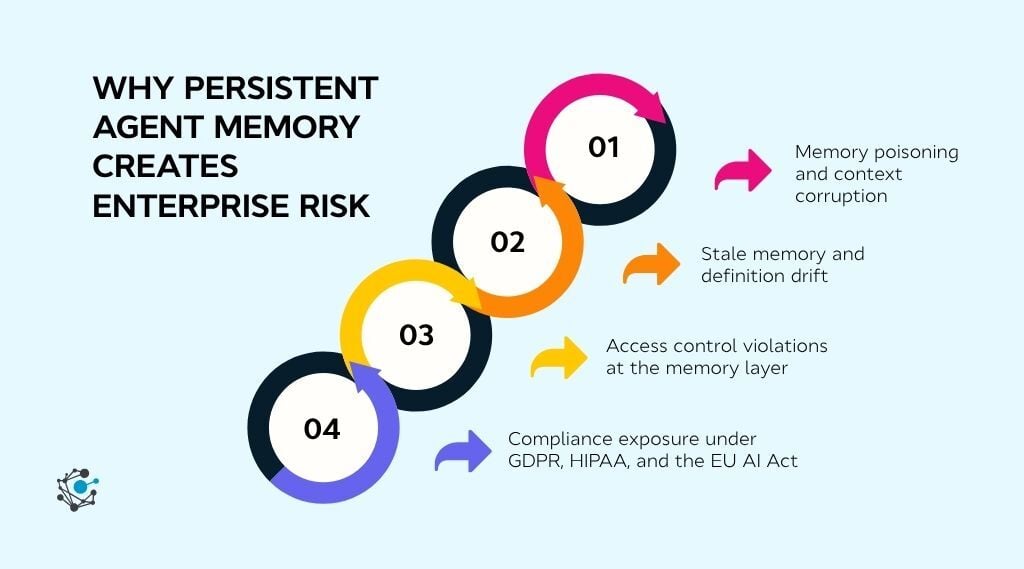
Why persistent agent memory creates enterprise risk
A stateless chatbot can produce an incorrect answer once, and the error disappears when the session ends. An agent with ungoverned persistent memory can store that incorrect answer, retrieve it in future sessions, and treat it as verified fact. The error compounds silently with every subsequent interaction that references it.
Gartner's 2026 agentic AI research predicts that 40% of enterprises will demote or decommission autonomous AI agents by 2027 because governance gaps surface only after production incidents occur, and ungoverned persistent memory is precisely the type of gap that follows that pattern.
Memory poisoning and context corruption
An agent can store an incorrect answer (from a hallucination, a compromised source, or a prompt injection attack) into persistent memory. Every future session then retrieves that corrupted entry as a fact, compounding the original error across every downstream interaction.
Detection is particularly difficult because poisoned memory entries appear benign in isolation. The corrupted entry looks like any other stored fact, and the agent retrieves it with the same confidence it applies to verified information. The impact only surfaces through degraded output quality over weeks or months of accumulated interactions, long after the original corruption event.
Stale memory and definition drift
Enterprise definitions, policies, and data change regularly. Agent memory does not automatically update when the source changes. An agent that learned "active customer means a customer who purchased within the last 12 months" six months ago may continue applying that definition even after the business updated it to a 6-month window.
Without freshness signals or expiration controls, memory entries become silently outdated while the agent continues operating with full confidence on stale context. Detecting staleness requires connecting memory entries to their upstream sources through an enterprise context graph that tracks when definitions, policies, or source data change, so derived memory entries can be flagged or expired accordingly.
Access control violations at the memory layer
Agents with shared memory scopes can surface one user's data to another user who lacks authorization to view it. Many deployed systems rely on shared API keys for agent-to-agent authentication, which creates a shared memory scope by default.
Content written into memory during an elevated-permission interaction can later be retrieved by a lower-permission user if the memory store lacks identity-aware access controls. When access controls stop at the source system and do not extend to the memory store, the memory layer becomes an unintended path for unauthorized data exposure.
Compliance exposure under GDPR, HIPAA, and the EU AI Act
Regulatory frameworks do not exempt agent memory from their requirements:
|
Regulation |
Specific requirement |
Memory governance implication |
|
General Data Protection Regulation (GDPR) |
Article 17 requires erasure of personal data on request |
Memory stores must support identification, retrieval, and deletion of personal data entries |
|
Health Insurance Portability and Accountability Act (HIPAA) |
Protected Health Information (PHI) requires audit logging and 5 to 7 year retention |
Agent memory containing patient data needs structured retention and access logging |
|
European Union Artificial Intelligence Act (EU AI Act) |
Articles 12 and 13 require automatic event logging with traceability for high-risk systems |
Memory reads and writes must produce audit trails connecting decisions to source data |
Enforcement timelines are already in effect or approaching. EU AI Act high-risk system obligations take effect August 2, 2026. Most memory store implementations do not natively support erasure, retention controls, or audit trails at the granularity these regulations demand.
At OvalEdge, we believe regulatory obligations extend to agent memory, as it stores enterprise data.
Organizations that govern their data warehouses and analytics platforms already understand these obligations. The challenge is extending the same controls to a new data surface.
Five pillars of an agent memory governance framework
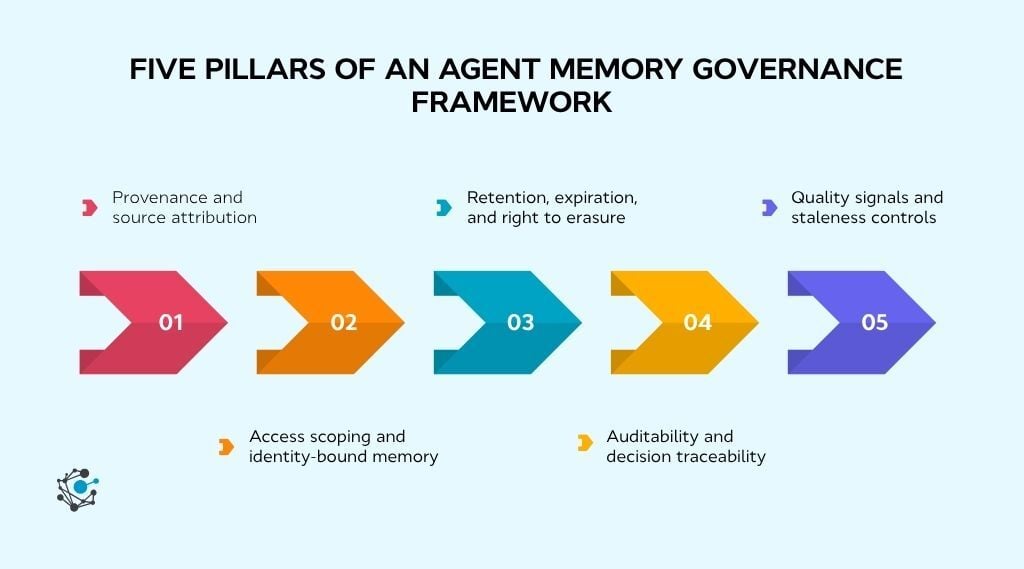
An effective agent memory governance framework rests on five pillars. Each pillar addresses a specific risk that autonomous AI agents create when they persist memory across sessions, and each maps to enforceable enterprise AI governance requirements:
-
Provenance and source attribution enable targeted rollback when memory entries derive from compromised or incorrect sources.
-
Access scoping and identity-bound memory prevent cross-user data leakage at the memory layer.
-
Retention, expiration, and right to erasure enforce regulatory-aligned lifecycle controls on every memory entry.
-
Auditability and decision traceability allow reconstruction of what the agent knew at the point of any consequential decision.
-
Quality signals and staleness controls ensure agents prefer current, verified entries over outdated or unverified ones.
1. Provenance and source attribution
Every memory entry should carry provenance metadata documenting where the information came from, when the agent wrote it, which agent or user authored it, and under what authority. Provenance enables targeted rollback: if a source is later found to be compromised or incorrect, all memory entries derived from it can be identified and quarantined through data lineage tracing the derivation chain.
Without provenance, remediation after memory poisoning requires a full memory audit because no metadata connects individual entries to their origins. EU AI Act Article 12 reinforces provenance as a regulatory requirement by mandating traceability to source data for high-risk systems.
2. Access scoping and identity-bound memory
Memory must be partitioned by identity scope: user-level, team-level, and organization-level. An individual user's memory entries should never be retrievable by another user unless an explicit sharing policy authorizes it. Access policies from the source data must propagate to the memory store with the same enforcement rigor applied at the source system.
Identity-bound memory prevents cross-user data leakage and supports GDPR's purpose limitation requirements. Multi-agent systems require additional scoping to prevent agents from inheriting inappropriate context from other agents operating under different permission sets.
3. Retention, expiration, and right to erasure
Every memory entry needs a retention policy defining how long it persists, when it expires, and under what conditions the system deletes it. Time-to-live (TTL) controls limit the persistence window for any entry, reducing both staleness risk and compliance exposure.
Erasure controls must support GDPR Article 17 (right to deletion) and extend to all memory types rather than only the source system. Retention rules should align with the regulatory requirements specific to the data being stored: HIPAA requires 6 to 7 year retention for PHI-adjacent logs, while Sarbanes-Oxley Act (SOX) requires 7 years for financial records.
4. Auditability and decision traceability
When an agent makes a consequential decision, the organization must be able to reconstruct what the agent "knew" at decision time. Audit logs should capture which memory entries the agent retrieved, which policies were active, what sources informed the response, and what output the system generated.
EU AI Act Article 12 requires automatic event logging for high-risk AI systems. Decision traceability also supports internal accountability: if an agent-driven decision is challenged, the audit trail must demonstrate that the decision followed from governed, current, and authorized information.
Key insight: Decision traceability depends on the same lineage infrastructure that governs analytics. Organizations already tracing dashboard metrics to source data can extend that lineage model to trace agent decisions to the memory entries and policies that informed them.
5. Quality signals and staleness controls
Memory entries should carry quality signals including confidence scores, freshness indicators, and verification status. Staleness detection requires linking every memory entry to its source so the system flags or automatically expires derived entries when the source changes. Quality-weighted retrieval ensures agents prefer recent, verified entries over older or unverified ones during memory lookups.
Without quality signals, the agent treats a six-month-old entry derived from a hallucination with the same confidence as a freshly verified fact drawn from a certified data lineage chain. Quality signals convert agent memory from a passive accumulation of data into an actively governed knowledge base.
Why memory governance starts with the data governance foundation
Most memory governance conversations focus on the memory store itself: how to version it, scope it, expire it. The more consequential question is what enters the memory store in the first place, and whether the enterprise has governed definitions, trusted sources, and enforced policies upstream. Without that foundation, memory governance is control applied to content that was never verified at the point of entry.
According to Gartner's 2024 data and analytics governance forecast , 80% of governance initiatives will fail by 2027 due to insufficient business-centric urgency.
Memory governance compounds that projection because agents store and act on whatever governance signals they encounter upstream, feeding ungoverned content directly into persistent memory when definitions, quality standards, and ownership structures are missing.
Governed definitions prevent conflicting memory
When an agent stores a business fact like "customer churn rate is 8.2%," that entry is only trustworthy if the underlying definitions of "customer," "churn," and "rate" are governed and consistent across the organization.
Without a governed business glossary connected to the agent's data sources, the same agent can store conflicting definitions across sessions because different sources use the same term with different meanings.
A governed glossary acts as the disambiguation layer for agent memory. It prevents the agent from writing "revenue equals net" from one source and "revenue equals gross" from another into memory as equally valid facts. Conflicting memory is a symptom of ungoverned definitions upstream.
Lineage and ownership as memory trust signals
Every memory entry derives from a source. Data lineage tracks that derivation chain from the original data asset through the retrieval or interaction that produced the memory write. When a source changes, lineage enables the organization to identify every memory entry derived from it and flag those entries for review or automatic expiration.
Ownership metadata identifies who is accountable for the underlying data. If the agent stores a fact from an unowned, uncertified source, that fact carries no accountability and no one to escalate to when questions arise.
From governed assets to governed memory
Governance was historically consumed by humans: analysts read glossary definitions, stewards reviewed quality issues, and data owners approved access requests. Agentic AI systems now also consume governance metadata, requiring the same information in a machine-readable format that the agent can interpret at write time and retrieval time.
Agent memory governance is data governance extended to a new consumer, requiring the same governance foundation rather than a parallel program built from scratch.
Operationalizing that shift means connecting the governance layer to the agent's runtime environment, whether through APIs, MCP-based context protocols, or direct platform integration. Governed memory depends on governed assets upstream.
The definitions, lineage, quality scores, ownership records, and policy controls that mature organizations already maintain for structured data need to reach the agent's memory layer through integration rather than duplication.
How to build an agent memory governance framework: a practical checklist
The checklist below follows an intentional sequence: visibility first (inventory and classify), then controls (provenance, scoping, retention), then accountability (audit trails, lineage linking), then integration with the existing governance foundation.
Each step maps to a risk or pillar covered earlier in the guide.
-
Inventory what agents store: Audit every deployed agent's memory to document what types of information the agent writes, from which sources, at what volume, and with what retention behavior. Most organizations lack visibility into what their agents have accumulated.
-
Classify memory by sensitivity: Apply the same data classification policies used for structured data assets. Personally Identifiable Information (PII), PHI, financial data, and confidential content in memory carry the same regulatory obligations they carry in any other data store.
-
Attach provenance to every memory write: Require source attribution, timestamp, authoring identity, and authority metadata for every entry written to memory. Provenance is what makes memory correctable after a poisoning or corruption event.
-
Scope memory by identity: Partition memory by user, team, and organization. Verify that no cross-user memory leakage exists in current deployments, especially in systems using shared API keys for agent authentication.
-
Set retention and expiration policies: Assign TTL values aligned with the regulatory requirements for the data types being stored. Automate expiration and support manual erasure to satisfy GDPR Article 17 requests.
-
Link memory entries to source lineage: When the source changes, memory entries derived from it should be flagged for review or expired. Without the lineage link, stale memory remains undetectable until it causes a downstream error.
-
Log every read and write: Build an audit trail that captures which entries the system wrote, retrieved, and acted upon, with timestamps, identity context, and the policies that were active at the time. Design the logging architecture for regulatory defensibility from the start.
-
Extend existing governance to the memory layer: Connect the organization's existing glossary, lineage, quality, and policy controls to the memory layer through integration. Adding memory-specific controls (TTL, identity scoping, provenance) on top of that foundation avoids the cost and drift of building a parallel governance program.
Key insight: Organizations that are already invested in catalog, glossary, lineage, and quality infrastructure hold the strongest starting position for memory governance because the foundation they need already exists as an operational layer they can extend.
Conclusion
The five pillars of memory governance, provenance, access scoping, retention, auditability, and quality signals, map directly to governance fundamentals that mature organizations already practice for structured data. Agent memory introduces a genuinely new data surface, but the governance disciplines required to manage it are established and operational in most enterprise data programs.
Governance leaders should begin by assessing whether their existing governance controls, including glossary definitions, lineage, quality standards, and access policies, currently reach the agent memory layer. The answer determines whether memory governance requires new infrastructure or an extension of what already operates.
OvalEdge helps organizations close that gap by connecting glossary, lineage, quality, and policy controls into a unified governance layer that extends to both human and agent consumers of enterprise data.
Ready to see how your existing governance foundation extends to the agent memory layer?
Schedule a demo to explore how OvalEdge connects metadata, lineage, and policy controls to the data surfaces your AI agents depend on.
.png?width=1081&height=173&name=Forrester%201%20(1).png)
.png?width=1081&height=241&name=KC%20-%20Logo%201%20(1).png)