-Sep-07-2026-09-38-34-7946-AM.png)
Every engineering team building a retrieval pipeline eventually reaches the same decision point: which framework will carry it? The choice shapes how quickly a team ships, how the pipeline scales, and how much it costs to maintain.
Enterprise intent to adopt hybrid retrieval tripled from 10.3 percent to 33.3 percent in the first quarter of 2026, even as 22 percent of enterprises still ran no production RAG system at all, according to VentureBeat's VB Pulse survey data.
Framework choice drives a real share of that shift, since teams rebuilding retrieval often start by re-evaluating the framework underneath it. Four frameworks that compete for this decision are: LangChain and LangGraph, LlamaIndex, Haystack, and DSPy.
Picking the right framework gets a retrieval pipeline built. It does not decide whether what that pipeline retrieves can be trusted, and that gap gets covered directly near the end.
Here's what this guide covers: a profile of each framework against the same five criteria, a side-by-side look at open source versus enterprise licensing, and a decision table mapped to specific use cases.
What is a RAG framework?
A RAG framework is a software library that orchestrates the moving parts of a retrieval-augmented generation pipeline, connecting to a vector store or search index, retrieving relevant content, and passing that content to a language model to generate an answer. It handles the wiring between components, not the storage or the model itself.
A RAG framework is not the same as a vector database. A vector database stores and searches embeddings, while a framework decides how and when to call that database, how to chain retrieval steps together, and how to hand results to the model.
A RAG framework also differs from a managed RAG platform, which hosts the entire pipeline end to end. Frameworks give engineering teams the orchestration layer while letting them plug in their own storage, embedding models, and language models.
For teams building retrieval-augmented generation on their own infrastructure, the framework is the layer that turns disconnected pieces- vector stores, embedding models, and LLMs- into a working retrieval pipeline.
RAG frameworks comparison table
The table below lines up all four frameworks against the factors that matter most for a production decision.
|
Framework |
License |
Best for |
Retrieval focus |
Orchestration depth |
Vector stores supported |
|
LangChain / LangGraph |
MIT |
Multi-step, tool-using agents |
Moderate, extensible through hundreds of integrations |
High, LangGraph adds durable, resumable state |
Pinecone, Weaviate, Chroma, Qdrant, pgvector, and most major stores |
|
LlamaIndex |
MIT |
Document-heavy Q&A, retrieval accuracy |
High, purpose-built indexing and query engines |
Moderate, agent workflows layered on top of retrieval |
Pinecone, Weaviate, Milvus, Qdrant, and most major stores |
|
Haystack |
Apache 2.0 |
Regulated, auditable pipelines |
High; every pipeline step is inspectable |
Moderate, agents run as one component type |
Elasticsearch, OpenSearch, Weaviate, Qdrant, Pinecone |
|
DSPy |
MIT |
Teams optimizing prompts programmatically |
Moderate, retrieval is a configurable module |
Low to moderate, optimization-first rather than agent-first |
ColBERTv2, plus most stores through community integrations |
What are the 5 criteria for evaluating a RAG framework?
Evaluating a RAG framework comes down to five factors, each one shaping how well the framework fits your pipeline today and a year from now.
1. Retrieval strategy flexibility
A framework should support more than one retrieval method: dense vector search, sparse keyword search, and hybrid retrieval that blends both. Hybrid retrieval gained ground fast through 2026, and a framework locked into one method limits how far a team can tune accuracy later.
2. Orchestration and agentic depth
Some pipelines need a single retrieve-then-generate pass. Others need multi-step reasoning, tool calls, and conditional branching between steps. A framework built for simple pipelines can struggle once a team adds agentic behavior, so orchestration depth matters even when the first use case looks straightforward.
3. Vector store integrations
Every framework connects to vector stores differently, and the depth of that connection affects migration cost later. Narrow store support can lock a team into one vendor's pricing and performance characteristics long after the initial choice.
4. Licensing and deployment
Open source licensing tells only part of the cost story. Some frameworks separate a free core from a paid server, observability layer, or managed platform, and that split changes the total cost of running a pipeline in production.
5. Production readiness
A framework needs tracing, error handling, and retry logic that hold up under real traffic, not a clean demo. Community size and release cadence are rough proxies for how quickly bugs get fixed, and new model providers get supported.
OvalEdge expert insight: Licensing and vector store lock-in decisions are hard to reverse once a pipeline reaches production. Teams that skip this step during evaluation often re-platform within a year.
RAG frameworks compared in depth
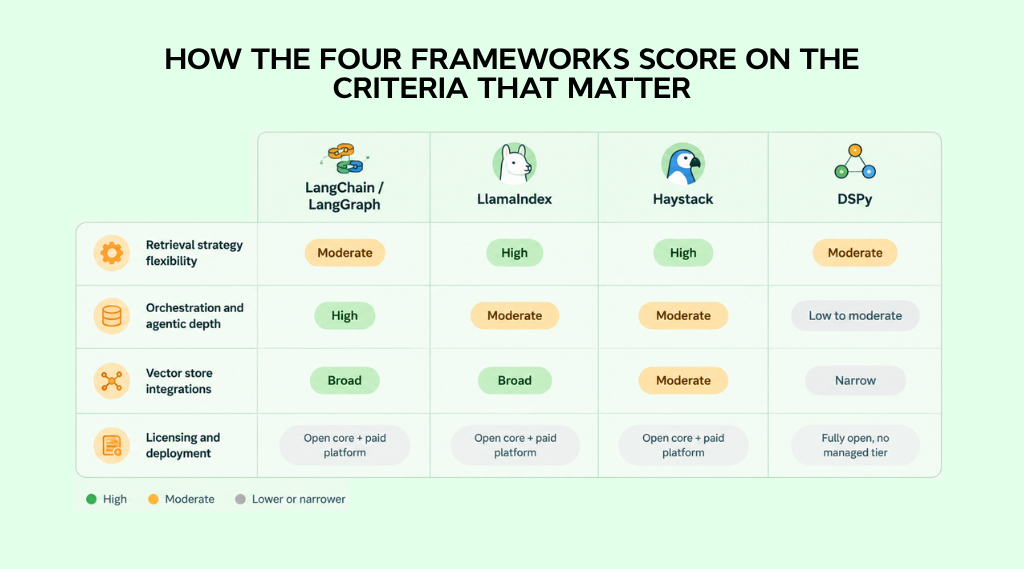
The profiles below use the same criteria from the section above, so a reader can scan for the one that matters most to a specific use case instead of reading through every profile in full.
LangChain and LangGraph
LangChain ships under an MIT license and carries the largest ecosystem of the four, with connectors for hundreds of vector stores, document loaders, and model providers. Its breadth makes it the default starting point for teams who are not yet sure which integrations they will need.
LangGraph extends LangChain with durable, resumable state for multi-step agentic workflows. A LangGraph agent can pause mid-task, wait for human approval, and resume exactly where it left off, which matters for workflows involving conditional branching or a human-in-the-loop step.
The LangGraph and LangChain-core libraries stay MIT-licensed, though the hosted LangGraph Platform and its production server component run under a separate commercial license, a detail worth checking before assuming the entire deployment stack is free.
Teams building agents that call multiple tools, loop, or wait on external input tend to land here first.
LlamaIndex
LlamaIndex, also MIT-licensed, takes the opposite starting point from LangChain. Instead of building outward from orchestration, it builds outward from the index itself: how documents get chunked, embedded, and organized into query engines that answer questions accurately.
Community benchmarks and practitioner comparisons regularly point to LlamaIndex as the leaner, faster option for document-heavy Q&A, since a purpose-built index adds less overhead per query than a general orchestration layer retrofitted for retrieval. It also typically needs less code to reach a working RAG pipeline than LangChain does for the equivalent task.
For teams whose primary problem is retrieval accuracy rather than complex agent behavior, LlamaIndex usually gets there with less setup.
Haystack by deepset
Haystack, maintained by the Berlin-based company deepset, runs under an Apache 2.0 license. Its defining trait is a modular pipeline design where every component- retriever, ranker, generator- works as a separate, inspectable unit connected through typed sockets.
Teams that need to show exactly where a pipeline failed value this design most, rather than treating the pipeline as a black box. A retriever returning the wrong document, a ranker demoting the right one, or a generator hallucinating past good context each traces back to a specific component instead of getting buried inside one opaque chain.
Regulated industries and public sector deployments favor Haystack for exactly this reason: an auditable pipeline is a requirement there, not a preference.
DSPy
DSPy comes from Stanford's NLP group under an MIT license and takes a fundamentally different approach from the other three. Instead of hand-writing prompts, a developer defines a signature, the input and output a step should produce, composes signatures into modules, and lets an optimizer compile the whole program into tuned prompts and few-shot examples.
Retrieval in DSPy works as one configurable module rather than the framework's central focus, which makes it less of a natural fit for teams whose main problem is indexing large document sets. Its strength shows up when prompt quality, not retrieval mechanics, is the bottleneck holding a pipeline back.
Teams comfortable treating prompting as an optimization problem, with a labeled training set and a metric to optimize against, get the most out of DSPy's compile step.
OvalEdge expert insight: GitHub stars and ecosystem size are easy to compare and easy to over-weight. The framework that fits a team's actual production requirements,
The question of what data feeds these four frameworks connects directly to context engineering, and it resurfaces later in this guide.
Open source vs. enterprise RAG frameworks
Each framework's open source core maps to a different managed layer, and that mapping decides where it fits an enterprise deployment.
|
Open source core |
Managed layer |
Enterprise fit |
|
|
LangChain / LangGraph |
MIT-licensed core framework |
LangGraph Platform and LangSmith, paid tiers |
Strong for teams already invested in the ecosystem and willing to pay for hosted orchestration |
|
LlamaIndex |
MIT-licensed core framework |
LlamaCloud, credit-based pricing |
Strong for document-heavy retrieval, lighter agent orchestration needs |
|
Haystack |
Apache 2.0-licensed core framework |
Haystack Enterprise Platform, observability and governance add-ons |
Strong for regulated industries needing inspectable, auditable pipelines |
|
DSPy |
MIT-licensed, community-maintained |
No official managed platform as of mid-2026 |
Requires in-house ML engineering to run and maintain optimizer compiles |
Open source licensing does not remove cost from a RAG pipeline. It shifts cost from license fees to engineering headcount. Teams running any of these frameworks eventually need someone on call for the retrieval pipeline in production, and that break-even point, not the license itself, usually decides when a team moves to a managed tier.
At OvalEdge, we believe the framework decision matters less over time than the governance decision behind it. Teams that get licensing and support right but skip building a connected context layer still feed their pipeline unreliable information.
RAG architecture: Where the framework fits
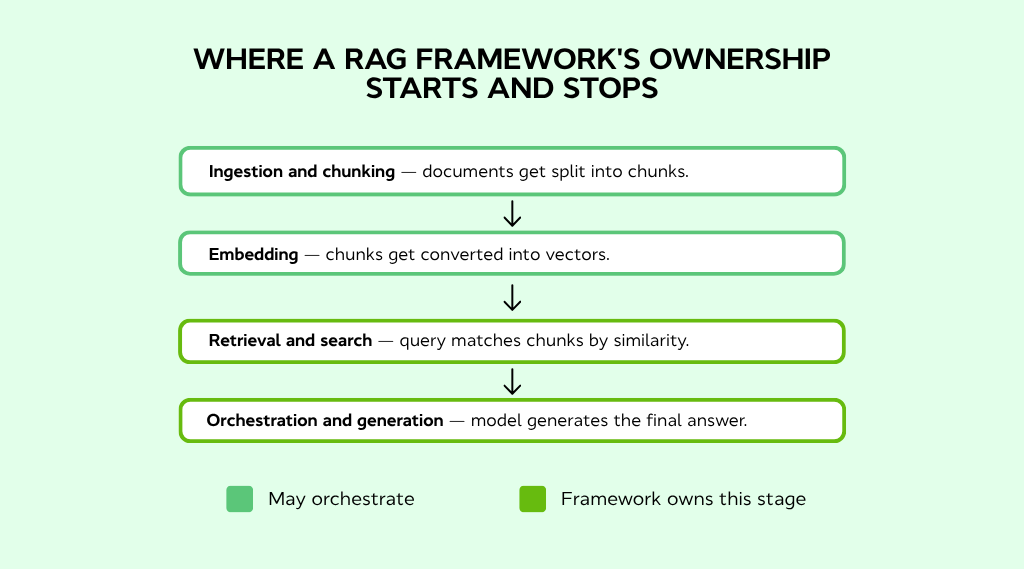
Every RAG pipeline moves through four distinct stages, and a framework only owns part of that journey. Seeing the full picture clarifies where its responsibility starts and ends.
Here are the four stages:
1. Ingestion and chunking
2. Embedding
3. Retrieval and search
4. Orchestration and generation
A framework's job is to own stages three and four, and it often orchestrates the first two as well. Deciding what data enters the pipeline, how it gets classified, and who is allowed to see it happens upstream of any framework, and no framework decides that on its own.
Three architectural patterns show up across production deployments. Naive RAG runs a single retrieve-then-generate pass and works well for straightforward Q&A. Agentic RAG adds multiple steps, tool use, and conditional branching; the pattern LangGraph and DSPy serve directly.
GraphRAG retrieves over a knowledge graph rather than flat vector similarity, which matters when the relationships between entities carry more signal than semantic closeness alone, tracing a metric to its definition, source table, and owner in one pass instead of several.
OvalEdge expert insight: Architecture diagrams rarely show where governance belongs in the pipeline, yet ingestion and classification decisions made upstream determine most of what a framework can retrieve safely downstream.
For a closer look at how relationship-aware retrieval works in practice, see knowledge graph tools for enterprise AI.
Which RAG framework should you choose?
Match your situation to the row that fits, then start there. The table below maps five common starting points to the framework built for that exact job.
|
If you are |
Start with |
Why |
|
Building multi-step, tool-using agents |
LangGraph |
Durable, resumable state and conditional branching are built for exactly this pattern |
|
Doing document-heavy Q&A where retrieval accuracy is the priority |
LlamaIndex |
Purpose-built indexing and query engines add less overhead per query than a general orchestration layer |
|
In a regulated industry needing auditable pipelines |
Haystack |
Modular, inspectable components trace failures to a specific step instead of a black box |
|
Comfortable treating prompting as an optimization problem |
DSPy |
Compiled, optimizer-tuned prompts outperform hand-tuned ones once a labeled dataset exists |
|
Already deep in one cloud ecosystem |
The cloud's native RAG service first |
Bedrock Knowledge Bases, Azure AI Search, or Vertex AI Search reduce integration overhead before a separate framework earns its cost |
At OvalEdge, we believe most teams over-index on the framework decision and under-index on what feeds it. A framework choice is reversible within weeks of engineering time. The context feeding a poorly governed pipeline does not get fixed by swapping frameworks.
Teams building the agent pattern in the first row should also see how agentic analytics applies the same governance requirement to autonomous decision-making.
What can a RAG framework not fix on its own?
A framework retrieves exactly what the index tells it to retrieve. If the index holds a superseded metric definition, an unpermitted record, or a stale policy document, the framework returns it with the same confidence as a correct answer.
None of the four frameworks profiled above catches this on its own, because the failure lives in the index, not the retrieval code.
Four gaps fall outside what any framework can see in the text it retrieves:
1. Trust: Which version of a duplicated table or document is the certified one.
2. Freshness: Whether a definition or figure was superseded last quarter.
3. Permission: Whether the specific requester is cleared to see this specific row.
4. Meaning: Whether a term like "active customer" here matches the definition finance uses elsewhere.
For example, a LangChain pipeline retrieving a "churn rate" definition that finance updated last quarter, but the vector index has not refreshed, will confidently return the outdated number.
An Enterprise Context Graph operates upstream of whichever framework a team chooses, supplying the freshness signals, ownership records, and permission awareness that framework has no way to derive from the text alone.
For analytical use cases like churn analysis, forecasting, or fraud detection, that context decides whether a confident answer is also a correct one. The relationship is complementary, not competitive. An Enterprise Context Graph does not replace LangChain or LlamaIndex. It determines what those frameworks are allowed to retrieve and how current that content is.
Platforms like OvalEdge operate upstream of the framework, exposing an Enterprise Context Graph through MCP that supplies the freshness, lineage, and permission signals a retrieval pipeline cannot generate on its own.
Teams evaluating AI agent metadata platforms face the same underlying question framework selection raises: who governs the context an agent trusts.
Conclusion
Four frameworks solve orchestration well today: LangChain and LangGraph for multi-step agents, LlamaIndex for retrieval-heavy document Q&A, Haystack for auditable, regulated pipelines, and DSPy for teams optimizing prompts programmatically. They differ mainly on retrieval focus, orchestration depth, and licensing, not on whether they can move data from a store to a model.
The framework decision is reversible within weeks of engineering time. The governance decision behind it- what gets ingested, how it stays current, and who is allowed to retrieve it - compounds with every pipeline built on top of it.
Ready to see how a governed context layer keeps every framework working from trusted, current data?
Book a demo with OvalEdge and see how an Enterprise Context Graph supplies the freshness, lineage, and permission signals your retrieval pipeline depends on.
.png?width=1081&height=173&name=Forrester%201%20(1).png)
.png?width=1081&height=241&name=KC%20-%20Logo%201%20(1).png)