Agentic analytics is an approach to data intelligence where autonomous AI agents continuously monitor business signals, interpret changes in context, and take approved actions without waiting for a human to query a dashboard or run a report.
Most enterprise teams already have dashboards and data pipelines in place. The gap is not visibility. It is the lag between seeing a signal and doing something about it. Agentic analytics closes that gap by shifting analytics from a passive reporting function to an active decision system, one where agents detect anomalies, reason through the data, and trigger actions within governance boundaries.
This guide covers how agentic analytics works, what the five-layer architecture requires to function reliably, and what needs to be in place before enterprises can trust it in production.
What is agentic analytics, and how does autonomous data intelligence work?
Agentic analytics is a form of data intelligence where AI agents autonomously monitor data streams, detect patterns or anomalies, reason about results using business context, and take approved actions with minimal human intervention.
Unlike traditional BI, which answers questions users already know to ask, agentic analytics surfaces insights proactively and routes them into decision workflows. The system operates within governance boundaries that define what data agents can access, what actions they can take, and what gets logged for compliance.
Gartner's 2026 Market Guide defines agentic analytics as software that applies AI agents across the data-to-insight workflow, orchestrating tasks semi-autonomously or autonomously toward stated goals. The must-have capabilities include data source connectivity, data preparation, agent workflow orchestration, automated insights, and natural language query.
Three continuous motions distinguish this approach from static reporting:
-
Signal interpretation: agents monitor data streams to detect changes, anomalies, or emerging patterns as they happen.
-
Contextual understanding: agents interpret each signal using metric definitions, historical patterns, and data lineage to ensure the insight reflects how the business defines and uses data.
-
Decision execution within boundaries: agents recommend or take action based on predefined policies, keeping automation controlled, auditable, and aligned with business rules.
Together, these motions move analytics from detection to interpretation to action without waiting for manual intervention.
How enterprise analytics evolved to agentic decision-making
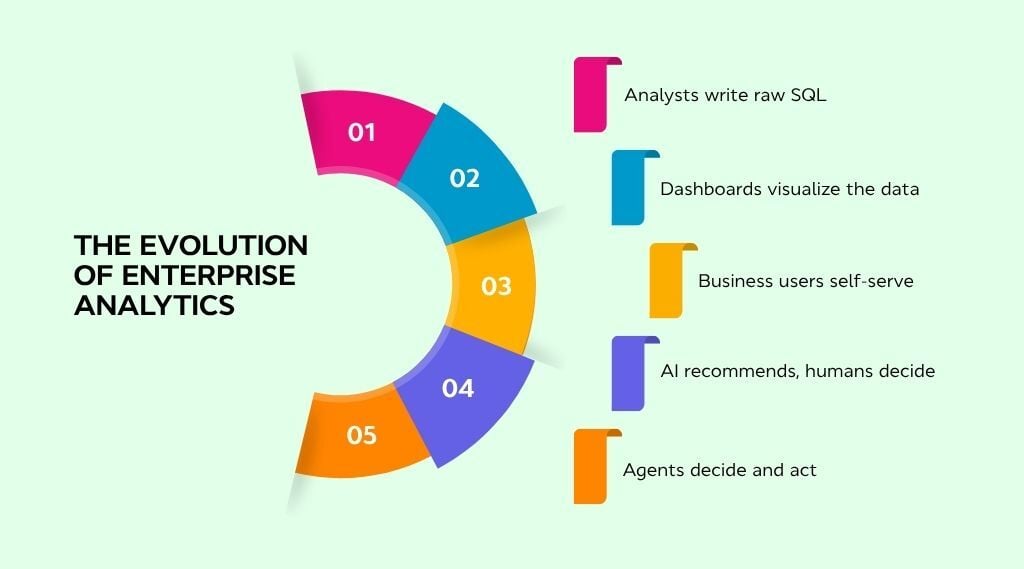
Agentic analytics builds on decades of analytics maturity:
-
Manual SQL: analysts queried databases directly to answer specific questions.
-
BI dashboards: data was visualized for reporting; humans interpreted results.
-
Self-service BI: business users explored data without relying on analysts.
-
Augmented analytics: AI surfaced insights and recommendations, though humans still made every decision.
-
Agentic analytics: AI agents act on insights autonomously, within defined governance boundaries.
Each stage reduced the effort required to get from data to decision. Agentic analytics closes the gap between insight and action entirely for repeatable, time-sensitive decisions.
How agentic analytics compares to augmented analytics and traditional BI
Augmented analytics uses AI to assist human analysts. It automates data preparation, suggests visualizations, surfaces anomalies, and recommends next steps. The human remains in control of every decision. Most modern BI platforms with natural language query (NLQ) capabilities fall into this category.
Agentic analytics goes further. The agent monitors data continuously, reasons through multi-step investigations, and executes actions within defined governance boundaries. The human role shifts from driving every decision to defining policies and reviewing exceptions.
The difference is operational. Augmented analytics makes analysts faster. Agentic analytics enables decisions that happen without an analyst in the loop, within controlled boundaries.
|
Capability |
Traditional BI |
Augmented Analytics |
Agentic Analytics |
|
Primary function |
Reporting and visualization |
AI-assisted insight discovery |
Continuous decision execution |
|
When it runs |
On demand or scheduled |
On demand |
Continuously |
|
Human involvement |
Drives every step |
Makes the final decision |
Reviews exceptions only |
|
Governance |
Applied to data access |
Applied to data access |
Embedded into every action |
|
Best for |
Historical reporting |
Analyst productivity |
Enterprise decision automation |
The distinction matters because many teams assume adding a chatbot to their dashboard constitutes agentic analytics. A chatbot answers the question asked. An agentic system identifies which question should be asked, investigates it, and acts on the answer.
The five-layer architecture that powers enterprise agentic analytics
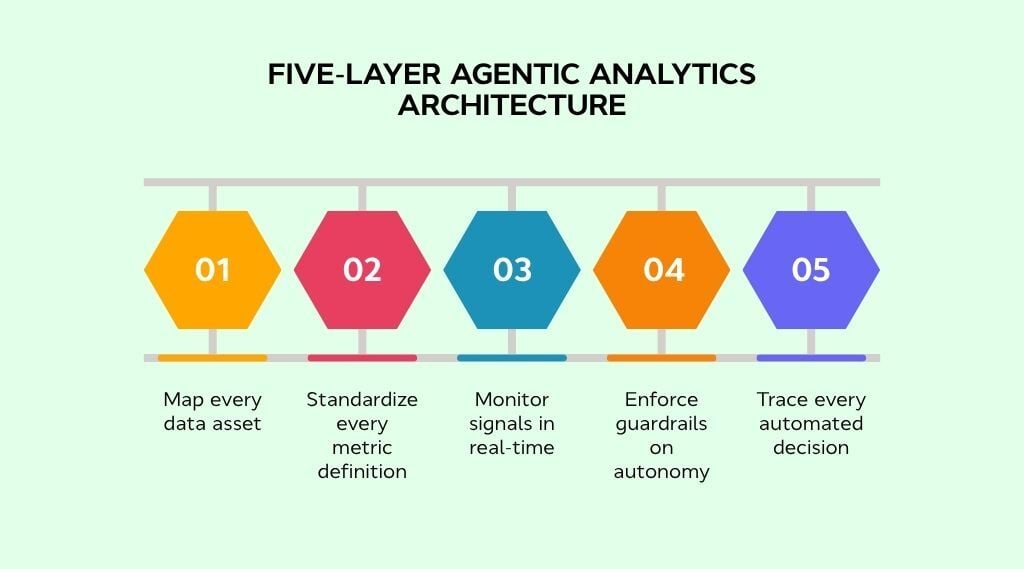
Agentic analytics is not a single feature. It is a system built on interconnected layers that ensure AI agents interpret data correctly, act within defined boundaries, and improve over time.
1. Data and metadata foundation
Every agentic system starts with a clear map of what data exists, what it represents, how it moves, and who owns it. A centralized data catalog with documented definitions, ownership, lineage, and usage context provides this foundation.
Without metadata, agents access raw tables without business meaning and produce outputs that are technically correct but operationally misleading. The metadata layer ensures meaning travels with the data.
2. Semantic and business logic layer
Agents require consistent definitions to interpret data correctly. In many enterprises, metrics like revenue or churn are defined differently by each team.
A governed business glossary resolves this by establishing a single, approved definition for every metric, dimension, and business term. Without it, agents retrieve conflicting answers and either pick one arbitrarily or surface the conflict.
3. Continuous monitoring and signal detection
Agentic systems observe business signals in real time rather than relying on scheduled reports. These signals include customer behavior, transaction patterns, inventory changes, and operational metrics. Agents detect when signals cross thresholds or deviate from expected patterns, enabling proactive response before the issue shows up in a quarterly review.
4. Decision boundary and policy enforcement
Autonomous decisions require clearly defined guardrails. This layer governs what agents can access, what actions they can take, and when escalation is required.
-
Data access permissions define which datasets and fields the agent can query.
-
Allowed actions define the range of responses available (alert, adjust, escalate).
-
Escalation thresholds define when the decision is too complex or high-risk for autonomous handling.
This is governed autonomy: matching the level of automation to the level of risk.
5. Audit trail and explainability
Every decision must be traceable. This layer captures what triggered the action, what data was used, what rules applied, and what outcome was produced.
Each decision is linked through data lineage, showing how data flowed from source to action. Automated column-level lineage derived from source code parsing maps these flows without manual effort, reading SQL, ETL, BI reports, and application code directly to produce ground-truth lineage rather than inferred approximations.
This transparency is what makes agentic analytics auditable at enterprise scale.
Why the semantic layer makes or breaks enterprise agentic analytics
The semantic layer has emerged as the single most discussed prerequisite for reliable agentic analytics. The reason is architectural: Model Context Protocol (MCP) gives agents a way to connect to data systems, but connection is not context.
Without a governed semantic layer underneath, MCP retrieves raw tables and fields that carry no business meaning, no ownership, and no certified definitions.
If three teams define "active customer" differently, the agent that retrieves all three definitions will produce outputs that look correct to each team individually but contradict each other when compared.
A governed semantic layer resolves this before the agent encounters the data. It maps every business term to the specific data assets, tables, and calculations it represents. The agent does not guess which revenue figure is authoritative. It uses the one that has been defined, approved, and certified.
Retrieval finds content. Governance determines which content is trusted. A governed semantic layer addresses this by continuously linking ontology, glossary, lineage, catalog, quality, and policy into a single evolving knowledge structure.
Platforms like OvalEdge operationalize this through an enterprise context graph, where AI agents such as Lingo (glossary building), Nexus (ontology creation), and Notary (data certification) continuously refine the structure so definitions stay current as the business evolves.
Without this layer, better retrieval only retrieves confusion faster.
How enterprises layer agentic analytics on top of existing BI systems
Most organizations do not replace their BI systems when adopting agentic analytics. They layer it on top.
BI continues to provide reporting, visibility, and historical analysis. Agentic analytics extends this by continuously monitoring data, detecting signals, and triggering actions within governance boundaries. The dashboards remain. The reliance on them for time-sensitive decisions decreases.
Bedrock, a commercial real estate firm managing over 21 million square feet across Detroit and Cleveland, built a governed data foundation before introducing automation.
With a lean governance team and multiple departments creating different versions of the same reports, the company used OvalEdge to standardize business definitions through a governed glossary, connect those definitions to catalog and lineage, and consolidate siloed reports into a single source of truth.
Auto-lineage alone replaced months of manual data flow mapping, giving the team the transparency needed to fix data quality issues at the source rather than downstream.
This layered approach reduces risk. Teams automate decisions without disrupting workflows that already work.
What agentic analytics looks like in a real-time enterprise decision workflow
Consider a financial services team that runs daily liquidity risk reports sourced from multiple upstream systems. A data quality rule is configured: if null rates in a key input field exceed 2%, or if record counts deviate more than 10% from the historical baseline, the system should flag the issue before the report runs.
On a Tuesday morning, the anomaly detection layer identifies that a source system feed delivered 30% fewer records than expected overnight. Rather than letting the incomplete data flow silently into the liquidity report, the system fires an alert and routes it to the assigned data steward through the configured notification channel.
The steward opens the alert and sees the full context: which data quality rule failed, which source table was affected, and a lineage trace showing every downstream report, dashboard, and metric that depends on that table. Instead of spending hours manually mapping the blast radius, the lineage graph shows it immediately: three dashboards, one regulatory report, and two downstream aggregation tables are affected.
The steward pauses the downstream refresh, coordinates with the source team to resolve the feed issue, and marks the incident as remediated. The entire sequence, from detection to containment, completes before the liquidity report would have run with bad data.
Where different enterprise roles see measurable value from agentic analytics
Agentic analytics does not impact every team the same way. Its value depends on the decisions each role is responsible for and the governance requirements those decisions introduce.
Data and analytics leaders benefit from reduced repetitive analysis. Agents handle common queries and pattern detection, freeing teams for data strategy. The key risk is metric drift, which is why a governed glossary and catalog matter more in agentic environments than traditional ones.
Operations teams move from periodic reporting to continuous monitoring. Agents track KPIs in real time and trigger alerts when thresholds are crossed. Clear decision boundaries prevent faster response from introducing operational risk.
Compliance and risk teams require every automated decision to be traceable: what triggered it, what data was used, what rules applied, and what action followed. A built-in audit trail with full lineage is what makes agentic analytics viable in regulated industries like financial services and healthcare.
Executives receive proactive summaries of performance, anomalies, and risks. Unified governance platforms like OvalEdge address the trust challenge by grounding every agent output in a cataloged, lineage-tracked, and quality-scored data foundation, so the answers leadership sees are explainable and defensible.
How to implement agentic analytics: a step-by-step enterprise adoption framework
Implementation failures rarely happen because the models are inadequate. They happen because the data foundation is missing.
Step 0: Establish the governed data foundation
Before deploying any agent, the underlying data environment must be structured, governed, and traceable. This means three things:
-
A centralized data catalog with documented definitions, ownership, and lineage.
-
Governance policies that define what data agents can access, what actions are allowed, and where human approval is required.
-
Audit infrastructure that logs every automated action with a traceable record of inputs, rules, and outcomes.
A practical approach follows a phased model: connect data sources and let AI build lineage and inventory, validate recommendations and standardize definitions, then enable humans and agents to find, trust, and act on governed data. OvalEdge structures this as a Crawl, Curate, Consume workflow, with 170+ pre-built connectors across modern and legacy systems, ensuring governance spans the full data estate from day one.
Steps 1 through 4: From pilot to production
Once the foundation is in place, the rollout follows a structured sequence that builds confidence at each stage.
Identify high-impact decision points. Focus on workflows where delays, manual effort, or inconsistency create measurable business impact.
Select tools aligned with governance requirements. Evaluate platforms on integration with existing data sources, governed data access, real-time capability, and flexibility.
Deploy with a controlled rollout. Start with one focused use case. Define timelines, involve cross-functional teams, and tie success metrics to business outcomes.
Monitor, validate, and improve continuously. Track decision accuracy, review audit logs, refine rules as conditions change, and incorporate user feedback. Agentic analytics improves over time, but only with a feedback loop connecting performance back to governance.
Each step builds confidence so the organization scales based on demonstrated outcomes rather than assumptions.
Key challenges and governance risks in enterprise agentic analytics adoption
The challenges in enterprise agentic analytics adoption are manageable with the right governance controls, but ignoring them leads to cascading failures that move faster than any team can manually detect.
Data quality and integrity
Agentic systems act on the data they receive. If that data is incomplete, inconsistent, or outdated, the system scales those errors across every decision. Data quality monitoring with rule-based and ML anomaly detection flags integrity issues before agents act on compromised data.
Integration with legacy systems
Many enterprises still rely on systems not designed for real-time data processing. A unified data layer with broad connector coverage that spans modern cloud platforms and legacy infrastructure allows agents to operate on governed, consistent data without a full infrastructure replacement.
Error propagation in autonomous systems
When agents act on incorrect inputs, errors cascade across downstream workflows before anyone detects the original failure. Containment depends on validation checkpoints between agent actions and audit trails that let teams trace a bad output back to the input that caused it.
Resistance to adoption
Teams may hesitate to trust systems that automate decisions, especially when outcomes are not easily explainable. Clear traceability for every automated action, combined with positioning AI as augmentation rather than replacement, is critical.
How to build a governed foundation for reliable enterprise agentic analytics
Agentic analytics shifts how organizations operate: from systems that answer questions to systems that actively pursue outcomes. The organizations that succeed are the ones that build the right foundation first.
That foundation includes clearly defined data, consistent business logic, governed access, and complete auditability. Without it, agents produce outputs that look correct but cannot be trusted over time. With it, data governance becomes the operating layer that agents depend on to act reliably, and each decision strengthens the next.
OvalEdge brings governed agentic analytics to the enterprise by combining conversational AI with a trusted, cataloged, and lineage-tracked data foundation.

Book a demo to see how it works within a governed environment.
.png?width=1081&height=173&name=Forrester%201%20(1).png)
.png?width=1081&height=241&name=KC%20-%20Logo%201%20(1).png)