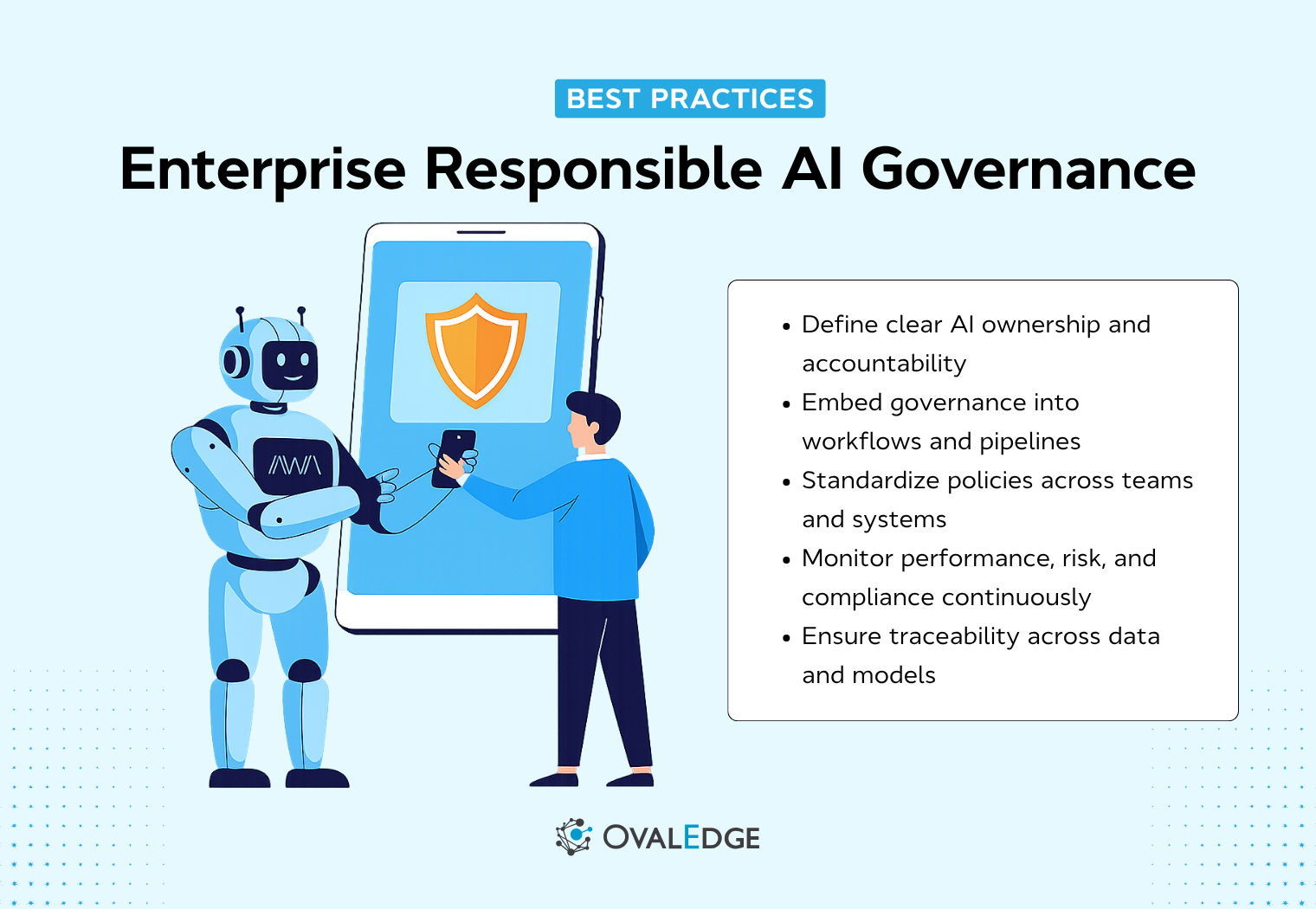
In many enterprises, AI adoption has outpaced the systems needed to manage it. Teams build models independently, data pipelines evolve without coordination, and AI-driven decisions increasingly shape business outcomes.
On the surface, everything appears effective, but consistency, visibility, and accountability often begin to break down.
A recent McKinsey report (2023) found that only 21% of organizations have established clear policies and governance frameworks for AI risk management, despite widespread adoption.
This creates a gap between intent and execution. Governance may exist in theory, but enforcement varies across teams. Models perform, yet decisions remain difficult to explain or audit, increasing risk and reducing trust over time.
Enterprise responsible AI governance addresses this challenge by shifting the focus from policy definition to consistent execution across systems, teams, and workflows.
This guide outlines how enterprises can move from fragmented AI practices to a structured, accountable approach that supports scale, compliance, and reliable decision-making.
What is enterprise responsible AI governance?
Enterprise responsible AI governance defines how organizations control, monitor, and manage AI-driven decisions across systems, teams, and workflows. It goes beyond policies and focuses on execution.
More specifically, it represents how governance operates in practice. It embeds controls, accountability, and oversight directly into systems and workflows, for example, through model approval workflows that block deployment until risk and compliance sign-off is completed.
This ensures that AI decisions are not only guided by principles but consistently enforced during real-world execution.
Defining control over enterprise AI decisions
At its core, governance is about clarity over how AI influences decisions. Organizations need to identify where AI outputs directly affect business outcomes, whether in credit approvals, pricing, or supply chain planning.
Once these decision points are clearly defined, boundaries can be set to ensure decisions remain aligned with business rules, risk tolerance, and regulatory expectations.
Strong governance ensures:
-
Decisions can be reviewed and validated
-
High-risk use cases include human oversight
-
Clear escalation paths exist when issues arise
When decision accountability is clearly defined, it becomes easier to trace how outcomes are generated, who is responsible for them, and how exceptions are handled.
This reduces ambiguity, prevents uncontrolled automation, and ensures that AI-driven decisions remain transparent, auditable, and aligned with enterprise policies.
Scope across data, models, and workflows
Governance spans the full lifecycle of AI systems.
It begins with data ingestion, where quality and lineage are controlled. It continues through model development and deployment, where validation takes place. It extends further into downstream systems where business users rely on AI outputs.
The critical factor is connecting these layers:
-
Data pipelines feed models
-
Models influence dashboards, APIs, and applications
-
Decisions are made based on these outputs
Without these connections, governance becomes fragmented and difficult to enforce.
Ownership across governance and risk teams
Unclear ownership is a common point of failure.
Data teams manage pipelines, model teams focus on performance, and risk teams oversee compliance. However, effective governance requires coordination across all three.
Organizations that succeed:
-
Assign ownership for data quality and lineage
-
Define responsibility for model validation and monitoring
-
Enable risk teams to enforce policies consistently
When ownership is clearly defined and shared across functions, governance becomes easier to enforce and scale. It reduces gaps between teams, ensures accountability at every stage, and creates a more consistent approach to managing AI risks across the enterprise.
Responsible AI governance vs AI governance vs data governance
As enterprises scale AI adoption, governance often evolves in layers, with data governance, AI governance, and responsible AI governance emerging as distinct but interconnected domains.
Understanding how these areas differ is critical to establishing clear accountability and avoiding overlap in controls.
|
Aspect |
Responsible AI Governance |
AI Governance |
Data Governance |
|
Focus |
Ethical, accountable AI decisions |
Model lifecycle and controls |
Data quality and management |
|
Scope |
Data, models, decisions, impact |
Models and deployment |
Data pipelines and storage |
|
Key Concern |
Fairness, explainability, risk |
Performance, reliability |
Accuracy, lineage |
|
Ownership |
Cross-functional |
ML teams |
Data teams |
|
Outcome |
Trustworthy AI systems |
Efficient AI operations |
Reliable data foundation |
This distinction clarifies that enterprise responsible AI governance extends beyond managing models or data alone, focusing on ensuring accountable and explainable AI-driven decisions across the entire enterprise.
What responsible AI governance looks like inside enterprise operations
Responsible AI governance becomes meaningful only when it is operationalized across systems, workflows, and decision points. It is reflected not in policy documents, but in how data, models, and decisions are managed consistently during execution.
Governance embedded in day-to-day workflows
In mature organizations, governance is not an afterthought. It is built directly into operational workflows.
|
For example, Accenture’s “Responsible AI: From Compliance to Confidence” (2022) report highlights that organizations with higher responsible AI maturity embed governance directly into data and AI operations, ensuring controls are applied consistently as systems scale.
Instead of relying on manual reviews after the fact, validation and monitoring are integrated into workflows where data and models are continuously checked. |
Similarly, before a model is deployed, validation steps are triggered within workflows. This reduces reliance on manual reviews and ensures consistency.
Approvals, access, and controls in execution
Access control is where governance often becomes visible.
Enterprises use role-based permissions to ensure only authorized users can access data or modify models. Approval workflows are embedded into systems, requiring validation sign-offs before models are deployed or updated.
When access and approvals are consistently enforced, it reduces the risk of unauthorized changes and ensures that governance policies are applied uniformly across teams.
Interaction with governed data and model outputs
Governance is also reflected in how business users consume outputs.
When a business analyst interacts with a dashboard, there should be clear context around:
-
Where the data originated
-
How the model generated results
-
Confidence levels and underlying assumptions
This context enables more informed and reliable decision-making.
Without it, AI outputs become opaque, making it difficult to interpret results or trust the decisions they support.
The operating model behind enterprise responsible AI governance
Enterprise responsible AI governance requires more than defined policies and controls. It depends on a structured operating model that aligns roles, processes, and accountability across the organization. Without this structure, governance efforts remain fragmented and difficult to scale.
A well-defined operating model ensures that governance is consistently applied across use cases, systems, and teams, making it repeatable rather than dependent on individual decisions.
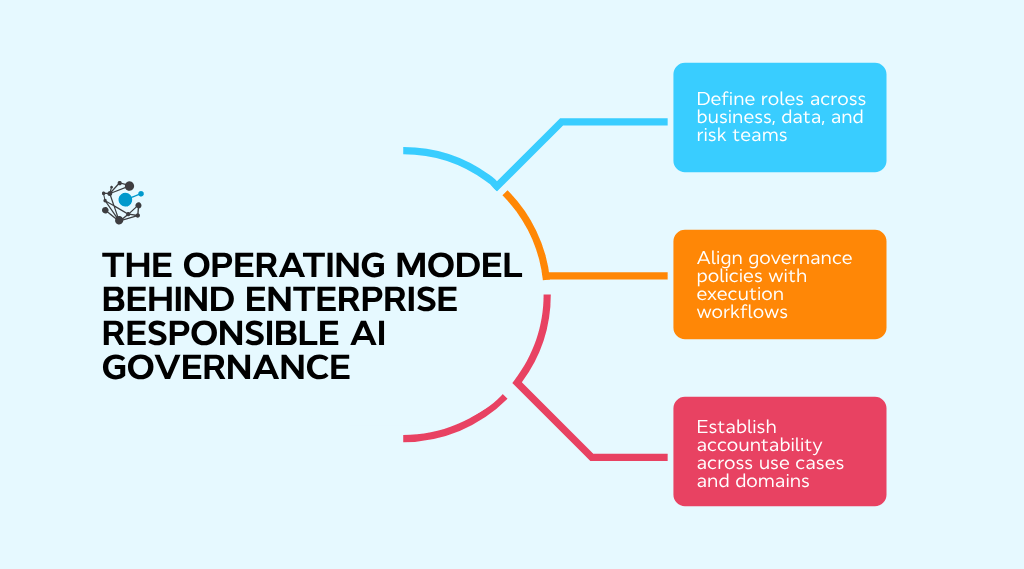
Step 1: Define roles across business, data, and risk teams
Effective governance starts with clearly defined roles across functions.
This involves establishing ownership not just for tasks, but for outcomes. Data owners are responsible for the integrity, quality, and lineage of datasets.
Model owners oversee development, validation, deployment, and lifecycle management. Risk and compliance teams define policies, monitor adherence, and manage exceptions.
Additional perspectives on governance principles
|
Principles of data governance emphasize the importance of clearly defined ownership and accountability to maintain consistency and trust across systems, as outlined in the blog, A Complete Guide to Data Governance Principles in 2026 |
Responsibilities should be aligned with core governance activities such as model validation before deployment, approval checkpoints for changes, and ongoing performance monitoring.
In practice, this ensures that accountability is embedded across the AI lifecycle. Clear ownership makes it easier to trace decisions, manage risks, and reduce gaps between teams, enabling more consistent governance at scale.
Step 2: Align governance policies with execution workflows
Policies create intent, but execution determines effectiveness. To ensure consistency, governance requirements must be translated into operational processes applied uniformly across teams and systems:
-
Validation requirements embedded within development and deployment pipelines
-
Access controls are enforced at the system and data levels
-
Standardized workflow templates to guide how teams build and deploy models
This alignment ensures governance is not left to interpretation. Instead, it becomes part of the workflow itself, reducing variability across teams and minimizing the risk of policy bypass or inconsistent implementation.
Step 3: Establish accountability across use cases and domains
Governance must be anchored to specific use cases to be effective. Each AI use case should include:
-
Clearly defined ownership across business, data, and technical stakeholders
-
Audit trails to track decisions, model changes, and data usage
-
Monitoring mechanisms to evaluate performance, risks, and compliance over time
By linking governance to use cases, organizations can track how AI systems behave in real-world scenarios. This makes governance measurable and enforceable, while also improving visibility into how decisions are made across different business functions.
Systems required to enforce responsible AI at enterprise scale
At enterprise scale, governance cannot rely on manual processes or fragmented controls. It requires systems that consistently enforce policies across data, models, and decision workflows, regardless of where they operate.
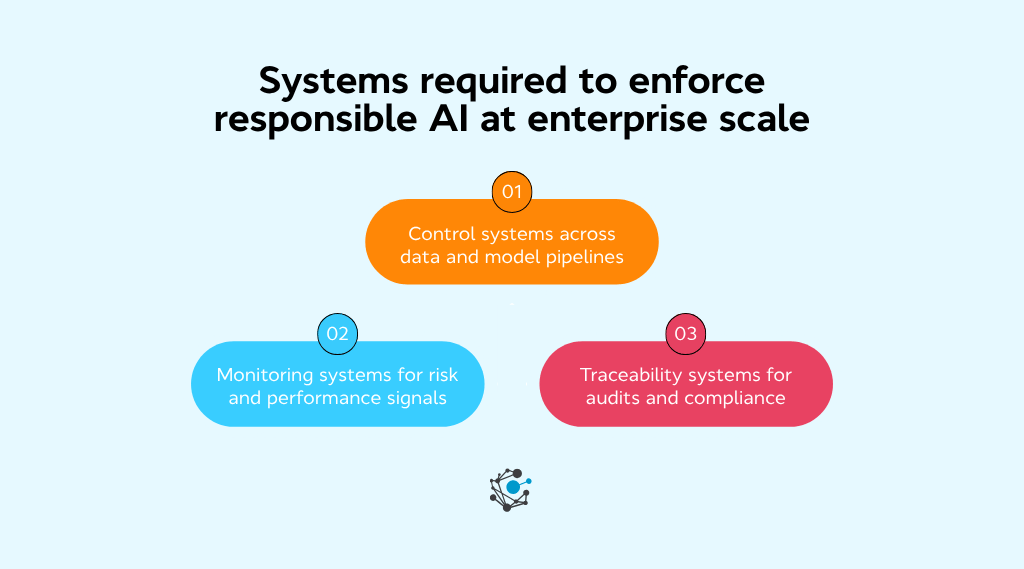
1. Control systems across data and model pipelines
Control systems ensure that governance policies are applied automatically during execution.
These systems embed rules directly into pipelines, preventing issues before they propagate downstream:
-
Data validation checks during ingestion and transformation
-
Model approval checkpoints before deployment
-
Restrictions that prevent unauthorized changes
|
Strengthening control systems with automated lineage Automated lineage capabilities, such as those provided by OvalEdge, strengthen these control systems by continuously tracking how data flows across pipelines and into models. |
When controls are integrated with automated lineage, governance becomes proactive rather than reactive. It reduces dependency on manual reviews, improves traceability of changes, and ensures consistent enforcement across environments.
2. Monitoring systems for risk and performance signals
Monitoring enables continuous oversight of AI systems after deployment. Enterprises track key indicators to detect risks early:
-
Model accuracy and performance drift
-
Bias or fairness indicators
-
Unexpected or anomalous outputs
When anomalies are detected, automated alerts trigger escalation workflows, allowing teams to respond before issues impact business outcomes.
Continuous monitoring shifts governance from periodic checks to real-time risk management, improving responsiveness and reducing exposure.
3. Traceability systems for audits and compliance
Traceability provides the foundation for transparency and accountability. At enterprise scale, organizations need end-to-end visibility across:
- Data lineage from source to consumption
- Model changes and version history
- Access logs and decision records
This level of traceability supports audit requirements and regulatory compliance while enabling teams to understand how decisions are generated.
It also strengthens internal trust by making AI systems more explainable and verifiable.
Moving from isolated controls to enterprise-wide consistency
As AI adoption expands, isolated governance controls become a limiting factor. Enterprises must transition from team-specific practices to standardized, organization-wide approaches that ensure consistency across systems and domains.
Many organizations start with isolated controls. A team builds its own checks. Another team defines its own standards. This approach does not scale.
To achieve consistency, organizations must focus on three areas:
-
Standardizing governance foundations: Define common policies for data, models, and access. Standardize definitions, thresholds, and validation criteria to ensure consistency across systems.
-
Aligning teams and operating models: Align governance practices across teams and domains. Ensure data, model, and risk functions operate within a shared framework to avoid fragmentation.
-
Embedding governance into systems: Integrate controls directly into pipelines and tools. Automate enforcement to reduce reliance on manual intervention and improve consistency at scale.
When governance is standardized and embedded, enforcement becomes consistent across environments.
The outcome is:
-
Consistent governance across the enterprise
-
Improved visibility into AI systems
-
Reduced operational and compliance risk
Where enterprise responsible AI governance breaks under scale
As AI systems scale across business units, governance challenges become more pronounced. What works in controlled environments often fails under distributed, real-world conditions.
Without strong foundations, gaps in visibility, enforcement, and execution begin to surface, increasing both operational and compliance risk.
Visibility gaps across data, models, and decisions
Limited visibility is one of the most critical challenges at scale. Enterprises often struggle to trace how data moves through pipelines, how models transform that data, and how final decisions are generated. This lack of end-to-end visibility makes it difficult to understand dependencies and identify where issues originate.
Common gaps include:
-
Untracked data transformations across pipelines
-
Limited insight into model logic and dependencies
-
Incomplete visibility into decision pathways influenced by AI
Without clear lineage and traceability, organizations cannot reliably validate outcomes or investigate anomalies. This reduces transparency and makes governance reactive rather than proactive.
Inconsistent enforcement across teams and systems
Governance often breaks when standards are applied unevenly.
As different teams build and deploy AI systems independently, variations in tools, processes, and interpretations of policy begin to emerge. What is enforced rigorously in one system may be loosely applied in another.
This leads to:
-
Differences in how governance policies are interpreted and applied
-
Fragmented tools and disconnected workflows
-
Lack of centralized oversight across environments
Over time, these inconsistencies create uneven governance, where some systems operate under strict controls while others remain loosely governed. This fragmentation increases risk and makes enterprise-wide compliance difficult to achieve.
Gaps between policies and real-world execution
A common failure point is the disconnect between governance design and actual implementation.
Policies may be clearly defined, but they are not always embedded in day-to-day workflows. As a result, teams may bypass controls, rely on manual processes, or interpret requirements inconsistently.
Typical challenges include:
-
Controls are being bypassed to meet operational deadlines
-
Manual processes introduce variability and errors
-
Governance is not being integrated into execution workflows
When governance is not operationalized, it remains theoretical. This gap reduces its effectiveness and increases the likelihood of unmanaged risks, especially as systems scale.
|
Bridging governance gaps with a unified approach Addressing these challenges requires a unified, system-driven approach that ensures consistent visibility, control, and enforcement across the enterprise. OvalEdge enables this in the following ways:
|
What strong enterprise governance looks like in measurable terms
Enterprise governance maturity is reflected not just in the presence of controls, but in how consistently and effectively they are applied across the organization. Measurement helps distinguish between fragmented practices and scalable governance.
-
From partial to comprehensive coverage: Early-stage governance applies to select models or datasets. Mature governance ensures most systems operate under defined controls.
-
From limited visibility to full traceability: Initial stages lack clear lineage and auditability. Mature systems provide end-to-end visibility into data, models, and decisions.
-
From reactive to proactive risk management: Basic governance responds to issues after they occur. Advanced governance detects and addresses risks in near real time.
-
From fragmented to standardized execution: Inconsistent practices across teams evolve into uniform enforcement of policies across systems and domains.
These shifts reflect the progression from isolated governance efforts to a structured, enterprise-wide model. As organizations move toward higher maturity, governance becomes more predictable, measurable, and aligned with business outcomes.
This not only improves control and compliance but also strengthens trust in AI-driven decisions across the enterprise.
Conclusion
Enterprise responsible AI governance is not about adding more rules. It is about making governance work consistently in real operations.
The shift happens when organizations move from fragmented practices to structured systems. Clear ownership, aligned workflows, and embedded controls ensure governance becomes part of execution.
The next step is to identify gaps in visibility, ownership, and enforcement, starting with high-impact use cases. Establish accountability and connect data, models, and decisions through integrated systems.
Platforms like OvalEdge bring together metadata, lineage, data quality, and governance controls into a unified system, enabling scalable and consistent governance across the enterprise.

Organizations exploring this approach may choose to schedule a demo with platforms like OvalEdge to see how it can be applied in practice.
FAQs
1. How do enterprises integrate responsible AI governance with existing risk frameworks?
Enterprises align AI governance with existing risk and compliance frameworks by mapping AI use cases to risk categories, extending controls to AI systems, and integrating monitoring into enterprise risk management processes for consistent oversight.
2. What industries require stricter enterprise responsible AI governance?
Industries such as finance, healthcare, insurance, and the public sector require stricter governance due to regulatory scrutiny, sensitive data usage, and high-impact decision-making that directly affects customers, patients, or citizens.
3. How do enterprises handle governance for third-party AI models?
Enterprises establish validation, documentation, and monitoring requirements for third-party models. They assess data sources, performance, and risks, while ensuring contractual and compliance obligations are met before deployment and during ongoing use.
4. What role does explainability play in enterprise AI governance?
Explainability helps enterprises understand how models generate outputs, enabling validation, regulatory compliance, and user trust. It supports audits and allows teams to justify decisions, especially in high-risk or customer-facing use cases.
5. How often should enterprise AI governance policies be updated?
Enterprises review governance policies periodically based on regulatory changes, new AI use cases, and performance insights. Continuous monitoring and feedback loops ensure policies remain relevant as systems and risks evolve.
6. What skills are required to manage enterprise responsible AI governance?
Teams need a mix of data engineering, machine learning, risk management, and compliance expertise. Collaboration across technical and business roles ensures governance is effectively implemented and aligned with enterprise objectives.
.png?width=1081&height=173&name=Forrester%201%20(1).png)
.png?width=1081&height=241&name=KC%20-%20Logo%201%20(1).png)