.png)
AI is moving deeper into clinical workflows, but trust has not caught up.
ECRI ranked the misuse of AI chatbots as the #1 health technology hazard for 2026, pointing to the risk of confident answers that can still be clinically wrong.
For healthcare data leaders, that shifts the conversation from model capability to the context surrounding every decision. The challenge is making sure AI sees the right patient data, clinical rules, provenance, and permissions at the right moment.
This guide explores how a context layer for healthcare AI can support that goal, from metadata and lineage to knowledge graphs, governance, and point-of-care delivery.
What is a context layer for healthcare AI?
A context layer for healthcare AI is governed infrastructure that determines which clinical data an AI system can use at the moment of a decision. It also carries the metadata, lineage, access rules, and clinical meaning needed to interpret that data correctly.
A healthcare AI context layer typically provides:
-
Semantic meaning: Connects codes, terms, and clinical concepts so the model understands what the data represents.
-
Governance controls: Applies policies for PHI, access, consent, and approved use.
-
Lineage and provenance: Shows where data came from, how it changed, and whether it can be trusted.
-
Clinical and business rules: Adds care pathways, formulary logic, operational rules, and decision constraints.
-
Inference-time context: Delivers the right patient and clinical context when an AI model, agent, or decision-support tool needs it.
That distinction matters in healthcare because technically correct data can still lead to unsafe output if the surrounding clinical context is incomplete, outdated, or inappropriate for the decision being made.
Why healthcare AI fails without a context layer and the clinical fix
Healthcare AI often fails not because models are weak, but because they lack the right clinical context. Without it, outputs can be fluent yet unsafe, incomplete, or based on the wrong patient data.
The solution is to treat context as a clinical responsibility, not just a technical input.
Hallucinations, fragmented data, and the compliance gap
Healthcare data is rarely available as one clean record. Relevant context may be spread across:
-
EHRs (FHIR/HL7v2)
-
Claims and billing systems
-
Lab results
-
Imaging metadata
-
Social determinants of health
-
Patient-reported outcomes
Even when data is accurate, it is often incomplete in isolation. A medication recommendation, for example, can change based on a recent lab result, allergy, new diagnosis, or care setting change.
This becomes critical in use cases like ambient documentation, prior authorization, care coordination, and clinical decision support. These workflows require more than retrieval. They require provenance, access control, clinical relationships, and up-to-date policy context.
Without governance, it becomes difficult to trace which data influenced an AI output or ensure that sensitive data was used appropriately. Trusted healthcare AI therefore depends on controlling both what data is accessed and how it is used.
Physicians as context engineers: Data, task, tool, and goal context
A 2026 Nature Medicine article describes physicians as “context engineers” in the age of generative AI, shaping four key dimensions: data, task, tools, and goals.
For context engineering for medical AI, those dimensions translate into practical decisions:
-
Data context: Decide which parts of the medical record, imaging, biometrics, or social information are relevant to the current decision.
-
Task context: Define exactly what the AI should do, what form the output should take, and how uncertainty should be represented.
-
Tool context: Control which external resources the AI can access, such as clinical guidelines, risk calculators, or institutional protocols.
-
Goal context: Align the system with the intended clinical outcome, patient preferences, institutional policies, and privacy requirements.
This shifts AI from a vendor-defined system to a clinician-shaped workflow. The required context also varies by use case: ambient documentation, prior authorization, and decision support each need different information depth.
A healthcare AI context layer provides the infrastructure to manage this consistently while preserving clinical judgment.
Core components of a healthcare AI context layer
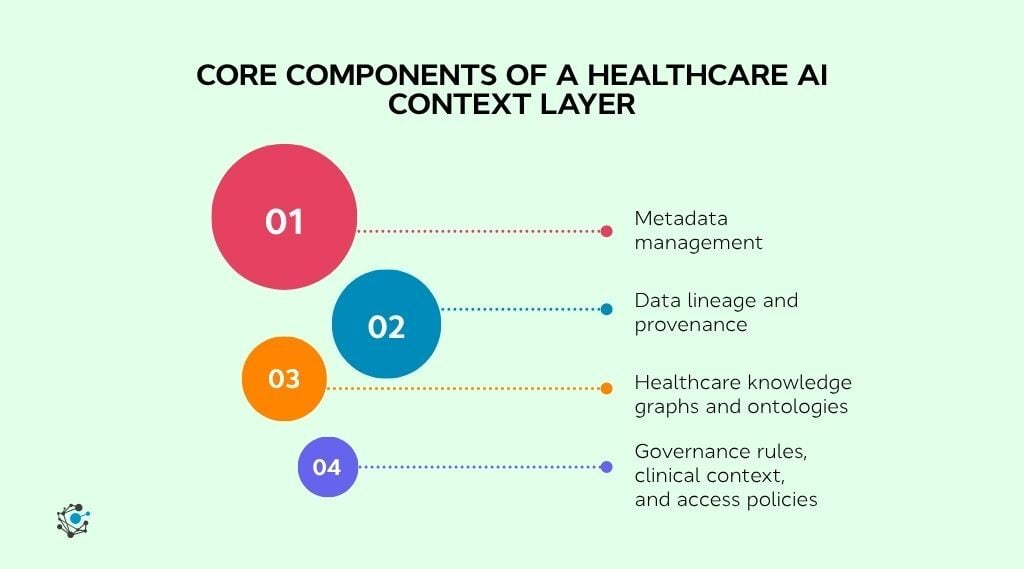 A healthcare AI context layer turns clinical responsibility into infrastructure by connecting metadata, provenance, relationships, and governance controls around the data AI systems use.
|
Component |
What it captures |
Healthcare example |
|
Metadata management |
Meaning, definitions, classifications, ownership |
ICD-10, SNOMED CT, LOINC, patient identifiers |
|
Data lineage and provenance |
Source, transformations, movement, dependencies |
Tracing a lab value from the source system to an AI output |
|
Knowledge graphs and ontologies |
Relationships between clinical entities |
Linking patients, diagnoses, medications, providers, and outcomes |
|
Governance and clinical rules |
Access, policies, protocols, decision constraints |
Restricting PHI retrieval based on role and clinical need |
Metadata management
Healthcare metadata management gives AI systems the definitions needed to interpret clinical data correctly.
It connects technical fields with business and clinical meaning, including patient identifiers, coding systems, ownership, sensitivity classifications, and usage rules. Central governance also reduces the risk of different departments applying conflicting definitions to the same concept.
For AI, this metadata becomes part of the context used to determine whether a data point is relevant and how it should be interpreted.
Data lineage and provenance
Lineage shows where a data point originated and what happened to it before an AI system used it.
For example, a clinician reviewing an AI-generated recommendation should be able to trace a lab result back to its source, see whether it was transformed, and confirm that the version was current.
Healthcare data lineage for AI supports this traceability across source systems, pipelines, models, and downstream applications.
Healthcare knowledge graphs and ontologies
A healthcare knowledge graph captures relationships that individual records cannot express on their own.
It can connect:
-
Patients to conditions.
-
Conditions to medications.
-
Medications to contraindications.
-
Providers to encounters.
-
Treatments to outcomes.
Ontologies add standardized clinical meaning to those relationships. Together, they help AI reason across connected clinical concepts instead of treating each field as an isolated fact.
Governance rules, clinical context, and access policies
The context layer also controls which information an AI system can retrieve and under what conditions.
This may include clinical protocols, care pathways, formulary rules, consent requirements, and role-based permissions. For PHI, context windows should follow HIPAA’s minimum necessary principle so AI systems receive only the information required for the task.
This governance layer makes clinical context usable while keeping access purposeful, traceable, and controlled.
IBM and Ponemon’s Cost of a Data Breach Report 2025 found that 97% of organizations reporting an AI-related security incident lacked proper AI access controls.
A healthcare context layer therefore needs to govern what information an AI system can retrieve at the point of use, rather than relying only on permissions applied further upstream.
Context layer vs. semantic layer vs. data catalog in healthcare
These terms are often used interchangeably, but they solve different problems. The distinction matters when healthcare teams are deciding what infrastructure AI systems actually need.
|
Dimension |
Context layer |
Semantic layer |
Data catalog |
|
Primary purpose |
Delivers governed, task-specific context to AI at inference time |
Standardizes business and analytical meaning |
Helps teams discover, understand, and govern data assets |
|
Primary audience |
AI systems, agents, clinical applications, and governance teams |
Analysts, BI teams, and data consumers |
Data stewards, engineers, analysts, and governance teams |
|
Healthcare role |
Combines patient data, clinical rules, lineage, permissions, and relationships for a specific AI task |
Creates consistent definitions for measures and clinical concepts |
Documents datasets, ownership, metadata, classifications, and policies |
|
Real-time use |
High; context is assembled when an AI system needs it |
Usually query or analytics driven |
Primarily discovery and governance driven |
|
Governance depth |
Enforces what context an AI can access and use |
Governs meaning and metric consistency |
Governs assets, metadata, ownership, and policy information |
A healthcare semantic layer can give AI consistent meaning, while a data catalog provides trusted metadata and governance information. The context layer builds on those capabilities and delivers the relevant combination of data, meaning, rules, and permissions for the decision being made.
For healthcare AI, these layers are complementary. The context layer becomes the point where existing governance assets are assembled into usable clinical context.
Building a healthcare AI context layer: A practical framework
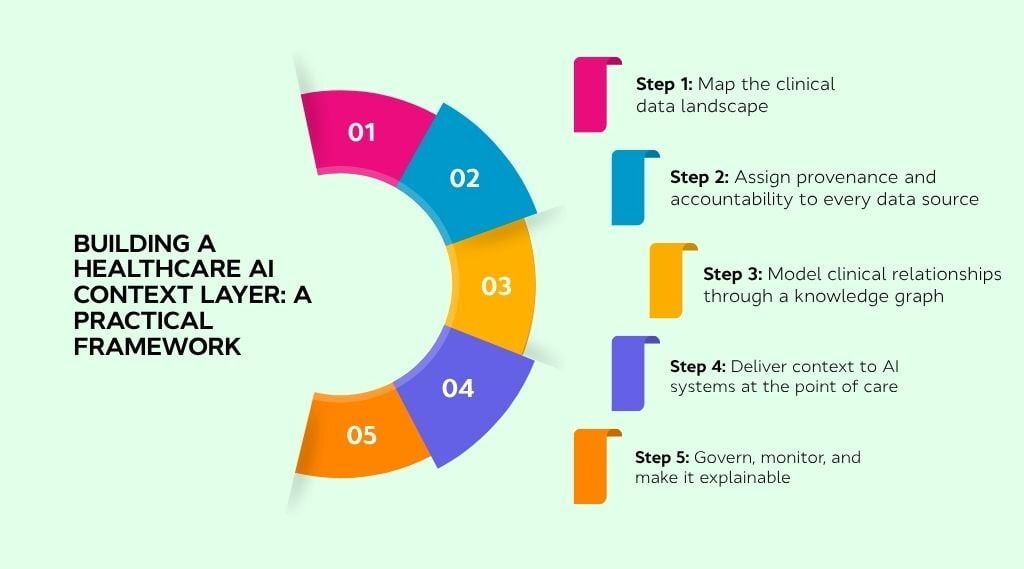 A healthcare AI context layer works best when it is built around clinical workflows, accountability, and governed delivery from the start.
Step 1 — Map the clinical data landscape
Start by identifying where the clinical entities AI will depend on actually live. That includes patients, encounters, diagnoses, orders, results, medications, claims, imaging, and social determinants of health.
Focus first on:
-
Which systems hold authoritative versions of each entity.
-
Where duplicate or conflicting records exist.
This map should update as sources and workflows change. A static inventory quickly becomes unreliable context for AI.
Step 2 — Assign provenance and accountability to every data source
Next, establish where each critical data point originates and who is responsible for it.
Healthcare data lineage should trace information from the source through transformations and downstream AI use. Pair that lineage with a named clinical or operational owner who can answer questions about meaning, quality, and appropriate use.
For example, knowing that a lab value came from a specific source system is useful. Knowing who owns the definition, validation process, and correction workflow makes that provenance actionable.
The goal is simple: every important piece of context should have both a traceable origin and an accountable owner.
Step 3 — Model clinical relationships through a knowledge graph
AI needs relationships as much as individual facts. A healthcare knowledge graph can connect patients with conditions, medications, procedures, providers, encounters, and outcomes.
These relationships help systems answer questions that isolated records cannot.
For example, a diagnostic workflow may need to connect:
-
Current symptoms with longitudinal history.
-
Medications with contraindications.
-
Conditions with relevant laboratory findings.
Clinical teams should participate in defining these relationships. A technically accurate graph can still be clinically weak if it does not reflect how physicians reason through a patient case.
Step 4 — Deliver context to AI systems at the point of care
Context becomes valuable when it reaches the AI system at the moment a decision is being made.
FHIR APIs provide a standardized way to exchange healthcare data across systems.
CMS also requires impacted payers to implement several API capabilities, including a Prior Authorization API, beginning January 1, 2027.
These requirements reinforce the move toward programmatic, workflow-level access to healthcare information.
For AI agents, Model Context Protocol (MCP) is becoming an important part of the infrastructure discussion. MCP defines a common client-server model through which AI applications can access resources and tools.
A useful way to think about the two is:
FHIR standardizes how healthcare systems exchange structured clinical data. MCP provides a developing pattern for how AI applications can access tools and contextual resources around those systems.
MCP is still evolving, so healthcare organizations should treat it as an emerging integration approach rather than a settled clinical standard.
The broader goal is to make AI-ready healthcare data available with the right permissions, provenance, and task-specific context whenever a clinician or agent needs it.
Step 5 — Govern, monitor, and make it explainable
The final step makes every earlier layer trustworthy.
Explainability in healthcare AI should allow a clinician, auditor, or governance team to trace an output back to the data and rules that influenced it. That requires:
-
Lineage back to authoritative sources.
-
Clinical definitions and relationships.
-
Access and usage policies.
-
Records of which context entered the AI workflow.
Regulation is also evolving. The HTI-1 final rule established algorithm-transparency requirements for predictive technologies included in certified health IT.
The proposed HTI-5 rule, published in December 2025, would streamline parts of the ONC certification framework, so teams should distinguish current requirements from proposed changes.
Governance also has to account for drift. Coding standards, clinical guidelines, formularies, access policies, and care settings change over time. The same patient record may require different context in inpatient care, outpatient treatment, and telehealth.
Effective healthcare AI governance therefore requires continuous validation of the context itself. That is what keeps AI outputs traceable, clinically relevant, and defensible as systems and policies evolve.
Build trusted healthcare AI on governed context
A healthcare AI context layer should build on governance assets you already have. Your catalog, glossary, lineage, quality rules, ownership records, and policies can become the governed context AI systems draw on at the moment of use.
OvalEdge helps connect these assets so healthcare teams can deliver trusted, explainable, and policy-aware context across AI workflows without rebuilding governance from scratch.
If you are preparing clinical data for AI, the next step is making that context usable, traceable, and governed.

Book a demo with OvalEdge to see how.
.png?width=1081&height=173&name=Forrester%201%20(1).png)
.png?width=1081&height=241&name=KC%20-%20Logo%201%20(1).png)