-2.png)
A semantic data model describes enterprise data in business terms. It captures the entities, attributes, relationships, and rules people actually reason with, so a "customer" or "active account" means the same thing across every report, dashboard, and AI query.
Most enterprises have a meaning problem. Sales defines an active customer one way, finance defines it another, and marketing has a third version buried in a dashboard filter. Every team is technically right. The reports still do not agree. Trust erodes, decisions slow down, and AI outputs inherit the same confusion.
This guide walks through what a semantic data model is, how it differs from conceptual, logical, and physical models, how to build one step by step, and where it fits in data governance and AI readiness.
What is a semantic data model?
A semantic data model explains data in business terms. Instead of focusing only on database structures such as tables, columns, keys, and indexes, it represents real-world concepts such as customers, products, orders, accounts, policies, or regions, along with their meanings, relationships, and business rules.
A semantic data model typically includes:
-
Business entities and concepts
-
Attributes that describe those entities
-
Relationships between concepts
-
Business definitions and approved terminology
-
Rules that govern how data should be interpreted
For example, a customer success manager should be able to understand what an "active customer" means without reviewing SQL logic or database documentation. A semantic model provides that context by defining the term, its relationships, and the rules that determine how it is calculated.
A semantic data model is distinct from a few related concepts:
|
Term |
Simple meaning |
How it relates |
|
Semantic data model |
Defines business meaning, concepts, and relationships |
Foundation for shared interpretation |
|
Semantic layer |
Makes business definitions available to BI, analytics, or AI tools |
Uses semantic meaning for consumption |
|
Ontology |
Formal model of concepts and relationships |
Formalizes concepts, relationships, and constraints for machine reasoning |
|
Knowledge graph |
Network of connected entities |
Uses relationships to connect meaning across systems |
A semantic data model establishes the business meaning that supports consistent reporting, governance, and analytics. A semantic layer builds on that foundation by delivering governed definitions to BI, analytics, and AI tools.
Organizations with highly connected data or advanced AI use cases may also adopt ontologies or knowledge graphs for more complex relationships.
Research finding: Gartner's April 2026 research found that organizations with successful AI initiatives invest up to 4 times more in foundational areas like data quality and governance than those experiencing poor AI outcomes.
Why business meaning sits at the center
Most operational systems store and process data efficiently, but they expose it through technical field names and codes that are hard for business users to interpret.
|
Technical field |
Business meaning |
|
cust_id |
Customer Identifier |
|
txn_dt |
Transaction Date |
|
acct_status_cd |
Account Status |
|
prod_cat |
Product Category |
A semantic data model solves this by organizing data around familiar business concepts. It documents how marketing, finance, and customer success each use a term like "customer," and where those definitions overlap or differ, so every team applies it correctly in their own context.
Semantic model vs conceptual, logical, and physical data models
Semantic, conceptual, logical, and physical data models all describe data, but they serve different purposes.
|
Model type |
Main focus |
Primary users |
Example question it answers |
|
Semantic data model |
Business meaning, definitions, and interpretation |
Business users, analysts, stewards |
What does "active customer" mean? |
|
Conceptual data model |
High-level business concepts |
Business stakeholders, architects |
What major entities does the business care about? |
|
Logical data model |
Structured entities, attributes, and relationships |
Architects, analysts, engineers |
How should Customer and Order relate? |
|
Physical data model |
Database implementation and storage |
DBAs, developers, and engineers |
How are tables and indexes created? |
These four models are not alternatives. They sit at different points in the data workflow. Conceptual, logical, and physical models describe how data is structured and stored. A semantic data model sits on top and describes what that data means to the business.
The same concept across all four models
Here is what a single business concept, "Customer," looks like at each level:
-
Conceptual: Customer is an entity the business cares about, alongside Product, Order, and Region. No detail on structure yet.
-
Logical: Customer has attributes such as CustomerID (primary key), Name, Email, Region, and SignupDate, with a one-to-many relationship with Order.
-
Physical: A customer table in PostgreSQL with cust_id (int, PK), full_name (varchar), email (varchar, unique), region_cd, signup_dt, indexed on region_cd and signup_dt.
-
Semantic: A customer is any account that has signed a contract. An "active customer" is one who has made a purchase in the last 12 months. Ownership sits with Revenue Operations. Customer connects to Order (places), Product (buys), and Region (belongs to).
The semantic model is why semantic modeling shows up most in reporting, self-service analytics, and AI, where the person on the other end needs to make sense of the data before they can act on it.
How does a semantic data model work?
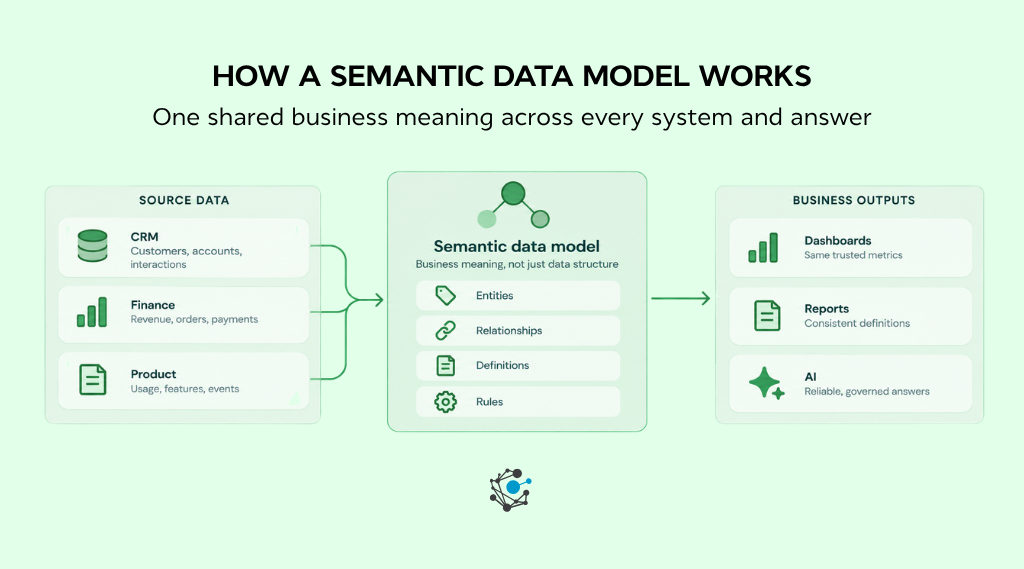
A semantic data model works by organizing data around business concepts rather than technical structures. It identifies the key objects that matter to the business, the information that describes them, the relationships between them, and the rules that govern how they should be interpreted.
Semantic data modeling is rarely a one-time exercise. As business needs, source systems, and reporting requirements change, teams revisit and refine earlier elements to keep the model accurate.
1. Entities
Entities represent the primary business objects included in the model. They define what the organization wants to understand, track, or analyze.
For example, a retail company may define entities such as Customer, Product, Order, Supplier, and Store. An insurance company may use Customer, Policy, Agent, and Claim.
Goal: Establish a common set of business objects that everyone can reference consistently across systems and reports.
2. Attributes
Attributes describe the characteristics of an entity. They provide the details needed to identify, classify, and analyze business objects.
For example, a Customer entity may include attributes such as Customer ID, Name, Region, Segment, Status, and Signup Date. A Product entity may include Category, Price, Brand, and Launch Date.
Goal: Provide meaningful business context about each entity without requiring users to interpret technical database fields.
3. Relationships
Relationships define how entities connect to one another. They help explain how different business concepts interact.
For example, a Customer places an Order, an Order contains a Product, and a Product belongs to a Category. These relationships create a connected view of the business rather than isolated data points.
Goal: Show how business objects relate to each other so users can understand data in context.
4. Business rules and definitions
Business rules and definitions explain how important terms, metrics, and concepts should be interpreted throughout the organization.
For example, an active customer may be defined as a customer who has made at least one purchase in the last 12 months. Net revenue may be calculated as gross revenue minus discounts, refunds, and taxes.
Goal: Ensure that business terms and metrics are applied consistently across reports, dashboards, and analytics workflows.
A worked example: What all four elements look like together
Here is a small slice of a semantic data model for a Revenue Operations team.
Entity: Active Customer
Attributes: Customer ID, Company Name, Segment (SMB, Mid-Market, Enterprise), Region, First Purchase Date, Last Purchase Date, Contract Status
Relationships:
-
Active Customer places Order
-
Active Customer belongs to Region
-
Active Customer is managed by Account Executive
-
Active Customer has Net Revenue (metric)
Business rules:
-
An Active Customer is any account with at least one purchase in the last 12 months and a Contract Status of "Signed."
-
Net Revenue = Gross Revenue − Discounts − Refunds − Taxes.
-
Ownership: Revenue Operations. Steward: [Name]. Last reviewed: [Date].
-
Any change to the "Active Customer" definition requires approval from Finance and Sales Operations before it is applied downstream.
Documented at this level, the model becomes something a marketing team, a CFO, and an AI query engine can all rely on when they ask about "active customers."
How semantic data models support data governance
Enterprise data governance gets harder the moment business concepts start meaning different things across teams, reports, and systems. A semantic data model is what makes those concepts governable in the first place.
It gives every business term one approved definition, then connects that definition to the metadata, ownership, and traceability that governance workflows actually run on.
This is also where a semantic data model starts feeding into the broader Self-service BI tools that scale with governed definitions that AI and analytics teams rely on. Definitions, glossary entries, lineage, and ownership stop living in separate places and start behaving as one connected context layer that both people and AI agents can query.
1. Shared business definitions
Governance starts with a common language. When departments use different definitions for the same business term, reports become difficult to reconcile, and decision-making slows down.
A semantic data model helps standardize terms such as customer, revenue, product, account, or risk score. Instead of allowing definitions to vary by team, the model establishes a consistent interpretation that can be referenced across the organization.
This reduces confusion, improves communication, and helps ensure that governance policies are applied to the same concepts everywhere they appear.
Also read: Self-service BI tools that scale with governed definitions
2. Metadata and business glossary alignment
Business definitions alone are not enough. A glossary explains what a term means; metadata identifies the tables, columns, reports, dashboards, and pipelines where it is used.
Connecting the two turns governance assets from static documentation into resources people actually use to find and interpret data.
3. Lineage, ownership, and trust
Trust depends on visibility. Deloitte's 2026 State of AI in the Enterprise report found that only one in five companies has a mature governance model for autonomous AI agents, and lineage gaps sit near the top of the reasons why.
By linking business concepts to lineage and ownership, semantic models let users trace metrics back to their sources, see how they were derived, and identify who maintains them. That transparency strengthens accountability and supports audits.
A semantic data model gives governance something concrete to govern. When definitions, metadata, lineage, and ownership are connected, the same rule applies whether the term shows up in a finance report, a marketing dashboard, or an AI-generated answer.
How semantic data models support AI readiness
AI systems can process large amounts of enterprise data, but they do not automatically understand how an organization defines its business terms, metrics, and relationships.
McKinsey's 2025 State of AI survey found that 78% of organizations now use AI in at least one business function, up from 55% a year earlier, which means the volume of AI queries hitting enterprise data is growing faster than the definitions behind that data are being formalized.
Without that context, the same question can be interpreted in different ways, and the answers stop being trustworthy long before anyone notices.
A semantic data model gives AI the context it needs. By defining concepts such as customers, products, revenue, and accounts consistently, it helps AI systems connect a business question to the right data and the right definition.
In practice, that context does not sit in the semantic model alone. It has to travel with the data through glossary entries, lineage, and ownership, which is why teams increasingly plug the semantic model into a broader Enterprise Context Graph that carries every layer of meaning to the point of consumption.
As a result, semantic data models can help:
-
Reduce ambiguity in business terminology
-
Improve the accuracy of AI-generated insights
-
Support natural language queries against enterprise data
-
Create more consistent interpretations of metrics and KPIs
At OvalEdge, we see semantic models as a critical foundation for AI readiness, not the complete solution. A customer may mean different things across CRM, finance, product, and reporting systems. A semantic model can describe those definitions, but organizations still need governance rules that decide when each definition should be used.
That is where business glossaries, approved definitions, stewardship, and governance processes come in.
It is also how a tool like OvalEdge can answer a natural-language question about "active customers" and return the same answer a finance report would, because both are pulling from one governed definition rather than guessing at the meaning of a column name.
Ready to see how a governed semantic model plus an Enterprise Context Graph keeps "active customer" and "net revenue" consistent across every report, dashboard, and AI query? Book a demo to see OvalEdge in action.
How to build a semantic data model step-by-step
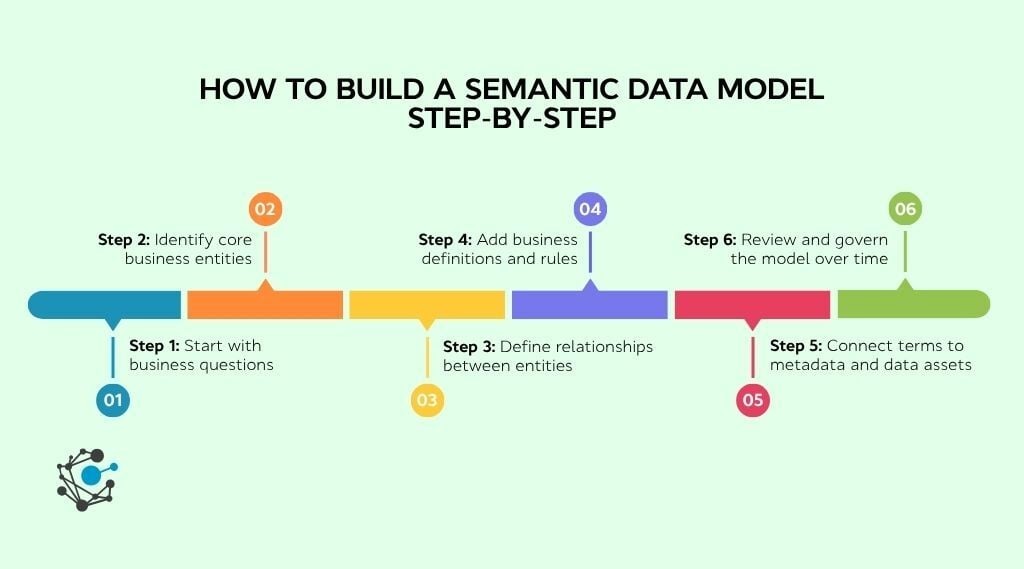
Building a semantic data model starts with understanding the business. The aim is to create a model that reflects how the organization defines, uses, and interprets its data.
Step 1: Start with business questions
Decide which business questions the model needs to answer. A sales team may want to know which customers are active, which products generate the most revenue, or which regions are growing fastest. Each question points to the concepts and metrics that need a definition.
Outcome: A short list of business questions that scopes every other step.
Step 2: Identify core business entities
Identify the business objects behind those questions. A sales domain may include Customer, Product, Order, Sales Representative, and Region. Skip technical objects that only exist inside one source system.
Outcome: A defined list of entities, agreed with the business teams that use them.
Step 3: Define relationships between entities
Map how entities interact. A Customer places an Order, an Order contains a Product, a Sales Representative manages a Customer account. Documenting these links makes it easier to answer questions that span more than one entity.
Outcome: A relationship map ready for definitions and rules to sit on top.
Step 4: Add business definitions and rules
Document the definitions, metrics, and calculation logic the business relies on. An active customer may be defined as a customer who has purchased in the last 12 months. Net revenue may be gross revenue minus discounts and refunds. Each definition should be signed off by the business stakeholders who own the term.
Outcome: An approved set of definitions and calculation rules every team can point to.
Step 5: Connect terms to metadata and data assets
Link each business concept to the tables, columns, reports, and dashboards where it lives. Strong metadata management keeps this connection intact as the data landscape grows.
Outcome: A semantic model connected to the real data assets that support it.
Step 6: Review and govern the model over time
A semantic data model has to evolve with the business.
Practitioners push back on the idea that a semantic layer can be built once and left alone. They claim that the semantic layer represents the business, and the business itself keeps changing, so ownership, review cycles, and controlled updates are part of the model, and not tasks to add later.
Outcome: A living semantic model that keeps pace with how the business defines and uses its data.
Types of semantic data models
The scope of a semantic data model depends on the question it needs to answer. A finance team's model looks nothing like a company-wide model, and both differ from a model built on top of an existing warehouse.
Four types show up most often:
-
Domain-specific models describe one business domain in depth. A finance team might model revenue, cost, and margin. Fastest to build and easiest to keep accurate because ownership sits with one team.
-
Enterprise-wide models cover concepts that show up across every domain, such as Customer, Product, Employee, and Region. They need cross-functional sign-off, so they take longer to agree, but they are what make the same "Customer" definition hold across marketing, sales, finance, and support.
-
Subject-area models sit between the two. They cover a subject that crosses more than one domain, like Customer Experience or Revenue Operations. Useful when a question depends on concepts from several teams but does not need the full weight of an enterprise-wide model.
-
Dimensional-plus-semantic models overlay semantic definitions on top of an existing dimensional model in a data warehouse. Common when organizations already have a strong warehouse and want to add business meaning without redesigning the schema.
Most organizations end up with a mix. A common pattern is one enterprise-wide model for the core shared concepts, plus domain-specific and subject-area models that go deeper where a team needs it.
The right combination depends on how the business is structured and where reporting inconsistencies show up most.
Common semantic data modeling challenges and best practices
Most initiatives run into the same set of problems. Definitions drift, ownership gets fuzzy, or the model quietly starts describing the source systems it was supposed to sit above.
|
Challenge |
Why it happens |
Best practice |
|
Conflicting definitions |
Teams define the same term differently |
Establish approved definitions with clear ownership |
|
Multiple valid business definitions |
The same term exists across systems and domains with different meanings |
Define approved usage rules and context-specific definitions |
|
Too much technical detail |
The model mirrors database structures instead of business concepts |
Start with business questions and business terminology |
|
Weak ownership |
No one maintains definitions and rules |
Assign data stewards or domain owners |
|
Poor metadata connections |
Business terms are not linked to data assets |
Connect concepts to cataloged metadata |
|
Stale definitions |
Business rules and reporting requirements change |
Review and update definitions regularly |
|
Low adoption |
Users find the model difficult to use |
Use plain language and business-friendly terms |
|
Weak access context |
Users cannot determine appropriate data usage |
Align business concepts with governance and access policies |
Semantic data models work best when treated as living business assets. A clear review cadence, named ownership for every definition, and tight alignment with the enterprise data catalog are what keep the model useful long after the first version is signed off.
How OvalEdge helps teams connect business meaning with governed data
Defining business concepts is the first half of the work. The harder half is making sure those definitions apply the same way across every report, dashboard, analytics workflow, and AI application that touches the data.
A term like "customer" often carries different meanings in CRM, finance, product, and reporting systems, and each meaning is valid in its own context. A semantic data model captures those meanings, but organizations still need governance workflows to decide which definition applies where, and when.
At OvalEdge, we build the Enterprise Context Graph to sit exactly there. The ECG connects the semantic model to the glossary, metadata, lineage, stewardship, and governance workflows that decide how a business concept gets used. Together, they let organizations define both what a concept means and how it should be applied in a given report, query, or AI answer.
A Forrester Total Economic Impact study of OvalEdge customers found a 337% ROI over three years, with sensitive data classification effort reduced by 75% and analyst productivity up by 30%.
OvalEdge helps organizations connect semantic models with:
-
Data Catalog for discovering and understanding data assets
-
Business Glossary for managing approved business terminology and definitions
-
Data Lineage for tracing data origins and transformations
-
Data Quality for monitoring critical data assets
-
Data Certification for identifying trusted data resources
-
Access Governance for supporting controlled data usage
-
Connectors and APIs for integrating metadata across enterprise systems
-
Automation Workflows for supporting governance processes at scale
When these capabilities work together, business meaning stops living in a documentation page and starts behaving as a governed layer that analytics, governance, and AI all pull from.
Give every business term one meaning
A semantic data model is what turns "we have the data" into "we agree on what the data means." Without it, active customer, net revenue, and every other business term end up with a slightly different version in every report, every dashboard, and every AI query.
A semantic data model turns "we have the data" into "we agree on what the data means." Without one, active customer and net revenue end up with a slightly different definition in every report, dashboard, and AI query.
As AI and self-service analytics take on more of the day-to-day reporting, that shared meaning becomes the difference between answers a business can act on and answers it has to double-check.
Book a demo with OvalEdge and see how a governed semantic model plugs into the Enterprise Context Graph to keep every business term consistent across reports, dashboards, and AI queries.
.png?width=1081&height=173&name=Forrester%201%20(1).png)
.png?width=1081&height=241&name=KC%20-%20Logo%201%20(1).png)