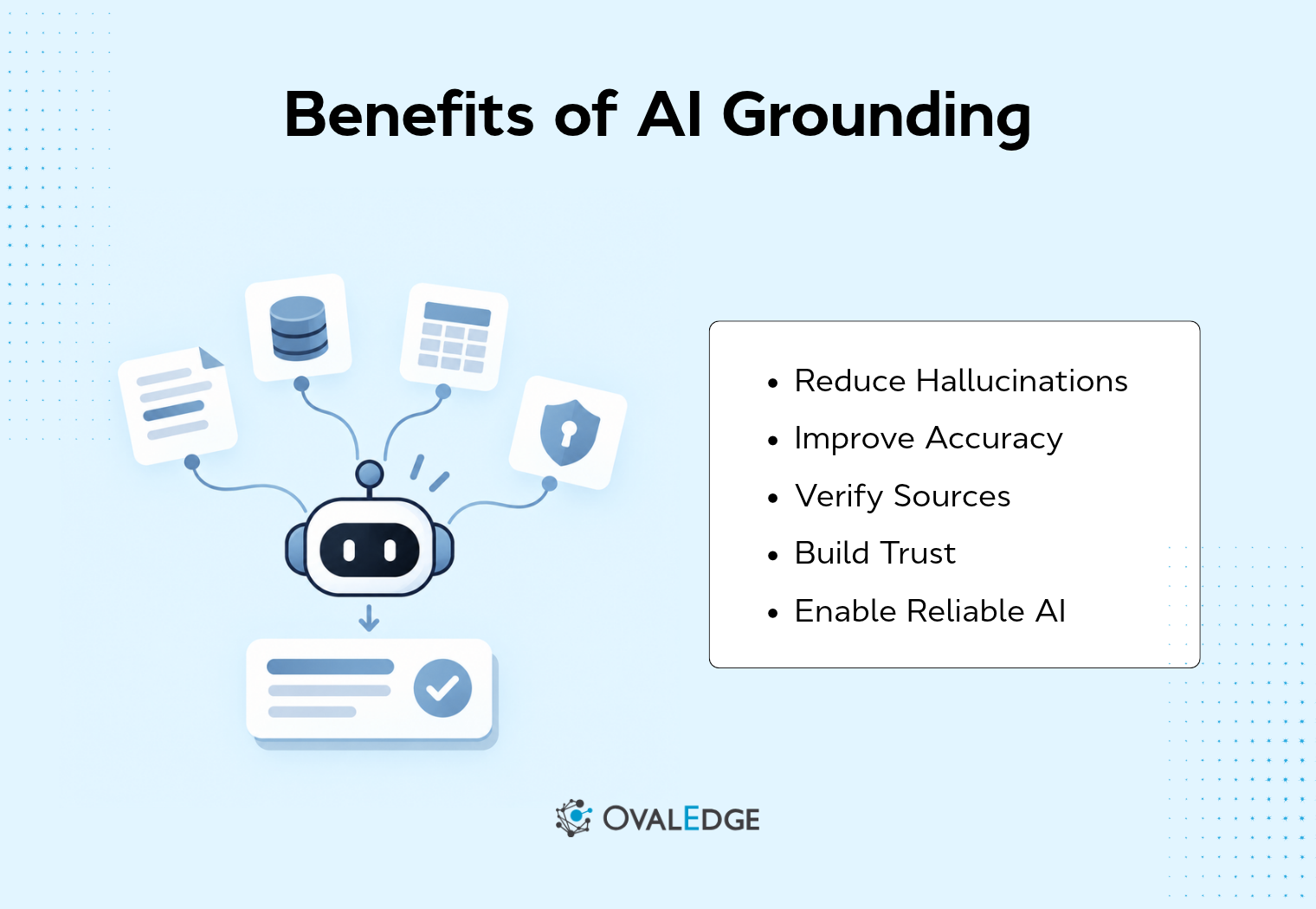
AI grounding is what separates an AI system that sounds right from one that actually is right. A VP of finance asks for quarterly revenue by region. The model returns a confident answer, but revenue has three competing definitions across the organization, and the model picked one with no way to know which the CFO approved.
AI grounding, sometimes called LLM grounding or grounding in generative AI, anchors AI responses to verified, enterprise-specific sources at query time. For analytical use cases like forecasting, risk scoring, and churn analysis, ungrounded answers carry real cost.
We cover what grounding is, why it breaks on enterprise data, how it works, which techniques matter, how to measure it, and what makes it reliable.
What is AI grounding?
AI grounding is the practice of anchoring AI-generated responses to specific, verified sources of information rather than relying on the model's training data alone. Grounding connects an AI system to external data governance inputs (enterprise data, business definitions, policies, certified datasets) so that every answer can be traced back to a named source. The result is AI output that is explainable, auditable, and aligned with how the business actually defines its terms.
Grounding is a core mechanism within context engineering, the discipline of designing, governing, and delivering enterprise context for AI.
The term has taken on new urgency as enterprises move beyond proof-of-concept AI into production analytics. In a pilot environment, a plausible-sounding answer might be good enough. In production, the line between "sounds right" and "is right" becomes the difference between a useful forecast and a costly miscalculation.
Grounding is often confused with two related practices, but it solves a different problem from each:
-
Prompt engineering shapes the instructions the model receives. Grounding shapes the factual foundation the model reasons over, which makes them fundamentally different problems with different solutions.
-
Fine-tuning changes the model's weights before deployment using domain-specific training data. Grounding leaves the model unchanged and supplies verified context at query time. Fine-tuning is static and pre-deployment; grounding is dynamic and traceable at runtime.
Consider a sales forecasting model predicting next quarter's pipeline. An ungrounded model generates its own definition of "qualified pipeline" based on patterns from training data. A grounded version pulls the company's approved definition (last updated by RevOps in March, sourced from the CRM certification workflow), cites the specific dataset it used, and flags the quality score of that source.
The difference is traceability: every number in the grounded answer points back to a named, governed artifact.
Why AI grounding breaks on enterprise data
An Alteryx 2026 Enterprise AI Survey of 1,400 business and IT leaders found that only 27% trust AI for forecasting and planning decisions.
The gap between adoption and trust often traces back to a structural problem: enterprise data is complex, ungoverned, and full of competing definitions that generic retrieval cannot navigate.
1. Enterprise data is not a single clean source
Most grounding discussions focus on document Q&A, where the source is a single knowledge base with clear text passages. Grounding an LLM with enterprise data presents a fundamentally different problem.
Large organizations carry competing definitions across departments. Five teams may maintain five versions of "net revenue," each built from different source tables, segmentation rules, and accounting standards. Beyond definitions, the complexity compounds:
-
Data quality varies across sources
-
Access restrictions change by role and geography
-
Column names are ambiguous, and joins are undocumented
-
Metadata is scattered across tools that were never designed to talk to each other
The Spider 2.0 benchmark (Yale University, 2024) quantifies this gap clearly. The same GPT-4o-based method that scored 86.6% on Spider 1.0's clean academic databases dropped to just 5.68% on Spider 2.0's enterprise-scale tasks, which feature databases averaging over 800 columns across multiple schemas. Even with a purpose-built agent framework, GPT-4o reached only 12.34%.
The gap reflects enterprise data complexity rather than model capability.
A retrieval system pulling from an ungoverned index faces the same structural problem. It cannot distinguish an approved definition from a deprecated one, a certified table from an experimental copy, or an authorized dataset from a restricted source.
2. Grounding in regulated environments needs governance signals
In financial services, healthcare, and insurance, an AI answer needs to trace back to a named source, a versioned definition, and a certified dataset. The trace itself is the compliance requirement.
Under the EU AI Act (Article 12), high-risk AI systems must maintain automatic logging of:
-
Events during system operation
-
Reference databases used
-
Input data that produce matches
Enterprise data governance frameworks now need to account for these traceability requirements, ensuring that context provenance (which version, which owner, which approval date) travels with the answer rather than living in a separate system.
Grounding that retrieves an uncertified dataset or a deprecated definition creates more than an accuracy problem. In a regulated environment, it creates a compliance liability that audit teams will eventually need to explain.
OvalEdge expert insight: Enterprise grounding fails when governance and retrieval live in separate worlds. The retrieval system finds context fast, but without governance signals attached, it cannot distinguish an approved definition from a deprecated one.
How AI grounding works: from query to trusted answer
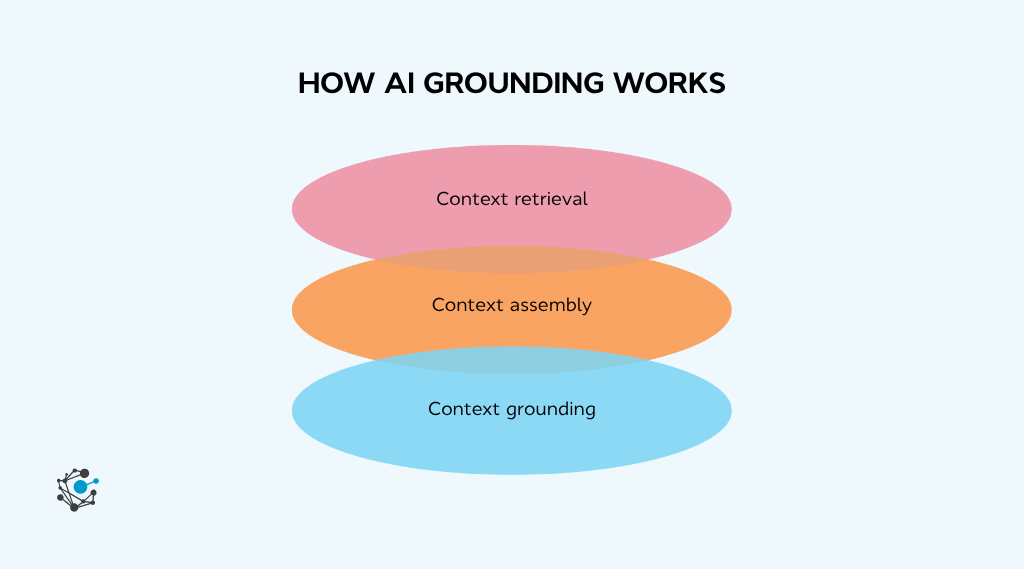
Between a user asking a question and receiving a grounded response, three distinct steps take place. Each handles a different job, and each depends on the quality of the governed foundation underneath it.
1. Context retrieval
The AI system first identifies what context is relevant to the query. For enterprise analytics, relevant context goes well beyond text passages. Retrieval needs to find:
-
The right business definitions
-
The certified data source
-
Applicable segmentation rules
-
Data quality scores
-
Access policies governing who can see what
Context retrieval differs significantly from document retrieval. Document retrieval pulls text chunks from a knowledge base. Context retrieval pulls structured governance artifacts, each carrying metadata about approval status, ownership, and certification. When definitions, lineage, and quality metadata are organized in a data catalog, retrieval can surface governed artifacts rather than unstructured text.
Retrieval quality depends entirely on what the underlying foundation contains. If definitions live in spreadsheets across five departments, the retrieval step surfaces five conflicting answers with no way to rank them.
2. Context assembly
Retrieved context then gets filtered, ranked, and combined into a single payload the model can reason over. Assembly is where governance signals do their heaviest work:
-
Filtering for the approved definition
-
Confirming certification status of each source
-
Verifying that the requesting user has permission to see the data
-
Ensuring the payload reflects current versions, not cached copies from months ago
The assembly step separates governed grounding from naive retrieval. Naive retrieval passes everything it finds to the model. Governed assembly passes only what is approved, current, certified, and authorized.
3. Context grounding (the outcome)
Grounding is the property of the final answer being anchored in named, verified sources. A grounded answer does more than return a number. It tells you which definition produced that number, which dataset it came from, who owns the dataset, and what quality score it carries.
Grounding is also verifiable: anyone with the right permissions can trace the answer back through assembly to retrieval to the original governed source. Traceability is what makes grounded answers auditable in practice.
Here is what grounding looks like at a mid-sized bank. The FP&A head asks: "Show me European net revenue for last quarter by customer segment." The grounded answer returns:
-
Result: European net revenue in Q3 was 412M EUR, down 4.8%. Largest driver: 9.1% decline in commission income from the affluent retail segment in Benelux.
-
Definition cited: Net revenue definition version 4.2, approved by Group Finance in June
-
Source table: EU_REVENUE_MASTER, owned by European Data Operations
-
Quality score: 99.1% completeness
Anyone in the organization can check exactly how the number was produced.
At OvalEdge, we believe the runtime sequence of retrieval, assembly, and grounding is where governed context becomes operational. Each step depends on the quality of the foundation underneath it. Grounding is the visible outcome, but governance is the invisible prerequisite.
AI grounding techniques that work at enterprise scale
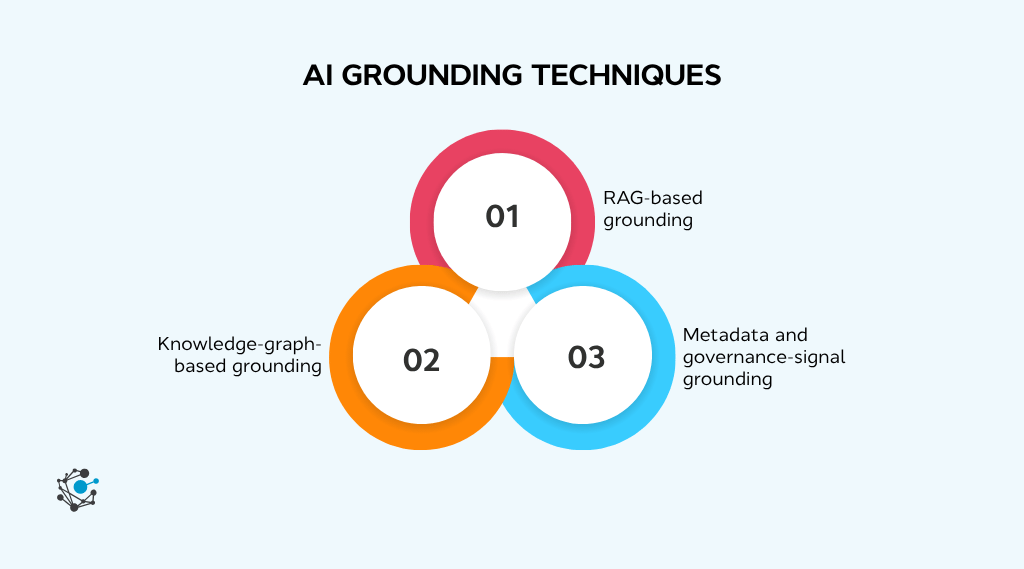
Multiple grounding techniques exist, each with different strengths for different use cases. For enterprise analytical AI, the question is which approaches handle the complexity of governed, multi-source data at scale.
1. RAG-based grounding
Retrieval-augmented generation is the most widely adopted grounding technique. It retrieves relevant text or data at query time and passes it to the model alongside the prompt. For document Q&A and general knowledge bases, RAG works well because the source material is typically a single, coherent corpus.
The limitation becomes clear when RAG is applied to enterprise analytics. RAG retrieves whatever the index contains. If the index holds five conflicting definitions of "customer churn" from five departments, RAG surfaces all five without knowing which one the CFO approved. RAG is a delivery mechanism for context: it retrieves fast, but it has no built-in awareness of which context is trustworthy.
2. Knowledge-graph-based grounding
Knowledge graphs ground AI through relationships rather than text similarity alone. Instead of matching a query to the nearest text chunk, a knowledge graph encodes structured relationships. For "net revenue," those relationships include:
- Defined by policy X
- Sourced from table Y
- Owned by team Z
- Certified as of date W
All of these relationships are queryable, giving the model a richer and more precise foundation to reason over.
For analytical use cases where terms, metrics, and datasets are deeply interconnected, knowledge graph tools offer a structural advantage. The Spider 2.0 benchmark underscores why. Models without access to semantic relationships between columns perform at single-digit accuracy rates on enterprise-scale databases averaging over 800 columns.
But the top-performing systems on the same benchmark, the ones with access to semantic metadata and graph-structured schema context, reached accuracy rates above 90%. The gap is not model capability. It is whether the model has structured, governed context to reason over.
Graph RAG, a variant that combines graph traversal with retrieval-augmented generation, adds retrieval speed to graph depth. Its reliability, however, depends entirely on the quality and governance of the underlying graph.
3. Metadata and governance-signal grounding
The third technique goes beyond content and relationships to include trust signals:
-
Data quality scores
-
Certification status
-
Lineage
-
Ownership
-
Access policies
For regulated industries, grounding that surfaces an uncertified dataset creates more risk than returning no answer at all.
The strongest enterprise grounding combines all three layers:
-
Retrieval to find relevant context
-
Graph relationships to connect related artifacts
-
Governance signals to verify that what was found is trustworthy
Each layer adds confidence to the final answer.
How grounding differs from RAG
RAG and AI grounding are often used interchangeably, but they solve different problems. RAG is a retrieval pattern that fetches context, while grounding is a reliability property of the output itself.
|
Dimension |
RAG |
AI grounding |
|
What it is |
A retrieval pattern that fetches context at query time |
A reliability property of the AI output |
|
What it solves |
Getting relevant information to the model |
Ensuring the output is anchored in verified sources |
|
Governance awareness |
None by default; retrieves whatever is in the index |
Requires governance signals (quality, certification, ownership) |
|
Best for |
Document Q&A, knowledge bases, general search |
Analytical AI, regulated industries, auditable decisions |
|
Relationship |
RAG can be one delivery mechanism for grounding |
Grounding is the outcome, not the method |
For enterprise analytical AI (forecasting, risk scoring, revenue analysis), RAG alone leaves too much ambiguity in place. Retrieval without governance simply surfaces that ambiguity faster. Grounding requires that the retrieved context carry trust signals: whether a business glossary definition is approved, whether a source is certified, and who owns it.
For example: A demand forecasting model grounded in a knowledge graph retrieves not just the forecast table but also its lineage (three upstream sources), its quality score (98.4% completeness), its owner (supply chain analytics team), and the policy that governs who can use it.
How to measure grounding quality
Grounding is only useful if you can prove it is working. Four metrics tell you whether your grounded answers are actually anchored in trusted sources or just appearing to be.
|
Metric |
What it measures |
Governance connection |
|
Groundedness (faithfulness) |
Claims supported by retrieved context |
Improves with certified, versioned sources providing a single approved measure |
|
Citation accuracy |
Correct attribution to named, verifiable sources |
Depends on context provenance; data lineage provides the chain of custody |
|
Context precision |
Relevance of retrieved context, minimal noise |
Rises with governance-filtered retrieval (certification, freshness, access policy) |
|
Hallucination rate |
% of claims with no support in retrieved context |
Drops with complete, governed context payload vs. fragmented metadata |
Each of these metrics is a grounding eval, and the AI data governance quality of the underlying context directly affects every one of them. Organizations that track these four measurements gain a clear, data-driven view of whether their grounding in generative AI is actually producing trustworthy output or simply producing plausible-sounding answers faster.
What makes enterprise AI grounding reliable?
Most enterprises already have years of governance work in place. For analytical AI use cases, this existing foundation already provides a significant portion of the context AI needs to ground its answers.
1. Data governance as the grounding foundation
Most enterprises already have years of governance work in place. For analytical AI use cases, this existing foundation already provides a significant portion of the context AI needs to ground its answers.
The building blocks are familiar:
- Business glossaries
- Data catalogs
- Lineage mapping
- Quality rules
- Ownership assignments
- Certification workflows
- Policy controls
The gap is rarely about creating governance from scratch. Most organizations have invested heavily in governance artifacts for regulatory compliance, data quality improvement, and operational consistency. The real challenge is making those existing artifacts usable by AI systems at runtime, in the moment a user asks a question.
The organizations furthest ahead on AI grounding are often the ones with the most complete governance foundations, because the model can only ground its answers in context that is actually available and structured. Advanced model capabilities matter, but the quality and completeness of the governed context matters more.
2. Connected context for analytical AI
Governance artifacts become AI-usable when they move out of isolated tools and into a single, queryable structure. When definitions, lineage, quality scores, ownership, and policies are linked together, AI systems can ground their answers in the full picture rather than a single metadata field pulled from one tool.
The impact shows across every metric in the previous section. Analytical use cases where this matters most include:
-
Sales forecasting and demand planning
-
Financial analysis and revenue analytics
-
Fraud detection and risk scoring
-
Churn analysis
The quality of grounding in each case depends directly on the quality of the connected governance context underneath it.
Unified data governance platforms like OvalEdge connect these existing governance artifacts through an Enterprise Context Graph, making them queryable by AI applications and agents. Instead of rebuilding context from scratch, organizations can activate the governance foundation they have already invested years in building.
The shift is fundamental: governance moves from compliance infrastructure to AI infrastructure. The same artifacts that satisfy regulatory requirements (lineage, ownership, classification, access control) are the ones AI needs for reliable grounding.
Organizations that recognize this connection can accelerate their AI grounding initiatives without starting over, because the hardest work is already done.
Conclusion
AI grounding is the difference between enterprise AI that sounds right and AI that is right. For analytical use cases, ungrounded AI produces plausible numbers that no one can trace, verify, or trust when the decision matters most.
Most enterprises already have the raw material of reliable grounding in their data governance programs. Approved definitions, certified datasets, documented lineage, ownership assignments, quality rules, and access policies: these are the artifacts AI needs to produce trustworthy, auditable answers.
The next step is connecting and activating this existing foundation so AI applications can query governed context at runtime. OvalEdge's Enterprise Context Graph brings these governed artifacts together into a connected, queryable structure purpose-built for analytical AI.
The result is AI-driven forecasting, risk analysis, and revenue analytics that every stakeholder can trust, because every answer traces back to a named, governed source.
For organizations ready to ground their analytical AI in governed enterprise context, request a demo to see how OvalEdge makes it work.