Data governance becomes visible only when something breaks. A model fails in production because training data cannot be traced. An analytics rollout stalls while access approvals sit in a queue. A compliance review exposes gaps that formed months ago. These failures rarely come from missing policies. They come from governance systems running at the speed of periodic reviews while data and AI move in real time.
According to Gartner's 2024 Press Release, up to 60 percent of AI initiatives risk being abandoned through 2026 because they lack AI-ready data.
The organizations facing the sharpest version of this problem are the ones scaling AI on data they cannot find, cannot trust, and cannot explain. Context engineering is data governance becoming operational for AI agents, and agentic governance is the architecture that makes it work.
This guide covers how agentic data governance works, how it compares to traditional and automated models, what it means to govern the agents themselves, where it breaks down, and how to start.
What is agentic data governance?
Agentic data governance is an approach where AI agents autonomously enforce, monitor, and adapt data governance policies across data systems in real time. Instead of relying on static rules applied by humans in periodic review cycles, intelligent agents make context-aware decisions as data moves through its lifecycle: creation, access, transformation, sharing, and deletion.
Three characteristics separate agentic governance from automated data governance:
-
Context-aware decision-making: Agents evaluate multiple signals simultaneously (data sensitivity, user role, purpose of use, regulatory scope, lineage impact, behavioral patterns) before choosing to approve, deny, mask, delay, or escalate. Rule-based automation evaluates one condition at a time.
-
Continuous learning: Agents learn from enforcement outcomes, steward overrides, and false positives. Over time, they adjust thresholds and flag policies that no longer match real usage.
-
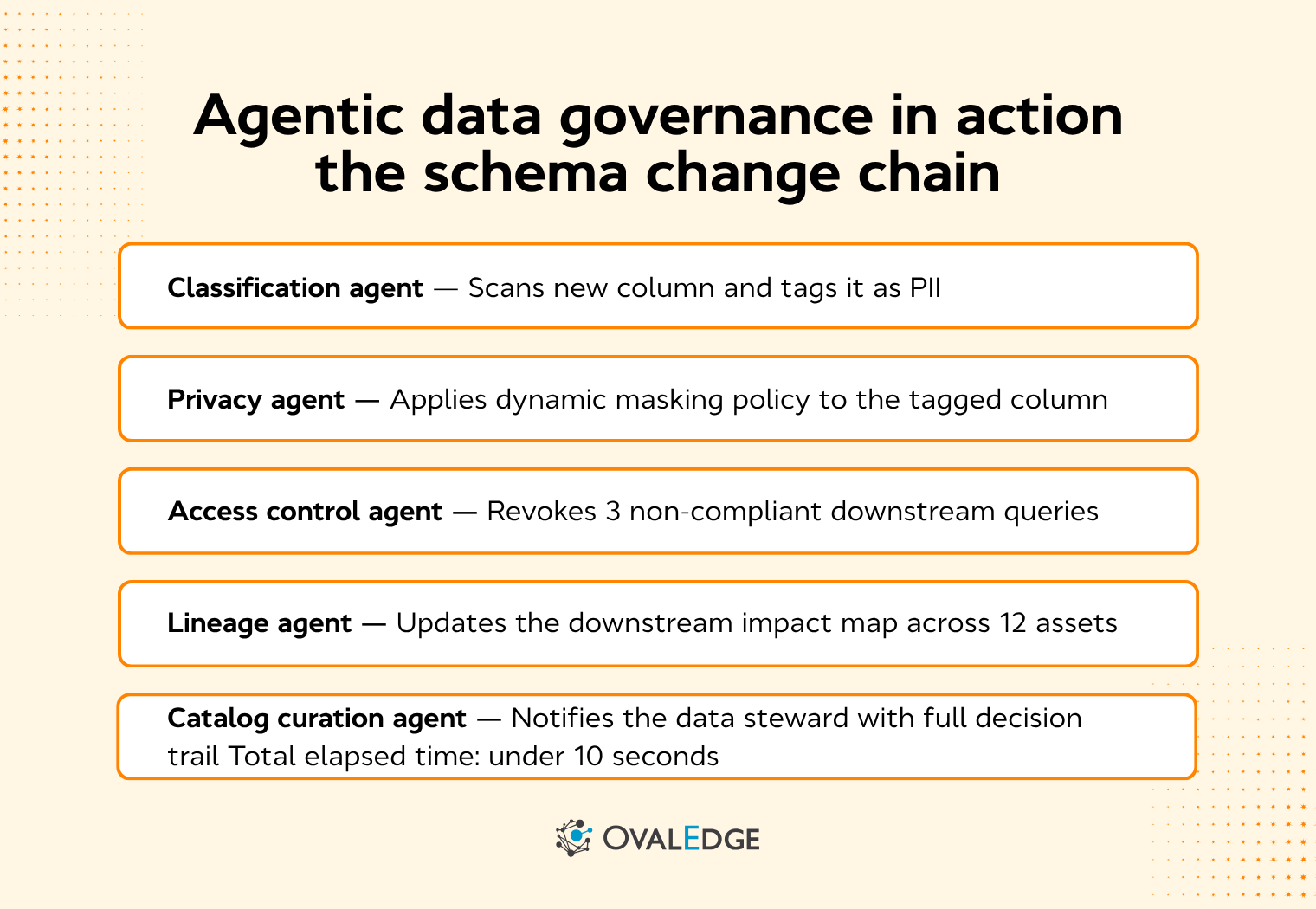
Multi-agent coordination: Domain-specific agents (classification, lineage, quality, access, privacy) operate independently while coordinating through shared signals. A schema change can trigger classification updates, then privacy checks, then access control adjustments, then lineage refresh, all sequenced automatically.
A related term gaining traction is "agentic data management," which focuses on the operational data layer (pipeline health, quality remediation, metadata enrichment). Governance is the policy and enforcement layer. In practice, the two overlap: agents that monitor pipeline quality also enforce governance rules, and governance agents depend on accurate metadata from the management layer. Most enterprise implementations eventually span both.
Worth noting: According to Gartner, the organizations most likely to succeed with AI treat data governance as an operating layer rather than a compliance exercise. Governance maturity, specifically AI readiness, directly predicts whether AI initiatives graduate from pilot to production.
How does agentic data governance work?
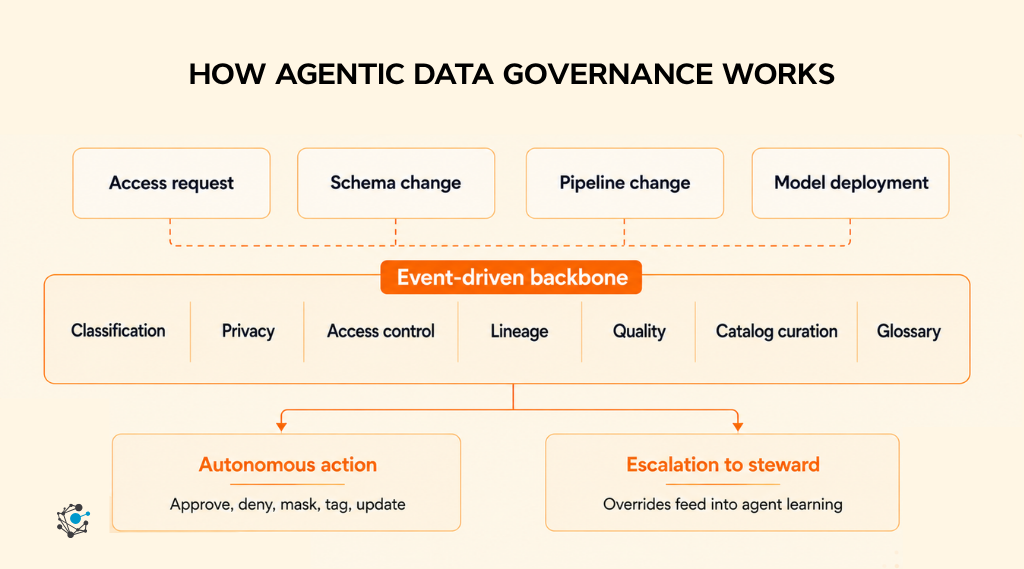
Agentic data governance embeds autonomous decision-making directly into the data lifecycle. The architecture has five layers that work together.
Event-driven backbone
Agents respond to triggers as data moves through systems. Common events include:
-
Access requests: Agents evaluate role, purpose, location, and historical behavior, then grant, deny, mask, or route for approval.
-
Schema changes: Agents detect new columns, evaluate policy impact, trigger reclassification, and update downstream controls.
-
Pipeline changes: Agents validate whether transformations break retention, privacy, or lineage rules.
-
Model deployments: Agents detect sensitive features in training or inference paths and enforce appropriate controls.
Each trigger initiates a sequence of agent actions rather than a single rule check. A schema change in a customer table, for example, can cascade through classification, privacy evaluation, access control updates, and data lineage refresh within seconds.
Specialized agent roles
Effective agentic governance distributes responsibility across specialized agents. In an agentic governance framework, each agent owns a specific domain:
-
Classification agents scan connected systems to detect and classify sensitive data (Personally Identifiable Information (PII), Protected Health Information (PHI), financial data) using Machine Learning (ML) classifiers and configurable policies.
-
Lineage agents build and maintain automated column-level lineage derived from source code parsing, covering SQL, Python, ETL, and Business Intelligence (BI) tools.
-
Quality agents analyze data profiles, existing quality issues, and schema patterns, then recommend technical data quality rules.
-
Access control agents enforce fine-grained Role-Based Access Control (RBAC) down to the column or row level, with automated approval workflows.
-
Catalog curation agents identify missing metadata, descriptions, and documentation, then reach out to the right people to capture tribal knowledge.
-
Glossary agents discover business terms across the enterprise, suggest definitions, and flag conflicting terminology in the business glossary.
These agents operate within a connected enterprise context graph that links ontology, glossary, lineage, catalog, quality, and policy into a single, continuously evolving structure.
Every agent works from the same trusted context. For a deeper look at how AI agents drive governance automation, including architecture patterns and agent interaction models, the linked guide covers the technical detail.
Human-in-the-loop escalation
Fully autonomous governance is not the goal. Effective systems build in escalation paths when risk scores are ambiguous, classifications are missing, or a request falls outside normal patterns. Overrides require justification.
Every escalation decision feeds back into the agent's learning loop, improving future accuracy. This creates a system where data stewards focus on high-judgment decisions while agents handle the repeatable ones.
Agentic governance vs. traditional and automated governance
The distinction matters because enterprises often conflate automation with agentic behavior, which leads to governance that looks modern on paper while still depending on manual intervention at every decision point.
|
Criteria |
Traditional governance |
Automated governance |
Agentic governance |
|
Decision-making |
Human committees review and approve |
Rule engines execute predefined conditions |
AI agents interpret context, weigh risk, and select actions |
|
Speed |
Days to weeks per decision |
Milliseconds for matching rules, stalls on exceptions |
Milliseconds with context-aware exception handling |
|
Adaptability |
Manual policy updates, quarterly reviews |
Frequent rule maintenance, brittle at scale |
Learns from outcomes, adjusts thresholds, flags stale policies |
|
Context awareness |
Depends on human interpretation |
Limited to predefined attributes |
Evaluates sensitivity, lineage, behavior, regulatory scope, and purpose |
|
Auditability |
Retrospective audits, inconsistent documentation |
Logs exist, reasoning is limited |
Explainable decisions with full audit trails by default |
|
Handling ambiguity |
Escalates everything |
Fails or produces false positives |
Reasons through uncertainty, escalates only when confidence is low |
Pro tip: A practical way to evaluate governance maturity is to apply the three-category framework.
Category 1 capabilities (data catalog, lineage, quality, access controls) already exist in most organizations and don't need reinventing for AI. They need to be trusted, complete, and activated.
Category 2 capabilities (the business glossary and semantic layer) must evolve from human-readable dictionaries into AI-ready meaning systems that support taxonomy, ontology, and semantic mappings.
Category 3 capabilities (agent permissions, Model Context Protocol (MCP) servers, governed autonomy, tool-use governance) are genuinely new and require new architecture.
Enterprises that try to skip Category 1 and jump to Category 3 fail predictably. For more on the four pillars of data governance that underpin this framework, the linked guide breaks down each layer.
Governing AI agents: The other side of agentic governance
Most conversations about agentic data governance focus on one direction: using AI agents to govern data. The other direction matters just as much. As AI agents become autonomous data consumers (querying databases, combining information across systems, triggering actions), enterprises need governance frameworks that control what agents can access and do.
This is the distinction between governance BY agents and governance OF agents. The strongest AI governance programs address both simultaneously.
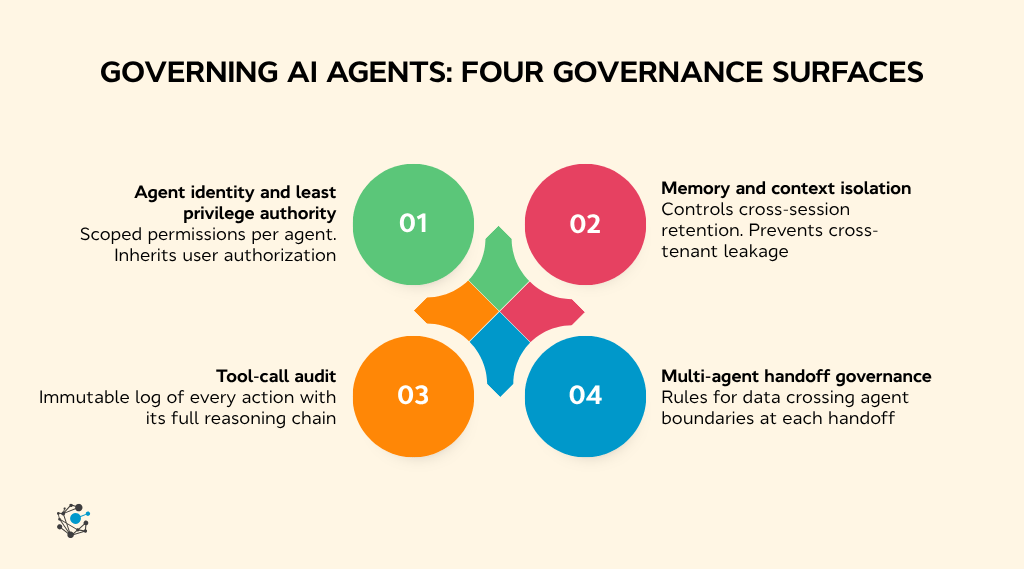
Four governance surfaces unique to agentic AI
-
Agent identity and least-privilege authority: Every agent needs its own identity, scoped permissions, and an explicit allow-list of actions. Static API keys are not sufficient. Agents acting on behalf of a user should inherit that user's authorization constraints.
-
Memory and context isolation: Agents accumulate context across sessions. Controls must prevent cross-session contamination, cross-tenant data leakage, and unauthorized retention of sensitive information. An agent memory governance framework defines what gets written, who can access it, how long it persists, and when it must be deleted.
-
Tool-call audit: Every external action an agent takes (database queries, API calls, file operations) needs immutable logging with the reasoning that led to it. Audit trails must be granular enough that a compliance reviewer can reconstruct the full decision chain.
-
Multi-agent handoff governance: When agents pass data to other agents, explicit rules govern what information crosses the boundary, whose policy applies at each handoff, and how lineage continues.
The regulatory dimension
The European Union (EU) AI Act's high-risk obligations take effect on August 2, 2026, with fines up to €35 million or 7 percent of global turnover for serious violations.
General Data Protection Regulation (GDPR) and California Consumer Privacy Act (CCPA) requirements for automated decision-making apply directly to agent-driven processes. Organizations that deploy agentic governance without building agentic AI compliance infrastructure are accumulating regulatory debt.
The practical integration point is MCP (Model Context Protocol). MCP servers expose governed enterprise context (glossary definitions, lineage, quality signals, certifications, access policies) to AI models and agents, ensuring every agent interaction runs through the same policy layer.
Context engineering makes this operational: the data catalog, lineage graph, and quality signals become the runtime context that agents consume, governed at every step.
What are the challenges and limitations of agentic data governance?
Agentic governance introduces real risks that organizations should plan for, not discover in production. Here are the five risks that stand out across early implementations.
-
Metadata readiness: Agents enforce governance based on what metadata tells them. If classification labels are missing, ownership records are stale, or lineage is incomplete, agents will make incorrect decisions.
The metadata foundation is the single biggest prerequisite. Unified governance platforms like OvalEdge address this through a unified data catalog with automated discovery and AI-powered classification across 170+ connected systems, which reduces the manual metadata effort that typically blocks governance programs from scaling.
-
Policy translation: Governance policies written for human interpretation ("sensitive data should be handled carefully") do not translate to agent logic. Policies need clear conditions, defined decision boundaries, documented exception paths, and machine-readable formatting before agents can act on them.
Data contracts help bridge this gap by formalizing quality, access, and retention expectations at the dataset level.
-
Autonomy calibration: Too much agent freedom creates risk (an agent masking data that a legitimate workflow needs). Too many guardrails create the same bottleneck that manual governance already causes. The right calibration matches the level of automation to the level of risk, what some frameworks call governed autonomy.
High-risk actions (deleting data, granting cross-domain access) should always escalate. Low-risk, high-frequency actions (tagging metadata, routing approval requests) can run fully autonomous.
-
Multi-agent emergent behavior: When multiple agents operate in the same environment, their interactions can produce outcomes that no individual agent was designed to create.
Two agents independently applying valid policies to the same dataset can create conflicting access states. Coordination protocols and event sequencing are necessary to prevent this.
-
Explainability. Stakeholders need to understand why an agent made a specific decision.
Transparency in agent reasoning builds the organizational trust necessary for implementing agentic data governance beyond the pilot phase.
How to get started with agentic data governance?
Enterprise data governance at scale does not require starting from scratch. It requires starting narrow, proving value, and expanding with evidence. These five steps provide a practical path.
Step 1: Identify one governance pain point worth solving
Look for areas where manual approvals delay analytics, where access requests pile up, where audits require extensive cleanup, or where policies drift from actual usage. These high-friction areas are the best candidates. Prioritize pain points that affect multiple teams.
Step 2: Make policies agent-ready
Human-readable policies need translation into machine-interpretable rules with clear conditions, decision boundaries, and exception paths. Start with one policy. Define exactly what should trigger approval, denial, or escalation. Document acceptable exceptions instead of handling them informally.
Step 3: Fix the metadata foundation
Validate ownership and sensitivity labels for critical datasets. Fill lineage gaps in high-impact data pipelines first. Standardize how teams capture usage context for shared assets. A practical implementation model follows three phases: Crawl (connect data sources, let AI build lineage and inventory automatically), Curate (agents perform most enrichment work while stewards validate), and Consume (teams find, trust, access, and analyze governed data).
This model makes governance operational in weeks. According to Forrester TEI, organizations using this approach have reported up to a 40 percent reduction in effort to catalog metadata, fulfill data requests, and compile lineage, alongside a 75 percent reduction in effort to find, tag, and secure sensitive data.
Step 4: Pilot one high-impact workflow
Start with a focused use case: automated access approvals for sensitive data, continuous classification across a specific data platform, or AI agent metadata enrichment for a critical pipeline. Choose a workflow with clear success metrics and involve both governance and business stakeholders.
Step 5: Measure, learn, scale
Compare approval times and manual review hours before and after automation. Track prevented policy violations and access misuse. Capture agent overrides and review them for policy gaps. Use pilot results to expand incrementally to additional domains and workflows.
Governance programs that deliver measurable value early maintain organizational support. Programs that start too broadly stall before demonstrating impact.
Pro tip: Resistance to agentic governance often comes from governance teams who feel replaced, not from the technology itself. Frame agents as automation that handles the repetitive 80 percent (tagging, routing, classification) so stewards can focus on the high-judgment 20 percent (resolving conflicts, setting policy direction, auditing exceptions).
For guidance on how the stewardship role evolves alongside agentic systems, the linked guide covers the practical transition.
Conclusion
Agentic data governance moves governance from documentation into execution. The organizations getting this right treat governance as an operating layer for trusted data: clarity over the data estate, context for every human and agent decision, control over access and policy without becoming a bottleneck, and adoption that sticks because the program delivers measurable value in weeks rather than years.
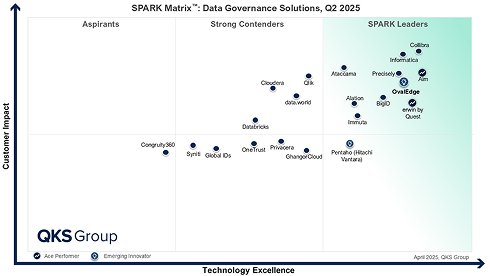
The shift requires a platform that unifies catalog, lineage, quality, access, and policy enforcement into a single operating layer. OvalEdge delivers this as a unified data governance platform, recognized as a Gartner MQ 2025 participant and a SPARK Matrix 2026 Leader, with built-in governance agents that make agentic governance operational from day one.
Book a demo to see how agentic governance delivers clarity, context, and control across a data estate.
.png?width=1081&height=173&name=Forrester%201%20(1).png)
.png?width=1081&height=241&name=KC%20-%20Logo%201%20(1).png)