-2.png)
If you’ve ever had trouble finding the right piece of data in a sea of spreadsheets, reports, and systems, you’re not alone.
Data catalogs are making waves because they help businesses sort through all this noise. Imagine having a tool that organizes everything, so you don’t have to waste time searching for information.
It’s exactly what data catalogs are doing for companies of all sizes, helping them get a handle on their data, find what they need, and make smarter decisions.
What’s more interesting is how these catalogs are evolving. They’re not just about keeping track of where your data is anymore.
Now, they’re becoming smarter, powered by AI, which means they’re automatically tagging, organizing, and updating data to keep everything in check.
The way businesses manage their data is changing, and data catalogs are at the center of this shift.
In this blog, we’ll explore the data catalog market: why it’s growing so fast, what’s driving the change, and how it’s shaping the future of data management.
Data catalog: Market definition and why it matters
The data catalog market is a vital component of modern data management, enabling organizations to efficiently organize, discover, and govern vast amounts of data.
Data catalogs serve as metadata repositories, helping businesses optimize data quality, improve analytics, and ensure compliance.
With the growing need for real-time data access and AI-driven metadata management, the market is expanding rapidly.
By 2026, the data catalog market is projected to experience significant growth, driven by factors like increased data complexity, cloud adoption, and regulatory pressures.
Companies across various industries are leveraging data catalogs to streamline data governance and enhance decision-making.
At its core, a data catalog is a tool that organizes and manages the data scattered across an organization.
It provides businesses with a centralized view, ensuring that data is not only accessible but also trustworthy and relevant.
With data playing a central role in business strategy, the demand for tools that facilitate data discovery, governance, and quality is only increasing.
Data catalogs are becoming essential in ensuring that businesses can harness their data effectively.
Data Catalog market size & forecast
The data catalog market is experiencing rapid growth, with forecasts projecting significant expansion through the late 2020s and beyond.
|
Did you know? According to The Business Research Company, the global data catalog market was valued at $1.1 billion in 2024 and is expected to reach $3.12 billion in 2029, growing at a strong CAGR of approximately 22.8%. The increase in data loss, cybercrimes, and a boost in innovation in data integration and analytics are driving the growth. North America was the largest region in 2024, while the Asia-Pacific is the fastest-growing region. |
Forecasts vary, and this variance in estimates reflects different methodologies and market definitions, but the consensus is clear: the data catalog market is poised for robust growth.
Factors driving this expansion include the increasing need for data governance, the rise of cloud technologies, and the growing regulatory pressures around data management.
As organizations continue to rely more heavily on data for decision-making, the demand for data catalogs, tools that help companies better organize, govern, and leverage their data, will only continue to rise.
|
Also read: As the data catalog market grows, ensuring strong data governance is crucial for maximizing the value of your data. For practical insights on implementing effective data governance, download our How to Implement Data Governance whitepaper. |
Key growth drivers in the data catalog market
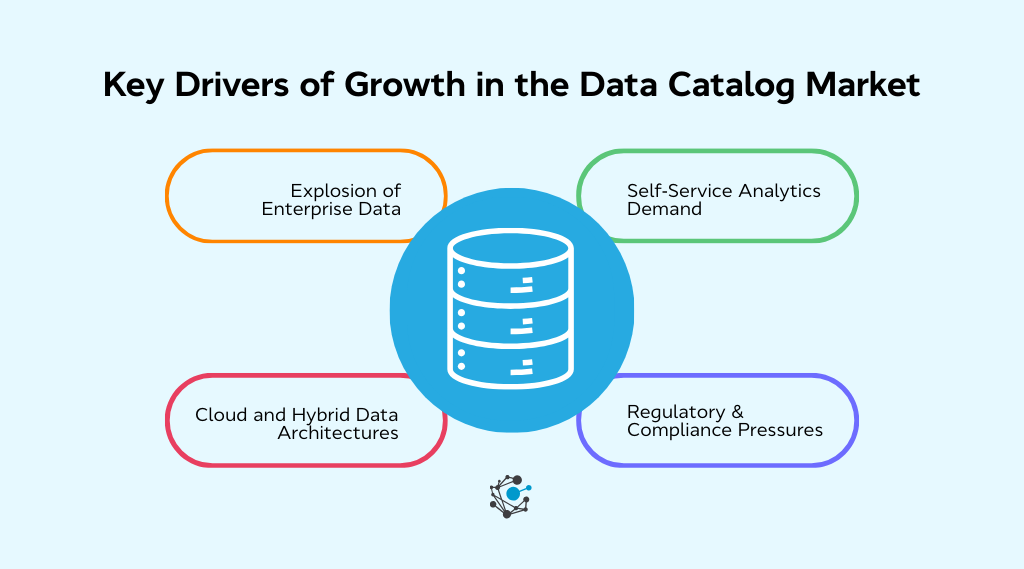
Several fundamental forces are fueling the rapid expansion of the data catalog market, each contributing to the growing demand for these solutions. Let’s dive into some of the key drivers:
1. Explosion of enterprise data
As businesses generate more structured and unstructured data, the need for tools to organize, discover, and govern it becomes essential.
Data catalogs help manage the growing complexity, making data more accessible and actionable.
|
Insight: 2025 reports from Future Market Insights emphasize that data democratization, data lineage tracking, and enterprise data governance are key factors accelerating the data catalog market's growth. |
2. Self‑service analytics demand
Business users now require easy access to curated, trustworthy data for decision-making.
Data catalogs support this shift by enabling faster self-service analytics, allowing non-technical users to find and use data without relying on IT.
3. Regulatory & compliance pressures
With stricter data regulations like GDPR and CCPA, organizations must ensure their data is secure, auditable, and compliant.
Data catalogs help by providing transparency and control over data assets, making it easier to meet compliance requirements.
4. Cloud and hybrid data architectures
As companies adopt cloud and hybrid architectures, data catalogs provide visibility and governance across distributed data sources.
This ensures data can be accessed and managed consistently, regardless of where it’s stored.
5. Connector depth
As data stacks expand, connector depth is becoming a key differentiator in the data catalog market.
Catalogs with strong native connectors are better equipped to capture richer metadata, maintain accurate lineage, and stay in sync as source systems evolve.
In contrast, reliance on shallow or third-party connectors often limits visibility and slows adoption in complex environments.
Over time, connector depth directly impacts how well a data catalog scales with enterprise data architectures.
Emerging Trends in the Data Catalog Market (2025-2026)
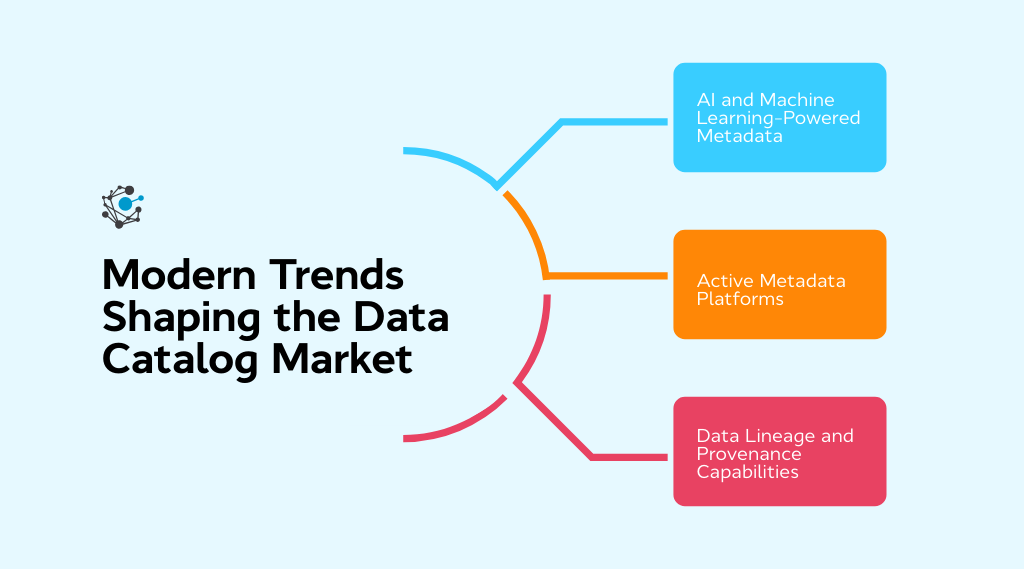
The data catalog market is evolving rapidly, with several emerging trends shaping its future.
What started as a way to search and look up datasets is now evolving into a layer that supports exploratory analysis and decision-making.
Today’s catalogs are expected to provide multi-asset views, clear lineage paths, and intuitive domain navigation that help users understand context, not just locate data.
This shift reflects a broader change in how organizations use data catalogs: from simple discovery tools to decision infrastructure that supports analytics, governance, and trust at scale.
Here are the key developments:
1. AI and machine learning–powered metadata
AI and machine learning are transforming how metadata is managed. These technologies automate the extraction, classification, and quality tagging of metadata, significantly reducing manual effort and improving accuracy.
By automatically organizing data and identifying patterns, AI-driven catalogs enable businesses to manage vast amounts of data more efficiently, making it easier to discover relevant insights.
|
Insight: According to IMARC Group, the global data catalog market is continuously growing, highly driven by the increasing trend of integrating AI and machine learning into these tools. It is expected to reach $5.059 billion by 2033, growing at an 18.1% CAGR from 2025 to 2033. Innovations like AI-driven metadata management are helping to automate tasks like data tagging, classification, and quality control, making it easier for users to find relevant datasets. |
2. Active metadata platforms
Traditional data catalogs rely on static metadata, but the shift is moving toward active metadata platforms.
These platforms provide real-time metadata propagation across systems, allowing businesses to integrate metadata into operational analytics workflows.
Active metadata enables dynamic updates and faster decision-making by providing continuously updated views of the data landscape, which is crucial for organizations that need to respond quickly to changes.
This is also why AI-driven data catalogs are gaining an edge. Active metadata enables continuous refresh through event-driven updates, allowing catalogs to react as data changes rather than relying on periodic scans.
More importantly, it supports governance actions in real time, such as flagging policy violations, updating lineage automatically, or triggering quality checks. As a result, catalogs move beyond visibility to active participation in data operations.
3. Data lineage and provenance capabilities
Data lineage, or the ability to track data’s origin and flow throughout systems, is becoming a critical capability in data catalogs.
As organizations focus more on governance and data trust, understanding where data comes from, how it’s transformed, and where it’s being used helps ensure compliance and maintain data integrity.
This is especially important in regulated industries where proving data accuracy and compliance is non-negotiable.
|
Insight: Gartner’s Magic Quadrant has noted that active metadata, a step beyond traditional static metadata, is becoming more integrated into these tools, making them smarter and real-time. With active metadata platforms, organizations can monitor data as it moves across systems, providing up-to-date insights into data changes, flow, and usage. This shift to intelligent, real-time metadata management is helping companies not just track their data, but also leverage it more effectively in operational and analytical workflows. |
The above trends are shaping the data catalog evolution. As businesses continue to grapple with growing data complexity, these innovations are making it easier to govern, discover, and trust data in real-time. The shift towards smarter, more dynamic catalogs is not just a passing trend; it’s the future of data management.
Data Catalog Vendors: Categories and Market Leaders
The data catalog market is diverse, with vendors offering different types of solutions depending on business needs, deployment preferences, and technical requirements. Let’s break down the key categories that dominate the market today:
1. Dedicated enterprise data catalog solutions
These are full-featured platforms designed for large enterprises that require comprehensive data governance, lineage, collaboration, and AI-powered metadata management.
Enterprise data catalog solutions often integrate with multiple data systems and support complex workflows, making them ideal for businesses with vast, decentralized data environments. These platforms provide robust metadata management capabilities, automated data discovery, and advanced security features.
|
Typical buyers: Large enterprises, regulated industries, and companies managing complex data ecosystems. Fit in enterprise stacks: These solutions integrate deeply into enterprise data lakes, business intelligence systems, and governance frameworks, often playing a central role in the organization’s data management strategy. |
2. Cloud‑native catalog platforms
Cloud-native data catalog platforms are designed to work seamlessly within specific cloud ecosystems, such as AWS, Azure, or GCP.
These platforms leverage cloud computing's scalability and flexibility, making them ideal for organizations that are already heavily invested in cloud infrastructure.
They offer automatic scaling, high availability, and real-time updates, ensuring seamless data governance and access in dynamic cloud environments.
|
Typical buyers: Cloud-first organizations, mid-market businesses, and companies looking for scalability without heavy on-premises infrastructure. Fit in enterprise stacks: These platforms integrate tightly with cloud data warehouses, data lakes, and analytics tools, making them a natural choice for businesses leveraging cloud ecosystems. |
3. Embedded and open source catalog tools
Embedded catalog tools are often part of broader analytics or data platforms, offering modular functionality that businesses can tailor to their specific needs.
Open-source data catalog tools, on the other hand, provide flexibility and cost efficiency for businesses with technical expertise.
These tools are often used by organizations that need a customizable solution without the hefty price tag of enterprise platforms.
While they may lack some of the advanced features of full-fledged catalog solutions, they can be powerful when combined with other data management tools.
|
Typical buyers: Small to medium-sized businesses, startups, and companies with technical teams capable of customizing open-source tools. Fit in enterprise stacks: These tools are often used as part of DIY data management stacks or embedded within other applications, such as analytics or business intelligence platforms. |
Each vendor category in the data catalog market serves different needs and organizational sizes, from large enterprises to cloud-native businesses and flexible open-source solutions.
Understanding these categories helps companies choose the right data catalog platform that fits their infrastructure, goals, and data management strategies.
|
Evaluating vendors? Data catalog platforms differ widely in areas like governance depth, integrations, and scalability. Download our Data Catalog Comparison Guide that breaks down these differences to help teams shortlist the right options faster. |
Strategic insights & future outlook
As the data catalog market continues to evolve, several key trends point toward a future where these platforms become even more integral to business operations. Here are some forward-looking insights:
1. Catalogs are evolving into governance and action layers
Data catalogs are increasingly converging with data governance platforms. Rather than only describing data, catalogs are now expected to support access requests, policy enforcement, and stewardship workflows across the organization.
This shift reflects a broader market trend where catalogs act as coordination layers that connect data discovery with governance decisions, making them central to how organizations operationalize trust and control.
2. Convergence of active metadata, governance, and analytics
Active metadata is accelerating this convergence by enabling real-time awareness of how data is created, changed, and used. As metadata flows continuously across systems, catalogs are becoming tightly coupled with analytics and governance engines, helping organizations move from passive oversight to continuous governance aligned with business activity.
3. Catalogs as enablers of AI readiness and trust
As AI adoption grows, catalogs are playing a critical role in establishing trust frameworks. Market trends indicate that catalogs will increasingly support AI readiness by ensuring data is traceable, policy-compliant, and stewarded across its lifecycle, reducing risk while improving confidence in AI-driven outcomes.
4. Sustained high growth driven by complexity
Forecasts continue to point toward sustained, high-double-digit growth, driven less by raw data volume and more by architectural complexity. Multi-cloud environments, regulatory pressure, and distributed ownership models are reinforcing the need for catalogs that operate as strategic infrastructure rather than isolated tools.
In conclusion, the data catalog market is on a strong growth trajectory, with key trends pointing to more integrated, intelligent, and AI-driven solutions that are essential for managing modern, complex data environments.
Key players in the global data catalog market
The data catalog market includes a combination of large platform providers, enterprise data management vendors, and specialized catalog solutions, each addressing different aspects of data discovery, governance, and metadata management.
Major cloud and analytics vendors typically embed catalog capabilities within broader data platforms, appealing to organizations seeking native integration across storage, analytics, and cloud services.
In parallel, enterprise-focused vendors position data catalogs as governance-centric systems, emphasizing lineage, stewardship workflows, and compliance for complex, regulated environments.
A growing segment of the market is made up of specialized and emerging vendors focused on active metadata, AI-driven discovery, and domain-oriented data ownership.
These solutions are gaining adoption as organizations deal with distributed data architectures and increasing governance complexity.
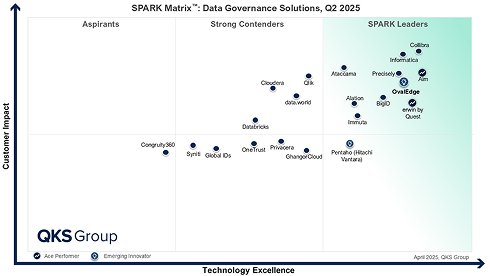
Within this landscape, OvalEdge is positioned around operational metadata and governance workflows, focusing on helping enterprises not just discover data, but actively manage ownership, access, and policy enforcement across modern data stacks.
This reflects a broader market shift toward catalogs that function as governance and control layers, rather than passive metadata repositories.
Conclusion
The data catalog market is on a clear upward trajectory, driven by growing data complexity, increasing regulatory pressures, and the rising demand for AI-powered data solutions.
As businesses continue to rely on data for decision-making, data catalogs are becoming essential for managing, discovering, and governing that data effectively. Their role in improving data accessibility, governance, and integration with advanced analytics is crucial for businesses looking to maintain a competitive edge.
As the data catalog market matures, leading platforms are increasingly combining discovery, governance, and automation into unified solutions. OvalEdge is one example of this broader shift, focusing on operational metadata, governance workflows, and AI readiness.
Ready to take control of your data? Schedule a call with OvalEdge today to explore how their platform can help your organization manage and maximize its data assets.
FAQs
1. What are the key benefits of implementing a data catalog?
A data catalog helps improve data discovery, enhances collaboration, ensures data governance, and accelerates decision-making by organizing and indexing data assets for easy access. It enables businesses to efficiently manage metadata, ensuring data quality and compliance with regulatory standards.
2. How does AI enhance data cataloging processes?
AI enhances data cataloging by automating metadata extraction, classification, and tagging. This reduces manual efforts, improves data accuracy, and speeds up data management processes. AI-powered tools also enhance data search capabilities and enable predictive analytics, improving overall data governance and accessibility.
3. What industries benefit most from data catalog solutions?
Industries such as healthcare, finance, retail, and manufacturing benefit from data catalogs by improving compliance, enhancing data governance, and enabling better decision-making through easier data access. These industries rely on data catalogs to manage large, complex datasets while ensuring data quality and security.
4. What factors are driving the growth of the data catalog market?
The increasing complexity of data, regulatory requirements, and the rise of data-driven decision-making are major factors driving the growth of the data catalog market. Additionally, the demand for real-time analytics and the shift toward cloud-based and hybrid data architectures are also contributing to the market's expansion.
5. What are the differences between cloud-based and on-premises data catalogs?
Cloud-based data catalogs offer scalability, remote access, and reduced infrastructure costs, making them ideal for businesses with large or distributed datasets. On-premises data catalogs, on the other hand, provide enhanced security and control, suitable for highly regulated environments where sensitive data must remain within the organization's infrastructure.
6. Who are the top vendors in the data catalog market?
OvalEdge is one of the leading vendors in the data catalog market. It offers innovative solutions that focus on data governance, discovery, and integration, helping businesses streamline their data management processes and ensure compliance with industry standards. OvalEdge provides a comprehensive suite of tools designed to support data-driven organizations in optimizing their data operations.
.png?width=1081&height=173&name=Forrester%201%20(1).png)
.png?width=1081&height=241&name=KC%20-%20Logo%201%20(1).png)