.png)
A data catalog is a centralized inventory of an organization's data assets. What that inventory looks like, who uses it, and what it actually does has changed dramatically over the past decade.
The evolution of data catalogs reflects four distinct generational shifts, each driven by a different organizational pressure: growing data volume, governance mandates, business user demand, and AI adoption.
-
The first generation solved visibility. Engineers could finally see what data existed across scattered systems.
-
The second added governance, lineage, and trust.
-
The third opened the catalog to business users through graph-powered discovery and collaboration.
-
The fourth, now emerging, embeds AI directly into the catalog so users get answers instead of just assets, while AI agents query governed metadata at machine speed.
Each generation introduced new capabilities, expanded the user base, and redefined what "managing data" actually means in practice.
This guide traces that arc, covers the features and use cases that defined each shift, and helps you assess where your organization sits today and what the next move requires.
Why the data catalog had to evolve
Data catalogs didn't appear on a product roadmap because metadata management sounded exciting. They emerged because organizations hit a wall. Data was growing faster than anyone's ability to find, understand, or govern it, and the tools that existed at the time weren't designed to solve that problem at scale. Three pressures converged at once, and none of the existing solutions could handle all three together.
The problems that created the category
1. Complex, fragmented data stacks
A mid-sized enterprise today runs dozens of data systems: relational databases, cloud warehouses, BI platforms, SaaS applications, file storage, and ETL pipelines. Data about the same customer, product, or transaction lives in five or six places, structured differently in each one.
The result: analysts routinely spend more time hunting for the right dataset than actually analyzing it. The data exists. Finding it, and confirming it's the right version, is the hard part.
2. Dispersed, undocumented knowledge
In most organizations, the context around data lives in people's heads. A senior analyst knows which tables are reliable, which ones have quirks, and which fields were deprecated two years ago but never deleted. There's no system of record for institutional data knowledge:
-
"This column means X in this context, but Y in finance reporting"
-
"Don't use this table for revenue calculations because it excludes refunds"
-
"This dataset is refreshed weekly, but the dashboard pulls from a daily copy"
When that person leaves, transfers, or just goes on vacation, the knowledge disappears with them.
3. Governance that can't scale
Without a central inventory, there's no scalable way to:
-
Enforce consistent data standards across departments
-
Assign and track data ownership
-
Trace how data moves and transforms between systems
-
Demonstrate compliance with regulations like GDPR or CCPA
Data governance becomes a manual exercise run out of spreadsheets. That works for a small team with a handful of databases. It breaks the moment data volume or team count grows.
These three problems didn't get solved in a single product cycle. Each generation of data catalogs tackled a different layer, and the sections below trace what each one introduced, where it fell short, and what triggered the shift to the next.
Gen 1 — Metadata repositories for technical users (2015-2017)
The first data catalogs solved the most basic version of the problem: nobody knew what data the organization actually had. Gen 1 replaced tribal knowledge with a searchable, centralized metadata inventory.
What Gen 1 catalogs introduced
The earliest data catalogs appeared around 2015 as straightforward metadata repositories. Before they existed, understanding what data an organization had meant asking around.
An engineer might know about the tables in their own database, but the marketing team's analytics warehouse or the finance team's reporting layer was a black box. Gen 1 catalogs eliminated that guesswork by automating metadata collection from:
-
Relational databases (Oracle, SQL Server, MySQL)
-
Hadoop distributions
-
Cloud platforms like Amazon Redshift and Google BigQuery
-
Object storage systems
Once connected, these catalogs offered basic data profiling. Users could see row counts, column types, null percentages, distinct value counts, and top values for any table or file in the inventory. For data engineers and data scientists who spent hours every week tracking down datasets and confirming their structure, this was a real productivity gain.
The user base, though, was narrow. Gen 1 catalogs were built by technical teams for technical teams. The interfaces assumed SQL fluency, search was keyword-based with no business context, and there was no collaboration layer. You could find a dataset in the data catalog, but you couldn't tell your colleagues anything about it inside the tool.
Where Gen 1 fell short
The catalog could tell you a dataset existed. It could show you its schema and basic statistics. But it couldn't answer the questions that actually mattered for decision-making:
-
Is this data trustworthy?
-
Who owns it?
-
How was it transformed between the source system and this table?
-
What does "customer" mean in this context, and is it the same definition the finance team uses?
There was no governance layer, no lineage, no business glossary, and no quality framework. Gen 1 was an inventory. A useful one, but an inventory is not a platform. That gap is what triggered the shift to Gen 2.
Gen 2 — Governance, lineage, and trust (2017-2020)
Knowing what data existed turned out to be the easy part. The harder question was whether anyone could trust it, who was responsible for it, and whether it met the standards required for compliance.
Features that defined the governance shift
Gen 2 catalogs introduced four capabilities that transformed the catalog from a passive inventory into an active governance system.
1. Data lineage
Data lineage was the defining feature. For the first time, catalogs could visually map how data flowed from source to destination, including every transformation, join, and enrichment step along the way. This unlocked three things that Gen 1 couldn't do:
-
Trace errors back to their root cause instead of guessing which upstream system broke
-
Assess the downstream impact of a schema change before making it
-
Demonstrate to auditors exactly how a number in a report connected to its raw source
2. Business glossary
Organizations needed a shared vocabulary so that "customer churn," "active user," or "net revenue" meant the same thing across every department. Gen 2 catalogs hosted these definitions and linked them directly to the underlying technical metadata. When an analyst searched for "churn," the catalog returned the approved definition alongside the specific tables and columns that contained the data. This bridged a gap that had caused reporting inconsistencies for years.
3. Data quality rules and metrics
Catalogs began surfacing trust signals directly alongside datasets:
-
Completeness: What percentage of expected values are present?
-
Freshness: When was this dataset last updated?
-
Validity: Do values fall within expected ranges and formats?
These scores gave users a way to assess whether a dataset was reliable before building a report or feeding it into a model.
4. Stewardship and ownership
Formalized workflows assigned clear roles with specific responsibilities:
-
Data owner: Accountable for the dataset's business purpose and access policies
-
Data steward: Responsible for maintaining metadata accuracy and enforcing standards
-
Data custodian: Manages the technical infrastructure and storage
OvalEdge expert insight: Governance without ownership assignment is just documentation. The real shift from Gen 1 to Gen 2 happened when organizations stopped cataloging data passively and started assigning accountability for it.
Use cases that drove Gen 2 adoption
1. Regulatory compliance
GDPR enforcement began in 2018, and CCPA followed in 2020. Both required organizations to know:
-
Where sensitive data lived across the enterprise
-
Who had accessed it and when
-
How it flowed and transformed between systems
Catalogs with lineage tracking and sensitive data classification became the compliance backbone. What used to be a months-long audit preparation exercise could now be answered in minutes from the catalog.
2. Data trust at scale
Defining who owned each dataset and what quality standards applied made it possible for teams beyond engineering to use data confidently. Analysts could check a dataset's quality score, read the business glossary definition, and verify lineage before building a dashboard, all without filing a ticket with the data team.
3. Data literacy
With business terms linked to technical assets, organizations started closing the gap between data teams and business users. The catalog became a teaching tool, helping non-technical staff understand what data meant in their specific context and which datasets were approved for which use cases.
Gen 3 — Graph-powered discovery and collaboration (2020-2023)
By 2020, governance was in place at most mature data teams. But business users still couldn't find or use data without asking an engineer. Gen 3 catalogs fixed that by redesigning how metadata was structured, searched, and shared.
From technical tool to business platform
Gen 3 catalogs changed the game by rethinking how data relationships were structured under the hood. The key architectural shift was graph databases. Instead of storing metadata in flat, table-based structures, Gen 3 catalogs mapped relationships between data assets as interconnected nodes. This made two layers of discovery possible:
-
Technical discovery: Schemas, columns, data types, and lineage paths were still available, but now navigable through relationship maps rather than static lists. Engineers could click from a table to its upstream sources, downstream consumers, and related assets in seconds.
-
Business discovery: KPIs, business terms, and domain-specific context were surfaced in plain language. A marketing analyst searching for "campaign performance" could find the right dataset without knowing which database it lived in or what the table was called.
This is where data democratization actually happened. The catalog stopped being a reference tool for specialists and became a working surface for the whole organization. Collaboration features like comments, annotations, shared insights, and usage ratings turned static metadata into a living knowledge base that improved as more people used it.
Data products and DataOps
Gen 3 also introduced two use cases that didn't exist in earlier generations.
1. Data product marketplace
Teams could publish curated, reusable datasets with clear ownership, service-level agreements (SLAs), and quality metrics. Instead of every department maintaining its own copy of "customer data," a single governed version could be published, documented, and consumed across the organization. Data shifted from ad-hoc access to governed, scalable reuse.
2. Data operations and observability
Catalogs integrated with pipeline orchestration and monitoring tools to surface operational health directly alongside metadata. Schema changes, pipeline failures, and data drift became visible inside the catalog through watchlists and alerts, giving DataOps teams a single place to monitor and respond.
Relationship mapping from graph-based metadata architectures was the technical enabler behind both use cases. Without the ability to see how assets connected across systems, data products couldn't be scoped, and lineage-aware observability couldn't work.
At OvalEdge, we believe the real test of a Gen 3 catalog is whether business users actually use it without being forced to. Adoption, not feature count, is what separates a catalog that works from one that just exists.
Gen 4 — AI-powered catalogs and the agentic era (2023-present)
The first three generations expanded who could use the catalog. Gen 4 expands what the catalog can do. For the first time, the audience includes not just humans but AI agents querying metadata at machine speed.
What the AI layer changes
Gen 3 made data findable for business users. Gen 4 makes it usable without leaving the catalog.
The defining shift is straightforward: users no longer want to browse metadata and then open a separate BI tool to get answers. They want to ask a question in plain language and get a response. Gen 4 catalogs make that possible by embedding AI directly into the discovery and analysis workflow.
What this looks like in practice:
-
Natural language queries. A business user types "What's my customer churn rate this quarter?" The catalog identifies the relevant datasets, runs the analysis, and returns a visual answer. No SQL. No data request ticket. No waiting.
-
Automated classification and tagging. AI scans metadata across the entire data estate, detects personally identifiable information (PII), flags sensitive fields, and applies tags automatically. A process that used to take weeks of manual review now completes in days.
-
Real-time metadata enrichment. The catalog updates itself as data changes. Schema modifications, new tables, and freshness signals are captured continuously rather than waiting for a scheduled crawl or a manual update from a steward.
-
Embedded governance. Access controls, audit trails, and policy enforcement are built into the workflow, not layered on top. Users get governed access to trusted data as a default, not as an extra step.
The cumulative effect is that self-service analytics becomes real. Business users access trusted data independently, reducing IT dependency and accelerating time to insight.
The Enterprise Context Graph is an example of this architecture in action, connecting metadata, lineage, glossary terms, and governance policies into a unified layer that both humans and AI systems can query.
The agentic shift
The newest layer in Gen 4 goes beyond serving human users. AI agents now query catalog metadata at runtime to make decisions, access data, and execute tasks autonomously.
This changes what the catalog needs to provide:
-
Agent-readable metadata. Structured, API-accessible, and updated in real time. An agent can't browse a UI or interpret a tooltip. It needs machine-readable context delivered programmatically.
-
Governed access for autonomous agents. The same policy enforcement that applies to human users must extend to agents. If a human analyst can't access a dataset without approval, neither should an agent acting on their behalf.
-
Context for AI models. Training data lineage, model inputs, data drift tracking, and explainability signals all need to live in the catalog so organizations can audit AI-driven decisions after the fact.
The catalog is becoming the governed context layer for the entire AI stack. Every agent, model, and pipeline that touches enterprise data needs access to trustworthy, governed metadata, and the catalog is where that metadata lives.
OvalEdge expert insight: The catalog's new consumer is not a human browsing a UI. It's an agent querying metadata at machine speed. If your catalog can't serve both audiences reliably, it's already a generation behind.
How to assess where your organization stands
Most enterprises aren't cleanly sitting in one generation. They have Gen 2 governance running alongside a Gen 1 discovery experience, or Gen 3 adoption for some teams while others still email the data engineer for every request.
Data catalog maturity matrix
Use this matrix to identify which generation your catalog currently operates at across six core dimensions. Your overall maturity is determined by your weakest dimension, not your strongest.
|
Dimension |
Gen 1 |
Gen 2 |
Gen 3 |
Gen 4 |
|
Primary users |
Data engineers, data scientists |
+ Governance teams, stewards |
+ Business analysts, domain leads |
+ AI agents, LLMs |
|
Core problem solved |
Visibility |
Trust |
Usability |
Intelligence |
|
Metadata management |
Automated crawling, basic profiling |
+ Business glossary, ownership assignment |
+ Graph-based relationships, active metadata |
+ AI-enriched, real-time, agent-readable |
|
Data discovery |
Keyword search, schema browsing |
+ Lineage navigation, quality filters |
+ Business term search, domain navigation, collaboration |
+ Natural language queries, AI recommendations |
|
Governance model |
None |
Role-based stewardship, manual policy enforcement |
+ Data products with SLAs, observability alerts |
+ Embedded automated governance, agent access controls |
|
Analytics capability |
None (export and analyze elsewhere) |
None (export and analyze elsewhere) |
Limited (BI integrations, curated datasets) |
Embedded (ask questions, get answers inside the catalog) |
How to read the matrix
Find the column that best describes your current state across all six rows. If your metadata management is at Gen 3 but your governance model is still Gen 2, your effective maturity is Gen 2. The ungoverned dimension is where risk accumulates and where the next investment should go.
A generation-by-generation diagnostic
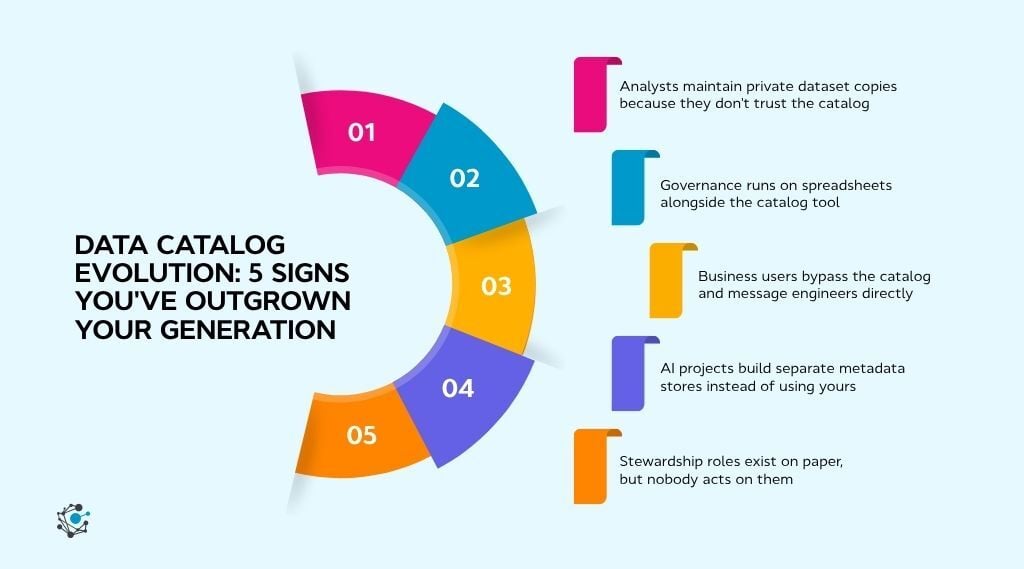
You're in Gen 1 if your catalog can inventory data, but nobody outside engineering touches it. There are no ownership assignments, no glossary, no lineage, and no quality signals.
Your next move:
-
Assign data owners and stewards for your 10 to 15 highest-priority datasets
-
Build a business glossary for the 20 to 30 terms that cause the most confusion across teams
-
Turn on lineage tracking for the pipelines that feed your most critical reports
-
You don't need to govern everything at once. Start narrow and expand.
You're in Gen 2 if governance workflows exist, but business users still can't find or use data without asking an engineer. Stewardship roles are assigned, lineage is documented, and quality rules are defined, but catalog adoption outside the data team is low.
Your next move:
-
Invest in graph-based relationship mapping so users can navigate from a business term to the actual data behind it
-
Add collaboration features: annotations, ratings, shared insights
-
Publish your first data products with clear ownership and quality contracts
-
The goal is making the catalog a daily tool for analysts, not just a compliance system for stewards
You're in Gen 3 if business users can find data confidently, but they still export it to Excel or a BI tool to get answers. AI initiatives may be underway, but they run on separately managed pipelines with no connection to the catalog.
Your next move:
-
Add natural language interfaces and embedded analytics inside the catalog
-
Enable automated metadata enrichment so the catalog maintains itself
-
Evaluate whether your catalog can serve metadata programmatically through APIs, not just through a human-facing UI
-
If AI agents are on your roadmap, governed agent access is no longer optional
What the next shift requires
Three threads are shaping what comes after Gen 4:
-
Catalogs as governed infrastructure for AI. Every AI agent, model, and pipeline needs governed access to metadata. The catalog stops being a tool you log into and becomes infrastructure that runs underneath everything.
-
Convergence with data governance platforms. The line between "catalog" and "governance platform" is already blurring. The next generation won't be a standalone product category. It will be a capability layer embedded across the data stack.
-
Data product thinking. Catalogs will manage governed, reusable data products with SLAs, quality contracts, and consumption metrics, not just datasets with descriptions attached.
At OvalEdge, we believe the organizations that will get the most value from AI are the ones that built the governed data foundation first. The catalog isn't a prerequisite for AI. It's the prerequisite for AI you can trust.
Conclusion
Data catalogs started as metadata inventories for engineers who needed to find datasets across scattered systems. Over four generations, they evolved into something fundamentally different: the governed intelligence layer that powers both human decision-making and autonomous AI agents.
Each generation solved a real problem. Gen 1 solved visibility. Gen 2 solved trust. Gen 3 solved usability. Gen 4 is solving intelligence. And each one built the foundation the next required. The organizations that tried to skip governance and jump straight to AI-powered analytics learned quickly that intelligence without trust creates more problems than it solves.
OvalEdge spans the full arc, from automated metadata crawling and lineage to business glossary management, governance workflows, and the Enterprise Context Graph that gives AI agents the governed context they need.
Whether you're building your first data inventory or preparing your metadata layer for agentic AI, schedule a demo to see how OvalEdge can help you move forward.
.png?width=1081&height=173&name=Forrester%201%20(1).png)
.png?width=1081&height=241&name=KC%20-%20Logo%201%20(1).png)