If there’s anything that’s defining thriving businesses today, it’s a strong understanding and strategizing the use of a company’s data.
However, it brings up a whole range of questions, from both users and stakeholders- What data exists in my company? Where is it stored? What is the best data for my problem? When you have figured that out, more questions arise- How do I access it? Can I trust it?
A data catalog takes care of finding and understanding your data part effectively. Providing and monitoring data access, ensur
ing data quality and data protection – all come under data governance. Now a data catalog is combining the capabilities of a data governance toolset. The merger of data cataloging and data governance in a toolset is very opportune. That is because their functions are so intertwined.
What is Data Governance?
When we talk about data governance meaning, some people say that it is a set of procedures and policies, while some talk about data management. Various vendors in privacy and cataloging try to sell their software as Data Governance software.
According to Lights on Data, “Data governance enables businesses to exert control over the management of data assets. This process encompasses the people, process, and technology that are required to ensure that data is fit for its intended purpose.”
Simply put, data governance is the process of providing and monitoring data access, ensuring data quality, and data protection.
When we talk about data governance following terms often appear in the conversation. For a better understanding, I am defining them briefly.
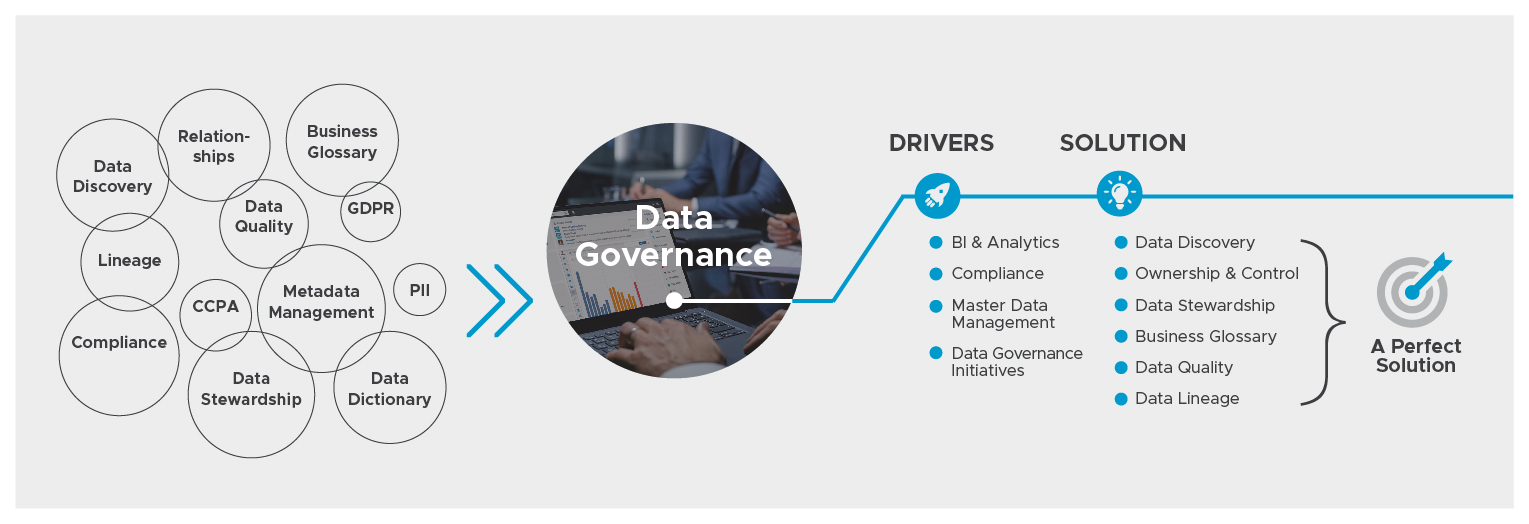
- Data Discovery – the act of finding relevant data from the data assets that exist within the company and understanding it quickly.
- Data Lineage – is a graphical representation of how and where the data originated and its processing logic, and its destination.
- Business Glossary - is a repository that enables data stewards to build and manage a common business vocabulary across the company. A business glossary can contain many data dictionaries.
- Data Dictionary – is a repository that defines data elements, their meanings, and their allowable values. While a data glossary is enterprise-wide and should be created to improve business understanding of the data, data dictionaries are more technical in nature and tend to be system-specific.
- PII – Personally Identifiable Information
- Data Privacy Compliance – is a company’s conformity to personal information protection guidelines or regulations. GDPR (General Data Protection Regulation) and CCPA (California Consumer Privacy Act) are two such regulations.
Master Data Management - Data Quality – Data quality is a perception or an assessment of data’s fitness to serve its purpose in a given context. The quality of data is determined by factors such as accuracy, completeness, relevance, and how up-to-date it is. (Source: WhatIs.com)
- Data Steward – A Data steward is a role that helps to provide business users with high-quality data that is easily accessible in a consistent manner.
Every organization is looking for a solution to its data-related problem, from data governance. This means that if you talk to directors or CDOs from different companies, their understanding of data governance would be different since their challenges are different.
Why has data governance suddenly become so important?
Many people will have this question in mind at some point. Although data in electronic form has been in existence since computers, data governance importance has become a hot topic in the past few years.
This is because we are moving from cumbersome centralized applications to SaaS-based, easy-to-use applications.
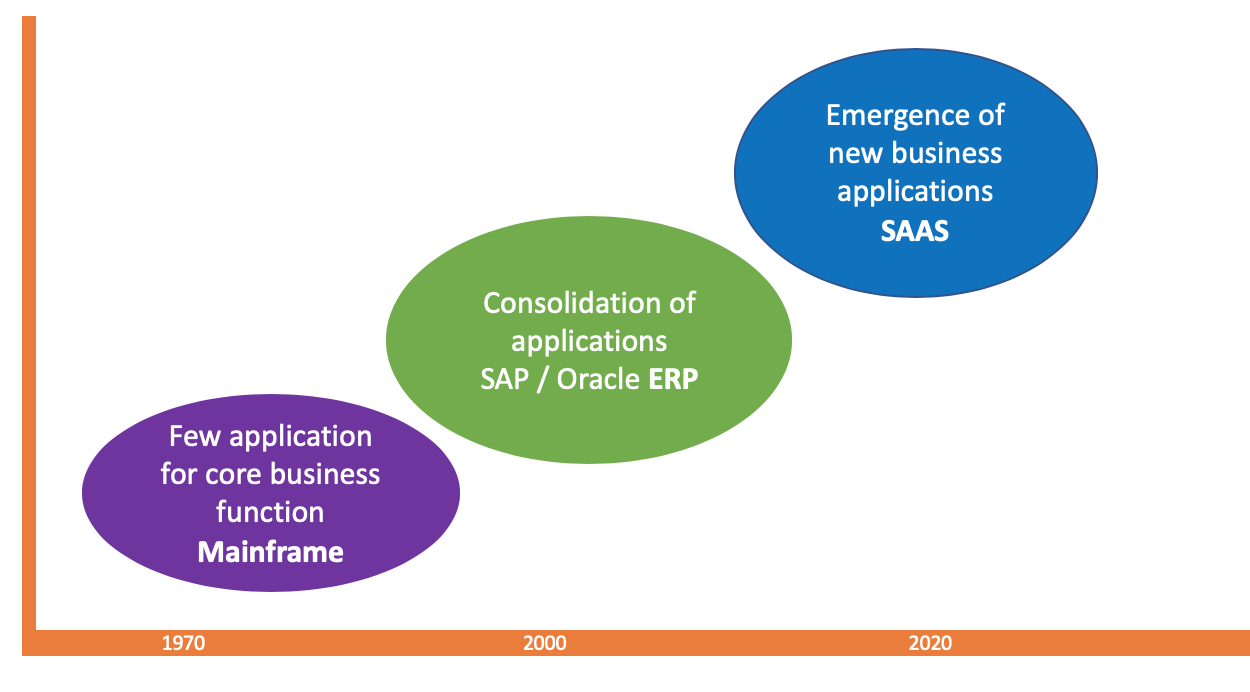
The emergence of SAAS, digital marketing, and sales applications has created a new wave of siloed applications. When you have only one application to do an entire business function (i.e., SAP), you don’t have any governance issues since SAP is providing the solution. However, when there are multiple applications, there will consequently be various data challenges.
In the sections below, you will see how BI/Analytics & Compliance has complicated the need for automated and structured data governance.
Key Data Governance Drivers
The key drivers of data governance stem from the growing need for compliance, data quality, operational efficiency, and trustworthy insights. As organizations handle increasing volumes of data across cloud, SaaS, and hybrid environments, maintaining accuracy, accessibility, and security has become critical. Let’s look at what drives data governance and why its importance is rising across modern enterprises.
1. Regulatory Compliance
One of the strongest drivers of data governance is the rapid expansion of privacy and security regulations worldwide. Frameworks such as GDPR, CCPA, and HIPAA require companies to protect sensitive and personal data, define ownership, and maintain transparent audit trails.
Non-compliance can lead to legal penalties and reputational harm. Data governance ensures organizations know where data resides, who owns it, and how it’s used key to passing audits and maintaining stakeholder trust.
2. Data-Driven Decision-Making
Modern organizations rely heavily on analytics and business intelligence (BI) to guide strategy. Data governance ensures that these decisions are backed by accurate, complete, and consistent information.
It defines data ownership, improves metadata visibility, and creates traceability, empowering leaders to make decisions confidently based on reliable data.
3. Data Quality and Accuracy
Poor data quality can derail entire business processes, leading to wasted resources and flawed insights. Governance frameworks establish clear standards for data validation, cleansing, and integration, ensuring that every department operates with the same accurate datasets.
Without data governance, duplicated, incomplete, or outdated data can result in misleading reports and poor decision-making.
4. Big Data and Digital Transformation
The rise of IoT, AI, and cloud technologies has made enterprise data ecosystems larger and more complex. Data governance enables scalability by defining consistent rules for collection, storage, and access across hybrid and multi-cloud environments.
It also strengthens metadata management and lineage tracking, essential for interpreting vast, interconnected datasets and ensuring transparency in analytics and compliance.
5. Operational Efficiency
Over 50% of CIOs identify operational efficiency as a key driver of data governance. By minimizing duplication, clarifying ownership, and automating data workflows, governance reduces manual effort and improves collaboration across departments.
This structured approach accelerates reporting, compliance checks, and analytics delivery, making business operations faster and more reliable.
6. Data Security and Privacy
In an era of rising cyber threats, data security and privacy have become non-negotiable. Governance frameworks establish strict access controls, encryption standards, and data lifecycle policies to ensure that sensitive data remains protected without compromising usability.
Strong governance enables organizations to balance compliance with efficiency, ensuring that both internal and external data handling meets global privacy expectations.
7. AI, Analytics, and Self-Service BI
AI and advanced analytics depend on clean, well-governed data. Data governance ensures that these models are trained on accurate, bias-free datasets, enhancing reliability and ethical compliance.
It also supports self-service BI, where business users can independently access and analyze data while governance maintains centralized oversight to prevent misuse or inconsistencies.
Transition: From Strategic to Operational Drivers
While the above factors highlight the strategic importance of data governance, organizations also face operational challenges that make governance essential. These day-to-day realities from managing multiple systems to integrating enterprise data are equally critical drivers that bring governance efforts into focus.
8. Master Data Management (MDM)
Most enterprises operate hundreds of applications, each managing specific business functions but sharing common data elements like customers, employees, and financial records.
To maintain accuracy, organizations establish Master Data Management (MDM) systems that define one authoritative source for each core data element. However, mergers, acquisitions, and rapid scaling often lead to duplicate or conflicting records.
MDM projects, therefore, require robust governance practices combining IT and business collaboration to consolidate master records, enforce consistency, and ensure enterprise-wide data integrity.
9. Integrations Across Systems
With multiple applications performing interrelated business processes, data integrations have become a major governance concern. For example, CRM systems often need to integrate with financial platforms for invoicing or customer lifecycle management.
As data moves between systems, governance ensures business rules, data transformations, and access controls remain consistent. Without proper governance, integrations can become brittle, error-prone, and difficult to audit.
10. Business Intelligence (BI) and Analytics
BI and analytics are at the core of modern enterprise strategy, but their success depends on governed, high-quality data.
Governance frameworks ensure that insights like quarterly sales, profit margins, or customer churn are based on reliable, traceable information. On the advanced end, customer-facing analytics such as Amazon’s product recommendation engine depend entirely on well-governed data pipelines.
As more business units deploy their own analytics tools and data scientists, automated data governance becomes vital for managing access, quality, and consistency across the organization.
Compliance with Data Privacy and Financial Regulations
GDPR and CCPA are some new regulations to which companies have to comply. These regulations have strict rules that deal with how organizations can capture and store customer data.
These regulations not only deal with individual data elements but also go to cookie-ID or any mechanism that can track a customer’s behavior.
As companies store various kinds of data in different databases, they need to manage the data and all the problems associated with it because of compliance.
Data Quality Assurance
All of these needs are driving data governance to the point of urgent necessity. They all have different business requirements and are looking for a solution.
Frequently Asked Questions
Q1. What is Data Governance?
Data governance is the practice of managing data availability, usability, integrity, and security through defined roles, policies, and processes.
Q2. What drives the need for Data Governance?
Key drivers of data governance include regulatory compliance, data quality, analytics readiness, and growing data complexity due to digital transformation.
Q3. Why is Data Governance important for organizations?
Understanding data governance importance helps ensure trustworthy data for decision-making, compliance, and improved collaboration across teams.
Q4. How can companies build a Data Governance Framework?
Define data ownership, establish policies, automate monitoring, and use tools like OvalEdge for metadata management and compliance reporting.
What you should do now
|
.png?width=1081&height=173&name=Forrester%201%20(1).png)
.png?width=1081&height=241&name=KC%20-%20Logo%201%20(1).png)