At any fast-growing organization, the biggest challenge is not data volume or tooling. The real challenge is understanding what the data actually means. Some core terms like customer, active user, and revenue carry different definitions across teams. As a result, reports conflict, projects stall, and confidence in analytics steadily declines.
This situation is common in organizations that lack a clear and well-managed data dictionary. Without consistent definitions, even strong data infrastructure produces unreliable outcomes. Metrics lose alignment, reporting becomes questionable, and decision-making suffers.
It is essential to follow certain best practices to address this problem at its root. This guide focuses on practical approaches to implementing, maintaining, and scaling a data dictionary that strengthens clarity, restores trust in data, and supports well-informed decisions across the organization.
Data dictionary implementation best practices
A well-maintained data dictionary is foundational to strong data governance. It ensures every stakeholder, whether technical or business, has a common understanding of data definitions, source systems, calculation logic, and usage guidelines.
Below are essential data dictionary best practices that help organizations standardize documentation, improve data quality, and enforce clarity across data ecosystems.
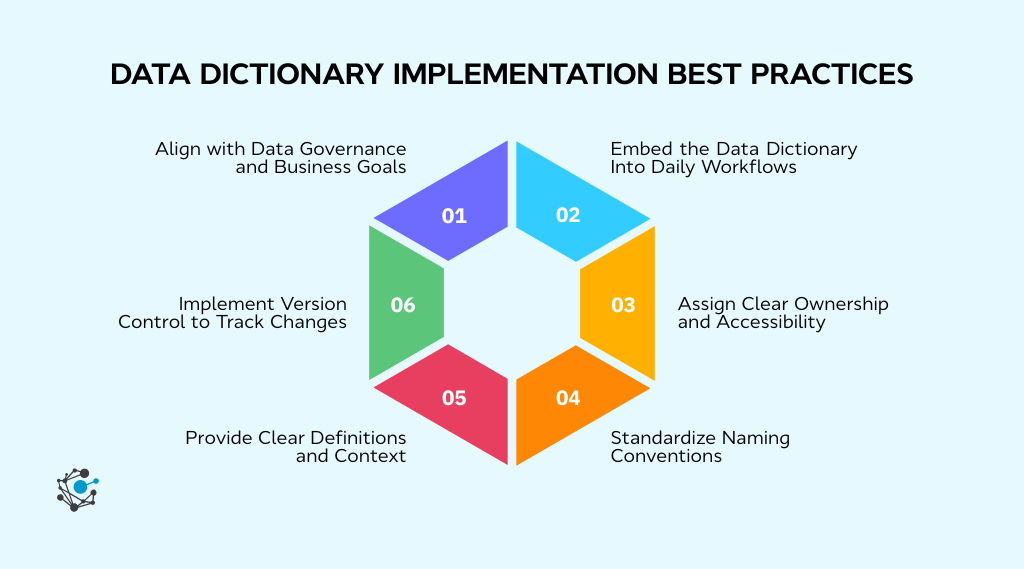
1. Align with data governance and business goals
A data dictionary is not just a catalog of field names and formats. It is the mechanism by which data definitions are standardized, made transparent, and aligned with business priorities.
Most failed governance initiatives didn’t lack tools. They lacked agreement on definitions. Without a shared understanding of key terms, even the most advanced data stack fails to produce trustworthy or consistent outcomes.
When data definitions are inconsistent or disconnected from business use cases, teams end up working in silos, making conflicting assumptions about the same data point.
This undermines both strategic alignment and decision-making accuracy. A properly implemented data dictionary prevents these conflicts by ensuring that each term is vetted, standardized, and explicitly connected to business logic and compliance requirements.
To put this into practice:
-
Start by identifying data elements tied to critical business functions, such as financial reporting, regulatory filings, and operational KPIs.
-
Document not just the field name and type, but also calculation methods, applicable exclusions, data lineage, and usage notes.
-
Define stewardship responsibilities so that domain experts are accountable for keeping definitions current and reflective of evolving goals.
By integrating the data dictionary into your governance framework, you improve cross-functional clarity, reduce the risk of misreporting, and create a solid foundation for scalable analytics and audit readiness.
2. Embed the data dictionary into daily workflows
Creating a robust data dictionary is only half the battle. The real value emerges when it becomes a daily reference point across teams. Too often, data dictionaries sit unused in isolated tools or shared folders, disconnected from the daily workflows.
This disconnect leads to guesswork, duplication of logic, and data quality issues.
According to a 2024 Gartner Report on the Future State of D & A Governance, 80% of data governance initiatives will fail by 2027 if they remain isolated from business outcomes or embedded workflows.
Embedding the dictionary into daily workflows means meeting users where they are. Analysts should be able to see definitions inside their BI tools, whether they’re working in dashboards, writing queries, or analyzing trends.
Developers and data engineers should have direct access while designing schemas or building pipelines, ensuring consistency in how fields are used across systems.
To make this actionable:
-
Integrate definitions into reporting platforms and analytics tools through overlays or API connections.
-
Include links to relevant terms directly in data model documentation and tickets during development sprints.
-
Make dictionary access part of team onboarding and project initiation processes, so new members understand shared terminology from day one.
When the dictionary is embedded into routine operations, it transforms from static documentation into a living, collaborative asset that actively supports better decisions.
3. Assign clear ownership and accessibility
When no one is responsible for a data element, definitions quickly become outdated, and if the ownership is unclear, the data dictionary will decay.
Ownership ensures accountability, but effective ownership goes beyond assigning a name to a field. It defines who approves changes, who validates accuracy, and who answers questions when definitions are unclear.
In practice, ownership works best when it is aligned with domain expertise. Business-critical fields such as revenue, customer status, or eligibility flags should be owned by the teams that understand their real-world meaning and impact.
This prevents situations where technical teams maintain definitions that no longer reflect how the business actually uses the data. Without this alignment, organizations often face conflicting interpretations during reporting reviews or audits.
When data definitions are maintained by those closest to the business context, the data dictionary becomes a trusted reference rather than a static document that people work around.
4. Standardize naming conventions
Standardizing naming conventions is a foundational data dictionary best practice that directly improves clarity and efficiency.
Effective naming conventions are predictable, descriptive, and aligned with how the business thinks about data. A field name should immediately signal what the data represents, not just how it is stored.
|
For example, a metric labeled total_users should have a single, well-documented meaning that applies consistently across dashboards, models, and reports. If another team uses active_users to describe the same concept, the dictionary should clarify whether these terms are equivalent or intentionally different. |
Standardization becomes even more important as organizations scale and add new systems. Without shared conventions, teams may create duplicate fields that represent the same data under different names, increasing technical debt and reporting inconsistencies.
Clear rules around prefixes, suffixes, and abbreviations help prevent this fragmentation and make data models easier to navigate.
By standardizing names and documenting them clearly in the data dictionary, organizations reduce ambiguity, improve cross-team understanding, and create a more scalable and maintainable data environment.
5. Provide clear definitions and context
Most data issues arise because people misunderstand how a data element is calculated, where it originates, or how it is intended to be used. Data dictionary best practices focus on eliminating this ambiguity by documenting both meaning and context.
A strong definition should answer several questions at once. It should explain the business meaning in plain language, outline the calculation logic or derivation rules, identify the source system, and clarify when the field should or should not be used.
|
For example, a metric labeled active_user can be interpreted very differently depending on whether it includes trial users, internal accounts, or inactive logins. Stating these rules explicitly prevents misaligned dashboards and conflicting analyses. |
Context also matters over time. Business logic changes, products evolve, and definitions that once made sense can become outdated.
Including usage notes and change history helps users understand why a definition exists in its current form and whether it is appropriate for their use case.
This is especially important for shared metrics that appear in executive reporting, regulatory submissions, or cross-functional dashboards.
Best practices for clear definitions include:
-
Writing definitions in business language first, with technical details layered underneath.
-
Documenting calculation rules, exclusions, and dependencies explicitly.
-
Including source systems and transformation logic to support traceability.
-
Adding usage guidance so users know when a field is appropriate and when it is not.
When definitions are clear and contextual, the data dictionary becomes a trusted reference rather than a glossary that still leaves room for interpretation.
6. Implement version control to track changes
In many organizations, reporting discrepancies are traced back to silent definition changes. A calculation is adjusted, an exclusion is added, or a source system is replaced, but the original definition is overwritten without context.
When this happens, analysts and business users have no way to understand whether a difference in results reflects a real business change or a documentation gap. Version control solves this problem by preserving history rather than rewriting it.
Effective versioning captures what changed, when it changed, and why it changed. This includes updates to business logic, source systems, calculation methods, and usage guidance.
Maintaining a change log alongside each definition allows users to trace the evolution of a data element and assess whether older reports or models are still comparable.
This is especially important for regulated reporting, financial analysis, and long-term trend analysis, where historical consistency matters.
Strong practices for version control in a data dictionary include:
-
Recording all definition changes with timestamps and clear descriptions.
-
Linking changes to approval workflows or governance decisions.
-
Allowing users to view previous versions to support audits and investigations.
-
Communicating significant updates so downstream users can adjust their analyses.
When version control is built into the data dictionary, it reinforces transparency and accountability. Teams spend less time reconciling conflicting numbers and more time focusing on insights.
How to maintain a data dictionary over time
Maintaining a data dictionary is not a one-time task. It is a continuous process that ensures definitions remain accurate, relevant, and aligned with business needs.
Strong maintenance practices are critical to preserving the integrity and usefulness of your metadata documentation.
1. Define a regular review cadence
Without active upkeep, even the most well-built data dictionaries lose value quickly. As systems evolve, data pipelines shift, and business logic changes, outdated definitions introduce risk and confusion.
Establishing a structured review cadence is essential to keep the dictionary updated. This cadence can be monthly, quarterly, or aligned with development sprints or data governance meetings. The key is making reviews a routine, not a reaction to issues.
Without this structure, teams often discover outdated definitions only after inconsistencies surface in reporting or when a regulatory audit demands metadata transparency.
Best practices for review cadence include:
-
Creating review workflows with defined roles, responsibilities, and escalation paths.
-
Prioritizing high-impact or frequently used fields for more frequent validation.
-
Establishing cross-functional metadata councils for complex or shared data domains.
-
Documenting each review with a timestamp and decision log to support audits and institutional memory.
When reviews are consistently executed, the data dictionary becomes a reliable source of truth rather than an outdated artifact.
2. Automate metadata updates and keep systems in sync
As data platforms, pipelines, and schemas evolve, manual documentation can cause serious problems, from broken reports to compliance failures, especially in highly regulated industries. Automation is essential for keeping the data dictionary current and minimizing the burden on human stewards.
This includes capturing field names, data types, table relationships, and lineage across systems. When metadata is kept in sync automatically, discrepancies can be flagged early.
|
For example, if a field is renamed or dropped in a source system but remains referenced in reporting or dashboards, automation can trigger an alert before the issue impacts decision-making or customer-facing analytics. |
Automation alone is not enough, however. It must be combined with human validation to ensure the business meaning of a field remains accurate.
While scripts can detect schema changes, only people can determine whether a new field should replace an old one or if a transformation logic change affects how a metric should be interpreted.
Maintaining synchronization between systems and the data dictionary supports long-term sustainability by eliminating the technical debt that accumulates when documentation fails to keep pace with system evolution.
3. Audit, validate, and continuously improve data quality
Routine audits are a critical part of maintaining the integrity and usefulness of a data dictionary.
According to a 2025 IBM Research Report on Data Quality, nearly half (49%) of executives cite data inaccuracies and bias as a barrier to technology adoption.
At scale, spreadsheet-based data dictionaries fail for structural reasons. Definitions drift as systems change, and there is no reliable way to keep documentation synchronized with live data.
Platforms like OvalEdge address this gap by binding definitions directly to metadata, lineage, and change events, ensuring the documentation reflects real-time system behavior.
To perform an effective audit:
-
Compare dictionary entries against live database schemas to identify undocumented or deprecated fields.
-
Validate that field definitions are complete, with clear names, data types, calculation logic, business context, and usage guidance.
-
Check for consistency in naming conventions and formatting across domains and systems.
-
Review ownership metadata to ensure that each definition has a current, accountable steward.
However, audits alone are not enough. A high-quality data dictionary thrives on active collaboration. When users can easily report unclear terms or suggest new entries, the dictionary evolves in response to actual business needs.
Enable this by:
-
Embedding feedback forms or comment features directly in the data dictionary interface.
-
Creating a lightweight intake process for term clarification or enhancement requests.
-
Prioritizing fixes or improvements based on usage frequency and business impact.
-
Sharing audit outcomes with stakeholders to foster transparency and encourage engagement.
Ultimately, consistent audits and open feedback channels are not just documentation hygiene. They are strategic levers for enabling better decisions, minimizing risk, and reinforcing data governance throughout the enterprise.
Data dictionary management tips for scaling organizations
As organizations grow, data complexity grows with them. New teams, new systems, and new priorities multiply the number of data sources and definitions in circulation.
Without deliberate structure and visibility, the data dictionary can become fragmented, underutilized, or ignored, leading to confusion, redundant work, and poor data quality.
For scaling environments, strong data dictionary practices are essential to maintain clarity and drive alignment across all levels of the organization.
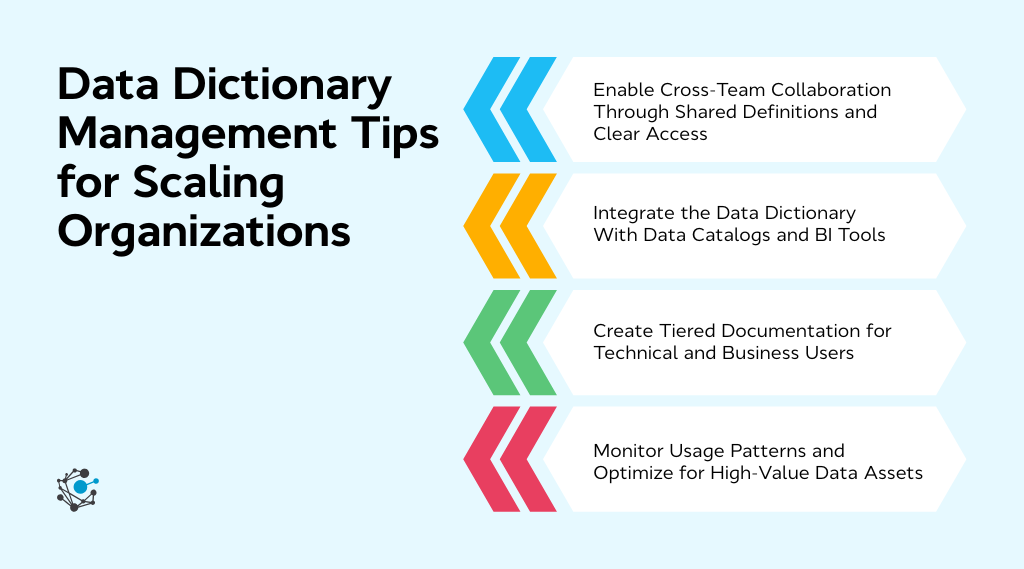
1. Enable cross-team collaboration through shared definitions and clear access
Cross-functional collaboration often breaks down due to inconsistent terminology. A metric like “conversion rate” can mean different things to marketing, sales, and product teams unless there is a single, shared definition documented and agreed upon.
Making the dictionary truly collaborative means:
-
Assigning co-ownership of terms where multiple domains intersect, such as revenue metrics or customer segmentation.
-
Establishing a process for reviewing and approving new definitions through a data council or governance group.
-
Enabling commenting or feedback features to allow business users to flag unclear terms or suggest improvements.
-
Providing permissioned access that allows technical teams to update schemas while business users contribute narrative context or usage notes.
As organizations scale, the goal is not just to document definitions, but to create a culture of shared language and understanding. A data dictionary that is widely adopted and collaboratively maintained becomes a powerful bridge between teams, reducing rework and improving decision-making.
2. Integrate the data dictionary with data catalogs and BI tools
Data definitions are often siloed in spreadsheets, slide decks, or tribal knowledge, making it difficult for users to know where to look or which version to trust.
When definitions are embedded into reporting tools like Tableau, Power BI, or Looker, analysts and business stakeholders can quickly understand the meaning, lineage, and ownership of each field without having to search elsewhere.
This supports real-time comprehension and reduces reliance on internal clarifications or outdated documentation.
Integration with data catalogs further enhances discoverability and control. Catalogs can serve as the metadata backbone, linking the dictionary to upstream systems, ETL pipelines, and downstream analytics.
This creates end-to-end visibility and enables features like:
-
Lineage tracking to understand how a data field flows across systems and reports.
-
Impact analysis to assess what happens when a field is modified or deprecated.
-
Policy enforcement to flag unapproved terms or undocumented fields before they reach production.
To execute this well:
-
Map your dictionary fields to physical data assets across platforms.
-
Establish two-way syncs between your dictionary and data catalog to keep definitions and schemas aligned.
-
Use embedded tooltips or field descriptions in BI dashboards to surface key metadata inline.
-
Encourage teams to document not just what data is, but how and why it’s used in different business contexts.
By embedding the dictionary into the tools people use daily, users make faster, more informed decisions because they don’t just see the data; they understand it. In a scaling environment, this level of embedded clarity becomes a competitive advantage for data governance, operational efficiency, and cross-team trust.
3. Create tiered documentation for technical and business users
A well-structured data dictionary must serve diverse audiences, from data engineers working on pipelines to business users analyzing performance metrics.
One-size-fits-all documentation creates friction, either by overwhelming non-technical users with schema-level metadata or by leaving technical teams with vague, context-light definitions. To avoid this disconnect, tiered documentation is essential.
|
For example, a field like user_status_code might be defined in the technical layer as a VARCHAR(3) pulled from a CRM source system. But the business-facing definition should explain what each code means (e.g., "ACT" = active customer, "CHU" = churned), how it's typically used in reporting, and what business questions it supports. |
Practical steps for effective tiered documentation include:
-
Structuring each entry with separate sections for technical attributes (e.g., data type, nullability, default values, source system) and business context (e.g., meaning, usage scenarios, reporting caveats).
-
Creating cross-references between technical fields and business glossary terms. For instance, tie revenue_flag to a definition of “Recognized Revenue” in the business glossary.
-
Exposing the right level of documentation and context in BI tools, data catalogs, or notebooks. Engineers should see technical specs in schema registries or source control, while analysts should see business definitions in dashboards.
-
Assigning domain-specific stewards. Technical stewards should maintain schema accuracy, while business stewards are accountable for contextual clarity. This dual stewardship ensures each tier remains current and relevant.
When layered well, the data dictionary becomes more than a repository of field names. It becomes an authoritative reference that connects business outcomes to technical design, supporting data governance, compliance, and decision-making in equal measure.
4. Monitor usage patterns and optimize for high-value data assets
In scaling data environments, not all data fields carry equal weight. Some are referenced daily in dashboards, reports, or compliance filings, while others may be rarely accessed or outdated.
Monitoring how data definitions are consumed allows teams to prioritize maintenance and documentation efforts based on real business impact, rather than applying a one-size-fits-all approach.
Start by tracking user interactions with your data dictionary. This includes which definitions are viewed most frequently, how often terms are edited or flagged, and which fields are linked to high-traffic dashboards or core reports. These signals help identify which assets are business-critical and also surface hidden risks.
To operationalize this:
-
Implement logging and analytics within your data dictionary platform to monitor term-level engagement.
-
Correlate frequently accessed terms with business KPIs or compliance-critical reports.
-
Create review tiers that flag high-usage terms for more frequent validation cycles.
-
Use popularity metrics to inform training, documentation updates, or data governance discussions.
This optimization approach supports both scalability and efficiency. Rather than spreading stewardship resources thin across hundreds or thousands of entries, teams can focus on the data elements that drive the most business value.
Conclusion
A great data dictionary doesn't just document fields. It empowers teams, enhances trust, and turns data into a shared language across your organization. When done right, it supports governance, reduces risk, and drives faster, smarter decisions.
The best time to start building or improving your data dictionary is today. Begin with what matters most, including clarity, ownership, and collaboration. Then expand.
As you grow, your dictionary becomes more than documentation. It becomes the foundation for reliable, data-driven growth.
So ask yourself. What definition in your organization is still unclear? What report do you question every time you open it? Start there and build your way to trust.
Wondering where to start?

Book a demo with OvalEdge today to understand how to build a scalable, intuitive data dictionary that delivers trust, consistency, and clarity from day one.
FAQs
1. What is the main purpose of a data dictionary?
To provide a shared, authoritative reference that explains what data means, how it should be used, and who is responsible for it.
2. How do I build an effective data dictionary?
An effective data dictionary starts with identifying high-impact data elements, defining each field with business context, calculation logic, and usage guidance, and assigning clear ownership. Integrating automation for metadata capture and version control ensures it remains accurate and scalable.
3. Why is a data dictionary important for data governance?
A well-maintained data dictionary standardizes definitions across teams, supports audit readiness, ensures compliance, and minimizes the risk of misinterpretation. It acts as a single source of truth, promoting alignment between business and technical stakeholders.
4. How do I keep a data dictionary up to date?
To keep a data dictionary up to date, automate metadata syncing with source systems, assign stewardship for manual review, and establish a review cadence. Monitoring usage patterns and implementing feedback loops also help prioritize updates and ensure definitions reflect real-world usage.
5. What tools are used to manage data dictionaries?
Organizations use data catalogs, metadata management tools, and integrations with BI platforms to manage data dictionaries. These tools enable metadata automation, version tracking, lineage visualization, and embedding definitions directly into analytics workflows.
6. What are the benefits of standardized data definitions?
Standardized definitions eliminate ambiguity, reduce rework, and ensure consistent reporting across teams. This enhances collaboration, improves trust in data, and streamlines compliance by making data meaningful and transparent and traceable across systems.
.png?width=1081&height=173&name=Forrester%201%20(1).png)
.png?width=1081&height=241&name=KC%20-%20Logo%201%20(1).png)