.png)
More than a decade after BCBS 239 was introduced, many financial institutions are still working to meet its expectations for reliable risk data and reporting.
According to BearingPoint’s 2025 Regulatory Reporting Study, The Glass Bank, Beyond Data, only 18% of surveyed financial institutions reported fully implementing BCBS 239 principles.
The finding highlights an enduring challenge: producing accurate, complete, and timely risk information across complex systems and business units.
The stakes extend beyond regulatory compliance. During periods of financial or market stress, boards, senior management, and regulators need a clear view of exposures without lengthy reconciliation or manual reporting.
BCBS 239 provides the principles for building that capability. This guide examines all fourteen principles, who they apply to, evolving supervisory expectations, common implementation challenges, and the practical steps required to establish a sustainable BCBS 239 compliance program.
What is BCBS 239?
BCBS 239 sets out how banks must collect, reconcile, and report risk data so that leadership can see accurate exposure across every business line, legal entity, and asset class. The framework covers credit risk, market risk, liquidity risk, and operational risk. It applies in normal conditions and, more importantly, under stress.
The core requirement is deceptively simple. A bank must be able to produce a complete, accurate, current view of its risk position on demand, including for scenarios nobody planned for. Meeting that requirement means the underlying data has to be discoverable, traceable, governed, and trustworthy at all times, which is why BCBS 239 is really a data governance mandate wearing a risk management label.
Why the Basel Committee introduced it
During the crisis, several institutions took days or weeks to assemble group-wide exposure figures. Risk data lived in separate systems per desk, per region, and per legal entity, stitched together manually in spreadsheets. Boards received reports that were internally inconsistent, and supervisors received numbers that could not be reconciled against each other.
The Basel Committee concluded that risk management had failed less because banks misjudged risk and more because they could not see it. BCBS 239 was published in January 2013 to close that gap.
Who has to comply with BCBS 239?
The framework applies directly to Global Systemically Important Banks, or G-SIBs. Institutions designated as G-SIBs by November 2012 had to comply by January 1, 2016. Banks designated after that date get three years from their designation.
National supervisors are also expected to apply the principles to Domestic Systemically Important Banks, or D-SIBs, within three years of designation. In practice, the reach now extends further. Regional banks, insurers, asset managers, and financial technology firms increasingly face RDARR-style expectations, either through direct supervision, through group requirements from a parent institution, or through counterparty due diligence.
The 14 principles of BCBS 239
The fourteen principles fall into four groups. The first eleven are obligations on banks. The last three describe what supervisors will do.
|
Principle |
Group |
What it requires |
|
|
1 |
Governance |
Governance and infrastructure |
Board-approved framework with clear ownership, standards, and accountability for risk data |
|
2 |
Data architecture and IT infrastructure |
Governance and infrastructure |
Systems that support risk data aggregation during normal operations, stress, and recovery scenarios |
|
3 |
Accuracy and integrity |
Risk data aggregation |
Largely automated aggregation, reconciliation to authoritative sources, and documented controls |
|
4 |
Completeness |
Risk data aggregation |
All material risks captured across business lines, entities, geographies, and asset classes |
|
5 |
Timeliness |
Risk data aggregation |
Risk data aggregated quickly enough to meet defined reporting requirements, including during stress |
|
6 |
Adaptability |
Risk data aggregation |
Ability to respond to ad hoc requests and changing stress scenarios without major system re-engineering |
|
7 |
Accuracy |
Risk reporting |
Reports accurately reflect aggregated risk data and are supported by appropriate validation |
|
8 |
Comprehensiveness |
Risk reporting |
Coverage of all material risk areas, including significant exposures and concentrations |
|
9 |
Clarity and usefulness |
Risk reporting |
Reports are clear, concise, tailored to recipients, and useful for decision-making |
|
10 |
Frequency |
Risk reporting |
Reporting frequency reflects the nature of the risk and can increase during periods of stress |
|
11 |
Distribution |
Risk reporting |
Risk reports reach relevant recipients promptly while maintaining confidentiality |
|
12 |
Review |
Supervisory review |
Supervisors periodically assess banks’ compliance with the principles |
|
13 |
Remedial actions and supervisory measures |
Supervisory review |
Supervisors require corrective action when deficiencies are identified and can use appropriate measures |
|
14 |
Home/host cooperation |
Supervisory cooperation |
Supervisors across jurisdictions cooperate when overseeing internationally active banks. |
Two principles carry most of the practical weight. Principle 6, adaptability, is the one that separates real capability from documented intent, because it demands answers to questions nobody prepared for.
Principle 2 is the one that determines whether Principle 6 is achievable, because ad hoc aggregation is impossible when architecture is fragmented across dozens of unconnected systems.
A deeper walkthrough of each principle and its supervisory expectations is available in the BCBS 239 principles guide.
BCBS 239 key dates and compliance timeline
|
Date |
Event |
|
November 2012 |
First cohort of G-SIBs designated, establishing the timeline for the original compliance deadline |
|
January 2013 |
Basel Committee publishes the BCBS 239 principles |
|
January 1, 2016 |
Compliance deadline takes effect for G-SIBs designated in November 2012 |
|
2018 |
ECB thematic review finds that none of the 25 significant institutions assessed had fully implemented the principles |
|
July 2023 |
ECB publishes its draft guide on effective risk data aggregation and risk reporting |
|
May 2024 |
ECB publishes its final Guide on effective risk data aggregation and risk reporting (RDARR) |
|
2025–2027 |
ECB makes remediation of risk data aggregation and reporting deficiencies a key supervisory priority |
|
January 6, 2026 |
Basel Committee reports that implementation remains an ongoing effort, with challenges including data lineage, ad hoc reporting, and cross-border consistency. |
The pattern in that timeline matters more than any single date. The original deadline passed a decade ago, supervisors found widespread non-compliance, and rather than relaxing, expectations have tightened every few years since.
What the ECB RDARR guide changed
The European Central Bank published its Guide on effective risk data aggregation and risk reporting in May 2024, and it reshaped how the principles are examined. Where BCBS 239 states outcomes, the ECB Guide states expectations, which makes it far harder to argue that a partial implementation satisfies the intent.
Four expectations stand out.
-
Management body accountability. The Guide places responsibility for risk data capability directly with the board and senior management. The ECB has been explicit that persistent deficiencies can lead it to question whether individual members remain suitable for their roles.
-
An Independent Validation Function. Banks are expected to maintain validation of risk data aggregation and reporting that sits outside the teams producing the data. This is a genuine organisational requirement, not a documentation exercise, and it is one of the most common gaps in current programs.
-
Effective data lineage. The Guide expects traceability from the report a board reads back to the system of record, at field level, with transformations documented. Diagram-based lineage maintained by hand does not meet this expectation.
-
Governed critical data elements. Banks must identify the data elements that drive risk metrics, assign them owners, apply quality rules, and monitor them continuously.
The Basel Committee's January 2026 newsletter echoed the same themes, singling out data lineage and traceability, ad hoc reporting during crises, and cross-border data alignment as the areas where progress is still needed.
Penalties for BCBS 239 non-compliance
There is no fixed fine attached to BCBS 239. Enforcement runs through the supervisory escalation ladder instead, and that ladder has become steeper.
Supervisors typically begin with findings letters and remediation plans with committed milestones. When milestones slip, the response escalates through on-site inspections, qualitative requirements written into supervisory decisions, and formal operational restrictions.
From there, the consequences become financial and structural:
-
Pillar 2 capital add-ons. Supervisors can require a bank to hold additional capital specifically because weak risk data makes its own risk figures unreliable. This is the most common material penalty, and it hits the balance sheet directly.
-
Business restrictions. Limits on growth in a portfolio, on new product approval, or on acquisitions until the underlying data capability is fixed.
-
Periodic penalty payments and fines. Recurring charges that accrue until the deficiency is remediated.
-
Suitability challenges. The ECB has signalled it will assess whether board members overseeing persistent deficiencies remain fit for their positions.
The indirect cost usually exceeds the direct one. A bank that cannot produce reliable exposure data on demand tends to attract heavier supervisory attention across every other review it faces.
How BCBS 239 relates to Basel III, Basel IV, and other frameworks
BCBS 239 supports a broader regulatory ecosystem. Its requirements for accurate, complete, timely, and traceable risk data provide capabilities that banks can reuse across capital, resilience, stress testing, and privacy programs.
1. Basel III
Basel III governs capital adequacy, leverage, and liquidity. BCBS 239 supports these requirements by improving the quality and reliability of the underlying risk data used for regulatory calculations and reporting.
2. Basel III final reforms (“Basel IV”)
The Basel III final reforms introduce more granular approaches to risk-weighted asset calculations and the output floor. This increases the importance of consistent, accurate, and traceable data across risk systems.
3. ECB RDARR Guide
The ECB RDARR Guide translates BCBS 239 into more detailed supervisory expectations for banks under ECB supervision, giving institutions clearer requirements for governance, data architecture, quality, lineage, and reporting.
4. Operational resilience and stress testing
BCBS 239 also supports operational resilience and stress testing. Banks need complete and adaptable risk data to respond to disruptions, run scenarios, and produce ad hoc risk assessments under tight deadlines.
5. GDPR and privacy regulations
BCBS 239 and privacy regulations share underlying governance capabilities, including data classification, lineage, ownership, quality controls, and access management. A unified data governance and compliance framework can help reuse these capabilities across regulatory programs.
Rather than building each compliance program independently, banks can establish shared governance capabilities that support multiple requirements. Reusing lineage, metadata, classification, quality rules, and ownership structures can reduce duplicated effort while creating a more consistent foundation for regulatory reporting and risk management.
Data quality and critical data elements under BCBS 239
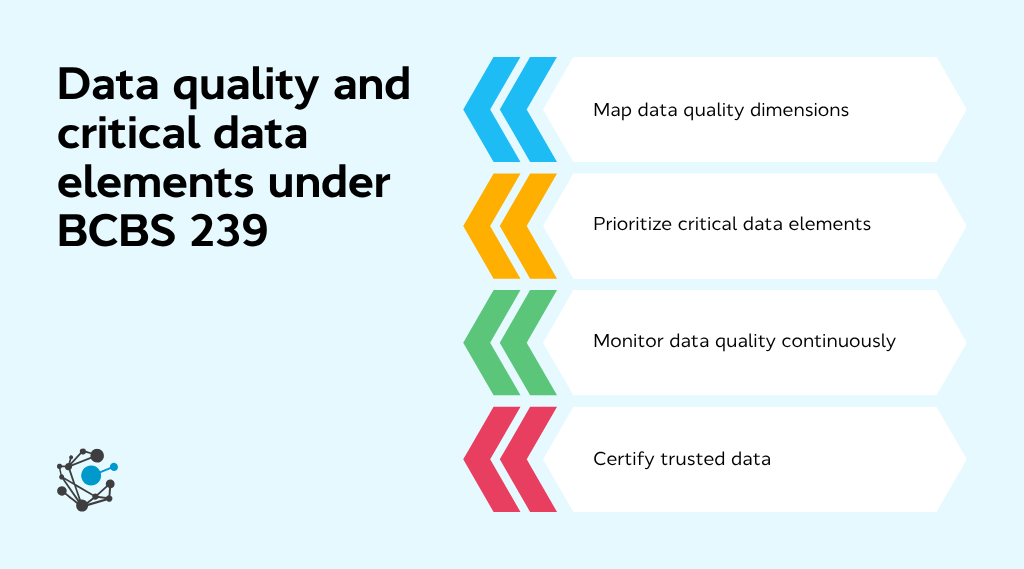
BCBS 239 requires banks to maintain reliable risk data for regulatory and management reporting. In practice, this means defining quality standards, prioritizing critical data, monitoring issues, and identifying trusted datasets.
1. Map data quality dimensions
Principles 3 through 6 translate into six practical data quality dimensions:
-
Accuracy: Data reflects the actual exposure or transaction
-
Completeness: Required risk data is present
-
Timeliness: Data is available within reporting deadlines
-
Consistency: Values align across systems and reports
-
Validity: Data follows defined rules and formats
-
Uniqueness: Duplicate records are controlled
These dimensions provide measurable criteria for BCBS 239 quality controls.
2. Prioritize critical data elements
Critical Data Elements (CDEs) are the fields that materially affect risk metrics, regulatory reports, and Key Risk Indicators. Banks should identify these elements and assign:
-
Named owners and stewards
-
Authoritative sources
-
Quality rules and thresholds
-
End-to-end lineage
-
Monitoring and escalation processes
This focuses governance effort on the data with the greatest regulatory impact.
3. Monitor data quality continuously
Manual checks become difficult to scale across complex risk environments. Operational data quality monitoring can continuously track freshness, null rates, schema changes, anomalies, and quality-rule failures.
Automated monitoring helps identify problems before unreliable data reaches regulatory or board-level reports. Data observability extends this visibility across data pipelines.
4. Certify trusted data
Risk teams also need to know which datasets are approved for regulatory use. Data certification records trust signals such as steward validation, ownership, and quality status.
Together, CDE governance, monitoring, lineage, and certification provide a stronger control foundation for BCBS 239 compliance.
Why BCBS 239 programs stall
The ECB's thematic reviews keep surfacing the same failure patterns, and they are organisational far more often than technical.
-
Fragmented architecture. Risk data spread across legacy core systems, regional platforms, cloud warehouses, and end-user spreadsheets, with no connected inventory. An enterprise data catalog is usually the first missing piece.
-
Manual aggregation. Spreadsheet-based consolidation that works in calm conditions and collapses under a two-day ad hoc request. Principle 3 explicitly expects aggregation to be largely automated.
-
Unclear ownership. Nobody accountable for a given data element, so quality issues circulate between teams without resolution. Establishing a real data stewardship model is the fix, and the pillars of data governance provide the structure around it.
-
Lineage that exists only on slides. Hand-drawn diagrams that were accurate the quarter they were made. Supervisors now ask to trace a specific number back to source, and static documentation fails that test immediately.
-
Legal entity complexity. Different jurisdictions, different definitions of the same metric, and no reconciliation between them.
-
Treating it as a project. Programs scoped as one-time remediation degrade the moment a system changes, which is why data governance risk management has to be continuous.
How to implement BCBS 239: a practical approach
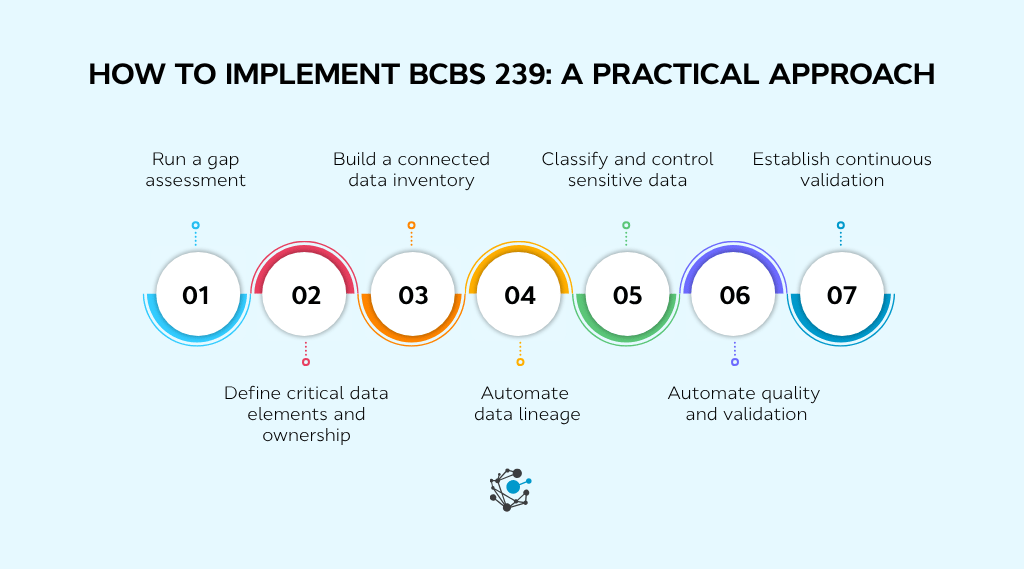
BCBS 239 implementation works best as a phased program that prioritizes critical risk data, establishes accountability, and automates controls wherever possible.
Step 1: Run a gap assessment
Assess current capabilities against all fourteen principles. Identify manual processes, disconnected risk data, reconciliation gaps, and areas where reporting cannot meet required timelines.
Step 2: Define critical data elements and ownership
Work backward from regulatory and board reports to identify the data elements that drive them. Assign a business owner and technical steward to each critical element.
Step 3: Build a connected data inventory
Catalog every system that contributes to risk reporting, including legacy platforms. Pre-built connectors for enterprise data sources can reduce the engineering effort required to establish coverage.
Step 4: Automate data lineage
Establish field-level traceability from risk reports back to source systems. Automated data lineage helps keep this traceability current as pipelines and transformations change.
For complex environments, source code intelligence can extend lineage across SQL, ETL pipelines, BI reports, notebooks, stored procedures, and semantic models.
Step 5: Classify and control sensitive data
Identify personal and confidential risk data and apply appropriate policies. Enforce data access controls consistently across systems based on classification and user permissions.
Step 6: Automate quality and validation
Move reconciliation and quality checks into monitored workflows with defined thresholds, alerts, and escalation processes. These data quality tool features help determine which capabilities to prioritize.
Step 7: Establish continuous validation
Create independent validation outside the teams producing risk data. Continuously track lineage coverage, data quality, reporting timeliness, and unresolved exceptions.
OvalEdge insight: A practical rollout can follow a crawl, curate, consume sequence: connect and map risk data first, validate and govern it second, then make trusted data available for reporting and analysis.
Governance agents can automate parts of classification, ownership, quality, and certification while keeping human review in the workflow.
What artificial intelligence changes for risk data aggregation
The Basel Committee noted in January 2026 that AI and automation adoption in risk data aggregation remains at an early stage. Banks are beginning to use AI agents for data curation, classification, and quality while also allowing them to consume risk data.
This raises new governance requirements. AI agents need the same trusted definitions, lineage, certified sources, quality controls, and access boundaries as human analysts.
Unified governance platforms like OvalEdge connect ontology, glossary, lineage, catalog, quality, and policy through an enterprise context graph. This helps people and AI agents work from consistent definitions and access rules while maintaining traceability for AI-generated risk insights.
Conclusion
BCBS 239 compliance now requires banks to demonstrate that risk data is accurate, traceable, governed, and ready for scrutiny across the full data estate. That means maintaining clear ownership, reliable lineage, consistent controls, and continuous oversight.
OvalEdge brings catalog, lineage, data quality, access, and policy together in one governance layer, helping banks keep risk data traceable and audit-ready across existing systems.
Book a data governance demo to see how OvalEdge can support BCBS 239 risk data aggregation and reporting while strengthening governance across your banking data environment.
.png?width=1081&height=173&name=Forrester%201%20(1).png)
.png?width=1081&height=241&name=KC%20-%20Logo%201%20(1).png)