-1.jpg)
Data lineage tools track how data moves, transforms, and connects across every system in an organization's stack. Open-source frameworks capture lineage events at pipeline runtime with zero licensing cost but limited governance. Enterprise platforms build on lineage capture with compliance reporting, access controls, quality checks, and business context that open-source projects rarely provide out of the box.
Choosing between them depends on what lineage needs to do beyond tracking data flows. Teams running cloud migrations need column-level tracing for impact analysis. Regulated industries need audit trails that map lineage directly to reporting requirements under BCBS 239, GDPR, or SOX. AI and ML teams need provenance tracing that follows model inputs and feature pipelines back to source systems, validating data quality before it reaches production.
The 13 tools below span both open-source and commercial platforms, compared by lineage depth, AI automation, governance integration, compliance readiness, and deployment model.
Data lineage tools at a glance
The table below summarizes all 13 tools across six evaluation dimensions. Commercial platforms appear first, followed by open-source and community projects.
Column-level lineage, AI capabilities, and governance integration are the three areas where these tools diverge most. Deployment model drives total cost: open-source tools require in-house infrastructure and maintenance, while commercial platforms range from SaaS-only to full hybrid options.
|
Tool |
Type |
Lineage depth |
AI features |
Governance integration |
Deployment |
|
OvalEdge |
Commercial |
Column-level across 170+ connectors |
AI-powered discovery, classification, metadata enrichment |
Glossary, catalog, quality, access, classification, privacy |
SaaS, cloud, on-prem, hybrid |
|
Atlan |
Commercial |
End-to-end column-level |
AI SQL interpretation, MCP server for AI agents |
Tag propagation, policy enforcement, trust signals |
SaaS |
|
Collibra |
Commercial |
Column-level with visual mapping |
Limited native AI |
Certification, compliance (GDPR, CCPA), impact analysis |
Cloud, self-hosted |
|
Informatica IDMC |
Commercial |
Code-level parsing (SQL, ETL, stored procedures) |
AI-powered metadata discovery |
Scanner-based, ecosystem-integrated |
SaaS |
|
Alation |
Commercial |
Column-level |
Catalog-assisted discovery |
Stewardship, compliance (BCBS 239, GDPR, SOX) |
SaaS, on-prem |
|
OpenLineage |
Open-source |
Column-level via facets |
Enables downstream AI applications |
None (lineage spec only) |
Self-hosted (framework) |
|
Marquez |
Open-source |
Job-level; column via OpenLineage |
Structured metadata for analysis |
None |
Self-hosted |
|
DataHub |
Open-source |
Column-level |
ML-assisted ownership and tagging |
Basic access policies and tags |
Self-hosted, managed (Acryl) |
|
OpenMetadata |
Open-source |
Column-level |
ML tagging and anomaly detection |
Quality checks, governance workflows |
Self-hosted, managed (Collate) |
|
Apache Atlas |
Open-source |
Column-level |
No native AI |
Classification, policy-based access |
Self-hosted |
|
Egeria |
Open-source |
Metadata-level |
No native AI |
Federated governance framework |
Self-hosted |
|
OpenDataDiscovery |
Open-source |
Column-level |
ML pipeline and model tracking |
None |
Self-hosted |
|
Spline |
Open-source |
Column-level (Spark only) |
No native AI |
None |
Self-hosted |
Disclosure: OvalEdge publishes this article and is one of the platforms reviewed below.
.jpg?width=1024&height=569&name=59%20(1).jpg)
Enterprise and commercial data lineage tools
Enterprise data lineage platforms combine lineage capture with governance, compliance, and business context, serving organizations that need lineage tied into data management programs rather than running as a standalone capability.
1. OvalEdge
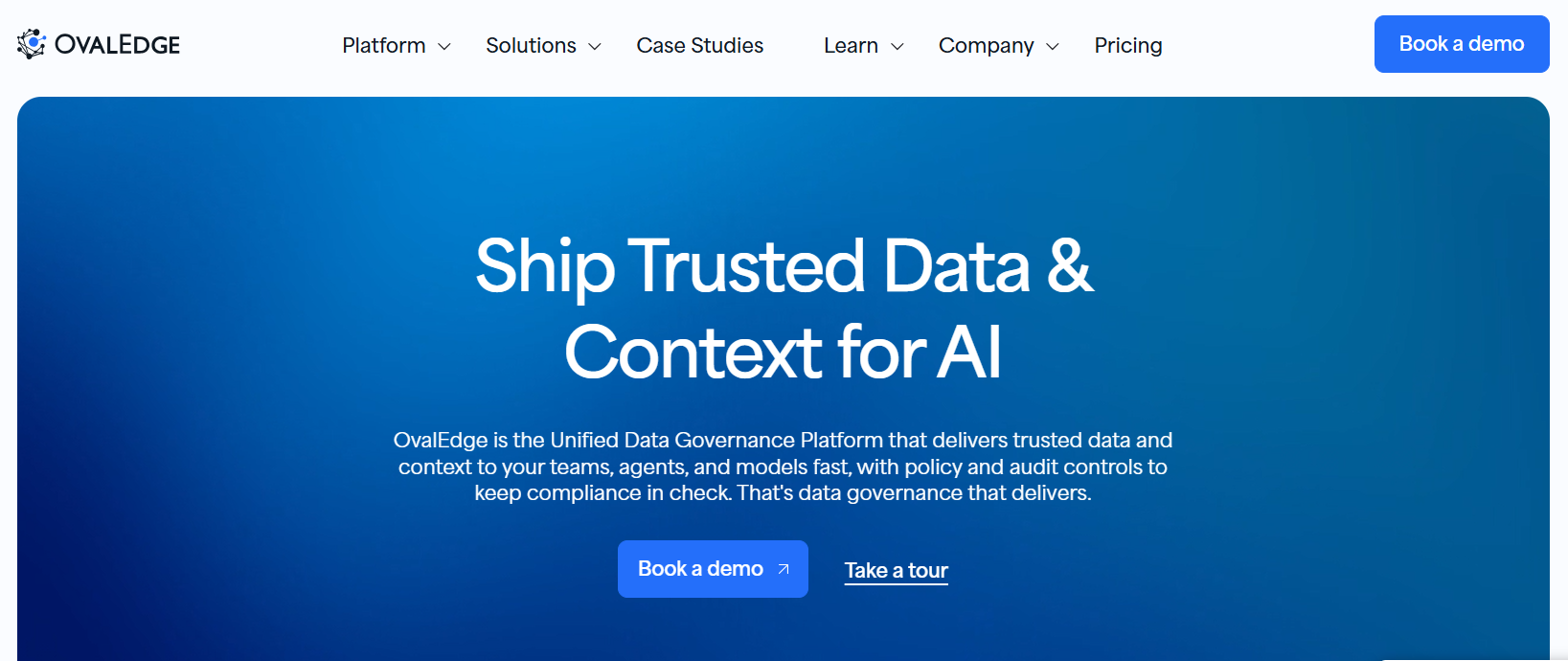
OvalEdge is a data governance and catalog platform that manages automated data lineage inside its Enterprise Context Graph, connecting lineage with glossary, catalog, quality, privacy classification, and access policies in one continuously updated graph.
How it traces lineage
-
Automates column-level lineage extraction across 170+ native connectors from source systems to dashboards without manual mapping
-
AI agents like Sift, the lineage agent, identifies transformation logic and surfaces impact paths across connected systems
-
Nexus discovers business concepts, maps relationships across glossary, catalog, and lineage assets, and resolves synonyms
-
Curo connects quality rules and scores to lineage paths, showing whether data passed its checks at every step
Where it fits
-
Links lineage with business glossary, privacy classifications, access policies, certification, and ownership in a single governance layer
-
Every traced data flow carries its business context and governance metadata into analytics and AI workflows
-
Deployment options include SaaS, customer-managed cloud, on-prem, and hybrid
-
Commercial platform with licensing costs, not open-source
-
Organizations that only need standalone lineage capture may use a fraction of the full governance and catalog suite
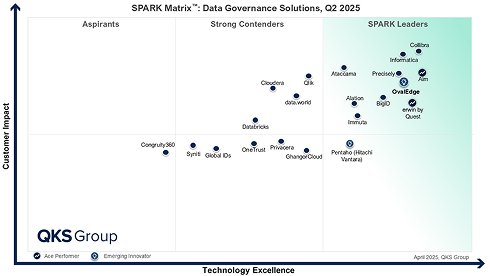
OvalEdge expert insight: A Forrester Total Economic Impact study found 337% ROI for OvalEdge customers, with analyst productivity improving by up to 30%. OvalEdge is also recognized in the Gartner Magic Quadrant 2025 and named a Leader in the SPARK Matrix 2026.
The Forrester Total Economic Impact study was commissioned by OvalEdge. Read the study →
2. Atlan
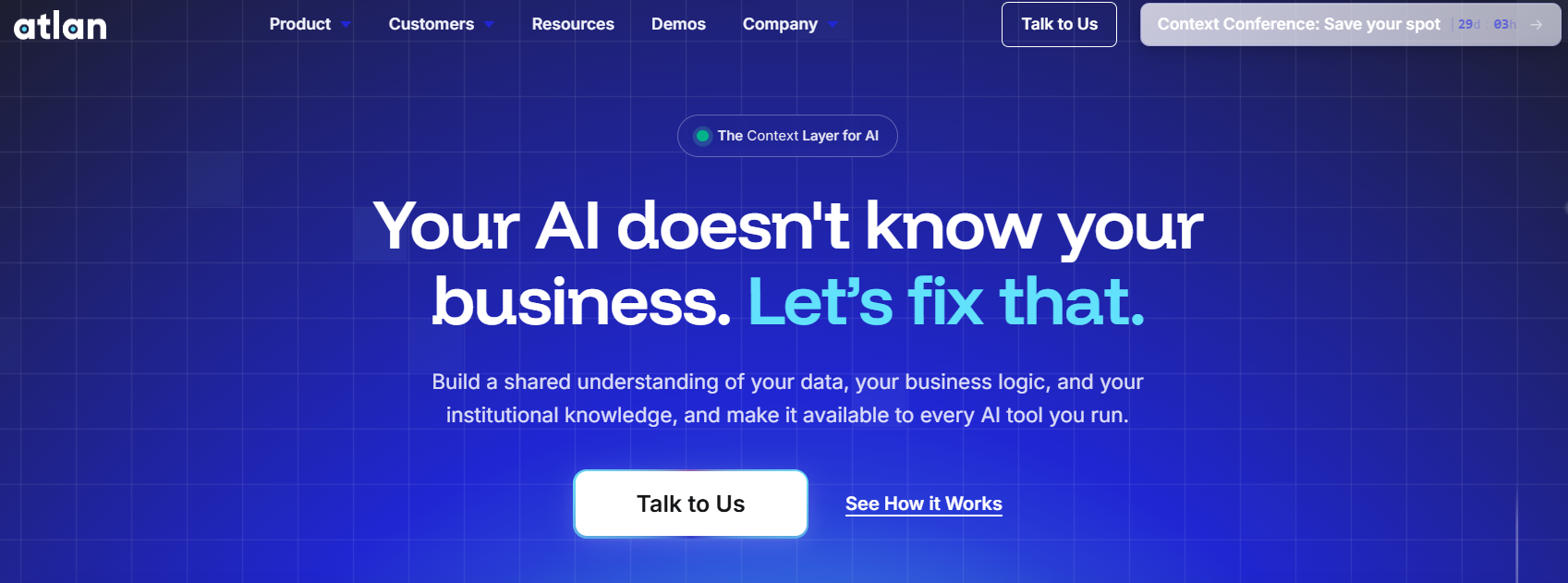
Atlan is a cloud-native data and AI governance platform that delivers column-level lineage as a queryable property of its active metadata graph, with built-in AI interpretation and MCP server integration for AI agent workflows.
How it traces lineage
-
Traces end-to-end column-level lineage from source systems through transformations (dbt, SQL) into warehouses, lakehouses, and BI tools
-
AI-assisted SQL interpretation explains transformation logic in natural language, reducing the time engineers spend reading pipeline code
-
MCP server connects lineage context to AI tools for impact checks and troubleshooting without switching platforms
Where it fits
-
Propagates business definitions, policies, and trust signals along lineage paths through its governance layer
-
Open APIs and SDKs support programmatic lineage access and custom integrations
-
SaaS-only deployment with no on-prem or self-hosted option, which may not suit organizations with strict data residency requirements
-
Connector coverage for legacy and mainframe systems may be narrower than platforms like Informatica or Collibra that have decades of enterprise integration history
3. Collibra
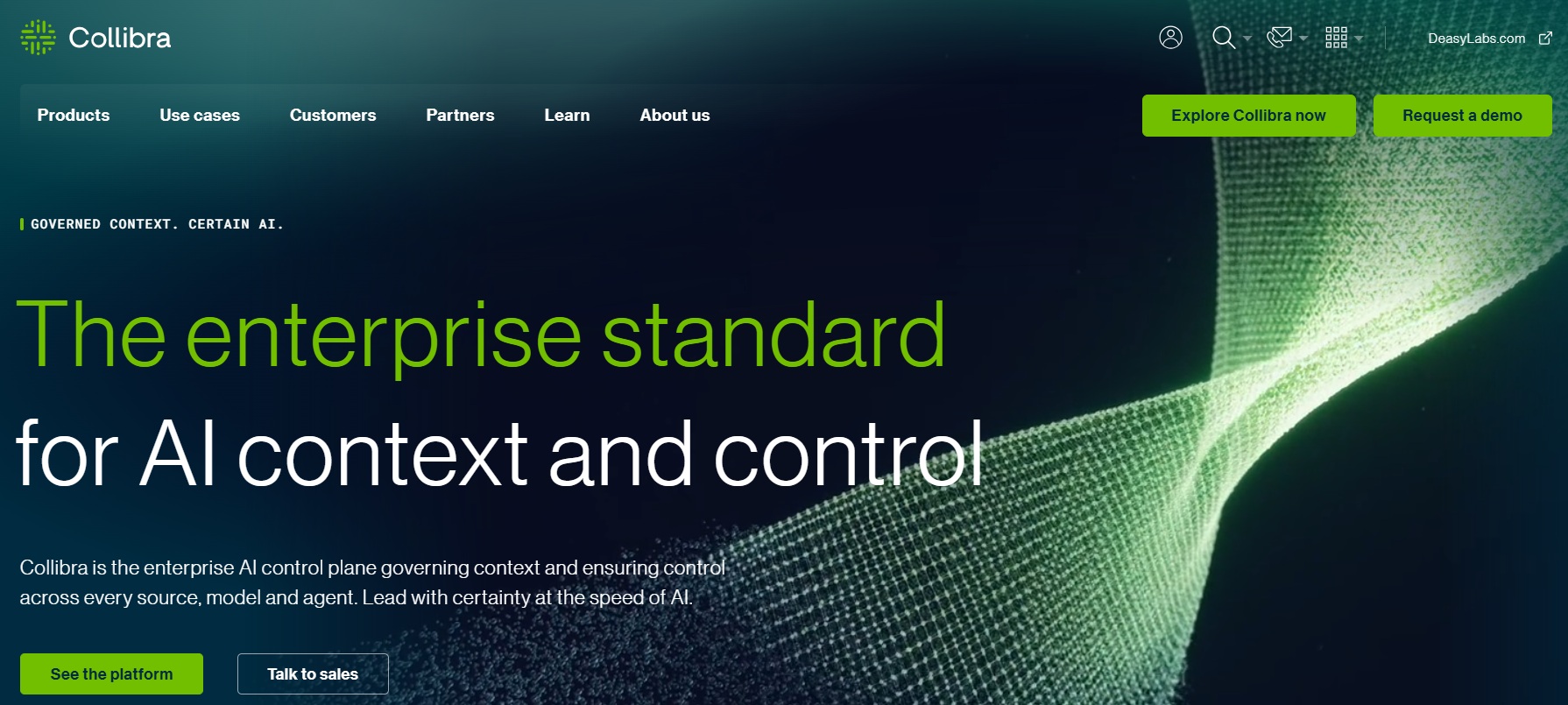
Collibra is an enterprise data governance platform with a dedicated lineage module that maps data flows at column and report level, connecting lineage directly to its governance, quality, privacy, and compliance workflows.
How it traces lineage
-
AI-powered lineage extraction documents data flows automatically across nearly 40 supported data sources, including SQL databases, ETL tools, and BI platforms
-
Traces lineage at table, column, and report level with support for indirect lineage through conditional statements and joins
-
Supports the OpenLineage standard for ingesting lineage events from open-source pipeline tools
Where it fits
-
Connects lineage to data quality, observability, privacy controls, and compliance workflows within Collibra's broader governance suite
-
AI Command Center brings lineage into AI agent governance, tracing model inputs back to source for explainability
-
Available as cloud and self-hosted deployments
-
Native connector count (~40 sources) is significantly smaller than some competitors, so complex environments may need custom integrations
-
Implementation and configuration can be resource-intensive, particularly for organizations new to enterprise governance platforms
4. Informatica IDMC
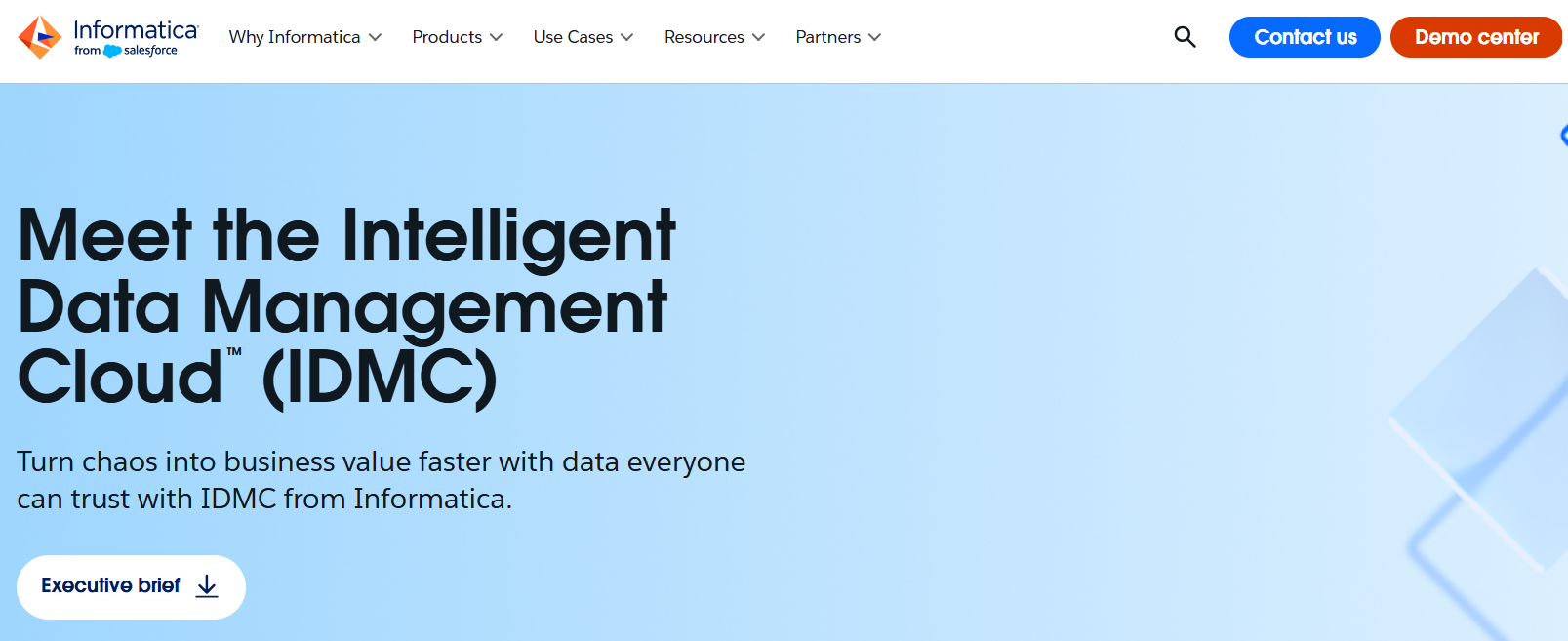
Informatica Intelligent Data Management Cloud delivers code-level lineage through deep parsing of SQL, stored procedures, and ETL logic, with the broadest legacy system coverage of any platform in this comparison.
How it traces lineage
-
Parses SQL, stored procedures, ETL mappings, and scripting logic at the code level to extract column-level lineage across complex transformation chains
-
CLAIRE AI engine automates lineage mapping, relationship detection, and anomaly identification across connected systems
-
Scanner-based approach supports one of the widest connector libraries in the market, covering mainframe, ERP, cloud, and modern data stack systems
Where it fits
-
Integrates lineage into Informatica's broader data governance, quality, and master data management ecosystem
-
Strong fit for organizations with existing Informatica investments (PowerCenter, IICS) or complex legacy environments
-
SaaS deployment through IDMC with on-prem components available for scanner infrastructure
-
Licensing and implementation costs can be substantial, with modular pricing that varies by capability
-
Organizations running modern cloud-native stacks without legacy dependencies may find the platform's breadth unnecessary
5. Alation

Alation is a data intelligence platform that positions lineage as an integrated layer within its AI-powered data catalog, with a strong emphasis on business user accessibility and compliance auditing.
How it traces lineage
-
Maps end-to-end data flows from source to report with automatic technical lineage extraction
-
Business lineage overlay lets non-technical users trace data using Trust Flags, quality indicators, and deprecation warnings
-
Impact analysis identifies downstream dependencies before changes are made, reducing the risk of breaking reports and dashboards
Where it fits
-
Built for compliance-heavy environments with certifications including HIPAA, ISO 27001, ISO 27701, and SOC 2
-
Lineage connects to Alation's catalog, stewardship, and governance workflows for audit-ready documentation
-
Available as SaaS and on-prem deployments
-
Lineage depth is more catalog-oriented than engineering-focused; organizations needing deep code-level parsing may require supplementary tools
-
Primary strength is discovery and cataloging, so teams buying specifically for standalone lineage may find the lineage module secondary to the catalog experience
Open-source and community data lineage tools
Open-source lineage tools provide lineage capture infrastructure without licensing costs. The trade-off is in-house deployment, maintenance, and the absence of built-in governance that commercial platforms include.
6. OpenLineage
OpenLineage is an open standard and API specification for collecting lineage metadata as data jobs execute, backed by the Linux Foundation's LFAI and Data initiative.
How it traces lineage
-
Captures lineage events in real time as jobs start, complete, or fail across pipeline frameworks including Airflow, Spark, dbt, Flink, and Dagster
-
Provides a framework-agnostic standard so different data technologies produce lineage in a common format
-
Column-level lineage is available through facets, with depth varying by integration
Where it fits
-
Open and vendor-neutral (Apache 2.0) with a growing integration ecosystem
-
Suited for engineering teams that want to standardize lineage collection across multiple pipelines while choosing their own storage and visualization layer
-
No built-in UI, storage, or governance; requires a downstream platform like Marquez or DataHub to store and display lineage
-
Self-hosted framework, not a turnkey deployment
7. Marquez
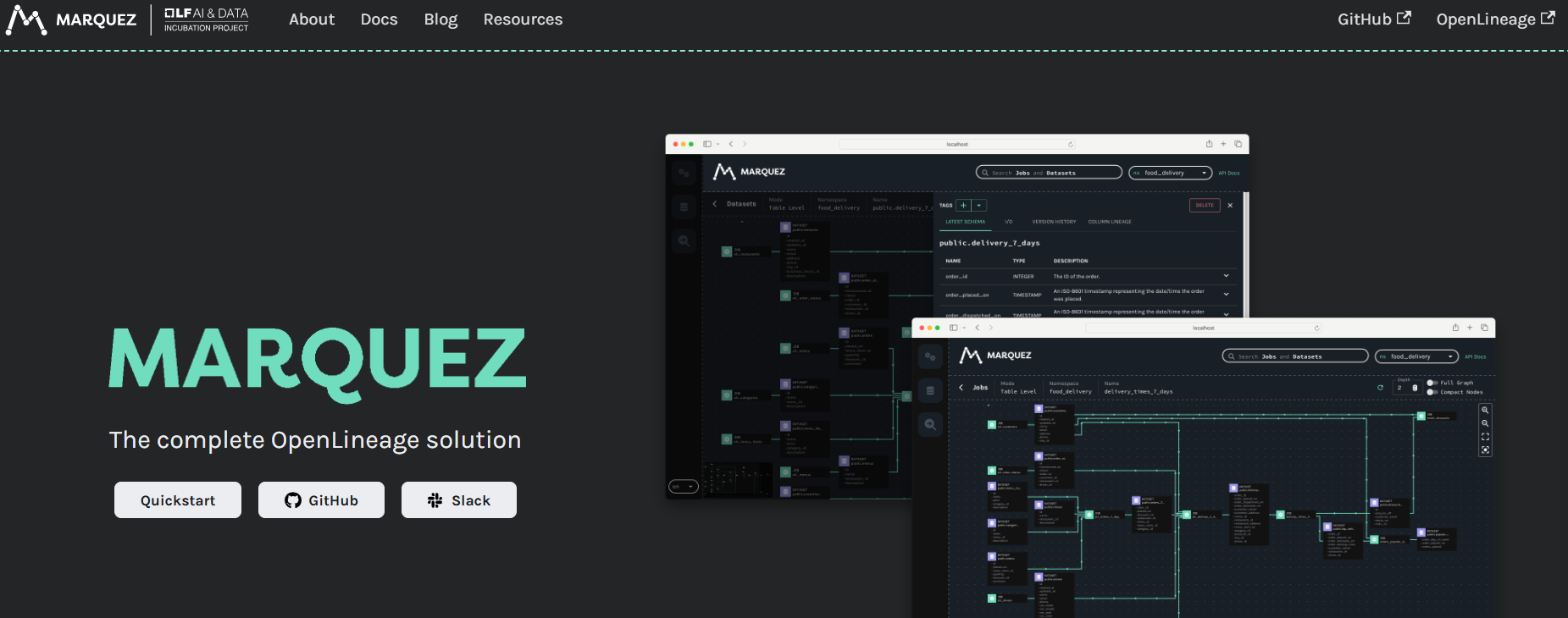
Marquez is the reference implementation for OpenLineage, giving teams a ready-made backend to store, version, and visualize lineage events. It pairs a metadata repository with a REST API, so pipeline history is queryable from day one.
How it traces lineage
-
Ingests OpenLineage events natively and stores them in a versioned metadata repository, creating a running history of every dataset and job change.
-
Provides built-in lineage visualization through its web UI, letting teams trace upstream and downstream dependencies without adding a separate graphing tool.
-
Exposes a REST API for programmatic lineage queries, making it straightforward to integrate lineage checks into CI/CD pipelines or custom dashboards.
Where it fits
-
Best for teams already emitting OpenLineage events that need a lightweight backend to collect and explore them.
-
Column-level lineage is partial, so teams requiring full field-level traceability across complex transformations may hit gaps.
-
Governance features are minimal. There is no built-in policy engine, classification, or access control layer.
-
Works well as a starting point for OpenLineage adoption, but larger environments often outgrow it and move lineage data into a broader catalog.
8. DataHub
DataHub, originally built at LinkedIn, is an extensible metadata platform that combines data discovery, governance, and lineage in a single graph. It supports column-level lineage and uses ML-assisted classification to tag sensitive fields automatically.
How it traces lineage
-
Captures lineage at both dataset and column level through ingestion connectors that pull metadata from warehouses, pipelines, and BI tools on a scheduled basis.
-
Builds a searchable metadata graph that links datasets, dashboards, ML models, and users, so impact analysis spans the full stack rather than stopping at the warehouse.
-
Applies ML-assisted classification to detect PII and sensitive data types, adding governance context directly to lineage nodes.
Where it fits
-
Strong choice for teams that want lineage, discovery, and governance unified in one platform without paying for a commercial license.
-
Infrastructure requirements are significant. DataHub runs on Kafka, Elasticsearch, and a graph database, so smaller teams may find the operational overhead hard to justify.
-
The managed cloud option (Acryl Data) reduces that burden but moves the deployment closer to a commercial model.
-
UI can feel dense for non-technical users who just need to trace a report back to its source tables.
9. OpenMetadata
OpenMetadata is a unified metadata platform that bundles discovery, lineage, quality, and governance into a single interface. It offers column-level lineage out of the box and uses ML-driven tagging to classify sensitive data across connectors.
How it traces lineage
-
Extracts column-level lineage automatically from SQL queries and pipeline definitions, mapping field-to-field transformations across warehouses, dashboards, and ETL jobs.
-
Layers data quality test results directly onto lineage nodes, so teams can see not just where data flows but whether it arrived correctly at each step.
-
Uses ML-based auto-classification to tag PII and sensitive columns, linking governance labels to the lineage graph without manual intervention.
Where it fits
-
Good fit for teams that want lineage, quality monitoring, and a business glossary in one open-source platform rather than stitching separate tools together.
-
Built-in role-based access control and policy engine make it one of the more governance-ready open-source options.
-
The connector library is growing but still smaller than commercial catalogs, so teams with niche or legacy sources should verify coverage before committing.
-
Self-hosted deployment requires MySQL or Postgres plus Elasticsearch, which adds operational load compared to lighter tools like Spline or Marquez.
10. Apache Atlas
Apache Atlas is a metadata management and governance framework built for the Hadoop ecosystem. It provides lineage tracking, classification, and policy enforcement through tight integration with Apache Ranger for access control.
How it traces lineage
-
Captures lineage automatically from Hadoop components like Hive, Sqoop, Storm, and Falcon, recording how data moves through each processing step.
-
Stores metadata in a type-based graph model that supports custom entity definitions, letting teams extend lineage tracking to fit their specific pipeline architecture.
-
Integrates with Apache Ranger to enforce access policies based on lineage classifications, connecting data flow visibility to security controls.
Where it fits
-
Natural choice for teams already running a Hadoop-based stack that need lineage and governance without adding a separate platform.
-
Outside the Hadoop ecosystem, connector coverage is limited. Teams running cloud-native warehouses or modern ELT tools will find significant gaps.
-
The UI feels dated compared to newer platforms, and non-technical users often struggle to navigate lineage graphs without training.
-
Community development has slowed in recent years, so teams evaluating Atlas should weigh long-term maintenance risk against their current Hadoop investment.
11. Egeria
Egeria is a Linux Foundation project designed for federated metadata management. Rather than centralizing all metadata into one repository, it connects distributed catalogs through open APIs, letting each team keep its own tools while sharing lineage and governance context across the organization.
How it traces lineage
-
Uses Open Metadata Access Services (OMAS) to exchange lineage events across federated repositories, so lineage assembled in one catalog is visible in another without duplicating storage.
-
Supports integration connectors that pull lineage from third-party tools and map it to Egeria's open type system, bridging gaps between platforms that would otherwise stay siloed.
-
Models metadata relationships as a distributed graph, allowing lineage queries to span multiple repositories without requiring a single centralized store.
Where it fits
-
Strongest fit for large enterprises running multiple metadata catalogs that need interoperability without ripping out existing tools.
-
The federated architecture adds complexity. Small to mid-size teams with a single catalog will find the setup overhead hard to justify.
-
Documentation and community resources are thinner than more widely adopted projects like DataHub or OpenMetadata, which steepens the learning curve.
-
Best treated as a metadata integration layer rather than a standalone lineage tool. Teams still need a front-end catalog for day-to-day discovery and exploration.
12. OpenDataDiscovery
OpenDataDiscovery (ODD) is an open-source metadata platform focused on observability for data and ML pipelines. It emphasizes automated discovery and monitoring, making it easier to track how data moves through training sets, feature stores, and production models.
How it traces lineage
-
Automatically discovers and maps lineage across data pipelines and ML workflows by scanning infrastructure metadata, reducing the need for manual annotation.
-
Tracks dataset-level dependencies through an event-driven architecture, capturing upstream and downstream relationships as pipelines execute.
-
Provides pipeline health monitoring alongside lineage, so teams can see not just the flow path but whether each step completed successfully.
Where it fits
-
Strong fit for ML engineering teams that need lineage visibility across training pipelines, feature engineering, and model deployment rather than traditional BI reporting chains.
-
Governance capabilities are limited compared to platforms like OpenMetadata or DataHub. There is no built-in policy engine, glossary, or classification framework.
-
Connector library skews toward modern data stack and ML tools. Teams with legacy sources or broad warehouse coverage needs should verify support before adopting.
-
Community is smaller than more established projects, so teams should factor in the pace of feature development and available support when planning long-term adoption.
13. Spline
Spline is a lightweight, automatic lineage tracker built specifically for Apache Spark. It hooks into Spark's execution plan to capture lineage without requiring any changes to existing jobs, making it one of the fastest open-source tools to deploy for Spark-heavy environments.
How it traces lineage
-
Intercepts Spark execution plans at runtime and records lineage automatically, capturing every read, transformation, and write without code changes or manual annotations.
-
Tracks lineage down to the attribute level within Spark jobs, so teams can trace individual columns through complex transformation chains.
-
Stores lineage events in a dedicated backend with a REST API, keeping the lineage archive separate from the Spark cluster itself.
Where it fits
-
Ideal for teams running heavy Spark workloads that need lineage visibility with near-zero setup friction. Install the agent, and lineage capture starts immediately.
-
Scope is limited to Spark. Pipelines that span Airflow, dbt, or non-Spark engines will need a separate tool to cover those segments.
-
No built-in governance, cataloging, or quality monitoring. Spline solves one problem well but does not replace a broader metadata platform.
-
Works best as a complementary tool, feeding Spark lineage into a larger catalog like DataHub or OpenMetadata through its REST API.
How to evaluate data lineage tools
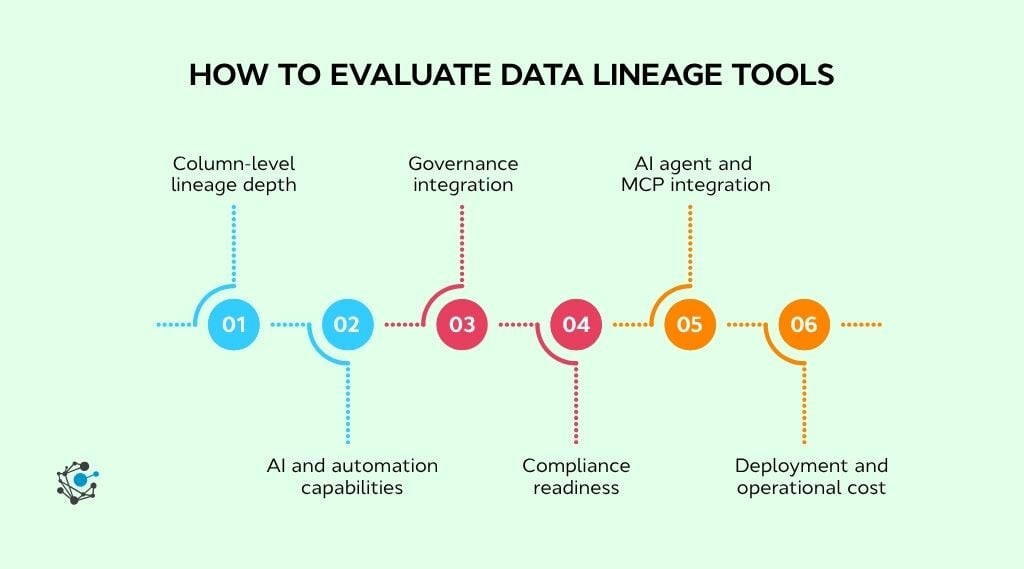
Choosing a data lineage tool starts with knowing what lineage needs to do for the organization. The evaluation criteria below apply whether the platform is open-source, commercial, or a managed service.
The EDM Association's 2026 Global Data Management Benchmark Report found that 89% of organizations have an active data management initiative, yet only 39.9% have achieved capability in data governance.
That gap is exactly what lineage tools with governance integration are designed to close.
1. Column-level lineage depth
Does the tool trace transformations at the column level, or only at the table or job level? Column-level lineage is essential for impact analysis, regulatory reporting, and debugging data quality issues. Tools vary widely here: some parse SQL and extract column-level mappings automatically; others require manual annotation.
2. AI and automation capabilities
Lineage tools increasingly use AI for metadata discovery, classification, schema matching, and anomaly detection. Evaluate whether AI features are production-ready or experimental, and whether they work across the organization's actual stack.
3. Governance integration
Standalone lineage tools show where data came from. Governance-integrated tools also show who owns it, what policies apply, whether it passed quality checks, and who can access it. For regulated industries, governance integration is non-negotiable. A strong data lineage governance framework connects lineage to business glossary definitions, ownership records, and access policies.
4. Compliance readiness
BCBS 239, GDPR, SOX, and HIPAA all require demonstrable data lineage. Evaluate whether the tool provides audit trails, retention controls, and reporting formats that compliance teams can use directly.
5. AI agent and MCP integration
As AI agents consume enterprise data, lineage needs to travel with the data into agent workflows. Evaluate whether the tool exposes lineage through MCP servers or comparable interfaces so AI systems can trace provenance without custom integration.
6. Deployment and operational cost
Open-source tools have no license fees but carry implementation, infrastructure, and maintenance costs. Enterprise platforms carry license fees but reduce operational overhead. The total cost comparison is rarely as simple as "free vs. paid."
At OvalEdge, we believe lineage without governance context is just a diagram. Connecting lineage to ownership, quality, and access policies is what turns traceability into a decision-making tool.
Where open-source data lineage tools fall short
Open-source lineage tools solve the capture problem well. Most can record how data moves from source to destination, and several now handle column-level tracing. Where they consistently fall short is everything that surrounds lineage in an enterprise environment.
Governance is the most common gap. Open-source tools rarely include policy engines, role-based access controls, or classification frameworks. Teams end up building these layers themselves or bolting on separate tools, which fragments the metadata landscape rather than unifying it.
Compliance reporting is another weak spot. Regulated industries need audit trails, retention controls, and exportable lineage reports that map to specific frameworks like BCBS 239 or GDPR. Most open-source projects leave this to the implementing team.
Maintenance costs are easy to underestimate. Self-hosted deployments require infrastructure management, version upgrades, connector maintenance, and on-call support. The total cost of ownership often exceeds commercial licensing once engineering time is factored in.
Finally, business context is almost always missing. Open-source lineage shows technical flow but rarely connects it to data ownership, quality signals, or glossary definitions. Without that layer, lineage answers "where did this data come from" but not "should I trust it."
OvalEdge expert insight: Teams that start with open-source lineage and later need governance, compliance, and business context often spend more time integrating separate tools than they would have spent adopting a unified platform from the start.
Conclusion
The right data lineage tool depends on what lineage needs to do beyond tracking data flows. Open-source frameworks like OpenLineage and DataHub provide strong lineage capture infrastructure for teams with engineering capacity. Enterprise platforms add governance, compliance, and business context on top.
OvalEdge takes the governance-first approach. Its Enterprise Context Graph connects lineage with glossary, catalog, quality, privacy classification, and access policies, so every traced data flow carries its business context and ownership into analytics and AI workflows. Sift automates column-level lineage extraction. Nexus maps relationships across assets. Curo connects quality signals to lineage paths.
Book a demo to see how OvalEdge governs data lineage across the enterprise.
.png?width=1081&height=173&name=Forrester%201%20(1).png)
.png?width=1081&height=241&name=KC%20-%20Logo%201%20(1).png)