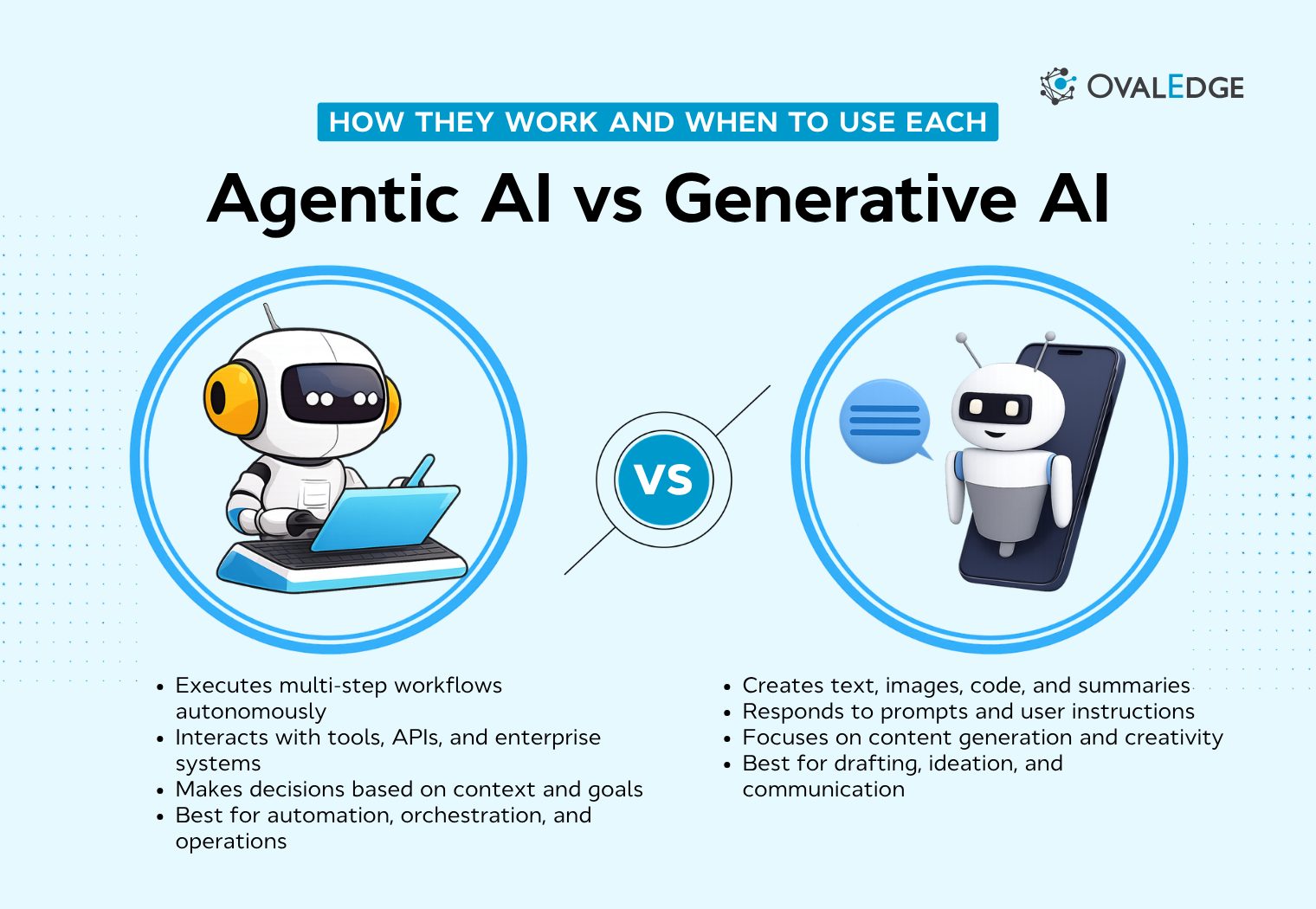
Generative AI produces content. Agentic AI completes tasks. Generative models create text, images, and summaries on demand. Agentic systems plan, decide, and act across tools to achieve specific outcomes, often using generative AI as their reasoning layer underneath.
The difference matters because the risks are different. Generative AI introduces informational risk: hallucinations, biased outputs, and inaccurate content. Agentic AI introduces operational risk: autonomous systems taking actions on live data, customer workflows, and business operations.
Most enterprises are deploying both in 2026.
In McKinsey’s The State of AI: Global Survey 2025, 62% of organizations said they are experimenting with agentic AI systems, but only 23% have scaled them into production.
The gap is governance: knowing which AI system made a decision, what data it accessed, and who remains accountable when autonomous actions are executed.
This guide explains how generative AI and agentic AI differ across autonomy, memory, workflows, tool usage, and governance, and when businesses should use one versus both together.
Agentic AI vs generative AI: How do they work?
Agentic AI and generative AI represent two different approaches to artificial intelligence. Generative AI focuses on creating content, while agentic AI focuses on executing tasks and achieving goals autonomously.
Generative AI uses models like LLMs and diffusion models to generate text, images, code, and summaries from user prompts. It is reactive: it produces an output and waits for the next instruction.
Agentic AI is proactive. It can plan actions, interact with external tools and APIs, retain context across workflows, and execute multi-step tasks with minimal human intervention. Most agentic systems also use generative AI as a reasoning layer.
|
For example, a generative model may draft an email, while the agentic system gathers customer data, sends the message, updates the CRM, and triggers the next workflow automatically. |
In simple terms, generative AI creates content. Agentic AI orchestrates actions and workflows.
What is generative AI? Core concepts
Generative AI is built on advanced machine learning models, such as Large Language Models (LLMs), diffusion models, and multimodal systems. These systems generate text, images, audio, and more, all from a user prompt. The core idea is that these models are trained on vast datasets to recognize patterns, make predictions, and output content based on statistical likelihoods.
Generative AI operates in a reactive pattern, meaning it waits for a user to provide a prompt, then generates an output. This output could be anything from a paragraph of text to an image or code snippet, depending on the model's design.
|
For example, when you ask a generative model to write an article or summarize a document, the system draws from learned patterns and contextual embeddings to create meaningful text. It doesn't make decisions or plan ahead, but simply reacts to what you ask for. |
What is agentic AI? Key characteristics
Agentic AI represents a step forward from traditional generative systems. These AI systems don't just generate content; they plan, execute, and act autonomously to achieve specific goals. Unlike generative AI, which is reactive, agentic AI is proactive.
It can handle multi-step workflows, make decisions in real-time, and interact with various tools and systems to complete tasks.
Key features of Agentic AI include:
-
Decision-making autonomy: Agentic AI systems can assess situations, decide on actions, and execute them without continuous user input.
-
Tool and API integrations: These systems can integrate with existing tools and services through an AI agent platform to automate workflows across enterprise systems.
-
Multi-step workflow execution: From gathering data to analyzing it, making decisions, and taking actions, agentic AI handles complex processes.
-
Memory tracking and reflection: Some agentic AI systems use stateful memory to track actions across sessions, enabling adaptive behavior.
In a typical agentic AI workflow, the AI might gather data, analyze it, decide what action to take, and execute that action, whether it’s sending an email, generating a report, or updating a database. Unlike generative AI, which is limited to creating outputs, agentic AI systems can complete entire tasks autonomously.
|
Did you know? askEdgi by OvalEdge is a perfect example of Agentic AI in action. Unlike traditional analytics tools that require navigating complex dashboards, askEdgi uses conversational AI to let users interact with data through simple, natural language queries. |
Comparison table: Agentic AI vs generative AI
Comparing agentic AI and generative AI is essential to choosing the right solution for your business needs. The table below provides a quick side-by-side comparison of their core functionalities to help you navigate which approach is best for your business.
|
Feature |
Agentic AI |
Generative AI |
|
Core Purpose |
Achieve goals, execute tasks |
Create content |
|
Mode |
Proactive |
Reactive |
|
Workflow |
Multi-step, tool-driven |
Single prompt → response |
|
Autonomy |
High |
None |
|
Memory |
Persistent/episodic memory |
Typically stateless |
|
Tools/APIs |
Core requirement |
Optional |
|
Best for |
Automation + decision processes |
Content generation |
Key differences between agentic AI and generative AI
While both agentic AI and generative AI are groundbreaking technologies, they serve very different purposes and excel in distinct areas. Understanding these differences is key to leveraging each tool effectively in your business.
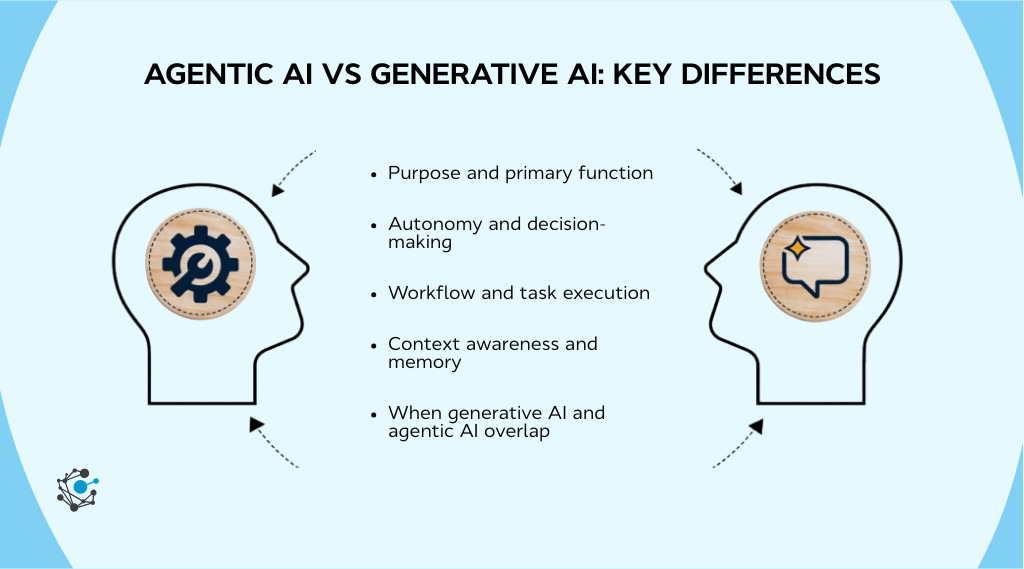
1. Purpose and primary function
The primary difference between generative AI and agentic AI lies in their purpose. Generative AI is focused on creating content based on patterns it has learned from large datasets. It can generate text, images, and even videos, but it does not make decisions or take actions on its own.
Agentic AI, on the other hand, is designed to autonomously execute tasks. It can plan, make decisions, and complete multi-step processes like scheduling, reporting, and interacting with external systems.
2. Autonomy and decision-making
Generative AI lacks autonomy and only produces output in response to specific user prompts. It doesn’t have the ability to make decisions or determine the next steps in a task.
An arXiv academic study 2025 shows that generative AI can increase retail productivity by up to 16.3%, while agentic AI is projected to enhance productivity through automation and multi-step workflows.
It can break down complex tasks into smaller actions, decide what needs to be done next, and then carry out those actions. It’s like a digital assistant that not only understands the task but can also take steps to complete it on its own.
3. Workflow and task execution
Generative AI operates on a one-time prompt-response basis. Once you give it a prompt, it generates a response. There’s no continuity between requests.
In contrast, agentic AI handles multi-step workflows. For instance, if you need to research a topic, generate a report, and schedule a meeting, agentic AI can automate the entire process. It retrieves data, analyzes it, decides on the next steps, and takes actions, essentially handling the full workflow autonomously.
4. Context awareness and memory
Generative AI typically operates with session-bound context, meaning it processes the current prompt to generate an output without retaining memory of previous interactions.
Agentic AI, however, often relies on persistent memory to track past actions, allowing it to adjust its behavior over time.
While traditional agentic AI systems use memory to handle complex tasks and adapt to new inputs, askEdgi operates differently. It focuses on providing real-time insights through conversational interactions rather than using a long-term memory structure.
5. When generative AI and agentic AI overlap
Generative AI and Agentic AI can complement each other in certain systems. While agentic AI is not a "better" version of generative AI, it does expand its capabilities.
For instance, askEdgi leverages generative AI to process natural language queries and provide insights, but it does not autonomously execute tasks like generating reports or updating systems. Instead, it enables data-driven conversations to help users derive insights without manual query-building.
Side-by-side: Same task, two AI approaches
The easiest way to understand the difference is to compare how both AI types handle the same business task.
The task: Send a personalized follow-up email to a sales lead after a discovery call using CRM context and recent company news.
With generative AI
A sales rep opens ChatGPT or Claude and prompts the model to draft a follow-up email. The AI generates the content, but the rep still gathers customer context, edits the message, sends the email, and logs the activity manually.
With agentic AI
An agentic workflow automatically pulls CRM data, checks recent company updates through APIs, drafts the email using a generative model, routes it for approval, sends it, and logs the interaction back into the CRM.
|
Step |
Generative AI |
Agentic AI |
|
Trigger |
Human prompt |
CRM workflow trigger |
|
Context gathering |
Manual |
Automated via APIs |
|
Drafting |
LLM output |
LLM coordinated by the agent |
|
Review |
Human edits |
Human approval threshold |
|
Sending |
Manual action |
Automated workflow |
|
Logging |
Manual update |
CRM API integration |
Generative AI accelerates one task. Agentic AI orchestrates the entire workflow. That difference is also why agentic systems require stronger governance and oversight, especially when autonomous actions affect customers, systems, or business operations.
Where askEdgi fits: askEdgi runs the same pattern for agentic analytics. A business user asks a question in natural language, and the platform retrieves governed data, applies access controls, and delivers traceable insights in real time.
Governance and risk: where the two AIs diverge sharply
The biggest difference between generative AI and agentic AI is accountability.
Generative AI introduces informational risk. Models can hallucinate facts, generate biased outputs, or produce inaccurate content. In most cases, humans review the output before it is used.
Agentic AI introduces operational risk. These systems can interact with live environments by sending emails, updating records, triggering workflows, or executing actions across connected tools. Errors can directly impact business operations.
This is why governance is critical for enterprise adoption.
Three controls are essential for scaling agentic AI safely:
-
Human-in-the-loop approvals: Define which actions can run autonomously and which require explicit approval. In enterprise environments, these controls should be built into the AI agent platform itself, not added later through prompts or manual oversight.
-
Provenance and auditability: Track which models, APIs, and data sources were involved in every action.
-
Strict access controls: Limit agent access to only the systems and datasets required.
This is where governed platforms matter. askEdgi operates on top of OvalEdge’s governed data catalog and access controls, ensuring every AI-generated insight remains traceable, permission-aware, and aligned with enterprise governance standards.
To see how governed agentic analytics works in practice, book a demo with OvalEdge and explore how askEdgi delivers conversational AI with trusted, enterprise-ready governance.
Why agentic AI matters? Use cases and applications
Agentic AI is already transforming industries through automation, real-time decision-making, and workflow orchestration. The next sections explore some of the most widely adopted agentic AI solutions and where they deliver the most business value.
1. Business workflow automation
One of the most valuable applications of agentic AI is its ability to automate business workflows, saving time and improving operational efficiency. Here are a few key examples:
-
Customer support follow-ups: Automatically sending personalized follow-up emails or notifications after customer interactions, ensuring no query goes unanswered. This approach becomes even more powerful when combined withself-service analytics for customer service, enabling support teams to access real-time insights without relying on technical teams.
-
Report generation: Seamlessly pulling data from multiple systems, analyzing it, and generating comprehensive reports with minimal human intervention.
-
Email sequencing: Automating the process of sending personalized emails to customers based on specific criteria, enhancing engagement and improving customer relationships.
-
CRM updates: Keeping customer records up-to-date automatically, so your team can focus on high-value tasks instead of routine data entry.
These applications showcase how agentic AI can streamline repetitive tasks, improve accuracy, and free up time for more strategic work.
2. Commerce and customer-facing operations
Commerce is one of the clearest examples of how generative AI and agentic AI work together in real-world business operations.
-
Generative AI for content creation: Generative AI creates product descriptions, ad copy, personalized emails, and storefront content at scale.
-
Agentic AI for operational workflows: Agentic AI automates workflows such as monitoring pricing, reallocating ad spend, triggering inventory reorders, and managing customer engagement actions in real time.
-
How both work together: In modern commerce systems, agentic AI handles decisions and workflow orchestration, while generative AI creates the human-readable content used throughout the process.
-
Why governed data matters: Reliable agentic commerce depends on governed data such as product catalogs, customer records, pricing data, and inventory systems that are accurate, current, and access-controlled.
As enterprises scale AI-driven commerce, governance becomes essential for ensuring that automated decisions remain accurate, compliant, and aligned with business goals.
3. Complex task orchestration
Where agentic AI truly shines is in managing complex, multi-step processes that require thoughtful decision-making and orchestration. Here’s how it can enhance efficiency:
-
Sales research: Identifying potential prospects, reaching out through email or other channels, and logging results, all handled autonomously.
-
Financial analysis: Analyzing large volumes of financial data, updating spreadsheets, and summarizing findings, ensuring your team can focus on interpreting insights rather than gathering data.
-
IT operations: Diagnosing and resolving technical issues quickly, reducing downtime, and ensuring smooth business operations with minimal human involvement.
These use cases highlight how agentic AI goes beyond simple automation to handle sophisticated workflows that demand context, decision-making, and continuous management.
4. Emerging and advanced domains
The capabilities of agentic AI extend into more specialized and cutting-edge domains, where its autonomy and precision can make a significant impact:
-
Robotics: Enabling robots to perform a range of tasks autonomously, from manufacturing to delivery, improving operational efficiency in industries like logistics and healthcare.
-
Autonomous research assistants: Automating the process of gathering, analyzing, and synthesizing research materials, allowing researchers to focus on deeper insights and innovation.
-
Multi-agent systems: Coordinating multiple agents to solve complex simulations or handle decision-making processes that require input from diverse data sources, such as supply chain management or crisis response scenarios.
These emerging applications are pushing the boundaries of what AI can do, unlocking new efficiencies and capabilities in both traditional and advanced industries.
5. Data-driven support
Data-driven support is one of the most impactful applications of agentic AI, enabling businesses to unlock valuable insights quickly and make smarter, faster decisions.
For instance, askEdgi takes this a step further by offering a conversational, self-service platform built on governed data. It belongs to the broader category ofAI-driven conversational analytics platforms, but with governance built into the foundation rather than added as a separate layer.
Key benefits of using askEdgi for data-driven support include:
-
Instant access to insights: It enables users to query data conversationally and receive real-time, actionable insights without needing to build complex queries or rely on static dashboards.
-
Simplified data analysis: It processes unstructured data from various sources and compiles it into easy-to-understand summaries, recommendations, and trends.
-
Self-service for non-technical users: No need for specialized technical expertise; askEdgi is a self-service platform that empowers business users to explore data and make decisions on their own.
-
Governed and secure data: As a platform built on governed data, it ensures that all insights are drawn from secure and compliant sources, making it reliable for decision-making in regulated industries.
By automating the data analysis process and providing actionable intelligence in real time, Agentic AI tools eliminate the delays and complexities associated with traditional analytics methods.
How to choose the right agentic AI tool?
With the growing variety of agentic AI tools available in 2026, choosing the right platform depends on your business goals, workflow complexity, and governance requirements.
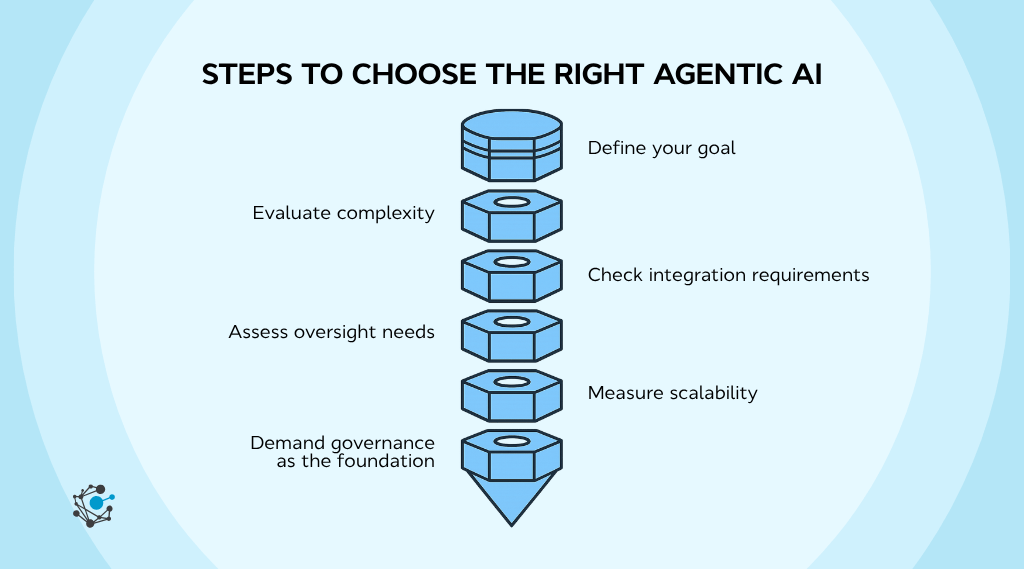
When selecting an agentic AI tool, consider the following:
- Define your goal: Are you looking to automate workflows, generate content, or tackle complex tasks? Clearly outlining your objective will help you choose a tool that aligns with your primary needs and expected outcomes.
- Evaluate complexity: If your tasks involve branching logic or require integration with multiple systems, agentic AI is ideal. Complex workflows demand a solution capable of adapting and automating decision-making across various stages.
- Check integration requirements: Make sure the AI tool integrates seamlessly with your existing tools and systems. Effective integration is key to enabling smooth operations and reducing the friction of adopting new technology.
- Assess oversight needs: Consider how much autonomy your agentic AI tool should have. If your tasks require human intervention at critical stages, ensure the system allows for real-time oversight and approval.
- Measure scalability: Choose a solution that can evolve as your business grows. A scalable tool will accommodate future expansions, additional tasks, or more complex workflows without a complete system overhaul.
- Demand governance as the foundation: Enterprise AI systems should provide full visibility into data lineage, permissions, and auditability. Platforms built on governed data catalogs and access controls, like askEdgi by OvalEdge, make AI outputs traceable, compliant, and enterprise-ready.
The best agentic AI platforms combine automation, governance, and usability, enabling organizations to scale AI adoption without compromising trust, security, or operational control.
Conclusion
Generative AI and agentic AI serve different but complementary roles in modern enterprises. Generative AI excels at creating content and accelerating individual tasks, while agentic AI enables autonomous workflows, real-time decision-making, and cross-system orchestration.
As organizations scale AI adoption in 2026, the real challenge is not just automation. It is governance, visibility, and trust. Businesses need AI systems that can deliver accurate insights while maintaining control over data access, lineage, and compliance.
This is where OvalEdge stands out. With askEdgi built on top of OvalEdge’s governed data catalog, business glossary, and access controls, organizations can combine conversational AI with enterprise-grade governance. Users get faster, self-service access to trusted insights, while data teams maintain visibility, consistency, and compliance across the entire AI workflow.
Ready to see governed agentic analytics in action? Schedule a demo with OvalEdge today and discover how it can streamline your workflows and help your team unlock actionable insights with ease.
FAQs
1. What is the main difference between agentic AI and generative AI?
Generative AI creates content in response to prompts, while agentic AI autonomously executes multi-step tasks to achieve a goal. Generative AI generates outputs. Agentic AI orchestrates workflows and actions.
2. Are generative AI and agentic AI the same?
No. Generative AI is reactive and typically stateless, producing outputs when prompted. Agentic AI is proactive and stateful, capable of planning tasks, using tools, and adapting based on results. Most agentic systems use generative AI as part of the workflow, but they are not interchangeable.
3. How does agentic AI differ from generative AI?
The biggest differences are autonomy, memory, tool usage, and risk. Agentic AI can act across workflows and systems with minimal human input, while generative AI focuses on creating content from prompts. Agentic AI introduces operational risk, while generative AI introduces informational risk.
4. What makes a workflow a strong candidate for agentic AI?
Workflows are ideal for agentic AI when they involve multiple steps, span different systems, require conditional decision-making, and have a clearly defined outcome. Examples include customer follow-ups, fraud detection, inventory management, and IT incident response.
5. How does agentic AI enhance business automation?
Agentic AI automates complete workflows instead of individual tasks. It can gather data, decide next actions, interact with APIs, and trigger follow-up processes automatically, improving efficiency across operations.
6. What industries can benefit from agentic AI?
Industries such as healthcare, finance, retail, ecommerce, manufacturing, customer service, and IT operations benefit from agentic AI because they rely on real-time decisions and multi-system workflows.
.png?width=1081&height=173&name=Forrester%201%20(1).png)
.png?width=1081&height=241&name=KC%20-%20Logo%201%20(1).png)