-1.png)
Enterprise data volumes continue to grow, but collecting more data does not mean organizations are getting more value from it.
According to G2’s 2026 Big Data Statistics report, nearly 90% of enterprise data goes unused, highlighting a growing gap between the data organizations hold and the data they can actually put to work.
Traditional data warehouses can widen that gap when every new analytics question requires data movement, pipelines, modelling, and permanent infrastructure. A pop-up data warehouse offers a more flexible approach by keeping data in its existing source systems, centralizing the metadata needed to understand and govern it, and provisioning temporary compute only when required.
For ad hoc analytics, short-term projects, and fast-changing AI workloads, this model can reduce unnecessary data movement and infrastructure. This guide explains how pop-up data warehouses work, where they fit, what they cost, and when to use them.
What is a pop-up data warehouse?
A pop-up data warehouse is a temporary cloud analytics environment that centralizes metadata while leaving underlying data in its source systems. It spins up short-lived compute for a specific analytics request, retrieves only the required data, returns the result, and shuts down when the work is complete.
Unlike a traditional data warehouse, it does not copy and permanently store data by default. Instead, it maintains a centralized metadata layer that maps:
-
What data exists and where it resides
-
Business definitions and relationships
-
Data lineage and quality information
-
Data ownership
-
Access and governance policies
Metadata makes this model possible because it is relatively small and practical to centralize. The underlying enterprise data remains distributed across source systems, reducing the need to move and duplicate large datasets.
For example, if a finance team needs a one-time analysis of overtime spending across departments, the platform can identify the relevant payroll and HR data, verify definitions and permissions, retrieve only the required records, and spin up temporary compute to perform the analysis. Once the result is delivered, the temporary environment shuts down.
This model fits short-lived questions such as regional churn analysis, contract-renewal exposure checks, or ad hoc financial investigations. These requests can support important decisions without requiring weeks of permanent pipeline and data-model development.
The term “pop-up warehousing” is also used in supply chain management to describe temporary physical storage during periods of peak demand. Here, it refers specifically to the temporary analytics architecture
Pop-up data warehouse vs traditional, virtualized, and federated architectures
Three neighbouring approaches get confused with the pop-up model, and the differences matter when a team is choosing between them.
|
Approach |
Where the data sits |
When compute runs |
How governance is applied |
Best fit |
|
Traditional cloud data warehouse |
Copied into central storage |
Always available, billed continuously |
Inside the warehouse, after loading |
Recurring reporting on modelled data |
|
Data virtualization |
Stays in source systems |
At query time, through a persistent virtual layer |
By the virtualization layer, often duplicating source rules |
Live views across a known, stable set of sources |
|
Data federation |
Stays in source systems |
At query time, split across each source |
Inherited separately from every source system |
Joining a few systems without integration work |
|
Pop-up data warehouse |
Stays in source, retrieved in slices per query |
Created for one workload, then torn down |
At the central metadata layer, before retrieval |
Ad hoc questions, short projects, AI experiments |
Virtualization and federation both solve the access problem. Neither creates dedicated processing capacity, which is why complex joins across large tables tend to disappoint on both. The pop-up model adds two things: temporary compute sized for the workload in front of it, and a governance decision that happens before retrieval rather than after. That ordering is the part most comparisons miss.
The distinction also affects what a team already owns. Organizations running one of the major cloud data warehouse platforms do not need to replace it to adopt a pop-up approach, because the pop-up layer can route work to that platform's compute when the data already lives there.
How a pop-up data warehouse works
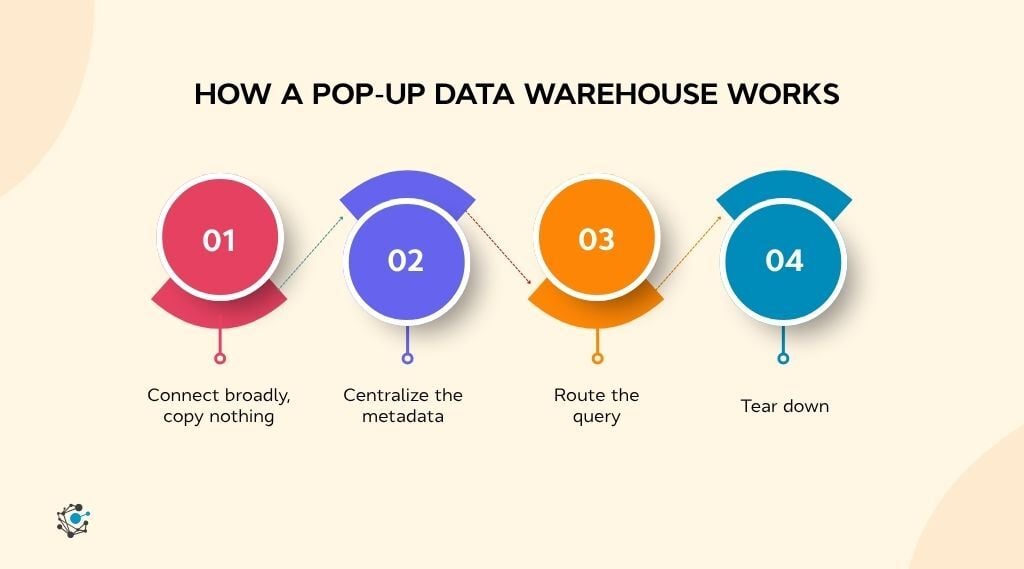
A pop-up data warehouse follows four core steps, from connecting distributed sources to releasing temporary compute once the analysis is complete.
1. Connect broadly, copy nothing
The platform connects to databases, software-as-a-service (SaaS) applications, files, documents, and streaming sources. The connection is lightweight because its purpose is to understand what data exists and how to reach it later, without copying the underlying data into a central repository.
2. Centralize the metadata
Instead of relocating data, the platform assembles everything that describes it in a central metadata layer, including:
-
Technical structure
-
Data lineage
-
Business definitions and classifications
-
Quality signals
-
Ownership
-
Permission rules
Keeping this layer current requires continuously refreshed metadata rather than periodic scans, because stale metadata can lead to incorrect routing and analysis.
3. Route the query
When someone submits a question, the platform determines where and how the required data should be processed.
Two paths are possible:
-
Data already in a warehouse: The query runs on the warehouse's existing compute, avoiding duplication and taking advantage of existing performance tuning.
-
Data distributed across systems: The platform retrieves only the required slices, places them in a temporary cache, and processes them using short-lived compute.
This routing step is where the architecture earns its name. Compute and temporary storage are created specifically for the workload rather than maintained as permanent infrastructure.
4. Tear down
Once the answer is delivered, the temporary environment is released. Temporary data and compute do not remain as permanent infrastructure, reducing storage overhead and ongoing maintenance for one-time workloads.
Pro tip: A pop-up analytics engine can automate this process across warehouses, lakehouses, relational databases, enterprise applications, files, and APIs. It uses centralized metadata to locate and govern the required data, retrieves only the necessary slices, and processes them without creating permanent copies or duplicate pipelines.
The routing step is often the hardest part to implement. Querying systems that were never designed to work together introduces challenges around access, schema differences, performance, and governance.
A metadata-driven approach provides the context needed to determine what data to retrieve, where to process it, and which policies must apply before the query runs.
Why the pop-up model became viable now
This architecture would have been difficult to make practical a decade ago. Retrieving data on demand introduced enough latency to slow interactive analysis, while the tooling needed to generate query logic automatically was still limited.
Four technology shifts changed the equation:
-
Faster network throughput: Moving a working slice of data across systems became fast enough for interactive analytics rather than batch processing.
-
Elastic cloud compute: Cloud platforms can provision and release compute in seconds, making temporary infrastructure practical for individual workloads.
-
In-memory query engines: Modern engines can process raw and semi-structured data quickly, reducing dependence on permanently pre-modelled tables.
-
Generative AI: When grounded in rich metadata, AI can generate the SQL and API calls required for an analysis using available definitions, lineage, quality signals, and other context.
The last shift introduces an important dependency: AI-generated query logic is only as reliable as the metadata and lineage behind it. Lineage inferred from query logs can miss relationships or transformations that are not visible at runtime.
Source Code Intelligence addresses this by parsing SQL, extract-transform-load (ETL) jobs, business intelligence (BI) reports, notebooks, stored procedures, and semantic models to derive column-level relationships directly from the underlying transformation logic.
This gives the metadata layer more precise context for determining where data came from and how it has changed before AI-generated queries use it.
What a pop-up data warehouse costs compared with a permanent one
The cost difference comes down to what you pay for: permanent capacity or actual usage.
A permanent data warehouse typically carries four ongoing costs:
-
Storage for data regardless of how often it is queried
-
Compute for recurring workloads
-
Engineering to build and maintain data pipelines
-
Data duplication across warehouses and source systems
A pop-up data warehouse shifts more of that spend to usage. Costs depend on how often queries run, how much data each query retrieves, and how much temporary compute it requires. Persistent storage is minimized, while one-off analyses can avoid the cost of building permanent pipelines.
The trade-off is frequency. A question asked once a quarter may be cheaper to handle with temporary retrieval and compute. A query that runs every morning is usually better suited to a permanent, modelled data structure because repeated retrieval and compute setup can outweigh the savings.
A practical rule is simple: use pop-up infrastructure for occasional and unpredictable questions, and move frequently repeated workloads into permanent models.
How governance travels with the query
Metadata-driven governance applies policies before data is retrieved. Classification identifies sensitive assets such as personally identifiable information (PII), protected health information (PHI), and payment card data and determines which handling rules apply.
Access policies are then checked at the metadata layer. If a user does not have permission to access specific data, the query does not proceed to retrieval. Users can still discover tables, definitions, and lineage without viewing restricted values.
For restricted data, approval workflows route access requests through defined processes and record each decision. This creates an audit trail covering who requested the data, what was approved, and how access was granted.
At enterprise scale, automation becomes important because manually classifying and governing data across hundreds of systems is difficult to maintain. AI-powered classification can identify sensitive data, while column-level and row-level policies control what each user or workload can access.
Did you know? Governance agents can automate governance activities across connected systems. Sift applies sensitive-data classifications, while Notary evaluates assets against quality, lineage, documentation, and ownership standards before recommending them for certification.
Where a pop-up data warehouse is the wrong choice
The honest limitations are worth stating, because the failures are predictable.
-
Questions asked on a schedule. Anything running daily or hourly should be modelled once and served from a permanent table. Repeated retrieval is the expensive path.
-
Deep historical analysis. Trend work spanning several years of granular history involves pulling volumes that make temporary retrieval slow and costly compared with a table built for the purpose.
-
Strict data residency rules. Where regulation forbids data crossing a regional boundary even transiently, the retrieval step needs architectural exceptions that can erase the simplicity advantage.
-
Reproducible frozen snapshots. Audit submissions and model training sets need a fixed, versioned copy that can be re-examined months later. A temporary environment by definition does not preserve one.
None of this argues against the model. It argues for pairing it with a permanent enterprise data warehouse that handles steady-state reporting while the pop-up layer absorbs everything unpredictable.
What AI agents need from a pop-up architecture
AI agents do not need access to entire datasets. They need context: what data exists, what business terms mean, who owns the data, whether it can be trusted, and what they are allowed to access. A pop-up architecture provides this through its centralized metadata layer.
This context needs to be governed before retrieval. If two teams define revenue differently, an agent can retrieve both definitions and produce an inconsistent answer. Clear business definitions, lineage, quality signals, and access policies help the agent identify the right data before querying it.
An enterprise context graph can provide this foundation by connecting glossary terms, lineage, ownership, quality, and policies. The pop-up architecture can use this governed context to determine which data an agent should access and how it should be handled.
When an agent receives a question, the pop-up architecture identifies trusted sources, checks permissions, retrieves only the required data, and provisions temporary compute. A natural-language interface such as AskEdgi can then turn cross-system queries into answers grounded in governed, certified sources.
How to evaluate and implement a pop-up analytics platform
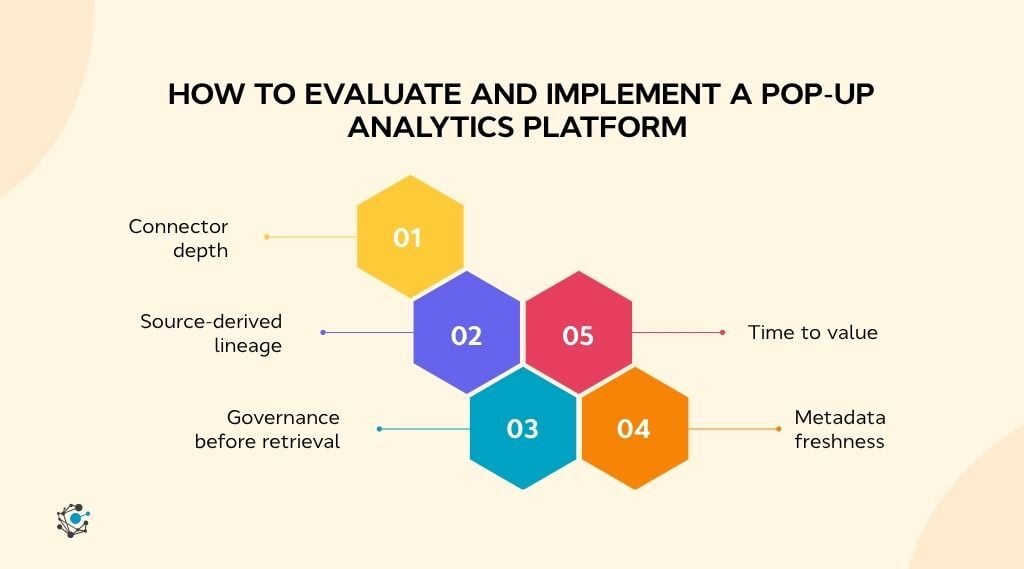
A practical pop-up analytics platform should meet five core criteria:
-
Connector depth: Support both modern and legacy data systems.
-
Source-derived lineage: Build lineage from actual transformation logic rather than relying only on query logs.
-
Governance before retrieval: Apply permissions and policies before data moves.
-
Metadata freshness: Continuously reflect changes in sources, definitions, and policies.
-
Time to value: Deliver useful analytics without a long implementation cycle.
Implementation can follow three stages: crawl, curate, and consume. Crawl connects data, reports, code, and metadata; curate adds business context and governance; consume makes governed data available for discovery, analytics, and AI.
Platforms such as OvalEdge support this model with 170+ pre-built connectors across modern and legacy systems, helping organizations establish the metadata foundation needed for cross-system analytics.
The key evaluation question is where control sits. Warehouse-first platforms centralize data, while metadata-first platforms centralize the context needed to find, govern, and retrieve data on demand.
The three phases of data architecture that led here
Data architecture has evolved through three major phases, each reducing how much data needs to be moved, stored, and maintained before it can deliver value.
1. Phase one unified compute, storage, and data
Large clusters and monolithic warehouses put everything in one place. This provided centralized processing power but required organizations to move data into a single system before it could be used.
2. Phase two separated storage from compute
Cloud warehouses introduced elastic compute and more flexible storage, while data catalogs created a dedicated layer for metadata and governance. However, data still typically had to be centralized before analysis.
3. Phase three centralizes metadata alone
Data can remain in source systems while metadata provides the context needed to discover, govern, and access it. Retrieval and compute happen on demand and last only as long as the workload requires.
The progression is straightforward: centralize everything, separate compute from storage, then centralize metadata while accessing data only when needed.
Conclusion
A pop-up data warehouse gives data teams another way to handle analytics without turning every new question into a permanent pipeline. Existing warehouses can continue supporting recurring, modelled workloads, while temporary infrastructure handles ad hoc analysis and short-lived requirements.
The model depends on a reliable metadata foundation. Teams need accurate information about what data exists, what it means, where it came from, who can access it, and whether it can be trusted. With that foundation in place, governance can guide retrieval while compute and data movement happen only when required.
OvalEdge brings metadata, lineage, governance, quality, and business context together to support governed analytics across existing warehouses, business applications, and legacy systems.
Book a demo with OvalEdge to see how pop-up analytics can work across enterprise data without centralizing it first.
.png?width=1081&height=173&name=Forrester%201%20(1).png)
.png?width=1081&height=241&name=KC%20-%20Logo%201%20(1).png)