-Dec-30-2025-07-53-33-2507-AM.png)
Data products transform raw data into reusable, trusted assets that drive faster, standardized decisions, support AI, and improve operations. Examples include dashboards, APIs, ML models, and automated pipelines. They ensure clear ownership, governance, and quality, reduce redundant work, and integrate insights directly into workflows, enabling scalable, actionable data across teams.
Reports pile up, dashboards tell different stories, and decisions slow down because no one knows which numbers to trust.
This is exactly why businesses are searching for data products examples: real-world ways data becomes reliable, reusable, and decision-ready.
This urgency is also reflected in where organizations are investing.
Gartner forecasted worldwide AI spending to reach $1.5 trillion in 2025, much of it tied to data foundations and AI-enabled products that depend on reliable, reusable data assets.
Data products change how organizations use data. Instead of one-off reports, teams build analytics products, real-time data products, and AI-driven solutions that deliver insights directly into workflows.
These data-driven products power executive decisions, operational alerts, and customer-facing experiences.
In this guide, we’ll explore practical data product use cases, break down the main types of data products, and explain how modern teams develop and choose the right data product for their organization.
What is a Data Product?
A data product is essentially any data-driven output created to provide value to users, teams, or systems.
Unlike raw datasets, a data product is structured, curated, and packaged in a directly usable way.
Examples include dashboards, reports, APIs, machine learning models, and automated pipelines.
These products focus on usability, accuracy, and reliability, ensuring that stakeholders can make informed decisions quickly.
They often include documentation, metadata, and governance measures, making them repeatable, scalable, and trustworthy across the organization.
In short, a data product turns raw data into a ready-to-use, actionable asset rather than just a collection of numbers.
Data Products vs. Data-as-a-Product
A data product is a tangible output created from data that provides actionable insights or functionality, such as dashboards, APIs, ML models, or reports.
Data-as-a-Product (DaaP) is a broader approach or mindset that treats data itself as a product, emphasizing governance, quality, discoverability, ownership, and reusability.
While a data product is the specific deliverable, DaaP is the framework and standards that ensure data products are reliable, scalable, and valuable across the organization.
Data products examples: Why do they matter?
Data products examples show how businesses turn raw data into reusable, governed assets that deliver measurable value. Common examples include analytics dashboards, data APIs, machine learning models, real-time metrics, and automated pipelines.
Teams build data products for decision-making, operations, and customer experiences. Each data product has clear ownership, documentation, and quality standards. These real-world examples help organizations scale analytics, support AI use cases, and treat data as a product rather than a static report.
Data products matter because they change how teams actually use data day-to-day.
Instead of rebuilding the same analysis in different tools, organizations package trusted data, logic, and metrics into reusable analytics products. Teams spend less time validating numbers and more time acting on them. Decisions move faster because everyone works from the same source of truth.
Data products also unlock scale without chaos. They make it possible to support self-service analytics while keeping quality and governance intact. When done well, data products help businesses.
-
Turn raw data into actionable insights that teams can trust
-
Standardize metrics and business logic across departments
-
Reduce manual reporting and repeated analysis work
-
Deliver insights directly into workflows, not just dashboards
-
Align technical teams and business users around shared outcomes
As data-driven business products, data products don’t just inform decisions; they support how work gets done. That’s what makes them foundational for modern analytics, operations, and customer experiences.
|
Did you know? This shift is already visible across data leadership teams. In higher-maturity organizations, 56% list the development of data products as a top priority, alongside AI and advanced analytics initiatives. |
Types of data products with real-world examples
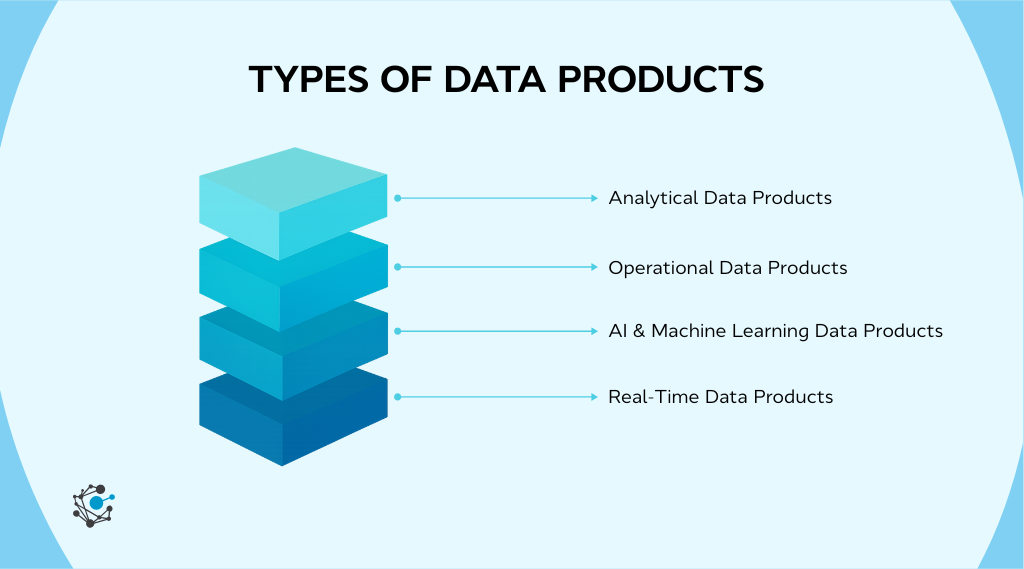
Not all data products serve the same purpose. Some help leaders understand performance, others guide day-to-day operations, and some automate decisions entirely. Understanding the different types of data products makes it easier to match the right solution to your business goals, data maturity, and use cases.
Below are the most common types of data products organizations rely on today, along with real-world examples of how they’re used.
1. Analytical data products
Analytical data products focus on generating insights, tracking performance, and identifying trends over time.
They sit on top of data warehouses and data lakes, providing consistent, trusted metrics for teams and stakeholders.
These products help answer strategic and tactical questions, measure outcomes, and inform planning and forecasting.
|
A common example is an executive KPI dashboard that standardizes revenue, customer growth, and operational metrics across the organization. Marketing attribution models and customer segmentation analytics products also fall into this category, helping teams understand which channels perform best and how different customer groups behave. |
They are essential because they transform raw data into reusable, governed assets that can be queried repeatedly without re-engineering.
This improves data quality, usability and reduces redundant effort by data teams.
Example use cases
a. Executive KPI dashboards standardize revenue, customer growth, and operational metrics across the organization.b. Marketing attribution models to understand which channels perform best.
c. Customer segmentation analytics to study behavior across groups.
Analytical data products provide a foundation for trustworthy reporting, but their value is maximized when combined with operational data products that enable timely, actionable insights.
2. Operational data products
Operational data products bring data directly into business workflows, delivering real-time signals that guide decisions in the moment. Instead of analyzing reports after the fact, teams can act immediately, improving responsiveness and execution.
|
Retail and supply chain teams often rely on inventory replenishment alerts driven by demand and stock levels. Sales and customer success teams use CRM-embedded performance metrics or SLA breach notifications to stay ahead of issues. In these cases, data products guide daily decisions without requiring manual analysis. |
They are essential because they embed trusted data into day-to-day operations, reduce manual monitoring, and help teams focus on action rather than reporting.
Example use cases
a. Inventory replenishment alerts in retail and supply chain based on demand and stock levels.
b. CRM-embedded performance metrics and SLA breach notifications for sales and customer success teams.
c. Automated alerts for production, operations, or service performance to prevent downtime or bottlenecks.
Operational data products complement analytical products by turning insights into timely, actionable outcomes across the organization.
3. AI & machine learning data products
AI and machine learning data products automate predictions, recommendations, and decision-making at scale. They go beyond generating insights, directly influencing actions across business processes. These products continuously learn from new data, improving over time, and enabling organizations to anticipate trends, personalize experiences, and optimize operations.
|
Examples include demand forecasting systems used in retail and manufacturing, recommendation engines that personalize digital experiences, and predictive maintenance products that anticipate equipment failures before they happen. These data products continuously learn from new data and improve over time. |
At the same time, results aren’t guaranteed. Research shows that 74% of companies still struggle to generate tangible value from AI, often because data foundations, ownership, and productization aren’t mature enough.
Because they influence automated decisions, these data product examples require strong data foundations, clear ownership, and ongoing monitoring to remain accurate and trustworthy.
Example use cases
a. Demand forecasting systems in retail and manufacturing to optimize inventory and production.
b. Recommendation engines for e-commerce and digital platforms to personalize user experiences.
c. Predictive maintenance products in industrial settings to anticipate equipment failures before they occur.
AI & machine learning data products complement analytical and operational products by enabling automated, intelligent, and adaptive business processes across the organization.
4. Real-time data products
Real-time data products deliver insights as events occur. They support use cases where even small delays can reduce value or increase risk.
|
Fraud detection alerts flag suspicious transactions instantly. Live customer behavior tracking helps digital businesses personalize experiences during active sessions. IoT monitoring dashboards provide immediate visibility into equipment health and environmental conditions |
Real-time data products depend on streaming data pipelines, automated processing, and strong quality controls to ensure insights remain accurate under constant change.
|
Also read: Data products need strong governance and clear ownership to be effective. For practical guidelines on how to establish this, download our How to Implement Data Governance whitepaper. |
Example use cases
a. Fraud detection alerts that flag suspicious transactions instantly.
b. Live customer behavior tracking for digital businesses to personalize experiences during active sessions.
c. IoT monitoring dashboards provide immediate visibility into equipment health and environmental conditions.
Real-time data products complement analytical, operational, and AI/ML products by enabling immediate, event-driven actions that prevent losses, optimize experiences, and reduce operational risk.
How data products are developed (from raw data to value)?
.png?width=1024&height=569&name=How%20data%20products%20are%20developed%20(from%20raw%20data%20to%20value).png)
What separates successful data products from one-off analyses is a clear development approach that starts with a business need and ends with measurable value.
Teams that get this right treat data product development as an ongoing process, not a one-time project. The focus stays on outcomes, usability, and adoption, not just data movement.
1. Data product development lifecycle
Most data products follow a simple but disciplined lifecycle. It begins with identifying a specific business problem worth solving.
From there, teams discover and source the right data, then model and transform it into formats that are easy to use and understand.
Once the data is ready, teams productize it through dashboards, APIs, or embedded applications.
The final step is adoption and measurement. Teams track usage, gather feedback, and refine the product over time to ensure it continues to deliver value as needs change.
This lifecycle helps keep data products aligned with real business goals instead of becoming unused assets.
2. Key components of a scalable data product
Scalable data products share a few essential building blocks that make them reliable and reusable across teams. These components help ensure trust as usage grows.
a. Trusted, well-defined data sources that teams agree on
b. Metadata and documentation that explain meaning, context, and usage
c. Standardized business logic and metrics to avoid conflicting definitions
d. Clear consumption layers, such as dashboards or APIs, for easy access
e. Quality, security, and governance controls to protect data and users
Together, these elements turn raw data into data-driven products that teams can confidently rely on.
3. Data product ownership & governance models
Ownership plays a critical role in whether data products succeed or fail.
Domain-driven ownership assigns responsibility to the teams closest to the business context, making it easier to maintain relevance and quality over time.
Governance works best when it enables progress instead of blocking it.
Clear ownership, defined SLAs, access policies, and documentation create consistency without slowing teams down.
When governance supports collaboration and accountability, data products become trusted assets rather than bottlenecks.
|
Stat: A McKinsey survey on the state of AI shows that 39% of companies already report enterprise-level financial impact from AI, underscoring how critical strong data products are to turning insights into outcomes. |
How to choose the right data product for your organization?
Choosing the right data product isn’t about picking the most advanced solution. It’s about selecting something your organization is actually ready to use and scale.
The wrong choice often leads to low adoption, duplicated effort, and data products that look good on paper but deliver little value in practice.
A good starting point is understanding your current readiness. Before investing time or resources, teams should be clear on a few fundamentals:
a. Do you have reliable and accessible data for the problem you want to solve?
b. Are key metrics and definitions already aligned across teams?
c. Is there clear ownership for maintaining quality and documentation?
d. Does the use case tie directly to a business outcome people care about?
Answering these questions helps narrow the type of data product that makes sense right now, whether that’s a simple analytical product or something more operational or real-time.
The next decision is how to build it. Some organizations choose to build custom data products when differentiation or complexity is high.
Others buy pre-built analytics products to move faster and reduce internal effort. Many teams take a middle path and compose data products using platforms that support discovery, governance, and reuse.
Platforms like OvalEdge support this approach by helping teams discover trusted data, understand ownership, and deliver governed data products without starting from scratch each time.
This balance between speed and control often leads to better adoption and long-term value.
If you’re exploring how to scale data products without adding complexity, booking a quick demo can help you see how this approach works in practice.
Conclusion
Most data initiatives fail because insights never make it far enough to change how teams work.
When data stays trapped in reports or disconnected tools, even the best analytics lose momentum.
The next step isn’t building more dashboards; it’s turning data into products that teams can trust, reuse, and act on every day.
This is where platforms like OvalEdge come in. When teams work with OvalEdge, the focus starts with understanding existing data, ownership, and use cases.
From there, teams gain visibility into trusted data assets, clarify accountability, and create governed data products that scale across the organization.
The goal isn’t to replace your tools, but to help your data products actually get used.
If you’re ready to move from scattered insights to data products that drive real decisions, the best next step is a conversation. Schedule a call with OvalEdge to explore how your data can become a reliable foundation for action without adding complexity.
FAQs
1. How are data products different from dashboards or reports?
Data products go beyond static reporting by offering reusable, governed, and continuously updated data assets. They are designed for long-term consumption, automation, and integration into business workflows rather than one-time analysis.
2. Who typically uses data products inside an organization?
Data products are consumed by business users, analysts, data scientists, and applications. Depending on the use case, they support decision-making, operational automation, or embedded analytics without requiring users to access raw data directly.
3. What skills are required to build and manage data products?
Building data products requires a mix of data engineering, analytics, domain expertise, and governance skills. Product thinking, stakeholder collaboration, and an understanding of business metrics are equally important for long-term success.
4. Can data products be reused across multiple teams?
Yes, well-designed data products are reusable by default. When properly documented, governed, and standardized, the same data product can support multiple teams, use cases, and analytical needs without duplication of effort.
5. How do organizations measure the success of a data product?
Success is measured using adoption rates, data quality metrics, business impact, and user satisfaction. Monitoring how frequently a data product is used and whether it improves outcomes helps determine its long-term value.
6. Are data products suitable for small or mid-sized organizations?
Data products are not limited to large enterprises. Small and mid-sized organizations can start with focused, high-impact data products to improve decision-making, scale analytics capabilities, and reduce reliance on ad-hoc reporting.
.png?width=1081&height=173&name=Forrester%201%20(1).png)
.png?width=1081&height=241&name=KC%20-%20Logo%201%20(1).png)