-2.png)
Most organizations don’t realize they have a data visibility problem until someone asks a simple question they can’t answer: where exactly does our data live? When systems multiply and ownership blurs, compliance checks, audits, and governance decisions slow to a crawl.
A data inventory fixes this by creating a clear, structured view of all data assets across systems, teams, and platforms. It documents what data exists, where it resides, how it is used, and who is accountable for it. For organizations facing growing compliance, privacy, and governance demands, this visibility is no longer optional.
Even inside the same company, data visibility looks very different depending on who you ask.
In a Capgemini survey, 71% of data executives felt confident about their data inventory visibility, but only 45% of business executives said the same.
In this guide, we’ll explain what a data inventory is, why it matters for compliance and governance, and how to build one step by step. You’ll also learn what to look for in data inventory platforms and the best practices that help organizations keep their inventories accurate, scalable, and useful over time.
What is data inventory?
A data inventory is a centralized record of all organizational data assets across systems, sources, and formats. It identifies where data lives, what it contains, who owns it, and how it is used. A data inventory supports compliance, governance, and security by documenting metadata, classification, and sensitivity. Organizations use data inventories to improve visibility, reduce risk, enable audits, and manage data accurately and consistently.
Beyond the definition, a data inventory acts as the foundation for understanding your entire data landscape. It brings together information that is often scattered across teams, tools, and documentation, creating a consistent view that everyone can rely on. This becomes especially important as organizations manage both structured and unstructured data across cloud platforms, SaaS applications, and legacy systems.
To be effective, a data inventory goes deeper than a simple list of datasets. It captures the context needed to make data usable and governable across the organization. This typically includes:
-
Data assets such as databases, files, tables, and reports
-
Source systems and storage locations
-
Business and technical metadata that explains purpose and structure
-
Ownership and stewardship assignments
-
Classification and sensitivity context
-
Usage, access details, and data lineage
Why data inventory matters for compliance and governance
Data inventory brings much-needed clarity to complex data environments. When teams share a consistent view of where data lives and how it is used, compliance and governance stop feeling reactive and start becoming manageable.
At a practical level, a data inventory helps organizations:
-
Gain visibility into data spread across systems, applications, and platforms
-
Eliminate blind spots that often lead to compliance gaps or security risks
That risk is not hypothetical.
A 2024 privacy governance survey found that 49% of respondents worked at organizations that experienced a data breach in the last year, which is exactly why unknown data locations become a serious liability
Ownership is another critical factor. Assigning clear owners and stewards ensures accountability does not disappear when questions arise. Data quality, access decisions, and usage reviews become part of regular operations instead of last-minute escalations.
From a compliance perspective, a data inventory reduces risk by making sensitive data easier to identify and manage. Regulations depend on knowing where personal and regulated data exists and how it flows through systems. A well-maintained inventory supports faster audits, more accurate reporting, and fewer surprises.
Governance becomes practical when everyone works from the same source of truth. Policies, controls, and oversight processes align to a consistent set of data assets, helping organizations shift from reactive problem-solving to proactive data control.
|
Did you know? In ISACA’s 2025 survey, 63% of privacy professionals said their job is more stressful than five years ago, driven by fast-changing technology, compliance demands, and resource shortages. |
Core components of an effective data inventory
A data inventory is only as useful as the information it captures. To support governance, compliance, and day-to-day decision making, it needs to go beyond a simple list of datasets and include the right context around each data asset.
The following components form the backbone of an effective and reliable data inventory.
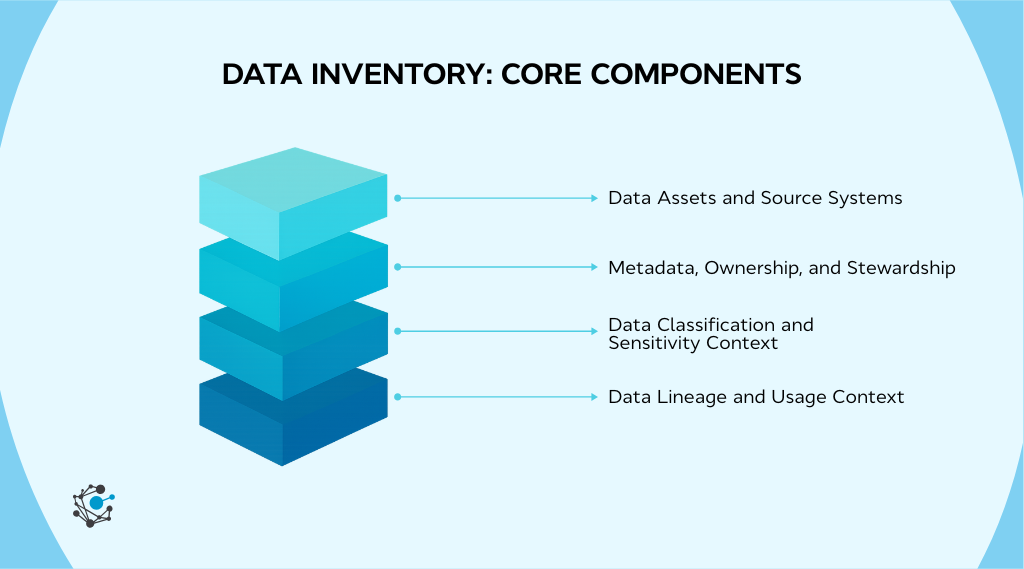
1. Data assets and source systems
At its core, a data inventory catalogs all relevant data assets across the organization. This includes operational databases, data warehouses, cloud storage, SaaS platforms, and shared file systems. Each asset is linked back to its source system, creating a clear and navigable map of where data originates and where it is stored.
Without this level of coverage, sensitive or critical data often goes unnoticed. A comprehensive view helps teams uncover hidden data stores, reduce blind spots, and understand the true scope of their data environment.
2. Metadata, ownership, and stewardship
Metadata gives data its meaning. Details such as field definitions, formats, refresh frequency, and business purpose help users understand what the data represents and how it should be used. Without this context, even accurate data can be misunderstood or misused.
Ownership and stewardship turn documentation into accountability. Assigning clear owners ensures someone is responsible for data quality, access decisions, and ongoing maintenance. Stewards help enforce standards and keep information accurate as systems and use cases evolve.
3. Data classification and sensitivity context
Classification adds an essential layer of context to a data inventory. Tagging data as personal, financial, confidential, or public helps teams apply the right governance and security controls without overcomplicating the process.
Sensitivity context also helps prioritize effort. Instead of treating all data the same, governance teams can focus on assets that carry higher privacy, regulatory, or business risk.
4. Data lineage and usage context
Data lineage explains how data flows from source systems to reports, dashboards, and downstream applications. This visibility makes it easier to trace issues back to their origin and understand the impact of changes.
Usage context complements lineage by showing who accesses data and for what purpose. Together, they build trust in the data and support better decision-making by making data movement and consumption transparent.
|
Also read: Data Products Examples for Analytics, AI & Operations |
How to create a data inventory: A step-by-step guide
Building a data inventory does not have to be overwhelming. When broken into clear, manageable steps, it becomes a practical process that teams can implement and improve over time rather than a one-time documentation exercise.
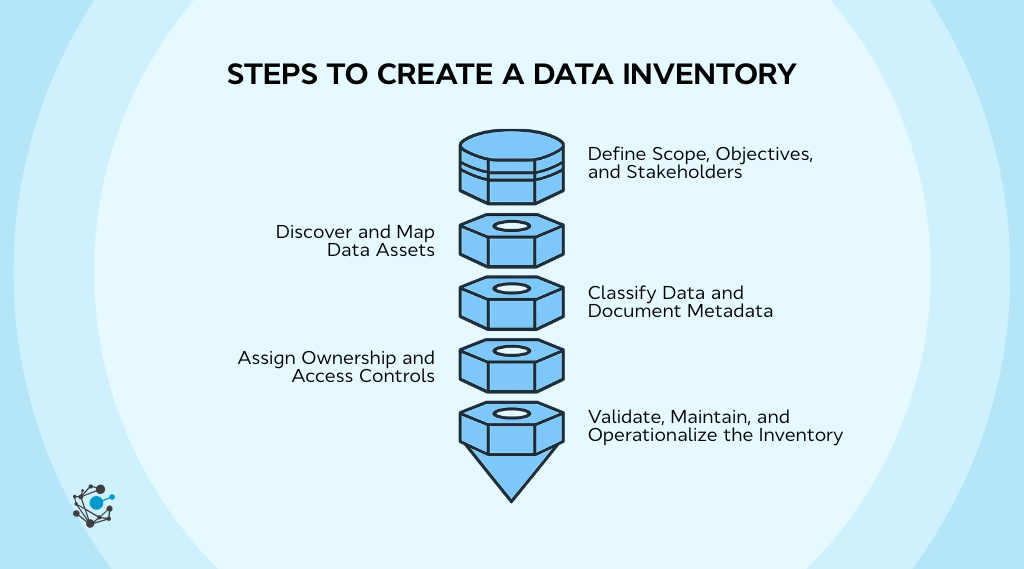
Step 1: Define scope, objectives, and stakeholders
Start by deciding what you want to inventory and why. Some organizations begin with a specific department or business function, while others focus on regulated data or high-impact systems. Clear objectives help keep the effort focused and prevent scope from expanding too quickly.
Stakeholder alignment is just as important. Involving data owners, IT, security, and compliance teams early ensures shared expectations and reduces rework later in the process.
Step 2: Discover and map data assets
Discovery helps uncover where data actually exists across the organization. This includes databases, files, dashboards, cloud storage, and third-party platforms. Many teams are surprised by how much data they uncover once they start looking.
It’s also why discovery and inventory work is getting more budget attention.
A 2024 Forrester survey noted that 69% of data and analytics decision-makers planned to increase spending across data and data management-related initiatives
Data mapping adds structure by connecting assets to systems, processes, and downstream usage. This step creates the foundation for understanding how data moves and where dependencies exist.
Step 3: Classify data and document metadata
Once assets are identified, classification and metadata bring order to the inventory. Documenting details such as asset name, system, owner, data type, sensitivity, and usage purpose turns raw discovery into usable information.
This structure makes it easier to apply governance rules, answer compliance questions, and support day-to-day data use.
Step 4: Assign ownership and access controls
Ownership transforms documentation into accountability. Assigning clear owners ensures someone is responsible for data quality, access decisions, and ongoing maintenance.
Access controls align data usage with internal policies. Together, ownership and access management help governance operate consistently instead of relying on informal processes.
Step 5: Validate, maintain, and operationalize the inventory
A data inventory is a living asset. Systems change, data evolves, and new use cases emerge. Regular validation helps keep information accurate and trustworthy.
Operationalizing the inventory means embedding it into audits, access reviews, and governance workflows. When teams rely on it daily, the inventory stays current and delivers long-term value.
|
Quick Tip: Starting with a Data Inventory Template Many teams begin their data inventory using a simple data inventory template before moving to automated tools. A template helps standardize what you capture early on, such as asset name, system, owner, data type, and sensitivity. While templates work well for initial scoping or smaller environments, they become harder to maintain as data grows, which is why many organizations later transition to data inventory software. |
Data inventory tools and software options
As data environments grow more complex, the way organizations manage their data inventory starts to matter just as much as the inventory itself. Choosing the right approach and tools can mean the difference between a living system that teams trust and documentation that quickly becomes outdated.
Manual vs automated data inventory approaches
Many organizations start with manual methods before realizing their limitations. Understanding the trade-offs helps teams choose an approach that fits their scale and maturity.
|
Approach |
How it works |
Where it fits best |
|
Manual data inventory |
Uses spreadsheets, documents, and interviews to capture data details |
Small environments, early-stage efforts, or short-term assessments |
|
Automated data inventory |
Uses discovery, metadata harvesting, and lineage tracking to maintain inventories |
Growing organizations with complex, changing data landscapes |
This is why many teams move beyond spreadsheets once scale hits. A 2025 Forrester study on a modern data governance platform reported a 355% ROI over three years with a payback period of under six months.
Manual approaches can work when data volumes are low and systems are stable. As environments expand, keeping spreadsheets accurate becomes time-consuming and error-prone. Automated tools reduce this burden by continuously discovering and updating data assets as systems change.
Key features to look for in data inventory software
Not all data inventory software delivers the same value. The most effective tools focus on accuracy, scalability, and long-term usability rather than just feature count.
Key capabilities to look for include:
-
Automated discovery across databases, files, cloud platforms, and SaaS tools
-
Metadata capture that combines technical details with business context
-
Data classification and sensitivity tagging
-
Data lineage to track how data flows across systems
-
Reporting and dashboards to support audits and governance reviews
-
Integration with governance, security, and analytics platforms
Platforms like OvalEdge bring these capabilities together in a unified way. While primarily a data catalog platform, OvalEdge integrates discovery, metadata management, and governance workflows, helping organizations streamline data management and ensuring accuracy across their data assets.
Relationship between data inventory, data catalogs, and metadata repositories
These concepts are closely related but serve different purposes. A data inventory focuses on understanding what data exists and where it resides. A data catalog builds on that foundation by making data easier to find and use for analytics and business insights. A metadata repository stores the technical and business definitions that keep everything consistent.
Together, they form a connected governance ecosystem. The data inventory establishes visibility, the catalog enables consumption, and the metadata repository ensures shared understanding across teams.
Data inventory best practices for long-term success
Building a data inventory is an important milestone, but keeping it useful over time is where most organizations struggle. Long-term success depends on treating data inventory as an ongoing capability that evolves with your data environment, rather than as a one-time project.
The following best practices help ensure your data inventory stays accurate, relevant, and trusted:
-
Align data inventory with governance programs so policies, controls, and standards are grounded in a shared view of data assets
-
Establish clear ownership and accountability to ensure data quality, access decisions, and updates do not fall through the cracks
-
Define processes to keep the inventory current as systems, data sources, and use cases change
-
Leverage automation wherever possible to reduce manual effort and improve consistency
-
Set and maintain a clear scope to avoid inventory sprawl and unnecessary complexity
-
Avoid static documentation that quickly becomes outdated and loses credibility
When these practices are in place, a data inventory becomes part of daily operations rather than a forgotten artifact. That foundation sets the stage for stronger governance, smoother compliance efforts, and better decision-making across the organization.
|
Also read: Data Lineage Best Practices for 2026: Ensure Accuracy & Compliance |
Conclusion
Knowing you have a data problem is one thing, but knowing exactly where your data lives, who owns it, and how it is used is what actually changes outcomes. Without that clarity, governance efforts stall, compliance feels reactive, and risk quietly grows in the background.
The next step starts by operationalizing your data inventory so it stays accurate, connected to governance processes, and usable across teams. This is where many organizations struggle, not because they lack intent, but because manual approaches do not scale.
When you engage with OvalEdge, the focus shifts from theory to execution. As a data catalog platform, OvalEdge helps you discover, organize, and govern data across systems, capture meaningful metadata, assign ownership, and embed workflows into your data management strategy. Instead of managing data in silos, you gain a dynamic, scalable system that evolves with your organization.
If you are ready to move from fragmented visibility to confident control, schedule a call with OvalEdge today and see how a comprehensive data catalog can support your governance, compliance, and security goals.
FAQs
1. How often should a data inventory be updated?
A data inventory should be reviewed regularly, typically quarterly or after major system changes. Frequent updates help organizations keep pace with new data sources, evolving usage patterns, and changing ownership responsibilities.
2. Who is responsible for maintaining a data inventory?
Responsibility is usually shared between data owners, stewards, and governance teams. Clear accountability ensures updates are completed consistently, and data assets remain accurate, trusted, and aligned with organizational policies.
3. Can small organizations benefit from a data inventory?
Yes. Smaller organizations gain early visibility into their data assets, reduce operational confusion, and establish governance foundations that scale easily as systems, tools, and regulatory expectations grow over time.
4. What is the difference between a data inventory and data mapping?
A data inventory focuses on cataloging and documenting data assets, while data mapping emphasizes how data flows between systems. Both complement each other, but they serve different governance and operational purposes.
5. Is a data inventory required before implementing data governance?
While not mandatory, a data inventory provides essential visibility that makes governance programs more effective. It helps define ownership, prioritize controls, and establish a reliable baseline for governance activities.
6. How long does it take to build a data inventory?
Timelines vary based on scope and tooling. Initial inventories can take weeks, while broader enterprise efforts may take months. Starting small and expanding incrementally helps teams deliver value faster.
.png?width=1081&height=173&name=Forrester%201%20(1).png)
.png?width=1081&height=241&name=KC%20-%20Logo%201%20(1).png)