.png)
Healthcare teams rarely question the importance of patient data until something goes wrong. A patient arrives at the emergency department with chest pain. The physician opens the EHR and finds duplicate patient records.
One profile includes allergy information while another does not. Recent lab results are missing because systems failed to synchronize correctly. Nurses spend valuable time verifying records instead of focusing on care.
These issues are more common than many healthcare leaders realize.
A 2022 study published in JAMA Network Open found that over 50% of words in electronic medical records were duplicated from previous notes rather than newly documented information.
Poor healthcare data quality creates operational inefficiencies and can directly affect patient safety, clinical decisions, care coordination, and treatment outcomes.
This guide explains how healthcare organizations can improve EHR data quality through governance, interoperability standards, and structured data management practices.
What is data quality in healthcare?
Healthcare data quality refers to the accuracy, completeness, consistency, reliability, and usability of patient and clinical data across healthcare systems. Every healthcare organization depends on data to support patient care, billing, analytics, reporting, compliance, and operational decision-making.
Definition of healthcare data quality in EHR systems
Healthcare data quality in EHR systems means patient records remain accurate, complete, accessible, and usable throughout the care lifecycle.
This applies across:
-
EHR and EMR platforms
-
Laboratory and imaging systems
-
Claims and billing applications
-
External provider networks
-
Health information exchanges
Healthcare data quality now extends beyond structured EHR fields into unstructured clinical information such as physician notes, radiology reports, discharge summaries, and AI-consumed medical content. Structured data includes diagnoses, medications, allergies, and lab results, while unstructured data supports clinical context and decision-making.
Poor EHR data quality creates operational and clinical challenges. Missing medication histories, inconsistent coding, or incorrect demographic data can delay treatment, affect care coordination, increase claim denials, and reduce trust in analytics.
|
Do you know? A 2024 review published in JMIR Medical Informatics found that up to 30% of EHR data suffers from incompleteness or inconsistency, including missing medication histories, incorrect demographic information, and incomplete laboratory results. |
Key data quality dimensions for patient and clinical data
Healthcare organizations measure healthcare data quality across several core dimensions to ensure patient records remain reliable, usable, and consistent across clinical systems. These dimensions help healthcare teams identify risks that affect patient safety, interoperability, reporting accuracy, and operational efficiency.
|
Dimension |
Meaning in Healthcare |
Example |
|
Accuracy |
Data correctly reflects patient information |
Correct diagnoses, medications, and lab values |
|
Completeness |
Required patient information is available |
Missing allergies or incomplete lab results |
|
Consistency |
Data remains aligned across systems |
Matching records across EHR and billing systems |
|
Timeliness |
Data is available when needed |
Real-time lab updates and clinical alerts |
|
Uniqueness |
Each patient has a single record |
Elimination of duplicate patient profiles |
|
Validity |
Data follows standardized formats |
ICD-10, SNOMED CT, and LOINC standards |
As healthcare organizations expand interoperability and AI-driven analytics initiatives, maintaining these data quality dimensions becomes increasingly important.
|
Pro tip: Platforms such as OvalEdge help healthcare teams monitor data quality metrics, track lineage, enforce governance policies, and improve trust in patient and clinical data across systems. |
Why data quality is critical for population health and care delivery
Every clinical decision depends on trustworthy patient data. When records are incomplete, outdated, or inconsistent, clinicians may miss critical information during diagnosis, medication management, or care coordination.
Common healthcare data quality problems, such as duplicate records, missing lab results, or inconsistent coding, can quickly affect both patient care and operational efficiency.
Poor healthcare data quality can lead to:
-
Delayed or incorrect treatment decisions
-
Duplicate tests and unnecessary procedures
-
Gaps in care coordination between providers
-
Inaccurate reporting and compliance risks
-
Higher operational costs and administrative rework
The impact extends beyond individual patient care. Population health programs rely on accurate clinical data to identify high-risk groups, predict readmissions, monitor chronic conditions, and improve preventive care strategies.
Predictive analytics and AI models also depend on reliable patient data to generate meaningful insights and support better healthcare outcomes.
High-quality healthcare data ultimately improves clinical trust, strengthens care coordination, and enables more informed decision-making across the healthcare ecosystem.
Key data quality challenges in healthcare systems
Healthcare organizations manage patient data across multiple systems, departments, and external providers. As information moves between EHRs, laboratories, pharmacies, insurers, and analytics platforms, maintaining accurate and consistent healthcare data becomes increasingly challenging.
Duplicate patient records and master patient index issues
Duplicate patient records remain a persistent challenge across healthcare systems. Variations in patient names, incomplete demographic details, and inconsistent identifiers often create multiple profiles for the same individual.
These fragmented records make it difficult for care teams to maintain a unified patient history across systems. Master Patient Index (MPI) and master data management strategies help healthcare organizations improve patient identity consistency and reduce record fragmentation.
Incomplete and inconsistent EHR data across systems
Healthcare organizations frequently struggle with incomplete or inconsistent EHR data because documentation practices vary across departments and external providers.
Missing medication histories, incomplete laboratory data, and inconsistent demographic records reduce trust in analytics and reporting while increasing manual verification efforts for clinical teams.
Lack of standardization in clinical data and coding systems
Clinical data standardization remains a major obstacle for organizations managing data across multiple systems.
Different departments may use varying coding standards, abbreviations, or local terminology when documenting the same condition or procedure. Even with standards such as ICD-10, SNOMED CT, and LOINC, implementation often varies across workflows.
Without standardized clinical data, organizations face challenges in reporting, analytics, interoperability, and quality measurement initiatives.
Interoperability gaps between EHR and external systems
Interoperability challenges continue to affect how healthcare organizations exchange patient information across systems. Many environments still rely on legacy platforms, custom integrations, or manual transfer processes that were not designed for standardized, real-time data exchange.
As systems evolve independently, differences in data structures, update timing, and clinical terminology can create synchronization failures between applications. These integration gaps often expose underlying healthcare data quality issues, including duplicate patient identities, inconsistent coding standards, and conflicting clinical definitions.
|
For example, a patient discharged from one hospital may arrive at another care facility with an incomplete medication history because both systems exchange data differently. |
The result is a fragmented clinical context and additional administrative effort for healthcare teams.
Impact of poor data quality on healthcare operations and compliance
Poor healthcare data quality affects patient care, operational efficiency, compliance workflows, and financial performance. Even small inconsistencies in clinical data can increase administrative burden and reduce trust across healthcare systems.
-
Patient safety: Missing allergy histories, outdated medication records, or incomplete documentation can affect treatment decisions and increase clinical risk.
-
Operational inefficiencies: Duplicate registrations, repeated laboratory testing, manual claims corrections, and delayed reporting workflows increase administrative workload and reduce productivity.
-
Compliance risks: Regulations such as HIPAA, HITECH, and the 21st Century Cures Act require accurate and traceable patient information. Poor data quality increases the risk of reporting inaccuracies, audit failures, and incomplete documentation.
-
Financial impact: Incorrect coding and incomplete documentation often lead to denied claims, delayed reimbursements, and revenue leakage.
-
AI and analytics reliability: Predictive analytics, AI models, and population health initiatives depend on accurate and standardized healthcare data. Poor-quality data can weaken model accuracy, distort insights, and reduce trust in AI-driven clinical and operational decisions.
Reliable healthcare data quality is essential for improving patient care, operational efficiency, compliance readiness, and financial performance. Healthcare organizations increasingly rely on governance, data quality monitoring, and lineage visibility to build trust in clinical and operational data at scale.
Book a demo with OvalEdge to see how healthcare teams can reduce data inconsistencies, improve compliance readiness, and strengthen reporting accuracy.
Data standards and interoperability frameworks in healthcare
Healthcare data quality depends heavily on standardization.
Without shared frameworks and coding standards, healthcare organizations cannot reliably exchange or interpret patient information across systems.
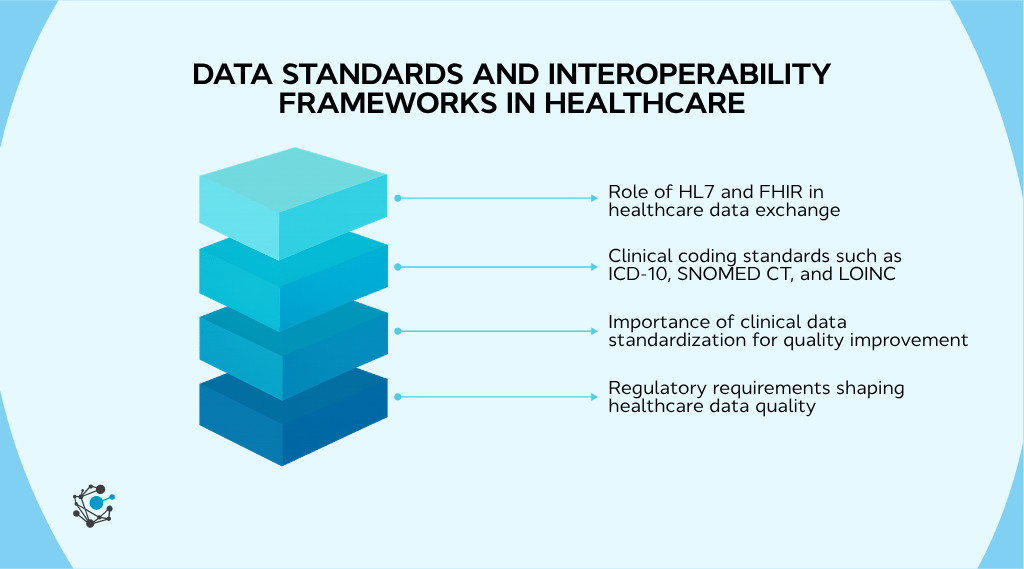
1. Role of HL7 and FHIR in healthcare data exchange
HL7 and FHIR are key interoperability standards that help healthcare systems exchange clinical data consistently across providers and applications.
|
Standard |
Primary Purpose |
Common Usage |
|
HL7 |
Structured healthcare messaging |
Legacy EHR and hospital system integrations |
|
FHIR |
API-based interoperability |
Patient portals, mobile apps, and modern healthcare platforms |
FHIR improves healthcare data quality by:
-
Reducing data transformation errors
-
Standardizing data structures
-
Improving real-time access to patient information
-
Supporting consistent interoperability workflows
Today, FHIR supports use cases such as care coordination, patient portals, population health analytics, and remote patient monitoring.
2. Clinical coding standards such as ICD-10, SNOMED CT, and LOINC
Clinical coding standards help healthcare organizations maintain consistent clinical documentation, reporting, and interoperability across systems.
-
ICD-10: Standardizes diagnoses and procedures for billing, reporting, and clinical documentation across healthcare organizations.
-
SNOMED CT: Provides detailed clinical terminology that supports more granular and standardized documentation across specialties and care settings.
-
LOINC: Standardizes laboratory and diagnostic data, enabling consistent exchange of test results between providers and healthcare systems.
Without standardized coding systems, organizations often experience inconsistent reporting, fragmented analytics, and interoperability challenges.
|
For example, the same diagnosis documented differently across systems can affect population health reporting and quality measurement initiatives. |
Strong data governance and metadata management practices help healthcare organizations maintain consistency across clinical data standards and reporting workflows.
3. Importance of clinical data standardization for quality improvement
Clinical data standardization helps healthcare organizations maintain consistency across systems, workflows, and reporting processes.
Standardized formats, definitions, and coding practices improve interoperability, strengthen reporting accuracy, reduce ambiguity in clinical interpretation, and support more reliable analytics and benchmarking initiatives.
Organizations with standardized clinical data are better equipped to support quality improvement programs, population health initiatives, and advanced analytics workflows.
4. Regulatory requirements shaping healthcare data quality
Healthcare regulations increasingly emphasize data accuracy, interoperability, privacy, and security across clinical systems.
Key regulations include:
-
HIPAA: Establishes standards for patient privacy and secure data handling
-
HITECH: Accelerated EHR adoption and strengthened data integrity expectations
-
21st Century Cures Act: Promotes interoperability and patient access to healthcare data
These regulations require healthcare organizations to maintain accurate records, secure interoperability workflows, traceable data changes, and audit-ready reporting processes. Poor healthcare data quality can increase both operational and compliance risks.
How to improve data quality in healthcare step by step
Improving healthcare data quality requires structured processes that combine governance, standardization, validation, and continuous monitoring across clinical systems.
Step 1: Identify critical patient and clinical data elements
Start by identifying high-priority data that directly affects patient care, compliance, and operations, such as patient demographics, diagnoses, medications, allergy histories, laboratory results, and insurance information.
This helps healthcare organizations focus improvement efforts on the most critical clinical and operational workflows.
Step 2: Implement the master patient index and deduplication
Use a Master Patient Index (MPI) and MDM solutions to unify patient identities across systems and reduce duplicate records.
For example, a patient registered differently across emergency, laboratory, and billing systems can create fragmented clinical histories. Deduplication and standardized registration workflows help maintain a consistent patient view.
|
Related reading: Master Data Management Tools Guide explains how MDM platforms help healthcare organizations reduce duplicate patient records and maintain a unified patient view across systems. |
Step 3: Define data quality rules and validation checks
Implement validation rules at the point of data entry to prevent incomplete, inconsistent, or incorrect information from entering healthcare systems. Early validation improves data accuracy at the source and reduces downstream correction efforts.
Common controls include mandatory fields, format validation, duplicate detection alerts, clinical coding validation, and required-value checks embedded directly into EHR workflows.
Step 4: Standardize clinical data and coding systems
Apply standardized coding systems such as ICD-10, SNOMED CT, and LOINC consistently across departments, providers, and platforms.
Standardization ensures that clinical information is interpreted consistently across systems, improving interoperability, reporting accuracy, analytics reliability, and population health reporting while reducing ambiguity in patient records.
Step 5: Establish healthcare data governance and stewardship
Define clear ownership, accountability, and governance policies for patient and clinical data across departments and systems. Strong governance frameworks help maintain consistency in documentation, reporting, access controls, and data management practices.
Data stewards should monitor quality metrics, resolve inconsistencies, enforce standardized workflows, and coordinate with clinical and operational teams to maintain reliable healthcare data.
Step 6: Integrate data quality controls into EHR and pipelines
Apply automated monitoring and quality controls throughout the healthcare data lifecycle, including ingestion, integration, transformation, and reporting workflows. Embedding monitoring directly into systems helps organizations identify issues before they affect patient care, analytics, or compliance reporting.
Automated tools can continuously detect missing values, duplicate records, failed transformations, and inconsistent clinical data across EHRs and downstream pipelines.
Step 7: Monitor, audit, and continuously improve data quality
Healthcare data quality improvement should be treated as an ongoing process rather than a one-time cleanup initiative. Continuous auditing helps organizations identify recurring issues and improve long-term data reliability.
Organizations should use dashboards, alerts, audit logs, and recurring reviews to track metrics such as duplicate record rates, missing field percentages, coding accuracy, and validation error trends.
Managing healthcare data quality at scale requires continuous monitoring, governance, and lineage visibility across systems.
Schedule an OvalEdge demo to explore how automated data quality and governance workflows support reliable healthcare reporting and interoperability initiatives.
Role of data governance and MDM in healthcare data quality
Improving healthcare data quality is not just a technology initiative. Healthcare organizations also need clear ownership, standardized governance policies, and centralized patient data management to maintain consistency across systems.
Data governance and master data management (MDM) provide the structure required to sustain long-term healthcare data quality improvements, especially in environments with multiple EHRs, external providers, and disconnected workflows.
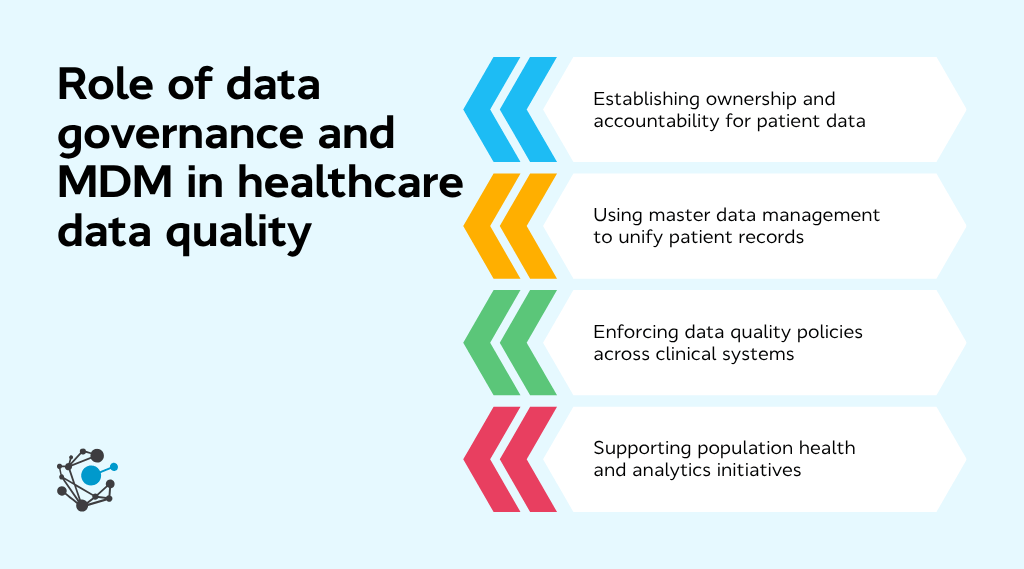
1. Establishing ownership and accountability for patient data
Healthcare organizations need clearly defined ownership models to maintain accountability for patient and clinical data.
Strong governance frameworks define:
-
Data stewardship responsibilities
-
Standardized clinical definitions
-
Escalation and issue resolution workflows
-
Data quality accountability metrics
This alignment improves collaboration between clinical, operational, compliance, and IT teams while reducing inconsistencies across departments.
2. Using master data management to unify patient records
Master data management helps healthcare organizations create a unified and trusted patient view across systems.
MDM platforms consolidate patient information from EHRs, laboratories, billing platforms, and external providers to improve patient identity consistency and reduce fragmented records.
This improves:
-
Patient matching accuracy
-
Care coordination
-
Reporting consistency
-
Analytics reliability
|
How OvalEdge supported healthcare data consolidation Challenge A mid-sized healthcare company managed sales and operational data across nearly two dozen databases, creating fragmented reporting, limited data visibility, and expensive data warehouse efforts. Actions taken by OvalEdge:
Business impact:
|
3. Enforcing data quality policies across clinical systems
Healthcare data governance policies help maintain consistency across departments, systems, and workflows.
Standardized policies support uniform coding practices, validation workflows, interoperability processes, and controlled data access across clinical platforms. This becomes especially important in large healthcare networks operating multiple EHR systems.
4. Supporting population health and analytics initiatives
Reliable healthcare data quality is essential for population health analytics, predictive modeling, and value-based care initiatives.
Accurate patient segmentation, risk stratification, and longitudinal analysis all depend on trusted clinical data. Poor-quality data can weaken analytics accuracy and reduce confidence in AI-driven healthcare insights.
Organizations investing in advanced analytics increasingly rely on governance, lineage visibility, and standardized data management practices to support trustworthy reporting and decision-making.
Tools and platforms for healthcare data quality and governance
Managing healthcare data quality across multiple systems, providers, and workflows requires more than manual monitoring. Modern data governance and MDM platforms help healthcare organizations automate validation, improve interoperability, monitor data quality, and maintain consistent patient information across clinical ecosystems.
Role of data quality and MDM platforms in healthcare
Healthcare data quality and MDM platforms help organizations automate validation, monitoring, matching, and governance processes across clinical systems. These platforms reduce manual effort while improving consistency, interoperability, and trust in patient data.
|
Key Feature |
Best Fit in Healthcare |
|
Data quality monitoring |
Detect missing, inconsistent, or invalid clinical data |
|
Patient matching and deduplication |
Unify fragmented patient records across systems |
|
Validation workflows |
Improve accuracy during EHR data entry |
|
Metadata management |
Standardize clinical definitions and terminology |
|
Data lineage tracking |
Trace healthcare data movement across systems |
|
Governance workflows |
Manage stewardship, approvals, and policy enforcement |
|
Compliance monitoring |
Support HIPAA, HITECH, and audit readiness initiatives |
Healthcare organizations increasingly rely on these capabilities to improve reporting accuracy, strengthen interoperability workflows, and maintain consistent patient records across complex healthcare ecosystems.
Integration with EHR systems like Epic, Cerner, and Allscripts
Modern governance platforms increasingly integrate directly with major EHR systems to improve real-time validation and monitoring.
Real-time integration supports:
-
Immediate validation during data entry
-
Automated monitoring and alerts
-
Faster issue resolution
-
More consistent interoperability workflows
This helps healthcare organizations reduce downstream correction efforts and improve trust in patient data.
Metadata management and data lineage for healthcare data
Metadata management and data lineage help healthcare organizations understand how patient and clinical data move across systems, integrations, and reporting workflows.
Lineage visibility improves transparency, audit readiness, root cause analysis, regulatory compliance, and trust in analytics. Healthcare organizations increasingly rely on metadata and lineage capabilities to support governance and interoperability initiatives.
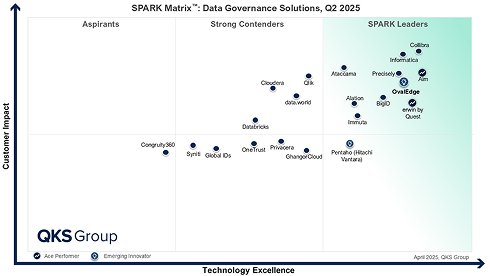
How platforms like OvalEdge support healthcare data quality
As healthcare organizations scale beyond manual governance processes and fragmented interoperability workflows, specialized data governance platforms become essential for managing data quality, compliance, and cross-system visibility.
|
Platform |
Key Strengths |
Best Fit for Healthcare Use Cases |
|
Data governance, metadata management, lineage, stewardship workflows, data quality monitoring |
Improving healthcare data governance, interoperability visibility, compliance readiness, and trust in clinical reporting |
|
|
Enterprise data integration, MDM, and large-scale data quality automation |
Managing complex healthcare integrations, patient matching, and enterprise-scale data management |
|
|
Collaborative data catalog, governance collaboration, metadata discovery |
Enabling cross-functional collaboration and improving visibility into healthcare data assets |
These platforms help healthcare organizations standardize patient data, improve interoperability workflows, strengthen governance practices, and support reliable analytics initiatives across clinical systems.
Conclusion
Healthcare data quality directly affects patient care, operational efficiency, compliance readiness, and analytics accuracy. As healthcare ecosystems become more interconnected and AI-driven, trusted clinical outcomes increasingly depend on trusted healthcare data.
Improving healthcare data quality requires strong governance, continuous monitoring, standardized clinical data practices, and master data management across systems.
OvalEdge helps healthcare organizations improve data governance, interoperability visibility, and healthcare data quality across complex clinical ecosystems.

Book a demo with OvalEdge to explore how healthcare teams can improve patient data reliability, compliance readiness, and reporting accuracy.
FAQs
1. How is healthcare data quality measured in real-world systems
Healthcare data quality is measured using indicators such as error rates, duplicate record percentages, data latency, and adherence to coding standards. Teams also track data usage patterns, audit logs, and reconciliation reports to assess reliability across clinical workflows and reporting systems.
2. What causes poor data quality in EHR systems
Poor data quality in EHR systems often results from manual data entry errors, inconsistent workflows, a lack of standard formats, and disconnected systems. Integration gaps between departments and external providers also introduce inconsistencies, making it difficult to maintain a unified and accurate patient record.
3. How does interoperability affect healthcare data quality?
Interoperability directly impacts data quality by enabling or limiting accurate data exchange between systems. When systems use different formats or standards, data can become incomplete or misinterpreted. Strong interoperability ensures consistent, accurate, and timely data flow across providers and care settings.
4. What is the role of data stewardship in healthcare data quality?
Data stewardship ensures that designated individuals manage data definitions, quality standards, and issue resolution. Stewards monitor data accuracy, coordinate with clinical teams, and maintain consistency across systems, helping organizations sustain reliable data for both operational and analytical use.
5. How can hospitals reduce duplicate patient records?
Hospitals reduce duplicate records by using advanced matching algorithms, standardizing patient identifiers, and implementing real-time validation during data entry. Regular audits and integration with identity resolution tools also help maintain a clean and unified patient record across systems.
6. How does healthcare data quality impact reporting and analytics?
Healthcare data quality affects reporting accuracy, regulatory submissions, and analytics outcomes. Poor quality data leads to incorrect insights, delays in reporting, and unreliable forecasts. High-quality data ensures that analytics models and reports reflect true clinical and operational performance.
.png?width=1081&height=173&name=Forrester%201%20(1).png)
.png?width=1081&height=241&name=KC%20-%20Logo%201%20(1).png)