%20(1).png)
Picking a master data management (MDM) tool in 2026 is harder than it should be. The market is crowded, the analyst categories overlap, and most vendors hide pricing behind a sales call.
This guide compares the 14 most-evaluated MDM tools head-to-head: features, deployment, pricing, where it's public, ideal buyer, and where each one falls short.
The list draws on the 2026 Gartner Magic Quadrant for Master Data Management Solutions, which evaluated 20 vendors this year, plus Gartner Peer Insights ratings and the platforms our own customers most often evaluate against OvalEdge.
The comparison table below gives you a quick view of all 15 tools. If you want help building a shortlist, the "How to choose" section near the end covers the five criteria most teams use.
What are master data management tools?
Master data management (MDM) tools are software platforms that consolidate, clean, and govern an organization's core business records like customers, products, suppliers, and employees across every system, so each application and AI model works from one accurate, up-to-date source of truth.
Most MDM tools share four building blocks:
-
A central repository that holds the golden record for each business entity
-
A matching engine that resolves duplicates across source systems
-
A governance layer for ownership, stewardship, and approval workflows
-
A distribution layer that publishes clean records back to CRMs, ERPs, and analytics tools
14 MDM tools compared at a glance
Here's how the 14 tools stack up on Gartner positioning, ideal buyer, deployment, and pricing. Each row links to the full breakdown further down the page.
|
Tool |
Key feature |
Best for |
Deployment |
Pricing |
|
Profisee |
Azure-native, business-user stewardship UI |
Microsoft-centric enterprises needing multi-domain MDM |
Cloud, on-prem |
On request |
|
Salesforce (Informatica) |
CLAIRE AI for matching and cleansing at enterprise scale |
Large enterprises on the Salesforce or Informatica stack |
Cloud, hybrid |
Consumption-based |
|
Semarchy |
DataOps with native Git and CI/CD pipelines |
Mid-market to enterprise multi-domain MDM |
Cloud, on-prem, hybrid |
On request |
|
Ataccama ONE |
Unified MDM, data quality, and governance in one platform |
Teams consolidating MDM and data quality |
Cloud, on-prem |
On request |
|
PiLog |
Specialized product and material data management |
Asset-heavy industries and SAP-centric orgs |
Cloud, on-prem |
On request |
|
Boomi Data Hub |
Built into the Boomi integration platform |
Existing Boomi customers and integration-led MDM |
SaaS |
On request |
|
IBM InfoSphere |
Enterprise-grade MDM with strong compliance tooling |
Regulated industries with hybrid data estates |
Cloud, on-prem, hybrid |
On request |
|
Precisely |
Combined MDM, data quality, and location data |
Product, supplier, and location-heavy use cases |
Cloud, on-prem |
On request |
|
Reltio |
Graph-based data model with real-time APIs |
Cloud-native customer 360 and multidomain MDM |
SaaS |
On request |
|
SAP MDG |
Native MDM module inside the SAP ecosystem |
SAP-centric enterprises on S/4HANA |
Cloud, on-prem |
On request |
|
Stibo Systems |
Multi-domain MDM with deep PIM capabilities |
Product information at enterprise scale |
Cloud, on-prem |
On request |
|
Syncari |
Real-time agentic data flows across CRM, ERP, and analytics |
Real-time, automation-first MDM |
SaaS |
On request |
|
Syndigo |
Product MDM with retailer syndication network |
Retail and CPG product experience management |
SaaS |
On request |
|
TIBCO EBX |
Multi-domain MDM and reference data management |
Data fabric and multi-domain governance |
Cloud, on-prem |
On request |
The top five are covered in depth below. The rest are listed for reference.
Top master data management tools
The 14-tool comparison table above gives you a quick view. Below are detailed write-ups of the five most-evaluated platforms, in order of 2026 Gartner Magic Quadrant positioning.
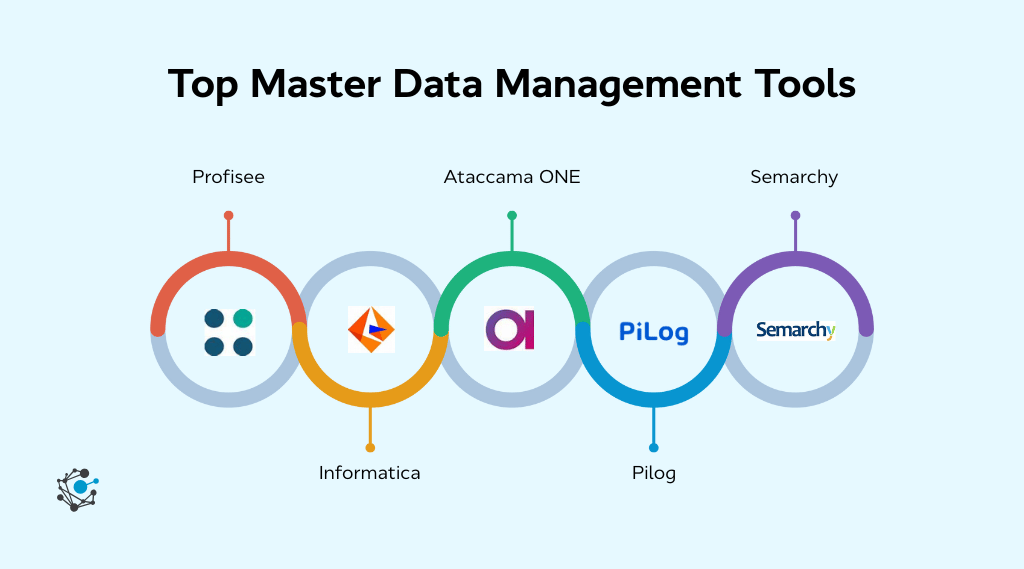
1. Profisee
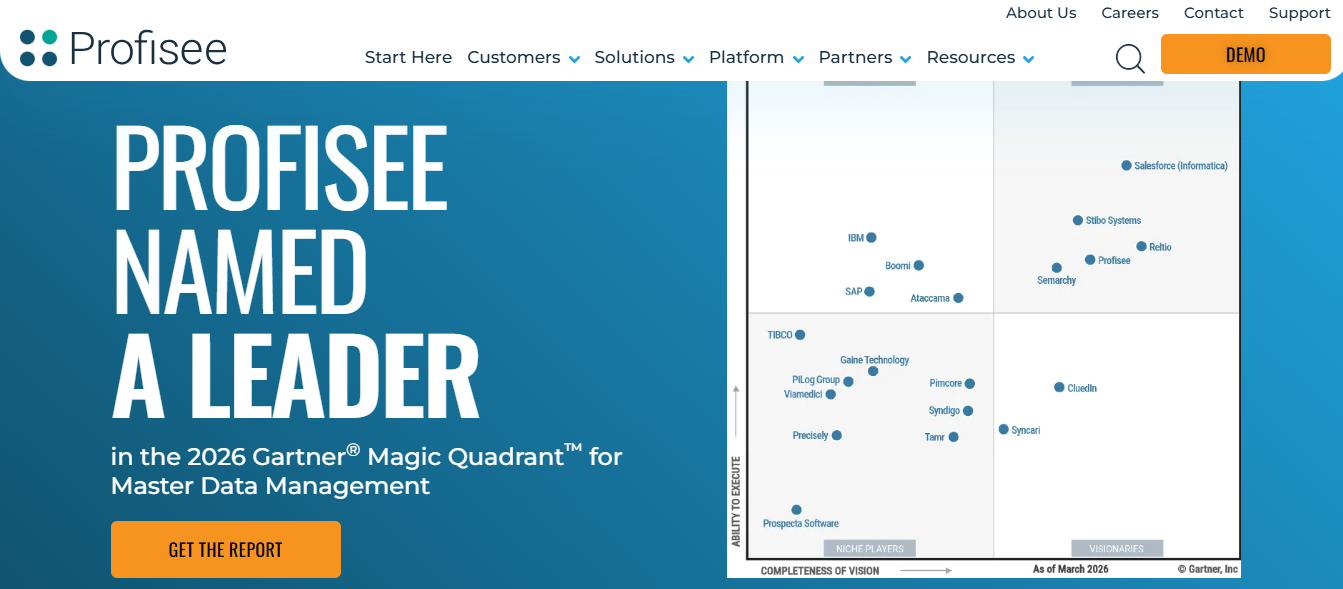
Profisee is a multi-domain MDM platform built natively on Microsoft Azure, named a Leader in the 2026 Gartner Magic Quadrant for Master Data Management Solutions. The default MDM choice for most Microsoft-centric enterprises.
Key features
-
Multi-domain MDM (customer, product, supplier) in one platform
-
Microsoft Azure-native deployment and Fabric integration
-
Business-user-friendly stewardship UI with low IT dependency
Pros: Intuitive interface lets business users manage data without heavy IT involvement. Scales from mid-market to large enterprise. Strong CRM, ERP, and analytics integration.
Cons: Full deployment can take time in complex environments. Highly customized workflows often need developer support.
Best for: Mid to large Microsoft-centric enterprises needing scalable multi-domain MDM.
What it can improve: Implementation runs long in complex environments, and customizing workflows often needs developer support. More robust out-of-the-box configurations would help teams scale without leaning on IT.
Pricing: Custom, based on deployment model and scale.
Rating:
2. Salesforce (Informatica)
Informatica is one of the most established MDM platforms on the market, named a Leader in the 2026 Gartner MQ and positioned highest for Ability to Execute. Following Salesforce's acquisition of Informatica in November 2025, the platform is now sold as Salesforce (Informatica). The deepest option for large enterprises with complex, regulated data estates.
Key features
-
AI-powered data quality through CLAIRE for matching, cleansing, and enrichment
-
Comprehensive governance and regulatory compliance tooling
-
Broad integration coverage across cloud and on-prem sources
Pros: Handles large data volumes and complex enterprise needs. AI reduces manual cleansing work. Strong fit for finance, healthcare, and government compliance.
Cons: Complex to configure and deploy, needs skilled specialists. Premium pricing.
Best for: Large enterprises with complex data, especially on the Salesforce or Informatica stack.
What it can improve: Users consistently flag a steep learning curve and a non-intuitive UI. Version control and CI/CD limitations frustrate engineering teams. Worth exploring Informatica alternatives if your team is small.
Pricing: Consumption-based, custom quote.
Ratings:
3. Semarchy
Semarchy's Data Platform (SDP) covers MDM, data integration, and governance in one converged platform. Named a Leader in the 2026 Gartner MQ. Differentiates on DataOps-style workflows with native Git and CI/CD pipelines.
Key features
-
Multi-domain MDM (customer, product, employee)
-
Operational and analytical MDM in one platform
-
DataOps-driven design with Git, VS Code, and CI/CD support
Pros: Flexible architecture adapts to most enterprise setups. Handles operational and analytical workloads together. Scales for high data volume and complexity.
Cons: Setup is more intricate than simpler MDM tools. Full capabilities take training to use well.
Best for: Mid-market to enterprise teams that want one platform for operational and analytical MDM.
What it can improve: Pricing is a barrier for smaller teams, and customization gets cumbersome as needs evolve. A lighter-weight tier would broaden Semarchy's reach.
Pricing: Flexible, scales by implementation and user count. More affordable for mid-market than premium tools.
Ratings:
4. Ataccama ONE
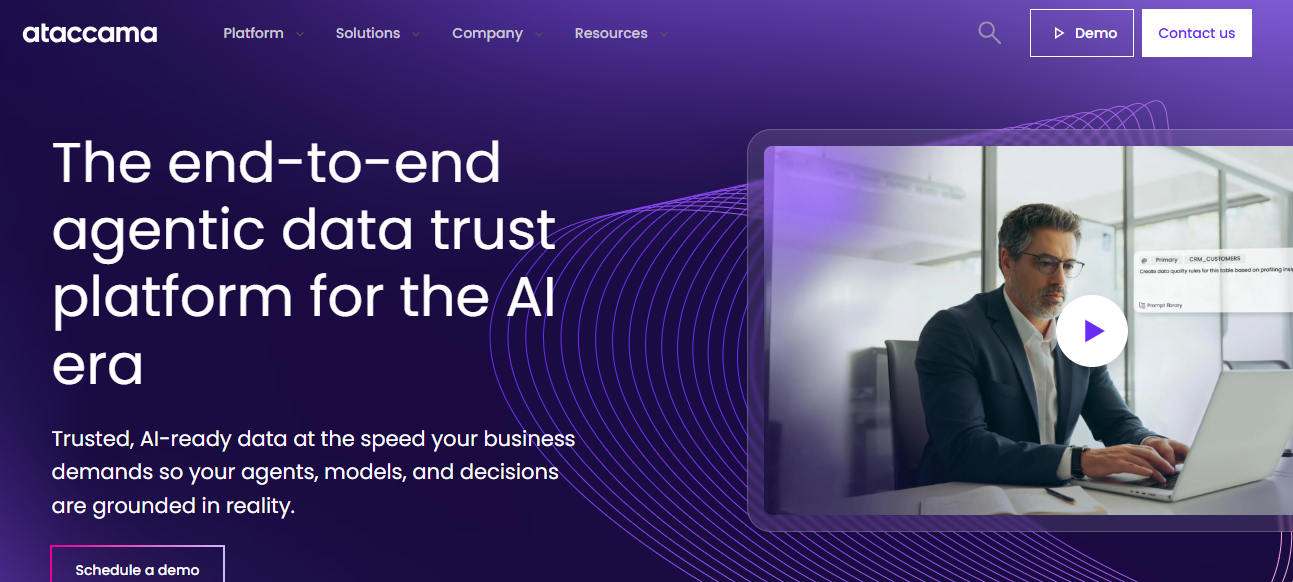
Ataccama ONE combines MDM, data governance, and data quality in one platform, with AI-driven automation across profiling, cleansing, and matching. Evaluated in the 2026 Gartner MQ for MDM and named a Leader in the 2026 Gartner MQ for Augmented Data Quality Solutions.
Key features
-
AI-powered data profiling and cleansing
-
Built-in stewardship workflows for governance
-
Unified MDM, data quality, and governance
Pros: Automation cuts manual data quality work. One platform replaces three separate tools. Real-time processing supports operational MDM.
Cons: Niche industries may need customization. Steep initial setup learning curve.
Best for: Teams that want automated data quality and MDM in one platform.
What it can improve: Users praise the UI but flag stability issues in early deployments and inconsistent reliability at scale. Tightening the experimental feel would let teams lean on Ataccama without workarounds.
Pricing: Custom, premium category.
Ratings:
5. PiLog
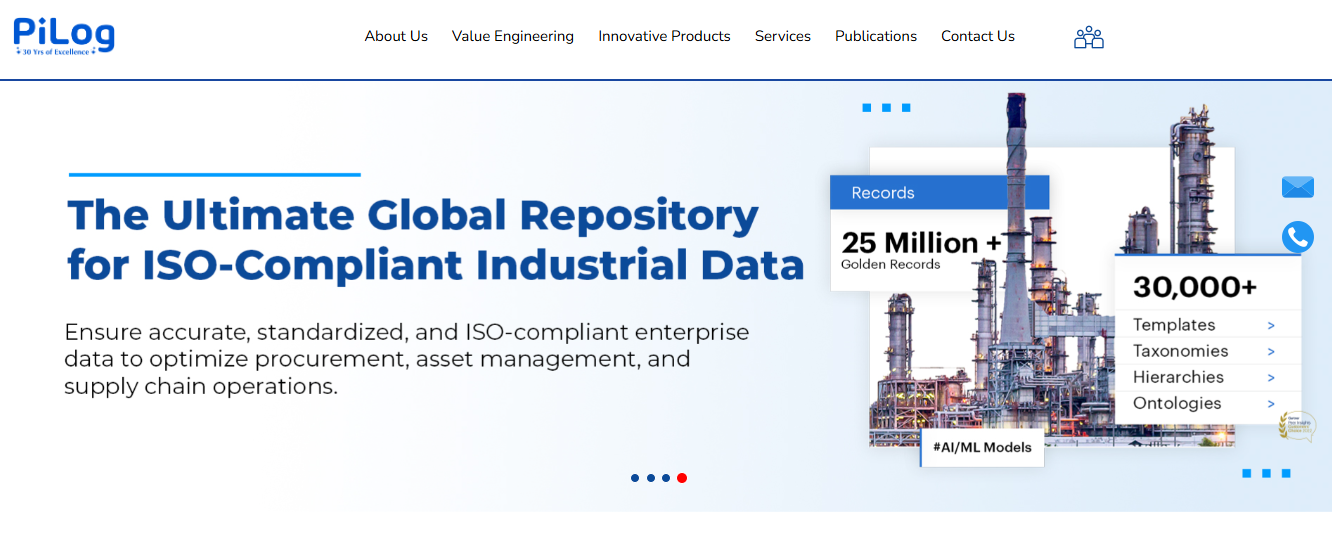
PiLog specializes in material and product master data, with deep SAP and ERP integration. Evaluated in the 2026 Gartner MQ. Most common in asset-heavy industries: oil and gas, manufacturing, utilities, and supply chain.
Key features
-
Material and MRO data management
-
Deep SAP, Magento, and Shopify integration
-
Multilingual data dictionaries and catalog management
Pros: Specialized depth for product and material data. Strong ERP and e-commerce integration. Reliable governance for supply chain data.
Cons: Narrower than full multi-domain platforms. Multi-domain buyers will need a second tool for customer or employee MDM.
Best for: Retailers, manufacturers, and asset-heavy industries managing product and material data across the supply chain.
What it can improve: Deployment timelines run long in industries with complex data, and customization for specialized workflows lags expectations. Better support for advanced configuration would help PiLog scale across complex enterprises.
Pricing: Custom, generally more affordable than broader MDM platforms.
Rating:
Key capabilities to look for in master data management tools
Most MDM platforms claim the same feature list. What separates the strong tools from the weak ones is depth in these seven capabilities.
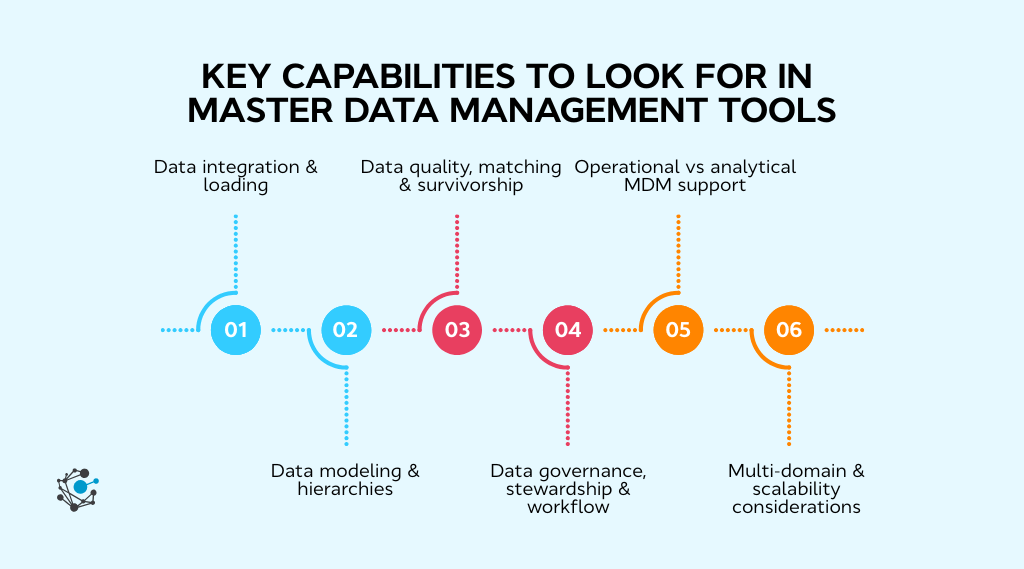
1. Data integration
Data integration is how an MDM tool reads from every system that creates or updates master data: CRMs, ERPs, billing platforms, data warehouses, and third-party enrichment services. Strong tools handle real-time and batch loading natively without forcing a choice.
Check the vendor's pre-built connector library against your stack first, since custom integrations stretch implementation timelines by months. Also, ask about reverse ETL, which pushes clean master records back to source systems. It's how the golden record actually reaches the people using it, but most vendors don't advertise it.
2. Data modeling
Data modeling determines how the MDM tool represents real business relationships. Products roll up to categories, customers roll up to accounts, employees roll up to org units, and a strong platform models these natively without forcing flat structures.
Check for cross-domain relationships too, the kind that link a customer to a product to a region, since real business questions rarely sit inside one domain. Business users need a visual interface for hierarchy management. If only the data engineering team can change the model, governance breaks the moment they're busy with something else.
Pairs with a data dictionary tool when your team needs schema-level documentation alongside the master records.
3. Data quality
Data quality in MDM is how the tool decides which version of a record wins when two systems describe the same customer or product. Get it wrong, and the golden record is worse than no record, because downstream systems trust it.
Strong tools combine probabilistic matching, which catches fuzzy duplicates like "Robert Smith" and "Bob Smith Jr.," with deterministic rules for exact matches on stable identifiers. Survivorship rules should run per attribute, not per record. The most recent address might come from one system while the verified phone number comes from another.
Match confidence scores should also be visible to stewards, so low-confidence matches get human review instead of silent failures.
4. Data governance
Data governance is what keeps the golden record clean six months after go-live. Most MDM failures trace back to weak stewardship workflows, not weak matching algorithms.
The platform needs role-based access and ownership assignment per data domain, so the marketing team owns the customer master while the supply chain owns the product master. Approval workflows should route changes through the right stewards before they hit production.
Audit trails and end-to-end lineage from source to golden record matter for both compliance reporting and root-cause analysis when something breaks. Pairs with broader data governance tools when your MDM platform doesn't cover policy management at the same depth.
5. Operational vs analytical MDM
MDM tools serve two different jobs, and most teams need both. Operational MDM handles live transactions like orders, billing, and customer service, which means sub-second latency and high match accuracy because every wrong match hits a real customer. Analytical MDM feeds reporting, BI, and ML model training, where daily batch latency is fine, and match errors average out across aggregated reports.
Reltio, Syncari, and Profisee lead on operational use cases. Informatica, Stibo, and Ataccama are stronger on the analytical side.
The best platforms cover both. If your shortlist forces a choice between them, it's a signal to keep looking.
6. Multi-domain MDM
Single-domain MDM, meaning just customer or just product, is cheaper to start and harder to extend later. Most enterprises need multi-domain within two years of go-live, and bolted-on domains rarely match the depth of native multi-domain platforms.
Check that customer, product, supplier, and employee sit in one model, not in parallel schemas glued together. Pricing should scale by data volume, not per-domain license, because per-domain pricing punishes you for the architecture you'll eventually need.
Ask for performance benchmarks at 10x your current record count, not your current size.
7. Augmented MDM
Augmented MDM is the use of AI to do work that used to need rules or humans. The 2026 Gartner MQ for MDM was revived specifically because this shift changed what these tools can do.
AI matters in three places. Matching, where LLMs handle fuzzy duplicates and contextual edge cases that rules miss. Stewardship, where AI agents triage low-confidence matches and only escalate the genuinely ambiguous ones to humans. Policy enforcement, where continuous monitoring replaces point-in-time validation.
The catch is explainability. Stewards need to see why an AI matched two records, or an audit trail break, and trust in the golden record erodes.
OvalEdge's framework for agentic data governance covers how AI agents handle the stewardship layer without removing human oversight.
|
Build the business case for MDM and governance Once you've shortlisted tools, the next hurdle is internal buy-in. This whitepaper covers how to size the ROI, frame the risk of inaction, and structure the proposal for finance and IT leadership. |
How to choose a Master Data Management tool
Choosing the right Master Data Management (MDM) tool for your organization is a critical decision that will shape how you manage and govern your core business data. Given the complexity and variety of MDM solutions available today, the process requires careful consideration of several factors that directly impact your data strategy.
Here’s a comprehensive guide on how to choose the right MDM tools, taking into account your unique business needs, existing infrastructure, and long-term goals.
1. Start with domain priority
Pick the master data domain causing the most measurable pain. Customer data fragmentation breaks marketing attribution and sales handoffs. Product data fragmentation breaks the supply chain and e-commerce.
A product-first shortlist usually includes PiLog or Stibo. A customer-first shortlist usually includes Reltio or Informatica. A multi-domain shortlist usually includes Semarchy or Profisee. Multi-domain platforms exist, but specialists go deeper in their domain. Lead with the painful domain, then confirm the tool can extend later.
2. Match deployment to risk profile
Cloud-first MDM goes live faster and costs less upfront, but moves master data outside the organization's perimeter. On-premise keeps data inside, but adds significant time and infrastructure cost. Hybrid splits the difference and doubles the integration complexity.
Banking, healthcare, and government usually start with hybrid or on-prem. Cloud-native enterprises usually start with SaaS. The wrong choice locks the organization into years of architecture debt.
3. Pressure-test integration and governance
Ask the vendor to demo their connectors against the team's main source systems. Check what's ready out of the box versus what needs custom work, since custom builds are where timelines slip.
Governance is the harder question, and it's internal. Are data owners named for each domain? Are stewards funded, or is the work expected as side-of-desk? The gap is rarely the tool. It's the discipline around it.
4. Calculate TCO, not list price
The license fee is a small part of the total. Add implementation, ongoing consulting, internal team costs (stewards, data engineers, governance leads), and integration upkeep. Implementation often costs more than the license, and consulting can run for years on premium tools.
Premium enterprise tools sit at the top of the cost range. Mid-market tools sit lower. Specialist tools cost the least but cover one domain. Match the spend to the domain priority from step 1.
|
Where OvalEdge fits Most teams buy MDM first and bolt governance on later. The result is a clean golden record that nobody can find, trust, or trace. OvalEdge takes the other path. MDM sits inside one platform with catalog, quality, lineage, and access management. |
Picking the right master data management tool
Most MDM evaluations stall in feature comparison loops. The shortlist gets longer, demo calls pile up, and six months in, the golden record still doesn't exist. The teams that ship MDM successfully skip ahead. They name the real problem first, then pick the tool that solves it.
If the real problem is fragmented data inside one stack, the platforms above will handle it. Pick the one that matches the stack and move.
If the real problem is fragmented governance, where master data, catalog, quality, and lineage all live in different tools and stewards spend more time switching tabs than managing data, MDM-only platforms won't fix it. They'll add a fifth tool to the stack.
OvalEdge solves that problem. MDM, catalog, quality, lineage, and access management in one platform. One set of metadata. One place for stewards to work. Deployed in weeks, not quarters.

See how OvalEdge handles the seven capabilities above in a 30-minute walkthrough.
FAQs
1. What's the difference between MDM and data governance?
MDM manages the actual business records (customers, products, suppliers) to create a single trusted version. Data governance sets the rules, ownership, and policies for how that data is used. MDM produces the golden record. Governance decides who's accountable for it.
2. MDM vs PIM: Which one is needed?
PIM manages product information for marketing, ecommerce, and catalogs. MDM manages product data alongside customers, suppliers, and other domains. A retail or CPG team usually needs PIM. A multi-domain enterprise needs MDM. Some platforms, like Stibo and Syndigo, cover both.
3. How is MDM different from a customer data platform (CDP)?
CDPs unify customer data for marketing activation: campaigns, segmentation, and personalization. MDM unifies master data across all domains for operational and analytical use, with stricter governance. CDPs feed marketing tools. MDM feeds every system in the business, including the CDP.
4. How long does an MDM implementation take?
Cloud-native MDM implementations typically go live in 3 to 6 months. On-premise and hybrid deployments run 9 to 18 months. Timelines depend more on internal data governance readiness and source-system complexity than on the tool itself.
5. Do small businesses need an MDM tool?
Small businesses with under 5 systems holding master data usually don't need a dedicated MDM tool. Spreadsheets, CRM-native deduplication, or a data quality tool will cover it. MDM becomes necessary once 5+ systems disagree on the same customer or product.
6. How is MDM ROI measured?
MDM ROI is measured through reduced data quality costs, faster reporting cycles, fewer duplicate customer or product records, and better marketing or sales conversion. Most enterprises track time saved on manual reconciliation and revenue lift from cleaner customer or product data.
.png?width=1081&height=173&name=Forrester%201%20(1).png)
.png?width=1081&height=241&name=KC%20-%20Logo%201%20(1).png)