
-2.png)
The blog explains the differences between data observability and data lineage, highlighting how both are crucial for ensuring data health and reliability. Data observability monitors real-time data performance, detecting issues proactively, while data lineage tracks the journey of data across systems. Together, they provide a comprehensive approach to managing data, improving issue detection, root cause analysis, and decision-making in organizations.
You’ve seen it happen: a key business metric suddenly shifts with no explanation, dashboards break without warning, and your analytics team scrambles to figure out why. These data disruptions slow down operations, shake trust across teams, and drain valuable resources.
If you’ve ever wondered whether your data stack needs better monitoring or deeper traceability, you’re not alone. The terms data observability and data lineage often get used interchangeably, yet they solve very different problems. Data observability helps you detect problems as they happen, while data lineage shows you how data travels and transforms across systems.
According to Gartner, 55% of decision‑makers say they struggle to translate data use cases into tangible business value, highlighting how many teams need better frameworks for data reliability like observability and lineage.
With the right tools, like OvalEdge, you can not only detect and monitor data health but also trace its journey across your systems, helping your team identify and resolve issues faster.
In this article, we'll break down the difference between data observability and data lineage, explain how they work together, and help you figure out which capabilities your team should prioritize, so you can stop reacting to data fires and start preventing them.
What is data observability?
Data observability is the practice of continuously monitoring and tracking the health and performance of your data in real-time. It gives data teams the ability to spot issues quickly, understand how data is performing, and ensure that it meets the quality standards necessary for accurate decision-making.
71% of organizations now report having a formal data governance initiative in place, up from 60% previously, which underscores why data observability is gaining traction as a complementary discipline.
With data observability, your team can get ahead of problems before they affect operations.
Core components of a data observability framework
A solid data observability framework is built on several key components that enable continuous monitoring and ensure data stays healthy. These elements work together to give your team the insights needed to keep everything running smoothly.
-
Anomaly detection: Identifying when data deviates from expected patterns (e.g., freshness, schema changes, or unexpected volume fluctuations).
-
Data quality monitoring and SLAs: Ensuring data consistently meets predefined quality metrics and service-level agreements (SLAs).
-
Pipeline health and reliability signals: Monitoring the performance of the data pipeline, ensuring it is running smoothly and efficiently.
-
Metadata-driven insights: Leveraging metadata to understand data quality and operational health.
-
Root cause lifecycle management: Pinpointing the root causes of data issues to improve the incident resolution process.
What problems does data observability solve?
Data observability doesn’t just detect problems; it helps prevent them from happening in the first place by giving your team the tools to monitor and fix data issues proactively.
-
Reactive firefighting: Prevents waiting until problems occur by allowing proactive detection of data anomalies.
-
Hidden data downtime: Identifies and resolves silent data downtime, ensuring data availability.
-
Broken trust in analytics: Reduces the risk of inaccurate reports or analytics that stem from bad data.
-
Lack of operational visibility across pipelines: Provides a clear, real-time view into how data flows through various systems.
In short, data observability is about maintaining a pulse on the health of your data in real-time. It allows you to detect issues early, maintain trust in your analytics, and keep your data pipeline running efficiently.
But while observability helps you understand what is going wrong, it doesn’t tell you why or how data behaves across your systems. That’s where data lineage comes into play.
What is data lineage?
When you’re working with large data systems, it’s not enough to simply have the data in hand; you need to understand where it came from and how it got here.
Data lineage is the process of tracking and documenting the entire journey of your data, from its origins through transformations and into final use. It provides a visual map of how data is passed across systems, applications, and processes, offering deep insights into its transformations and usage along the way.
With data lineage, you can answer critical questions about the flow and history of your data, enabling better decision-making and transparency.
Types of data lineage: Technical, business, and operational
Data lineage comes in different forms, depending on the perspective you need. Whether you're looking at how data is structured, used, or transformed, each type of lineage offers unique insights that can help you manage and understand your data more effectively.
-
Technical lineage: Shows how data is transformed across tables, columns, and databases through technical processes.
-
Business lineage: Tracks how business metrics and KPIs are derived from raw data.
-
Operational lineage: Focuses on how data moves through operational processes, including data pipeline dependencies.
What problems does data lineage solve?
Data lineage is a powerful tool for solving several common challenges in data management. By providing clear visibility into data's journey, it helps organizations better understand, trust, and manage their data.
-
Understanding where data comes from: Provides transparency about the origins of data, which is essential for making reliable decisions.
-
Impact analysis for upstream changes: Helps teams understand how changes upstream (such as schema changes) can affect downstream processes.
-
Compliance and auditability: Ensures that data handling processes are transparent and compliant with regulations, such as GDPR.
-
Faster onboarding and documentation: Helps new team members understand how data is structured and flows across systems.
In short, data lineage provides visibility into the full lifecycle of your data, offering a clear view of its origins, transformations, and destinations.
|
Also read: Data Lineage vs Data Catalog: Key Differences for 2026 |
Data observability vs data lineage: What’s the difference?
Data observability and data lineage are essential concepts in managing data quality, governance, and compliance.
Data lineage tracks the flow and transformations of data across systems, providing an audit trail and ensuring data integrity. On the other hand, data observability offers real-time monitoring, helping to detect anomalies and assess data quality continuously.
Both processes contribute to proactive data management, with lineage supporting traceability and observability, ensuring actionable insights. Understanding the differences between these two can improve decision-making, enhance compliance efforts, and drive more efficient data-driven practices across organizations.
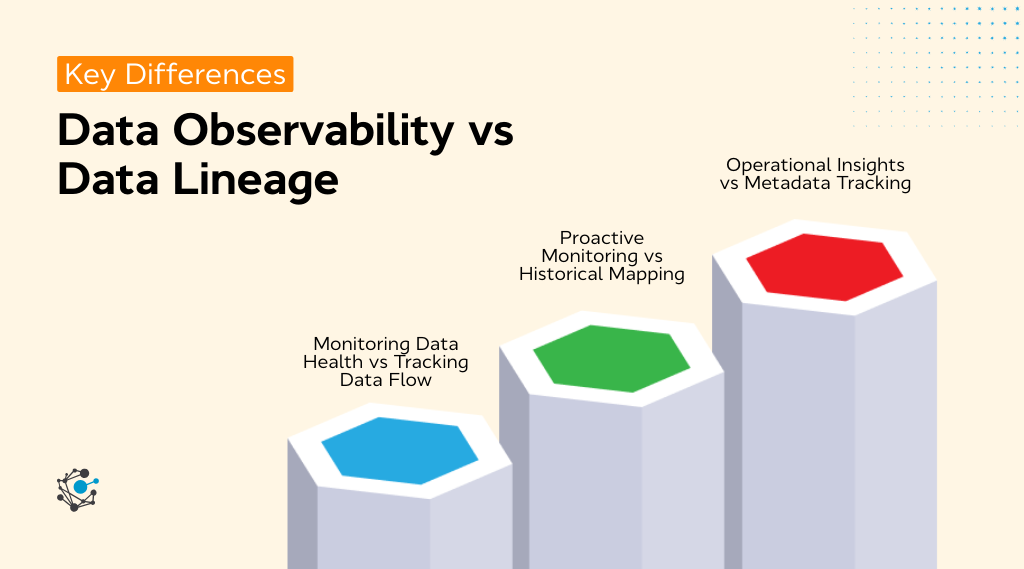
Monitoring data health vs tracking data flow
When managing complex data systems, two critical aspects come into play: monitoring how well your data is performing in real-time and understanding how data flows through systems.
|
Feature |
Data observability |
Data lineage |
|
Purpose |
Monitor data health in real-time |
Document data flow and transformations |
|
Time focus |
Real-time monitoring |
Historical mapping |
|
Primary users |
Data engineers, analysts |
Data engineers, compliance officers |
|
Core outputs |
Anomaly detection, pipeline health |
Data flow documentation, impact analysis |
Proactive monitoring vs historical mapping
The key difference between data observability and data lineage is the time frame and purpose of the insights they provide.
-
Data observability helps teams monitor data health in real time, immediately detecting anomalies or issues as they occur.
-
Data lineage provides a historical view, helping teams understand past data transformations and the upstream causes of any problems.
While observability allows for quick responses to ongoing issues, lineage offers critical context for resolving the root causes of these issues.
Operational insights vs metadata tracking
In the world of data, observability is all about real-time visibility. It surfaces operational insights that help teams track how data is performing at any given moment. For example, it flags issues such as broken pipelines, stale data, or unexpected anomalies.
Data lineage, however, is concerned with metadata; specifically, how data is transformed, used, and passed across systems. This gives teams a deeper understanding of where and how data is being consumed and modified throughout its lifecycle.
When you combine both, you enhance your Mean Time to Resolution (MTTR) by providing operational insights along with the full metadata context to diagnose issues more effectively.
|
Did you know: Enterprise spending on data observability software is projected to nearly double from USD 1.5 billion in 2025 to USD 3.6 billion by 2035, underscoring increasing enterprise demand for tools that monitor data health across complex stacks. |
How data lineage supports data observability
When it comes to ensuring the health of your data systems, data observability is essential for real-time monitoring. But on its own, it might not provide enough context to understand the full scope of a problem.
By offering a detailed map of how data flows, transforms, and is consumed across various systems, data lineage brings crucial context to the table. This context is invaluable for identifying the root cause of issues flagged by observability tools, helping your team resolve problems faster and more accurately.
Root cause analysis with lineage context
Imagine this scenario: your observability platform flags an anomaly, but the root cause isn’t immediately clear. Is the problem in the pipeline? Was it a data transformation issue?
Data lineage allows you to trace the issue back to the specific asset or process where things went wrong, providing context about upstream changes and dependencies. Instead of simply addressing the symptom (the anomaly), it helps you understand the underlying cause of the problem.
This combination of observability and lineage reduces investigation time significantly, turning a potentially hours-long analysis into a quick, informed response. With lineage in place, your team can move from detection to resolution faster, minimizing downtime and reducing the impact on business operations.
Pipeline visibility and impact analysis
One of the greatest strengths of data lineage is its ability to offer deep visibility into the data pipeline. When a disruption occurs, it’s not just about fixing the immediate issue, because understanding its broader impact is critical.
Lineage allows you to trace which downstream systems and consumers rely on the affected data. This understanding, often referred to as the “blast radius,” provides clarity on how widespread the problem might be.
With this visibility, you can quickly communicate the impact of the issue to all relevant stakeholders, ensuring that everyone is on the same page. Whether it’s a data analyst, compliance officer, or business leader, understanding the ripple effect of a data issue helps prioritize response efforts and ensures a more coordinated and efficient resolution process.
|
Stat: The data observability market is growing quickly, from an estimated USD 2.94 billion in 2025, projected to reach about USD 5.27 billion by 2029, reflecting rising demand for real‑time monitoring and data reliability tools. |
Using data observability and data lineage together
When used together, data observability and data lineage create a comprehensive framework that enhances both real-time monitoring and long-term data management.
For example, consider a scenario where an observability platform flags a freshness anomaly in your data. Using data lineage, you can trace the issue back to the upstream data transformation, significantly reducing debugging time compared to manually investigating the issue.
Real-world example: Debugging a broken analytics dashboard
-
Observability flags a freshness anomaly: data hasn’t been updated in hours.
-
Lineage traces the failure to an upstream transformation issue in the ETL pipeline.
-
Resolution time is reduced because lineage provides direct context.
When do you need data observability, data lineage, or both?
Deciding whether your organization needs data observability, data lineage, or a combination of both depends on your team’s role and the maturity of your data systems.
Each team within your organization interacts with data differently, so understanding when and why they need these capabilities is key to ensuring your data workflows remain smooth and reliable. Let’s break it down by team and maturity level.
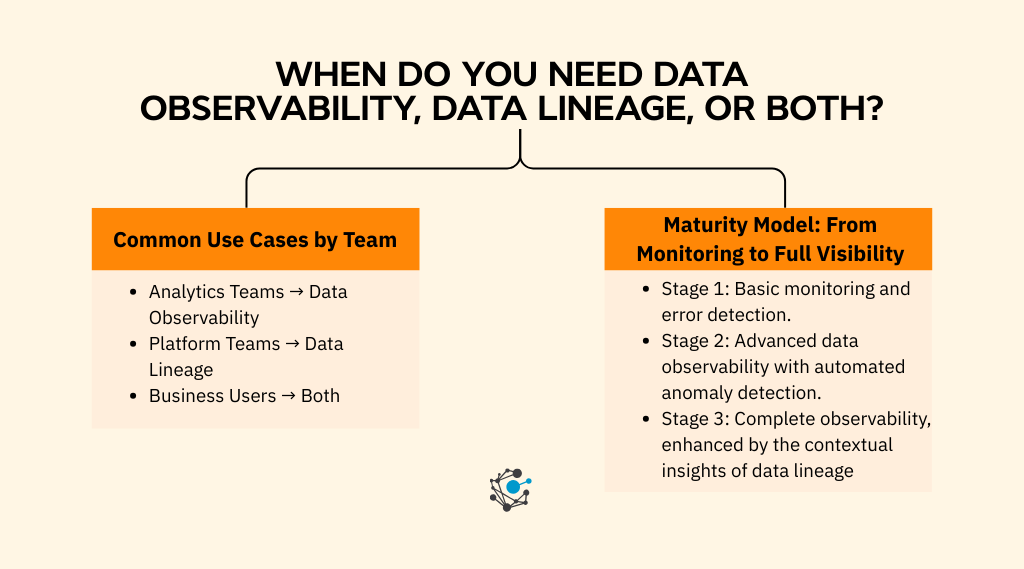
Common use cases by teams
-
Analytics teams: For analytics teams, the primary concern is data accuracy. Data observability ensures data quality and integrity in real-time, making sure that the metrics and insights they rely on are always trustworthy
-
Platform teams: Data lineage plays a crucial role for platform teams. Their job is to ensure that data flows seamlessly through systems without disruptions.
-
Business teams: They often rely on both observability and lineage to maintain confidence in the metrics they use for decision-making. Observability ensures they’re working with up-to-date, accurate data, while lineage gives them transparency into the data’s journey, providing context for the metrics they see.
Maturity model: From monitoring to full visibility
Just like any other part of the business, your data management capabilities evolve over time. Understanding where your organization stands in its data maturity model will help you determine whether you need basic monitoring, advanced observability, or full-fledged visibility.
-
Stage 1: Basic monitoring and error detection: At this stage, systems focus on catching obvious errors, such as missing data or pipeline failures. This allows for quick issue detection, but teams still rely on manual fixes and reactive troubleshooting.
-
Stage 2: Advanced data observability with automated anomaly detection: Here, automation takes over, enabling tools to detect anomalies without manual input. Teams can act proactively, spotting data issues before they escalate.
-
Stage 3: Complete observability enhanced by the contextual power of data lineage: In this mature stage, data observability is integrated with data lineage, giving teams real-time monitoring with a full understanding of the data journey. This combination allows for not only faster issue detection but also a deeper understanding of data transformation and root causes.
As your organization matures, moving from basic monitoring to full visibility enhances the efficiency, reliability, and trust in your data.
For teams looking to integrate both data observability and data lineage, OvalEdge offers an all-in-one solution that streamlines both capabilities. It helps teams monitor, trace, and understand data in real time, offering clear visibility into the entire data lifecycle, from source to transformation, ensuring your data flows smoothly and stays reliable.
|
Also read: Data Lineage vs Data Provenance: Which One Does Your Business Need? |
Conclusion: Choosing the right approach for your data stack
Data challenges don’t have a one-size-fits-all solution. Data observability and data lineage are both necessary to ensure your data systems are healthy, reliable, and well-understood. Without observability, you’re blind to real-time issues; without lineage, you lack the context needed to resolve those issues quickly.
OvalEdge can help you seamlessly integrate both capabilities into your workflow. When you contact us, we’ll walk you through how our platform can provide real-time data health monitoring alongside detailed data lineage, all within an intuitive interface.
Our team will work with you to tailor the solution to your organization’s unique needs, ensuring that your data is fully optimized for success.
Ready to improve your data management? Schedule a call with OvalEdge today to learn how we can help you implement both capabilities and drive efficiency across your data systems.
FAQs
1. Is data observability the same as data monitoring?
No. Data monitoring tracks predefined checks, while data observability analyzes patterns across datasets to surface unknown issues. Observability helps teams understand why problems happen, not just that they occurred.
2. Can data lineage help with data quality issues?
Yes. Data lineage provides context for data quality problems by showing upstream sources and transformations. While it doesn’t detect issues directly, it helps teams trace quality degradation back to its origin.
3. Do small data teams need both data observability and data lineage?
Not always. Smaller teams often start with observability to manage data reliability. As pipelines and dependencies grow, lineage becomes valuable for understanding impact, onboarding faster, and reducing debugging time.
4. How does data lineage improve trust in analytics?
Data lineage increases trust by making metric definitions, data sources, and transformations transparent. When users can see how data is produced, they are more confident using dashboards for decision-making.
5. What happens if you rely only on data lineage without observability?
Without observability, teams may understand data flow but miss real-time failures. Issues like late or missing data can go unnoticed until stakeholders report problems, leading to delayed responses.
6. Is data observability mainly for data engineers?
No. While data engineers use observability heavily, analytics engineers, analysts, and platform teams also benefit. It helps everyone detect data issues early and maintain reliable data products across the organization.
Deep-dive whitepapers on modern data governance and agentic analytics
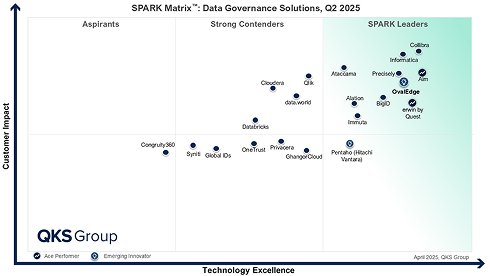
OvalEdge Recognized as a Leader in Data Governance Solutions
.png?width=1081&height=173&name=Forrester%201%20(1).png)
“Reference customers have repeatedly mentioned the great customer service they receive along with the support for their custom requirements, facilitating time to value. OvalEdge fits well with organizations prioritizing business user empowerment within their data governance strategy.”
.png?width=1081&height=241&name=KC%20-%20Logo%201%20(1).png)
“Reference customers have repeatedly mentioned the great customer service they receive along with the support for their custom requirements, facilitating time to value. OvalEdge fits well with organizations prioritizing business user empowerment within their data governance strategy.”
Gartner, Magic Quadrant for Data and Analytics Governance Platforms, January 2025
Gartner does not endorse any vendor, product or service depicted in its research publications, and does not advise technology users to select only those vendors with the highest ratings or other designation. Gartner research publications consist of the opinions of Gartner’s research organization and should not be construed as statements of fact. Gartner disclaims all warranties, expressed or implied, with respect to this research, including any warranties of merchantability or fitness for a particular purpose.
GARTNER and MAGIC QUADRANT are registered trademarks of Gartner, Inc. and/or its affiliates in the U.S. and internationally and are used herein with permission. All rights reserved.