


-3.png)
Data governance and data management serve distinct yet interdependent roles in ensuring an organization’s data is trustworthy, secure, and usable. Governance sets the policies, ownership structures, and compliance requirements, while management enforces those policies through operational systems, controls, and workflows. This guide explores how both disciplines work together across the data lifecycle, from ingestion to retirement, and how organizations can implement feedback loops, automation, and certified datasets at scale. It also highlights the importance of aligning governance frameworks with day-to-day data processes to maintain quality, privacy, and regulatory compliance in real-world environments.
If your organization treats data governance and data management as interchangeable, you’re creating silent gaps in your data strategy that don’t show up until something breaks.
Key takeaways:
- Data governance decides who owns data, what rules apply, and why those rules exist.
- Data management is how those rules are put into action across systems and workflows.
- Governance without execution stays theoretical.
- Management without governance moves fast, but creates long-term risk.
- Strong data programs connect decision-making and operations through automation and feedback.
On the surface, both seem to deal with how data is handled. But scratch that surface, and their responsibilities diverge completely. Data governance sets the rules, such as ownership, access, compliance, and quality standards.
Data management executes those rules by storing, processing, integrating, and securing data in real time. One is strategic, while the other is operational. You can’t implement one effectively without the other.
Yet, many companies try. To reduce tooling costs or operational overhead, they choose one. They invest in data management platforms but ignore governance frameworks. Or they define governance policies without enabling the teams and systems to act on them.
In both cases, the outcome is the same:
-
Incomplete control
-
Inconsistent data, and
-
Rising risk exposure.
Good data doesn’t happen by accident. You need the controls and the execution. Governance ensures accountability, and management ensures usability. If one breaks, the other stalls.
In this blog, we discuss why these two functions must operate in tandem, not just in theory, but in architecture, process, and practice. We’ll show how a fragmented approach can quietly erode trust in your data, and what it takes to get both sides working together.
What is Data Governance?
Data governance is a strategic framework that defines how data is owned, accessed, and regulated within an organization. It ensures data privacy, security, compliance, and quality through clearly defined roles, policies, and standards.
Governance establishes accountability for data decisions and aligns data usage with business goals and legal requirements. Unlike data management, which handles storage and operational access, governance focuses on oversight and control.
Effective data governance builds trust, reduces risk, and supports regulatory alignment across all data systems and processes. These outcomes are driven by foundational data governance principles applied consistently across teams.
Core data governance components
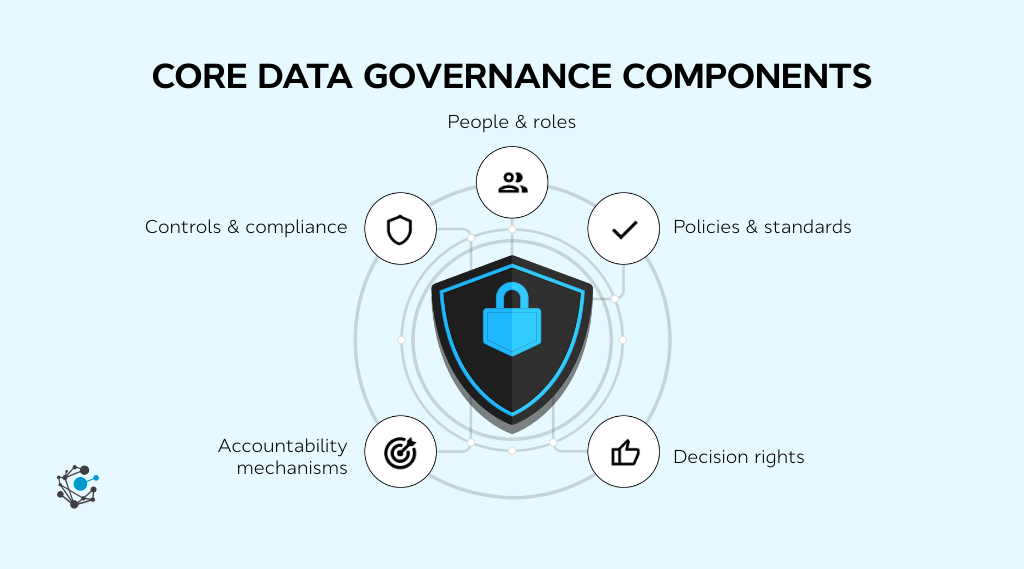
Effective data governance involves a broad framework of components that are crucial to ensuring data is used responsibly, securely, and in alignment with organizational goals.
-
People & roles
The foundation of any successful data governance strategy is the people who are responsible for the data. It’s crucial to define roles clearly to avoid ambiguity and ensure that each person understands their responsibilities.
Key roles typically include:
-
Data owners: These individuals or teams are responsible for the overall stewardship of specific datasets. They make decisions about who has access to the data, what constitutes appropriate use, and when data should be archived or deleted.
|
For example, in a healthcare organization, data owners might include department heads who ensure compliance with healthcare regulations like HIPAA. |
-
Data stewards: Stewards manage and protect the data at a tactical level, ensuring it is accurate, complete, and appropriately used across the organization. A data steward’s role involves daily monitoring, quality control, and applying governance policies across data systems.
-
Governance councils: These committees or bodies are responsible for overseeing data governance processes and making high-level decisions about data strategy, policies, and compliance. They ensure that governance practices align with the organization’s objectives and external regulatory requirements.
According to a 2024 Forrester Report on Data Governance, data governance establishes an organizational operating model, within which governance councils play a central role in enabling cross-functional collaboration, enforcing policy standards, and maintaining compliance across business units.
Their strategic position ensures governance is not siloed but integrated across the enterprise.
-
Security/compliance partners: These roles ensure that data governance aligns with regulatory standards like GDPR, CCPA, or industry-specific compliance rules. Their responsibilities extend to ensuring that governance policies are implemented in a way that mitigates risks associated with data breaches, misuse, or non-compliance.
-
Policies & standards
Policies and standards form the backbone of data governance. They set the framework for how data should be handled across the organization. Key aspects include:
-
Access controls: Governance policies must define who can access data and under what conditions. This includes creating access control lists (ACLs), implementing role-based access control (RBAC), and establishing procedures for granting, modifying, and revoking access to ensure security and compliance.
|
For instance, sensitive financial data may require additional clearance, or access to personally identifiable information (PII) might be restricted to a limited group of authorized employees |
-
Data privacy policies: These policies ensure that personal data is handled according to legal and ethical standards. Data privacy policies must comply with local and global privacy laws, such as GDPR or CCPA, to safeguard personal information from unauthorized use or exposure.
-
Retention rules: Governance sets clear policies around how long data should be kept and when it should be deleted. These rules help businesses comply with legal requirements (e.g., tax records retention) and manage the lifecycle of data efficiently.
-
Classification standards: Data must be classified based on sensitivity, risk, and relevance.
|
For example, financial data may be classified as highly sensitive and require additional security protocols, while general company data might be classified as public. |
-
Decision rights
Decision rights determine who is authorized to make key decisions about data governance. These decisions can range from defining access policies to determining which datasets are of strategic importance.
Establishing decision rights ensures that governance is executed with authority and clarity. Some examples include:
-
Data definitions: Deciding what constitutes a "customer" or "transaction" across the organization ensures consistency and alignment across all departments. A governance body might define what data elements make up a customer’s record to standardize reporting across sales, marketing, and customer service teams.
-
Quality thresholds: Governance defines the minimum acceptable quality standards for data, such as accuracy, completeness, and timeliness. The governance council or data owners may decide on quality thresholds based on business requirements. These thresholds are typically based on defined data quality dimensions such as accuracy, completeness, and consistency.
-
Access exceptions: While policies define who can access data, governance must decide who has the authority to approve exceptions, ensuring that unauthorized access is minimized while still supporting business needs.
-
Accountability mechanisms
Effective accountability mechanisms ensure that data governance policies are followed and that any issues are addressed promptly. This includes:
-
Issue management: Governance processes must define how data issues (such as quality problems, access violations, or security breaches) are reported and addressed. A clear escalation path ensures that issues are resolved quickly and systematically.
-
Audit readiness: Data governance should include mechanisms that allow for audits of data use, access, and management. This is especially important for compliance purposes, such as showing evidence of GDPR compliance or adherence to internal data handling standards.
-
Controls & compliance
Governance ensures that data is used in a controlled manner that aligns with both internal policies and external regulatory requirements. This includes:
-
Risk Management Protocols: Governance helps identify, assess, and mitigate risks associated with data use.
|
For example, an organization might establish procedures to limit access to financial data to minimize the risk of fraud or data leaks. |
-
Monitoring requirements: Continuous monitoring of data systems is necessary to ensure compliance with data policies. Automated tools can be used to track data usage, access, and integrity, ensuring compliance with standards and regulations.
-
Evidence for audits: A solid governance framework provides documentation and evidence that data is being used properly.
|
For instance, organizations can produce logs, reports, and audit trails during a regulatory audit to show that data management practices are in line with compliance standards like GDPR. |
By addressing these core components in a comprehensive and systematic way, organizations can ensure that their data is secure, compliant, and optimized for business use. Moreover, transparency and accountability help create a culture of trust around data, enabling informed decision-making across departments and stakeholders.
What is Data Management?
Data management is the practice of organizing, storing, integrating, and securing data to ensure it is accurate, accessible, and usable. It includes operational processes such as data integration, modeling, quality control, metadata management, and lifecycle handling.
Data management supports decision-making by delivering trusted, high-quality data with consistent data quality controls across systems. It enforces governance policies through role-based access controls, automated validation, and audit logging.
Unlike governance, which defines policies, management executes them through systems and tools. Effective data management reduces risk, improves efficiency, and ensures compliance across the data lifecycle
Data Governance vs Data Management at a glance
|
Aspect |
Data Governance |
Data Management |
|
Primary purpose |
Define rules, ownership, and accountability |
Execute data operations reliably |
|
Focus |
Policies, standards, compliance |
Pipelines, storage, quality, access |
|
Who owns it |
Governance councils, data owners, compliance teams |
Data engineers, platform and IT teams |
|
Outputs |
Policies, certifications, audit readiness |
Curated datasets, reports, analytics |
|
Risk if missing |
No control or accountability |
Data inconsistency and operational failure |
Core Data Management capabilities
Effective data management is essential for ensuring that an organization's data is not only available but also usable, high-quality, and secure. This operational side of managing data makes it accessible and valuable for decision-making, reporting, and analytics.
-
Data integration
Data integration refers to the process of collecting data from various sources, transforming it into a standardized format, and loading it into a centralized system for use.
This process typically involves techniques like ETL (Extract, Transform, Load) or ELT (Extract, Load, Transform) pipelines. Data integration ensures that data flows smoothly between systems, creating a unified view of information across the organization.
|
For example, a retail company may have sales data in one system, inventory data in another, and customer data in a CRM tool. Integrating these data sources through automated pipelines allows the company to generate comprehensive reports on customer behavior, product sales, and stock levels in real-time. |
However, integration is not just about connecting systems. It requires maturity in processes and strategy.
According to a 2025 Gartner Research Guide on Data Integration, data integration maturity remains low in many organizations, even though it plays a central role in analytics and operational decision-making.
Advancing this maturity demands more than tools. It requires alignment with governance, metadata management, and a clear integration strategy to ensure consistent, high-quality data delivery.
-
Storage & modeling
Data storage and modeling are fundamental to how data is organized and accessed across the organization. This includes managing data lakes, data warehouses, or lakehouses that store structured and unstructured data in a scalable and secure environment.
To understand how enterprise data warehouses specifically contribute to secure and structured storage within a governed data ecosystem, explore our detailed guide on Enterprise Data Warehouse
-
Data lakes: A data lake stores raw, unstructured data from various sources. While this provides flexibility in data storage, it requires advanced data modeling techniques to ensure the data remains usable and accessible.
Learn how modern data lakehouse architecture helps bridge the gap between raw storage and structured access in our guide to Data Lakehouses
-
Schema and semantic modeling: To ensure the data is usable and understandable, businesses create schemas that define how data is structured.
Semantic models also provide a layer of abstraction, helping users from various business units understand and query the data in a way that aligns with business terminology.
A common issue arises when data is not structured well enough for end-users to derive insights quickly.
|
For example, if a company’s data warehouse doesn’t have proper indexing or is missing key relationships, queries can become slow and cumbersome, impeding timely decision-making. |
By investing in well-defined data models, implementing automatic indexing, and ensuring clear metadata management, businesses can make their stored data more accessible and actionable.
3. Data quality operations
Data quality is about ensuring that the data used for decision-making is accurate, complete, consistent, and reliable. Data quality operations include processes like profiling, anomaly detection, and automated data quality checks.
These activities help businesses maintain high standards of data integrity across the organization.
-
Profiling: This involves analyzing data to understand its structure, quality, and anomalies.
|
For instance, if you’re dealing with customer data, profiling might reveal that some records are missing email addresses or have invalid phone numbers. |
-
Automated tests: Automated tests help in checking the quality of data at different stages of the pipeline. This could include checks for duplication, data range consistency, or completeness.
-
Anomaly detection: Using machine learning or statistical techniques, anomaly detection tools flag data that deviates from the expected pattern.
|
For example, if an e-commerce website suddenly sees a spike in orders from a single region, anomaly detection would flag it for review. |
-
Security implementation
Data security is a critical aspect of data management, particularly as the number of data breaches and cyberattacks continues to rise. Ensuring robust security involves implementing encryption, role-based access controls (RBAC), and comprehensive audit logs.
-
Encryption: Data should always be encrypted both at rest (stored data) and in transit (data being transferred). This ensures that even if data is intercepted, it remains unreadable to unauthorized users.
-
Role-Based Access Control (RBAC): RBAC limits access to data based on the roles assigned to users.
|
For example, a financial analyst might have access to sensitive budget data, but a marketing employee may only have access to customer demographic information. |
-
Audit logs: Keeping detailed records of who accessed data, when, and for what purpose is essential for ensuring accountability and meeting regulatory compliance requirements.
-
Metadata operations
Metadata management involves keeping a comprehensive catalog of data assets, capturing data lineage, and supporting tagging and classification. This ensures transparency and makes it easier for users to find, understand, and trust the data they use.
-
Data catalog: A data catalog is a centralized inventory that provides a searchable index of all data assets within an organization. It helps users locate datasets, understand their source, and ensure the data is being used correctly.
-
Lineage tracking: Data lineage shows the flow of data from its source to its final destination. It allows data engineers and analysts to trace any issues back to their source, ensuring data quality and security.
-
Tagging and classification: Metadata tags help classify data based on attributes like sensitivity, quality, and relevance. This makes it easier for users to understand the context of the data they’re working with.
Without proper metadata management, data can become disorganized and difficult to use.
|
For example, if data analysts can't find relevant datasets quickly or understand where the data came from, it creates inefficiencies and hinders decision-making. |
Implementing a robust metadata management system, including a data catalog and lineage tracking, ensures that data is discoverable, transparent, and consistently used across the organization.
-
Lifecycle operations
Data lifecycle management ensures that data is properly archived, retained, and deleted in compliance with governance policies. This capability ensures that businesses are following best practices for data retention and compliance.
-
Archiving: Older data that is no longer in regular use should be archived. This allows businesses to retain important information for compliance or historical analysis without overloading their active systems.
-
Retention: Data retention policies ensure that data is kept for the appropriate amount of time, based on legal, regulatory, and business requirements.
|
For example, financial records may need to be retained for seven years, while marketing data may only need to be stored for a year. |
-
Deletion: Once data has reached the end of its useful life or is no longer needed, it should be securely deleted. Secure deletion ensures that sensitive data is completely removed and not recoverable.
Effective data management is critical to maintaining data quality, security, and usability. By aligning these data management capabilities with strong governance practices, organizations can avoid common pitfalls such as inconsistent data quality, compliance risks, and inefficient data workflows.
How Data Management Supports Governance
While data governance defines the rules and standards, data management is responsible for ensuring those rules are consistently followed in daily operations.
Without the operational backbone that data management provides, governance policies remain theoretical concepts with little impact on the organization’s data practices.
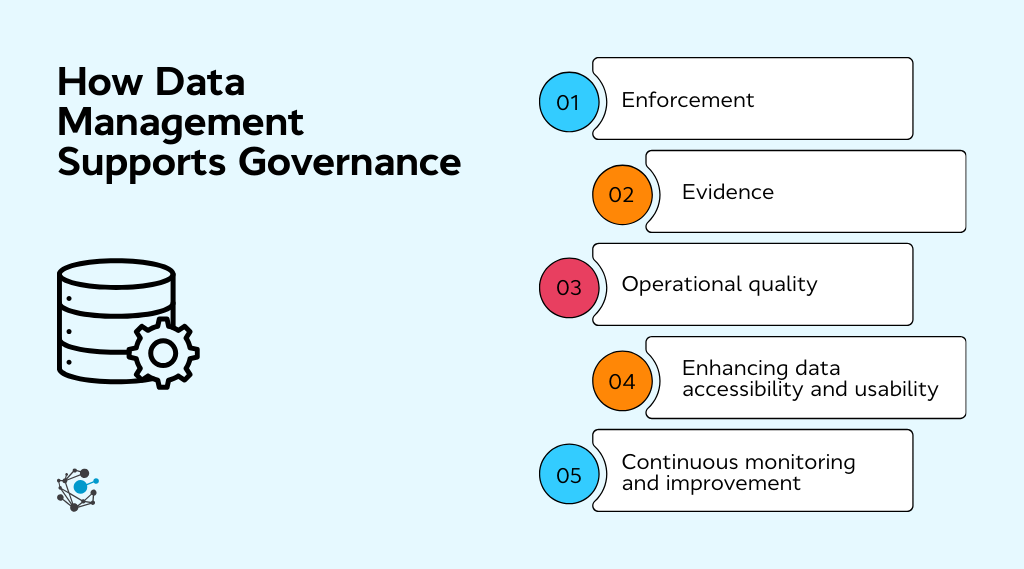
1. Enforcement
Data governance establishes the policies that guide how data should be accessed, used, and protected. However, these policies are ineffective unless they are actively enforced.
Data management provides the tools and mechanisms to ensure that governance rules are not just defined but also adhered to throughout the data lifecycle.
|
For example, if a governance framework dictates that sensitive financial data should only be accessible by the finance department, data management ensures that this rule is implemented via Role-Based Access Control (RBAC) systems. |
RBAC allows data managers to assign specific access rights based on the roles of users within the organization, ensuring that only authorized personnel can view or manipulate particular datasets.
Without data management systems, governance policies can easily be ignored or bypassed, leading to unauthorized access, data breaches, or compliance failures.
2. Evidence
A key responsibility of data governance is ensuring compliance with both internal policies and external regulations, such as GDPR, HIPAA, or CCPA.
To demonstrate compliance, organizations need solid evidence that they are following the established data governance frameworks. This is where data management plays a crucial role.
Data management systems generate the necessary audit trails, access logs, and reports that serve as evidence of compliance.
|
For example, every time a user accesses a dataset, the system can log their actions, documenting who accessed the data, when, and for what purpose. This audit trail is invaluable during internal audits or external inspections, as it provides a transparent record of data usage and access history. |
Without proper logging and monitoring mechanisms in place, organizations risk failing audits or being unable to demonstrate compliance during regulatory inspections. A lack of documentation can lead to non-compliance penalties, fines, and damaged trust with customers.
Implementing data management systems that automatically record and archive access logs, usage patterns, and data modifications ensures that businesses can quickly produce the evidence required during audits.
3. Operational quality
Data governance sets the high-level standards and expectations for data quality, such as accuracy, completeness, consistency, and timeliness. However, these standards would remain unattainable without data management systems that actively monitor, measure, and enforce them on an ongoing basis.
Data management ensures that the data quality rules defined by governance are consistently met through operational practices and automation.
|
For instance, if a governance framework sets a quality standard that customer data must be 98% accurate, data management can ensure this standard is maintained by implementing automated data profiling, validation checks, and anomaly detection tools. These tools continuously monitor the data for inconsistencies, missing values, or out-of-range data entries, and can alert data stewards when issues arise, allowing for quick remediation. |
4. Enhancing data accessibility and usability
A common challenge organizations face is making data both accessible and usable to different stakeholders while adhering to governance policies.
Data management supports governance by ensuring that the right data is available to the right people, when they need it, while maintaining proper security and privacy controls.
Effective data management platforms organize data into structured formats that are easy to query, analyze, and interpret, often using semantic models and structured metadata.
These platforms also implement data cataloging, where data is classified and indexed, allowing business users and analysts to find the right data quickly, while ensuring that access is governed by predefined policies.
Without data management tools, data becomes fragmented across multiple systems, and the users who need to access it may face challenges in finding or using it. Poor data organization can lead to inefficiencies, data redundancy, and frustration among employees who struggle to access the right data.
5. Continuous monitoring and improvement
Effective data management facilitates continuous monitoring and feedback loops, ensuring that governance policies are updated and improved as needed.
|
For example, data management tools can track metrics related to data usage, quality, access patterns, and incident reports, providing valuable insights into the effectiveness of governance policies. |
When data anomalies or compliance issues are detected, these insights are fed back to governance teams, who can refine the policies to address the root causes. This ongoing feedback loop ensures that governance frameworks evolve with the business’s needs and the ever-changing regulatory landscape.
Static governance policies may become outdated as new technologies, regulations, or business needs emerge. Without continuous monitoring and adaptation, organizations risk falling out of compliance or relying on inefficient data practices that hinder innovation.
By incorporating monitoring and reporting tools into data management systems, businesses can ensure that their governance frameworks remain relevant and effective.
As organizations continue to scale and navigate the complexities of data, the integration of data management tools and systems with governance frameworks becomes increasingly important.
By ensuring that governance policies are consistently applied across all data processes, organizations can protect sensitive information, enhance data quality, and maintain compliance.
How do Data Governance and Data Management work together?
The relationship between data governance and data management is crucial for any organization that seeks to leverage its data effectively while ensuring compliance, security, and operational efficiency.
While data governance defines the high-level principles and strategies regarding data use, data management provides the mechanisms that operationalize these strategies.
By working in tandem, they ensure that data is not only protected and compliant with regulations but also readily available, accurate, and usable across the organization.
1. The “decision rights → execution” operating model
At its core, the integration of data governance and data management is rooted in a model where governance defines the what and why, while management determines the how.
This operating model establishes a clear distinction between the strategic oversight provided by governance and the operational execution carried out by management.
Governance decides: Data governance is responsible for setting high-level policies, standards, and decision rights that guide data practices across the organization. These decisions include:
-
Data ownership
-
Privacy policies
-
Access control
-
Data quality standards
Management executes: Data management takes these high-level decisions and turns them into actionable processes. The role of data management here is to enforce governance policies through various systems and tools, ensuring that the rules set by governance are adhered to throughout the data lifecycle. For example:
-
Role-Based Access Control (RBAC)
-
Data quality assurance
By clearly defining roles and responsibilities, the “Decision Rights → Execution” model ensures that the organization’s data is both compliant with governance rules and effectively managed for daily operations.
2. Governance inputs that data management operationalizes
Data governance provides the strategic framework and input, while data management operationalizes these inputs, making the governance rules practical and actionable across the organization.
-
Access policy → RBAC groups and approval workflows: When governance defines who can access certain types of data (e.g., customer data, financial data, etc.), data management translates these decisions into actionable workflows.
Through RBAC and other access control mechanisms, data management ensures that only authorized users or groups are granted access to sensitive data.
Additionally, approval workflows are implemented to ensure that any exceptions to the access rules are properly reviewed and approved by relevant stakeholders.
|
For example, a financial institution might require that only members of the finance department can access transaction data, while data management systems automatically enforce this policy through RBAC. If an analyst from a different department requests access, the request goes through an approval workflow that ensures compliance with governance rules. |
-
Quality standard → automated tests and alerts: Governance might define specific quality standards (e.g., data completeness, accuracy, or timeliness), but it is data management that ensures these standards are met.
Automated testing tools, anomaly detection systems, and data profiling help maintain these standards by continuously checking the data as it is ingested, processed, and stored.
|
For example, if data governance requires that product data in an e-commerce platform must always include the product name, price, and description, data management systems run automated checks during data ingestion to flag any product listings that are missing required fields. |
-
Retention rule → lifecycle policies and archiving: Governance defines how long different types of data should be retained and when they should be archived or deleted.
Data management implements these rules through automated lifecycle policies, such as data archiving procedures for older records and scheduled deletion processes for obsolete data.
This ensures compliance with data retention regulations, such as the GDPR’s “Right to be Forgotten” or financial regulations requiring data to be stored for a minimum number of years.
|
For example, in a healthcare organization, patient records may need to be retained for at least five years. Data management ensures these records are archived and, after the retention period expires, securely deleted according to the retention rules set by governance. |
3. Data lifecycle mapping
Effective data management isn’t just about storing data. It’s about controlling and governing it throughout its entire lifecycle.
From data ingestion to retirement, data governance defines the rules, while data management ensures these rules are implemented consistently and effectively at every stage.
This seamless flow from strategy to execution creates a structure that ensures data is secure, compliant, high-quality, and useful for decision-making.
Data ingestion
Governance’s role: The first stage of the data lifecycle, ingestion, is where data enters the system. Governance defines the approved data sources and classification standards.
It establishes guidelines for which data can be ingested into the system, ensuring that only authorized sources are allowed, and that each dataset is classified appropriately (e.g., customer data, financial data, or sensitive health data).
Governance is also responsible for ensuring that data quality checks are in place to validate the data at the point of ingestion.
Management’s role: Data management ensures that only approved sources are ingested by implementing data connectors and ETL pipelines. These pipelines not only pull data from the right sources but also apply classification tags (e.g., "high-risk," "confidential," "non-sensitive") during the ingestion process.
This guarantees that governance rules are followed from the very beginning, ensuring data is tagged and categorized appropriately before it enters the system.
Many organizations struggle with data silos and inconsistency during ingestion. Without a clear governance framework, different departments might ingest similar datasets without any standardized tagging, leading to issues with data retrieval, security, and compliance.
Implementing automated data classification and validation tools ensures that governance policies are applied at the ingestion point, reducing errors and maintaining data consistency.
Store
Governance’s role: Once data is ingested, governance ensures that it is securely stored, protected, and easily accessible to authorized users. Governance defines security policies, such as data encryption, and specifies access control mechanisms (e.g., role-based access control, or RBAC).
Governance also dictates the regulatory frameworks (e.g., GDPR, CCPA) that apply to the storage of personal and sensitive data.
Management’s role: Data management implements storage solutions such as data lakes, warehouses, or cloud platforms to store data securely. These systems are configured to meet governance standards, ensuring that data is encrypted at rest and that only authorized users or roles can access specific datasets.
|
For instance, personal customer data might be stored in a separate, highly secured database, accessible only by employees with specific access rights. Backup and recovery processes are also managed by data management to prevent data loss |
Transform
Governance’s role: Data governance defines the standards and definitions for data across the organization. It dictates how data should be standardized across systems (e.g., date formats, measurement units, customer identifiers) and ensures that data is consistent across departments.
This prevents the use of conflicting data definitions that could undermine data quality and decision-making.
Management’s role: Data management operationalizes these standards by implementing data transformation processes. This can include data cleansing, formatting, and standardization procedures during the transformation process.
Automated data quality checks and validation rules are applied to ensure that only high-quality, compliant data is processed.
|
For example, if governance dictates that all sales data must be normalized to a common currency or converted to a specific date format, data management enforces these transformations during ETL processes. |
Serve
Governance’s role: At the serving stage, data governance ensures that only certified datasets are made available for use in business intelligence (BI) and analytics tools.
This means data is validated for accuracy and consistency before being made available to stakeholders for analysis or decision-making. Governance also defines what analytics categories are appropriate and the conditions under which data can be shared across departments or with third parties.
Management’s role: Data management ensures that only trusted and certified data is made available for BI purposes. This can include defining data pipelines that serve up this data, managing data catalogs, and ensuring that only validated data is visible to end-users.
Data management tools are used to continuously monitor data quality, ensuring that it meets governance standards before being used for reporting.
Without proper controls, organizations risk disseminating unverified or low-quality data, which could lead to bad business decisions, missed opportunities, or compliance issues.
By using automated data certification systems and ensuring that all datasets are validated and cataloged according to governance standards, organizations can be confident that only trustworthy data is used in decision-making.
Retire
Governance’s role: Data governance dictates how long different types of data should be retained, based on both regulatory requirements and internal policies.
|
For example, financial data may need to be retained for seven years for tax purposes, while customer interactions may only need to be stored for a year. |
Governance also sets rules for data deletion or archiving, ensuring that data is not kept beyond its useful life.
Management’s role: Data management implements these retention and deletion policies, managing the lifecycle of data from storage to retirement.
Automated workflows are used to archive older data and ensure that outdated or irrelevant data is deleted securely. Management also ensures that data is archived in a manner that allows it to be retrieved easily, if needed, for audits or future use.
4. Feedback loops and continuous improvement
Data governance and data management must be viewed as iterative processes, with constant feedback loops that allow both frameworks to evolve based on changing business needs, regulations, and technological advancements.
As new technologies emerge, regulations change, and business processes evolve, the feedback loop between data governance and data management ensures that any shifts in governance policies are smoothly implemented across systems and workflows.
|
For example, if a company introduces new data privacy regulations, such as stricter requirements for customer data access under GDPR, data governance would define these new rules, while data management would modify the processes (such as role-based access control, or RBAC) to comply with those updated policies. |
One of the common challenges organizations face is that governance frameworks can become outdated if they are not actively revisited and updated in response to changing data usage or regulatory environments.
This can result in inconsistent data usage practices, non-compliance, and poor data quality.
By continuously refining and improving governance policies and data management practices, organizations can better handle the increasing complexity and volume of data they generate.
This iterative improvement ensures that data governance is not static, but rather adaptive to the evolving landscape of data usage, privacy laws, and business objectives.
Conclusion
Many organizations still treat data governance and data management as if they mean the same thing. But they don’t. This misconception often leads to major breakdowns in data systems.
Governance defines who is responsible, what the rules are, and how data should be controlled. Management focuses on the execution, including how data is collected, stored, used, and maintained. Organizations evaluating the best data governance tools should look beyond feature lists and assess how well governance policies are enforced in day-to-day data operations.
When only one side is prioritized, or when they’re treated as interchangeable, key business risks surface quickly:
-
What happens when teams manage data but no one enforces policy or accountability?
-
How do you ensure data quality if governance standards aren’t operationalized?
-
What do you audit when there’s no clear lineage or access control?
These aren’t hypothetical scenarios but common pain points in organizations that don’t separate strategy (governance) from operations (management).
That is why data governance and data management must work together. Governance sets the guardrails, while management keeps the data flowing within them. Without both, you can’t scale data operations, meet compliance demands, or trust the insights your data produces.
Still struggling to align data governance with day‑to‑day data operations?

See how OvalEdge helps teams govern smarter, deploy faster, and drive adoption with AI‑powered automation.

Book a demo to experience a comprehensive data governance platform built for scale, trust, and real-world usability
FAQs
1. What are the core pillars of data governance?
The main pillars include data ownership, data stewardship, compliance enforcement, policy definition, data quality standards, and accountability frameworks. Each supports consistency, traceability, and regulatory alignment across enterprise data.
2. Can the same platform manage both governance and management tasks?
Some platforms offer integrated features, but most organizations use a combination. Governance tools focus on policy, lineage, and compliance, while management systems prioritize storage, access, and integration workflows.
3. Are data governance and data management interchangeable?
No. Governance defines the rules, responsibilities, and compliance standards. Management executes and operationalizes those rules through processes and technology. They are complementary but not replaceable.
4. How does data classification support governance efforts?
Data classification assigns sensitivity levels to data (e.g., public, confidential). This helps enforce policies for access control, retention, encryption, and risk mitigation.
5. Can data governance be fully automated?
Not entirely. Automation supports enforcement and monitoring, but defining policies, resolving conflicts, and ensuring accountability require human oversight and strategic input.
6. What metrics help evaluate data governance success?
Common metrics include policy adherence rates, data quality scores, incident response times, data access audit trails, and reduction in regulatory risks or compliance violations.
Deep-dive whitepapers on modern data governance and agentic analytics
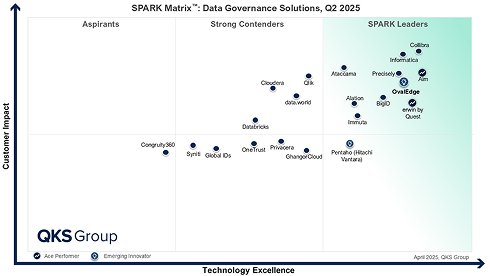
OvalEdge Recognized as a Leader in Data Governance Solutions
.png?width=1081&height=173&name=Forrester%201%20(1).png)
“Reference customers have repeatedly mentioned the great customer service they receive along with the support for their custom requirements, facilitating time to value. OvalEdge fits well with organizations prioritizing business user empowerment within their data governance strategy.”
.png?width=1081&height=241&name=KC%20-%20Logo%201%20(1).png)
“Reference customers have repeatedly mentioned the great customer service they receive along with the support for their custom requirements, facilitating time to value. OvalEdge fits well with organizations prioritizing business user empowerment within their data governance strategy.”
Gartner, Magic Quadrant for Data and Analytics Governance Platforms, January 2025
Gartner does not endorse any vendor, product or service depicted in its research publications, and does not advise technology users to select only those vendors with the highest ratings or other designation. Gartner research publications consist of the opinions of Gartner’s research organization and should not be construed as statements of fact. Gartner disclaims all warranties, expressed or implied, with respect to this research, including any warranties of merchantability or fitness for a particular purpose.
GARTNER and MAGIC QUADRANT are registered trademarks of Gartner, Inc. and/or its affiliates in the U.S. and internationally and are used herein with permission. All rights reserved.